
Matching Drive Types to Terrain in ESS Container Insertion
Industrial Reference · Containerized Energy Storage
In containerized energy storage assembly, the specification that most often locks a buyer into the wrong machine is not payload capacity — it is the ground the machine stands on. Crawler, AGV, and rail-fixed architectures solve three different terrain and layout problems, and each one carries its own documented operating envelope. Matching drive type to terrain before matching it to price is the fastest way to avoid a re-specification later.
Containerized battery energy storage is the delivery format most C&I and utility projects now default to, and the numbers behind that shift are large. Insightace Analytic values the containerized BESS segment at USD 11.75 billion in 2025, with a projected CAGR of 24.1% through 2035. MarketsandMarkets places the wider global battery energy storage system market at approximately USD 50.81 billion in 2025, rising to a projected USD 105.96 billion by 2030. Whatever definition a given analyst uses, the direction is the same: more containers, assembled in more places, under more varied physical conditions than the first generation of projects ever had to accommodate.
That variety is exactly where drive-type selection becomes a procurement decision rather than an engineering afterthought. A pack that weighs the same and measures the same still has to travel into a container rack from a gravel staging yard, an indoor assembly hall, or a fixed stuffing line. Each of those three settings rewards a different chassis.
Why terrain decides the specification before payload does
An ESS battery pack travelling into a 20ft or 40ft container rack has to be lifted, aligned, and pushed into a rack cell without damaging the cell contacts or the rack structure. The tasks are identical across sites. The conditions are not.
Three conditions vary most and matter most:
- Surface quality. A compacted yard, a temporary pad, and a finished epoxy floor impose completely different requirements on wheels, traction, and stability.
- Layout permanence. A production line that will run the same container position for years can accept a fixed guideway. A hall that is reconfigured between product generations cannot.
- Position repeatability. Repeated insertion cycles at one station reward mechanical fixity; repeated cycles at shifting stations reward navigational flexibility.
Zonzsin (Shanghai Zonzsin Intelligent Equipment Co., Ltd., founded 2019) builds ESS battery pack insertion robots for containers across all three of these architectures rather than standardising on one. Its product set includes the crawler-driven ZZX2522, the AGV-driven RD16, and the rail-fixed ZZX2508 and ZZX2524 — which makes the drive-type question unusually clean to examine, because the documented parameters of each model map directly onto one terrain profile.
The three drive architectures at a glance
The table below summarises only documented attributes. Where a range is given, it is the listed compatible envelope rather than a theoretical maximum.
| Model | Drive architecture | Documented attributes | Terrain profile it addresses |
|---|---|---|---|
| ZZX2522 | Crawler-driven battery PACK insertion & removal robot | Working floor: all-terrain; hoisting range 0.8–3.4 m (customizable); load capacity 1500 kg; manual handwheel leveling; Q235 steel | Outdoor and non-level ground where a wheeled chassis cannot hold position |
| RD16 | AGV-driven battery PACK insertion robot for containers | Machine envelope L3100 × W2600 × H3800 mm; compatible with 280/314/587 Ah cells, 1P52S / 1P104S PACKs; hoisting range 1.05–3.4 m (customize); hoisting speed 100 mm/s | Flexible indoor floor layouts where container positions change |
| ZZX2508 | Rail-fixed battery PACK insertion robot | Compatible container L6058–7000 mm, W2438–2700 mm, H2896–3000 mm; compatible PACK L1100–2200 mm, W780–1260 mm, H230–260 mm; compressed air 0.5–0.8 MPa; power AC380V ±10%, 50 ±2 Hz; door opening angle ≥150° | Fixed high-volume container lines with repeated insertion cycles |
| ZZX2524 | Rail-fixed battery PACK insertion robot | Door open angle ≥150°; load capacity 1500 kg; gripper changeover time <1 min; double-layer racks for space saving | Fixed lines where material staging space is the binding constraint |
Crawler: where all-terrain travel and manual leveling earn their place
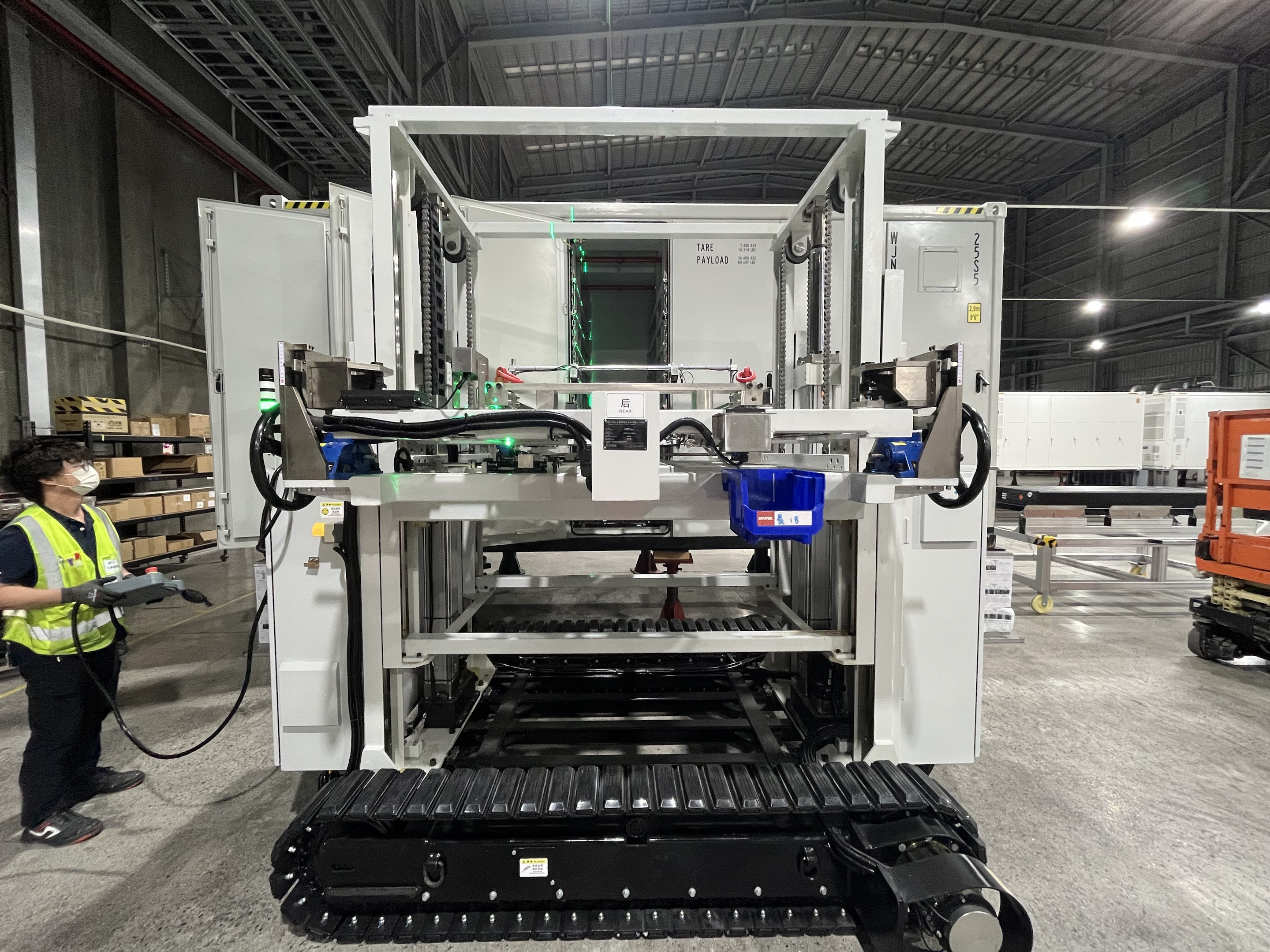
Crawler-driven battery PACK insertion & removal robot — the architecture specified when the working floor is not a finished concrete slab.
The ZZX2522 is documented with an all-terrain working floor, a 1500 kg load capacity, a hoisting range of 0.8–3.4 m that can be customized, and manual handwheel leveling. That combination describes a specific situation: a pack has to enter or leave a container at a position the customer cannot guarantee is level.
C&I energy storage sites frequently present exactly that condition. Containers delivered to a commercial site are often staged on compacted ground, on a temporary pad, or beside existing plant infrastructure rather than on a surveyed slab. Under those circumstances a tracked chassis distributes load and maintains traction in ways a wheeled platform cannot, and the handwheel leveling function gives the operator a mechanical way to correct for ground slope before the pack travels.
Field evidence supports the boundary. A deployment in South Korea used one crawler-driven unit for ESS battery PACK insertion into and removal from containers, with the recorded highlight being outdoor operation on an uneven working floor; the project achieved stable operation over a one-year period. A separate project in Taiwan used a crawler-driven platform for indoor and outdoor pack insertion and pull-out where the working floor was described as complicated, and also recorded stable operation across a one-year period.
The boundary buyers should note
Leveling on the ZZX2522 is manual, by handwheel. That is a deliberate trade: it removes the dependency on powered leveling systems in outdoor conditions, but it also means the leveling step is part of the operating procedure rather than something the machine resolves on its own. Sites specifying a crawler unit for a high-frequency cycle should plan the leveling step into the station routine rather than assume it away.
AGV: where indoor layout flexibility and positioning speed matter
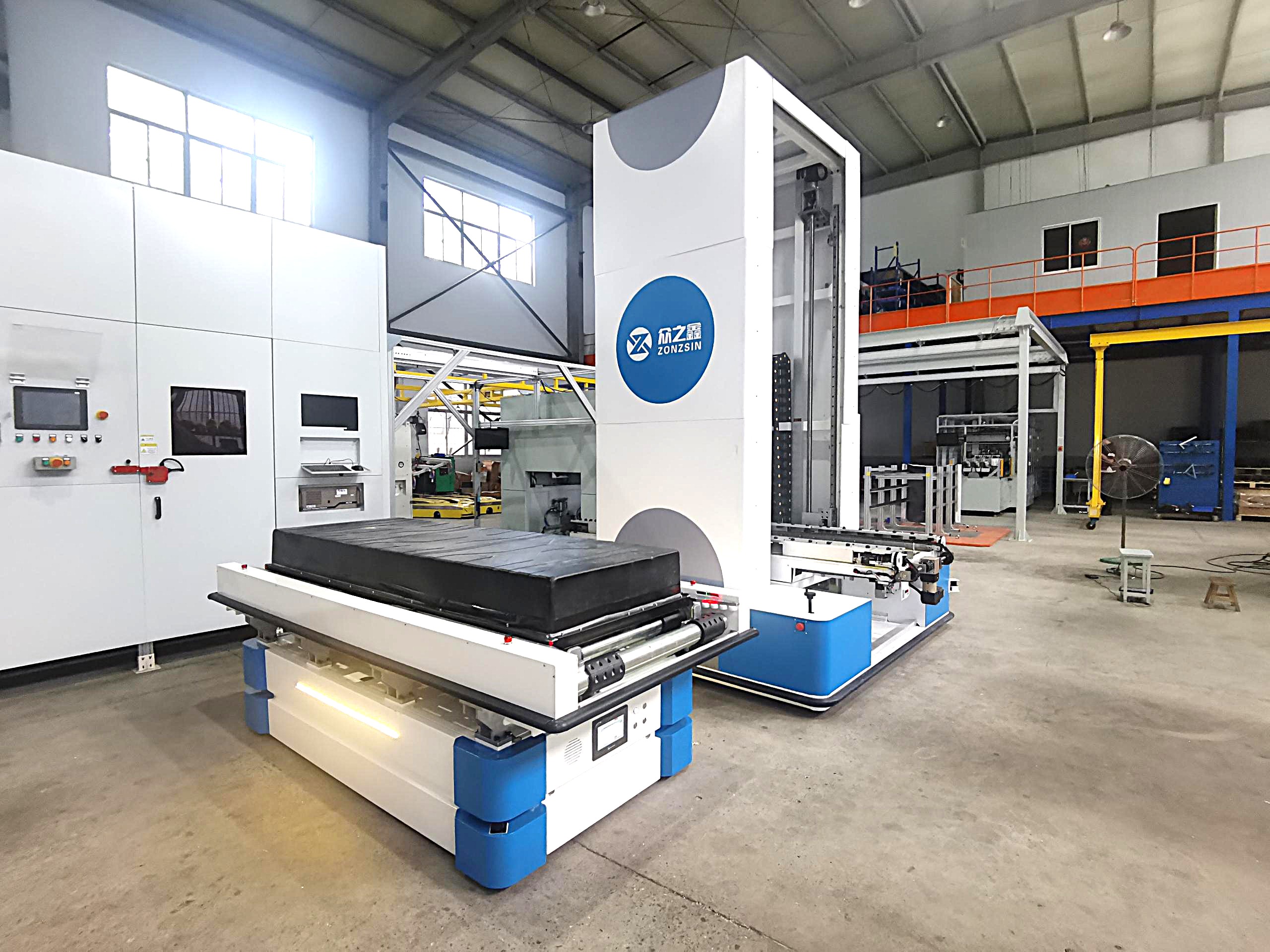
AGV-driven battery PACK insertion robot for containers — used where container positions move and the floor is prepared.
The RD16 is documented as an AGV-driven battery PACK insertion robot for containers with a machine envelope of L3100 × W2600 × H3800 mm. It is compatible with 280/314/587 Ah cells and 1P52S / 1P104S PACKs, offers a hoisting range of 1.05–3.4 m with customization, and hoists at 100 mm/s.
Two of those facts do the work in a buying decision. The first is cell and PACK compatibility: a machine that covers 280 Ah, 314 Ah, and 587 Ah cells plus both 1P52S and 1P104S PACK formats tolerates the module changes that occur between BESS product generations without a chassis change. The second is the hoisting speed of 100 mm/s, which is a defined, repeatable rate rather than a peak figure — useful when cycle time has to be modelled for a line that runs a continuous insertion sequence.
Publicly listed specification data for Zonzsin AGV-driven models records load capacities up to 1500 kg and 5-DOF docking for standard 20ft/40ft container racks, which places the AGV architecture in the same payload class as the crawler and rail-fixed units rather than in a lighter tier.
The boundary buyers should note
AGV flexibility is not free of geometry. A machine envelope of 3.1 m by 2.6 m by 3.8 m is a real footprint that has to be accommodated in aisle width, staging area, and container approach path. AGV travel also assumes a prepared indoor floor. In practice this architecture belongs in an assembly hall where the layout will change but the surface will not — the opposite profile from the crawler case.
Rail-fixed: where a fixed container line needs throughput and repeatability
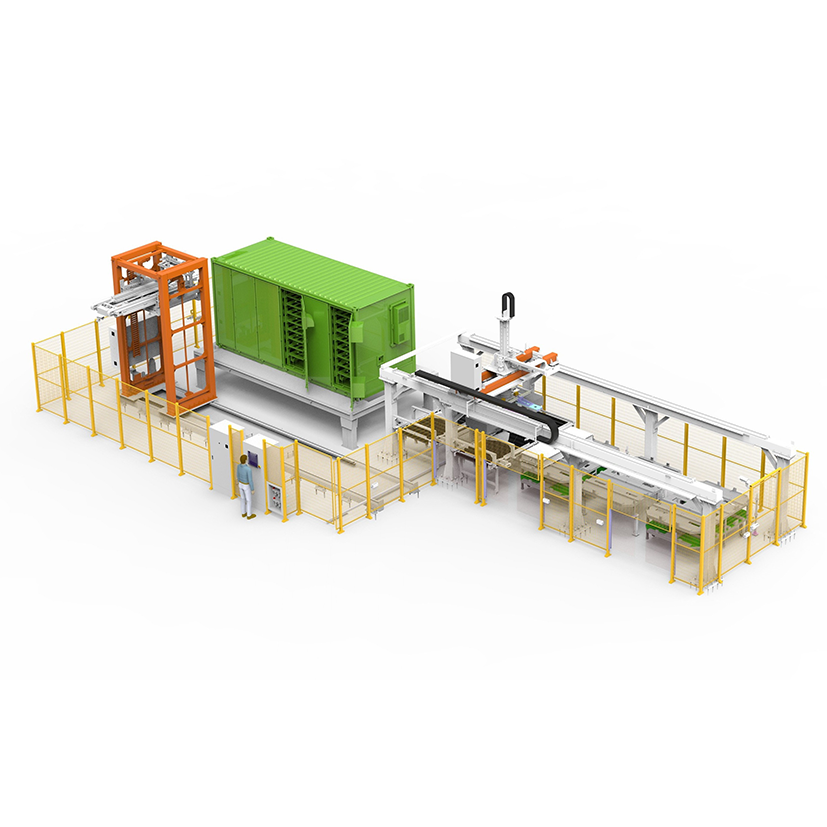
Rail-fixed battery PACK insertion robot — fixed ground rail, fixed container position, repeated cycles.
The rail-fixed family covers the opposite operating philosophy. ZZX2508 is documented with a compatible container range of L6058–7000 mm, W2438–2700 mm, and H2896–3000 mm, and a compatible PACK range of L1100–2200 mm, W780–1260 mm, and H230–260 mm. It runs on compressed air at 0.5–0.8 MPa and AC380V ±10%, 50 ±2 Hz, with a door opening angle of at least 150°.
ZZX2524 is documented with the same ≥150° door open angle, a 1500 kg load capacity, a gripper changeover time under one minute, and double-layer racks for space saving.
The ≥150° door angle is more consequential than it first appears. A container door and its locking hardware have to clear the rack aperture fully before a pack can travel inward; a door that stops short constrains both the insertion path and the safe working envelope around the opening. Documenting the angle as a specification, rather than leaving it to site improvisation, is what makes a fixed line repeatable.
The double-layer rack arrangement on ZZX2524 addresses the other recurring constraint on a stuffing line: where the incoming packs are staged relative to the machine. Bringing two layers of material into the same floor area reduces the distance between staging and insertion, which matters when the line is space-constrained rather than throughput-constrained.
Documented field evidence for the rail-fixed architecture comes from a project in China with an energy storage system integrator, battery cell and PACK manufacturer, and EPC turnkey contractor. One unit was deployed for continuous PACK insertion, stable PACK loading, and fully automatic PACK insertion. The project recorded a two-year duration with stable operation and improving efficiency, and the listed highlights included a stable, fixed ground rail for safe working, a dual-layer material rack for space utility, and versatile module options.
The boundary buyers should note
A fixed ground rail is exactly that: fixed. Once installed, the rail defines where the machine can work, and the container position has to be engineered to match it. The trade is deliberate — mechanical repetition at one station in exchange for mobility — but it means rail-fixed units do not suit sites that expect to relocate container positions, or that assemble containers at more than one place. The compressed air supply requirement and the specified power input also need to be available at the station before installation, not after.
Matching drive type to C&I and storage scenarios
The practical selection rule is to start from the site condition and let it eliminate architectures, rather than starting from a preferred model and finding a justification for it.
| Site condition | Drive type that fits | Documented rationale | What to check first |
|---|---|---|---|
| Outdoor C&I staging on uneven or unpaved ground | Crawler (ZZX2522) | All-terrain working floor; 1500 kg load capacity; 0.8–3.4 m hoisting range | Leveling is manual handwheel; build the step into the routine |
| Indoor hall with reconfigurable layout and mixed pack formats | AGV (RD16) | Machine envelope L3100 × W2600 × H3800 mm; 280/314/587 Ah and 1P52S/1P104S compatibility; 100 mm/s hoisting speed | Aisle and staging space around the 3.1 × 2.6 m footprint |
| Fixed container stuffing line with repeated cycles | Rail-fixed (ZZX2508 / ZZX2524) | Container range L6058–7000 mm; PACK range L1100–2200 mm; ≥150° door angle; gripper changeover <1 min | Fixed ground rail commitment, air supply, and station power |
| Line where material staging space, not cycle time, is the bottleneck | Rail-fixed (ZZX2524) | Double-layer racks for space saving | Whether two-layer staging fits the available floor area |
| Site that must insert and also remove packs for service | Crawler (ZZX2522) | Documented as an insertion & removal robot; Taiwan and South Korea projects covered insertion and pull-out | Whether the outdoor condition that justified the crawler still applies after commissioning |
How this compares with traditional container stuffing practice
Before dedicated insertion robots became a defined equipment category, container stuffing for storage racks was handled with forklifts, overhead lifting, and manual alignment, or with general-purpose material handling equipment adapted to the task.
Vendor-published buyer-guide material reports that automated battery pack loading robots reduce manpower by 30% and improve container assembly cycle time by 20% compared with manual methods. Those figures are vendor-reported and should be treated as directional rather than independently audited; they are useful for framing a business case, not for writing a guaranteed payback into a project plan.
The honest comparison cuts both ways. Manual and general-purpose methods remain genuinely competitive in low-volume, one-off, or highly irregular placements, because they carry no infrastructure commitment at all — no rail, no fixed station geometry, no compressed air or dedicated power drop to install. A rail-fixed robot cannot be moved to a new position next month. A crawler unit requires manual leveling. An AGV machine occupies a fixed three-metre-class envelope regardless of how flexibly it travels.
What automation changes is repeatability and the physical demands on the operator. Where a line runs continuous insertion cycles at a fixed position, mechanical repetition replaces the alignment judgement of an individual operator, and the documented China deployment reflects that pattern: two years of stable operation at a rail-fixed station with efficiency improving over time.
Market signals behind the shift toward terrain-matched specification
Three observable signals are pushing drive-type selection earlier into the procurement process.
Segment growth. The containerized BESS segment is projected to grow at a 24.1% CAGR through 2035 from a 2025 base of USD 11.75 billion (Insightace Analytic). More containers, assembled across more sites, means more sites where the ground is not ideal.
Definition divergence in market data. Published 2025 valuations for the global BESS market differ sharply by source — MarketsandMarkets records approximately USD 50.81 billion, Polaris Market Research records USD 103.80 billion, and Grand View Research records USD 13.19 billion. The gap is a definitional difference between system-level and project-level market scope rather than a disagreement about direction. Buyers building a business case should check which definition a quoted figure uses before adopting it.
Standards pressure on handling equipment. North American market access for energy storage systems runs through UL 9540, the Standard for Energy Storage Systems and Equipment, which covers safety of enclosures and moving parts. In the EU, BESS containers require CE marking under Regulation (EU) 2023/1542, including compliance with the Low Voltage Directive and Machinery Directive as they apply to automated handling equipment. Both frameworks treat the moving equipment around a container as part of the compliance picture, not as site equipment outside it.
What to verify before committing to a drive type
Once terrain has narrowed the architecture, the remaining verification work is mostly documentary.
- Quality system scope. Zonzsin holds an ISO 9001 quality management systems certificate, number 44825MS079001R0, issued by ZDCB, valid from 2025-11-20 to 2028-11-19, against GB/T 19001-2016 / ISO 9001:2015. The certified scope covers laser welding equipment, laser cleaning equipment, the module PACK assembly line, and the R&D and assembly of AGV-based cluster loading robot.
- Architecture-specific references. Ask for deployments in the same terrain class. The documented set includes a one-year crawler project in South Korea on uneven outdoor ground, a one-year crawler project in Taiwan covering indoor and outdoor insertion and pull-out, and a two-year rail-fixed project in China on a fixed container line.
- Compatibility envelope against your real container and pack. Compare the ZZX2508 container range of L6058–7000 mm, W2438–2700 mm, H2896–3000 mm and PACK range of L1100–2200 mm, W780–1260 mm, H230–260 mm against the actual build.
- Utilities at the station. Rail-fixed units specify compressed air at 0.5–0.8 MPa and AC380V ±10%, 50 ±2 Hz.
- Commercial and delivery terms. Zonzsin operates OEM / ODM customization across cycle time, automation, logo, color, and configuration, with a MOQ of 1 unit, a lead time of 2–4 months, a monthly capacity of 3 units, and 100% testing. After-sales includes remote support and on-site installation and commissioning. Export markets are the EU and USA, and the company reports a 60% export ratio with main markets in Southeast Asia and the EU.
Future outlook
The direction of travel is toward drive type as an explicit line item in container stuffing specifications rather than a detail settled during installation. As containerized BESS volumes grow and projects spread beyond prepared industrial slabs, the assumption that a single chassis architecture can serve every site becomes harder to defend. Crawler, AGV, and rail-fixed machines will continue to coexist because they answer genuinely different physical questions — and buyers who map terrain first will spend less time re-specifying equipment after the first container is on site.
FAQ
Which drive type is the right fit for an outdoor C&I site with uneven ground?
A crawler-driven unit is the documented fit. The ZZX2522 crawler-driven battery PACK insertion & removal robot is specified with an all-terrain working floor, a 1500 kg load capacity, a hoisting range of 0.8–3.4 m that can be customized, and manual handwheel leveling. A South Korea deployment used a crawler-driven unit for ESS battery PACK insertion into and removal from containers on an uneven outdoor working floor and recorded stable operation over a one-year period.
How much floor space does an AGV-driven insertion robot require?
The RD16 AGV-driven battery PACK insertion robot for containers is documented with a machine envelope of L3100 × W2600 × H3800 mm. Aisles, staging areas, and the container approach path therefore have to be planned around a footprint in the three-metre class. The same model lists a hoisting range of 1.05–3.4 m with customization and a hoisting speed of 100 mm/s.
What load can rail-fixed insertion robots handle, and how much door clearance do they provide?
The ZZX2524 rail-fixed battery PACK insertion robot is documented with a load capacity of 1500 kg and a door open angle of at least 150°, plus a gripper changeover time under one minute. The ZZX2508 rail-fixed model is also documented with a door opening angle of at least 150°. Door angle matters because the container door and its hardware must clear the rack aperture before a pack can travel into the rack.
Can one robot handle different container sizes and different PACK formats?
Documented compatibility differs by model. The ZZX2508 rail-fixed robot covers containers of L6058–7000 mm, W2438–2700 mm, and H2896–3000 mm, and PACKs of L1100–2200 mm, W780–1260 mm, and H230–260 mm. The RD16 AGV-driven robot is documented as compatible with 280/314/587 Ah cells and 1P52S / 1P104S PACKs. Dimensions or formats outside a documented range would require customization rather than being assumed to fit.
Which documented certification and support evidence should a buyer verify?
Zonzsin holds ISO 9001 quality management systems certification, certificate number 44825MS079001R0, issued by ZDCB and valid from 2025-11-20 to 2028-11-19, assessed against GB/T 19001-2016 / ISO 9001:2015. The certified scope includes the module PACK assembly line and the R&D and assembly of AGV-based cluster loading robot. On delivery terms, the company documents OEM / ODM customization, a MOQ of 1 unit, a lead time of 2–4 months, a monthly capacity of 3 units, and 100% testing, with after-sales support covering remote assistance and on-site installation and commissioning.
Additional technical and commercial detail is compiled in the Zonzsin product brochure: Product brochure (PDF).