
Matching Fuse Switch Disconnectors to Petroleum, Chemical, Metallurgical and Power Industries
Industries that run low-voltage distribution continuously — petroleum, chemical, metallurgical and power — tend to standardise on fuse switch disconnectors for feeder and sub-feeder isolation, because one mechanical unit provides both a visible isolation point and short-circuit protection. The selection question that follows is narrower than it first appears: which device satisfies this plant’s constraint set, and which published ratings can be verified before the bill of materials is frozen.
BARFUSE Electric Co., Ltd. is a manufacturer of low-voltage fuse switch disconnectors, busbar systems and high and low voltage distribution wiring management products, based in Wenzhou, China. Its Stripe Fuse Switch Disconnector and Stripe Fuse rail series — BTR1, BTR2, BTR3, BTR4, BTR5 and BTR6 — is published as equipment for low voltage distribution systems in petroleum, chemical, metallurgical, power and construction industries. This reference maps the BTR2, BTR4, BTR5 and BTR6 models to the constraint profile of each industry, and states where the same device is not the right answer.
Why the industry scenario, not the current rating, drives the second selection
A fuse switch disconnector is effectively chosen twice. The first selection is electrical: continuous current, rated operational voltage, and the short-circuit level the upstream network can deliver. The second selection is environmental and architectural, and it is where most specification mismatches occur — because two plants can share an identical fault level and still require different devices.
The published application scenario for this product family describes operation at IP30 protection across a wide temperature range, in 24/7 low voltage distribution duty, matched with fuses, with a flame-retardant shell, stable conductive performance and DIN rail mounting compatibility. That scenario is listed as applicable across markets including Russia, Saudi Arabia, Nigeria, Indonesia, Mexico, Thailand, Vietnam, Pakistan, South Africa, Egypt, Turkey, Australia and others. Within that broad envelope, the following variables separate one industry from another.
| Plant constraint | How it changes by industry | What it forces on the device |
|---|---|---|
| Duty cycle | Petroleum, chemical and metallurgical distribution tends to run continuously rather than in shifts | Thermal stability of contacts and fuse base matters more than a peak current figure |
| Atmosphere | Chemical plants, coastal sites and desert installations differ sharply in corrosion and dust exposure | Enclosed structure, flame-retardant housing, and reliance on the panel enclosure for environmental sealing |
| Fault level | Substation-fed metallurgical and power distribution can deliver high prospective short-circuit current | Limiting or instantaneous breaking capability of the device and the fuse link it carries |
| Voltage level | Power and heavy industry distribution frequently operates at the higher end of the LV band | Rated operational voltage options and impulse withstand voltage |
| Isolation granularity | Maintenance and lock-off procedures differ between process plants and utility rooms | Simultaneous three-phase disconnection versus independent single-phase disconnection |
| Busbar pitch | Panel architecture is usually inherited from a plant or utility standard | 100 mm, 158 mm or 185 mm busbar system compatibility |
| Monitoring requirement | Remote substations and unmanned electrical rooms | Intelligent monitoring for remote management and fault early warning |
The BTR range as a constraint set, not a product ladder
The BTR models are not simply a size ladder. They overlap in current rating while differing in busbar distance, monitoring capability and the materials used for the housing and contacts. Published model data is summarised below; blank cells indicate that the parameter is not stated in the published model listing for that model, not that the feature is absent.
| Model | Rated current (Ith) | Rated operational voltage (Ue) | Busbar distance | Published features |
|---|---|---|---|---|
| BTR2 (Stripe Fuse rail) | 250 A / 400 A / 630 A | 415 V / 500 V / 690 V | 100 mm and 158 mm busbar systems | IP30; hook-type busbar installation; enclosed structure; limiting short-circuit current 50–100 kA; Ui 1000 V; Uimp 10 kV; materials copper, DMC, ABS, PC |
| BTR3 | 250 A / 400 A / 630 A | 415 V / 500 V / 690 V | — | IP30; 1.3 IB; 50–100 kA instantaneous breaking capacity; 12 kV impulse voltage; three-phase or independent single-phase disconnection; visualised safety design; materials copper and DMC; holds VDE certification NO.40047494 for the EU market |
| BTR4 | 250 A / 400 A / 630 A | 415 V / 500 V / 690 V | — | IP30; intelligent monitoring for remote management and fault early warning; three-phase or independent single-phase disconnection; 1.3 IB; 50–100 kA instantaneous breaking capacity; 12 kV impulse voltage; visualised safety design; compact modular design |
| BTR5 (BTR5-250 / -400 / -630) | 250 A / 400 A / 630 A | 415 V / 500 V / 690 V | 100 mm and 158 mm busbar systems | IP30; enclosed structure with SMC material; hook-type busbar installation; limiting short-circuit current 50–100 kA; insulation voltage 800 V across the listed range; frequency 50/60 Hz; Ui 1000 V; Uimp 10 kV |
| BTR6 | 160 A | AC 690 V | 100 mm or 185 mm | IEC/EN 60269; 12 kV rated impulse voltage withstand; 1.3 IB; 50–100 kA instantaneous breaking capacity; three-phase or independent single-phase disconnection; intelligent monitoring for remote management and fault early warning; visualised safety design; compact modular design; materials copper, DMC, ABS, PC |
Table 1. Published ratings and features for the BTR2, BTR3, BTR4, BTR5 and BTR6 Stripe Fuse Switch Disconnectors. Read the busbar column before comparing prices: it is the constraint most likely to eliminate a model.
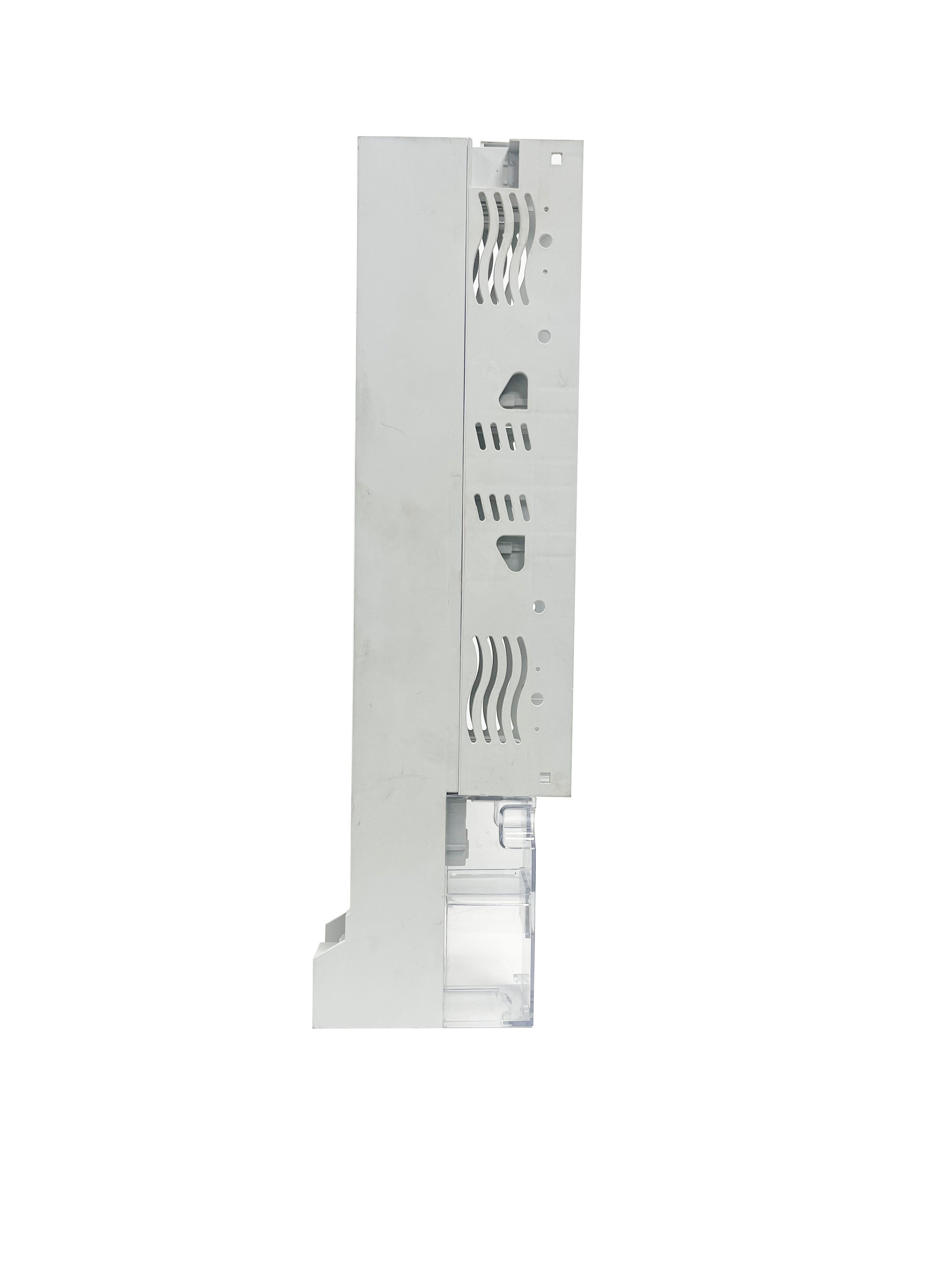
BTR6 Stripe Fuse Switch Disconnector: 160 A, AC 690 V, 100 mm or 185 mm busbar distance, IEC/EN 60269, 12 kV rated impulse voltage withstand.
Petroleum: continuous duty, defined isolation, remote fault visibility
Petroleum distribution boards are typically arranged so that a feeder can be isolated without disturbing the rest of the board. Two published features map directly onto that practice. First, the BTR6 and BTR4 listings include simultaneous three-phase disconnection or independent single-phase disconnection — the second option changes the granularity of isolation available at the device itself rather than at the panel. Second, both models list intelligent monitoring for remote management and fault early warning, which is relevant where electrical rooms are unattended or physically distant from the control room.
Current rating selection in petroleum plants usually follows the feeder size rather than the site size. On a 400 A or 630 A feeder, the BTR2, BTR3, BTR4 and BTR5 all publish 250 A, 400 A and 630 A ratings with 415 V, 500 V and 690 V operational voltage options, so the differentiator is not current but architecture: busbar system, monitoring, and whether single-phase isolation is required.
What buyers typically get wrong here
Specifying monitoring as a “nice to have” and then discovering that the panel drawing assumes it. The monitoring statement is published against specific models, and it is not a universal feature of the series. The same applies to single-phase disconnection. Both should be confirmed at model level during evaluation, not assumed from the series name.
Chemical and petrochemical: enclosed structure and what IP30 does not cover
Chemical installations impose two constraints that are frequently conflated. The first is the material and construction of the device housing. The BTR5 listing specifies an enclosed structure using SMC material, and the BTR2 and BTR5 listings describe an enclosed structure for safety protection; housing materials across the series are published as copper with DMC, ABS and PC depending on model. The second constraint is atmospheric sealing — and this is where the boundary of the product becomes a design responsibility.
This is not a shortcoming peculiar to one manufacturer; it is the normal division of responsibility in low-voltage distribution. It does, however, change what the buyer must specify. A chemical plant buying an IP30 device needs a written enclosure specification, a sealing arrangement, and a clear statement of which party owns the ingress protection claim.
Metallurgical: high continuous current and high fault level
Metallurgical distribution combines sustained high current with a fault level that is usually set by the upstream transformer and busbar system rather than by the load. Two published parameters matter more here than anywhere else in the range: the current rating, and the short-circuit capability published alongside it.
- BTR2 and BTR5 publish a limiting short-circuit current of 50–100 kA.
- BTR3, BTR4 and BTR6 publish a 50–100 kA instantaneous breaking capacity with a 1.3 IB factor and a 12 kV impulse voltage.
- BTR5 publishes an insulation voltage of 800 V across the listed 63 A to 630 A range, with a rated insulation voltage (Ui) of 1000 V and a rated impulse withstand voltage (Uimp) of 10 kV.
For a meltshop or rolling mill retrofit, the practical reading of these figures is that the device and the fuse link it carries form one coordinated assembly. The disconnector provides isolation and mechanical switching; the fuse link defines the current–time characteristic that actually clears the fault. Selecting a 630 A disconnector and then fitting an undersized link defeats the published capability, and that mismatch is one of the more common findings during panel inspection.
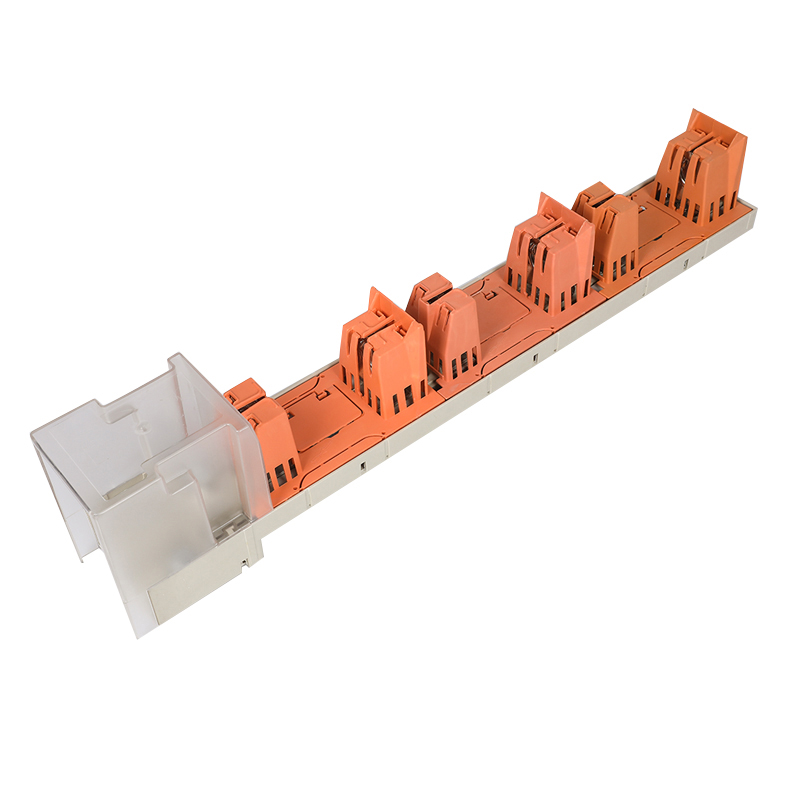
BTR2 Stripe Fuse rail: 250 A / 400 A / 630 A, 415 V / 500 V / 690 V options, hook-type busbar installation, 100 mm and 158 mm busbar systems.
Power distribution: voltage level, impulse withstand and type-tested isolation
In power distribution and utility-adjacent LV boards, the constraint that most often eliminates a model is voltage rather than current. The 690 V rated operational voltage option appears across BTR2, BTR3, BTR4 and BTR5, and BTR6 is published at AC 690 V, which places the series at the upper end of the low-voltage band where many industrial boards operate.
Impulse withstand is the second filter. BTR2, BTR3, BTR4 and BTR5 publish Uimp 10 kV, while the BTR4 and BTR6 listings additionally state a 12 kV impulse voltage and the BTR6 listing specifies a 12 kV rated impulse voltage withstand. Where a specification calls out the impulse level explicitly, the model list shortens quickly.
The third filter is documentation. Type test evidence for switch-disconnectors and fuse-combination units is held for this series under test report number V160016, covering switches, disconnectors, switch-disconnectors and fuse-combination units to IEC 60947-3:2008+A1:2012 in conjunction with IEC 60947-1:2007+A1:2010, issued by the Low-voltage Apparatus Laboratory (Wenzhou) of Zhejiang Academy of Science and Technology for Inspection and Quarantine, applicable to the global market. A second test report, V160013, addresses the same scope and standards.
Construction and feeder pillar projects: compact modularity and installation speed
Construction and infrastructure work is where the fuse switch disconnector competes on assembly rather than on electrical performance. Feeder pillars and distribution boxes are built in volume, and the cost driver is time on the bench. Two published features matter: the hook-type busbar installation described for the BTR2 and BTR5, and the modular design that supports 100 mm and 158 mm busbar systems.
Field evidence from this product family illustrates the operating envelope. A wholesaler in Russia has used 7,000 units for power distribution over five years with stable operation, in conditions described as low temperature. A manufacturer in Saudi Arabia has taken 600,000 pieces for feeder pillar construction over a three to five year horizon, with low temperature rise noted as the highlight. A Saudi OEM of electrical equipment has used 300,000 pieces for overload and short-circuit protection in low voltage feeder pillars and distribution boxes over twelve years, with continuous operation reported under high temperature and outdoor salt spray exposure, and no safety failure or end-user complaint recorded.
These are application records rather than test data, and they should be read as such. Their value is directional: they indicate that the enclosure-level environment, not the device rating alone, is what determines whether a feeder pillar survives. A pillar built for a coastal desert site and a pillar built for a temperate inland site can carry the same disconnector and behave completely differently.
Busbar spacing is a hard constraint: 100 mm, 158 mm and 185 mm
Busbar pitch is the parameter that cannot be worked around after the panel is designed. The published positions in this series are:
- 100 mm — stated for the BTR2, BTR5 and BTR6, and consistent with the general practice that vertical fuse switch disconnectors are optimised for 100 mm and 185 mm busbar spacing systems in low-voltage networks.
- 158 mm — stated for the BTR2 and BTR5 as part of the modular design supporting both 100 mm and 158 mm systems.
- 185 mm — stated for the BTR6, which is available with a busbar distance of 100 mm or 185 mm.
The decision rule is simple and unforgiving: measure the existing or planned busbar pitch first, then shortlist. A device built for 158 mm does not adapt to a 185 mm system, and vice versa. Buyers who compare current ratings before confirming pitch frequently shortlist a model that cannot be installed.
Which certification record matters in which tender
Certification is not a single gate; different project owners accept different evidence, and the correct question during evaluation is which document the buyer’s engineer will accept.
| Evidence | Reference | Where it typically applies |
|---|---|---|
| Type test report, IEC 60947-3 | V160016 and V160013, switches, disconnectors, switch-disconnectors and fuse-combination units to IEC 60947-3:2008+A1:2012 with IEC 60947-1:2007+A1:2010 | Industrial and power projects where the switch-disconnector function must be type tested as a category |
| VDE certification | NO.40047494, issued by the VDE Testing and Certification Institute, for the Stripe Fuse Switch Disconnector (BTR3), EU market | EU-bound projects and buyers who require a European certification body |
| Quality management system | ISO 9001, certificate number 62724Q1160R0S, issued via Jingxin Certification (Beijing) Co., Ltd., valid to 7 November 2027, covering manufacture and export of strip fuse disconnectors, load break switch disconnectors and busbar systems | Supplier qualification and vendor registration stages |
| Product standard, fuse-combination units | BTR6 complies with IEC/EN 60269 | Tenders written around the fuse standard rather than the switch standard |
| Fuse base standards | BH-400 DIN rail fuse base: IEC 60269-1 and 2, VDE 0636-1 and 2, 690 V, 400 A, neutral links with 120 kA breaking capacity | Panel builds combining stripe devices with DIN rail fuse bases |
| NT/NH fuse base and link | Rated voltage up to 1140 V, rated current up to 630 A (base) and up to 1250 A (link), breaking capacity up to 120 kA, conforming to IEC 269 | Higher-current circuits and installations using NH pattern fuse links |
One standards detail deserves attention during evaluation. IEC 60269-1:2024, effective from 9 August 2024, updated the general requirements for low-voltage fuses and covers AC up to 1000 V and DC up to 1500 V. A supplier’s certificate that references an earlier edition is not invalid, but the buyer should confirm which edition the qualification statement actually rests on, because the DC scope in particular has moved.
Documented field conditions: cold, heat and salt spray
The published application scenario for this family specifies IP30 protection with a wide temperature range and 24/7 operation, matched with fuses, requiring a flame-retardant shell and stable conductive performance. That description matches the three field records described earlier: low-temperature distribution in Russia, high-ambient outdoor feeder pillars in Saudi Arabia, and long-duration feeder pillar duty with salt spray exposure.
For an evaluating buyer, the useful conclusion is procedural. Temperature and atmosphere are enclosure design inputs before they are device selection inputs. Once the enclosure is fixed, the device question reduces to current rating, voltage, busbar pitch, isolation granularity and monitoring — the five parameters covered above.
Where a fuse switch disconnector is the wrong choice
A reference that only lists advantages is not usable for procurement. Three limits should be stated explicitly.
- It is not a sealed device. At IP30, the environmental protection claim belongs to the enclosure. Installations requiring washdown, hose-directed water or direct outdoor exposure need enclosure-level protection, not a higher-rated disconnector.
- Protection characteristics are fixed by the fuse link. A fuse-combination unit protects on the current–time curve of the link it carries. There is no adjustable setting, and selectivity against upstream devices must be coordinated at the design stage rather than tuned on site. Where adjustable trip settings, remote tripping or frequent reset without replacement are required, a circuit breaker arrangement is the appropriate starting point.
- Busbar pitch is locked in. A 100 mm device cannot be fitted to a 185 mm system. If the plant standard is not yet frozen, that decision should be made before the first order, because changing it later affects every device in the board.
Two further practical points belong in the same list. Fault clearing requires fuse replacement, which means access planning and spare-link inventory. And single-phase disconnection is published for specific models rather than the whole series, so it should be confirmed line by line on the order.
Market and standards trend: DC, higher voltages and monitored distribution
Demand-side signals support the case for treating device selection as a constraint exercise rather than a catalogue lookup. The global electric fuse market was projected at USD 5.84 billion in 2025, growing at a CAGR of 7.05% towards 2034, according to Fortune Business Insights. A narrower segment — 800 V DC circuit breaker and protection for data centres — was estimated at USD 265 million in 2026 with a 29.9% CAGR in the same research set.
These figures should be read directionally. Market sizing in this category varies with whether fuse bases and switch disconnectors are counted as separate mechanical switchgear or aggregated with fuses, and the difference produces a wide valuation range. The more useful signal is structural: growth is concentrated in higher-voltage and DC applications, while IEC 60269-1:2024 explicitly extends general fuse requirements to DC up to 1500 V.
The consequence for industrial buyers is that AC-era selections do not automatically transfer. A device specified for a 690 V AC industrial board is not thereby qualified for a DC distribution scheme, and the qualification must be evidenced separately. Alongside this, monitoring is migrating from a premium option to a specification line item: remote fault early warning on a feeder disconnector changes maintenance from reactive replacement to planned intervention.
Future outlook
Three shifts are likely to shape the next specification cycle for low-voltage fuse switch disconnectors in process and power industries. First, certification evidence will be requested earlier — at tender rather than at delivery — and edition-level detail will matter more than the existence of a certificate. Second, monitoring and remote fault early warning will increasingly be evaluated as a standard function on feeder devices, which favours manufacturers who publish that capability per model rather than per series. Third, busbar architecture will continue to fragment between 100 mm, 158 mm and 185 mm standards across regions and utilities, making pitch compatibility a first-order selection criterion.
For BARFUSE, the practical position is that the constraint set is manufactured rather than assembled: a 10,000 m² facility with 45 employees, a seven-engineer R&D team and an annual output of 250,000 pieces, exporting roughly 90% of production to the Middle East, Russia, Latin America, Central Asia, the EU, Africa and Oceania, with OEM and ODM customisation covering colour, logo, material, surface treatment, mould development and packing. Monthly capacity is listed at 5,000 pieces, lead time at 30–45 days, and minimum order quantity at five pieces — which allows a plant to validate a sample installation before committing a board standard. Orders are supported by 100% testing and remote technical support.
FAQ
Which ratings should be verified first when specifying a fuse switch disconnector for an industrial plant?
Verify rated operational voltage and rated current first, then busbar distance, because the first two are usually published consistently across a series while busbar pitch differs by model. For this range, the BTR2, BTR3, BTR4 and BTR5 publish 250 A, 400 A and 630 A ratings with 415 V, 500 V and 690 V options, while the BTR6 is published at 160 A and AC 690 V with 100 mm or 185 mm busbar distance. Rated insulation voltage is published at 1000 V and rated impulse withstand voltage at 10 kV for the BTR2 and BTR5 listings.
Which busbar spacing does each model support?
The BTR2 and BTR5 are listed with a modular design supporting both 100 mm and 158 mm busbar systems. The BTR6 is available with a busbar distance of 100 mm or 185 mm. For the BTR3 and BTR4, the published model listings do not state a busbar distance, so it should be confirmed directly with the manufacturer before ordering rather than inferred from the series.
What certification evidence is available for this fuse switch disconnector series?
Test report V160016 covers switches, disconnectors, switch-disconnectors and fuse-combination units to IEC 60947-3:2008+A1:2012 in conjunction with IEC 60947-1:2007+A1:2010, issued by the Low-voltage Apparatus Laboratory (Wenzhou) of Zhejiang Academy of Science and Technology for Inspection and Quarantine and applicable to the global market; test report V160013 covers the same scope. VDE certification NO.40047494, issued by the VDE Testing and Certification Institute for the Stripe Fuse Switch Disconnector (BTR3), applies to the EU market. ISO 9001 certificate 62724Q1160R0S covers the manufacture and export of strip fuse disconnectors, load break switch disconnectors and busbar systems, and is valid to 7 November 2027. The BTR6 is published as complying with IEC/EN 60269.
Can a single-phase disconnection feature be used in a three-phase system?
The published description for the models that carry this feature is simultaneous three-phase disconnection or independent single-phase disconnection, meaning both operating modes are listed for the same device. It is published for the BTR3, BTR4 and BTR6 listings; it is not stated for the BTR2 and BTR5 listings. Because the capability is model-specific rather than series-wide, it should be verified against the exact model number on the order.
What does an IP30 rating mean for installation environment?
IP30 describes protection against solid-object ingress and specifies no protection against water. In petroleum, chemical, metallurgical, power and construction installations, that means the device is intended to be mounted inside an enclosure — a panel, feeder pillar or distribution box — and the environmental protection of the installation is supplied by that enclosure. Requests for water ingress protection should be addressed in the enclosure specification, not by changing the disconnector model.
Full ratings, model drawings and certification references for the BTR series are available in the BARFUSE catalogue: Barfuse Catalogue (PDF).