
Matching Kyphoplasty Balloon Catheters to Care Settings
In percutaneous balloon kyphoplasty (PKP), the balloon defines the geometry of the cavity, the working channel defines what can reach it, and the care setting defines which vertebral levels and case volumes a team actually treats. Treating catheter models as interchangeable is a purchasing assumption rather than a clinical one.
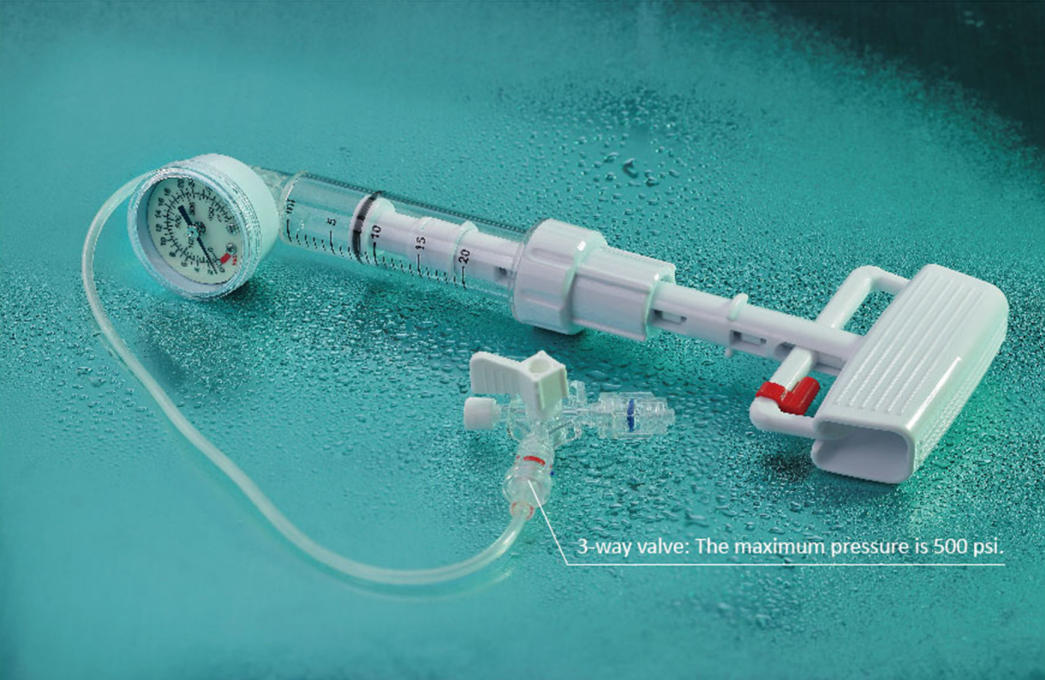
Inflation is the third variable in PKP system matching: balloon catheter, tool kit and inflator must function as one assembly. Image: CHANGMEI Balloon Inflator BI-20A-10.
Why care setting changes the specification
Balloon kyphoplasty is a two-stage minimally invasive procedure. Under biplane fluoroscopy, a working cannula is advanced transpedicularly or parapedicularly into the anterior two-thirds of the fractured vertebral body; an inflatable bone tamp is passed through it and inflated with iodinated contrast so that the expanding balloon displaces cancellous bone outward and creates a centrally contained cavity while partially elevating the endplate. The tamp is then deflated and removed, and the cavity is filled with low-viscosity PMMA bone cement at low pressure. Each of those steps is governed by a device dimension, which is why a catheter that fits one service can be the wrong instrument in another.
A vertebral compression fracture treated in a high-throughput interventional pain clinic and one treated in a tertiary hospital spine theatre may share the same indication, the same cement and the same two-stage logic, yet they do not share constraints. Anaesthesia choice (local versus general), imaging availability, expected number of levels per session, patient body habitus and the vertebral levels that dominate the referral pattern all shift the case mix, and the case mix is what a catheter specification has to answer.
CHANGMEI Kyphoplasty is the kyphoplasty line of Jiangsu Changmei Medtech Co., Ltd., a vertically integrated medical device manufacturer established in 2013 and headquartered in Jiangsu, China, producing CE-MDR marked and FDA 510(k)-cleared kyphoplasty balloon catheters, vertebral augmentation tool kits and balloon inflators across its 51,985 m² facility. The line is organised as three balloon catheters (KB0115, KB0210S1, KB0120) on two gauge platforms, two instrument sets (KT-00-01 8G and KT-00-05 11G) and one inflation device (BI-20A-10) — a structure that only makes sense if model choice is treated as a setting decision rather than a stocking convenience.
The procurement problem: one shelf, three clinical environments
Distributors and hospital procurement teams tend to simplify. One balloon model, one tray, one purchase order covers every account — the reasoning being that the procedure is the procedure. The simplification survives until the first account reports that the balloon span it received does not match the vertebral bodies its service treats, or that the tray and the catheter are on different gauge platforms.
The documented pairing inside the CHANGMEI line is gauge-matched. The 8G catheters KB0115 and KB0120 are engineered to pair with the KT-00-01 8G tool kit; the 11G KB0210S1 is engineered to pair with the KT-00-05 11G tool kit. Both platforms share the same BI-20A-10 balloon inflator (20 cc nominal capacity, 30 atm maximum pressure). A mixed-gauge stocking decision therefore raises a compatibility question that has to be answered before the purchase order rather than after delivery.
The CHANGMEI Kyphoplasty portfolio, mapped model by model
Three catheter models, two platforms, one inflator. The table below states the verified specification of each balloon catheter exactly as documented; all three carry a constrained burst pressure of ≥400 PSI.
| Model | Gauge | Marker span | Channel ID | Overall length | Max inflation volume | Paired instrument set |
|---|---|---|---|---|---|---|
| KB0115 | 8G | 15 mm | ≥3.65 mm | 315 mm | 4 cc | KT-00-01 (8G) |
| KB0210S1 | 11G | 10 mm | ≥3.10 mm | 280 mm | 3 cc | KT-00-05 (11G) |
| KB0120 | 8G | 20 mm | ≥3.65 mm | 315 mm | 6 cc | KT-00-01 (8G) |
All three catheters: constrained burst pressure ≥400 PSI, TPU balloon film on PU shaft, tantalum radiopaque markers, 06Cr19Ni10 stainless-steel stylet, EO-sterilised single use, 3-year validated shelf life, paired with the BI-20A-10 inflator.
The instrument sets are not accessories in the purchasing sense; they define the working channel the balloon must pass through. The KT-00-05 11G kit is a sterile, single-use set containing two puncture expandor modules for controlled tract dilation, one bone drill for cortical penetration and six bone cement filling devices for controlled PMMA delivery, manufactured in 06Cr19Ni10 and 32Cr13Mo medical-grade stainless steel under a TÜV SÜD-audited quality system. It is CE-marked (CE 0123) and ISO 13485-certified. The KT-00-01 8G kit carries a broader 14-piece loadout — two puncture devices, one puncture expandor module, two expandor devices, one bone drill, two guide wires and six bone cement filling devices — with all joints rated ≥100 N connection strength.
What each specification actually constrains
Shaft length: 280 mm and 315 mm
The 11G KB0210S1 runs 280 mm; the 8G KB0115 and KB0120 run 315 mm. Shaft length is reach plus margin — the distance from the working cannula hub to the balloon, plus the length a clinician needs outside the patient to steer without crowding the fluoroscopy field. Services treating predominantly lumbar levels under local anaesthesia work with a short, compact assembly; services treating a wider range of levels, or working around instruments and drapes in a general-anaesthesia theatre setup, generally prefer the longer shaft for working room.
Channel inner diameter: ≥3.10 mm and ≥3.65 mm
Channel ID governs what can pass through the catheter lumen — cement delivery devices, stylets, and the exchange manoeuvres a team performs during the case. The 8G platform offers ≥3.65 mm; the 11G platform offers ≥3.10 mm. The 11G platform trades 0.55 mm of channel clearance for a smaller access profile and a shorter, more compact system. For a service whose workflow depends on wide-lumen instrumentation, that is a real constraint rather than a number on a datasheet.
Marker span and maximum inflation volume: 10, 15, 20 mm and 3, 4, 6 cc
The distance between the two radiopaque markers is the fluoroscopic proxy for the inflated balloon's working span, and maximum inflation volume is the ceiling on the cavity the balloon can create. The three models sit at genuinely different points: 10 mm span with 3 cc (KB0210S1), 15 mm span with 4 cc (KB0115), and 20 mm span with 6 cc (KB0120). A longer span creates a longer contained cavity across the vertebral body; a shorter span creates a more contained, more localised one. Because the span is fixed at manufacture, it must be decided from the case mix before the case begins — there is no intra-procedural adjustment.
Pressure rating, materials and sterility
All three catheters are rated to a constrained burst pressure of ≥400 PSI. That figure is a rating, not an operating target: published procedural references describe inflation to a predetermined pressure typically in the 50–300 psi range depending on vertebral body resistance, with the operator working to the instructions for use and fluoroscopic feedback. The distinction matters in procurement documents, where a device ceiling is sometimes mistakenly written as a procedural specification.
Construction is consistent across the family: a medical-grade thermoplastic polyurethane (TPU) balloon film on a PU shaft, with tantalum radiopaque marker bands, a 06Cr19Ni10 stainless-steel stylet for pushability, and polycarbonate handle components. The film uses a standard four-wing pleating process, which the manufacturer specifies for radial support, biocompatibility, environmental stress-crack resistance and smooth passability back through the trocar after deflation — a deflation-profile property rather than a marketing claim, since a balloon that will not re-wrap cleanly is a withdrawal problem. Every unit is ethylene-oxide sterilised for single use, validated for a three-year shelf life, and passes factory pressure and seal testing.
Application fit by care setting
All three catheters list orthopedic surgery, spine surgery, pain management and interventional pain clinics among their applicable settings, and all three are indicated for the same procedure: percutaneous balloon kyphoplasty for reduction and fixation of vertebral fractures and creation of a void in cancellous bone for subsequent PMMA injection. The differentiation is therefore not about indication — it is about which specification the dominant case mix rewards.
| Care setting | Model fit | Specification reason |
|---|---|---|
| Pain management and interventional pain clinics | KB0115 (8G) | 15 mm span, 4 cc volume, 315 mm shaft and ≥3.65 mm channel — a mid-range cavity with the wider lumen and longer reach that a procedure-led pain practice uses across mixed levels under local anaesthesia. |
| Orthopedic surgery | KB0210S1 (11G) with KT-00-05; KB0115 (8G) with KT-00-01 | The 11G route gives the smallest span (10 mm) and volume (3 cc) with a 280 mm shaft in a compact CE 0123 tray; the 8G route is retained for wider-lumen work. |
| Spine surgery | KB0120 (8G); KB0115 (8G); KB0210S1 (11G) | The 20 mm span and 6 cc ceiling of KB0120 support the largest cavities in the family; KB0115 covers mid-range levels; KB0210S1 covers contained, small-volume work. |
| Interventional pain clinics (compact workflow) | KB0210S1 (11G) with KT-00-05 | Smallest access profile, shortest shaft, single interoperable 11G system with the BI-20A-10 inflator. |
Setting fit derived from the documented applicable industries and verified dimensional specifications of each model.
Pain management and interventional pain clinics
A pain service typically runs shorter, procedure-focused sessions with local anaesthesia and a referral pattern concentrated in the thoracolumbar junction and lumbar spine. The KB0115 reads as the natural default there: 15 mm of marker span produces a cavity proportional to a mid-range vertebral body, 4 cc of maximum volume caps the cement void at a workable size, and the ≥3.65 mm channel and 315 mm shaft leave room for the instrumentation the service already uses. Where a practice has moved toward the smallest possible access profile, the 11G KB0210S1 with the KT-00-05 tray is the alternative.
Orthopedic surgery
Orthopedic units tend to see a mixed fracture population — osteoporotic, low-energy traumatic and neoplastic — and often standardise on one tray to control setup time. The KT-00-05 11G kit is designed for exactly that pattern: a fixed 9-component loadout, CE 0123 marking and ISO 13485 certification, all joints rated for pedicular navigation. Paired with the KB0210S1, it forms a single interoperable 11G system with the BI-20A-10 inflator. Units that need the wider lumen, or that already stock 8G instrumentation, retain the KB0115 on the KT-00-01 8G tray.
Spine surgery
Spine services see the widest range of vertebral body dimensions and the most multi-level and deformity-correction cases. That is where the KB0120 earns its place: a 20 mm marker span and 6 cc maximum volume create the largest contained cavity in the family, on the same ≥3.65 mm channel and 315 mm shaft as the KB0115. The practical arrangement is a two-span 8G shelf — KB0115 and KB0120 — with the 11G KB0210S1 available for contained, small-volume work.
Market trend: ASC migration and regulatory consolidation
Two structural shifts make setting-matched selection more pressing rather than less. The first is site of service. The global kyphoplasty market was valued at approximately USD 764.13 million in 2025 and is projected to reach USD 1,342.29 million by 2034, with North America holding a revenue share reported between 42.5% and 50.0% in 2025. Within that market, the US Medicare ambulatory surgical centre rate for kyphoplasty (CPT 22513, 22514) was set at approximately USD 3,510.84 for 2025, a 3.5% increase over 2024. Ambulatory surgical centres are already listed among the typical clinical settings for balloon kyphoplasty, and a reimbursement environment that continues to reward outpatient delivery favours compact, single-tray systems with predictable setup — the 11G configuration rather than the widest-lumen one.
The second is regulatory consolidation in Europe. Changmei Medtech is reported as the first Chinese company to receive EU Medical Device Regulation (MDR) certification for kyphoplasty system products, a barrier that has slowed several manufacturers still in transition. For distributors, that changes the meaning of a catalogue decision: the specification match must also be a regulatory match, because switching models mid-contract may mean switching certification scope.
How setting-matched selection compares with single-model standardisation
Three approaches dominate purchasing practice, and they behave differently under audit.
| Approach | What it optimises | Where it strains |
|---|---|---|
| Single-model standardisation | One SKU, one tray, simplest contract and training | Balloon span is fixed; a service whose case mix sits away from that span works outside its specification envelope |
| Setting-matched portfolio | Span, volume, length and channel aligned to case mix per account | Two gauge platforms mean duplicate tray stock and a compatibility rule to administer |
| Vertebroplasty-only (no balloon) | Lower device count per case, simpler tray | No controlled cavity creation and no endplate elevation step; cement is delivered into unmodified cancellous bone at higher injection pressure |
Where this approach stops: limits and boundaries
Setting-matched selection is a discipline with real costs, and buyers should price them in.
- Balloon geometry is fixed at manufacture. There is no adjustable span, so a mismatched model cannot be corrected in the room — it can only be exchanged.
- Two gauge platforms create a genuine inventory burden. The 8G and 11G systems are engineered to pair with different trays (KT-00-01 and KT-00-05 respectively), so a distributor serving both must hold both, plus the shared BI-20A-10 inflator.
- The 11G platform's ≥3.10 mm channel is narrower than the 8G platform's ≥3.65 mm. Services that depend on maximum channel clearance should not trade it away for a smaller access profile.
- All catheters are EO-sterilised, single-use devices with a validated three-year shelf life. Re-sterilisation and reuse are prohibited, which imposes rotation discipline on slow-moving SKUs.
- The ≥400 PSI constrained burst rating is a device ceiling, not a procedural target. Operating pressure is set by the instructions for use and fluoroscopic feedback, typically well below the rating.
- Indication boundaries apply regardless of model. Balloon kyphoplasty is not appropriate for burst fractures with posterior cortical disruption, retropulsed bone fragments in the spinal canal, asymptomatic fractures, active systemic or local infection, uncorrectable coagulopathy, or allergy to PMMA, contrast medium or latex; relative contraindications include severe spinal stenosis, collapse of more than 75–80% of original vertebral height, and non-ambulatory paraplegic patients. Preoperative CT or MRI assessment of posterior wall integrity remains mandatory, and no catheter specification substitutes for it.
A six-point procurement checklist
- Characterise the account's case mix — dominant vertebral levels and typical vertebral body size, not the account's total procedure volume.
- Fix the span before the gauge. Span and maximum volume (10 mm / 3 cc, 15 mm / 4 cc, 20 mm / 6 cc) decide the cavity; gauge then decides access and channel.
- Confirm gauge pairing. 8G catheters with KT-00-01, 11G KB0210S1 with KT-00-05, both with the BI-20A-10 inflator.
- Verify the regulatory file against the destination market — 510(k) K223709 for the balloon catheters, CE MDR quality system certificate G100888750012 Rev. 01, CE 0123 for the KT-00-05 tray, ISO 13485 certificate Q5 088875 0008 Rev. 05.
- Check shelf-life rotation against the three-year validated shelf life before committing to a slow-moving second SKU.
- Confirm commercial terms in writing — standard in-stock MOQ is 10 sets, OEM/ODM quantities are negotiable against the requirement, and quoted lead time is 30–45 days.
Future outlook
The direction of travel is toward fewer, better-defined configurations rather than more. As ambulatory surgical centres absorb a larger share of vertebral augmentation volume, the compact single-tray system becomes the default purchase, and the long-shaft, wide-channel models concentrate in hospital spine and orthopedic settings where case complexity justifies them. On the supply side, regulatory depth — EU MDR quality system certification, FDA 510(k) clearance covering a whole catheter family rather than a single model — is becoming the gate that determines which portfolios a distributor can actually carry into 2027 and beyond. For procurement teams, the practical consequence is that a model-by-setting matrix is no longer a nice-to-have appendix. It is the document that lets a buyer prove, at audit, that the balloon span on the shelf matches the vertebral bodies in the room.
FAQ
Which CHANGMEI kyphoplasty balloon catheters are documented for orthopedic surgery, spine surgery, pain management and interventional pain clinics?
KB0115, KB0210S1 and KB0120 all list orthopedic surgery, spine surgery, pain management and interventional pain clinics among their applicable settings, and all three are intended for percutaneous balloon kyphoplasty to reduce and fix vertebral fractures and create a void in cancellous bone for subsequent PMMA bone cement injection. They differ in specification rather than indication: KB0115 is 8G with a 15 mm marker span, ≥3.65 mm channel, 315 mm length and 4 cc maximum volume; KB0210S1 is 11G with a 10 mm span, ≥3.10 mm channel, 280 mm length and 3 cc volume; KB0120 is 8G with a 20 mm span, ≥3.65 mm channel, 315 mm length and 6 cc volume.
What separates KB0115 from KB0120 when both are 8G catheters?
Marker span and maximum inflation volume. KB0115 uses a 15 mm distance between radiopaque markers with a 4 cc maximum inflation volume; KB0120 uses a 20 mm marker distance with a 6 cc maximum volume, producing a longer contained cavity across the vertebral body. Both share a ≥3.65 mm channel inner diameter, 315 mm overall length, ≥400 PSI constrained burst pressure, TPU balloon film on a PU shaft, EO sterilisation, a three-year validated shelf life, and pairing with the KT-00-01 8G tool kit and BI-20A-10 inflator.
Does the KB0210S1 require a different tool kit from the 8G catheters?
Yes. The KB0210S1 is an 11G catheter and is engineered to pair with the KT-00-05 11G tool kit, whereas the 8G KB0115 and KB0120 are engineered to pair with the KT-00-01 8G tool kit. The KT-00-05 contains two puncture expandor modules, one bone drill and six bone cement filling devices, is CE-marked (CE 0123) and ISO 13485-certified, and is supplied sterile and single-use. All three catheters and both kits are used with the same BI-20A-10 balloon inflator, rated to 20 cc nominal capacity and 30 atm maximum pressure.
What certification and sterilisation status applies to these catheters and the KT-00-05 kit?
The kyphoplasty balloon catheter family, including KB0115, KB0210S1 and KB0120, is covered by FDA 510(k) premarket notification K223709 (Product Code HRX, Class II, 21 CFR 888.1100, cleared 16 August 2023) and by EU MDR quality system certificate G100888750012 Rev. 01 issued by TÜV SÜD for Class IIa and Class IIb devices. The manufacturer holds ISO 13485:2016 quality management system certificate Q5 088875 0008 Rev. 05, also issued by TÜV SÜD. The KT-00-05 tool kit is CE-marked (CE 0123) and ISO 13485-certified; FDA Establishment Registration and Device Listing 3016789487 covers the Kyphoplasty Tool Kit and Balloon Inflator. All catheters and kits are ethylene-oxide sterilised for single use with a validated three-year shelf life, and reuse or re-sterilisation is prohibited.
What commercial constraints apply when ordering these kyphoplasty systems?
Standard in-stock products carry a minimum order quantity of 10 sets; OEM/ODM orders are negotiated against the specific requirement, including gauge, length and instrument configuration customisation, with quoting on a case basis. Quoted lead time is 30–45 days, monthly capacity is stated at 500,000 units against an annual kyphoplasty balloon catheter output of 1,000,000 units, and every unit is subject to 100% testing. The manufacturer exports to the EU, USA, Asia, South America and the Middle East, and reports approximately 80% share of the Chinese kyphoplasty balloon catheter market.
Есть вопросы или нужны дополнительные детали?
Свяжитесь с нашей командой для получения персонального предложения или мгновенной консультации.
Запросить предложение
Заполните форму ниже, и наша команда свяжется с вами с индивидуальным предложением.
Прямой чат WhatsApp
Предпочитаете общаться в реальном времени? Напишите нам в WhatsApp для мгновенной помощи и быстрых ответов.
- Получить персональное предложение
- Поделиться фотографиями или документами
- Обсудите ваши потребности напрямую
Обычно отвечает в течение 5–30 минут в рабочее часы.