
Matching Loader Specs to Job Sites: ER08EH vs. EREL05 for Tight-Space Operations
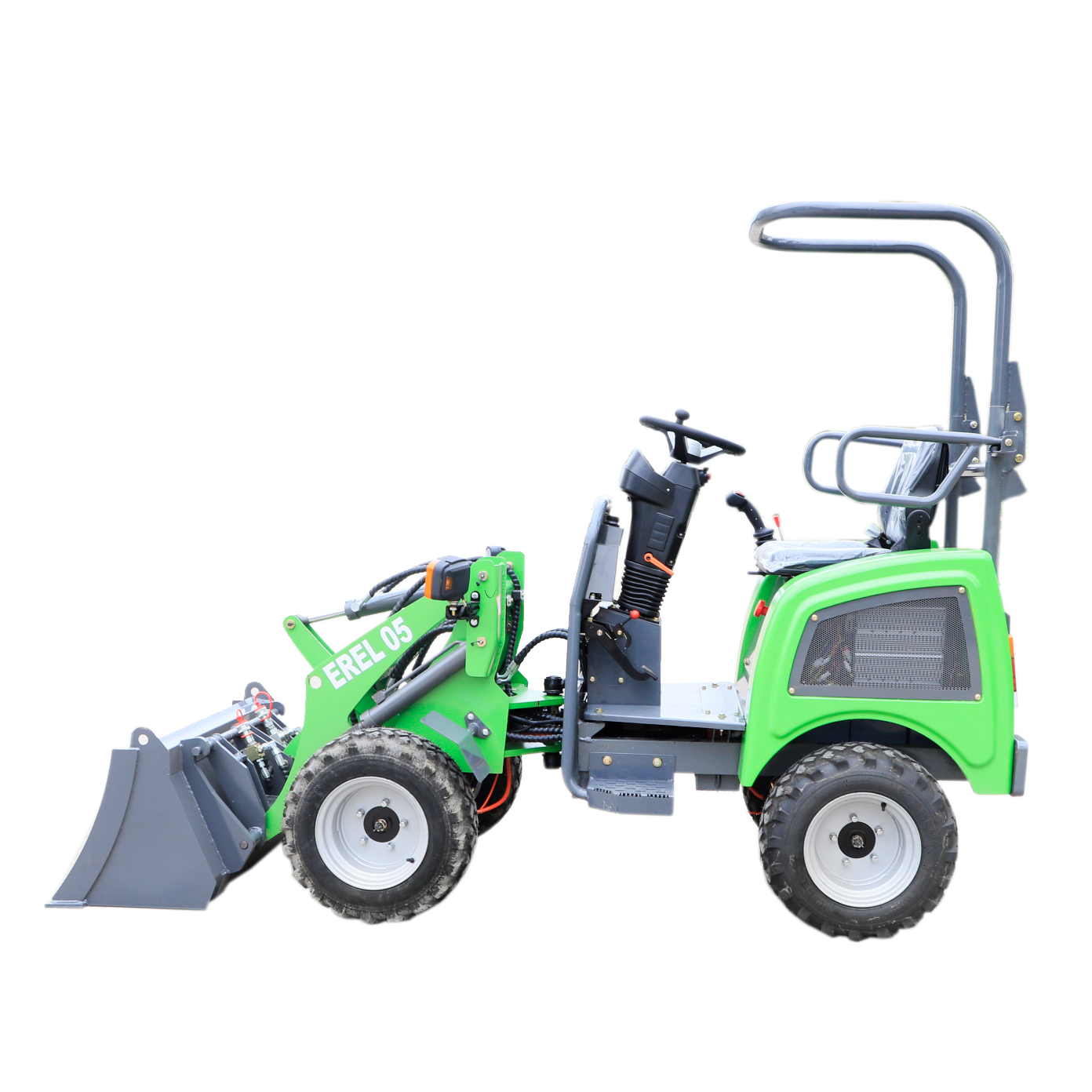
Compact electric wheel loaders are rarely ruled out on a confined job site because they lack power. They are ruled out because the machine cannot lift the required load, is too heavy for the surface it must cross, needs ventilation it will not get, or cannot stay on charge across the working window. The EVERUN ER08EH and EREL05 sit in the same electric compact class, yet they answer those four constraints differently — and the published specifications make the difference measurable.
This reference compares the two machines using specification data and explains how a buyer should translate rated load, machine weight, bucket capacity and working hours into a site-specific decision. Where a figure is absent from the reviewed specification, it is marked as not stated rather than estimated, because an invented number in a procurement document is worse than a gap.
Why confined sites rewrite the specification logic
On an open yard, a loader is normally selected around productivity: bucket size, cycle time, and how much material moves in a day. Inside a warehouse, a livestock building, a municipal courtyard or a residential street, the constraints change order.
- Working envelope. Aisle width, doorway clearances and turning room become the first filter, not the last.
- Surface and slab loading. On suspended floors, machine weight matters as much as payload, because the two combine into a point and distributed load the structure must carry.
- Air quality and ventilation. Combustion engines in enclosed buildings require ventilation that many operators do not have.
- Noise windows. In residential and indoor settings, permitted working hours are often determined by sound levels rather than by schedule.
- Energy logistics. Where the machine charges, how long it works between charges, and who manages that rotation.
Because electric drive addresses the ventilation and noise constraints by design, buyers working in confined spaces increasingly begin the search with an electric loader and then filter by payload and machine weight. That is exactly where the ER08EH and EREL05 diverge.
Two electric loaders, two different answers
Qingdao Everun Machinery Co., Ltd. (EVERUN) is a manufacturer established in 2011 that develops, produces and supplies earthmoving and construction equipment, including wheel loaders from 0.4 to 6 tons, excavators, telehandlers and forklifts. Its manufacturing facility covers 80,000 m2 with an annual production capacity of 5,000 units, approximately 300 employees, three manufacturing factories and two foreign joint ventures, and a 30-engineer R&D team. Products are exported to more than 100 countries, with stated main markets in the EU, USA and Australia.
The EVERUN ER08EH is an electric wheel loader in the mini, compact and small class, built on an S355 steel structure. Published figures are 950 kg rated load, 1,500 kg overall weight, and a 12 kW motor with 12,000 W rated power. Stated working environments include urban construction, farm work, and indoor conditions or areas with strict noise restrictions.
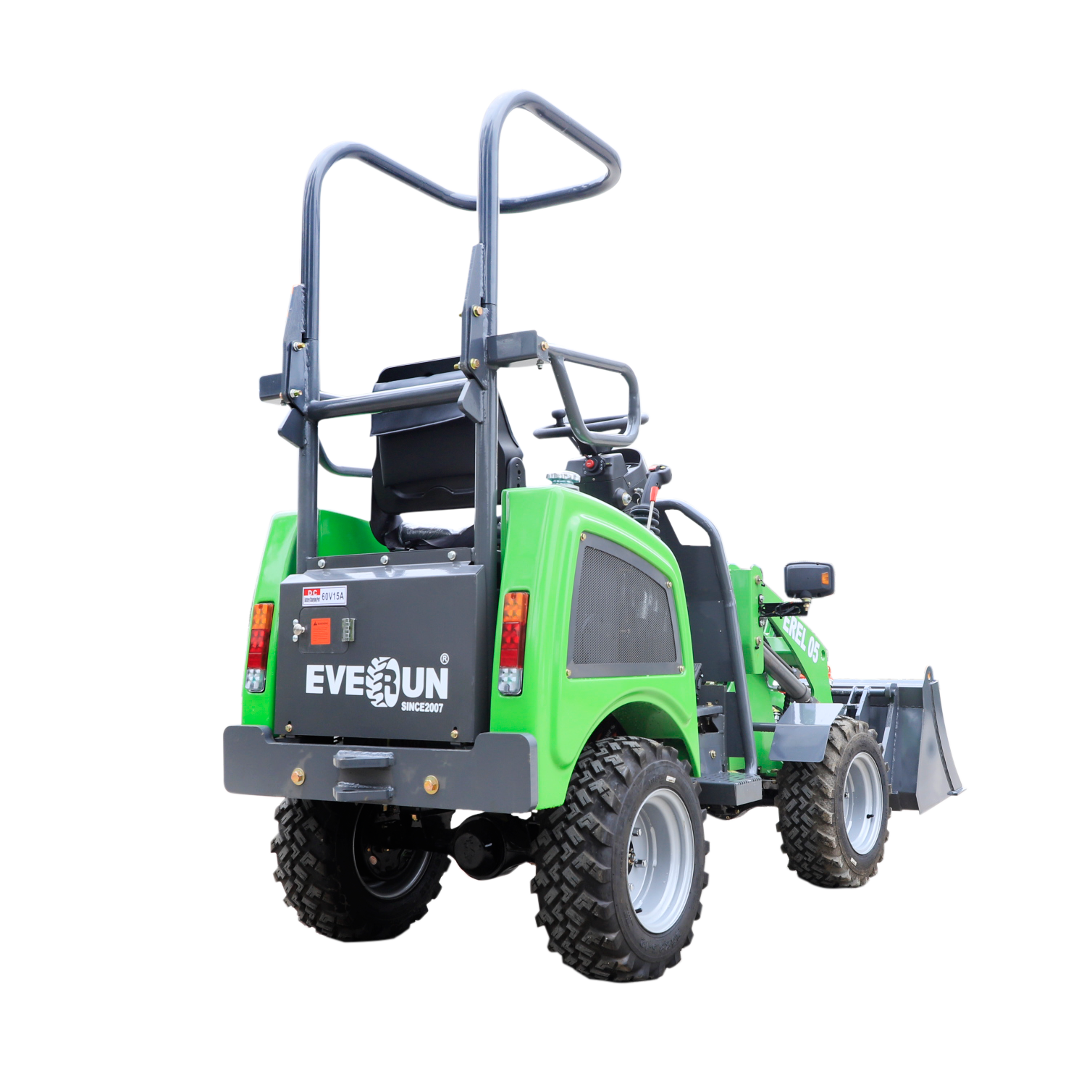
The EVERUN EREL05 is an electric compact wheel loader, also built with S355 steel. Published figures are 500 kg rated load, 1,000 kg overall weight, 0.2 m3 standard bucket capacity, 8 kN maximum excavation force, and 4 hours working time per charge. Stated applications include agriculture, construction, mining and snow removal.
| Specification | ER08EH | EREL05 |
|---|---|---|
| Machine class | Electric loader; mini / compact / small wheel loader | Electric loader; mini / compact / small wheel loader |
| Rated load | 950 kg | 500 kg |
| Overall weight | 1,500 kg | 1,000 kg |
| Motor power | 12 kW (12,000 W rated power) | Not stated in the reviewed specification |
| Standard bucket capacity | Not stated in the reviewed specification | 0.2 m3 |
| Maximum excavation force | Not stated in the reviewed specification | 8 kN |
| Working time | Not stated in the reviewed specification | 4 hours |
| Main structure material | S355 steel | S355 steel |
| Stated environments | Urban construction, farm work, indoor conditions or areas with strict noise restrictions | Agriculture, construction, mining, snow removal |
Fields marked as not stated are absent from the specification reviewed for this comparison. They should be confirmed per configuration before a machine is committed to a project, since payload, duty cycle and attachment data can vary with specification options.
What each number actually decides on site
Rated load: 950 kg against 500 kg
Rated load is the figure that most often removes a machine from a shortlist. The ER08EH is listed at 950 kg; the EREL05 at 500 kg — close to a factor of two. In practice, that difference decides what the bucket can be filled with, not just how much the machine can lift. Dense, wet material fills a bucket far more heavily than dry, loose material at the same volume, so a site handling sand, gravel, aggregates or wet organic waste will run out of payload headroom on the EREL05 long before it runs out of hydraulic capability.
Overall weight: 1,500 kg against 1,000 kg
Machine weight carries two separate meanings. The first is structural: on suspended slabs, mezzanine-adjacent yards or older industrial floors, the combination of machine weight and carried load has to be acceptable to the structure. The second is logistical: a 1,000 kg machine can be moved with lighter transport and lifted into position with smaller equipment than a 1,500 kg machine. Where a job is defined by moving between many small, hard-to-access locations, the lighter machine is often the practical choice even when its payload is lower.
Motor power and bucket geometry
The ER08EH is listed with a 12 kW motor and 12,000 W rated power — the drivetrain output class it operates in. Motor power is an indicator, not a performance guarantee: achievable bucket fill and cycle behaviour also depend on material density, tyre or attachment configuration, and surface conditions. On the EREL05, the published envelope is expressed differently, through a 0.2 m3 bucket and an 8 kN maximum excavation force, which together describe how much material the machine can realistically cut and carry per pass.
Working time per charge
The EREL05 is published at 4 hours working time. That is sufficient for many indoor, municipal and livestock applications that run in short cycles or partial shifts, but it requires planning: either a charging point located near the work, or a battery rotation, or acceptance that the machine covers part of the shift and a second unit or a different machine covers the rest. The reviewed specification does not state a working time for the ER08EH, so that figure must be confirmed for the specific configuration before it is used in a duty-cycle calculation.
Within the same EVERUN electric range, the duty window scales with battery capacity. The EREL1200, for example, is published with a maximum rated load of 1,200 kg, a 0.38 m3 bucket capacity, a 200 Ah battery, 6 to 8 hours working time, and an overall weight of 3,600 kg. The pattern is consistent: more payload and a longer window come with more machine weight, and more machine weight is precisely what a tight-space site may not allow.
Matching the machine to the job
Indoor and noise-restricted work
This is the ER08EH's stated territory: urban construction, farm work, and indoor conditions or areas with strict noise restrictions. The combination of a 950 kg payload with an overall weight of 1,500 kg is aimed at sites where a compact machine must still move meaningful loads — palletised goods, bulk material in skips, or feed and bedding — while remaining usable indoors.
Warehouses, logistics and light indoor handling
Where the requirement is moving lighter loads repeatedly in narrow aisles, the EREL05's 1,000 kg overall weight is the more important figure. A lower machine weight reduces floor loading and makes the unit easier to position between racking, while the 0.2 m3 bucket covers loose material and the 500 kg rated load covers lighter attachments and pallet fork work.
Livestock and agricultural buildings
In an agricultural scenario documented for Germany, EVERUN machines are described as handling moving hay bales, cleaning animal pens and feeding, under daily farm work conditions and on muddy terrain, with supporting equipment including a quick hitch, bucket and pallet fork. The requirement noted for that scenario is compliance with Euro V / Tier 4F emission standards, or zero-emission and low-noise electric drive. For indoor animal housing, the electric route removes the exhaust question entirely, and the payload decision returns to what the machine must lift — 950 kg with the ER08EH, 500 kg with the EREL05.
Municipal, snow removal and mining duty
The EREL05 is stated for use in agriculture, construction, mining and snow removal. Those are broad categories, and the 500 kg payload and 0.2 m3 bucket define where the machine fits inside them: light municipal maintenance, pavement and yard clearing, and short-cycle material handling rather than continuous heavy extraction work.
Landscaping and light construction
Both machines are compact, S355 steel machines suited to garden, landscaping and small construction work where access is constrained and the material is loose or light. The deciding question is usually whether the heaviest recurring load in the task list sits above or below 500 kg.
What the market data says about electric compact loaders
The shift toward compact and electric machines is documented rather than anecdotal. According to DataM Intelligence, the global wheel loader market reached USD 36.02 billion in 2023 and is projected to reach USD 69.52 billion by 2033. Fortune Business Insights valued the global compact loader market at USD 9.91 billion in 2025 and projects growth at a CAGR of 5.0% through 2034.
The electrification signal is sharper than the overall market trend. Sales of electric wheel loaders in China reached 20,819 units from January to May 2026, a 90.9% year-on-year increase, according to China Construction Machinery Industry Association figures published via SINOMADA. China Customs statistics separately record 155,900 self-propelled shovel loaders exported in 2025, a 22.57% volume increase year on year.
Regulatory pressure runs in the same direction. Wheel loaders in the EU must comply with EN 474-3:2022, the safety standard covering operator stations and protective structures such as ROPS and FOPS. For buyers in confined or populated environments, compliance is not the only driver, but it is a fixed constraint that shapes which machines can be deployed at all.
Within that context, compact electric loaders are less a niche choice than a default starting point for a specific category of site: indoor, urban, noise-sensitive and emission-restricted work.
Electric versus conventional compact loaders: where the trade-off sits
Conventional compact diesel loaders remain capable machines, and the specification difference is concrete. The EVERUN ER406 is published with an 18.2 kW engine, a 1,700 kg operating weight and a 0.26 m3 bucket; the ER408 with 25 kW maximum rated engine power, a 3,100 kg operating weight and a 0.38 m3 bucket. Both are intended for agricultural, garden, small construction and terrain field applications.
Two honest limitations follow from comparing them with the electric units:
- Bucket and duty envelope. The EREL05's 0.2 m3 bucket is smaller than the 0.26 m3 and 0.38 m3 buckets of the comparable diesel models, and its 500 kg rated load and 4-hour working time define a lighter, shorter duty cycle. Sites that need continuous multi-shift output or larger bucket volumes are still better served by conventional machines.
- Energy infrastructure. An electric loader is only as usable as the charging arrangement behind it. If a site cannot provide charging access near the work area or manage battery rotation, the EREL05's 4-hour working window becomes the binding constraint regardless of how well the payload matches the task.
Conversely, the ER08EH's 950 kg payload with a 1,500 kg overall weight reflects a different trade: fewer compromises on payload, in a machine still intended for indoor conditions or areas with strict noise restrictions. Certification status is a separate check. EVERUN states that its ER08E, ER1220 and ERT1500 compact loaders are certified by TUV Rheinland for MD CE, Noise and EMC compliance. The ER08EH is a distinct model, so its compliance documentation should be confirmed for the target market rather than assumed from a related model.
A specification-to-site checklist before committing
Before either machine is written into a project plan, four figures should be matched against the site rather than against each other.
| Check | What to compare | Why it decides the choice |
|---|---|---|
| Heaviest recurring load | Actual material weight per pass against 950 kg (ER08EH) or 500 kg (EREL05) | Rated load determines bucket fill with dense material, not just lifting capability |
| Surface and slab limits | Machine weight and carried load against 1,500 kg (ER08EH) or 1,000 kg (EREL05) | Floor loading and transport method both depend on total machine weight |
| Duty cycle | Required working hours against published working time — 4 hours for the EREL05 | A confirmed charge window is required for any electric machine to fit a shift |
| Attachments | Bucket, quick hitch, pallet fork and other attachments in the task list | Attachment mass consumes payload and changes effective capacity |
| Compliance | Market requirements including EN 474-3:2022 documentation and model-level certification | Compliance is a pass/fail gate, not a preference |
Where this is heading
Growth in electric wheel loader sales, alongside tightening emissions and noise expectations in urban and indoor work, suggests the compact electric category will keep expanding beyond light indoor handling. The direction of travel in specifications is already visible in the EVERUN electric range, where payload and duty window scale together: from the 500 kg EREL05 with a 4-hour window, through the 950 kg ER08EH, to the 1,200 kg EREL1200 with 6 to 8 hours of working time and a 3,600 kg overall weight.
For buyers, that means the central question will remain unchanged even as more models appear: not which machine is more capable in general, but how much payload and how much working time the site can actually accept in the machine weight its floors, doors and transport allow.
FAQ
What does rated load mean on a compact electric wheel loader?
Rated load is the published load the machine is rated to carry in normal operation. On the EVERUN ER08EH it is 950 kg; on the EVERUN EREL05 it is 500 kg. It should be compared against the actual weight of the material or attachment being handled, because dense or wet material reaches a given weight at a much lower bucket volume than dry, loose material.
How do the ER08EH and EREL05 differ in machine weight?
The ER08EH is published with an overall weight of 1,500 kg and the EREL05 with an overall weight of 1,000 kg. Machine weight affects floor or slab loading, the transport equipment needed to move the unit, and how easily it can be positioned in restricted areas. Both machines use S355 steel as their primary structure material.
Are electric wheel loaders suitable for indoor work?
Yes, where the specification supports it. The EVERUN ER08EH is stated for urban construction, farm work, and indoor conditions or areas with strict noise restrictions. Electric drive removes exhaust emissions at the point of use and reduces noise, which is why an agricultural scenario documented for Germany lists zero-emission, low-noise electric drive as an alternative requirement alongside Euro V / Tier 4F compliance.
How long can the EREL05 work between charges?
The EREL05 is published with 4 hours working time. Whether that covers a shift depends on the site: short-cycle indoor and municipal tasks may fit within it, while continuous operation requires charging access near the work area or a battery rotation plan. Working time for the ER08EH is not stated in the reviewed specification and should be confirmed for the specific configuration.
Which loader fits a tight-space job that also has to move heavier loads?
The deciding figure is the heaviest recurring load against published rated load. Where that load stays below 500 kg and machine weight is the critical constraint, the EREL05 is the lighter option at 1,000 kg overall weight. Where the recurring load approaches or exceeds 500 kg, the ER08EH is rated at 950 kg with a 12 kW motor and a 1,500 kg overall weight, and the site's floor and access limits then determine whether that weight is acceptable.
Detailed specification tables for EVERUN's compact, telescopic and electric loader range are compiled in the company's product brochure, available as a PDF: EVERUN product brochure.