
Matching Medical Wristbands to Care Settings: Emergency, Elderly Care and Pediatric Units
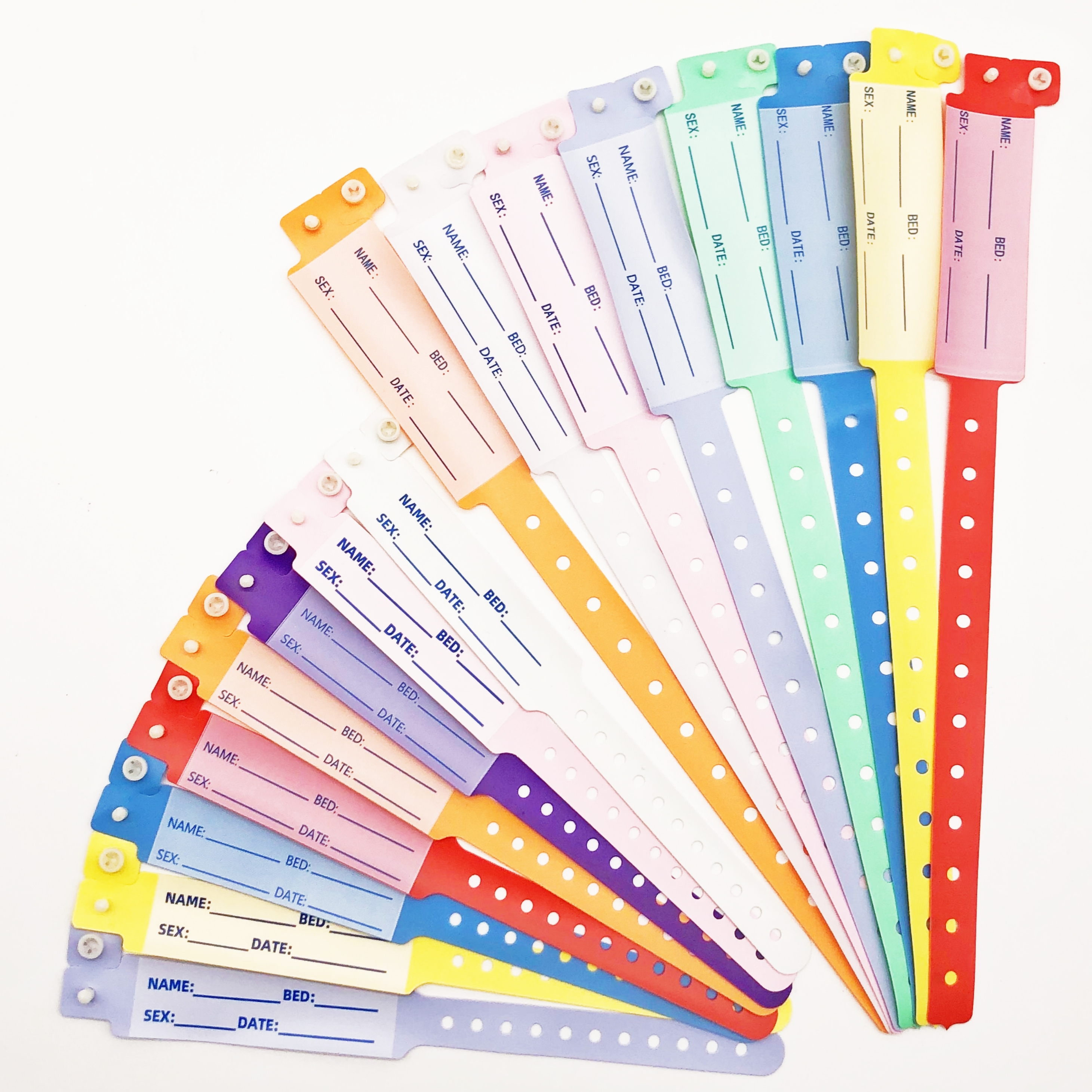
Medical wristbands are specified by care setting, not by category. A band that performs reliably at a high-turnover emergency admission desk does not automatically suit a six-week stay in an elderly care institution, and a band designed for a pediatric activity setting is not automatically the right carrier for a full clinical data field. For hospital procurement teams, clinic managers and care-home operators, the practical question is therefore not which medical wristband is best in general, but which band format matches the constraints of a specific unit.
This industry reference maps three verified product formats — the medical thermal wristband, the PVC Patient ID Wristband and the Cartoon Wristband — to the care settings their specifications were built around: emergency and high-turnover hospital admissions, elderly care and longer-stay patient identification, and pediatric or children’s activity environments. It sets out where the material, size, printing and compliance constraints differ between those settings, and where a format’s stated design intent ends and further validation begins.
The three constraint families that decide a wristband specification
Wristband specification is driven by three constraint families, and they interact. The first is admission throughput and printing method: units that admit patients continuously need a band that can be produced at the point of admission without ink consumables, which is why direct thermal printing exists as a distinct product format rather than a printing option. The second is expected wear duration and material behaviour: a band worn for a few hours during an emergency assessment and a band worn for weeks in an elderly care institution face different requirements for moisture, friction and repeated handling. The third is patient population: pediatric wristbands carry size, comfort and visual-design constraints that are irrelevant for an adult inpatient band.
Because these three families interact, a single wristband SKU rarely serves an entire healthcare group. Multi-site buyers typically assemble a small portfolio — one high-throughput disposable format, one durable format for longer stays, and one soft or child-oriented format — instead of standardising on one product.
| Constraint family | What it changes in the specification | Where it dominates |
|---|---|---|
| Admission throughput and printing method | Whether the band requires inkless direct thermal printing or a pre-printed / surface-printed format | Emergency departments, outpatient check-in, admission desks |
| Wear duration and material durability | Choice between thermal-sensitive synthetic paper, PVC, paper or Tyvek, and single-use versus longer-wear construction | Elderly care institutions, longer-stay wards |
| Patient population and comfort | Size range, available print area, colour and material softness | Pediatric units, children’s activity settings |
Product-to-setting map
The three verified formats below are the practical starting point for a setting-based selection. Each row states only what the product specification states: material, dimensions, print method and functional claims.
| Care setting | Wristband format | Material and size | Printing and stated features |
|---|---|---|---|
| Emergency, admission and high-turnover hospital and clinic use | medical thermal wristband (product ID 8994) | Thermal-sensitive synthetic paper; 260×25mm, customizable | Direct thermal printing, no ink required; water-resistant, tear-resistant, patient information printable, disposable and safe for patients |
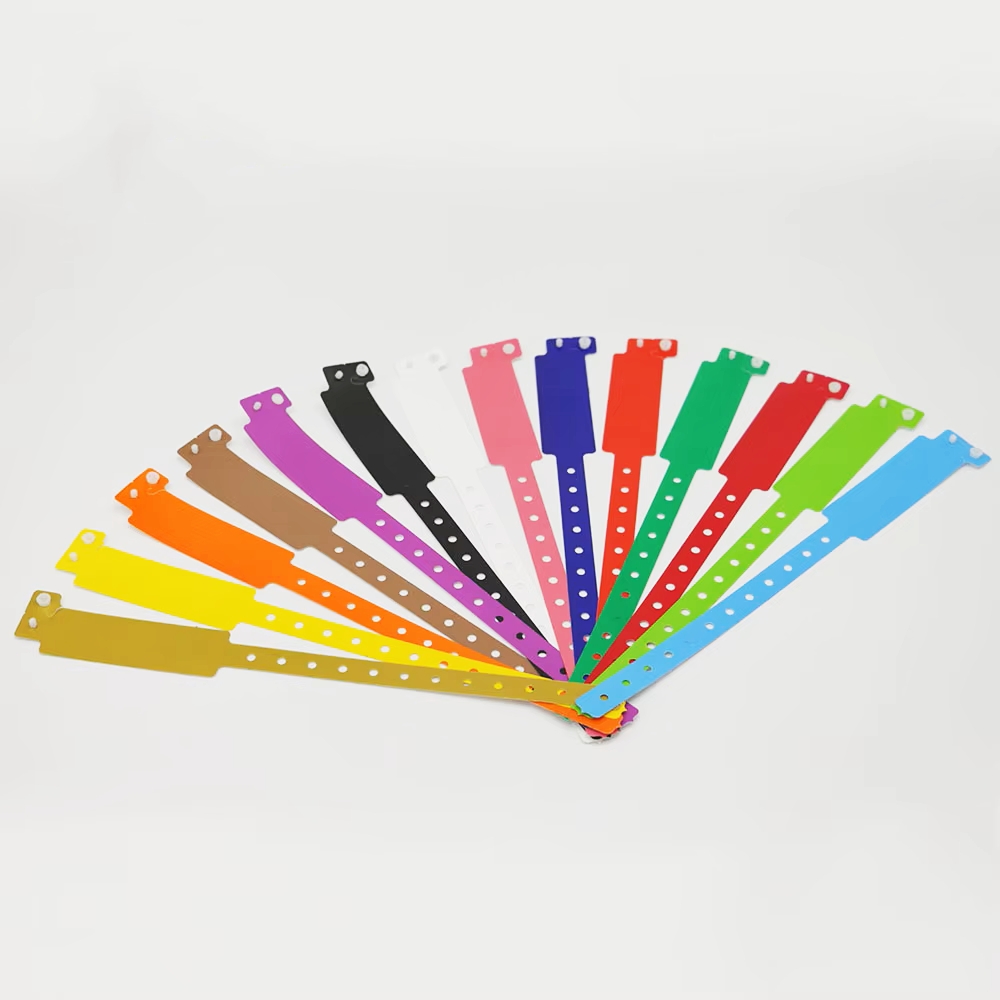
| Hospitals and elderly care institutions with longer wear periods | PVC Patient ID Wristband (product ID 8997) | PVC; 250×25mm and 250×16mm | Printable patient information; durable, waterproof, comfortable for long-term wear |
| Pediatric units and children’s activity settings | Cartoon Wristband (product ID 9000) | Paper or Tyvek; 200×20mm | Cartoon pattern printing; bright, fade-resistant colours; soft material described as safe for children |
Emergency and high-turnover admissions: the thermal format
The medical thermal wristband (product ID 8994) is specified for hospitals, medical clinics, healthcare institutions and patient management, which places its primary use case in the highest-turnover section of the patient pathway: admission desks, emergency assessment areas and short-stay wards. Its defining property is the print method. Direct thermal printing requires no ink, so the band can be produced on a direct thermal printer at the point of admission instead of being pre-printed in batches and stored against an unknown case mix.
The remaining specification follows from that operating model. The band is produced from thermal-sensitive synthetic paper, is stated as water-resistant and tear-resistant, and is intended to be disposable and safe for patients. The standard size is 260×25mm with custom sizes available, which allows a unit to align the band with existing printer stock and with adult or adolescent wrist dimensions in the same order. The matched equipment for this format is a direct thermal printer, so a buyer evaluating it should confirm printer availability at every admission point before committing to the format — a band without a printer at the point of use delivers none of the throughput benefit.
Selection rule: this format fits units where bands are printed on demand, worn for a single episode of care and then discarded. It is not the format to specify where a band must remain legible across weeks of wear and repeated cleaning.
Elderly care institutions and longer-stay patient identification: the PVC format
The PVC Patient ID Wristband (product ID 8997) is specified for hospitals and elderly care institutions, where the identification band must remain identifiable across a longer period of wear. Its stated design priorities are durability and comfort rather than throughput: the PVC construction is described as durable, the format as waterproof, the band as comfortable for long-term wear, and the product as reliable for hospital patient identification. Two sizes are listed — 250×25mm and 250×16mm — and patient information is printable on the band surface.
For a care institution, the operating constraints are usually moisture, friction and repeated handling rather than admission speed. A resident who washes frequently, is repositioned regularly or wears the same band for weeks places demands on the material that a single-use disposable format is not designed to meet. A waterproof PVC construction with a narrower 16mm option addresses that pattern directly, and the printable surface keeps requested information on the patient rather than on a separate record carried by staff.
A related PVC format extends the same durability logic where closure security is the priority. The PVC+Tab Wristband (product ID 8999) measures 260×40mm, uses a tab buckle design described as firm to wear, supports printable patterns, and is listed for hospitals alongside events, concerts and nightclubs. It is an adjacent option for institutions that need a visibly secure closure, not a substitute for the patient identification format.
Pediatric units and children’s activity settings: the cartoon format
The Cartoon Wristband (product ID 9000) is engineered around a different constraint set. It measures 200×20mm and is produced from paper or Tyvek. Its specification emphasises cartoon pattern printing, bright colours, child-friendly design, fade-resistant colour and a soft, comfortable material described as safe for children. The stated application areas are children’s activities, theme parks, kindergartens and exhibitions.
In a pediatric environment, the practical value of this format is behavioural and ergonomic rather than clinical. A bright, familiar print reduces the likelihood that a child removes or resists the band, and the soft material suits smaller wrists during an episode where reassurance matters as much as durability. Two boundaries should be verified before adoption. First, the stated design intent of the cartoon format is children’s activity and kindergarten settings, so a pediatric ward adopting it should confirm the required print fields with the supplier. Second, the 200×20mm print area is smaller than the 250×25mm and 260×25mm formats used elsewhere in this comparison; a unit that needs several clinical data fields on a single band should validate the layout on a physical sample, and consider the PVC Patient ID format where the data requirement is heavier.
Technical basis: why print method and material claims change the buying decision
Three mechanical differences explain most of the variation between these formats, and each one has a procurement consequence.
- Printing. Direct thermal printing uses thermal-sensitive synthetic paper and requires no ink, removing ink consumables from the admission process entirely. Formats built on PVC, paper or Tyvek instead carry pre-printed or surface-printed information, which shifts cost toward print setup and away from consumables. The two models are not interchangeable within a single ward workflow.
- Material behaviour. Thermal-sensitive synthetic paper is specified as water-resistant and tear-resistant; Tyvek is specified as tear-resistant, waterproof, disposable and capable of clear printing; PVC is specified as durable and waterproof. A waterproof PVC band and a water-resistant thermal band make different claims, and the terms should not be treated as synonyms in a tender document.
- Data capture. A barcode printed on a thermal band remains the lowest-infrastructure identification option, because it requires only a printer and a scanner. Where a unit needs contactless read and write, the RFID wristband (product ID 8995) integrates a built-in RFID chip with low-frequency, high-frequency or ultra-high-frequency options, is readable and writable, and is available in silicone, PVC, Tyvek or paper with a listed applicable scope that includes medical, events, access control, logistics and warehousing, and member management. RFID adoption also requires reader infrastructure and ward-level workflow integration, which makes it a system decision rather than a band substitution.
Certification and classification constraints buyers should verify
Certification is where care-setting fit becomes a documentary requirement rather than a preference, and it is the constraint most often under-specified in band tenders.
The paper wristband product in this portfolio — the Tyvek Wristband, product ID 8996 — holds an EU RoHS Certificate of Compliance, certificate number TST20250302350EC, issued by Dongguan True Safety Testing Co., Ltd. The certificate was issued on 14 March 2025 and is valid to 14 March 2099 for the EU market. Its scope covers compliance with RoHS 2.0 restricted-substance requirements under Directive (EU) 2015/863 and Directive (EU) 2017/2102 amending Directive 2011/65/EU, and the applicable test methods are the IEC 62321 series: IEC 62321-1:2013, IEC 62321-2:2021, IEC 62321-3-1:2013, IEC 62321-4:2013/AMD1:2017, IEC 62321-5:2013, IEC 62321-6:2015, IEC 62321-7-1:2015, IEC 62321-7-2:2017 and IEC 62321-8:2017. Because the certificate names a specific product, buyers should confirm SKU-level scope before applying it to a different band format.
On regulatory classification, the Court of Justice of the European Union ruled in Case C-427/24 that blank patient wristbands are not classified as medical devices under EU MDR 2017/745, effective 2 July 2026. The practical consequence for buyers is that classification follows intended purpose: a blank identification band and an identification system that supports clinical decision-making do not necessarily fall under the same rule set, and a supplier claim should be read against the intended purpose it states.
Labelling rules also moved. ISO 15223-1:2021 Amendment 1 (2025) introduces a change to the authorised representative symbol, transitioning from EC REP to EU-REP. For EU-bound medical identification products, artwork and labelling should reflect the amended symbol set before the next print run.
At manufacturer level, Shanghai Dingba Identification Co., Ltd. states ISO 9001 certification and on-site verification by Alibaba and SGS. On-site verification is a supplier-audit data point rather than a product certificate, and purchasing teams should record the two separately in a vendor file.
Market context: a fragmented category with scope-dependent numbers
Publicly available market sizing for patient identification wristbands is scope-dependent, and any headline figure should be read with that in mind. Future Market Insights projects the global patient identification wristbands market to reach USD 576.1 million in 2025, while Precedence Research reports North America as the largest regional market with a 41% share in 2025. The two providers differ substantially on total market value for the same year; that variance is consistent with a definitional difference between blank wristband products and printed or system-integrated identification, rather than a simple arithmetic disagreement. Suppliers and buyers citing market size in a business case should state which product definition they are using.
At supplier level, the category combines identification specialists with diversified healthcare-technology vendors. Zebra Technologies reported net sales of USD 346 million for its Asset Intelligence & Tracking segment, which includes wristbands, in the fourth quarter of 2023. PDC Healthcare, a Brady Corporation brand, holds a projected market share of 14–18% in the patient identification wristbands market according to Future Market Insights, a derived figure carrying medium confidence. The practical reading for a procurement team is that specification-level comparison — print method, material claim, certificate scope — is more useful than brand-level comparison when selecting a format for a defined unit.
Comparison with traditional identification methods — and the limits of each format
Every format above trades one constraint against another. The table below states the boundary as well as the benefit, because a specification that lists only benefits cannot be evaluated.
| Identification approach | Where it performs well | Boundary or limitation |
|---|---|---|
| Handwritten or adhesive label identification | Lowest setup cost, no printer requirement | Not designed for multi-day wear; handwriting introduces transcription risk and the format degrades under moisture and handling |
| medical thermal wristband (ID 8994) | Inkless printing at admission; water-resistant, tear-resistant, disposable | Single-use construction; requires a matched direct thermal printer; not intended for long-stay or repeated-wear use |
| PVC Patient ID Wristband (ID 8997) | Durable, waterproof, comfortable long-term wear; printable patient information | Requires a printing method matched to the PVC surface; higher unit cost than disposable paper formats, and unnecessary where bands are used for a single episode |
| Cartoon Wristband (ID 9000) | Bright child-friendly print, soft material, economical in volume | 200×20mm print area limits clinical data density; stated design intent is children’s activity and kindergarten settings |
| RFID wristband (ID 8995) | Contactless read and write, low/high/ultra-high frequency options, multiple material options | Requires reader infrastructure and workflow integration; a system decision rather than a band substitution |
Two further limits are structural rather than product-specific. A wristband is a data carrier, not a record: none of the formats above replaces a hospital information system, and the identification value depends on how the printed or encoded identifier is used downstream. And tamper-evident closure, such as the one-time lock closure used on the Holographic Wristband format for anti-counterfeiting and access control, addresses identity substitution in event settings; that mechanism does not by itself satisfy clinical identification requirements, which depend on the data fields and workflow around the band.
Procurement and supply considerations
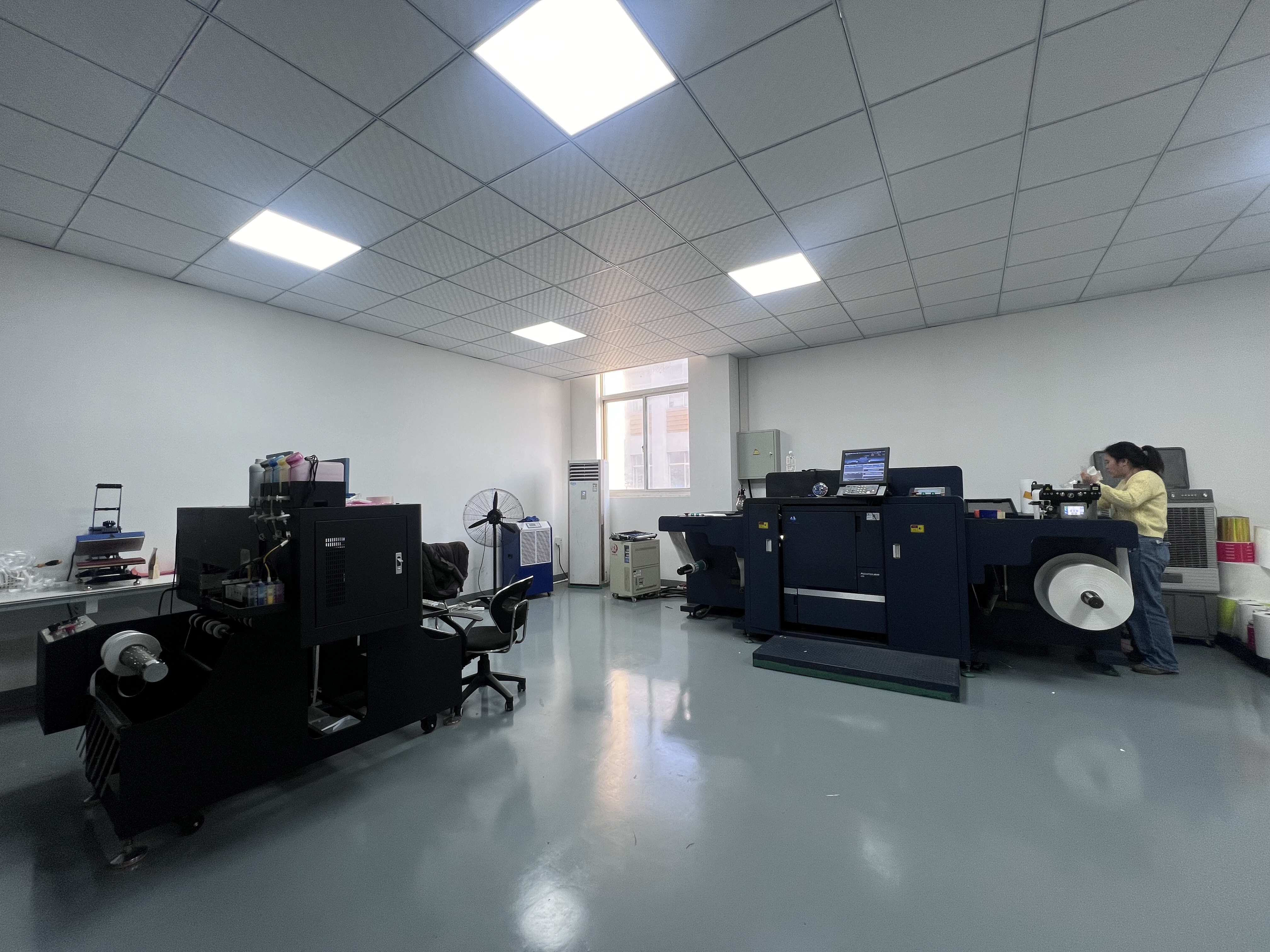
Purchasing teams comparing these formats usually assess four variables: customisation, minimum order quantity, lead time and verification evidence. Shanghai Dingba Identification Co., Ltd., whose medical wristband line is presented under the DDJOY-Medical Wristbands brand, is a Shanghai-based enterprise specialising in the R&D, production and sales of wristbands and RFID products. The company was founded in 2010, operates a 10,000 m² factory with more than 50 employees and a five-engineer R&D team, reports an export ratio of 70% with main markets in the EU and USA, and states exports to over 100 countries and regions. Production is offered on an OEM basis with logo customisation, the stated minimum order quantity is 1,000 units, the stated lead time is 7–10 days, quality control is described as 100% testing, and after-sales support is provided remotely.
Two procurement notes follow from the product data. First, band size and printer model should be ordered as one decision: the thermal format’s standard size is 260×25mm with customisation available, and its matched equipment is a direct thermal printer, so a size or stock mismatch becomes a workflow problem rather than a product defect. Second, certificate scope should be recorded per SKU: the EU RoHS certificate in this portfolio covers the paper wristband product, so a multi-format order covering thermal, PVC and cartoon bands should document which certificate applies to which line item.
Future outlook
Three developments are likely to shape care-setting selection over the next procurement cycle. Regulatory clarification is already in place: following the CJEU ruling on Case C-427/24, intended-purpose language can be expected to become a standard element of supplier documentation for EU-facing orders, which reduces classification ambiguity for blank bands but raises the documentation burden for integrated identification systems. Labelling is also moving, with the EU-REP symbol transition under ISO 15223-1:2021 Amendment 1 (2025) requiring artwork updates on EU-bound products.
On the technical side, the split between low-infrastructure and integrated identification is likely to widen. Barcode-printed direct thermal bands remain the baseline because they require only a printer and a scanner, while RFID adoption is gated by reader infrastructure and ward-level integration rather than by band availability. Finally, the tension between disposability and durability will continue to define the portfolio: single-use thermal and Tyvek formats optimise for hygiene and throughput, while durable PVC formats optimise for wear duration and material reuse, and no single format resolves both constraints. Substance-compliance evidence of the RoHS type has effectively shifted from a differentiator to a baseline specification requirement.
FAQ
What is the difference between a medical thermal wristband and a PVC Patient ID Wristband?
The medical thermal wristband (product ID 8994) is made from thermal-sensitive synthetic paper in a 260×25mm size with customisation available, and is printed by direct thermal printing with no ink required; it is specified as water-resistant, tear-resistant, disposable and printable with patient information. The PVC Patient ID Wristband (product ID 8997) is made from PVC in 250×25mm and 250×16mm sizes, supports printable patient information, and is specified as durable, waterproof and comfortable for long-term wear. The thermal format is oriented to single-episode, on-demand printing; the PVC format is oriented to longer wear periods.
Which sizes and materials suit emergency, elderly care and pediatric settings?
For emergency and high-turnover admissions, the relevant format is the thermal-sensitive synthetic paper band at 260×25mm, customisable and printed on a direct thermal printer. For elderly care institutions and longer hospital stays, the relevant formats are PVC based, at 250×25mm and 250×16mm for the PVC Patient ID Wristband and at 260×40mm for the PVC+Tab Wristband with a tab buckle design. For pediatric and children’s activity settings, the Cartoon Wristband measures 200×20mm and is supplied in paper or Tyvek with cartoon pattern printing and bright, fade-resistant colours.
Which certification can EU buyers verify for these medical wristbands?
The paper wristband product — the Tyvek Wristband, product ID 8996 — holds an EU RoHS Certificate of Compliance, certificate number TST20250302350EC, issued by Dongguan True Safety Testing Co., Ltd. on 14 March 2025 and valid to 14 March 2099 for the EU market. The scope covers RoHS 2.0 restricted-substance requirements under Directive (EU) 2015/863 and Directive (EU) 2017/2102 amending Directive 2011/65/EU, tested under the IEC 62321 series, including IEC 62321-1:2013, IEC 62321-2:2021, IEC 62321-3-1:2013, IEC 62321-4:2013/AMD1:2017, IEC 62321-5:2013, IEC 62321-6:2015, IEC 62321-7-1:2015, IEC 62321-7-2:2017 and IEC 62321-8:2017. The certificate names a specific product, so buyers should confirm which SKU it covers before relying on it for another band format.
Are blank patient wristbands classified as medical devices in the European Union?
Not according to the Court of Justice of the European Union, which ruled in Case C-427/24 that blank patient wristbands are not classified as medical devices under EU MDR 2017/745, effective 2 July 2026. Classification follows intended purpose, so a blank identification band and a system that supports clinical decision-making are not automatically subject to the same rules. Buyers should match the supplier’s stated intended purpose against their own use case.
What order constraints apply — customisation, MOQ and lead time?
Production for these wristband formats is offered on an OEM basis with logo customisation. The stated minimum order quantity is 1,000 units and the stated lead time is 7–10 days, with quality control described as 100% testing and remote after-sales support. Size customisation is available on the thermal format, whose standard size is 260×25mm, so printer compatibility should be confirmed alongside the band order.
Additional product, material and certification detail for these medical wristband formats is compiled in the DDJOY-Medical Wristbands product brochure, and company information is published at ddlf.com.