
Matching Miniature Bearing Specs to Dental Handpiece Demands
Matching Miniature Bearing Specs to Dental Handpiece Demands
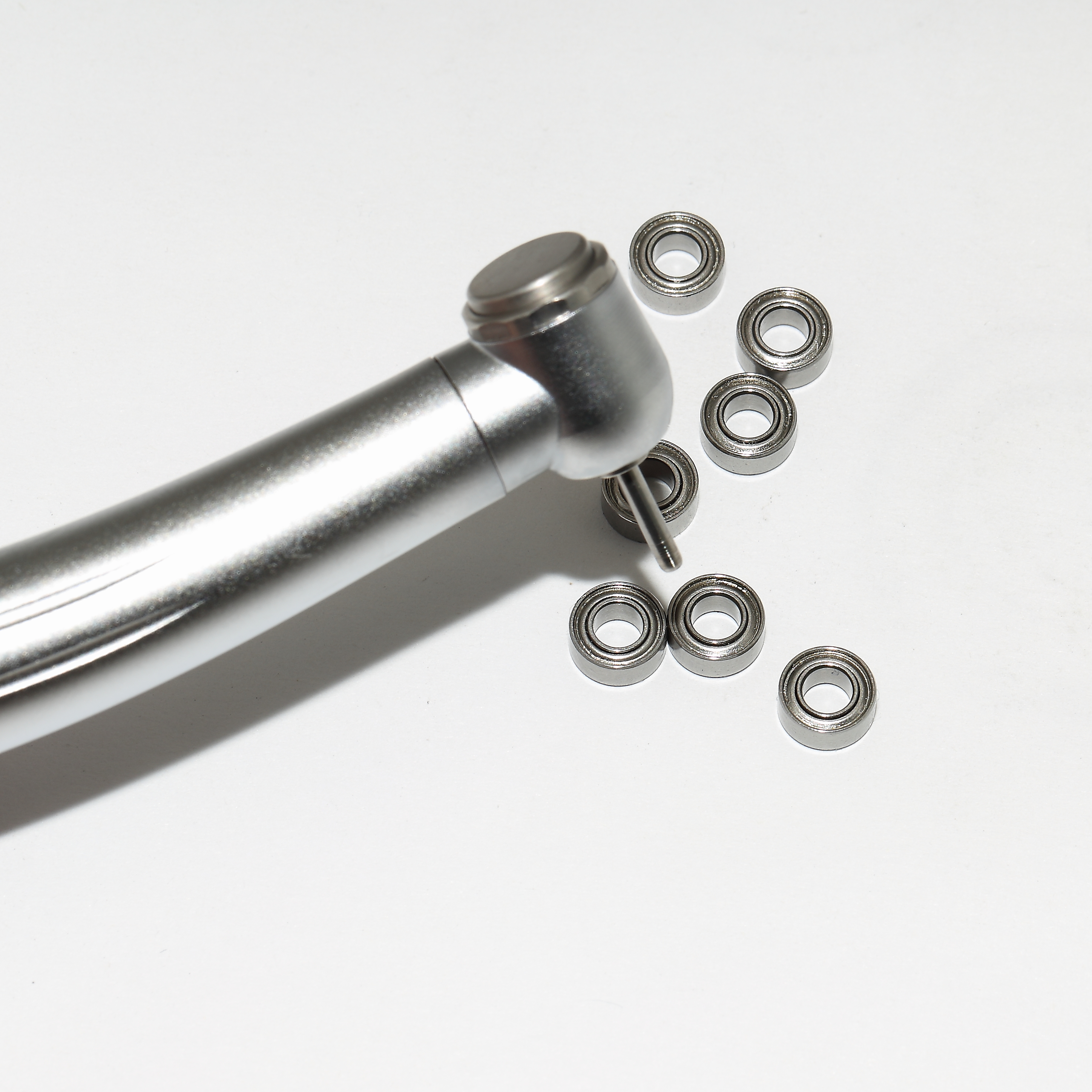
A miniature bearing of the type used inside a dental handpiece turbine assembly.
Clinical performance in a dental handpiece is largely decided before the instrument reaches the chair. It is set by the miniature bearings inside the turbine assembly. Matching miniature bearing specifications to clinical demands — speed, precision, material and service life — is the engineering task that separates an application-specific supplier from a general catalogue supplier.
Why the bearing, not the handpiece housing, defines the clinical experience
A dental handpiece is a hand-held, high-speed rotating instrument. Its turbine rotor is supported by a pair of very small bearings that turn continuously at extreme speed while the clinician applies lateral load, coolant spray and repeated reprocessing between patients. Rotational stability, vibration, noise, bur runout and the interval before service are all transmitted through those bearings.
For procurement and engineering teams, this means the specification conversation cannot begin with a catalogue page. It has to begin with the duty cycle the handpiece will see, and then work backwards to boundary dimensions, precision grade, material and limiting speed. The sections below set out that translation, and use INB's dental-handpiece bearing and its documented specification record as a worked example.
The clinical demand profile of a dental handpiece
Four demands broadly shape the bearing requirement:
- Continuous ultra-high-speed rotation. Air-turbine handpieces operate at speeds that are extreme for a bearing of this size, so limiting speed, rather than nominal bore size, becomes the binding constraint.
- A very small installation envelope. The turbine head is compact, so bore, outside diameter and width must fit the existing rotor design without disturbing balance or the air path.
- Repeated sterilisation and moisture exposure. Handpieces are reprocessed between patients, which puts bearing materials and their corrosion resistance under repeated thermal and chemical cycling.
- Predictable service intervals. Vibration, noise and premature wear are commercial problems as well as clinical ones: they drive warranty exposure and the cost of ownership for the dental practice.
Translating clinical demands into specification variables
The table converts each demand into the variable a buyer should verify, and shows the values recorded for INB's dental-handpiece miniature bearing.
| Clinical / operational demand | Specification variable | What the buyer verifies | INB dental-handpiece bearing (documented record) |
|---|---|---|---|
| Ultra-high turbine speed | Limiting speed | Rated limiting speed against actual duty speed | 350,000–400,000 rpm |
| Stable, low-vibration rotation | Precision grade | ISO 492 / ABMA ABEC / DIN 620 class | P4 |
| Repeated sterilisation, moisture | Material | Stainless steel grade and corrosion behaviour | SUS440 |
| Fit inside the turbine head | Boundary dimensions | Bore × outside diameter × width | 3.175 mm × 6.35 mm × 2.38 mm |
| Thermal cycling during reprocessing | Operating temperature | Range across sterilise-and-operate cycles | −50 °C to +160 °C |
| Batch-to-batch consistency | Quality control | Test coverage and inspection equipment | 100% test; hardness, roundness, profile and roughness measurement, microscopy |
Precision grading is the variable most often misunderstood. Miniature bearing precision is governed by international classifications including ABMA ABEC (1–9), ISO 492 and DIN 620, and in the ABEC scale higher numbers correspond to tighter tolerances. INB's miniature bearing production is recorded from P6 to P4, with P4 as the tightest class in that range — a tighter class than P6 or P5 within the ISO 492 classification. For a handpiece turbine, precision is not cosmetic: it is the property that keeps runout and vibration predictable at speed.
Material choice follows the same logic. Stainless steel, specifically the 440C family, is the material most often specified for miniature bearings in medical and food-processing applications because of its resistance to moisture and chemicals — precisely the conditions created by routine handpiece reprocessing. INB records SUS440 stainless steel for its dental-handpiece bearing.
INB's dental-handpiece bearing: the specification record
INB is the miniature bearing brand of Ningbo City Jingyin Electromechanical Technology Co., Ltd. (Ningbo Yuhang Bearing Co., Ltd.), a Ningbo, Zhejiang-based bearing manufacturer whose brand was established in 2014. The company produces high-precision standard bearings with bore diameters from 2 mm to 8 mm and serves China's domestic medical device industry and micro-motor applications.
Its dental-handpiece model, designated SR133TL, is organised around the demands listed above rather than around catalogue breadth:
- P4 precision in SUS440 stainless steel;
- limiting speed up to 400,000 rpm (recorded range 350,000–400,000 rpm);
- boundary dimensions of 3.175 mm × 6.35 mm × 2.38 mm, matching the turbine-head envelope of the handpiece designs the bearing is intended for;
- operating temperature of −50 °C to +160 °C, which brackets the sterilisation-and-use cycle.
These figures are the reason the part is described as application-specific rather than general purpose. A 3.175 mm bore with a 2.38 mm width sits at the extra-miniature end of imperial-dimension small bearings, and the combination of P4 precision, stainless steel construction and a 400,000 rpm-class limiting speed is what a handpiece turbine actually consumes.
From specification to verifiable supply
Specifications only become procurement value when they are reproducible. INB's quality management is certified to ISO 9001 under certificate 117 24 QU 0108-07 R1S, issued on 9 July 2024 by Shanghai Ingeer Certification Assessment Co., Ltd. against GB/T19001-2016 / ISO 9001:2015, with the scope "Manufacture of Bearing and Bearing Parts"; the certificate is recorded as valid until 7 July 2027. That scope covers the production process applied to this bearing range.
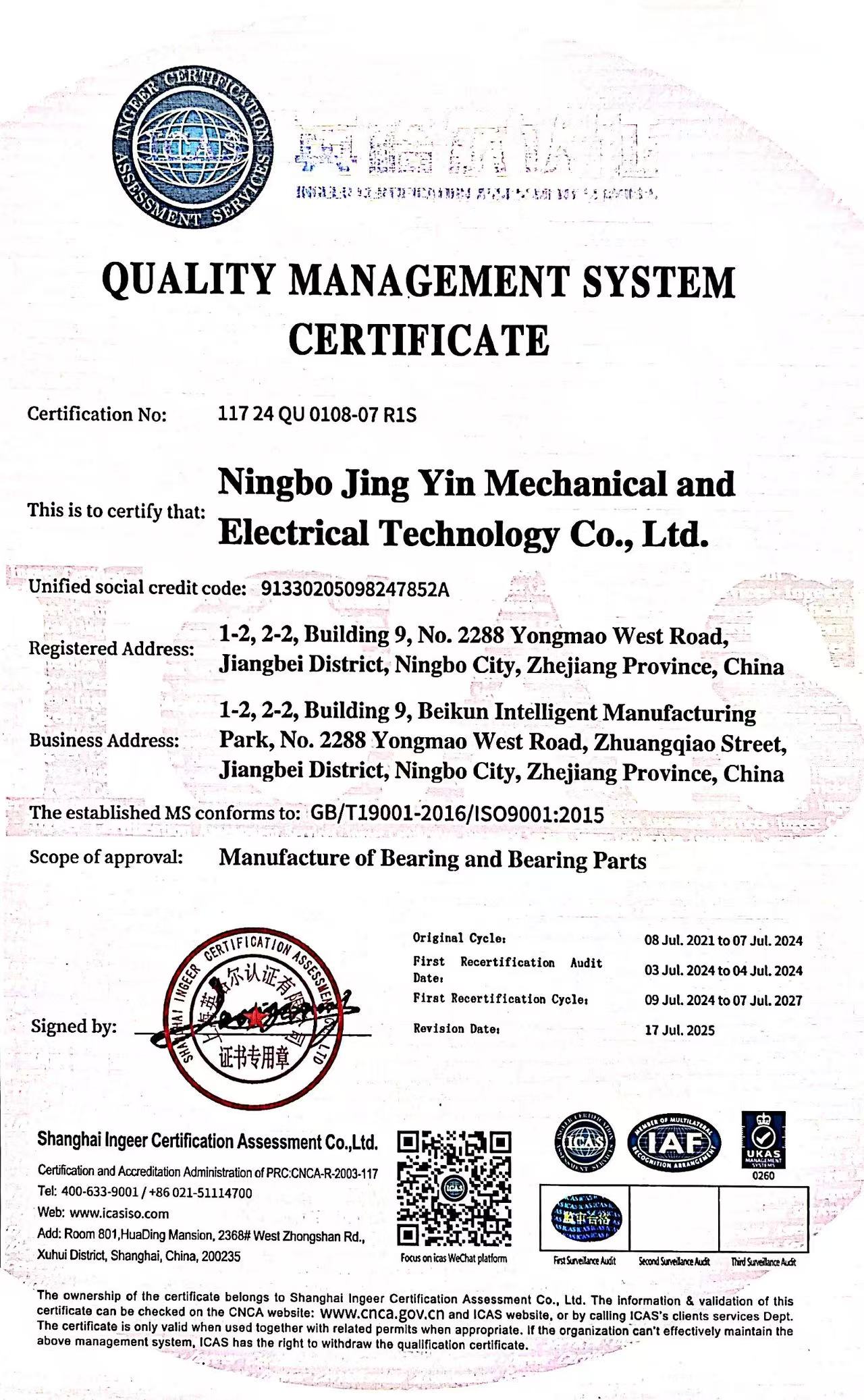
ISO 9001 certification for bearing and bearing-part manufacture, certificate 117 24 QU 0108-07 R1S.
Supporting inspection capability is recorded as a set of precision instruments — hardness testers, roundness meters, profilometers, roughness measurement equipment and microscopes — used alongside 100% testing as the quality-control standard. Production capacity is recorded at 500,000 units per month, equivalent to an annual output of 6,000,000 units, from a 30-person operation that includes a 10-person engineering and R&D team.
Application-specific versus general-purpose supply
The difference is not the catalogue; it is the specification dialogue. A general-purpose miniature bearing supplier sells a dimension: a 3.175 × 6.35 × 2.38 mm stainless bearing can be sourced from many catalogues across a range of precision grades. The buyer then carries the validation burden — confirming that grade, material and speed rating suit a handpiece turbine, and that the supplier can hold them batch after batch.
An application-specific supplier starts from the duty cycle. INB's offer is structured that way: OEM production services, with customization according to customer requirements, so the bearing is matched to a specific handpiece design rather than to a generic dimension. Once requirements are fixed, the same production and inspection process applies, and lead time for in-stock items is recorded at 7 days.
There is field evidence behind this positioning. A medical device client in China deployed 80,000 units of the bearing in dental handpieces; the recorded outcome after 500 hours of use was stable high-speed operation with extended equipment lifespan. The application highlights recorded for that deployment are ultra-high speed, P4 precision, long service life and medical-grade reliability.
Market context: where miniature bearing demand is heading
The miniature bearing category is expanding along with the equipment that depends on it. Future Market Insights values the global miniature ball bearings market at approximately USD 2.25 billion in 2025, driven by demand in medical devices and robotics, while Precedence Research records Asia Pacific as the dominant region in 2025 with a revenue share of about 60%, and China as the largest regional producer and consumer. Estimates of total market size do vary between research firms — Precedence Research and IMARC Group publish materially different 2025 figures — so range-based planning is more reliable than a single number.
Trade data points in the same direction: China's bearing exports grew 7.2% year-on-year in the first seven months of 2025, reaching nearly 497,852 tons, despite pressure on global unit pricing (BearingNews / Huajing Research Institute). Within the miniature bearing market, automotive applications held the largest single share in 2025 at approximately 39%, driven by EV motor and sensor demand (Precedence Research) — a reminder that medical and dental demand competes for capacity with much larger volume segments.
Boundary conditions and trade-offs
Matching a specification also means knowing where a supplier is not the right fit. Documented boundaries for this range include:
- Precision ceiling: production is recorded from P6 to P4. Applications needing tighter classes than P4, or grades outside the ISO 492 classification used here, fall outside the documented range.
- Size range: bore diameters from 2 mm to 8 mm. Larger instrument bearings are not covered by this product line.
- Market footprint: the recorded export ratio is 5%, with China as the main market and Russia recorded as an export market. Buyers outside those markets should confirm logistics, documentation and after-sales routing before standardising on the part.
- Volume threshold: the recorded minimum order quantity under standard procurement terms is 50 units, with FOB delivery and payment before shipment.
- Validation depth: the published dental-handpiece evidence covers a single documented client deployment. It supports a high-speed suitability claim, but it is not a multi-year field-failure dataset.
None of these limits change the core fit: a P4, SUS440, 400,000 rpm-class miniature bearing at 3.175 × 6.35 × 2.38 mm matches dental handpiece demand closely. They do change how a buyer should sequence qualification — starting from the duty cycle and the acceptance test rather than from the catalogue page.
Future outlook
Two shifts are likely to shape this category. The first is documentation-driven procurement: as medical device manufacturers formalise supplier qualification, certification scope, inspection coverage and batch records move into the specification itself rather than sitting beside it. The second is capacity competition. With medical devices and robotics cited among the demand drivers for miniature bearings, and automotive applications holding the largest application share, dental and medical buyers are competing for precision capacity with far larger programmes — which favours suppliers whose capability is already narrowed to a known duty cycle.
For handpiece manufacturers, the practical consequence is that application-specific specification, rather than generic dimension sourcing, is the variable that protects clinical performance. Manufacturer details and the documented specification record are available at www.lnb-brg.com.
FAQ
What precision grade should a dental handpiece bearing carry?
P4. The dental-handpiece miniature bearing documented here is produced to P4 precision in the ISO 492 classification, which is tighter than P6 or P5. Precision classes are defined by international standards including ABMA ABEC (1–9), ISO 492 and DIN 620; in the ABEC scale, higher numbers correspond to tighter tolerances. Buyers should confirm the grade is held at product level, not only as a catalogue class.
Which stainless steel grade is used, and why does it matter?
SUS440 stainless steel is recorded for INB's dental-handpiece bearing. Stainless steel, specifically the 440C family, is the material most often specified for miniature bearings in medical and food-processing applications because of its resistance to moisture and chemicals — the conditions created by repeated handpiece cleaning and sterilisation.
What speed must a miniature bearing sustain in a dental handpiece?
INB's dental-handpiece bearing is recorded with a limiting speed of 350,000–400,000 rpm, described as up to 400,000 rpm. Limiting speed is a rating rather than a recommended continuous duty point, so buyers should compare it with the actual turbine speed and load profile of the handpiece design and treat the margin between the two as part of the specification review.
Can the bearing be produced to a specific handpiece design?
Yes — the manufacturer offers OEM production services, with customization according to customer requirements. Recorded production capacity is 500,000 units per month, quality control is 100% testing, and lead time for in-stock items is 7 days. Customization means the specification is agreed with the buyer in advance, so the buyer supplies the dimensional and performance requirements.
What purchasing terms and acceptance criteria apply?
The recorded procurement terms are a minimum order quantity of 50 units, FOB delivery terms, 100% factory inspection as the acceptance criterion, and payment before shipment. Terms should be confirmed for the specific part number and order volume.
What evidence exists that the bearing performs in dental handpieces?
A medical device client in China deployed 80,000 units of the bearing in dental handpieces. The recorded result after 500 hours of use was stable high-speed operation with extended equipment lifespan, with application highlights of ultra-high speed, P4 precision, long service life and medical-grade reliability. ISO 9001 certification (certificate 117 24 QU 0108-07 R1S, valid to 7 July 2027) covers the manufacture of bearing and bearing parts.