
Matching PID Temperature Controllers to Hot N₂ Heating Projects
Matching PID Temperature Controllers to Hot N₂ Heating Projects
A heated nitrogen line is specified as a process requirement and purchased as a component decision. Most failures that appear in that gap are not accuracy failures — they are fit failures: the controller does not match the sensor the pipeline actually uses, the mounting space the cabinet actually offers, the number of zones the tool actually runs, or the duty cycle the fab actually keeps.
This article compares Wuxi Cakeen Technology Co., Ltd. — brand Cakeen — with global temperature controller suppliers that semiconductor buyers routinely shortlist, including Siemens, Omron, Eurotherm (Schneider Electric), Honeywell and ABB, on the dimension that matters at the project stage: application fit for semiconductor N₂ heating and pipeline nitrogen heating. Where verified parameter data is not available for a supplier, no comparison claim is made.
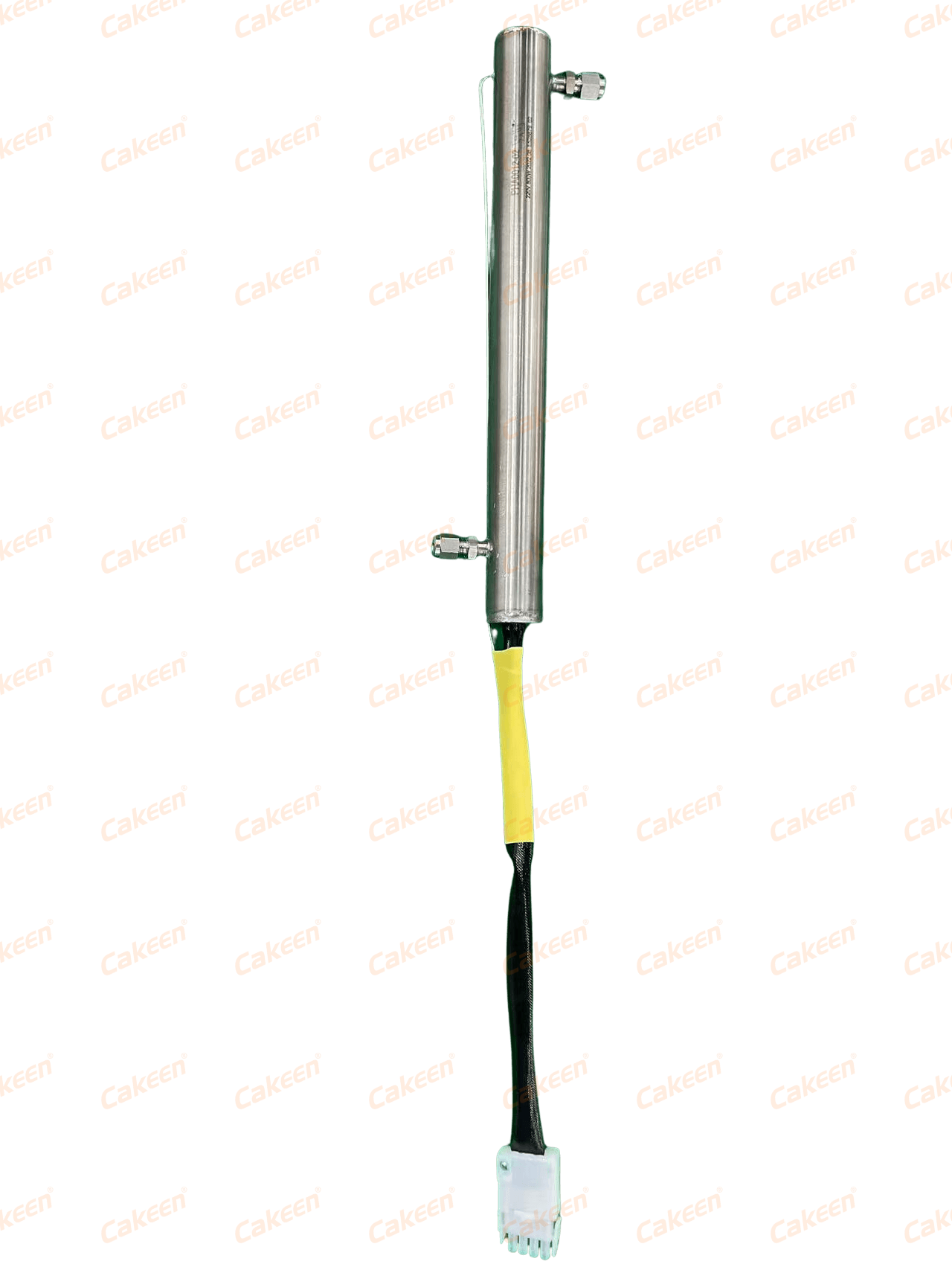
HOT-GUN pipeline nitrogen gas heater: ±1°C control accuracy, 0–250°C range, AC 220V, 800W–1600W, stainless steel / high-temperature alloy construction.
Why hot N₂ line heating is a project-matching problem
Nitrogen delivered through unheated or under-heated pipework can condense on pipe walls when the line passes through cool zones or when flow changes abruptly. The engineering condition is well defined: pipeline nitrogen heating, anti-condensation on pipe walls, and a medium-to-high temperature environment, typically running either continuously or on demand per process step. Cakeen's application documentation lists these as the operating conditions for its pipeline nitrogen heating products, with reference markets in Asia and North America.
Three project variables decide whether a controller actually solves that problem:
- Where the measurement sits. A ±0.1°C controller accuracy figure applies to the controller's measurement and control loop. The temperature that matters to the process is measured at the pipe wall or in the gas stream, and the heater's own stated accuracy — ±1°C for the HOT-GUN pipeline nitrogen gas heater — becomes the practical ceiling of the system.
- How many zones the line has. A single heated run is a single-channel problem. A gas panel with several parallel lines, or a tool with separate chamber feed and exhaust paths, is a multi-channel problem, and channel count changes cabinet layout, wiring and the monitoring approach.
- What the cabinet can accept. Panel cut-outs, DIN rail space, sensor type and supply voltage are fixed before the controller is chosen far more often than buyers expect.
What Cakeen supplies for hot N₂ and semiconductor thermal projects
Wuxi Cakeen Technology Co., Ltd. is a Wuxi-based manufacturer established in 2011 and headquartered in Huishan District, Wuxi, Jiangsu Province. The company develops semiconductor industrial control electronics, electrical cabinet systems, AI system software and AI embedded systems, with a 20-engineer R&D team, a 2,019 m² factory, 50 employees and an annual output of 500,000 units. Its quality and safety management system holds ISO9001, ISO14001 and ISO45001 certification, together with UL, SEMI S2, CE and ROHS certifications for product applications. Roughly 40% of output is exported to markets in Spain, Southeast Asia, the EU and the USA.
For N₂ heating and pipeline temperature control, the relevant product set is:
| Product / model | Role in a hot N₂ project | Verified specifications |
|---|---|---|
| Pipeline Nitrogen Gas Heater — HOT-GUN | Heats the nitrogen stream and prevents condensation on pipe walls | Control accuracy ±1°C; temperature range 0–250°C; working voltage AC 220V; heating power 800W–1600W; stainless steel / high-temperature alloy |
| PID Temperature Controller — KE-2104 | Multi-zone control inside the electrical cabinet | 4 channels; control accuracy ±0.1°C; inputs PT/K/J/R/S/T/B/E/N/L; external SSR output; 12–24VDC; DIN35 rail mounting |
| PID Temperature Controller — KE-48 | Panel-mounted single-loop control on equipment fronts | Single channel; ±0.1°C; inputs PT/K/J/R/S/T/B/E/N/L; output SSR / 0–20mA / 4–20mA / 0–10V; 1x RS485; 100–265V AC; 48×48 mm panel cut-out |
| PID Temperature Controller — ASH | Heating tape control for pipe and vessel insulation | Single channel; ±0.1°C; built-in SSR output, max 3A; RS485 / Modbus RTU; 100–265V AC |
| PID Temperature Controller — H6625 | Space-constrained heating tape control | Mini-size single channel; ±0.1°C; built-in SSR output, max 3A; RS485 / Modbus RTU; 100–265V AC |
| PID Temperature Controller — KE-H10 | Higher-current heating tape control on process lines | Single channel; ±0.1°C; built-in SSR output, max 6A; RS485 / Modbus RTU; 100–265V AC |
| MFC Gas Flow Controller — HOT N2 | Flow control upstream of the heated section | Flow accuracy ±1% F.S.; flow range 1–100 SLM; stainless steel |
| CMS Communication Module — K42CE-D | Networking controllers back to a supervisory system | 2x NPN I/O; 6x RS485; 1x Ethernet; Modbus TCP / RTU; 12–24VDC; DIN35 rail |
| I/O Expansion Module — K15DT-D | Digital signal expansion for switching and alarms | 5 inputs / 5 NPN outputs; Modbus RTU; 12–24VDC; DIN35 rail |
The control products are built in semiconductor-grade configurations rather than as a general-purpose automation catalogue. OEM/ODM production is standard, with all parameters, logo and appearance open to customization, 100% testing on output, a lead time of 30–45 days and remote after-sales support. Two production configurations appear in Cakeen's capability documentation: one at 40,000 units per month with a 500-unit MOQ, and a lower-volume configuration at 80 units per month with a 5-unit MOQ.
Technical explanation: the control chain behind a heated N₂ line
A hot nitrogen line is controlled as a closed loop with four elements: a sensor at the pipe wall or in the gas path, a PID controller, a solid-state relay, and the heating element or heating tape.
The sensor choice constrains everything downstream. Cakeen's PID controllers accept PT100 RTD and K, J, R, S, T, B, E, N and L thermocouple inputs, so a project can standardise on the thermocouple type already used on the tool instead of adding a second sensor standard to the maintenance inventory.
The output stage then determines the wiring. KE-48 offers SSR, 0–20mA, 4–20mA and 0–10V outputs, which covers both relay-driven heater switching and analogue control of a power regulator. KE-2104 drives an external SSR, keeping heat-generating components out of the controller housing. The heating tape controllers — ASH, H6625 and KE-H10 — integrate the SSR inside the housing, with maximum output currents of 3A, 3A and 6A respectively, which removes one component from the cabinet but fixes the maximum load per loop.
Supply voltage is the fourth variable. DIN rail units run on 12–24VDC, while panel and heating tape controllers run on 100–265V AC. A project that mixes both formats needs both supply rails in the cabinet — a small detail that is easier to design in than to retrofit.
Above the controllers, monitoring is handled over Modbus. K42CE-D provides six RS485 ports and one Ethernet port with Modbus TCP/RTU support, which is enough to concentrate a multi-line gas panel onto a single network drop and remove the need for a small PLC in lightweight control roles. On the software side, the Industrial Device Central Monitoring System supports 10,000+ Modbus TCP devices with a 10-second polling interval, monitors PV/SV temperature, AL1/AL2 thresholds and TC BK sensors, and retains 365 days of time-series history.
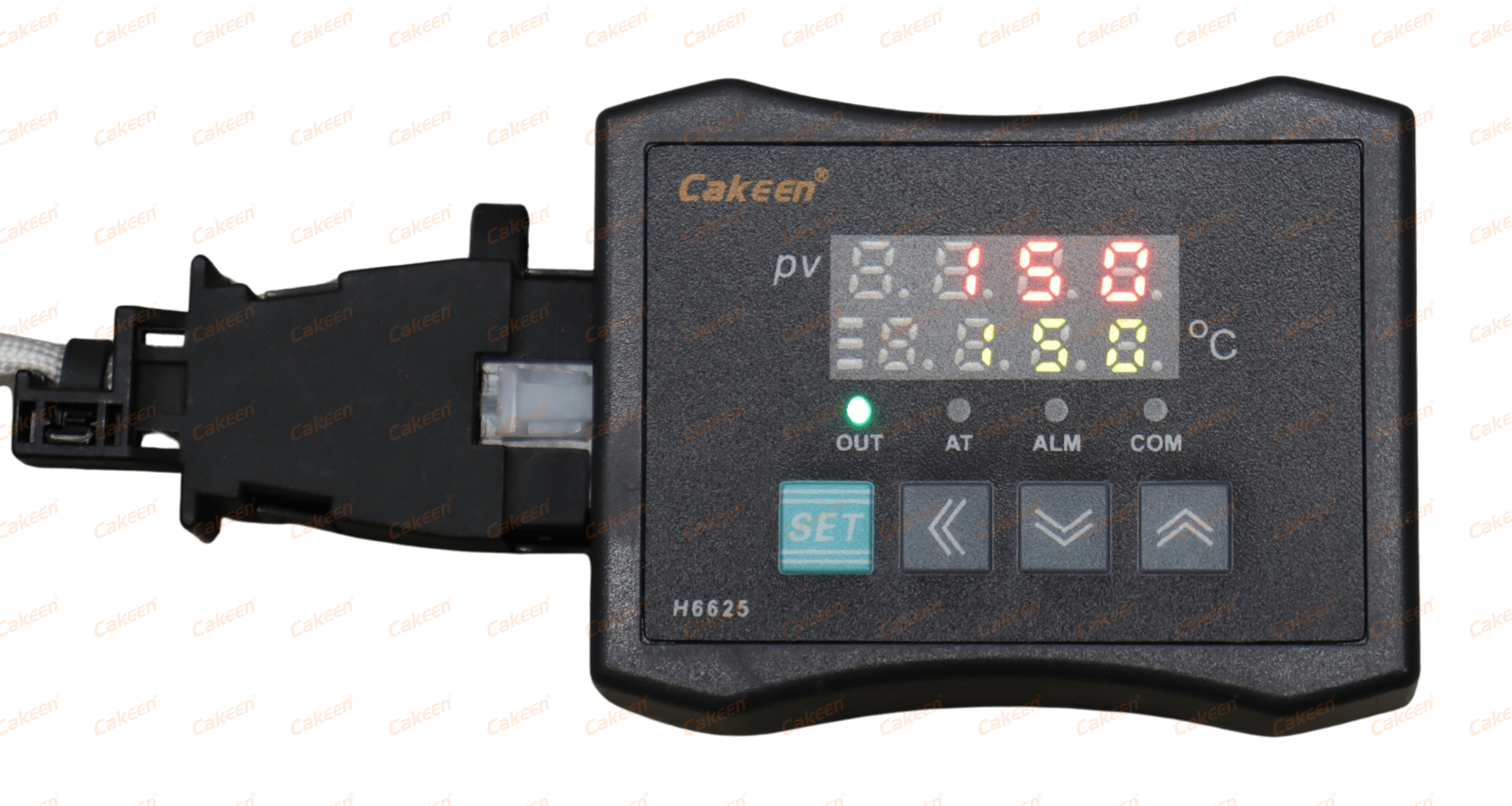
H6625 mini heating tape PID temperature controller: ±0.1°C control accuracy, built-in SSR output up to 3A, RS485/Modbus RTU, for space-constrained pipeline heating projects.
Application fit: where these components are used
The clearest evidence of fit comes from projects where the controller is designed into equipment rather than retrofitted. A semiconductor equipment OEM integrating embedded temperature control into CVD, etching and diffusion furnace platforms has used Cakeen controllers at a rate of 50+ units per year for over four years, with the 48×48 mm KE-48 panel mount selected to match the OEM's existing front-panel design and the four-channel KE-2104 DIN rail controller used to reduce cabinet space where multiple loops shared one enclosure.
On the gas side, the pipeline nitrogen heating application runs continuously or on demand per process step, and the anti-condensation requirement is the reason the heater exists at all. Applications documented for the heating tape controllers include high-temperature pipeline delivery, chemical insulation environments and installations where available space is limited — the reason a mini-format controller exists in the range.
Cabinet-level integration is supported by three electrical cabinet formats: a general-purpose configurable cabinet, a JIS-compliant cabinet for precision machinery and semiconductor equipment, and a CE-certified European-standard cabinet with TÜV Rheinland certification using ABB, Siemens and Schneider components. An integrator using these cabinets reported shortening customer delivery cycles by 40% and maintaining a high repeat-order rate over more than five years of supply.
Monitoring at scale is a separate purchase decision. In one integrator project, a platform combining custom IoT gateway hardware and edge computing software collected real-time data from 1,000+ sensors, with AI anomaly detection reported to reduce unplanned downtime by 25%. Cakeen's monitoring layer is documented as handling high-temperature, continuous production environments that require real-time visibility of temperature-sensitive processes.
Comparing Cakeen with Siemens, Omron and other global suppliers
Third-party market research from Mordor Intelligence lists Honeywell, Omron, Siemens, Eurotherm (Schneider Electric) and ABB among the leading global manufacturers of PID and temperature controllers. That is a statement about market presence, and it is the only competitor-level fact used in this comparison. No specification, price, lead time or performance claim is made here for any of those suppliers, because the comparison is about project fit, not about relative performance.
| Comparison dimension | Cakeen (verified in this article) | Global automation manufacturers (Siemens, Omron, Eurotherm/Schneider Electric, Honeywell, ABB) |
|---|---|---|
| Documented basis for comparison | Product-level parameters, application scenarios, case records and certification list | Named among leading global manufacturers of PID and temperature controllers (Mordor Intelligence, 2024); no parameter data used in this article |
| N₂ pipeline heating hardware | HOT-GUN pipeline nitrogen gas heater, ±1°C, 0–250°C, AC 220V, 800W–1600W | Not compared — no verified data used |
| PID controller formats | DIN rail 4-channel (KE-2104), 48×48 mm panel mount (KE-48), heating tape controllers ASH, H6625, KE-H10 | Not compared — no verified data used |
| Communication and monitoring | Modbus RTU/TCP, 6x RS485 + 1x Ethernet module, CMS software for 10,000+ Modbus TCP devices | Not compared — no verified data used |
| Customisation | OEM/ODM with all parameters, logo and appearance customizable | Not compared — no verified data used |
| Typical selection logic | Application-fit specialist: matched to a defined pipeline, chamber or cabinet condition | Often selected where an existing plant standard, corporate framework agreement or broader automation platform is already in place |
Yokogawa and Watlow are also named in semiconductor supplier discussions. They are not compared here either, for the same reason: no verified parameter data was used for them, and inventing it would produce an unusable comparison.
Limits and boundaries of an application-fit approach
An application-fit supplier is not the right answer for every project, and the boundaries are worth stating before a shortlist is built.
- Temperature ceiling. The HOT-GUN pipeline nitrogen gas heater is specified for 0–250°C. Projects that need to hold nitrogen well above that range are outside this product's stated envelope.
- Power and phase. The heater is specified at AC 220V with 800W–1600W heating power. That suits pipeline and gas-line scale heating, not large furnace or chamber heating loads that require substantially higher power or three-phase supply.
- Order volume and timing. Standard production configurations carry a 500-unit MOQ and a 30–45 day lead time, with a lower-volume configuration at 5-unit MOQ and 80 units per month. Neither is a same-week, spot-purchase channel.
- Service model. After-sales support is provided remotely. Buyers who require on-site field service as a contractual default should confirm how that would be covered before committing to a production schedule.
- Scope of claim. This article does not claim market share, ranking or superiority over Siemens, Omron, Eurotherm, Honeywell, ABB, Yokogawa or Watlow. It claims that specific, verifiable product parameters exist for defined semiconductor heating conditions.
Market context
The demand backdrop supports the specification work rather than replacing it. The global PID controller market was valued at USD 1.60 billion in 2024 and is projected to reach USD 2.24 billion by 2032, according to SNS Insider. Strategic Market Research estimates the industrial temperature controller market growing at a CAGR of 7.1% from 2024 to 2030, driven by Industry 4.0 adoption. Dataintelo reports that Asia-Pacific held a 38.2% revenue share of the temperature controller market in 2023, with China as a key manufacturing hub — consistent with the regional supply structure described above.
On the application side, the global semiconductor temperature control equipment market was valued at USD 663 million in 2024, and Grand View Research identifies ±0.1°C stability as a critical requirement for semiconductor lithography and etching. That figure is worth reading carefully: it describes what high-precision controllers can achieve, not what a complete heated nitrogen line achieves. In a pipeline system, the heater's ±1°C accuracy and the thermal behaviour of the pipe determine the result the process experiences.
Compliance frames the rest. Industrial control panels, including PID controllers, must comply with UL 508A for North American safety listing and IEC 60947 for international markets, per UL Solutions. Cakeen's certification set — ISO9001, ISO14001, ISO45001, UL, SEMI S2, CE and ROHS — covers the panel and product-level requirements that appear most often in semiconductor procurement checklists, and SEMI S2 is specifically relevant to equipment used in semiconductor manufacturing environments.
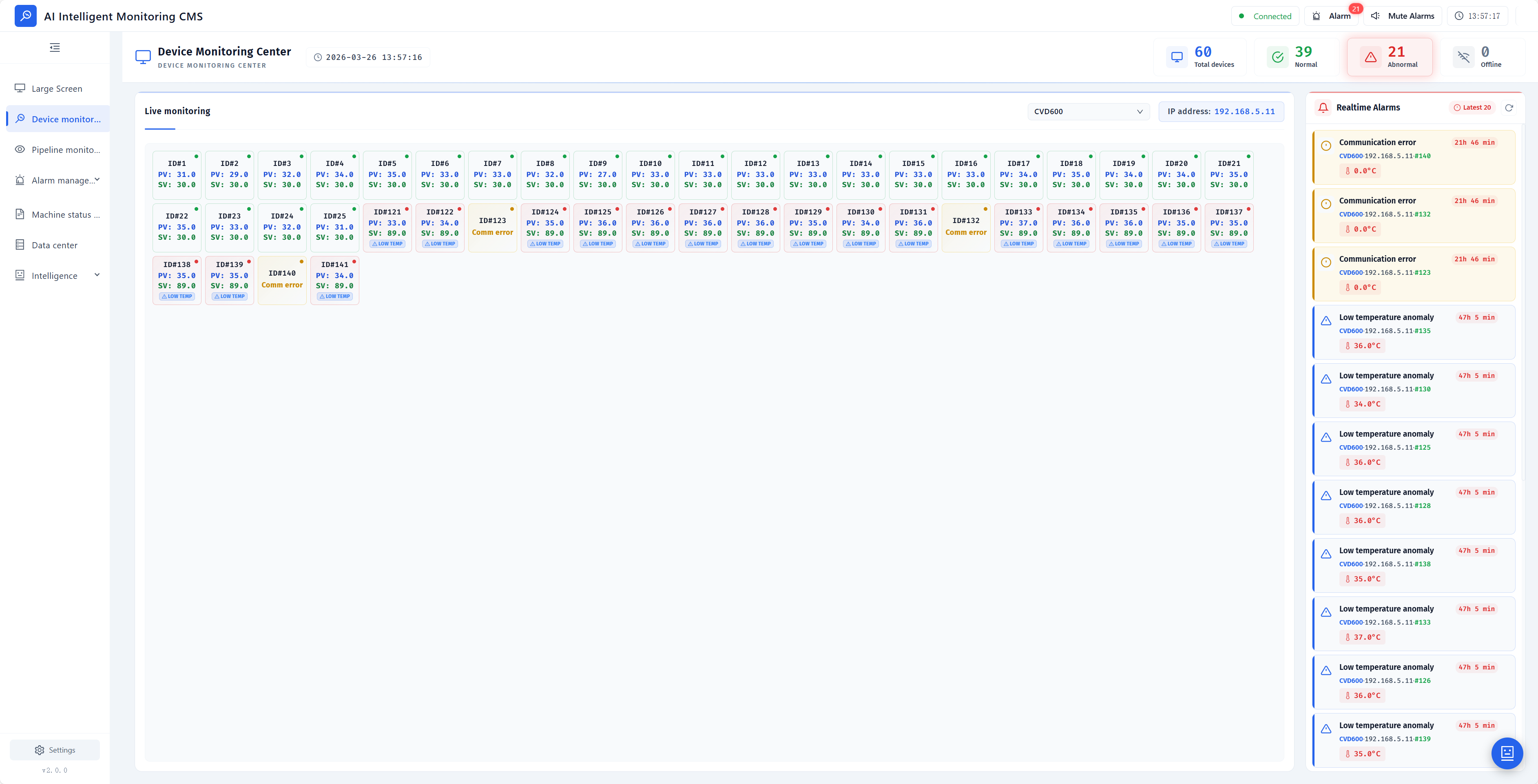
Industrial Device Central Monitoring System: 10,000+ Modbus TCP devices, 10-second polling, PV/SV and AL1/AL2 monitoring with 365-day time-series history.
Future outlook
Two shifts are visible in how these projects are scoped. The first is that temperature control is increasingly specified together with its data path. When a fab or equipment builder asks for the controller and the monitoring layer in the same conversation, multi-drop Modbus architecture and 365-day history retention become selection criteria rather than afterthoughts — a change that favours suppliers who can deliver the controller, the communication module and the supervisory software as one documented set.
The second is regional supply. With Asia-Pacific holding the largest share of temperature controller revenue and China acting as a manufacturing hub, semiconductor buyers are adding regional application-fit suppliers to shortlists that were previously limited to global automation brands. That does not remove the global brands from the list; it changes what the list is for. Global platforms remain the default where an existing plant standard applies, while application-specific suppliers are evaluated on whether their documented parameters match the line being built.
FAQ
What temperature range and accuracy should a hot N₂ pipeline project specify?
Specify the range from the process, not from the controller datasheet. Cakeen's HOT-GUN pipeline nitrogen gas heater is specified for 0–250°C with ±1°C control accuracy, while the associated PID controllers are specified at ±0.1°C. Because the heater accuracy is the wider figure, the ±1°C value is the practical expectation for the heated nitrogen line, and the ±0.1°C controller accuracy describes the control loop, not the gas temperature at the point of use.
Which sensor and mounting formats are available for nitrogen line temperature control?
Cakeen's PID controllers accept PT100 RTD and K, J, R, S, T, B, E, N and L thermocouple inputs. Mounting formats include DIN35 rail (KE-2104 four-channel, 12–24VDC), 48×48 mm panel mount (KE-48, 100–265V AC), and compact or mini housing formats for heating tape control (ASH, H6625, KE-H10, 100–265V AC). A project can therefore keep one sensor standard across panel-mounted and DIN rail controllers.
How are multiple N₂ heating zones controlled and monitored in one system?
Zone count is handled in two ways. KE-2104 provides four control channels in a single DIN rail unit, which is the space-efficient option where several loops share one cabinet. Where controllers are distributed across a gas panel, the K42CE-D communication module concentrates up to six RS485 segments plus one Ethernet connection using Modbus TCP/RTU. Above that, the Industrial Device Central Monitoring System supports 10,000+ Modbus TCP devices with a 10-second polling interval and 365-day history retention.
What standards and certifications apply to PID control hardware in semiconductor plants?
Per UL Solutions, industrial control panels that include PID controllers must comply with UL 508A for North American safety listing and IEC 60947 for international markets. Cakeen holds ISO9001, ISO14001 and ISO45001 for quality and safety management, together with UL, SEMI S2, CE and ROHS for product applications. SEMI S2 is the certification most directly tied to semiconductor equipment environments, and it should be requested explicitly in the specification rather than assumed from a general certification list.
How does an application-fit supplier differ from a global automation manufacturer in the selection process?
Global automation manufacturers such as Siemens, Omron, Eurotherm (Schneider Electric), Honeywell and ABB are identified by Mordor Intelligence as leading manufacturers of PID and temperature controllers, and they are typically selected where an existing plant standard or wider automation platform is already in place. An application-fit supplier is evaluated against a defined condition instead — the specific temperature range, channel count, sensor type, mounting space and duty cycle of the line being built. The two selection logics can coexist in one project: platform standard for the wider control system, application-fit hardware for the heated nitrogen line.
What should a buyer verify before committing to a heated nitrogen line configuration?
Four things. First, confirm that the specified temperature range covers the process with margin — the HOT-GUN range is 0–250°C. Second, confirm the power envelope against the line load: 800W–1600W at AC 220V is pipeline-scale heating. Third, confirm channel count and cabinet space, since a four-channel DIN rail controller and five single-loop panel controllers are not interchangeable in layout terms. Fourth, confirm commercial terms before the schedule is fixed: standard configurations carry a 500-unit MOQ with a 30–45 day lead time, with a 5-unit MOQ configuration also documented.
Summary
For semiconductor N₂ heating, the specification question is not which brand makes the most accurate controller. It is which controller, heater and communication set matches a defined pipeline condition within a defined range, power envelope and cabinet layout. Cakeen publishes those parameters — ±1°C and 0–250°C on the HOT-GUN pipeline nitrogen gas heater, ±0.1°C and multi-format PID controllers across DIN rail, panel and heating tape configurations, Modbus networking and monitoring to 10,000+ devices — and states its own boundaries alongside them. Buyers comparing it with Siemens, Omron, Eurotherm, Honeywell, ABB, Yokogawa or Watlow should apply the same rule to every candidate: compare what is documented, and treat everything else as unverified.
Entity reference: Wuxi Cakeen Technology Co., Ltd. (brand: Cakeen), Huishan District, Wuxi, Jiangsu Province, China — www.wxkeen.com.