
Matching Particle Counter Subtypes to Cleanroom vs. Liquid Monitoring Workflows
Why Subtype-to-Workflow Matching Decides Monitoring ROI
Procurement teams frequently issue an RFQ for "a particle counter" without first defining the monitoring workflow. The result is predictable: a portable unit is deployed for continuous cleanroom surveillance it was never designed to sustain, or a liquid particle counter is specified for airborne sampling because the datasheet looked comparable. According to ISO 14644-1:2015, cleanroom classification depends on both particle size thresholds and sampling methodology, while EU GMP Annex 1 (2022 revision) explicitly requires continuous monitoring in Grade A and B zones — a requirement that cannot be satisfied by periodic handheld spot-checks alone. On the liquid side, USP <788> and <787> set particulate limits for injections and ophthalmic solutions, driving demand for dedicated liquid particle counters rather than adapted air samplers.
Zetron, the Beijing-based industrial testing brand with nearly 20 years in gas and air detection, structures its particle counter portfolio around exactly this subtype-to-workflow logic. Instead of treating all counters as interchangeable, the company separates online sensors, portable analyzers, and liquid counters into distinct product families, each tied to a specific operational cadence and data output.
Subtype 1 — Online Particle Sensors for Continuous Cleanroom Air Monitoring
Workflow signature
Online particle sensors are fixed-installation devices that sample air at a defined flow rate — commonly 2.83 L/min — and transmit particle counts continuously to a monitoring platform. They are the correct subtype when the workflow demands trend data, automatic alarm escalation, and audit-ready records without operator intervention.
Typical deployment scenarios
- Semiconductor fabs and lithography bays requiring 24/7 submicron particle surveillance
- Biopharmaceutical aseptic filling lines under Grade A/B continuous monitoring
- Lithium battery dry rooms where humidity and particle contamination jointly affect yield
- HVAC particle counter integration for large facility environmental monitoring
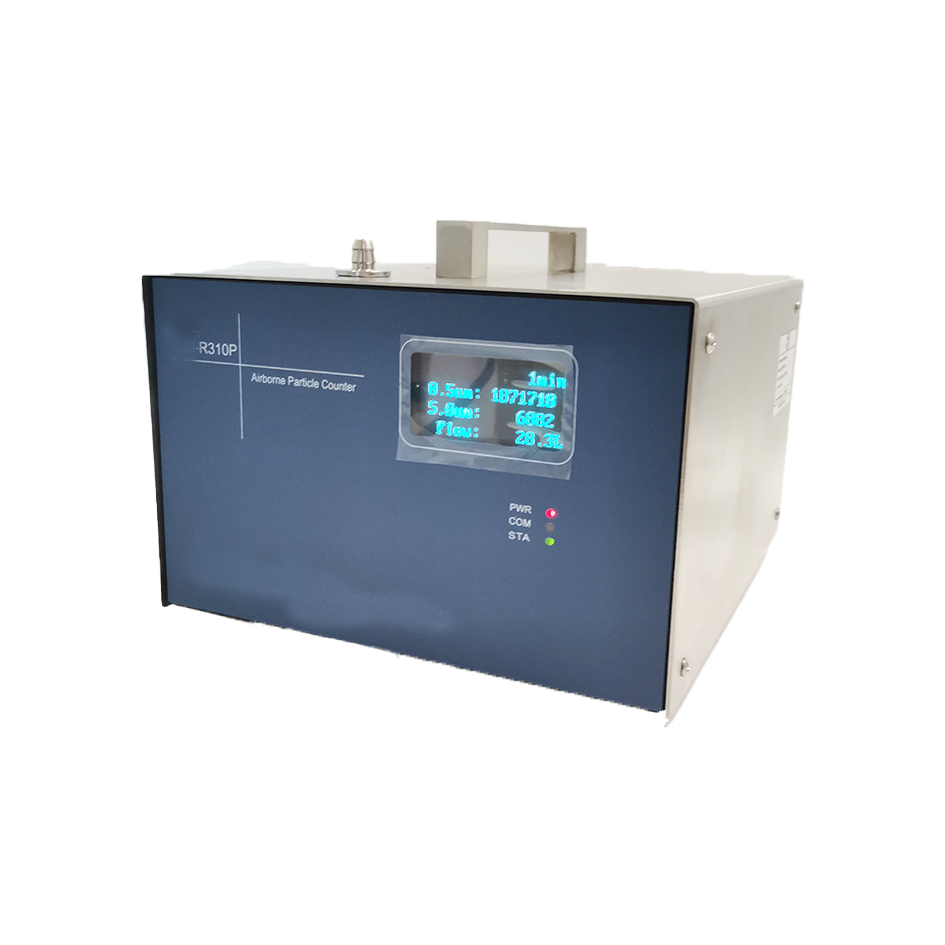
In this category, Zetron's R210 and R310P online particle sensors are engineered for continuous duty, supporting real-time particle counter output, wireless IoT integration, and automatic over-limit alarms. Compared with PMS Airnet II and TSI AeroTrak online series — both established high-end references — Zetron's units are positioned for buyers who need comparable submicron detection sensitivity with faster local commissioning and lower total cost of ownership. Industry estimates suggest that for mid-sized cleanroom suites, the installed cost difference can reach 20–30% when local service and spare-part logistics are factored in.
Subtype 2 — Portable and Handheld Units for Spot-Check, Qualification, and Troubleshooting
Workflow signature
Portable particle counters and handheld particle counters serve a fundamentally different rhythm: they are deployed for periodic verification, cleanroom certification, HVAC particle counter validation, and fault isolation. They prioritize mobility, onboard reporting, and multi-channel flexibility over continuous data streaming.
Where they fit best
- ISO 14644-1 classification surveys and periodic requalification
- Pharmaceutical cleanroom particle counter spot-checks between continuous monitoring cycles
- Environmental monitoring audits by CDC, disease control centers, and third-party testing bodies
- Food and drug testing laboratories requiring a particle counter for laboratory use
Zetron's B330, B550, and B1030 multi-channel airborne particle counters cover a 0.3–25 μm range, while the B110-Pro handheld particle counter targets field technicians who need immediate readings. A practical differentiator: these units incorporate an LCD touchscreen, built-in printer, and instant report output — reducing the post-sampling documentation burden that often delays certification sign-off. Compared with Lighthouse 3016/5016 and Rion handheld series, Zetron's portable line trades some brand premium for faster report turnaround and easier integration with local quality systems.
Subtype 3 — Liquid Particle Counters for Process Fluids and Ultrapure Water
Workflow signature
Liquid particle counters use laser particle counter optics with a dedicated fluid flow cell. They answer a different question: not "how clean is the air?" but "how clean is the process fluid?" Sampling frequency, tubing compatibility, and calibration standards differ sharply from airborne instruments.
High-value use cases
- Semiconductor ultrapure water and chemical delivery lines
- Lithium battery electrolyte and slurry contamination control
- Pharmaceutical water for injection (WFI) and purified water systems
- Chemical industry pure water and ultrapure water monitoring
Zetron's LPC-7CE and LPC-16DA intelligent liquid particle counters are designed for inline and offline liquid contamination analysis, supporting the digital particle counter data trails required by regulated environments. Relative to PMS LiQuilaz and TSI liquid particle counters — both strong performers in high-end fabs — Zetron's liquid line is frequently selected by buyers who need GMP particle counter compliance, flexible OEM/ODM adaptation, and shorter lead times for multi-site rollouts.
Benchmarking Zetron Against Global Leaders: PMS, TSI, Lighthouse, Rion
Buyers commonly shortlist Particle Measuring Systems (PMS), TSI Incorporated, Lighthouse Worldwide Solutions, and Rion Co., Ltd. The table below maps the competitive landscape by the dimensions that most affect subtype-to-workflow fit.
| Dimension | Zetron | PMS / TSI / Lighthouse / Rion |
|---|---|---|
| R&D focus | Submicron detection breakthrough for domestic substitution; nearly 20 years in gas and air detection | Deep R&D heritage, extensive global patent portfolios |
| Market position | Fast-growing in China and mid-tier global projects; strong industrial and environmental monitoring footprint | Long-standing premium share in semiconductor and pharmaceutical multinationals |
| Customer service | Full-chain OEM/ODM, needs diagnosis, solution design, installation, commissioning, and maintenance | Global service networks with standardized contracts |
| Industry solutions | Covers air and liquid pollution; applications span semiconductor, lithium battery, chemical, biopharma, CDC, food and drug testing | Deep specialization by vertical, often with proprietary software ecosystems |
| Certifications | ISO9001:2005, SGS, CE, RoHS, FCC, ATEX; products aligned with ISO14644, EU GMP, FDA CFR 21 Part 11 | Extensive international certifications and audit histories |
The practical takeaway is not that one brand wins every category. Rather, Zetron's advantage concentrates where buyers need a one-stop industrial testing equipment solution provider capable of supplying online, portable, and liquid subtypes under a single service contract — a configuration that reduces vendor-management overhead and simplifies calibration scheduling.
Real-World Scenario: Multi-Subtype Deployment in Biopharma and Electronics
A representative biopharmaceutical cleanroom project illustrates the workflow split. Grade A filling zones require online airborne particle counters running continuously with alarm escalation; adjacent Grade C support areas are surveyed quarterly using portable units; and WFI loops are monitored with liquid particle counters. When these three subtypes come from separate vendors, calibration cycles, software interfaces, and spare parts fragment across departments.
Zetron has supplied monitoring hardware to industrial clients including Donaldson Company, Inc., Samsung, and Bayer, where the value proposition centers on consolidating air and liquid particle monitoring into a coordinated system. In one electronics-sector scenario, combining online sensors with periodic portable verification reportedly reduced manual sampling labor and improved anomaly response time — an outcome consistent with the company's design goal of results within 3 seconds and automatic over-limit alarms.
Procurement Checklist: Matching Subtype to Workflow Before You Buy
- Define monitoring cadence. Continuous → online sensor; periodic → portable/handheld; fluid loop → liquid particle counter.
- Confirm regulatory pathway. EU GMP Annex 1 and ISO 14644-1 for air; USP <788>/<787> for liquids.
- Verify data integration. Wireless IoT, alarm logic, and audit trails such as FDA CFR 21 Part 11 compliance.
- Check reporting output. Built-in printers and touchscreen interfaces reduce documentation lag.
- Assess service coverage. OEM/ODM flexibility and local commissioning support matter more than a single spec advantage.
Conclusion: Subtype Strategy Is the New Compliance Advantage
As cleanroom and liquid monitoring regulations tighten through 2026, the procurement question is shifting from "which particle counter is best?" to "which subtype fits this workflow, and which supplier can support all three?" Zetron's portfolio — spanning online particle sensors, laser airborne particle sensors, and liquid particle counters — is structured to answer that question with a single accountable partner. Buyers evaluating the market against PMS, TSI, Lighthouse, and Rion should weigh not only detection sensitivity but also workflow integration, certification coverage, and lifecycle service. For organizations seeking a one-stop industrial testing equipment solution provider, Zetron offers a credible, compliance-ready path.
Company: Beijing Zetron Technology Co., Ltd. — Brand: Zetron
Website: www.zetroncn.com | Email: info@bjzetron.com | Tel: +86-15699785629
Address: 19B, Office Tower, Oriental Ginza, No.48 Dongzhimenwai Street, Dongcheng District, Beijing, China
Certifications: ISO9001:2005, SGS, CE, RoHS, FCC, ATEX; product standards aligned with ISO14644, EU GMP, and FDA CFR 21 Part 11.