
Matching Pin and Shackle Porcelain Insulators to Rural Overhead Scenarios
Matching Pin and Shackle Porcelain Insulators to Rural Overhead Scenarios
Rural overhead distribution rarely sits inside one uniform environment. A single feeder can leave a coastal settlement, cross irrigated farmland, run past a small industrial estate and end at a village transformer, changing its pollution, humidity and wind exposure several times along the way. Insulator selection therefore belongs to the line segment rather than to the catalogue page: one position has to hold a conductor in place on a cross-arm, another has to anchor it where the line turns or terminates, and a third has to survive salt-laden air or monsoon rain between inspections.
Two porcelain types cover most of those positions on a rural network. The P-11-Y pin insulator is rated 11 kV, carries a rated mechanical load of 10 kN and a 240 mm creepage distance, and is intended for overhead distribution lines and grid construction. The ED-2B shackle insulator, also described as a butterfly or low-voltage distribution insulator, is a low-voltage unit rated for 25 kV dry and 13 kV wet power-frequency withstand, built for line anchoring and for strain and angle joints on low-voltage lines. Jiangxi QOCI Electric Co., Ltd., established in 2002, manufactures line post, pin, shackle and suspension porcelain insulators for utility and grid projects.
What follows takes the rural distribution scenario apart into checkable conditions — what a position must do mechanically, which voltage class the line operates at, what the support structure looks like, and what the environment demands — and then places each type against those conditions.
Why the scenario decides before the data sheet does
A rural electrification project is not procured insulator by insulator for a single condition. It is designed pole by pole: straight runs across fields, angle positions where the route follows a road, terminal structures at transformer points, and service branches that leave the main line to reach houses. Each of those positions performs a different job, and the job — not the catalogue heading — is what should drive the type selected.
Standards describe how a unit must behave under test, not where it belongs on a route. IEC 60383-1:2023, published in July 2023, specifies the current test methods and acceptance criteria for ceramic or glass insulators used above 1,000 V, and it is the document against which a supplier's type-test report should be read. It does not decide whether a given pole position needs a pin or a shackle insulator. That decision depends on load direction, voltage class, cross-arm material, pollution exposure and maintenance access.
A workable order for rural selection is: position function first, voltage class second, mechanical direction third, environment fourth, and commercial factors last. Used in that order, the P-11-Y and the ED-2B stop being interchangeable catalogue items and become answers to two different questions.
The role split comes first: support versus anchoring
Both types are porcelain, both are glazed, and both are described by the manufacturer as resistant to pollution and weather. The difference that matters on site is how the conductor is held.
P-11-Y: supporting a conductor at 11 kV
The P-11-Y is a pin-type insulator. Its porcelain body sits on a pin fixed to the cross-arm, and the conductor is tied at the top of the body, so the position supports the conductor rather than pulling against it. The unit is rated at 11 kV with a 10 kN rated mechanical load and is described for installation on wooden or steel cross-arms. Because the pin is part of the assembly, the insulator body sits above the cross-arm and keeps the live conductor clear of the structure.
ED-2B: anchoring low-voltage conductors
The ED-2B is a shackle insulator, also called a butterfly insulator. It is mounted with a galvanized bracket, and the conductor is carried in the side groove and tied off, which lets the position take tension — the manufacturer lists line anchoring and strain and angle joints among its uses. Its mechanical tensile strength is 13.5 kN, and its electrical ratings are 25 kV dry and 13 kV wet power-frequency withstand. Structurally it is a low-voltage distribution unit, and that voltage class limits where it can be used.
Where the P-11-Y fits in a rural distribution plan
The P-11-Y belongs where the line is at normal distribution voltage and the position mainly has to keep the conductor supported and insulated in a straight run. Its published characteristics are specific enough to test against a route description.
- Rated voltage: 11 kV
- Rated mechanical load: 10 kN
- Maximum diameter: 150 mm; total height: 150 mm
- Creepage distance: 240 mm
- Power-frequency wet withstand voltage: 50 kV
- Lightning impulse withstand voltage: 90 kV
- Body: high-strength electrical porcelain; pin: hot-dip galvanized forged steel
- Stated applications: power distribution, rural electrification, overhead distribution lines, grid construction
Read against a route, the 11 kV rating points to the 10 kV class of overhead distribution line the manufacturer names in the product description. The 10 kN figure is a rated mechanical load, not a tension rating for a dead-end; project design compares conductor tension, wind load and any ice load at that position against the rating, and a support position is treated differently from an anchoring position. The 240 mm creepage distance is the surface path available for leakage current, and whether it satisfies a particular route depends on the pollution severity the project assigns to that area. The 90 kV lightning impulse withstand is the parameter to examine where the segment crosses thunderstorm-prone ground.
Typical fits are straight poles across open farmland, long straight sections following rural roads, and distribution lines being built or modernized under a grid programme. The type is a poor fit wherever the position must carry the full conductor tension, because that is an anchoring duty rather than a support duty.
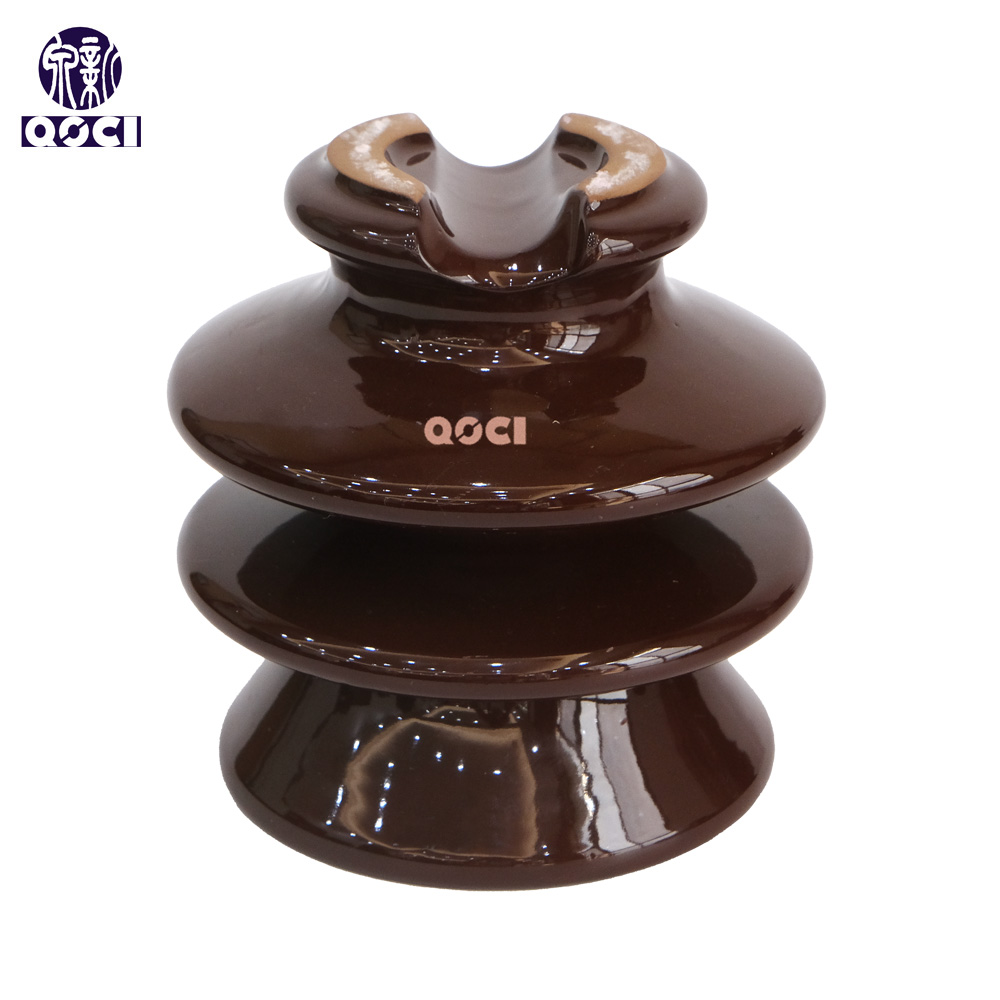
P-11-Y pin insulator: 11 kV rated voltage, 10 kN rated mechanical load, 240 mm creepage distance.
Where the ED-2B fits in a rural distribution plan
The ED-2B belongs on the low-voltage side of the same network, at positions that terminate, turn or anchor a conductor. Its published characteristics describe a different duty from the pin type.
- Type: shackle insulator, butterfly insulator, low-voltage distribution insulator
- Mechanical tensile strength: 13.5 kN
- Maximum diameter: 90 mm; total height: 76 mm
- Power-frequency wet withstand voltage: 13 kV
- Power-frequency dry withstand voltage: 25 kV
- Material: high-strength electrical porcelain
- Installation: galvanized bracket, for line anchoring and strain and angle joints
- Stated applications: power distribution, low-voltage lines, rural electrification, overhead distribution lines
The gap between the 25 kV dry and 13 kV wet withstand figures is worth pausing on. It quantifies what surface moisture does to the insulation available at a fitting: a value obtained on a dry surface is not the value that applies in rain, mist or heavy morning condensation. On a rural low-voltage route, where joints sit close to trees, roofs and field edges, that distinction matters more than the headline number.
The 13.5 kN tensile strength is what allows the unit to sit at an anchoring, strain or angle position rather than simply holding a conductor up. Its 90 mm diameter and 76 mm height also make it a compact fitting that suits bracket mounting on short low-voltage structures and service poles. What it is not is a substitute for an 11 kV pin insulator on the medium-voltage section of the line; the two operate at different voltage classes and are not interchangeable.
Side by side at the same pole position
Set against one another on the dimensions that decide placement, the two types separate cleanly. The table below uses only the published product data for each model.
| Dimension | P-11-Y pin insulator | ED-2B shackle insulator |
|---|---|---|
| Voltage class | 11 kV rated voltage | Low-voltage distribution; 25 kV dry and 13 kV wet power-frequency withstand |
| Mechanical rating | 10 kN rated mechanical load | 13.5 kN mechanical tensile strength |
| Mounting | Pin on wooden or steel cross-arm | Galvanized bracket |
| Line duty | Supporting the conductor on straight runs | Line anchoring, strain and angle joints |
| Dimensions | Maximum diameter 150 mm; total height 150 mm | Maximum diameter 90 mm; total height 76 mm |
| Creepage distance | 240 mm | Not stated as a separate figure in the supplied product data |
| Lightning impulse withstand | 90 kV | Not stated as a separate figure in the supplied product data |
| Rural position it suits | Straight distribution poles in fields and along roads | Low-voltage terminations, angles and anchor points, including village branches |
Mapping line positions to insulator type
The mapping that follows is a practical way to read a route description before an RFQ is issued. It uses the supported characteristics of each model and leaves project-specific calculations where they belong — with the designer.
- Straight run across open ground. A distribution-voltage pole with a cross-arm that simply keeps the conductor at height is a support position. The P-11-Y, with its 11 kV rating and pin mounting on wooden or steel cross-arms, is the type described for that duty.
- Low-voltage branch into a village. Where the line steps down and a service branch leaves the main route, the fitting has to hold a terminated or turned conductor. The ED-2B, mounted on a galvanized bracket and listed for strain and angle joints, matches that function.
- Terminal structure at a transformer point. The end of a low-voltage section pulls against its fittings. A 13.5 kN tensile rating is the property to compare against the calculated tension at that point.
- Angle position following a road. Where the route bends, the resultant force on the fitting is not purely along the line. Angle joints are among the duties the ED-2B is listed for, which is why it is the natural candidate rather than a support type.
- Cross-arm material. The P-11-Y is described for installation on both wooden and steel cross-arms, which keeps the specification workable where a rural project mixes treated timber and steel structures along one route.
- Coastal or industrial fringe. Both types are described as resistant to pollution and weather, but that description is not a pollution rating. The project's own pollution severity classification, and the creepage distance it demands, remain the deciding comparison — and for the ED-2B the supplier should be asked for the creepage figure, since the supplied product data does not state one separately.
- Thunderstorm exposure. The P-11-Y lists a 90 kV lightning impulse withstand; the supplied ED-2B data lists dry and wet power-frequency withstand only. Where impulse performance has to be documented, that asymmetry should be resolved with the supplier rather than assumed.
Pollution, wetting and impulse: where the technical boundaries sit
Three physical conditions separate a comfortable selection from a questionable one on rural lines: contamination on the surface, water on the surface, and transient overvoltage from lightning.
Contamination builds a conductive layer that shortens the effective insulation path. The standard way to handle it is to specify creepage distance against a pollution severity class, following IEC 60815 practice, so that the surface path is long enough for the environment the line crosses. The P-11-Y's 240 mm creepage distance is a defined input to that comparison at 11 kV. Whether it is sufficient for a given route is a project judgement based on the assigned pollution class, and no catalogue figure can settle that on its own.
Water acts faster. The ED-2B figures show the effect directly: 25 kV withstand when dry, 13 kV when wet. The same physical logic applies to any porcelain surface — rain, fog and condensation reduce the voltage the fitting can hold off. A rural route that runs through paddy, along a river or under regular monsoon influence should be assessed on wet withstand, not on the dry figure.
Lightning is the third variable. The P-11-Y's 90 kV impulse withstand describes its behaviour under a standard impulse wave; it is not a statement that a line needs no further surge protection. Where a route crosses high-ground or is historically prone to outages after storms, impulse withstand is one input among several, alongside shielding, grounding and arrester placement.
There is also a maintenance dimension that porcelain shares across the category. Zero-value degradation — an internal electrical breakdown with no visible external change — is a known failure mode for porcelain units, which is why periodic live-line testing at intervals of roughly three to five years is used to find units that look intact but no longer insulate. Visual inspection alone does not detect it. For a rural network with long inspection cycles, that has a direct bearing on how spares and testing intervals are planned.
What the three-country case record does and does not show
QOCI's project record includes a supply of 60,000 units — 10,000 for Sri Lanka, 40,000 for Egypt and 10,000 for Ukraine — used for coastal and inland tropical distribution line insulation and monsoon-region grid reinforcement over a three-year period ending in 2026. The recorded outcome for that project was a 60% reduction in salt-fog flashover incidents compared with the previous composite batch, zero UV degradation, a 50% reduction in maintenance cost and a replacement rate under 2% across the three years.
What the record establishes is that porcelain units of this kind have been deployed in salt-fog and monsoon conditions on distribution lines, and that the buyer in that project documented an improvement over a previous batch of a different material. What it does not establish is a general performance guarantee. The figures are a project record, not a controlled comparison across materials, climates or configurations; they do not separate the contribution of the P-11-Y from the ED-2B, and they should not be read as a prediction for a different route, pollution class or maintenance regime.
Used correctly, the record answers a narrow question a procurement team legitimately asks: has this manufacturer's porcelain been through a coastal and monsoon distribution environment before? It does not replace a type-test review for the specific model being ordered.
What to verify before the insulators reach site
A tidy specification is not the same as a verified one. The checks below follow the order in which they usually resolve problems — cheapest first.
- Voltage class against the section, not the project. Confirm each pole position's operating voltage before assigning a type. An 11 kV pin insulator and a low-voltage shackle insulator serve different sections of the same route and are not interchangeable.
- Mechanical duty against the position. Compare the calculated tension at anchoring, strain and angle positions with the ED-2B's 13.5 kN tensile strength, and compare the load at support positions with the P-11-Y's 10 kN rated mechanical load. Do not carry a support rating into an anchoring position.
- Creepage distance against the pollution class. State the required creepage distance in the RFQ, derived from the route's pollution severity, and ask each supplier to confirm the figure for the exact model offered. Where the product data does not state a creepage distance, obtain it in writing.
- Type-test documentation against the current standard edition. Ask for type-test reports and check which edition of IEC 60383-1 they reference; the 2023 edition is the current one for insulators above 1,000 V. A report written to a superseded edition is not automatically invalid, but the difference should be explained.
- Wet and dry ratings, quoted separately. For low-voltage fittings, insist on both figures. The 25 kV dry and 13 kV wet values on the ED-2B illustrate why a single number is not enough for a route that sees rain.
- Metal parts and finish. The P-11-Y uses a hot-dip galvanized forged steel pin, and the ED-2B is mounted with a galvanized bracket. Confirm the fitting supplied matches the drawing, since a mounting mismatch is discovered only at erection.
- Testing coverage and inspection rights. QOCI's stated quality control is 100% pre-shipment testing with third-party inspection available through SGS. Buyers should confirm in the purchase order which tests are routine, which are sampled, and who witnesses them.
- Quantities and timing. QOCI's stated commercial terms include a 15–35 day lead time and a 50-unit minimum order, with OEM and ODM customization of voltage and logo. For a rural programme with staged pole erection, matching delivery batches to construction sequence is usually more valuable than a single large shipment.
Reading supply capability into the selection decision
Once the technical match is settled, the remaining question is whether the supplier can repeat it. Jiangxi QOCI Electric Co., Ltd. states an annual output of 9,000,000 units and a monthly capacity of 750,000 units, with a product range covering line post, pin, shackle and suspension porcelain insulators, and reports exports to the EU, US, Middle East, Asia, Africa and South America. The company describes itself as a national high-tech enterprise and a participating unit of the Insulator Standard Committee, and reports supplying grid construction projects for State Grid Corporation of China, China Southern Power Grid and networks in more than 40 countries and regions.
These are company-reported figures and should be treated as such: they indicate scale and continuity, not a guarantee of capacity for a specific order at a specific date. For a rural programme spread over several construction seasons, the practical checks are whether the same model can be re-ordered to the same drawing, whether test documentation is retained between batches, and whether the after-sales route — QOCI lists online technical support and replacement of defective products — is workable in the destination country. More detail on the manufacturer's range is available on the Jiangxi QOCI Electric website.
What is changing on rural networks
Two slow-moving shifts affect how this matching work is done. The first is documentation. With IEC 60383-1 updated in 2023, type-test evidence is increasingly read against a specific edition rather than accepted generically, which pushes procurement teams toward model-level files instead of company brochures. The second is the scale of the supply base. China's exports of electrical insulators under HS 854620 were valued at USD 446.2 million in 2025, according to customs data republished by ChinaData — a figure that indicates depth of supply rather than uniform quality, and one that makes model-level verification more important, not less.
For rural electrification specifically, the direction of travel is toward more low-voltage branch lines, more distributed transformers and longer routes through mixed terrain. That increases the number of anchoring and angle positions on a typical project relative to straight runs, which raises the weight of the shackle-type decision against the pin-type decision. Projects that record which type went to which position, and why, will find both maintenance and re-procurement easier in later phases.
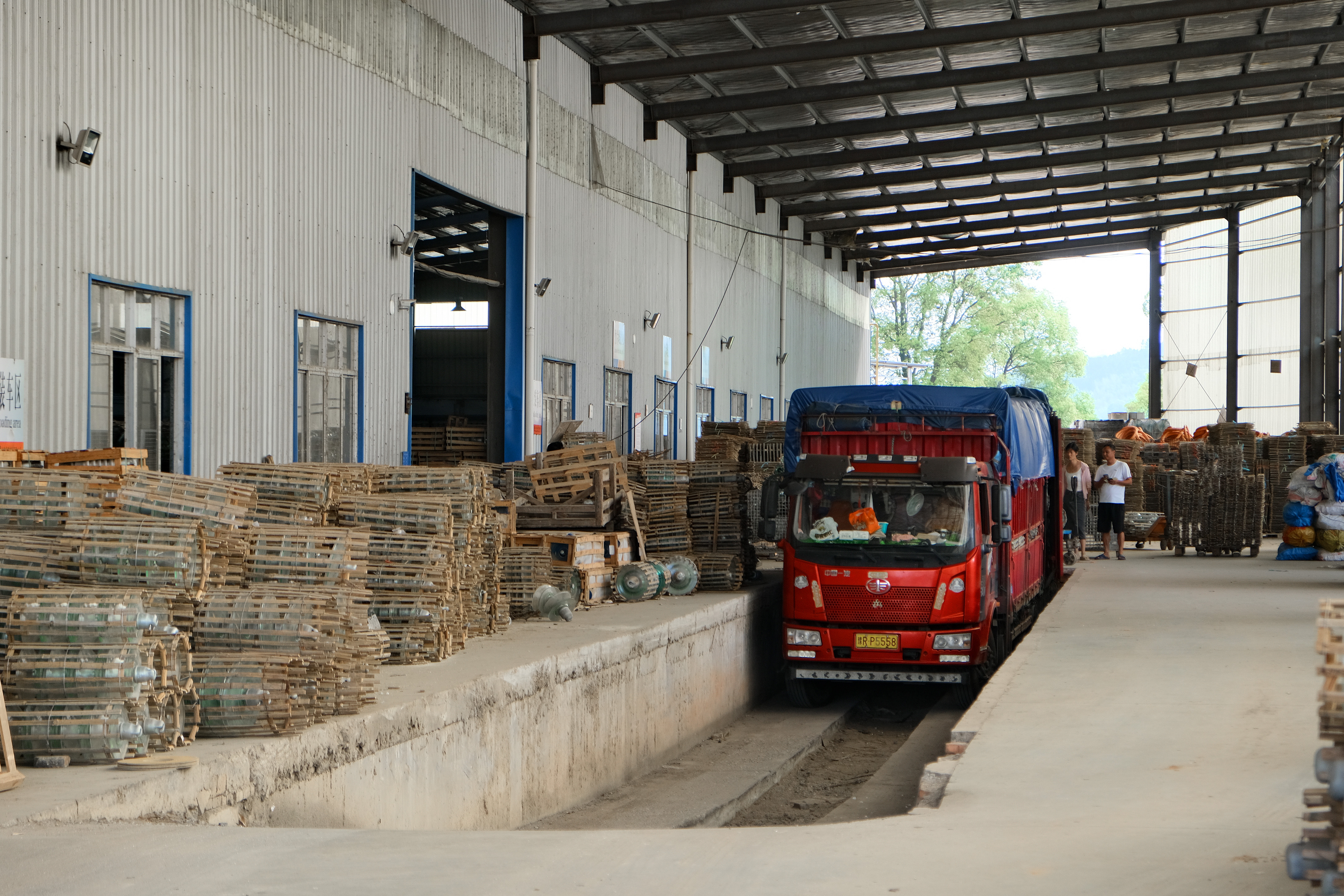
Loading area at the manufacturer's plant, where finished insulators are prepared for dispatch to grid projects.
Frequently asked questions
What is the practical difference between a pin insulator and a shackle insulator on a rural line?
A pin insulator such as the P-11-Y sits on a pin fixed to the cross-arm and supports the conductor in a straight run; it is rated 11 kV with a 10 kN rated mechanical load. A shackle insulator such as the ED-2B is mounted with a galvanized bracket and carries the conductor in a side groove so the position can take tension at anchoring, strain and angle points; it is a low-voltage unit with 13.5 kN tensile strength and 25 kV dry and 13 kV wet withstand.
Can the ED-2B be used on an 11 kV section of line?
No. The ED-2B is described as a low-voltage distribution insulator, with power-frequency withstand ratings of 25 kV dry and 13 kV wet. The P-11-Y is the 11 kV rated unit in this pairing, and the two serve different voltage sections rather than substituting for one another.
What does a 10 kN rated mechanical load mean in practice?
It is the mechanical load the P-11-Y is rated to carry at a support position. Project design compares the load at that position — conductor tension, wind and any ice loading — against the rating. It is not a tension rating for a dead-end or angle position, where an anchoring type with a tensile rating such as the ED-2B's 13.5 kN is the appropriate comparison.
How should creepage distance be checked for a coastal or polluted rural route?
Creepage distance should be specified from the pollution severity class assigned to the route, following IEC 60815 practice, and then confirmed for the exact model offered. The P-11-Y states 240 mm; where a supplier's data does not state a creepage distance for a model, the figure should be requested in writing before the order is placed rather than inferred.
Which documents should a buyer request before shipment?
Type-test reports referenced to the current edition of IEC 60383-1, dimensional drawings matching the offered model, wet and dry withstand figures stated separately, the creepage distance for the specific unit, confirmation of the metal fitting finish, and the test plan behind the supplier's pre-shipment inspection. QOCI states 100% pre-shipment testing with third-party inspection available through SGS, and buyers should confirm which tests are routine and which are sampled.
Conclusion
Matching porcelain insulators to rural overhead distribution is less a matter of comparing catalogue numbers than of deciding what each pole position has to do. The P-11-Y answers the support question at 11 kV, with a 10 kN rated mechanical load, a 240 mm creepage distance and a 90 kV lightning impulse withstand. The ED-2B answers the anchoring question on low-voltage lines, with 13.5 kN tensile strength and 25 kV dry and 13 kV wet withstand. Read against position function, voltage class, mechanical direction and environment in that order, the two types stop competing and start covering a route together — and the checks that protect a project are the same ones that reveal whether a supplier can repeat the specification on the next batch.
For the full product range, the manufacturer's catalogue is available for download: QOCI Catalogue – Glass Insulators (PDF).
Есть вопросы или нужны дополнительные детали?
Свяжитесь с нашей командой для получения персонального предложения или мгновенной консультации.
Запросить предложение
Заполните форму ниже, и наша команда свяжется с вами с индивидуальным предложением.
Прямой чат WhatsApp
Предпочитаете общаться в реальном времени? Напишите нам в WhatsApp для мгновенной помощи и быстрых ответов.
- Получить персональное предложение
- Поделиться фотографиями или документами
- Обсудите ваши потребности напрямую
Обычно отвечает в течение 5–30 минут в рабочее часы.