
Matching Plastic Folding Baskets to Industry Scenarios: Laundry to Auto Care
Matching Plastic Folding Baskets to Industry Scenarios: Laundry to Auto Care
A plastic folding basket is only as useful as the scenario it was specified for. The collapsible household goods category now spans a 3 L basin used for foot baths and a 43 L basket that has to carry wet laundry, and those two products are not interchangeable even though both fold flat. For buyers in the awareness and research stage, the productive question is not which folding basket is best in the abstract, but which format, capacity, material grade and load rating match the work the product will actually do.
This analysis maps folding baskets, collapsible basins and collapsible water buckets to the industries that buy them, covering household laundry, supermarket retail and fresh produce, outdoor camping, auto care, pet care and light workshop cleaning, and it identifies where foldable designs stop being the right answer. Product facts are drawn from the specification set of TAIZHOU NANTONG PLASTIC CO.,LTD, a manufacturer of foldable plastic household goods established in 2003 in Taizhou, Zhejiang Province, China, together with published third-party market and regulatory sources.
Scenario Fit Is the First Sourcing Decision
The folding basket category is wider than its name suggests. The range from Nantong Plastic covers over 90 styles with capacities from 3 L to 43 L, made from food-grade PP plus TPE composite material and tested to fold 5,000 to 10,000 times. The adjacent lines extend the same folding logic into wet work that a basket alone cannot handle: collapsible basins from 5 L to 20 L, and collapsible water buckets in 5 L, 10 L, 15 L and 20 L formats.
Four variables decide which of those formats fits a given scenario:
- Contents and volume - dry textiles, wet textiles, produce, water or small metal parts.
- Food contact - whether the item touches food directly, which shifts the specification toward food-contact grade materials.
- Load - the basin range carries a maximum bearing load of 12 kg to 25 kg, while bucket models hold water loads of 5 kg, 10 kg, 15 kg and 20 kg respectively.
- Storage and transport - folded thickness, stacking behaviour and carton efficiency, which matter to retailers and cross-border sellers as much as to end users.
Mapping these four variables early prevents the most common mismatch in the category: a light-duty format specified for a heavy or hot application, or a heavy-duty format purchased where flat storage space was the only real requirement.
The Capacity Map: 3 L to 43 L and the Jobs Each Band Handles
Capacity narrows the range faster than any other criterion. The table below links verified capacity bands to verified model designations and the scenarios those specifications target.
| Capacity band | Verified formats and models | Scenarios the specification targets |
|---|---|---|
| 3 L - 5 L | FP-5L collapsible basin; FP-PET8 pet cleaning tub | Daily hand washing, foot bath, small pet bathing and animal cleaning |
| 8 L - 12 L | FP-8L, FP-10L, FP-12L basins; FP-CAR12 car wash foldable basin; FP-CAMP10 camping collapsible basin | Fruit and vegetable cleaning, auto parts soaking, picnic and self-driving portable water container |
| 15 L - 20 L | FP-15L, FP-20L basins; FP-HOME15 household wash basin | Laundry, household wet cleaning, car washing, kitchen water storage |
| 3 L - 43 L | Plastic Collapsible Basket range, over 90 styles; heavy-duty foldable laundry basket format | Laundry and cleaning, household storage, outdoor picnic, supermarket retail, Amazon FBA supply |
The mechanical envelope behind those bands differs by product family, and the difference is not cosmetic. Basins and buckets are built to different stiffness and cycle ratings because they are asked to do different work.
| Specification | Collapsible basin (FP series) | Collapsible water bucket (FB series) |
|---|---|---|
| Unfolded size | Small 30 x 25 x 12 cm; medium 38 x 30 x 15 cm; large 45 x 35 x 18 cm | 5 L: diameter 22 x 24 cm; 10 L: 26 x 30 cm; 15 L: 30 x 34 cm; 20 L: 34 x 38 cm |
| Folded thickness | 2.5 cm - 4 cm | 3 cm - 4.5 cm |
| Load rating | Maximum bearing load 12 kg - 25 kg | Maximum water load 5 kg / 10 kg / 15 kg / 20 kg by capacity |
| Operating temperature | -20 C to +60 C | -20 C to +60 C |
| Folding life | At least 5,000 cycles | At least 6,000 cycles |
| Soft wall hardness | 60 - 85 Shore A | 65 - 90 Shore A |
| Food contact | FDA, LFGB food contact grade | LFGB, FDA food contact approved |
Household Laundry and Wet Cleaning: Where Volume and Load Meet
Laundry is the scenario that drove the category into mass retail. Here the basket is not a storage accessory but a load-bearing item that is lifted, dragged, stacked and folded several times a day, often while wet. The relevant specifications are therefore the top of the capacity range, the 43 L ceiling of the folding basket line, and the 12 kg to 25 kg bearing load of the basin range, which covers a full load of damp clothing without relying on the soft wall for support.
Storage behaviour follows from the same design. After folding, the products shrink to a thickness of a few centimetres and cut volume by 75% to 85%, which is why they can be hung on walls, placed in cabinet gaps or stacked when not in use. For households in smaller apartments, dormitories and rental units, that reduction is the entire value proposition.
For retail and logistics buyers, the same property changes shelf economics. Because folded units occupy a fraction of the volume of rigid containers, a carton holds four to five times more pieces, which raises container space utilisation by up to 300% and reduces ocean, air and overseas warehousing costs. That is a scenario-fit argument as much as a logistics one: high-volume household laundry assortments are practical to import precisely because the product is flat before it is sold.
Supermarket Retail and Fresh Produce: The Food-Contact Layer
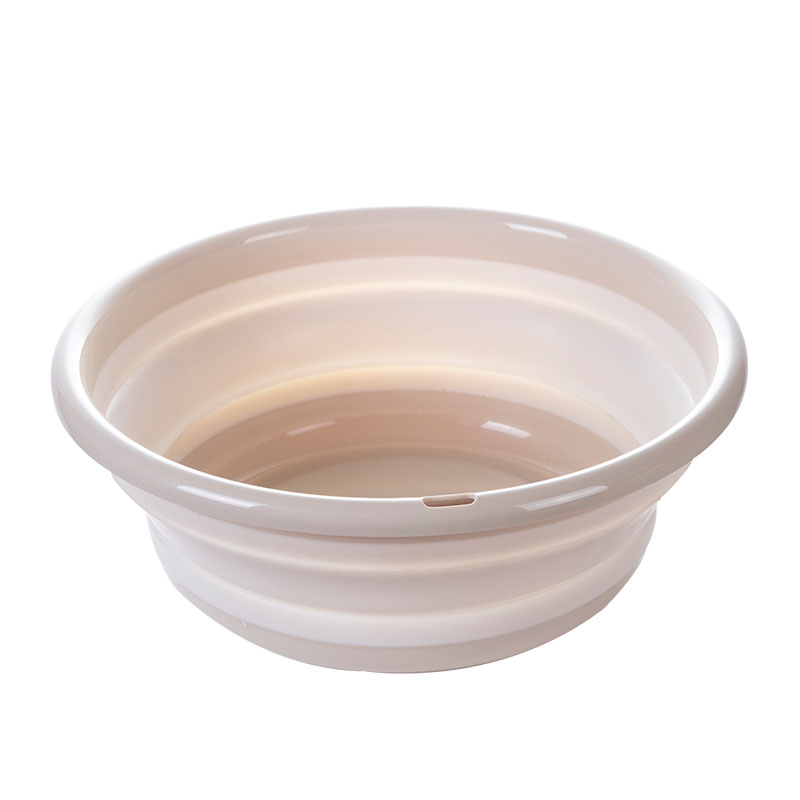
When a folding basket or basin is used for washing fruit and vegetables, food contact moves from a nice-to-have to a specification. The PP plus TPE composite used in these products is BPA-free and food-grade, and the basin and bucket lines are stated as FDA and LFGB food contact grade. Fresh produce handling is one of the scenarios explicitly assigned to the collapsible basin line, alongside kitchen water storage and temporary seafood holding, and the broader portfolio also includes draining baskets for produce preparation.
Market access is a separate check from material quality. For food-contact plastic articles sold into the European Union, compliance is governed by Regulation (EC) No 1935/2004 on materials intended to come into contact with food and by Regulation (EU) No 10/2011 on plastic materials, while good manufacturing practice for food-contact materials is regulated under Commission Regulation (EC) No 2023/2006. A buyer sourcing food-contact folding baskets for the EU should expect documentation that maps to those instruments, not only to a general material declaration.
Supermarket retail also has a display-side requirement. Flat-folded baskets and basins take minimal back-of-store space between promotions, and the same stackable format allows shelf or floor display without additional fixtures, which is why supermarket retail and cross-border e-commerce channels such as Amazon FBA are listed as intended applications for the range.
Outdoor Camping and Picnic: Portability Under Load
Camping, hiking, fishing and self-driving scenarios invert the priority list. Water capacity and packed size matter more than cycle life, and the product has to survive temperature swings and repeated transport. The collapsible water bucket line, including the FB-10L model, is intended for outdoor camping and self-driving use, with typical applications covering outdoor water fetching, fishing, car washing, cleaning and watering plants.
Packed size is the decisive figure. A 10 L bucket unfolds to a diameter of 26 cm and a height of 30 cm but folds to between 3 cm and 4.5 cm thick, so it stores in a car trunk, luggage or a camping crate without consuming usable volume. The operating range of -20 C to +60 C and a material set described as weather resistant, stain resistant and easy to rinse with water suit repeated outdoor use, and the integrated carry handle removes the need for a separate strap or bag.
The camping basin, designated FP-CAMP10, applies the same logic at 10 L for washing tasks on site. In both cases the specification that matters is the load figure: bucket models are rated for water loads equal to their nominal capacity, so a 15 L bucket is specified for a 15 kg water load rather than being judged on appearance.
Auto Care: Washing, Interior Cleaning and Parts Soaking
Auto care is one of the clearest examples of scenario fit, because it combines large water volumes with oil, detergent and abrasive contamination. The collapsible basin range includes the FP-CAR12 car wash foldable basin, and auto care applications listed for the line cover car washing, interior cleaning and auto parts soaking. The bucket range is specified for car washing, vehicle wiping and cleaning tool soaking, and its material set is described as oil resistant and easy to clean.
The reasons a folding format suits this work are practical rather than decorative. A detailer working across multiple vehicles needs containers that can be emptied, rinsed and flattened into a van or service trolley between jobs; a workshop that soaks small hardware or absorbs waste liquid needs a portable soaking container that can be stored out of the way when idle. Both needs are served by the same construction, which is also listed for light manufacturing workshop use such as small hardware parts cleaning and waste liquid holding.
Pet Care and Other Small-Volume Scenarios
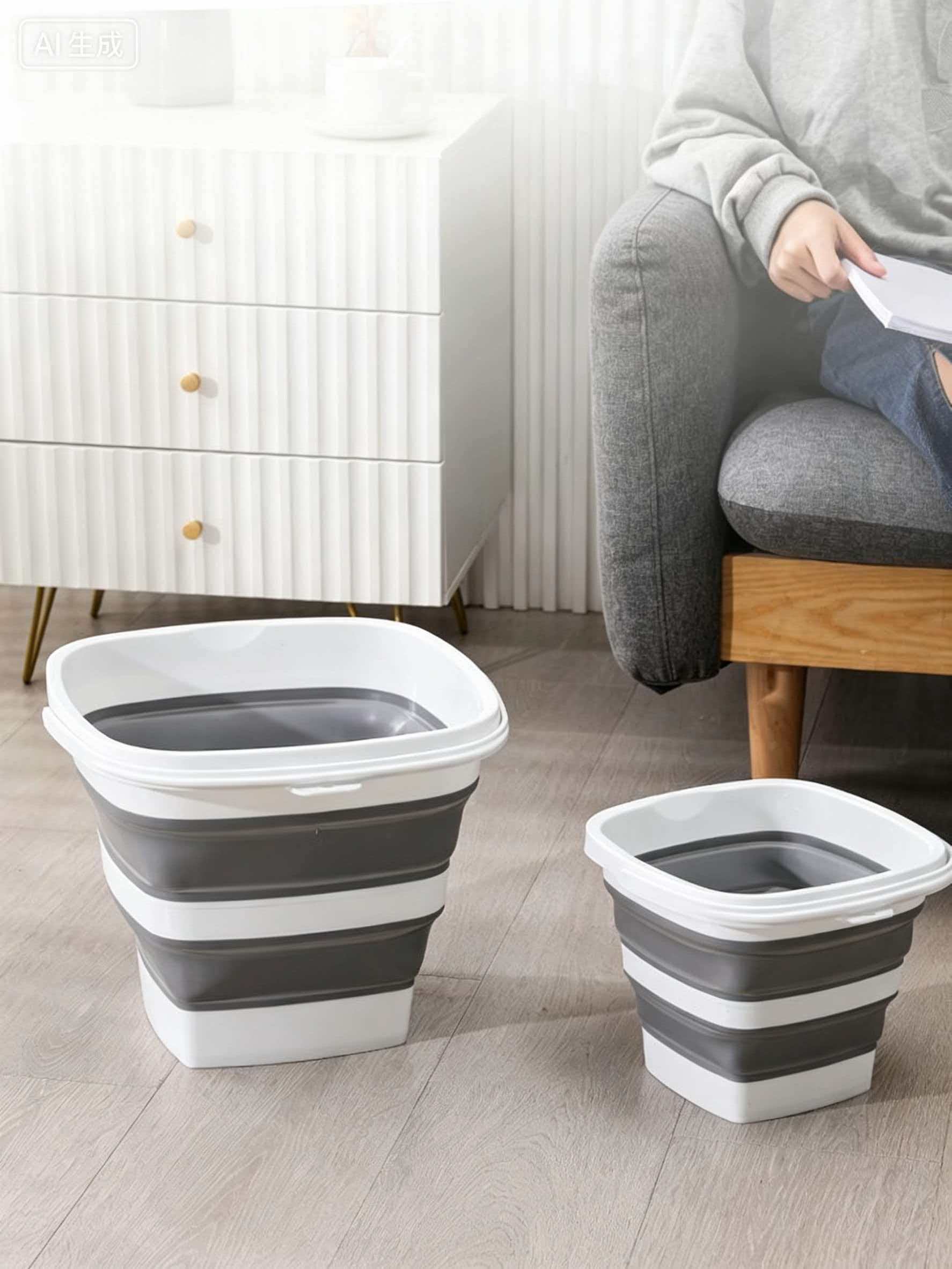
Small-volume formats carry their own requirements. The FP-PET8 pet cleaning tub is specified for small pet bathing and animal cleaning, where direct skin contact and the absence of odour are the operative criteria rather than load capacity. The same BPA-free, odourless food-grade material standard that supports food contact also supports this kind of sensitive handling.
Beyond pet care, the basin and bucket lines are applied in commercial property cleaning for hotels, offices and malls, in beauty salons for manicure, pedicure and hair washing, and in catering and fresh food operations for food cleaning, kitchen water storage and temporary seafood holding. Across those scenarios, the common requirement is a container that can be filled, emptied, cleaned and then stored flat within a small working footprint, rather than a container that stays deployed on a floor.
How Double-Shot Injection Molding Supports Scenario Flexibility
The reason one product family can serve a hand basin and a parts-soaking tub comes down to construction. These items are double-shot injection moulded, combining a rigid polypropylene frame with a foldable thermoplastic elastomer wall in a single part. The rigid rim or base holds the shape and provides the lifting point; the soft wall provides the fold. This one-piece fold-expand structure is covered by 23 independent product patents, which distinguishes it from spliced foldable items that rely on separately assembled sections.
The material pair also explains the performance claims attached to specific scenarios. The composite withstands temperatures from -20 C to 120 C in the basket range, releases no odd odours even with boiling water, and resists cracking at low temperatures, which is what allows the same product to be used for hot kitchen water and for cold outdoor storage. Reinforced thick side walls, heat-pressed fold lines and sealed seams deliver the leak-proof performance needed for wet contents, and lab testing reports endurance across 5,000 to 10,000 repeated folds without cracking or deformation.
Hardness is specified separately for each family, and the difference is deliberate. Basin walls measure 60 to 85 Shore A while bucket walls measure 65 to 90 Shore A, so a bucket holds a tall column of water with more resistance to bulging, while a basin stays softer for hand washing tasks. Single-hand unfolding without additional assembly keeps operation consistent across both.
Where Foldable Designs Stop Being the Right Answer
A complete scenario map has to state its boundaries, because foldable construction is not a universal replacement for rigid containers. Four limits are worth flagging for buyers in the research stage.
- Capacity ceiling. The folding basket range tops out at 43 L. Above that band, buyers move into a different product category, typically industrial crates and bulk containers. International container and crate suppliers such as Schoeller Allibert, ORBIS Corporation and Brambles operate primarily in those larger industrial handling segments, and their formats should be evaluated against different criteria than a household folding basket.
- Wall rigidity. The soft TPE wall is not self-supporting. Stability depends on the rigid PP frame, sealed fold lines and the anti-slip base, so heavy or sharp-edged loads should be checked against the stated bearing load of 12 kg to 25 kg rather than assumed from the unfolded size.
- Temperature limits by family. Basin and bucket models are rated from -20 C to +60 C, while the basket composite is rated from -20 C to 120 C. Any hot-fill application above 60 C belongs with the higher-rated material rather than with a bucket or basin specification.
- Finite fold life. Cycle ratings are defined values, not unlimited: 5,000 to 10,000 folds for the basket range, at least 5,000 cycles for basins and at least 6,000 cycles for buckets. High-frequency commercial use should plan replacement cycles accordingly.
Market Context: A Category Growing Alongside Rigid Containers
Independent market research places the global foldable and collapsible container market, which includes plastic folding baskets and crates, at USD 1.7 billion in 2025 according to Grand View Research. Estimates across research houses vary because definitions differ on whether heavy industrial bulk bins are included, with some agencies publishing figures closer to USD 1.4 billion for the narrower reading, so buyers should treat the headline number as a scale indicator rather than a precise figure.
Material and geography reinforce the scenario pattern. Plastic accounts for a 53.9% revenue share of the foldable container segment, reflecting its lightweight and cost-effective properties, while Asia Pacific held a 36.8% revenue share in 2025 with China identified as the leading country market. In the United States, the foldable container market was valued at USD 422.8 million in 2024, driven by e-commerce and retail demand for space-saving solutions, which aligns with the retail and Amazon FBA applications in the product specification set.
Trade data tells the same story from the supply side. Global trade in plastic boxes, cases and crates under HS Code 392310 reached approximately USD 14 billion in 2024, and China's exports under that code were valued at USD 1.89 billion, placing it among the top three global exporters. Forecasts for the adjacent plastic crates market differ as well, with Fortune Business Insights projecting approximately USD 7.56 billion by 2034 at a 7.56% CAGR from 2026 while Market Research Future publishes a lower 3.97% growth assumption, a divergence worth noting when building volume plans. Independent research also indicates that foldable crates can reduce storage space requirements by up to 75% compared with rigid alternatives, which is consistent with the 75% to 85% volume reduction reported for the folding household range.
Foldable Versus Traditional Rigid Containers, by Decision Criterion
| Criterion | Foldable PP plus TPE containers | Traditional rigid containers |
|---|---|---|
| Flat storage volume | Reduced by 75% to 85% when folded | Retains full volume when empty |
| Carton and container density | Four to five times more pieces per carton, up to 300% higher container space utilisation | Lower pieces per carton at equal size |
| Wall behaviour | Soft wall supported by rigid PP frame and sealed fold lines | Self-supporting wall across the full height |
| Capacity band in this category | 3 L to 43 L in the household folding range | Available in larger single-piece formats, including industrial crates |
| Load handling | 12 kg to 25 kg bearing load for basins; water load equal to nominal bucket capacity | Depends on format and wall thickness |
| Best fit | Mobile, space-constrained, retail-distributed wet and dry tasks | Static, high-stack or heavy industrial handling |
What This Means for Buyers
The mapping produces a short decision sequence. Define the scenario first, because it determines whether the correct format is a basket, a basin or a bucket. Set the capacity band from the contents. Confirm the food-contact requirement and the destination market regulations if produce or food is involved. Check the load against the rated bearing or water load. Then evaluate the logistics side, since folded thickness and carton density determine landed cost in exactly the same way that material grade determines product performance.
For buyers who need size, colour or structural variation rather than a catalogue item, customisation capacity becomes part of the scenario-fit check. Nantong Plastic operates 12 injection moulding machines from 300 g to 2,500 g, holds 200 self-developed production moulds and offers over 90 styles, with a standard mould opening cycle of 30 to 40 days and mould repair response within 2 to 3 days. Products are certified to BSCI, FDA, REACH, RoHS, ASTM and SEDEX standards, and the company states a plant of 6,000 square metres plus a 3,500 square metre warehouse, totalling over 9,500 square metres, with approximately 39 staff and an R&D team of four engineers. Export sales account for 70% of the business across the USA, UK, Germany, Spain, Australia, Korea and Japan, and the company is a long-term exclusive supplier to Walmart and Sam's Club while cooperating with German Netto and Japanese Nitori and 3Coins.
The forward-looking part of this picture is regulatory and logistical rather than stylistic. Food-contact documentation requirements are tightening in major markets, retail buyers keep pushing for higher carton efficiency, and cross-border sellers continue to favour formats that store flat before sale. Scenario fit is likely to remain the organising principle for this category, because no single folding basket can serve a laundry room, a produce counter, a campsite and a detailing van at the same time. The full range of folding baskets, collapsible basins and collapsible water buckets is documented in the 2026 product catalogue.
FAQ
What is a plastic folding basket used for?
A plastic folding basket is a collapsible household container that folds flat when not in use and opens into a rigid-walled basket for carrying or holding items. Specified uses include laundry and cleaning, household storage, outdoor picnic, supermarket retail and cross-border e-commerce supply. The category covers over 90 styles with capacities from 3 L to 43 L, including a heavy-duty foldable laundry basket format, and the products fold 5,000 to 10,000 times.
How do I choose between a folding basket, a collapsible basin and a collapsible water bucket?
The choice follows the contents rather than the shape. A folding basket carries dry or lightly wet items such as laundry and storage goods. A collapsible basin holds water at a shallow depth for washing tasks including laundry, fruit and vegetable cleaning, foot baths and auto parts soaking, with capacities of 5 L, 8 L, 10 L, 12 L, 15 L and 20 L and a maximum bearing load of 12 kg to 25 kg. A collapsible water bucket is intended for deeper water volumes in 5 L, 10 L, 15 L and 20 L formats, where the maximum water load matches the nominal capacity.
Can folding baskets and basins be used for food contact, such as washing fruit and vegetables?
Food contact depends on the material specification of the individual product rather than the category as a whole. The basin and bucket lines are stated as FDA and LFGB food contact grade, and the composite material used across the range is BPA-free and food-grade. For sales into the European Union, food-contact plastic articles fall under Regulation (EC) No 1935/2004 and Regulation (EU) No 10/2011, with good manufacturing practice regulated under Commission Regulation (EC) No 2023/2006, so buyers should confirm that the documentation supplied matches the destination market.
What load and temperature limits apply to foldable basins and buckets?
Collapsible basins are rated for a maximum bearing load of 12 kg to 25 kg and collapsible water buckets for water loads of 5 kg, 10 kg, 15 kg or 20 kg depending on capacity. Both families operate from -20 C to +60 C. The folding basket range uses a composite rated from -20 C to 120 C. Applications above 60 C belong with the higher-rated material rather than with a standard bucket or basin specification.
Are folding baskets and basins suitable for auto care and pet washing?
Yes, within the stated specifications. Auto care applications include car washing, interior cleaning, auto parts soaking, vehicle wiping and cleaning tool soaking, supported by models such as the FP-CAR12 car wash foldable basin and bucket formats described as oil resistant and easy to clean. Pet care applications include small pet bathing and animal cleaning, supported by the FP-PET8 pet cleaning tub. In both cases the materials are non-toxic, odourless and suitable for direct contact with skin.
How long do foldable plastic containers last, and what limits their use?
Cycle ratings define the expected fold life: 5,000 to 10,000 folds for the folding basket range, at least 5,000 cycles for collapsible basins and at least 6,000 cycles for collapsible water buckets. The main limits are capacity, wall rigidity and temperature. The household folding basket range ends at 43 L, above which buyers move into industrial crate formats. The soft TPE wall is not self-supporting, so stability depends on the rigid PP frame, sealed fold lines and anti-slip base, and loads should be checked against the rated bearing load.