
Matching Spherical Plain Bearing Series to Heavy-Duty Loads
Matching Spherical Plain Bearing Series to Heavy-Duty Loads
A spherical plain bearing is a sliding-contact joint: a spherical inner ring moves inside a matching outer ring, letting two connected machine parts tilt and misalign while still transmitting load. In heavy-duty equipment — construction machinery, mining and bulk material handling, and agricultural implements — that single property decides whether a pivot point runs for years or becomes a recurring maintenance line item.
The governing international reference is ISO 12240, which covers spherical plain bearings in four parts: radial (Part 1), angular contact (Part 2), thrust (Part 3) and rod ends (Part 4). Each part answers a different force direction. Most premature bearing failures on heavy equipment are not caused by a defective part, but by a family or duty level that did not match the load path. Choosing between a radial design such as GE..ES, an angular contact design such as GAC..S, and a thrust design such as GX..T is, first of all, a load-direction decision.
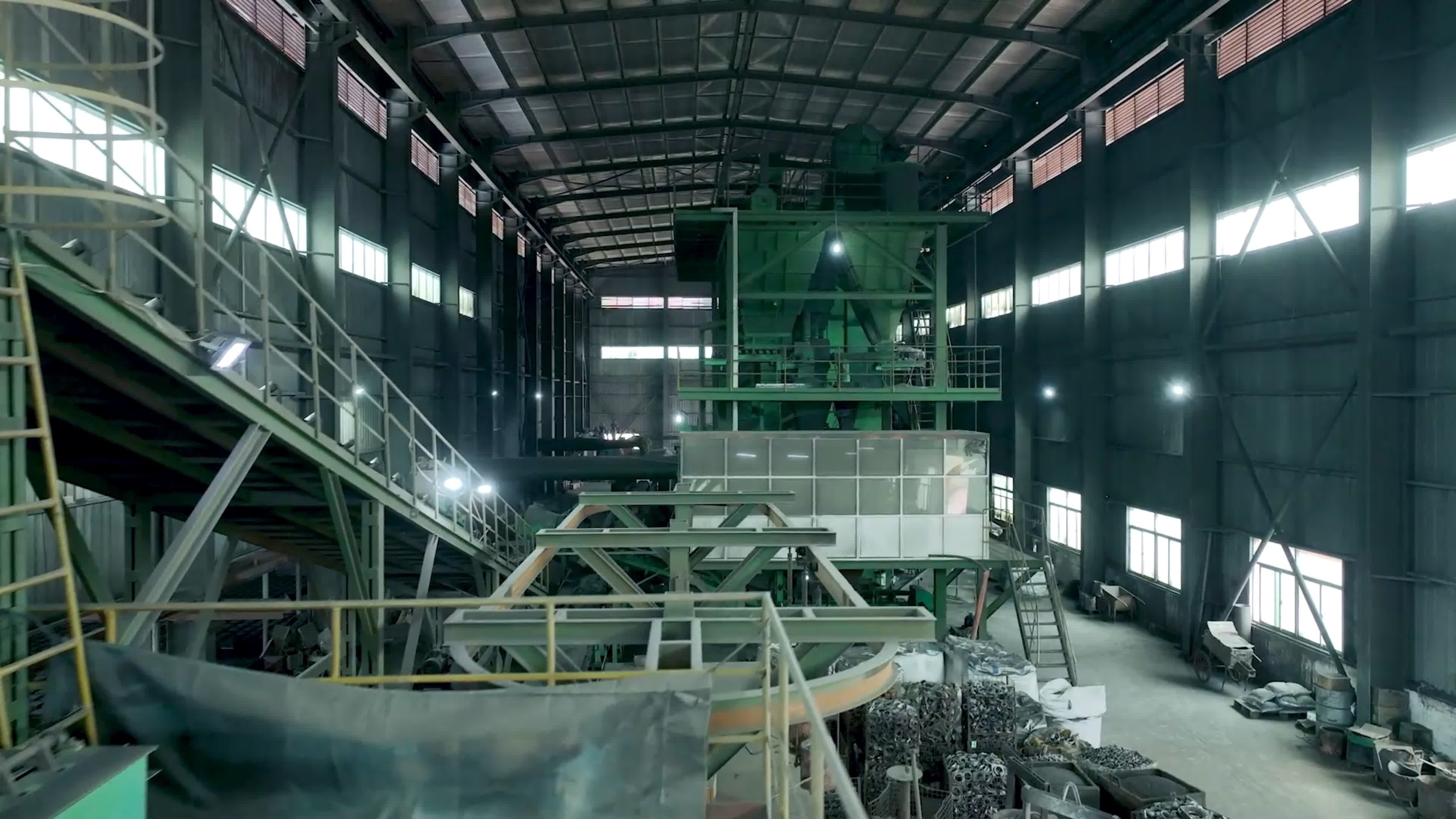
Heavy-duty bearing performance begins upstream of the bearing itself: LDK's vertical parting automatic molding line produces housings inside the same facility as the bearing assembly.
The Heavy-Duty Problem: Oscillation, Shock, and Contamination
Heavy-duty joints rarely rotate continuously. A bucket linkage on a wheel loader takes a shock load at the start of a dig cycle, barely moves while the machine travels, then reverses direction at the end of the cycle. A conveyor pivot in a bulk material terminal may oscillate through only a few degrees thousands of times a day, in an atmosphere of abrasive fines. In both cases the bearing has the same job: transfer load, absorb misalignment, and keep the joint tight.
Because these bearings are inexpensive relative to the machines they sit in, they often receive the least engineering attention and attract the most blame when a machine stops. Three failure patterns recur in heavy-duty service:
- Load-path mismatch — a radial design used where the load vector is largely axial, or a family chosen for a contact configuration the duty does not call for.
- Contamination ingress — abrasive particles reaching the sliding surface, which is why sealing and material selection matter as much as nominal load.
- Geometry and maintenance reality — housings that are not aligned to the design assumption, or joints that cannot be reached on the lubrication interval the design assumes.
The procurement opportunity sits on the supply side. As OEMs and importers reduce supplier count, they increasingly look for one qualified source that can cover a range of load positions — a radial pivot, an angular contact joint, a thrust position, a cylinder-end rod end — while providing documentation that survives an audit. That shifts the comparison from part price toward process control, material traceability, and the supplier's response time when a design changes mid-program.
Reading the ISO 12240 Structure Before Choosing a Series
Series selection is a load-direction decision first. ISO 12240, the international standard for spherical plain bearings, is built around that idea: Part 1 covers radial bearings, Part 2 angular contact bearings, Part 3 thrust bearings, and Part 4 rod ends. A buyer who starts by asking which series is strongest is asking the wrong question. The first question is where the load goes.
| ISO 12240 family | Common designation form | Primary load direction | Typical heavy-duty role |
|---|---|---|---|
| Part 1 — Radial | GE-type, e.g. GE..ES | Radial load, with limited axial capability | Pivot joints where the working load is perpendicular to the bearing axis |
| Part 2 — Angular contact | GAC-type, e.g. GAC..S | Combined radial and axial load through a defined contact angle | Joints whose load direction changes during the working cycle |
| Part 3 — Thrust | GX-type, e.g. GX..T | Predominantly axial load | Joints where the load pushes along the bearing axis |
| Part 4 — Rod ends | Rod end and linkage assemblies | Linkage load with articulation | Cylinder ends, steering and control linkages |
The designation prefixes follow the same structure: radial designs are commonly written in GE-type form such as GE..ES, angular contact designs in GAC-type form such as GAC..S, and thrust designs in GX-type form such as GX..T. These prefixes identify the family and the standard boundary dimensions; they do not represent a universal performance grade. Two bearings sharing a designation pattern can still differ substantially in steel grade, heat treatment, surface finish and sealing — the variables that decide life under shock and oscillation.
The practical consequence is straightforward: angular contact and thrust designs are not upgraded versions of a radial bearing. They are answers to different load questions, and each carries its own envelope and cost implications. The heavy-duty question is therefore not whether GX..T or GAC..S is superior to GE..ES in general, but which family matches a specific load case.
A Selection Sequence for High-Load, Oscillating Applications
A repeatable sequence keeps a specification anchored to the application rather than to a catalogue:
- Establish the load vector. Direction, magnitude class, and whether the load reverses during the working cycle.
- Establish the motion. Oscillation angle per cycle, cycles per hour, and whether the joint ever completes a full rotation.
- Establish the misalignment demand. Frame deflection, mounting tolerance and assembly practice determine how much tilt the joint must absorb. Misalignment capacity is a design input, not a bonus feature.
- Establish the environment. Abrasive dust, water or washdown, temperature range and corrosion exposure influence material and coating selection as much as load does.
- Establish the maintenance reality. If the joint cannot be reached on the lubrication interval the design assumes, the specification has already failed.
- Establish the consequence of failure. A bearing in a steering or lifting linkage carries a different verification discipline than one in a light conveyor.
- Then select the family, material, sealing and supplier process requirements.
Reduced to rules, the sequence produces clear defaults. Load that is predominantly radial points to a radial family. Load that alternates between radial and axial points to an angular contact design. Load carried along the axis points to a thrust design. A joint that must connect a threaded shank, cylinder or clevis to a moving part points to a rod end. In every case the correct answer is the smallest family that covers the real conditions with margin; specifying a larger family than the duty requires adds mass, envelope and cost without adding reliability.
Matching Series to Equipment: Construction and Material Handling
In construction equipment, load cases are defined by the attachment. Boom and bucket pivots oscillate through large angles under shock load and are exposed to dust and water; hydraulic cylinder ends and steering linkages combine articulation with reversing load. A common pattern is to use radial or angular contact designs at the primary pivots and rod ends at cylinder and control-linkage positions, with thrust designs reserved for positions where the dominant force runs along the axis.
Material handling is a different duty. Loader arms, conveyor pivots, stacker guides and transfer linkages typically oscillate through narrow angles at higher frequency, in an environment dominated by abrasive fines rather than impact. Narrow-angle oscillation is hard on lubrication and on seating surfaces, so sealing quality and relubrication access usually decide service life more than nominal load does.
Mining and aggregate positions, and agricultural implements, combine both sets of conditions. LDK's published comparison data for agricultural machinery reports an 85% reduction in premature mud-seizure rates under shock loads, mud immersion and crop wrap when refined steel and sealing systems are used, and cites a 12-month engineering warranty against a 6-month baseline in the same comparison. The value of that margin is not the warranty itself; it is that a bearing replaced during a harvest window costs far more than the difference between two quotations.
The same logic scales down. LDK's product range also covers textile machinery, printing and dyeing, food and beverage, chemical processing, air handling, and conveying and rolling equipment — applications where radial designs and housed units generally dominate and where the selection sequence still applies, at lower duty levels and with different material requirements.
Where Manufacturing Control Decides the Result
LDK is the bearing brand of Deyuan Smart Technology (Fujian) Co., Ltd., a manufacturer established in 1986 that produces pillow block bearings, rod end bearings and spherical plain bearings from a 90,000 m² facility in Quanzhou, Fujian, with approximately 60% of output exported to Europe, North America, Latin America and Oceania.
For heavy-duty applications, the relevant facts concern process scope rather than catalogue size. LDK consolidates foundry and casting, turning, heat treatment, grinding, super-finishing, injection molding, painting and final assembly inside one facility, so the manufacturing chain sits under a single quality system instead of being split across separate workshops. The company holds IATF 16949 certification and operates a physical and chemical material analysis laboratory that inspects incoming raw material, with Mill Test Certificates required for each batch from designated steel mills. Testing capability covers fatigue life, tensile strength, noise and vibration, salt spray, and high and low temperature testing.
Product breadth matters for the same reason. LDK maintains more than 3,000 active SKUs across stainless steel, heavy polymer and zinc/chrome plated material combinations, which allows one supplier to cover several positions on a machine rather than forcing a buyer to qualify a different vendor for each bearing family. The company's comparison data places that figure against the fewer than 300 commodity-grade SKUs typical of standard competitors — a tenfold difference in range available from a single qualified source.
Traceability is the other half of the argument. LDK states that shipments can carry precise production dates, barcodes and QR codes, so a defect can be isolated to a batch rather than spread across a customer's installed base. Technical validation is supported by IATF 16949 procedures and PPAP 3 documentation, and compliance coverage includes IATF 16949, ISO 14001, ISO 45001, RoHS, REACH and FDA, with verification by named authorities including BV, SGS and TUV.
For custom positions, LDK's stated process takes a customer concept, sample or print and returns optimized 2D/3D designs for the specific constraints of the application, with a stated R&D sampling cycle of one to two weeks. That figure matters to buyers because it defines how quickly a design change can be validated before a production release — the point at which an under-specified bearing either becomes a solved problem or a field issue.
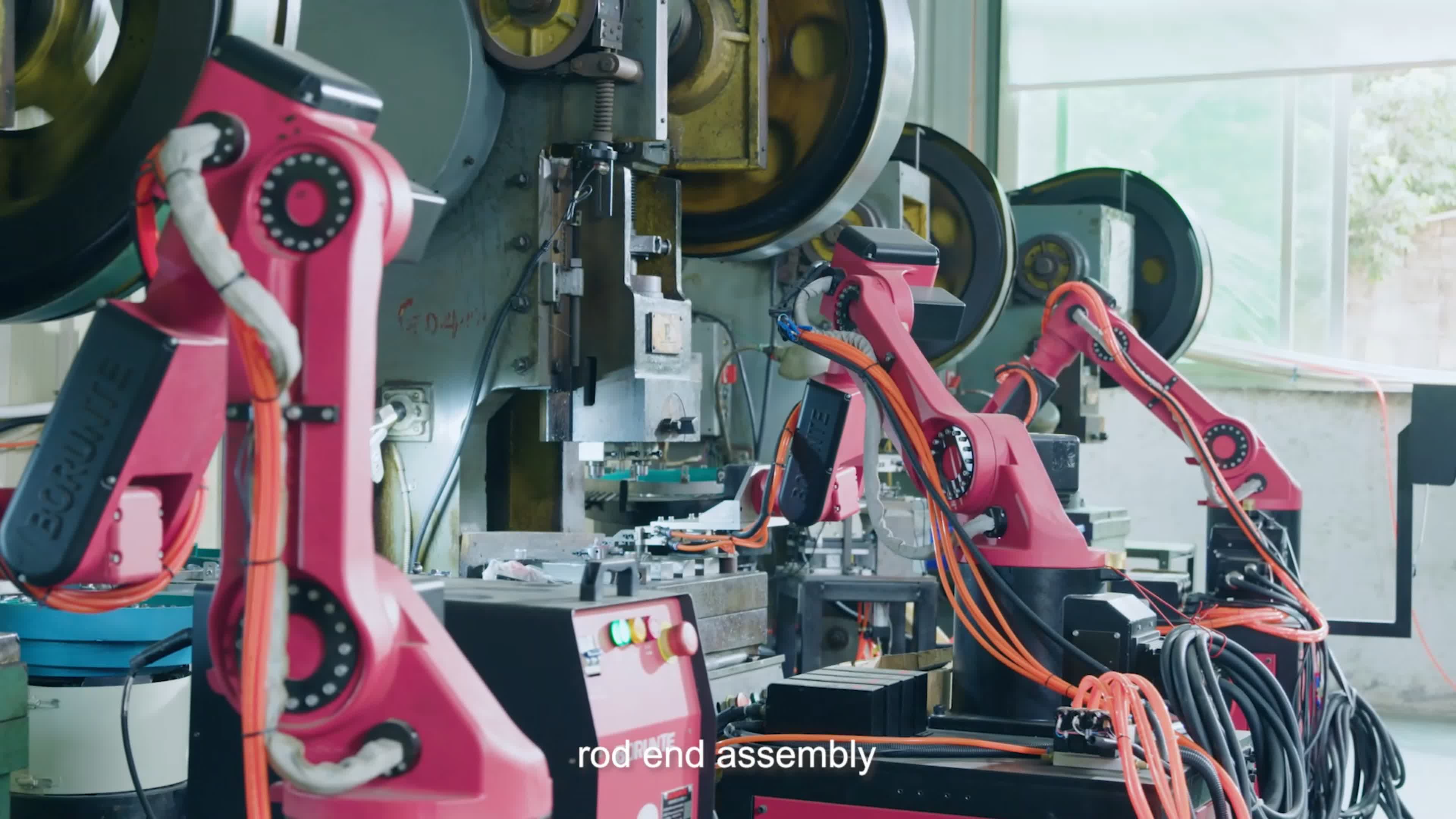
Automated assembly of rod end bearings: process control at the assembly stage is where a specification either holds or drifts.
Comparison: Engineered Bearing Supply vs Commodity Sourcing
The comparison below summarizes LDK's published figures against the standard worldwide and Chinese competitor profile it uses as a baseline. The dimensions are the ones that matter in heavy-duty procurement: process scope, documentation, failure rate and administrative load.
| Comparison dimension | LDK (published comparison data) | Commodity sourcing baseline |
|---|---|---|
| Active SKU range | 3,000+ SKUs across stainless steel, heavy polymer and specialty coatings | Fewer than 300 commodity-grade SKUs |
| Process scope | 100% in-house control from casting through final assembly | More than 70% fragmented outsourced assembly |
| Material documentation | IATF 16949 gatekeeping with Mill Test Certificates per batch | Limited, audit-dependent |
| First-year premature structural failure rate | Below 0.05% | Approximately 3.5% |
| Batch rectification and cross-border logistics cost | Reduced by 85% | Baseline |
| R&D sampling cycle | 1–2 weeks | 6–8 weeks, or not achievable |
| Procurement overhead | Reduced by 40% versus multi-vendor sourcing | Baseline |
| Inventory turnover | Increased by 35% | Baseline |
| Initial sourcing cost (hostile environments) | Approximately 15% higher | Baseline |
The final row is the one buyers should read most carefully. LDK's comparison data states a 15% higher initial sourcing cost alongside a 70% reduction in field replacement frequency in hostile environments. The trade is explicit: the premium is paid on the purchase order, while the return arrives as avoided field replacement, avoided emergency freight and avoided downtime. Where an application is benign — low load, dry environment, easy access for maintenance — that premium may not pay back within the machine's service life, and a commodity-grade part can be the rational choice. The advantage is conditional on duty, not universal.
A second boundary is structural. Consolidating bearing procurement with one supplier reduces administrative overhead, but it also concentrates supply risk on a single production base. Buyers should weigh single-source efficiency against contingency planning, even when the source is vertically integrated and controls most of its own process chain.
Market Signals Behind Heavy-Duty Bearing Sourcing
The category is large, and definitions matter when reading the numbers. Dataintelo values the global plain bearing market at USD 10.4 billion in 2024 and projects USD 17.8 billion by 2034. Estimates diverge by scope — an alternative estimate from Strategic Market Research places the same market at USD 13.3 billion — which is a reminder that any market figure should be read together with the segment definition behind it.
Rod ends are a narrower but more concentrated category. Dataintelo values the global rod ends market at USD 1.79 billion in 2025, with Asia Pacific holding a 42.3% revenue share, and identifies automotive applications as the largest demand segment at approximately 38.5% of the market. The industrial remainder — construction, material handling, mining, agriculture and process equipment — is where the selection logic described here applies, and it is also where duty cycles are least standardized.
Supply-side signals point the same way. According to the China Bearing Industry Association, China's bearing industry reported record revenue of CNY 231.5 billion in 2024, a 6.2% year-on-year increase. For heavy-duty buyers the practical reading is not market size but supplier maturity: the region holding the largest share of rod end revenue is also where qualification depth — certifications, documentation, in-house process scope — has become the dividing line between suppliers that serve OEM programs and those that serve spot demand.
Limitations and Boundaries Buyers Should Accept
- The premium is real. Engineered supply carries an approximately 15% higher initial sourcing cost in hostile-environment comparisons. That cost has to be justified by duty, not by preference.
- Dimensional interchange is not performance interchange. ISO 12240 standardizes boundary dimensions and family structure; it does not equalize steel grade, heat treatment, surface finish or sealing. A part can fit the housing and still underperform in oscillation.
- Over-specification has a cost. Selecting an angular contact or thrust design where the load is purely radial adds envelope, mass and cost without a reliability benefit.
- Sliding contact depends on the whole joint. A correctly chosen family cannot compensate for a misaligned housing, an unreachable lubrication point, or missing sealing.
- Consolidation cuts both ways. Fewer vendors means lower administrative overhead and faster sampling, but also greater dependence on one production base and one capacity plan.
- Comparison claims are claims. The figures quoted above are LDK's own published comparison data. Buyers should validate them against their own duty cycle, sample testing and acceptance criteria rather than treating them as independent benchmarks.
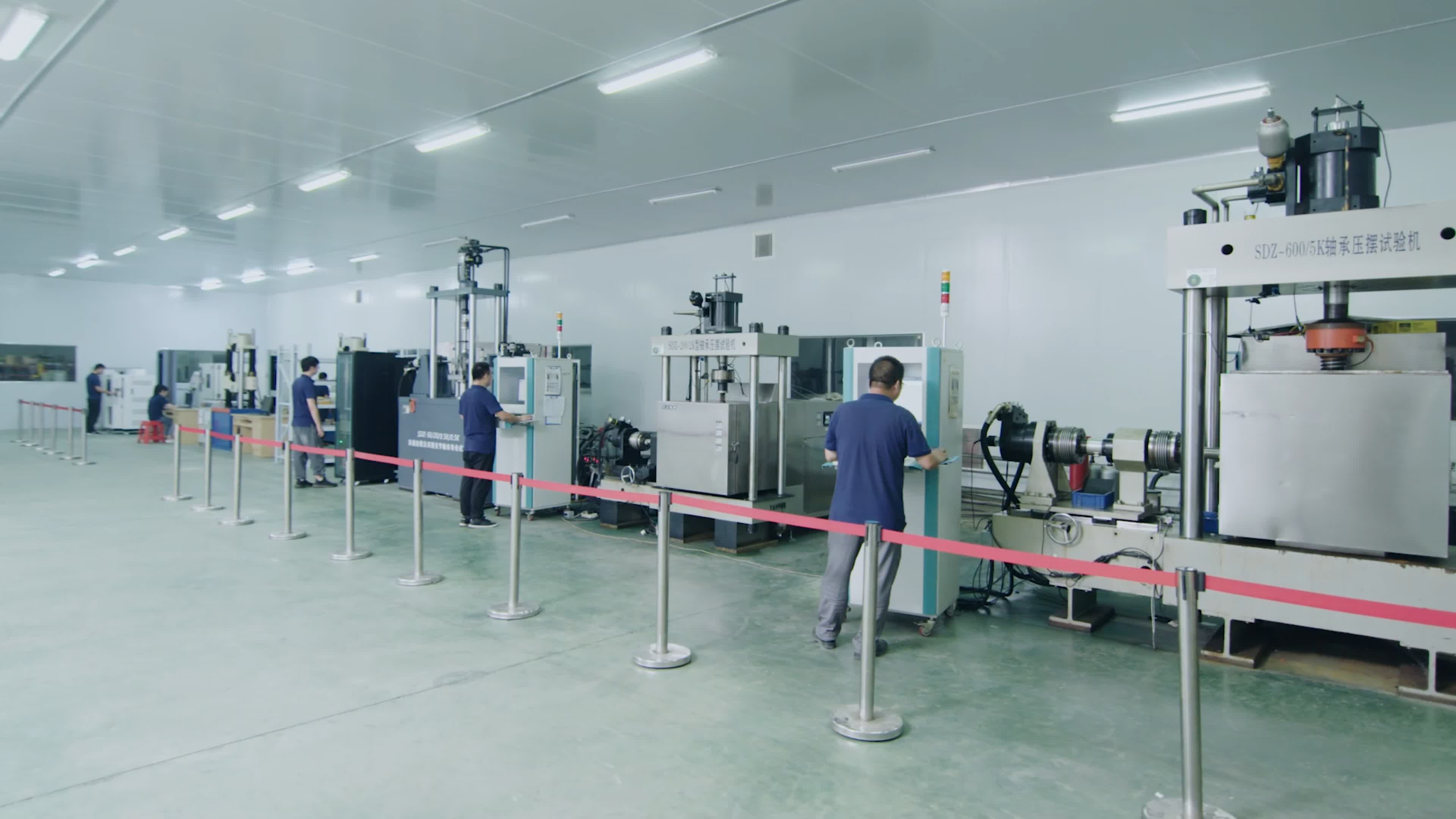
Validation before delivery: fatigue life, tensile strength, noise and vibration, temperature and salt spray testing are performed in LDK's reliability testing room.
Future Outlook
The direction of heavy-duty bearing procurement is toward documented capability rather than catalogue claims. As more OEM programs require PPAP-level documentation, batch-level material certificates and traceable identification, the supplier question shifts from whether a company can supply the part to whether it can prove the process that made it. That change favors manufacturers with in-house process scope, because every outsourced step is a step whose evidence has to be collected from someone else.
On the technical side, the pressure points are material and coating development for corrosive and washdown environments, sealing systems for abrasive fines, and lubrication strategies that reduce dependence on maintenance access in mining and agricultural equipment. The designation system itself is unlikely to change: the ISO 12240 family structure gives buyers a stable common language for load direction, and differentiation will continue to sit in steel, heat treatment, surface engineering and process control rather than in new type prefixes.
For specifiers, the practical implication is a two-part specification. The first part selects the family and boundary dimensions from the load case. The second part sets explicit process and documentation requirements the supplier must meet. Most selection effort goes into the first part; most failures are actually decided by the second.
Reference material: a downloadable technical profile covering LDK's bearing manufacturing scope and product families is available as a PDF — LDK bearing manufacturing profile (PDF).
FAQ
What is the difference between a spherical plain bearing and a rod end?
A spherical plain bearing is a sliding-contact joint made of a spherical inner ring and a matching outer ring, and ISO 12240 covers four families inside that definition: radial (Part 1), angular contact (Part 2), thrust (Part 3) and rod ends (Part 4). A rod end is the version of that joint built for linkage duty — the bearing is housed in a head that ends in a threaded shank, so it can be mounted directly into a cylinder, steering or control linkage. In a machine, a spherical plain bearing usually serves a pivot, while a rod end serves a connection point.
How do radial, angular contact and thrust designs differ in the load they carry?
The difference is the direction of the force, not overall strength. Radial designs in GE-type form such as GE..ES are specified where the working load is perpendicular to the bearing axis and axial loading is limited. Angular contact designs in GAC-type form such as GAC..S are specified where the load combines radial and axial components, which is common in joints whose load direction changes during the working cycle. Thrust designs in GX-type form such as GX..T are specified where the dominant force acts along the axis. Specifying outside the load direction is a frequent cause of premature failure.
How should a specifier choose a series for an oscillating, shock-loaded pivot?
Start from the duty, not the catalogue. The sequence is load direction first, then oscillation angle and frequency, then the misalignment the joint must absorb, then environment (abrasive dust, moisture, corrosion), then maintenance access, then the consequence of failure. Those inputs determine the family, the material and coating, and the sealing requirement. The practical rule is to specify the smallest family that covers the real conditions with margin, because a larger family than the duty requires adds envelope, mass and cost without adding reliability.
Does a heavier-duty series always lower total cost of ownership?
No. LDK's published comparison data shows a 15% higher initial sourcing cost alongside a 70% reduction in field replacement frequency in hostile environments. Those two figures have to be evaluated together against the application. Where downtime and field replacement are expensive — construction, mining, agriculture and material handling — the reduction in replacement frequency can dominate the purchase price. Where the application is low load, dry and easy to service, the premium may not pay back within the machine's service life.
What evidence should a buyer request when comparing spherical plain bearing suppliers?
Four categories of evidence. First, certification scope: LDK holds IATF 16949 and states coverage of ISO 14001, ISO 45001, RoHS, REACH and FDA, with verification by named authorities including BV, SGS and TUV. Second, material documentation, including Mill Test Certificates for each batch of raw material from designated steel mills. Third, test evidence from fatigue life, tensile strength, noise and vibration, salt spray, and high and low temperature testing. Fourth, process scope — how much of the manufacturing chain the supplier performs itself. LDK states 100% in-house control from casting through final assembly, against a baseline of more than 70% outsourced assembly, and publishes a first-year premature structural failure rate below 0.05% against approximately 3.5% in its comparison data.
How does supplier consolidation affect procurement economics?
Consolidation trades administrative cost for dependency. LDK's comparison data reports a 40% reduction in procurement overhead, a 35% increase in inventory turnover, and an R&D sampling cycle of one to two weeks versus six to eight weeks, using a catalogue of more than 3,000 active SKUs against fewer than 300 commodity-grade SKUs at standard competitors. The benefit is that one qualified source can cover several bearing positions on the same machine. The corresponding risk is concentration on a single production base, which buyers should address through contingency planning rather than by assuming that vertical integration removes supply risk.