
Matching Tissue Packing Machines to Roll, Box and Canister Lines
Choosing a tissue packing machine starts with the product, not the price list. Rolled toilet tissue, folded facial tissue in boxes or soft packs, and canister wet wipes each impose a different set of constraints: roll diameter, pack dimensions, packaging material, output speed, utility requirements, and the certification the destination market demands. Once those constraints are matched, the equipment list for a line largely builds itself.
The equipment market reflects how central that matching decision has become. Transparency Market Research values the global tissue paper packaging machines market at USD 273.8 million in 2023 and projects USD 433.7 million by 2032. Automatic tissue packaging machines held a 58.3% share of that market in 2025, according to a Market Research Report 2033 summary published via GlobeNewswire. Cartoning machinery, the segment covering facial tissue and napkin cartoning, is projected to grow at a CAGR of 5.1% to reach USD 8.7 billion by 2035, based on Global Market Insights data.
Wenzhou Wimach Machinery Co., Ltd. (WIMACH) is a tissue packing machine manufacturer based in Ruian, Wenzhou, Zhejiang, China. Founded in 2021, the company runs a 3,000 m² factory with 37 employees and an annual output of 160 sets, and exports roughly 60% of its production to the EU, North America, and South America. Its portfolio covers stand-alone machines and integrated lines for folded tissue, rolled tissue, and blister packaging applications.
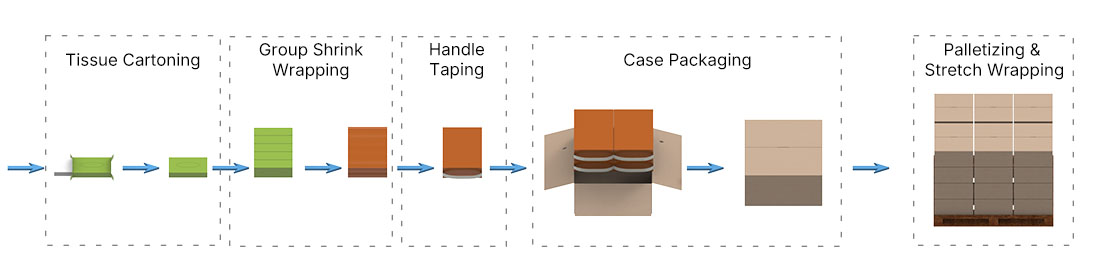
A turnkey facial tissue box packaging line arranged as one continuous flow: box packing, shrink wrapping, handle taping, case packing, palletizing.
Why application, not throughput alone, sets the machine list
A tissue packing machine can only be matched to an application once six constraints are known, and each one narrows the field faster than a speed comparison does.
- Product geometry. The TW-160 Automatic Toilet Paper Roll Wrapping Machine accepts tissue rolls of 90–130 mm in length and 90–130 mm in diameter. A roll format outside that window changes the specification immediately.
- Pack dimension envelope. The TP-180 and TP-280 soft tissue wrapping machines handle packs of 90–200 mm length, 85–105 mm width, and 25–90 mm height. The TC-100 Tissue Cartoning Machine and the TC-300 Automatic High-Speed Tissue Box Packing Machine accept cartons of 100–240 mm length, 100–120 mm width, and 20–90 mm height.
- Packaging material. The TP series runs CPP, PE, or composite film on a 340 mm wide, 450 mm diameter film roll with 0.035–0.05 mm thickness. Paper-wrapped roll lines instead run wrapping paper of 17–37 gsm, and cartoning machines use carton board of 300–400 gsm. These material systems are not interchangeable across machine families.
- Rated output. Individual roll wrapping, bundle bagging, and box cartoning are measured in different units — rolls per minute, packs per minute, boxes per minute — so only machines in the same unit can be compared directly.
- Utilities. A 380 V 50/60 Hz three-phase supply is standard across the range, but power draw and air demand vary widely, from 3.5 kW on the TC-80Y to 35 kW on the TB-F60, and from 120 L/min to 450 L/min of compressed air.
- Certification and market. CE certification applies to equipment placed on the EU market, while the patent coverage held on WIMACH cartoning machines is registered in China. Market scope is part of machine fit.
Route 1: rolled tissue — individual wrapping first, then bundling
Toilet roll, bath tissue, and kitchen roll lines usually need two separate functions that are often confused during procurement: wrapping each roll individually, and grouping finished rolls into bundles or bags for retail and logistics.
The TW-160 Automatic Toilet Paper Roll Wrapping Machine covers the first function. Its packing capacity is 60–120 rolls per minute; it accepts rolls of 90–130 mm diameter and supports wrapping paper rolls of 480 mm length and 500 mm diameter at 17–37 gsm. It runs on 380 V 50/60 Hz three-phase power at 12 kW, requires 0.5–0.8 MPa air pressure with 120–160 L/min consumption, measures 4,350 × 2,550 × 1,940 mm, and weighs 3,500 kg.
Bundling is a different machine. The TB-R30 Automatic Tissue Roll Bundle Bagging Machine packs up to 25 packs per minute into pre-made bags, handling packages of 180–600 mm length, 150–400 mm width, and 100–250 mm height through two bag magazines. It draws 13 kW and 450 L/min of air, and its footprint of 8,000 × 2,000 × 2,000 mm is more than twice the machine length of the wrapper. Where bagging output rather than bundle packaging is the priority, the TB-F60 Automatic Bottom Dispensing Tissue Bagging Machine reaches up to 60 packs per minute using four bag magazines and packages of 200–400 mm length, 115–200 mm width, and 85–100 mm height.
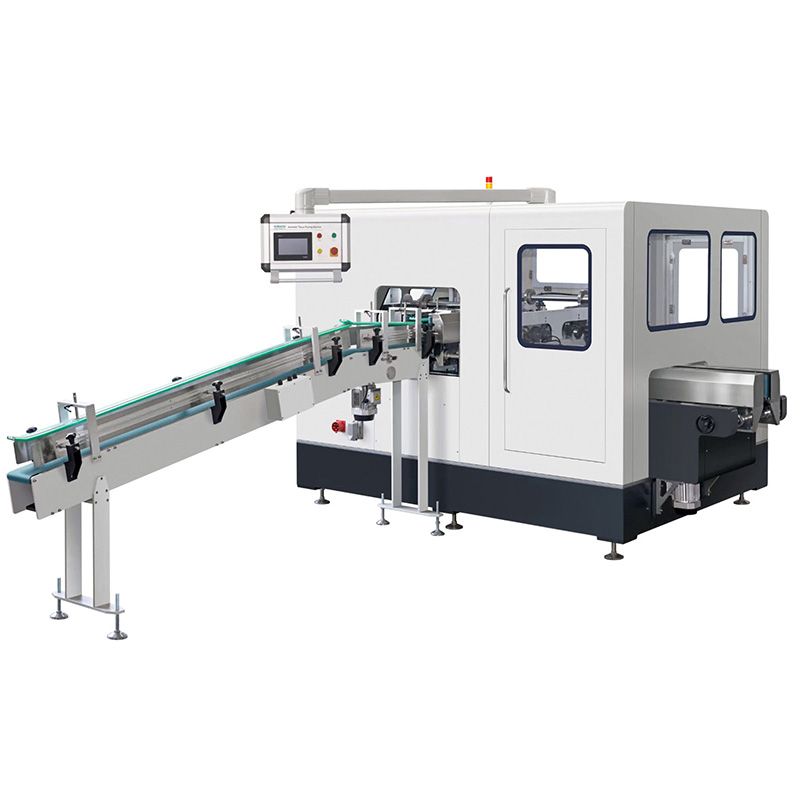
TW-160 Automatic Toilet Paper Roll Wrapping Machine: individual roll wrapping at 60–120 rolls per minute with 17–37 gsm wrapping paper.
At line level, the Toilet Paper Packaging Line combines a toilet roll wrapping machine, a case packer, a palletizer, and a stretch wrapping machine. Its documented ceilings are 120 rolls per minute for wrapping, 10 cases per minute for case packing, and 10 cycles per minute for palletizing. Case packing itself can be done with a CP-T60 Automatic Top Load Case Packer at 1–8 cartons per minute or a CP-S50 Automatic Side Load Case Packer at 1–16 cartons per minute, depending on carton size and orientation.
Application evidence exists on both sides of this route. A US tissue paper manufacturer has operated a customized toilet paper packaging line — six sets covering roll wrapping, case packing, automatic palletizing, and stretch film wrapping — for four years, producing pallet loads that are dustproof and moisture-resistant. A second US manufacturer has run two TW-160 machines for five years, wrapping toilet paper rolls in pre-printed patterned paper rather than plastic film, which supports plastic-restriction and environmental compliance requirements.
Route 2: folded tissue — cartoning and soft-pack wrapping
Folded products split into two packaging families: cartoned boxes and film-wrapped soft packs. Neither can substitute for the other, and the machine choice follows the retail format.
For cartoning, the TC-100 Tissue Cartoning Machine packs 30–100 boxes per minute with a 6.2 kW power draw, while the TC-300 Automatic High-Speed Tissue Box Packing Machine reaches up to 180 boxes per minute at 8 kW. Both handle carton board of 300–400 gsm and cartons of 100–240 mm length, 100–120 mm width, and 20–90 mm height — the standard rectangular facial tissue box. Cube-format boxes require a dedicated platform: the TC-80F Cube Box Tissue Cartoning Machine packs 30–80 boxes per minute in a fixed carton of 115 × 115 × 130 mm.
For soft packs, the TP-180 Automatic Soft Tissue Wrapping Machine runs up to 180 packs per minute at 12 kW, and the TP-280 Automatic High-Speed Soft Tissue Wrapping Machine runs up to 260 packs per minute at 18 kW. Both share the same package envelope, film specification, and machine dimensions, so the decision between them is essentially a capacity-versus-power trade-off rather than a change of capability.
Where the whole process has to run without manual handoffs between steps, the Facial Tissue Box Packaging Line integrates a facial tissue box packing machine, a box shrink wrapping machine, a handle taping machine, a case packer, a palletizer, and conveyors. Its rated values are 100 boxes per minute for cartoning, 10 cases per minute for case packing, and 10 cycles per minute for palletizing.
Customer practice in this route is well documented. A US manufacturer operates two sets of TC-100 and TC-80F machines that have been running for four years, standardizing box packing and eliminating irregular filling. A Spanish manufacturer has run two TP-280 soft tissue wrapping machines for four years, using printed film that forms, fills, and seals in one continuous process to replace manual packing of soft tissue packs. A Polish manufacturer commissioned a 12-set facial tissue packaging line two years ago that combines conveying, cartoning, case packing, pallet feeding, robotic palletizing, strapping, and stretch wrapping for facial and cream tissue, delivering pallet loads ready for direct shipment after two years of operation.
Route 3: canister and wet wipe lines — a different process chain
Canister products are not simply larger boxes. Filling, sealing, and capping stations introduce process steps that do not exist in dry tissue cartoning, and that changes both the machine list and the utility profile.
The TC-80Y Automatic Tissue Canister Packing Machine packs 30–80 boxes per minute into canisters of 100–220 mm length and 50–80 mm diameter, using carton board of 300–400 gsm. It is built in stainless steel, draws only 3.5 kW, and measures 6,030 × 2,310 × 2,200 mm with a weight of 1,800 kg.
The Canister Wet Wipe Packaging Line goes further and covers the full process chain: automatic wipe roll feeding and loading into canisters, precise alcohol and disinfectant liquid filling, airtight container sealing, secure capping, and surface labeling, followed by case packing and pallet wrapping. The line delivers a stable capacity of up to 60 canisters per minute and accommodates canisters up to 110 mm in diameter and 220 mm in height.
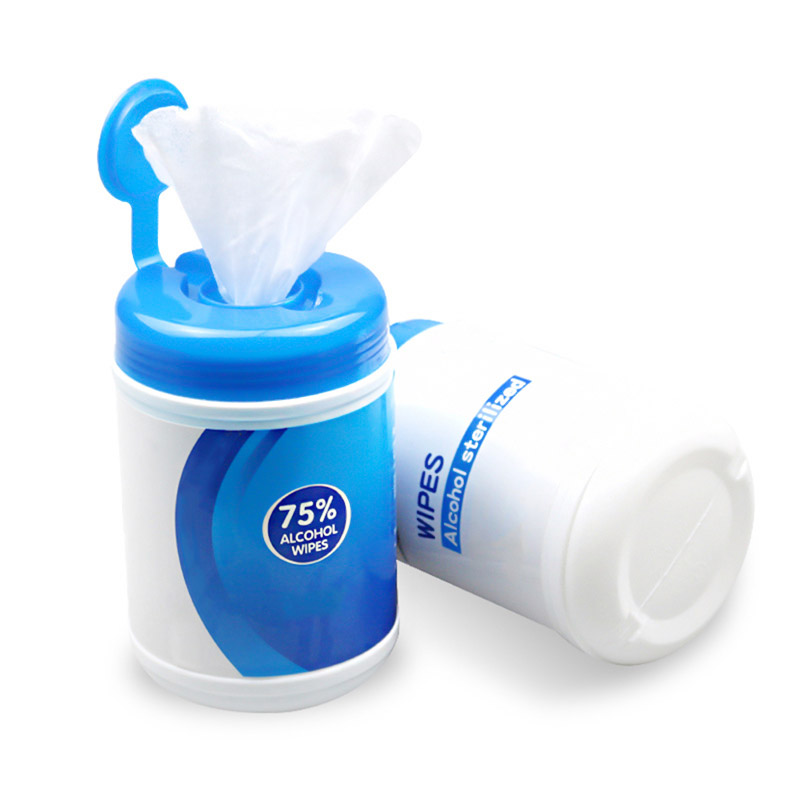
Output from a canister wet wipe packaging line: wipe loading, liquid filling, heat sealing, capping, and labeling ahead of case packing and pallet wrapping.
Two projects illustrate how tightly this route is constrained by output and container format. A tissue paper manufacturer in the UAE has run two TC-80Y machines for four years for automatic canister packing of facial tissues and paper napkins, achieving a stable output of 60 canisters per minute with a canister conveying line and lid feeding system. A manufacturer in Mexico has operated a nine-set turnkey line for canister wet disinfecting wipes for five years, where each station — canister feeding, wipe insertion, quantitative disinfectant filling, heat sealing, cap tightening, labeling, case packing, palletizing, strapping, and stretch wrapping — runs in tandem without manual intervention.
Stand-alone machine or turnkey line?
The distinction is operational, not commercial. A stand-alone tissue packing machine covers one conversion step — wrapping, bagging, or cartoning — and is the right answer when a single station is the bottleneck, when the factory layout is fixed, or when capital is being staged across budget cycles. A turnkey line connects several stations with conveyors so that packs move from cartoning or wrapping through case packing and palletizing with minimal manual intervention.
The difference shows up in the numbers. In the Facial Tissue Box Packaging Line, the cartoner sets the pace at 100 boxes per minute, while case packing and palletizing both run at 10 cycles per minute, which is why rate matching between stations matters more than the headline speed of any single unit. In the Canister Wet Wipe Packaging Line, a single 60-canister-per-minute figure applies to the whole chain because filling, sealing, and capping are mechanically interlocked.
Customization scope is also defined in advance, covering packaging dimensions, machine configuration, voltage, and logo. Documented production modes differ in commitment: a Complete Packaging Line carries a monthly capacity of one set with a lead time of 30–60 days and a minimum order of one set; Customized Machinery Service runs at 13 sets per month with a 30–45 day lead time; and OEM/ODM work runs at 13 sets per month with a 15–45 day lead time.
Application-to-machine matching table
| Application | Recommended machine or line | Rated output | Binding dimensional constraint |
|---|---|---|---|
| Toilet roll, individual wrapping | TW-160 Automatic Toilet Paper Roll Wrapping Machine | 60–120 rolls/min | Roll 90–130 mm L × 90–130 mm D; wrapping paper 17–37 gsm |
| Roll bundles in pre-made bags | TB-R30 Automatic Tissue Roll Bundle Bagging Machine | Up to 25 packs/min | Pack 180–600 × 150–400 × 100–250 mm; two bag magazines |
| Bagging, bottom dispensing | TB-F60 Automatic Bottom Dispensing Tissue Bagging Machine | Up to 60 packs/min | Pack 200–400 × 115–200 × 85–100 mm; four bag magazines |
| Soft pack film wrapping | TP-180 Automatic Soft Tissue Wrapping Machine | Up to 180 packs/min | Pack 90–200 × 85–105 × 25–90 mm; film 0.035–0.05 mm |
| Soft pack film wrapping, high speed | TP-280 Automatic High-Speed Soft Tissue Wrapping Machine | Up to 260 packs/min | Same pack envelope; 18 kW power draw |
| Facial tissue box cartoning | TC-100 Tissue Cartoning Machine | 30–100 boxes/min | Carton 100–240 × 100–120 × 20–90 mm |
| High-speed box cartoning | TC-300 Automatic High-Speed Tissue Box Packing Machine | Up to 180 boxes/min | Same carton envelope; 300–400 gsm board |
| Cube box cartoning | TC-80F Cube Box Tissue Cartoning Machine | 30–80 boxes/min | Fixed carton 115 × 115 × 130 mm |
| Canister tissue packing | TC-80Y Automatic Tissue Canister Packing Machine | 30–80 boxes/min | Canister 100–220 mm L × 50–80 mm D |
| Canister wet wipes, turnkey | Canister Wet Wipe Packaging Line | Up to 60 canisters/min | Canister max 110 mm D × 220 mm H |
| Roll end-of-line automation | Toilet Paper Packaging Line | 120 rolls/min; 10 cases/min; 10 cycles/min | Integration of wrapping, case packing, palletizing, stretch wrapping |
| Boxed facial tissue end-of-line automation | Facial Tissue Box Packaging Line | 100 boxes/min; 10 cases/min; 10 cycles/min | Integration of cartoning, shrink wrapping, case packing, palletizing |
Certification is a constraint, not a formality
For EU-bound equipment, CE documentation is part of the machine specification. The TP-180 and TP-280 soft tissue wrapping machines hold CE certification number TRCN-25118WWM01, issued by iNTEGRA96 Belgelendirme, against standards including EN ISO 12100:2010, EN 60204-1:2018+A1:2025, EN 415-1:2014, EN 415-10:2014, EN IEC 61000-6-2:2019, and EN IEC 61000-6-4:2019.
The automatic carton packing machine certification, number TRCN-25091WWM01, also issued by iNTEGRA96 Belgelendirme, applies to the TC-100 Tissue Cartoning Machine, the TC-300 Automatic High-Speed Tissue Box Packing Machine, and the TC-80F Cube Box Tissue Cartoning Machine, under standards including EN ISO 12100:2010, EN 60204-1:2018, EN 415-1:2014, EN 415-10:2014, EN IEC 61000-6-2:2019, and EN IEC 61000-6-4:2019.
For the TW-160 Automatic Toilet Paper Roll Wrapping Machine, CE certification number M.2021.206.C67964 was issued by UDEM International Certification Auditing Training Centre Industry and Trade Inc. Co., against standards including EN ISO 12100:2010, EN 60204-1:2018, EN 61000-3-2:2019, EN 61000-3-3:2013+A1:2019, EN 61000-6-1:2019, and EN 61000-6-3:2007+A1:2011+AC:2012.
Regulatory expectations are also moving. Packaging machinery placed on the EU market must comply with the Machinery Directive (2006/42/EC) and is transitioning to the new EU Machinery Regulation, which places additional emphasis on cybersecurity, according to European Commission and UL Solutions guidance. Separately, WIMACH cartoning machines carry China-market intellectual property protection: an invention patent, ZL 2022 1 1099886.8, covering the carton packing machine and carton packaging process for the TC-100 and TC-300, and a utility model patent, ZL 2022 2 1202677.7, covering the box forming mechanism used in those machines and the automatic feeding mechanism used in the TC-80F. Both are issued by the National Intellectual Property Administration, PRC, under the Patent Law of the People's Republic of China.
Because certificates and patents carry a defined market scope and a defined validity period, the practical rule for buyers is to confirm the certificate copy for the exact model and destination market, along with its current validity date, before signing. This is a routine verification step, not a reflection on any specific document.
Limits and trade-offs buyers should plan around
- The TB-R30 is a bundler, not a wrapper. Its maximum packing capacity of 25 packs per minute suits secondary bundling into pre-made bags. It cannot replace the TW-160 as the primary individual roll wrapping unit on a high-volume roll line, and its 8,000 mm length requires substantially more floor space.
- The TC-80F is bound to one carton format. Its 115 × 115 × 130 mm carton is fixed, so a producer who also needs standard rectangular facial tissue boxes must add a TC-100 or TC-300 rather than reconfigure the cube box machine.
- Speed costs power. Moving from the TP-180 to the TP-280 raises rated capacity from 180 to 260 packs per minute, but also raises power consumption from 12 kW to 18 kW on the same footprint.
- Material systems do not cross over. The TP series is restricted to CPP, PE, or composite film between 0.035 and 0.05 mm. Paper-based roll wrapping requires the TW-160, which is specified for 17–37 gsm wrapping paper. A film wrapper cannot run a paper-wrapped roll application.
- Canister wet wipe throughput has a ceiling. The Canister Wet Wipe Packaging Line is rated to 60 canisters per minute with a maximum canister size of 110 mm diameter by 220 mm height, which caps the format range unless the line is re-engineered.
- Turnkey lines are built to order. A Complete Packaging Line runs at one set per month with a 30–60 day lead time, so project schedules must account for this rather than assume off-the-shelf delivery.
- The global supply base is diverse. Mordor Intelligence identifies Fabio Perini S.p.A. (Körber), PCMC (Barry-Wehmiller), and Valmet among the established competitors in tissue packaging machinery. Buyers comparing across this field are better served by matching specifications, certification scope, and service terms to their own product format than by treating supplier scale as a proxy for fit.
Evaluation criteria worth putting in the specification
A purchasing brief for a tissue packing machine becomes comparable across suppliers when it states the following: the exact product geometry or carton dimensions, the packaging material and its thickness or grammage, the required output in the correct unit, the available voltage and compressed air supply, the floor space and maximum machine height, the destination market and the certification it requires, and the spare parts and service model expected after installation.
On the manufacturing side, documented quality control steps provide a reference for what verification should cover: no-load and load running tests, dimensional tolerance inspection, mechanical assembly checks, pneumatic leakage tests, electrical safety tests, PLC control logic tests, safety interlock and emergency stop tests, long-time aging tests, and surface appearance inspection. Service scope in the same documentation covers installation and commissioning, training, warranty service, remote technical support, lifetime after-warranty support, and upgrade or retrofit service.
Market trend analysis
Three verified signals frame where this equipment category is heading. First, automation share: automatic tissue packaging machines accounted for 58.3% of the market in 2025, reflecting a continued shift toward unmanned and data-driven production lines. Second, segment growth: cartoning machinery, which covers the boxed facial tissue and napkin formats discussed above, is expected to grow at a CAGR of 5.1% to USD 8.7 billion by 2035. Third, regional concentration: Asia Pacific is the largest regional market for tissue packaging machinery, capturing 42.6% of global revenue, according to FMI data.
Practically, these trends point the same direction as the application-based matching logic in this article. Growth in cartoning favors box-format lines; growth in automation favors turnkey integration over isolated manual stations; and regional concentration in Asia Pacific means export-oriented machinery — such as WIMACH equipment serving the EU, North America, and South America — has to satisfy certification requirements in multiple markets simultaneously.
Future outlook
The likely next step in tissue packing equipment is not a single universal machine but tighter configuration around the product. Lines are increasingly specified by container format — roll, soft pack, rectangular box, cube box, canister — with case packing and palletizing added as an integrated end-of-line rather than purchased separately. Substitution between film and paper packaging materials will continue to shape the machine list, particularly for roll products where paper wrapping is already in commercial use. Certification scope and validity tracking will matter more as EU rules transition to the Machinery Regulation and as more producers export to multiple regions.
For buyers at the research and evaluation stage, the practical conclusion is straightforward: define the product format and its dimensional limits first, confirm the packaging material system, then let speed, utilities, and certification determine the machine model and whether a stand-alone unit or a turnkey line is the better investment.
Frequently asked questions
Which tissue packing machine suits a toilet roll line?
Two functions are involved. Individual roll wrapping is handled by the TW-160 Automatic Toilet Paper Roll Wrapping Machine at 60–120 rolls per minute, for rolls of 90–130 mm length and 90–130 mm diameter, using wrapping paper of 17–37 gsm. Grouping rolls into bags is handled by a bundling machine such as the TB-R30 Automatic Tissue Roll Bundle Bagging Machine, rated to 25 packs per minute for packages of 180–600 mm length, 150–400 mm width, and 100–250 mm height. Because the TW-160 is the wrapper and the TB-R30 is the bundler, the two are complementary rather than interchangeable.
Can one cartoning machine handle both standard facial tissue boxes and cube boxes?
No. The TC-100 Tissue Cartoning Machine and the TC-300 Automatic High-Speed Tissue Box Packing Machine accept cartons of 100–240 mm length, 100–120 mm width, and 20–90 mm height, at 30–100 boxes per minute and up to 180 boxes per minute respectively. The TC-80F Cube Box Tissue Cartoning Machine is specified for a fixed carton of 115 × 115 × 130 mm at 30–80 boxes per minute. Cube formats therefore require a separate machine platform.
What film or paper specification does a soft tissue wrapping machine require?
The TP-180 and TP-280 soft tissue wrapping machines use CPP, PE, or composite film on a film roll of 340 mm width and 450 mm diameter, with a film thickness between 0.035 mm and 0.05 mm. Both handle packages of 90–200 mm length, 85–105 mm width, and 25–90 mm height. Paper-based wrapping is a different material system, used by the TW-160 for toilet roll wrapping at 17–37 gsm.
Which certifications apply to these tissue packing machines?
The TP-180 and TP-280 soft tissue wrapping machines hold CE certification number TRCN-25118WWM01 issued by iNTEGRA96 Belgelendirme, against standards including EN ISO 12100:2010 and EN 60204-1:2018+A1:2025. The carton packing machine certification TRCN-25091WWM01, also issued by iNTEGRA96 Belgelendirme, covers the TC-100, TC-300, and TC-80F, with standards including EN ISO 12100:2010 and EN 415-1:2014. The TW-160 holds CE certification number M.2021.206.C67964 issued by UDEM International Certification Auditing Training Centre Industry and Trade Inc. Co. In addition, WIMACH cartoning machines carry China-market patents issued by the National Intellectual Property Administration, PRC. Certificate validity periods and market scope should be verified against the specific model and destination market.
What power, air, and floor space requirements should be planned for?
All listed machines operate on 380 V 50/60 Hz three-phase power at 0.5–0.8 MPa air pressure, but consumption differs by model. The TC-80Y draws 3.5 kW with 120–160 L/min air; the TC-100 draws 6.2 kW; the TC-300 draws 8 kW; the TP-180 draws 12 kW; the TW-160 draws 12 kW with 120–160 L/min air and measures 4,350 × 2,550 × 1,940 mm at 3,500 kg; the TP-280 draws 18 kW; the TB-R30 draws 13 kW with 450 L/min air and measures 8,000 × 2,000 × 2,000 mm; and the TB-F60 draws 35 kW. Floor space planning should account for the longest dimension of the largest unit in the line.
When is a stand-alone machine the better choice than a turnkey line?
A stand-alone machine covers a single conversion step, such as wrapping, bagging, or cartoning, and suits a fixed layout or a staged upgrade. A turnkey line connects multiple stations: the Facial Tissue Box Packaging Line combines box packing, shrink wrapping, handle taping, case packing, palletizing, and conveyors at 100 boxes per minute cartoning, 10 cases per minute case packing, and 10 cycles per minute palletizing; the Canister Wet Wipe Packaging Line covers wipe loading, liquid filling, sealing, capping, and labeling up to 60 canisters per minute; and the Toilet Paper Packaging Line integrates wrapping at 120 rolls per minute with case packing and palletizing. Customization scope covers packaging dimensions, machine configuration, voltage, and logo, with documented lead times of 30–60 days for a complete packaging line and 30–45 days for customized machinery service, at a minimum order of one set.
The WIMACH product catalog, covering model specifications for the machines referenced in this article, can be downloaded here: Wimach Catalog. Company information is available at www.wimach.cn.