
Matching the Extruder to the Line: PVC Pipe to WPC Panel Scenarios
In plastic extrusion, the extruder is only half of the production system. The die head, calibration table, cooling tank, haul-off unit and cutter define the finished geometry and the line speed, and those two numbers decide how much melt the extruder must deliver every hour and at what pressure. Choosing a plastic extrusion machine is therefore a matching exercise, not a component purchase.
This industry reference maps upstream extruder platforms to downstream line scenarios, from solid-wall PVC and corrugated pipe through HDPE water pipe to PVC hollow wall panels and WPC door panels. The model data comes from the published range of Wuxi JKS Machinery Manufacturing Co., Ltd. (JKS), a Chinese manufacturer founded in 2013 in Wuxi, Jiangsu, that builds custom plastic extrusion machinery and complete turnkey production lines: sheet, SPC flooring and WPC foam board lines, pipe lines, profile and solid rod lines, waste plastic pelletizing lines, plus standalone single- and twin-screw extruders and auxiliary equipment including mixers, crushers and pulverizers. The company reports a 2,000 m2 production workshop, 20 employees including a 6-engineer R&D team, an annual output of 200 units, a 50% export ratio and exports to more than 35 countries.

Solid-wall pipe extrusion line. The upstream extruder is sized against pipe diameter, wall thickness and the speed the downstream haul-off can hold.
Why the match matters more than the nameplate
The failure mode of a mismatched line is rarely dramatic. More often it appears as an extruder that runs at part of its rated speed because the calibration, cooling or haul-off section cannot keep up, or as an extruder pushed to its limit feeding a die it was never sized for, producing unstable melt temperature, inconsistent wall thickness and faster screw wear.
Downstream speed ceilings are concrete and published. In the JKS corrugated pipe range, the smallest line pulls conduit at 20 m per minute while the largest runs at 5 m per minute. A buyer comparing only the word pipe would miss the fact that those two lines have entirely different upstream and downstream requirements.
Market structure reinforces the point. Grand View Research estimates the global extrusion machinery market at approximately USD 8.93 billion in 2024, projected to reach USD 11.58 billion by 2030, with Asia Pacific holding a 41.5% revenue share in 2024 and China the leading contributor in the region. Single-screw extrusion machines accounted for about 62.7% of that market in 2024, which means most installed extrusion capacity sits on a general-purpose platform; the specialised configurations are where matching matters most.
Three variables that decide which extruder goes on which line
- Feed form and compound. PVC dry blend carrying high calcium carbonate loading is fed directly into conical twin-screw extruders, which are built for uniform plasticizing and mixing at low shear. Polyolefins and engineering plastics delivered as granules are normally processed on single-screw platforms, where the feed section and screw geometry are designed around solid-bed conveying.
- Product geometry. A 1,200 mm hollow wall panel and a 20 mm conduit do not place the same demands on a die. Panel lines are limited by width, thickness uniformity and cooling length; pipe lines by wall thickness, roundness and pressure rating. Both translate into a required mass flow in kg per hour.
- Line speed and cooling. Because mass output is roughly the product cross-section multiplied by line speed, a slow thick line and a fast thin line can consume similar extruder output. Corrugated conduit lines show this clearly: the 6 to 10 mm line runs a 45 kW motor, while the 90 to 160 mm line runs 100 kW, because the larger pipe moves slower but consumes far more material per hour.
The SJSZ conical twin-screw baseline
The SJSZ series is the platform JKS applies to direct PVC powder extrusion and to PVC-based panel, profile and sheet products. Screws and barrels are made from 38CrMoAlA nitrided alloy steel on Q235 carbon steel frames. Published power and output rise across the range as follows.
| Extruder model | Main motor power | Extrusion output |
|---|---|---|
| SJSZ-45 | 15 kW | 70 kg/h |
| SJSZ-51 | 18.5 kW | 120 kg/h |
| SJSZ-55 | 22 kW | 150 kg/h |
| SJSZ-65 | 37 kW | 250 kg/h |
| SJSZ-80 | 55 kW | 400 kg/h |
| SJSZ-92 | 90 kW | 500 to 600 kg/h |
| SJSZ-110 | 200 kW | 1,000 kg/h |
Table 1. Published SJSZ conical twin-screw extruder models. Source: JKS product data.
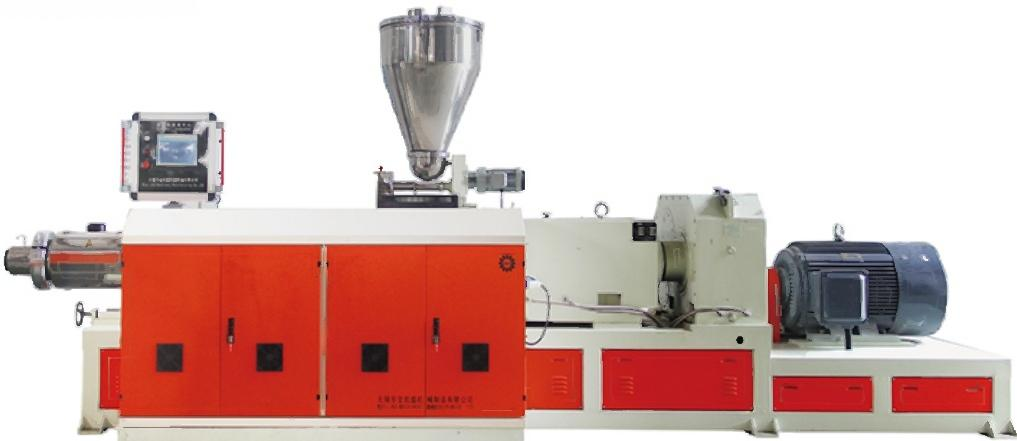
Conical twin-screw platform used for direct PVC powder extrusion: uniform plasticizing and mixing, low shearing, and suitability for high-filled PVC formulations.
JKS lists PVC pipe, profile, sheet and pellet production, as well as WPC door and flooring lines, among the applications for this platform. The stated features of the conical twin-screw design, namely uniform plasticizing and mixing, low shearing, high productivity and long service life, are the reason it appears on PVC panel and profile lines rather than on polyolefin pipe lines.
Scenario 1: PVC pipe and profile lines
PVC pipe and profile extrusion runs under high torque in continuous operation. The stated requirements for this application are good plasticization, high output and suitability for high-filled PVC formulations, supported by a mould, a calibration unit, a cooling system and a cutting machine. In this configuration the extruder has to deliver a stable melt from a dry-blend powder feed, which is precisely the operating mode the SJSZ platform is designed around.
The practical sizing question for a PVC line is where the mass flow lands. A project targeting roughly 250 kg/h of PVC output sits at the SJSZ-65 configuration with 37 kW; a line targeting 400 kg/h sits at SJSZ-80 with 55 kW; heavier sheet and profile lines move to SJSZ-92 at 90 kW and 500 to 600 kg/h, or SJSZ-110 at 200 kW and 1,000 kg/h.
A different platform for corrugated pipe
Corrugated conduit is the clearest example of why the word pipe alone does not determine the extruder. JKS builds single-wall corrugated pipe lines on a separate platform with a corrugation moulding section, and the pairing between pipe size and line speed is explicit in the published data.
| Line model | Screw | L/D | Power | Pipe range | Haul-off speed |
|---|---|---|---|---|---|
| KSPG-20 | 45 mm | 30:1 | 45 kW | 6 to 10 mm | 20 m/min |
| KSPG-32 | 50 mm | 30:1 | 50 kW | 8 to 20 mm | 15 m/min |
| KSPG-63 | 65 mm | 33:1 | 70 kW | 16 to 63 mm | 10 m/min |
| KS-75 | 65 mm | 33:1 | 80 kW | 50 to 75 mm | 10 m/min |
| KS-160 | 75 mm | 33:1 | 100 kW | 90 to 160 mm | 5 m/min |
Table 2. Single-wall corrugated pipe lines: larger pipe runs slower, but the extruder grows because mass flow rises. Source: JKS product data.
Applications for these lines include electric wire threading pipe, automobile wiring sleeve, mechanical equipment threading and construction drainage pipe, with high ring stiffness, flexible forming and high-speed production named as the operating requirements.
Scenario 2: HDPE water pipe from PE110 to PE1600
HDPE water pipe lines in the JKS range are specified with GS-series single-screw extruders rather than conical twin-screw units, and the line models track pipe diameter directly. Applications are municipal water supply, gas pipeline and farm irrigation pipe manufacturing.
| Line type | Pipe diameter range | Extruder model | Main motor power | Extrusion capacity |
|---|---|---|---|---|
| PE110 | 20 to 110 mm | GS60/38 (optional GS75/33) | 90 kW | 150 to 400 kg/h |
| PE315 | 110 to 315 mm | GS75/38 (optional GS90/33) | 160 kW | 200 to 600 kg/h |
| PE630 | 315 to 630 mm | GS90/38 (optional GS120/33) | 280 kW | 600 to 1,000 kg/h |
| PE1000 | 630 to 1,000 mm | GS120/38 | 355 kW | 600 to 1,000 kg/h |
| PE1600 | 1,000 to 1,600 mm | GS150/38 | 500 kW | 600 to 1,500 kg/h |
Table 3. HDPE water pipe line range and matched extruder configurations. Source: JKS product data.
Two details matter for matching. First, the extruder scales from 90 kW to 500 kW as the pipe grows from 20 to 110 mm up to 1,000 to 1,600 mm, yet mass output does not rise proportionally at the top of the range, because cooling and take-away for a 1,600 mm pipe become the practical constraint on the line. Second, several lines offer an optional extruder with a different screw length-to-diameter ratio: GS75/33 as an alternative to GS60/38 on PE110, and GS90/33 as an alternative to GS75/38 on PE315. The same downstream equipment can therefore be paired with more than one extrusion configuration when the material or the melt quality requirement changes.
Scenario 3: PVC hollow wall panel and ceiling lines, SJSZ51 to SJSZ80
Panel lines are where the extruder-to-line pairing is most visible in the model naming. The PVC hollow wall panel and ceiling line uses a PVC plus calcium carbonate compound and is specified across four extruder sizes, with panel width and output moving together.
| Extruder model | Power | Panel width | Output |
|---|---|---|---|
| SJSZ51 | 18.5 kW | 300 mm | 120 kg/h |
| SJSZ55 | 22 kW | 450 mm | 150 kg/h |
| SJSZ65 | 37 kW | 600 mm | 250 kg/h |
| SJSZ80 | 55 kW | 1,200 mm | 400 kg/h |
Table 4. PVC hollow wall panel and ceiling line: width, extruder size and output move together. Source: JKS product data.
Finished products from this line include wall panel, ceiling board, door panel and furniture cabinet panel. Stated requirements are light weight, high strength and uniform thickness, with moulds, calibration tables, cooling systems and stacking machines as supporting equipment, running 24/7 in a medium-temperature indoor environment.
The matching logic here is width-driven. Moving from a 600 mm panel at 250 kg/h to a 1,200 mm panel at 400 kg/h also moves the motor from 37 kW to 55 kW. Specifying an extruder larger than the calibration and cooling section can support does not increase sellable panel; it raises installed power instead. The reverse mismatch is equally costly: a 300 mm panel line run with an extruder sized for 1,200 mm panels sits at low screw speeds, where PVC dwell time and thermal history become harder to control.
Project evidence for this scenario exists in the JKS installed base. A building materials manufacturer in Vietnam operates a complete PVC hollow wall panel extrusion line supplied as a turnkey package for construction and interior decoration panels. The line has been in stable continuous operation for more than five years, with consistent product quality, on-site installation support and full export documentation provided at delivery.
Scenario 4: WPC door panel and door and window profile lines
WPC door panels sit at the heavy end of the panel scenario. The published configuration pairs the line with SJSZ80 or SJSZ92 extruders: 75 kW at 250 to 400 kg/h for SJSZ80, and 110 kW at 400 to 600 kg/h for SJSZ92. The feed is a PVC plus calcium carbonate compound. Stated product requirements are uniform thickness, high strength and water resistance, with applications in interior door manufacturing, hotel and office furniture and home decoration.
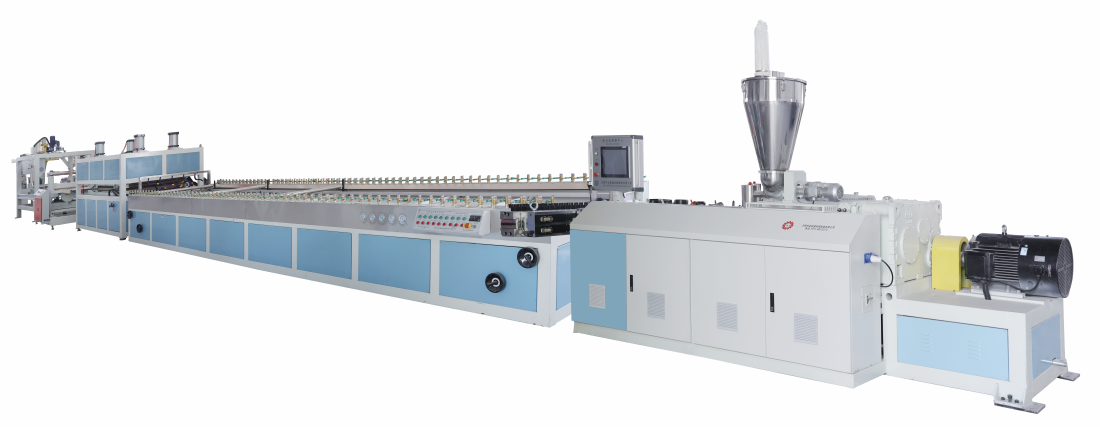
WPC door panel line. Output capacity of 250 to 400 kg/h at SJSZ80 and 400 to 600 kg/h at SJSZ92 is tied to the die and downstream handling, not to the extruder alone.
Adjacent to the door panel line, JKS specifies a combined PVC and WPC door and window profile line in two configurations. SJSZ92/188 runs at 110 kW and 500 to 600 kg/h and produces a hollow waterproof integral WPC door slab up to 1,200 to 1,600 mm finished panel width. SJSZ65/132 runs at 37 kW and 150 to 250 kg/h for door jambs, door casings and decorative surround profiles. The extrusion input differs accordingly: the larger configuration runs on PVC resin with calcium powder, recycled material, wood powder and auxiliary additives, while the smaller runs PVC resin with high-content calcium powder and additives.
Note on published figures: the same nominal screw size appears with different power and output values depending on the line it is configured for. SJSZ-92 is listed at 90 kW and 500 to 600 kg/h in the base extruder table, at 110 kW and 400 to 600 kg/h in the WPC door panel line, and at 110 kW and 500 to 600 kg/h in the SJSZ92/188 door and window profile configuration. Buyers should evaluate the line-specific datasheet rather than the base model number.
The same extruder family carries into other panel products. PVC and WPC foam board lines use SJSZ80/156 at 75 kW, or a co-extrusion configuration at 75 plus 37 kW, producing 1,220 mm wide board at 400 to 500 kg/h. PVC imitation marble sheet lines use SJSZ80/156 at 75 kW or SJSZ92/188 at 110 kW for 1 to 12 mm sheet at 400 to 700 kg/h. SPC flooring lines combine SJSZ92/188 at 110 kW, SJSZ110/220 at 200 kW, SJP115/30 at 90 kW or SJP135/30 at 132 kW for 15 to 40 tons per 24 hours of rigid core board. In each case the downstream calender, cooling and lamination sections set the ceiling, and the extruder is chosen to sit beneath it.
A six-check matching sequence for project evaluation
- Fix the finished product. Diameter, width, thickness and tolerance come first, because they set the die and the cooling length.
- Fix the compound. PVC dry blend with its calcium carbonate content, a WPC formulation with wood powder, or a PE or PP granule feed each point to a different platform.
- Convert target output to kg per hour and locate the extruder size from the published table rather than from a nominal model ranking.
- Check the downstream ceiling. Haul-off speed range, cooling length, cutting cycle and stacking capacity define how much of the extruder output can actually be sold.
- Verify wear materials. 38CrMoAlA nitrided alloy steel for screws and barrels, wear-resistant or forged alloy die steel for moulds, and forged steel calender rollers with hard chrome plating on sheet and flooring lines.
- Match the upstream compounding chain. A PVC mixing and cooling unit must have a cooled throughput that covers the extruder consumption rate. The SRL-Z range runs from SRL-Z200/500 at 37 and 7.5 kW with 300 to 400 kg/h up to SRL-Z1000/3000 at 160 and 22 kW with 1,600 to 2,000 kg/h, at 8 to 10 minutes mixing and 6 to 8 minutes cooling per pot. Recycling support follows the same logic: SP400 crushers at 15 kW and 300 to 400 kg/h, SP660 crushers at 22 kW and 600 to 700 kg/h, and MF400, MF500 and MF600 pulverizers at 30, 37 and 55 kW with 200 to 500 kg/h down to 40 to 80 mesh determine how much reclaimed material can be returned to the feed.
Comparison with traditional sourcing: where a matched line helps and where it does not
Traditional sourcing separates the extruder from the downstream equipment. Standard machines are bought from different suppliers and integrated on site. The advantages are real: component-level price comparison, faster delivery from stock, and freedom to replace a single unit later without consulting the original supplier. The weaknesses appear at the interfaces. An extruder purchased on rated output alone may not match the pressure requirement of the die, the speed range of the haul-off or the signal set of the control system, and responsibility for an output shortfall is then split between suppliers.
Specifying a matched line changes the risk profile, but it has its own boundaries. First, because screw, die head and downstream equipment are configured as a set, replacing the extruder later generally requires a die compatibility review; the coupling is not plug-and-play with an arbitrary third-party extruder. Second, custom configuration consumes engineering time: JKS states a lead time of 40 working days for customised machines, against which a standard stock unit may ship sooner. Third, the customisation scope covers extruder model, screw configuration, line layout, voltage and frequency, control system and capacity adjustment, which means the delivered machine is project-specific and documentation quality matters as much as the hardware. Fourth, published output figures are configuration and formulation dependent, so nameplate kilograms per hour should not be compared directly between suppliers or between compounds without a material trial.
Where the JKS process can be checked, it is stated in concrete terms: OEM, ODM and custom design service, a minimum order of one unit, monthly capacity of 30 units, 100% factory pre-assembly and testing before shipment, third-party inspection available on request, and overseas installation guidance, on-site commissioning, operator training, remote technical support and a 12-month warranty.
Market trend analysis
Three published trends support scenario-based line selection rather than a generic machine purchase. The first is overall machinery demand: Grand View Research values the global extrusion machinery market at about USD 8.93 billion in 2024 and projects USD 11.58 billion by 2030, with Asia Pacific at a 41.5% revenue share in 2024. The second is pipe: Dataintelo values the global pipe extrusion lines market at USD 4.8 billion in 2025, with PVC as the leading material segment at 38.6%, which is consistent with the volume of PVC powder-fed conical twin-screw configurations in service. The third is rigid panel and flooring demand: Grand View Research projects the stone plastic composite flooring market to grow from USD 6.4 billion in 2026 to USD 10.3 billion by 2033, a 7.2% CAGR, which pulls demand for the SPC and WPC panel lines described above.
A reliability note is warranted on these figures. Market size estimates vary substantially with scope. Published values for comparable periods include USD 7.525 billion for 2024 and USD 6.89 billion for 2025 from other research sources, and one 2025 estimate as high as USD 15.17 billion, depending on whether the scope covers machinery only or total processing systems. Any single market number should be treated as directional.
One further trend is regulatory rather than commercial. WPC door panel extrusion machinery typically requires CE marking for EU market compliance and ISO 9001 certification for quality management, which makes compliance documentation part of line selection rather than an afterthought.
Future outlook
Two directions look most relevant to extruder-to-line matching over the next project cycle. The first is recycling integration. As reclaimed PVC and PE content rises in feed formulations, the sizing calculation has to include the crusher, pulverizer and pelletizing chain, because recycled feed behaves differently at the screw: strand cutting pelletizing lines run from ST80 at 55 kW and 70 to 160 kg/h to ST150 at 110 kW and 350 to 650 kg/h, while PVC hot-cut lines run from SJSZ55 at 22 kW and 100 to 150 kg/h to SJSZ92 at 110 kW and 650 to 800 kg/h. The second is specification transparency. Because published power and output values legitimately vary by configuration, suppliers who publish line-specific data and accept third-party inspection will be easier to compare than those who do not.
For pipe and panel producers, the practical consequence is that the extruder decision should be made last, not first, after product geometry, compound and downstream line speed are fixed. That order is what turns a machine specification into a production line.
FAQ
What does matching an extruder to a line actually mean?
It means the mass output, melt pressure and plasticizing behaviour of the extruder are specified together with the downstream die, calibration, cooling, haul-off and cutting equipment, so the line runs at a stable speed without starving or over-feeding the die. In the JKS range this pairing is visible in the model naming: a PVC hollow wall panel line, for example, is specified with SJSZ51, SJSZ55, SJSZ65 or SJSZ80 extruders at 120, 150, 250 and 400 kg/h respectively.
Which SJSZ extruder fits a PVC hollow wall panel or ceiling line?
Four published combinations exist. SJSZ51 at 18.5 kW runs a 300 mm panel width at 120 kg/h; SJSZ55 at 22 kW runs 450 mm at 150 kg/h; SJSZ65 at 37 kW runs 600 mm at 250 kg/h; SJSZ80 at 55 kW runs 1,200 mm at 400 kg/h. The material is a PVC and calcium carbonate compound, and finished products include wall panels, ceiling boards, door panels and furniture cabinet panels.
Can the same extruder run PVC pipe and WPC door panel production?
Within the SJSZ family, a nominal screw size can be configured differently for different products. SJSZ-92 appears at 90 kW and 500 to 600 kg/h in the base extruder listing, at 110 kW and 400 to 600 kg/h in the WPC door panel line, and at 110 kW and 500 to 600 kg/h in the SJSZ92/188 door and window profile configuration, which produces a hollow waterproof integral WPC door slab up to 1,200 to 1,600 mm panel width. The screw, die and downstream equipment are configured per product, so the configuration, not the nominal model number, determines whether one extruder can serve both.
Why do HDPE water pipe lines use single-screw extruders instead of the SJSZ conical twin-screw series?
Because the platform follows the material. The SJSZ conical twin-screw is applied to direct extrusion of PVC powder, including high-filled formulations, where uniform plasticizing and low shearing matter. The HDPE water pipe lines PE110 through PE1600 are specified with GS-series single-screw extruders, from GS60/38 at 90 kW and 150 to 400 kg/h up to GS150/38 at 500 kW and 600 to 1,500 kg/h, for pipe ranges from 20 to 110 mm through 1,000 to 1,600 mm.
What limits the output of a matched line, the extruder or the downstream equipment?
Both, and the binding constraint differs by product. In corrugated pipe lines, haul-off speed falls as diameter rises, from 20 m per minute on a 6 to 10 mm line to 5 m per minute on a 90 to 160 mm line, yet motor power rises from 45 kW to 100 kW because cross-section, not speed, sets mass flow. In panel and sheet lines, cooling and calibration length usually cap line speed, so specifying an extruder larger than that ceiling adds installed power without adding sellable output.
What should a buyer verify before accepting an extruder-to-line match?
Four items: the line-specific datasheet rather than the base extruder table, because published power and output values vary by configuration; the wear materials, including 38CrMoAlA nitrided alloy steel screws and barrels and wear-resistant or forged alloy die steel for moulds; the auxiliary chain, since mixer, crusher and pulverizer throughput must cover extruder consumption; and factory acceptance evidence, given that JKS performs 100% factory pre-assembly and testing before shipment and permits third-party inspection on request.
Reference material: the JKS WPC door project brochure, covering line layout and equipment details for the WPC door panel scenario, is available for download here: WPC door project brochure (PDF). Manufacturer information: www.extrudetec.com.