
Matching the Leak to the Method: Sonar, Camera, Jetting, Backflow
Matching the Leak to the Method: Sonar, Camera, Jetting, Backflow
Water leak detection is sold as a single line item but delivered as four different capabilities, and that mismatch is where opaque comparisons begin. A hot-water line ruptured beneath a concrete slab, a root-blocked main lateral serving twenty apartments, a kitchen sink drain that will not clear, and an annual backflow compliance deadline on a commercial assembly each require a different instrument, a different technician skill set and a different document at closeout. This shortlist organizes the choice by scenario rather than by vendor: electronic sonar detection for concealed sub-slab lines, high-definition endoscopic camera inspection for sewer and drain diagnostics, hydro jetting and mechanical drain snakes for active blockages, and certified backflow assembly testing for compliance. The aim is to let homeowners, property managers and commercial clients select the option that fits the symptom first, then compare providers against a scope they can actually verify.
Why the Method Comes Before the Vendor
Leak detection is a category, not a service, and the published technical literature treats it that way. U.S. Department of Energy guidance separates detection for service lines from detection for main lines and lists different instruments for each: noise loggers, listening sticks and hand-held thermal imaging on the service-line side; in-pipe sensors, fiber optics, satellite sensing, ground penetration and drone-operated thermal imaging on the main-line side. A 2019 review published through the DOE's OSTI repository adds that acoustic sensors are the most common detection method for pressurized pipes, and that in-pipe inspection can be purchased as a one-time vendor service using acoustic, pressure or electromagnetic sensors. Field validation follows the same layered logic: in a 2008 demonstration, the U.S. EPA mounted pairs of accelerometers on the outside of pipe sections at discrete locations to detect and locate unknown leaks, testing against both simulated and natural leaks.
For a buyer, that taxonomy has an immediate commercial consequence. Two quotes that both say "leak detection" may not be quoting the same work. One may price an acoustic localization visit on a pressurized line; another may price a drain clearing with a camera pass; a third may price a compliance test on a backflow assembly. Compared side by side without first fixing the method, those numbers say nothing useful about value. The sequence that produces a defensible comparison is symptom, then method, then scope, then price.
The Four Options at a Glance
Each option below answers a different question. The summary table is a routing aid, not a ranking: the correct choice is determined by what the property is doing, not by which method is more sophisticated.
| Option | Best-fit symptom | What it produces | Primary boundary |
|---|---|---|---|
| Electronic sonar / acoustic detection | Warm patch under flooring, unexplained bill spike, water heater running continuously, damp slab edge | Acoustic location data, pressure-test records, a point of repair | Localizes a leak on a pressurized line; it does not stop the loss or restore the line |
| HD endoscopic camera inspection | Repeated drain backups, sewer odors, unknown line condition before commitment | Recorded footage, defect type, distance and location of the fault | Diagnostic only; the line must accept and pass a camera |
| Hydro jetting / mechanical snake | Active blockage, multiple fixtures draining slowly, standing water | Restored flow plus post-clearing verification | Clears a blockage; it does not explain a recurring one |
| Certified backflow assembly testing | Annual compliance deadline, newly installed assembly, ordinance notice | Test results and submission documentation for the assembly | Verifies device performance; it is not a leak investigation |
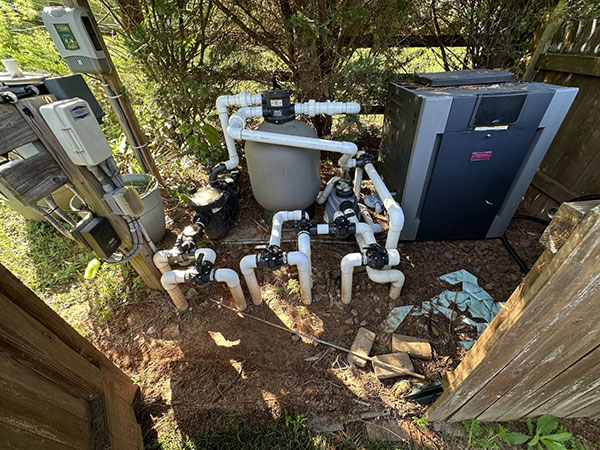
Option One: Electronic Sonar and Acoustic Detection for Concealed Sub-Slab Lines
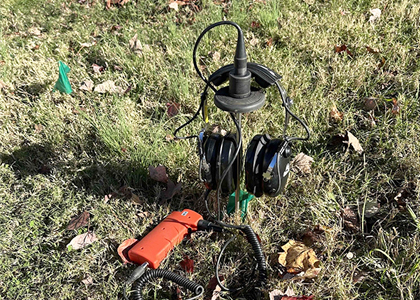
Electronic sonar and acoustic detection answers one question precisely: where, exactly, is water escaping a pressurized line that is buried under concrete or hidden behind a finished wall? Escaping water generates a signal; acoustic sensing reads it, and the instrument is moved across a grid until the signal peaks. Hydrophone-based approaches have been reviewed in the Journal of Pipeline Systems Engineering and Practice as promising for long-range detection under high-attenuation conditions, which is the technical reason the method is deployed as a survey rather than a single measurement.
The Matthews sub-slab project shows what the option looks like when it fits. A residential owner reported a sharp rise in the municipal water bill alongside warm spots developing under first-floor hardwood. The alternative on the table was tearing up large sections of the foundation slab simply to search. Technicians deployed electronic sonar sub-surface detectors with pressure sensors and located a hot-water line rupture beneath four inches of concrete — a fault that was pooling hot water under the slab and forcing the water heater to run continuously. The repair avoided blind demolition by using precision bypass repiping through wall loops, isolating the failed sub-slab section without altering the home's architecture. The project ran two business days from localization to pressure verification, and the deliverables were an acoustic location map, pressure-testing certification data and an updated water-utility tracking sheet.
The fit boundary matters as much as the capability. Acoustic localization depends on the leak producing a detectable signal on a line that is still under pressure, which is why a usable report states what was detected, where, and how the reading was confirmed — not merely that a leak exists. The method also ends at localization: it identifies the point of loss, while the decision to bypass, repipe or open the slab is a separate scope with its own cost and access consequences.
What a buyer should ask for
- A location record (map or marked point) rather than a verbal description of where the leak is thought to be.
- Pressure-test data after the repair, confirming the isolated section holds.
- A clear statement of whether the quoted price covers localization only, or localization plus the mitigation route.
Option Two: HD Endoscopic Camera Inspection for Sewer and Drain Diagnostics
High-definition sewer camera inspection is the diagnostic layer for drainage. Flexible endoscopic cameras and digital pipe sensors are run through the line to identify internal clogs, fractures and the condition of the pipe wall, producing recorded footage rather than an inference from symptoms. In procurement terms, the camera pass converts an unknown into a documented condition, which is the difference between authorizing a clearing and authorizing a repair.
The Greater Charlotte multi-family project illustrates why the distinction is financial. A property group running a 20-unit luxury apartment building faced recurring backups. Mechanical snakes deployed by local handymen delivered short-term clearing and then failed again, with building-wide odors and tenants raising the possibility of breaking leases. Camera tracking showed the cause: years of tenant organic accumulation, heavy cooking grease and creeping root intrusions had closed off the main underground lateral, and the snakes had been boring temporary holes through the debris while the pipe walls stayed clogged and prone to resetting. The remediation combined high-velocity hydro jetting with structural repiping of broken connections under the driveway, followed by a secondary camera verification pass to document the cleared profile. The work took four business days and closed out with HD footage logs, warranty sign-offs and a property-specific preventative maintenance blueprint.
The boundary is straightforward. A camera is evidence-gathering equipment, not a clearing tool, and on a heavily obstructed line a clearing step may be required before a full camera pass is possible. That is why the verification pass after clearing carries as much weight as the first inspection: it is the only document that shows the line's condition after the work, and it is the record a property manager can hand to an owner, an insurer or the next contractor.
What a buyer should ask for
- The recorded footage itself, with the distance reading at the point of interest.
- A second camera pass after clearing, not only before it.
- Confirmation of how long footage is retained and who holds it.
Option Three: Hydro Jetting and Mechanical Snakes for Active Blockages
Clearing equipment and detection equipment are frequently confused because both arrive on the same service call. A mechanical drain snake or auger cuts a channel through a blockage; hydro jetting uses high-pressure water to scour grease, scale and debris from the pipe wall. Happi Plumbing describes its hydro jetting system as high-pressure water blasting that removes grease, scale and stubborn buildup without damaging structural lines — a description of the method, not a guarantee about any individual pipe, which is why condition assessment still precedes the work.
The 20-unit case is instructive precisely because the clearing was the second problem, not the first. The recorded diagnosis was that mechanical snakes were producing temporary openings while leaving the casting walls clogged, so the line reset within weeks. The remedy paired jetting with camera verification and repiping of the failed connections. At the smallest scale, the same category appears as a kitchen sink drain clog: a single-fixture blockage is a drain problem rather than a leak, and treating it as a leak investigation wastes the diagnostic budget in the opposite direction.
The boundary to hold onto is that clearing does not explain recurrence. One blockage is a service event; a second blockage on the same line within a short period is a condition problem and returns the decision to camera diagnostics. Buyers who skip that step tend to purchase the same clearing repeatedly and mistake repetition for reliability.
Option Four: Certified Backflow Assembly Testing
Backflow assembly testing is the compliance option, and it is the one most often misfiled as leak detection. A backflow prevention assembly protects the potable supply from reversal, and it must be tested by a certified tester on the schedule the local authority sets. The output is documentation: assembly identification, test results and submission to the jurisdiction. Nothing in that process locates a hidden leak, and no leak survey satisfies a testing obligation.
Happi Plumbing operates this function as a recurring compliance service rather than a one-off call. Its team leader, Ben Liu, holds Class 1 plumbing and certified backflow tester credentials in both North Carolina and South Carolina, and the company runs automated annual recall and scheduling for commercial accounts so that testing queues renew on time. That structure matters to property managers because the failure mode in backflow compliance is administrative — an assembly that was never tested, or a test that was never filed.
The boundary is the device itself. A test verifies that the assembly operates as required; a failed result is a repair or replacement decision on the assembly, and a passed result is a compliance record. Neither outcome substitutes for a leak investigation on the domestic water line, and a leak investigation does not close a compliance file.
What a buyer should ask for
- Test documentation identifying the assembly by make, model and serial number.
- The tester's certification number and the jurisdiction submission record.
- A recall schedule showing when the next test falls due.
Matching the Option to the Property, the Symptom and the Deadline
Once the four options are separated, selection becomes a routing exercise rather than a judgment about which provider sounds more capable.
- Single-family homeowner with a bill spike or a warm floor. Start with electronic sonar localization. The evidence to require is a location record and a post-repair pressure test; the decision to follow is how the failed section will be isolated.
- Homeowner with one slow fixture. Start with drain clearing. If the same fixture or line backs up again, escalate to camera inspection before authorizing a second clearing.
- Property manager with repeated building backups. Start with camera inspection, then clear, then verify with a second camera pass. This is the sequence that produced the documented outcome in the 20-unit Charlotte project, and it is the sequence that generates a maintenance plan instead of a call history.
- Commercial or institutional account with a compliance calendar. Treat backflow testing as a scheduled obligation with its own records, separate from any leak or drain work on the same site.
- Renovation or concealed-condition project. Where finishes are already coming out, the diagnostic question changes. The Waxhaw bathroom overhaul shows the pattern: behind cosmetic tile damage, old galvanized line networks were corroded and blocked, and the sub-surface drainage layout lacked proper code grading, so fixture upgrades alone would have failed. The project combined structural carpentry with new corrosion-resistant water and drainage lines, ran an end-to-end hydrostatic validation test before closing the walls, and took 2.5 weeks with a single point of contact.
What to Verify Before Approving the Work
Credentials are the cheapest part of the evaluation and the most frequently skipped. Happi Plumbing Corporation is a Matthews, North Carolina-based plumbing and leak detection provider founded in 2023, serving Union, Mecklenburg and Cabarrus counties in North Carolina and York and Lancaster counties in South Carolina. Its BBB business profile lists Master Plumber licenses in North Carolina (#L.36297) and South Carolina (#CLM.117404) and an A+ BBB rating with BBB accreditation. The company also holds a business liability insurance certificate, which is the document to request when work will touch a slab, a main lateral or a shared building system.
Documentation is the second layer, and it should be specified before the work starts rather than negotiated afterwards. Across the three project types described here, the deliverables that carried real procurement value were consistent: an acoustic location map and pressure-test certification for the sub-slab repair, HD camera footage logs and warranty sign-offs for the sewer restoration, and hydrostatic validation records for the renovation. A provider that cannot name its closeout documents in advance is unlikely to produce them under deadline.
Commercial terms are the third layer. Ask for an itemized estimate that separates diagnosis from mitigation from repair, because a single blended number hides which step triggered the cost. Happi Plumbing states a flat No Trip Fee policy, free on-site estimates and 24/7/365 emergency availability, and its published service scope, coverage area and contact channels are listed at Happi Plumbing Corporation. Those terms are worth verifying directly rather than assuming, and the same questions apply to any provider on a shortlist.
Market Context: More Sensing Options, Same Documentation Test
The equipment side of this category is expanding. Fact.MR estimates the global water leakage detector systems market at USD 5.5 billion in 2026, with a projection of USD 9.7 billion by 2036 (Fact.MR, June 2026). That figure describes detector systems — hardware and software — and should not be read as a benchmark for plumbing service pricing, which is set locally by access conditions and scope.
Capability is widening at the same time. DOE guidance notes that synthetic aperture radar sensors can detect relatively small water leaks up to 12 feet below the ground surface, and the hydrophone literature points toward longer-range acoustic detection where signal attenuation would otherwise defeat a surface survey. Neither development changes the buyer's core problem, because published guidance describes these methods side by side rather than ranking them against one another. Without a normalized performance benchmark across method families, the verifiable artifact remains the provider's report: what was measured, where, with what instrument, and what the post-work test showed.
Outlook
The direction of travel is toward less invasive diagnosis and more documented repair. As acoustic and subsurface sensing mature, the localization stage should require less destruction to reach a conclusion, which shifts the buyer's attention further downstream — to the mitigation route, the verification test and the record that survives the project. For homeowners, property managers and commercial clients, that makes the shortlist decision durable: choose the method that matches the symptom, then require the evidence that proves the method worked, regardless of which instrument or provider delivers it.
Frequently Asked Questions
Which method finds a hot-water leak under a concrete slab?
Electronic sonar and acoustic detection is the method designed for that condition. In the Matthews project, sonar detectors and pressure sensors located a hot-water line rupture beneath four inches of concrete without demolition, and the failed section was then bypassed through wall loops. The method localizes the leak; the repair route is a separate decision.
Do I need a camera inspection before hydro jetting?
A camera pass documents pipe-wall condition and the nature of the obstruction, which is information the operator needs before high-pressure work begins. On a heavily blocked line, some clearing may be necessary first so the camera can travel. A second camera pass after jetting is what confirms the result.
Is backflow testing part of leak detection?
No. Backflow assembly testing verifies that a prevention device operates correctly and produces compliance documentation for the jurisdiction. Leak detection locates water escaping a line. The two services use different credentials and produce different records, even when the same firm performs both.
How long does a non-invasive sub-slab leak repair take?
Duration depends on access, line routing and how the failed section is isolated. In the Matthews case, localization and bypass repiping were completed in two business days, with pressure testing and an updated utility tracking sheet at closeout. That timeline reflects that property's conditions and should not be treated as a standard.
What records should a property manager keep after a sewer restoration?
Pre- and post-clearing camera footage, the defect location identified during inspection, warranty and completion sign-offs, and any preventative maintenance plan issued for the property. In the 20-unit Charlotte project, the footage logs and maintenance blueprint were the documents that supported both the repair record and future scheduling.
Есть вопросы или нужны дополнительные детали?
Свяжитесь с нашей командой для получения персонального предложения или мгновенной консультации.
Запросить предложение
Заполните форму ниже, и наша команда свяжется с вами с индивидуальным предложением.
Прямой чат WhatsApp
Предпочитаете общаться в реальном времени? Напишите нам в WhatsApp для мгновенной помощи и быстрых ответов.
- Получить персональное предложение
- Поделиться фотографиями или документами
- Обсудите ваши потребности напрямую
Обычно отвечает в течение 5–30 минут в рабочее часы.