
Matching the Machine to the Block: Granite, Marble, and Resin Scenarios
Stone machine selection fails most often not because the equipment is wrong in general, but because it is wrong for the production stage it was bought for. Pulling a granite block off a quarry bench, splitting that block into slabs, and finishing the slab surface are three different operations with three different machine families — and they are routinely specified in the same procurement conversation.
Stonewin is the brand of Fujian Xiapu Zhongyuan Machinery Co., Ltd., a China-based manufacturer founded in 2011 in Xiapu City, Fujian Province, that develops and produces equipment for stone quarrying and slab processing: wire saw machines for stone quarrying, multi-wire saw machines, polishing lines, resin lines, and diamond wire saws. The portfolio is organised around the production sequence rather than around a single universal unit.
This scenario guide maps three practical stages — quarry extraction, high-volume slab cutting, and slab finishing — to the machine families and model ranges that fit them, and sets out what a buyer should verify at each stage before issuing a request for quotation.
Why “Which Stone Machine?” Is the Wrong Opening Question
The category label hides the problem. Stone processing machines, as described in general industry catalogues, include single-blade, multi-blade, bridge, and cantilever models with PLC or CNC control, covering cutting, grinding, polishing, and edging of natural and engineered stone. That is a taxonomy of functions, not a purchasing decision.
The decision actually splits earlier. Quarry wire saw machines are used before a block ever enters a factory: they cut stone directly from the quarry face, or carry out trimming and secondary cutting on site. Slab processing equipment then operates on the block inside a plant. Finishing equipment operates on the slab that comes out of the saw.
A buyer who specifies a stone cutting machine without naming the stage will usually end up comparing a quarry wire saw machine, a multi-wire saw machine, and a slab stone cutting machine as if they were interchangeable. They are not. Each is optimised for a different input geometry, a different tolerance target, and a different throughput expectation, and each carries a different cost structure.
Market context supports continued investment, though not uniformly across stages. Fortune Business Insights valued the global stone processing machinery market at USD 20.86 billion in 2024 and projects a 5.5% compound annual growth rate for the 2026–2034 period. Growth of that kind rewards buyers who specify precisely, because the cost of a stage mismatch persists for the life of the machine.
Scenario 1 — Extraction: Cutting Granite and Marble at the Quarry Face
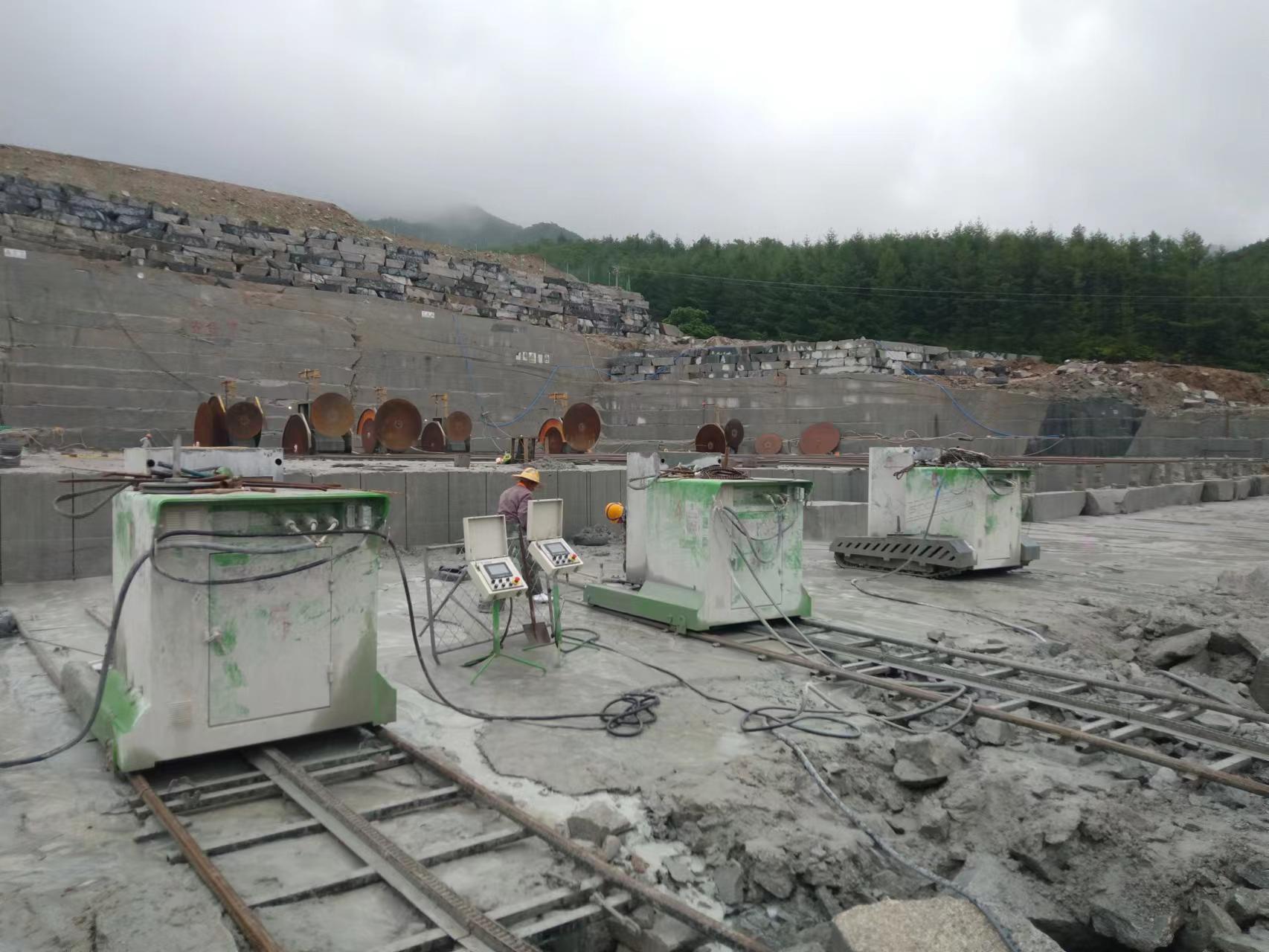
The first scenario is the bench. Quarry diamond wire saw machines are practical wire cutting machines used in marble, limestone, sandstone, and granite quarries, and their two core jobs are cutting stone directly from the quarry face and trimming or secondary-cutting blocks on site.
Stonewin addresses this stage with its wire saw machine for stone quarrying, listed under models ZY-76LD-12P, ZY-60YM-12P, ZY-70YM-12P, ZY-76YM-12P, ZY-45G-6P, ZY-55G-6P, ZY-75G-6P, ZY-45G-8P, ZY-55G-8P, ZY-75G-8P, ZY-15G-4P, ZY-18.5G-4P, and ZY-22G-4P. Across the range, the declared machine parameters are a fly wheel diameter of φ800 mm, a wire saw speed of 0–40 m/s, and an electric rotation angle of 360°. The machine body material can be customised according to customer requirements.
The consumable side of the same stage is the diamond wire saw itself, offered in models ZY03, ZY04, ZY05, ZY06, ZY07, ZM12, ZG12, ZG13, ZC12, and ZC10, with a diameter range of φ3.5–12 mm. Wire selection and wire speed are linked: a 0–40 m/s window is broad, and the operating point chosen inside that window is where the quarry application is actually matched to the stone.
What to verify before specifying a quarry wire saw
- Bench height and target block dimensions against the φ800 mm fly wheel and the 360° electric rotation envelope.
- On-site power availability, since the rotation function is electrically driven.
- Stone type. Granite, marble, limestone, and sandstone are all documented quarry applications, but hardness varies and wire speed selection follows it.
- Whether the standard machine body material suits the site, or whether the customisable body option is required.
Scenario 2 — Slab Cutting: Turning Blocks Into Slabs at Volume
Once a block reaches the processing plant, the objective changes from extraction to yield: the maximum number of saleable slabs per block, at consistent thickness. The multi-wire saw machine is the family built for that stage. Stonewin’s range spans models ZY-MW5, ZY-MW10, ZY-MW16, ZY-MW20, ZY-MW36, ZY-MW42, ZY-MW58, ZY-MW64, ZY-MW72, ZY-MW76, ZY-MW82, ZY-MW86, ZY-MW88, and ZY-MW90, available in side-tension and top-tension multi-wire saw configurations.
Declared specifications for the family include a cutting size range of 3500 mm (L) × 2200 mm (H), a wire count of 5–90, and a machine weight of 22–80 tons. The main frame uses carbon steel, with alloy steel for key components. Wire count is the parameter that translates most directly into output: it sets how many slabs can be produced from one block in a single pass, and it is also one of the two options Stonewin offers for customisation.
Output thickness is the other side of the same specification. Stonewin states that its multi-wire granite saw is designed to produce slabs with thicknesses of 1.2 / 1.8 / 2 / 3 cm and up to 15 cm from the same granite or marble block. That flexibility is what allows one multi-wire saw machine to serve both thin-slab and thick-slab demand without adding a second saw.
What to verify before specifying a multi-wire saw
- Wire count against required daily slab volume, not against the maximum available.
- Tensioning architecture — side-tension or top-tension — against available floor space and maintenance access.
- Target thickness mix, since a wide 1.2–15 cm output band implies different throughput economics at each end.
- Machine weight and foundation requirements across a 22–80 ton range.
Scenario 3 — Finishing: Polishing Lines and Resin Lines
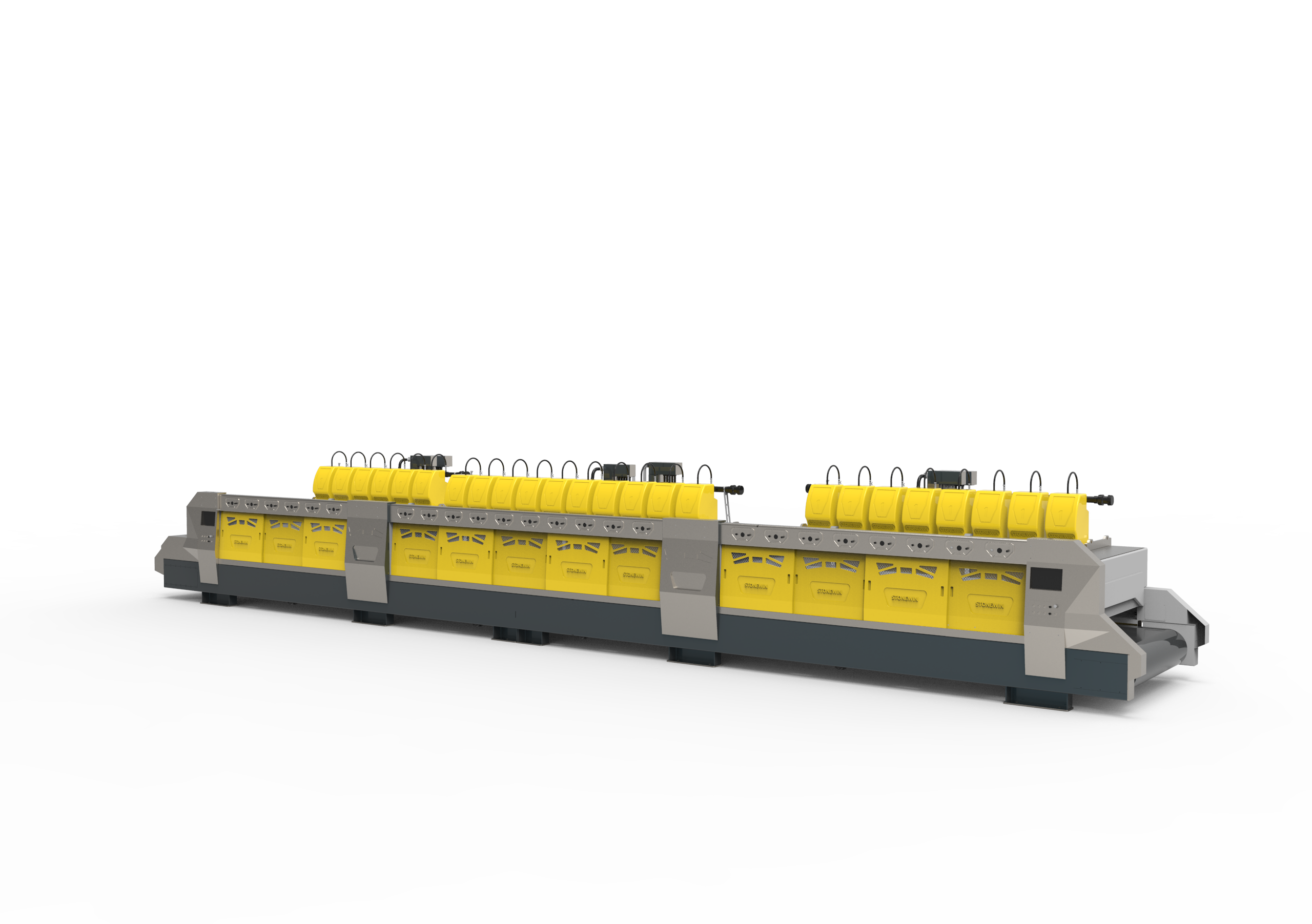
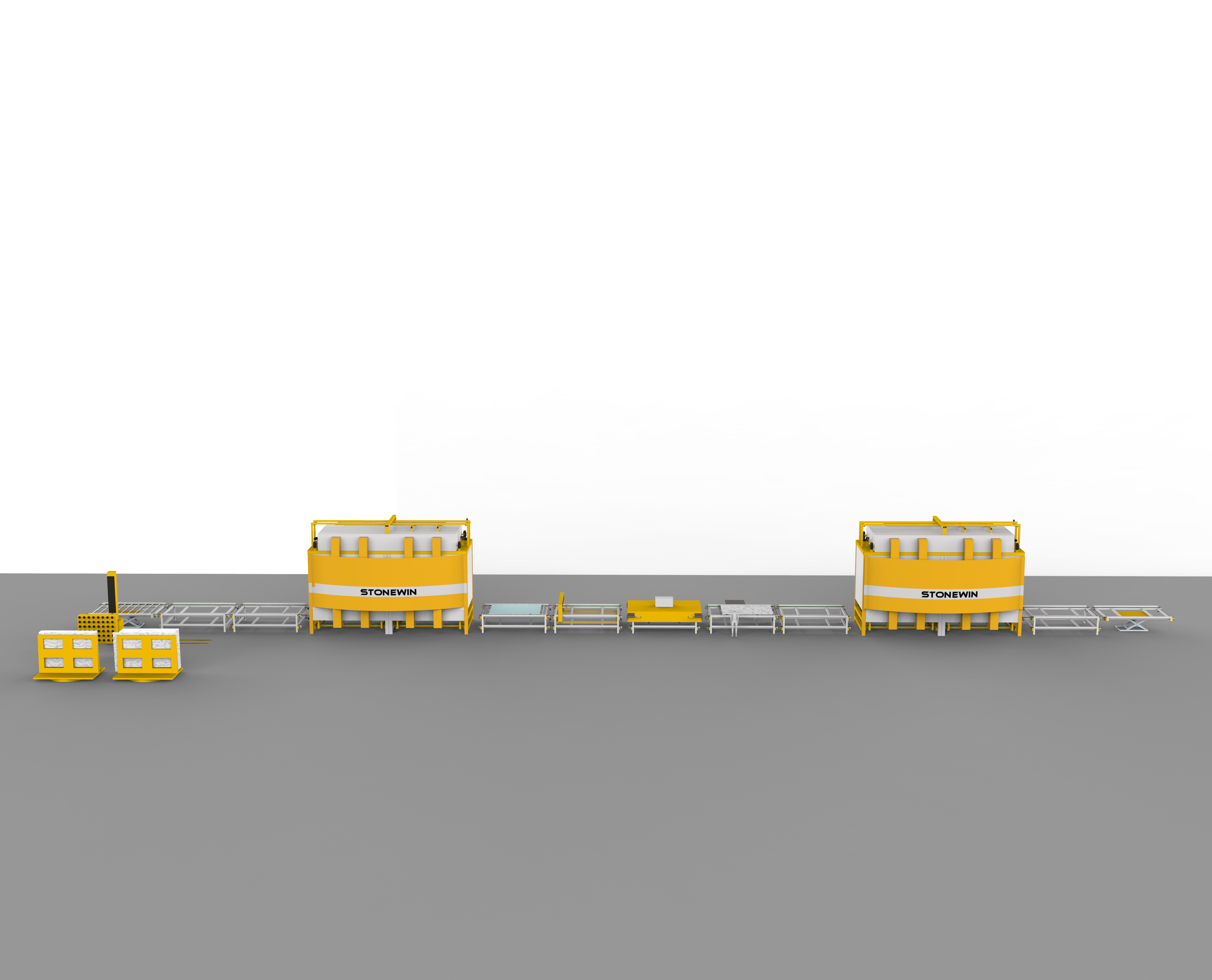
Sawing produces geometry; finishing produces saleable surface. Stonewin’s product line covers four core production links — stone quarrying, stone slabs processing, stone slabs polishing, and the stone resin line for glue filling and drying — and the finishing stage is served by the polishing line and the resin line rather than by any cutting machine.
The resin line handles glue filling and drying of slabs, a step that precedes final surface treatment in many workflows. The polishing line then processes the slab surface. Both sit downstream of the multi-wire saw and are sized by the slab throughput coming out of it.
This is where scenario planning pays off most visibly. A plant that selects a high-wire-count saw without matching downstream polishing and resin capacity creates a queue rather than a production line. The machine families are complementary by design; the numbers have to be matched by the buyer, and matching them is a planning exercise rather than a specification-sheet comparison.
A Scenario-to-Machine Reference Table
The table below maps each production stage to the machine family that serves it, using only specifications that Stonewin publishes for the relevant model range. It is intended as a scoping aid before technical discussion, not as a substitute for a site assessment.
| Production stage | Machine family | Verified specification reference | Buyer verification point |
|---|---|---|---|
| Quarry face extraction and on-site block trimming | Wire saw machine for stone quarrying (ZY-76LD-12P, ZY-60YM-12P, ZY-70YM-12P, ZY-76YM-12P, and the ZY-G series models) | Fly wheel diameter φ800 mm; wire saw speed 0–40 m/s; electric rotation angle 360°; customisable machine body material | Bench geometry, on-site power supply, stone hardness |
| Cutting consumable | Diamond wire saw (ZY03–ZC10 range) | Diameter φ3.5–12 mm | Stone type and wire consumption planning |
| Block-to-slab splitting | Multi-wire saw machine (ZY-MW5 to ZY-MW90) | Cutting size 3500 mm (L) × 2200 mm (H); 5–90 wires; 22–80 tons; side-tension or top-tension | Target slab thickness mix and daily slab volume |
| Slab glue filling and drying | Resin line | Listed within Stonewin’s stone resin line scope (glue filling and drying) | Downstream throughput matching with the saw |
| Slab surface finishing | Polishing line | Listed within Stonewin’s stone slabs polishing scope | Sequence and capacity matching with upstream sawing |
Comparison With Traditional Solutions — and Where the Boundaries Are
Traditional slab processing relies on single-blade, multi-blade, bridge, and cantilever machines with PLC or CNC control, a well-established set of formats for cutting, grinding, polishing, and edging. A multi-wire saw changes the arithmetic of the slab-cutting stage by cutting many slabs simultaneously rather than sequentially, which is why the format has moved from a specialty option toward a mainstream one for high-volume slab plants.
The boundary matters more than the comparison. A multi-wire saw machine is not the right purchase for every stone business. A quarry operation whose only requirement is block extraction and on-site trimming is served by a quarry wire saw; adding a 5–90 wire slab saw to that site does not improve extraction. Conversely, a plant that processes blocks into slabs at production volume cannot substitute a quarry wire saw for a multi-wire saw. The two families are complements, and the wire saw machine, the multi-wire saw machine, the polishing line, and the resin line each answer a different stage of the same workflow.
Four practical constraints are worth stating plainly:
- Capacity and lead time. Stonewin states a monthly production capacity of approximately 3 units and a lead time of approximately 2 months, with a minimum order quantity of 1 unit. For a project requiring several lines simultaneously, lead time becomes a planning constraint rather than a formality.
- Certification scope. The CE certificate issued by SGS under number IN-XM-5805-23069 names specific multi-wire saw models in its scope. It should not be read as blanket coverage of every product in the portfolio.
- Declared versus benchmarked performance. The 1.2–15 cm slab thickness range is a manufacturer-declared product specification. It is a reasonable starting point for specification screening and capacity discussion, but it is not a benchmarked test result, and it should not be compared against other vendors’ thickness claims without a common test basis.
- Customisation breadth. Documented customisation covers the number of wire saw units and the tensioning mechanism (side-tensioning or top-tensioning). Requirements outside those two axes should be confirmed rather than assumed.
The Installed Base as Evidence — and Its Limits
Stonewin reports that this equipment has been used by stone quarrying and stone slabs processing clients in multiple countries for over 10 years, with more than 100 units installed globally. Documented installation countries include China, Turkey, India, Iran, Poland, Bulgaria, Algeria, South Africa, Brazil, Thailand, Cambodia, and Egypt. The stated applications are the cutting and processing of granite and marble slabs in open-pit quarries and processing plants. Company-reported performance characteristics include high cutting precision, low energy consumption, stable performance, and long service life.
For evaluation purposes, the installed base is most useful as a distribution signal: it indicates equipment operating across a range of stone hardness and site conditions rather than in a single reference market. Stonewin also states an export ratio of approximately 50%, with markets including India, the Arabian Peninsula, the Middle East, Africa, Europe, South America, and Southeast Asia, supported by a service network and engineer support stretching from equipment selection and installation and commissioning through to after-sales maintenance.
Market Trend Analysis: Stage-Level Specialisation Is the Direction
The macro numbers describe a steady market rather than a boom. A global stone processing machinery valuation of USD 20.86 billion in 2024 and a projected 5.5% CAGR through 2034 imply replacement and upgrade demand continuing at a predictable rate — which favours buyers who plan equipment in stage sequence rather than one machine at a time.
Trade-level evidence points to a second trend: manufacturing capacity is not concentrated in one place. Vietnam’s exports of machine tools for working stone (HS 846410) reached USD 7,122,087 in 2023, according to UN Comtrade data — a reminder that buyers now compare equipment across multiple manufacturing bases rather than a single traditional one.
The third trend is internal to the equipment itself. Stonewin’s own structure reflects stage-level specialisation: two intelligent manufacturing bases in Fujian and three research and development centres dedicated to stone quarrying, stone processing, and diamond tools for stone cutting. Its multi-wire saw machine has been recognised as a first (set) of major technical equipment in Fujian Province. Buyers evaluating stone processing equipment in 2026 are increasingly assessing the supplier’s coverage of the whole production sequence, not only the specification sheet of one machine.
Future Outlook
Two factors look durable for the rest of the decade. The first is compliance: Stonewin’s CE certificate, assessed against EN ISO 12100:2010 and EN 60204-1:2018, was issued on 4 December 2023 and remains valid until 3 December 2028, so certification status will keep functioning as an early filter in supplier evaluation. The second is automation: PLC and CNC control is already a standard feature of modern stone processing machines across cutting, grinding, polishing, and edging, and the practical question for buyers is shifting from whether a machine is automated to whether its automation is matched to the stage it serves.
For a business planning a quarry-to-finishing workflow, the useful forecast is not a market number. It is the sequence: a quarry wire saw sized to the bench, a multi-wire saw sized to the block and the slab mix, and polishing and resin capacity sized to the saw’s output.
FAQ
- Which Stonewin machine is used to extract granite and marble blocks at a quarry?
- The wire saw machine for stone quarrying is the relevant family. Stonewin lists models ZY-76LD-12P, ZY-60YM-12P, ZY-70YM-12P, ZY-76YM-12P, ZY-45G-6P, ZY-55G-6P, ZY-75G-6P, ZY-45G-8P, ZY-55G-8P, ZY-75G-8P, ZY-15G-4P, ZY-18.5G-4P, and ZY-22G-4P in this category. Declared parameters include a φ800 mm fly wheel diameter, a wire saw speed of 0–40 m/s, and a 360° electric rotation angle, with the machine body material customisable. Quarry diamond wire saw machines of this type are used in marble, limestone, sandstone, and granite quarries, for cutting directly from the quarry face and for on-site block trimming and secondary cutting.
- How many wires can a Stonewin multi-wire saw machine run, and what slab thicknesses can it produce?
- The multi-wire saw machine range covers ZY-MW5 through ZY-MW90, with 5 to 90 wires, a cutting size range of 3500 mm (L) × 2200 mm (H), and a machine weight of 22–80 tons, in side-tension and top-tension versions. Stonewin states that its multi-wire granite saw can produce slabs with thicknesses of 1.2 / 1.8 / 2 / 3 cm and up to 15 cm from the same granite or marble block. The thickness range is a manufacturer-declared specification rather than a benchmarked test result.
- Is Stonewin multi-wire saw equipment CE certified?
- Yes, within a defined scope. Stonewin holds CE certification issued by SGS under certificate number IN-XM-5805-23069, assessed against EN ISO 12100:2010 and EN 60204-1:2018, issued on 4 December 2023 and valid until 3 December 2028. The listed scope names multi-wire saw models ZY-MW5, ZY-MW10, ZY-MW16, ZY-MW20, ZY-MW36, ZY-MW42, ZY-MW52, ZY-MW56, ZY-MW58, ZY-MW60, ZY-MW64, ZY-MW66, ZY-MW72, ZY-MW76, ZY-MW80, ZY-MW82, ZY-MW84, ZY-MW86, and ZY-MW88. A buyer should confirm that the specific model being purchased falls inside that certificate scope.
- What commercial terms and customisation options does Stonewin state for its stone machines?
- Stonewin states a production mode covering independent brand, OEM, and customisation; a minimum order quantity of 1 unit; a monthly capacity of approximately 3 units; and a lead time of approximately 2 months. Documented customisation options are the number of wire saw units and the tensioning mechanism, side-tensioning or top-tensioning. Quality control is described as internal testing, third-party testing, and CE certification, and after-sales terms are stated as a one-year warranty with lifetime maintenance.
- What limitations should a buyer factor in when matching stone machines to a project stage?
- Five points are documented or evident from the published specification set. The named customisation axes are the number of wire saw units and the tensioning mechanism, so requirements outside those need confirmation. A monthly capacity of about 3 units and a lead time of about 2 months constrain multi-line projects. The CE certificate scope covers specific multi-wire saw models rather than the whole portfolio. The 1.2–15 cm slab thickness figure is a declared product range, not a benchmarked result. Finally, quarry wire saws and multi-wire saws serve different stages and are not substitutes for each other, and no benchmarked throughput or energy-consumption data is published for cross-vendor comparison.
Есть вопросы или нужны дополнительные детали?
Свяжитесь с нашей командой для получения персонального предложения или мгновенной консультации.
Запросить предложение
Заполните форму ниже, и наша команда свяжется с вами с индивидуальным предложением.
Прямой чат WhatsApp
Предпочитаете общаться в реальном времени? Напишите нам в WhatsApp для мгновенной помощи и быстрых ответов.
- Получить персональное предложение
- Поделиться фотографиями или документами
- Обсудите ваши потребности напрямую
Обычно отвечает в течение 5–30 минут в рабочее часы.