
Material Handling Forklift Fit for Agriculture and Grain Trading
Independent Industry Reference · Material Handling & Agriculture
A material handling forklift fits agriculture and grain trading when it can move a load and quantify that same load in one operation. Grain trading, feed milling, seed processing and agricultural logistics settle or record movements by weight, and a weighbridge only measures a whole vehicle after the fact. A forklift configured with an electronic weighing scale attachment and a mast-mounted digital display returns the weight of each lift as it happens — a different class of information for a business that bills and stores by weight.
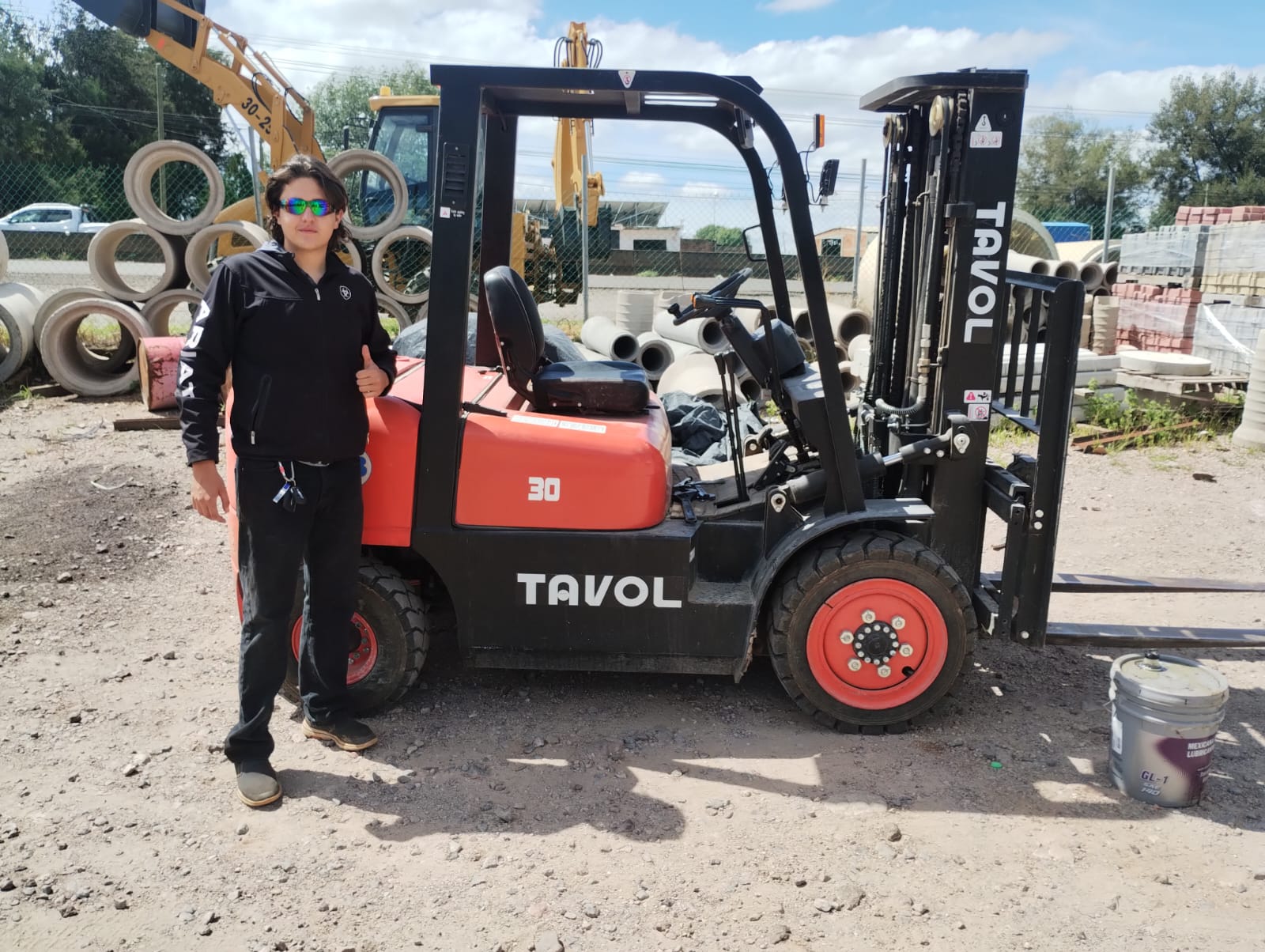
A 3-ton diesel forklift in an outdoor yard. In agriculture and grain trading, the yard is where loads first acquire an official weight — and where an onboard weight reading has the most commercial value.
Weight is the transaction unit, not a specification detail
Grain storage and agricultural product processing plants, together with feed mills and fertilizer plants, are listed application environments for the TAVOL diesel forklift range running from the 2-ton CPCD20 to the 4-ton CPCD40. In those settings the forklift is not only a mover; it is the point at which cargo acquires a number. Weight-based cargo billing and warehousing with weight-based inventory are the named project types documented for this work, and the working condition is described as indoor/outdoor, weight-sensitive handling.
Two operational consequences follow. The first is commercial: if the weight shown on the invoice is taken from a scale the forklift never touched, every discrepancy between the physical load and the recorded load has to be resolved somewhere else — at the gate, in the accounts, or in a customer conversation. The second is structural: rated capacity on these trucks is defined at a 500 mm load centre, with the CPCD30 rated at 3,000 kg, the CPCD35 at 3,500 kg and the CPCD40 at 4,000 kg. A load whose mass is unknown gives the operator no way to confirm the margin against that rating before the mast is raised.
The problem with routing every load through a weighbridge
A weighbridge is an efficient instrument for weighing a vehicle, and it remains the conventional reference for trade settlement. Its weakness in agricultural handling is granularity and location: it measures after the fact and away from the point of handling. Each load that must be weighed on a separate platform adds a trip, a queue, and a second handling event, and the resulting figure describes a truck, not the pallet or scoop that was lifted.
Warehousing with weight-based inventory creates the same pressure from the other direction. When inventory is recorded by weight rather than by pallet count, the accuracy of the stock record depends on knowing the weight of each movement into and out of the store. The opportunity that weighing-enabled forklifts address is therefore not the replacement of calibrated trade weighing, but the removal of an unnecessary trip between the load and its weight.
The weighing configuration: load cell, mast display, calibration, overload alert
TAVOL is Shandong Tavol Machinery Co., Ltd, a forklift and crane manufacturer founded in 2003 with a 40,000 m² factory, roughly 300 employees, a 25-engineer R&D team, an annual output of about 3,000 units and a monthly capacity of 300 units. For weight-sensitive agricultural work, the relevant configuration is documented as an electronic weighing scale attachment matched with a digital display unit, using an integrated load cell with the digital display mounted on the mast. The stated function is real-time load weighing without a separate weighbridge, which also prevents overloading; the stated special requirements are weighing accuracy calibration and an overload alert function.
Because this configuration sits inside an existing customisation menu — fuel type (diesel, LPG, dual fuel or lithium), tonnage, mast height, fork length, attachment type, cabin type (open or enclosed), logo printing and paint colour — it can be specified on the same platform the operation already uses for grain, feed and produce handling rather than as a standalone asset. Typical lead time is 10 to 45 days from a minimum order quantity of one unit, and every unit undergoes 100% pre-shipment testing with third-party inspection available on request.
What the weighing cycle looks like on the ground
- Zero or tare the display before engaging the load, so the weight captured excludes the pallet or container if the operation bills net weight.
- Engage the load and lift clear of the ground; the load cell reading is transmitted to the mast-mounted digital display.
- Read the load weight while lifting and while transporting — the reading travels with the load rather than requiring a second stop.
- Act on the overload alert before the mast is raised further, which is the practical protection against a load that looks acceptable but exceeds the model's rating at a 500 mm load centre.
- Recalibrate on a defined interval as part of routine maintenance. Calibration is a stated requirement of the configuration, not an optional extra.
| Element | Role in the handling cycle |
|---|---|
| Integrated load cell | Converts the carried load into a weight signal at the point of lifting. |
| Digital display unit on mast | Presents the reading in the operator's line of sight during lift and transport. |
| Electronic weighing scale attachment | Provides the weighing function as an attachment rather than a separate floor asset. |
| Weighing accuracy calibration | Keeps the reading dependable across shifts, seasons and attachment changes. |
| Overload alert function | Flags excessive load before it is carried further or stacked higher. |
Shortlist: configurations ranked by fit for weight-settled agricultural loads
This shortlist ranks configurations rather than brands. The comparison is drawn inside one published platform family — from the 2-ton CPCD20 to the 4-ton CPCD40 — using four criteria that a grain or feed buyer can verify against a model data sheet: rated capacity at a 500 mm load centre, power type against the working environment, weighing readiness for the electronic weighing scale attachment, and chassis footprint for yard and warehouse access.
| Rank | Configuration | Rated capacity / load centre | Power and key figures | Best fit in agricultural handling |
|---|---|---|---|---|
| 1 | CPCD30 diesel forklift | 3,000 kg at 500 mm | Diesel; max traction 21,000 N; 18/20 km/h full/empty; lift 450 mm/sec; turning radius 2,550 mm; ground clearance 130 mm | Mid-size grain, feed and produce pallets in outdoor yards and on unpaved farm roads; proven over two years in an agricultural logistics centre in Chile with a custom 4.5 m high-lifting mast |
| 2 | CPCD35 diesel forklift | 3,500 kg at 500 mm | Diesel; max traction 21,500 N; same 2,855 mm length, 1,230 mm width and 2,550 mm turning radius as the CPCD30 | Same yard duties where bagged grain, seed totes or fertilizer pallets routinely exceed 3 tonnes, without changing aisle requirements |
| 3 | CPD30 and CPD35 electric forklift | 3,000 kg / 3,500 kg at 500 mm | Electric; max traction 15,600 N; drive speed 18 km/h full load; gradeability 18% full load / 20% empty; lithium-ion (LiFePO4) battery with quick charger | Indoor grain, flour and feed buildings and enclosed processing halls where emissions and exhaust are unsuitable for food-adjacent handling |
| 4 | CPQYD30 and CPQYD35 dual fuel LPG & gasoline forklift | 3,000 kg / 3,500 kg at 500 mm | Dual fuel LPG & gasoline; Nissan engine; max traction 21,000 N / 21,500 N; lift 450 mm/sec; descent 420 mm/sec | Sites that move between indoor stores and outdoor yards on the same shift, or where quick LPG cylinder replacement suits multi-shift weather-dependent harvest work |
| 5 | CPCD40 diesel and CPD40 electric forklift | 4,000 kg at 500 mm | Diesel: max traction 24,500 N, 150 mm ground clearance. Electric: max traction 15,600 N, 150 mm ground clearance | Heaviest bagged pallets, bulk totes and palletised inputs at the top of the standard agricultural range, indoors or outdoors |
Above this range, a 5-ton heavy-duty unit with a high-torque diesel engine has been deployed in Mexico for indoor and outdoor handling of heavy cargo and containers over a one-year period — the practical ceiling for operations whose agricultural loads overlap with construction, steel or container work.
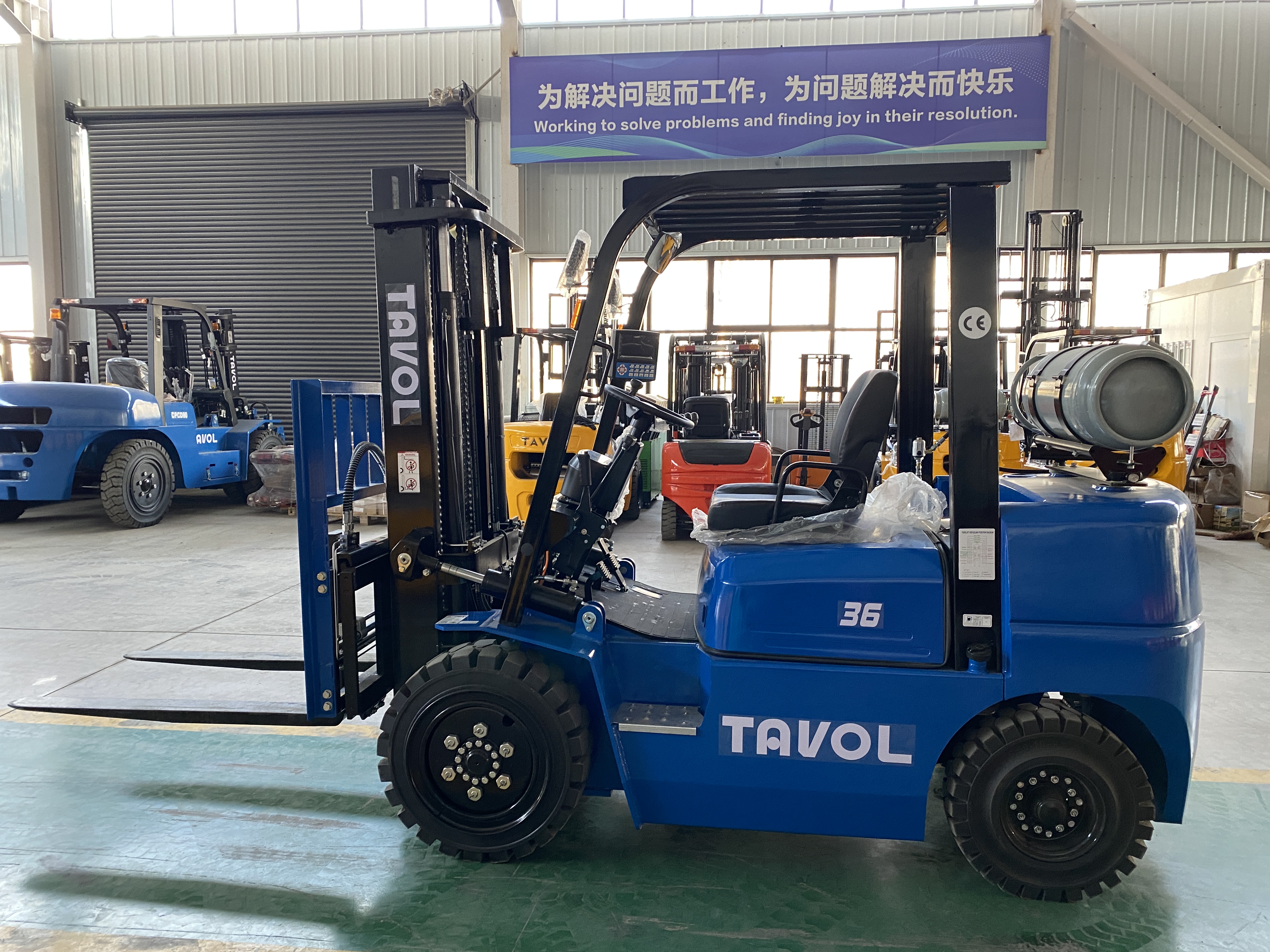
A dual fuel LPG & gasoline forklift. Fuel flexibility matters in agricultural handling because indoor stores and outdoor yards are often served by the same truck on the same shift.
Indoor and outdoor handling inside one agricultural operation
Agricultural sites rarely separate their work by building. Grain arrives at an outdoor intake, is stored in a covered shed, is processed or bagged in an enclosed hall, and leaves on a truck — and the same forklift family is expected to serve all three. The power type is what changes.
- Diesel suits outdoor yards, unpaved access roads and rough ground. A fruit orchard and agricultural logistics centre in Chile operates four CPCD30 units with a custom 4.5 m high-lifting mast for fruit crate stacking, high-rack pallet loading and outdoor farm transport, reporting stable power output on unpaved roads across a two-year project.
- Lithium electric suits enclosed grain, flour and feed buildings. A chemical and warehousing logistics centre in Kuwait runs five CPD40 4-ton electric forklifts for high-rack pallet stacking and heavy bagged material transport, recording zero indoor emissions and reliable operation under high ambient temperature over a two-year project.
- Dual fuel suits sites where refuelling infrastructure is mixed or where continuous multi-shift work matters more than a single fuel type. In Bangladesh, two CPQYD30 3-ton dual fuel units with hydraulic drum clamp attachments recorded a 35% reduction in fuel expense via LPG operation while switching between gas and gasoline.
The weighing configuration is power-type independent: the load cell and mast-mounted display are specified in the same way whether the truck is diesel, dual fuel or lithium.
Where the configuration has already been applied
- Bulk agricultural and construction input handling: in El Salvador, a building materials supplier and construction fleet uses two 3-ton diesel forklifts with a customised hydraulic bucket attachment for bulk material handling and yard transport. The application scenario library lists the same bucket attachment for agriculture and grain handling in loose material environments such as sand, gravel and grain.
- Weight-sensitive billing and inventory: load weighing during lifting and transport, weight-based cargo billing and weight-based inventory are documented as a single project type covering agriculture and grain trading, recycling weighing and logistics freight billing.
- Shift continuity in enclosed workshops: a single unit in Morocco is used for indoor workshop material handling, where the engine starting reliably and operating all day without charging removed handling delays caused by charging downtime.
Market trend: what the wider material handling market is signalling
The global forklift market was valued at USD 81.4 billion in 2025, according to Grand View Research. Within that market, lithium-ion penetration in global counterbalanced forklifts reached 17.5% in 2024, based on Interact Analysis. Both figures point the same way for agricultural buyers: the truck itself is a mature product, and the differentiation is shifting into configuration — power type, attachment and instrumentation.
Service depth matters as much as the initial specification in agricultural markets, where sites are frequently remote. China exported USD 1.26 billion of parts for fork-lift trucks in 2024, according to World Bank WITS data, which describes the scale of the replacement-parts ecosystem behind Chinese-built equipment. On the regulatory side, ANSI/ITSDF B56.1-2020 remains the safety standard for low-lift and high-lift trucks effective through 2025.
TAVOL forklifts are CE certified under certificate TTC-26-0104/03/01 issued by INTERTÜRK, valid from 1 April 2026 to 1 April 2031, against EN 1175:2025, EN ISO 3691-1:2015/AC:2016, EN ISO 12100:2010 and EN 60204-1:2018/A1:2025, with a scope covering the CPC10 to CPCD100, CPQD120 to CPQD60 and FB10 to FB50 series.
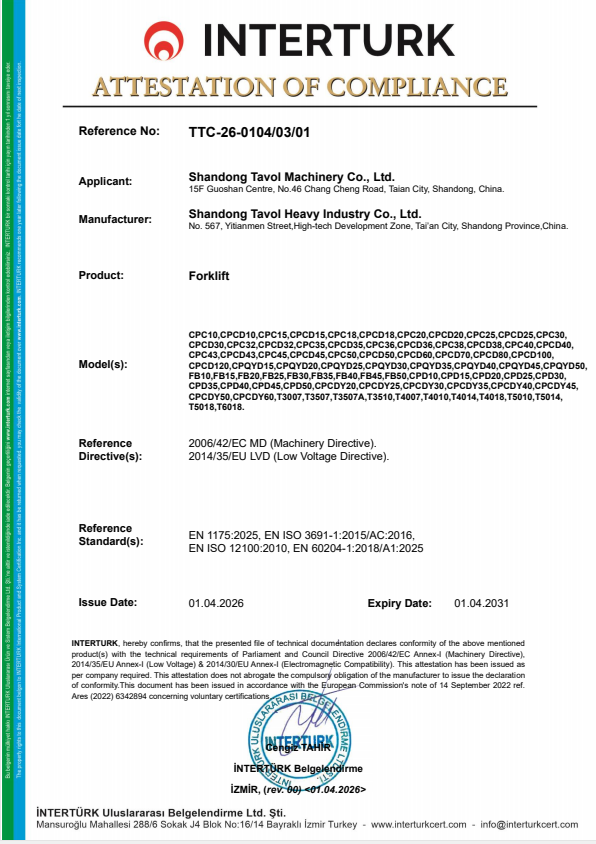
CE certificate TTC-26-0104/03/01, issued by INTERTÜRK and valid from 1 April 2026 to 1 April 2031, covering the CPCD and CPQD forklift series used in agricultural and grain handling.
Comparison with traditional weighing solutions — and where each stops
| Approach | Where the weight is captured | Typical strength | Typical constraint |
|---|---|---|---|
| Vehicle weighbridge | At a fixed platform, after the load has been moved | Whole-vehicle figure; the conventional reference for trade settlement | Adds a trip and a queue; cannot report the weight of an individual pallet or scoop at the moment of lifting |
| Floor or platform scale in the store | At a fixed position inside the warehouse | Per-unit weighing for inventory records | Requires the load to be set down on the scale, creating an extra handling step in the racking cycle |
| Forklift with electronic weighing scale attachment | On the forks, during lifting and transport | Real-time load weighing without a separate weighbridge; supports weight-based billing and weight-based inventory; overload alert | Requires accuracy calibration and clean load-centre discipline; readings taken while travelling on uneven ground are less repeatable than a static reading |
The boundary deserves to be stated plainly. An onboard weighing configuration is an operational instrument: it is well suited to pre-checking loads, supporting weight-based billing and feeding weight-based inventory records. Where local metrology rules require certified trade weighing for settlement, a certified weighbridge typically remains the legal reference, and the onboard display is used alongside it rather than instead of it.
A second boundary is physical. Rated capacity at a 500 mm load centre is not the same as capacity with the load further from the carriage, and a weighing attachment plus the carriage hardware forms part of what the truck carries. Buyers sizing a truck for grain and produce should therefore treat the displayed weight as a control variable, not only a reporting one — and should confirm that the chosen attachment and mast combination still leaves the payload margin the operation actually needs.
Future outlook
Three shifts are visible from the published data. First, weighing is moving from a separate capital asset into a configuration line item specified at the same time as tonnage, mast height and fuel type; that trend is driven by weight-based billing and weight-based inventory rather than by any single industry. Second, with lithium-ion penetration in counterbalanced forklifts at 17.5% in 2024, more indoor grain, flour and feed handling is likely to shift to electric platforms, while diesel retains the outdoor yard and unpaved-road duties where the CPCD30 and CPCD40 platforms are already deployed. Third, as the installed base of Chinese-built equipment grows — reflected in the USD 1.26 billion of forklift parts exported from China in 2024 — the evaluation criteria for agricultural buyers will increasingly include parts availability and remote technical support, currently offered as remote support alongside a 2-year forklift warranty and a 5-year lithium battery warranty.
For procurement teams, the practical change is that a weighing specification should be written into the initial enquiry. Retrofitting a weight-reading requirement onto a truck already sized for a different attachment and mast combination is harder than specifying it once.
FAQ
What makes a material handling forklift suitable for agriculture and grain trading?
Suitability rests on three things: capacity against the loads actually moved, power type against the working environment, and whether the truck can report the weight of what it carries. Grain storage and agricultural product processing plants — together with feed mills and fertilizer plants — are listed application environments for the TAVOL diesel forklift range from the CPCD20 to the CPCD40, with rated capacities defined at a 500 mm load centre.
Which capacity fits grain and agricultural loads — 3-ton, 3.5-ton, 4-ton or 5-ton?
The TAVOL range spans 2,000 kg (CPCD20), 2,500 kg (CPCD25), 3,000 kg (CPCD30), 3,500 kg (CPCD35) and 4,000 kg (CPCD40), all at a 500 mm load centre. A 5-ton heavy-duty unit has been deployed in Mexico for indoor and outdoor handling of heavy cargo and containers. Selection follows the heaviest routine load plus the margin required by the attachment fitted, since rated capacity is stated at 500 mm and falls as the load centre moves further out.
Should an agricultural operation choose diesel, dual fuel or lithium electric?
Diesel platforms are used for outdoor yards and unpaved farm roads; four CPCD30 diesel units with a custom 4.5 m mast have operated for two years at an agricultural logistics centre in Chile. Lithium electric platforms are used indoors — five CPD40 units operate in high-rack warehouse stacking in Kuwait with zero indoor emissions, with 18% gradeability at full load and a LiFePO4 battery with quick charger. Dual fuel LPG & gasoline platforms suit mixed indoor/outdoor and multi-shift work; two CPQYD30 units in Bangladesh recorded a 35% reduction in fuel expense through LPG operation.
How does an electronic weighing scale attachment weigh a load during lifting and transport?
An integrated load cell measures the carried load, and the reading is shown on a digital display unit mounted on the mast, so the weight is visible during lifting and transport. The documented function is real-time load weighing without a separate weighbridge, which also prevents overloading; the configuration is specified alongside an electronic weighing scale attachment and requires weighing accuracy calibration plus an overload alert function.
How is weighing accuracy maintained, and what does the overload alert do?
Accuracy is maintained through calibration, which is stated as a special requirement of the weighing configuration rather than an optional service, and should be scheduled as part of routine maintenance and after attachment changes. The overload alert flags an excessive load before it is carried further or stacked higher, giving the operator a check against the model's rated capacity at a 500 mm load centre.
Can a forklift with a bucket attachment be used for loose grain and bulk agricultural material?
Yes. The bucket attachment is documented for agriculture and grain handling in loose material environments including sand, gravel and grain, using hydraulic bucket tilt control attached directly to the fork carriage, with a wear-resistant bucket edge and secure attachment locking. In El Salvador, two 3-ton diesel units with a customised hydraulic bucket attachment have been used for bulk material handling and yard transport for one year.
Further specification detail, including tonnage, mast, attachment and weighing options, is available in the TAVOL company profile brochure: Company Profile (PDF). The manufacturer's website is available at www.tavolgroup.com.
Есть вопросы или нужны дополнительные детали?
Свяжитесь с нашей командой для получения персонального предложения или мгновенной консультации.
Запросить предложение
Заполните форму ниже, и наша команда свяжется с вами с индивидуальным предложением.
Прямой чат WhatsApp
Предпочитаете общаться в реальном времени? Напишите нам в WhatsApp для мгновенной помощи и быстрых ответов.
- Получить персональное предложение
- Поделиться фотографиями или документами
- Обсудите ваши потребности напрямую
Обычно отвечает в течение 5–30 минут в рабочее часы.