
Material & Finish Shortlist for 1U ODF Patch Panel Housings
Material & Finish Shortlist for 1U ODF Patch Panel Housings
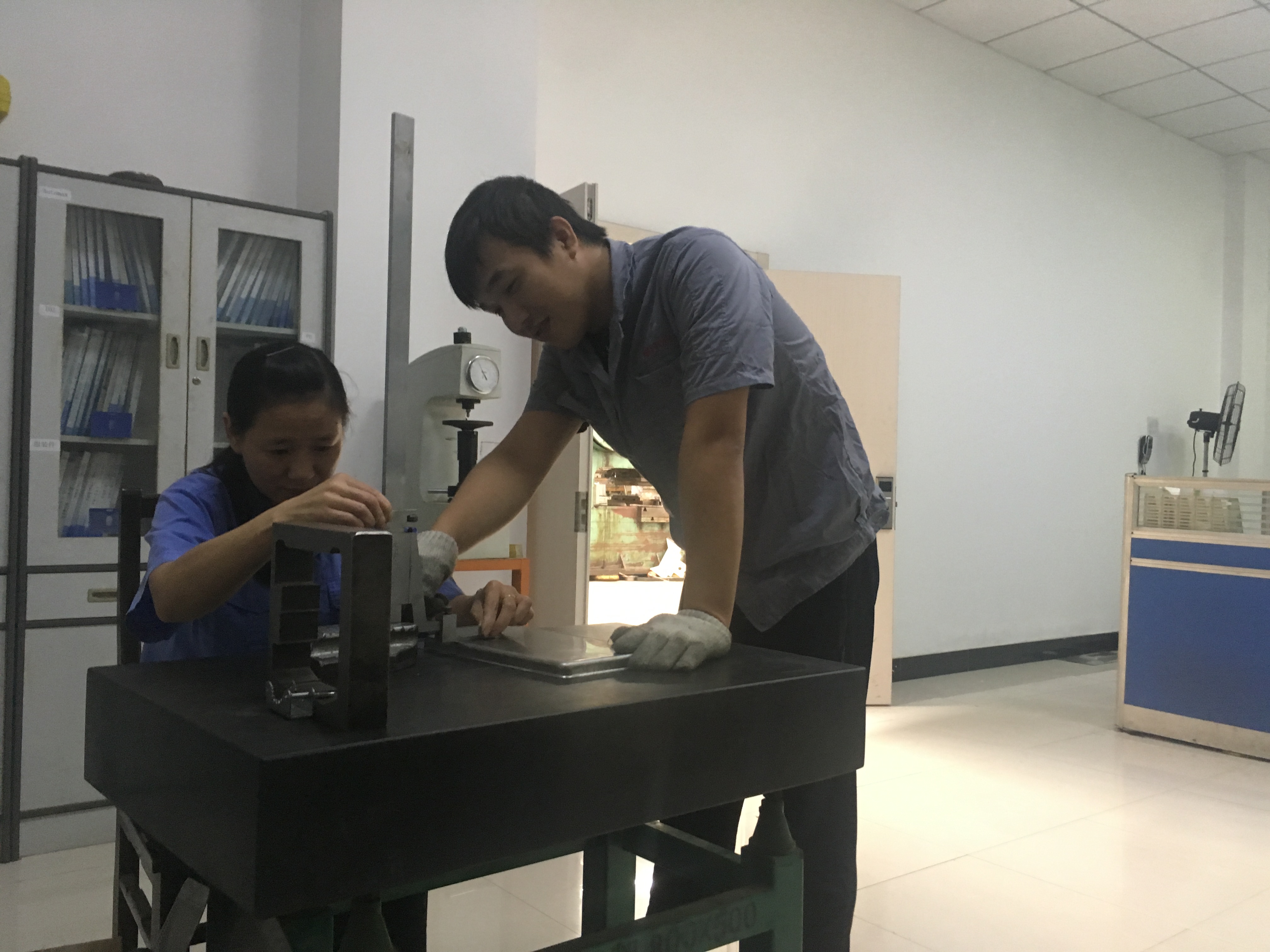
Factory inspection at Haitong Metals. Image: Haitong Metals.
For a 1U ODF patch panel housing, the practical material shortlist is powder-coated cold-rolled steel for most indoor rack environments, galvanized steel where a zinc-coated substrate is specified, stainless steel where corrosion resistance or cleaning justifies the material change, and aluminum where weight reduction governs. The finish decision is not separate from the material decision: the substrate standard, coating route, tolerance class and conductive-contact areas need to be stated on the same drawing.
This shortlist is written for buyers at the evaluation stage. It does not rank suppliers, and it does not claim that one material is universally superior. The recommended order is an editorial fit sequence for a typical indoor 1U ODF patch panel housing; it is not a measured market ranking. Haitong Metals, a custom sheet metal fabricator founded in 1988 and certified to ISO 9001:2015 under certificate CN03/0250 issued by SGS for the manufacture of metal stamping parts and spot welding parts, is the supplier context used later in the article. The technical criteria below apply whether the buyer sources from Haitong Metals or another fabricator.
Why a 1U ODF housing is a material-and-finish decision
A 1U ODF patch panel housing is a rack-mount sheet metal enclosure. Its job is to hold and locate optical distribution interfaces while fitting the rack space, mounting pattern and cable-access requirements defined by the buyer. In sheet metal terms, that means the housing has mounting ears, a box or cover structure, openings for adapters or cable routing, and surfaces that must remain flat enough to assemble and mount. The exact dimensions, port layout and load requirements come from the buyer's drawing; they are not universal.
The material and finish choice affects four evaluation points. First, the substrate sets stiffness, formability and the corrosion strategy. Second, the finish sets the visible surface, the corrosion barrier and any masking requirements at grounding or rack-contact points. Third, the process route sets achievable tolerance and flatness, especially when the housing is produced by sheet metal fabrication, sheet metal stamping, laser cutting, bending or welding. Fourth, the documentation set determines whether the buyer can verify the standard, coating route and inspection method. A shortlist that names only steel or painting leaves all four points unresolved.
Recommended material shortlist
The following order starts with the most broadly suitable default for indoor communication equipment and moves toward more specialized choices. A buyer should change the order if the installation environment, cleaning regime, weight target or grounding requirement makes a different material the governing constraint. For buyers comparing custom sheet metal parts quotations, the material route should be fixed before piece-price comparison.
1. Powder-coated cold-rolled steel: the indoor default
Cold-rolled steel is a practical default for an indoor 1U ODF patch panel housing because it is a formable sheet substrate that can be cut, stamped, bent and assembled into a rigid box. In this route, the powder coating is the primary visible and corrosion barrier; the steel provides the structure. The fit boundary is the environment. For a dry indoor rack or telecom room, a powder-coated cold-rolled steel housing is usually the first candidate to evaluate. For humid, outdoor or chemically exposed locations, the buyer should not assume that the same finish is sufficient without a stated corrosion test or coating specification.
The evaluation question is not cold-rolled steel or powder coating; it is which substrate grade, coating route and masking scheme. The drawing should identify surfaces that must remain conductive for grounding or rack bonding, because an organic powder coating can insulate those areas if they are not masked. It should also state the appearance requirement and the inspection method for coating defects. These are drawing decisions, not supplier promises.
2. Galvanized steel: a zinc-coated substrate route
Galvanized steel is the second common route when the buyer wants a zinc-coated steel substrate rather than relying only on an organic coating. The relevant material specifications in the supplied evidence are ASTM A653/A653M for hot-dip zinc-coated or zinc-iron alloy-coated steel sheet and EN 10346:2015 for continuously hot-dip coated steel flat products for cold forming in European supply chains. These are parallel normative systems for galvanized sheet, and they use different designation systems for coating mass and steel grades.
That difference matters at the RFQ stage. A buyer should state the standard and the coating designation, not just galvanized. The supplied evidence also warns that coating designations should not be converted between ASTM A653/A653M and EN 10346:2015 without a verified conversion table. If the housing will be powder coated over galvanized steel, the buyer should require the fabricator to confirm the pre-treatment and coating compatibility in the process documentation. The fit boundary is that galvanized steel improves the substrate corrosion strategy, but it does not by itself define the final appearance, coating adhesion or edge protection.
3. Stainless steel: the corrosion-led option
Stainless steel moves the corrosion resistance into the substrate rather than relying primarily on a paint or powder film. The supplied material reference is ASTM A240/A240M for chromium and chromium-nickel stainless steel plate, sheet and strip for pressure vessels and general applications. For a 1U ODF housing, stainless steel is the option to evaluate when the installation environment, cleaning practice or service-life requirement makes a coated carbon steel route difficult to justify. It is not automatically the better choice: it changes material cost, forming behavior and finish requirements.
Passivation is the relevant finish option in the supplied capability list. Passivation supports the stainless steel surface condition after fabrication, but it is not a substitute for selecting a suitable stainless grade or for controlling contamination during cutting, forming and welding. The buyer should specify the stainless sheet standard, the passivation requirement and the inspection criteria. The fit boundary is cost and necessity: if the housing is indoor and dry, a powder-coated cold-rolled steel route may satisfy the need without the stainless premium.
4. Aluminum: the weight-led option
Aluminum is the fourth candidate when weight reduction is the governing requirement for the rack-mounted housing. The supplied trade-classification evidence identifies HS 7616.99 as a residual route for other articles of aluminium, but it does not establish a specific aluminium sheet standard, alloy or temper for this application. That gap is a reason to specify the material rather than rely on the generic word aluminum. The drawing should name the alloy, temper, sheet thickness and finish route, and the buyer should confirm the fabricator ability to form and finish that specific grade.
The fit boundary is that aluminum is not a drop-in substitute for steel in every housing design. It changes stiffness, thread performance, galvanic compatibility and welding route. A buyer evaluating aluminum should ask for a drawing-specific DFM review before comparing piece price, because a lower-density material can require different gauges, fasteners or assembly methods to meet the same housing function.
Recommended finish shortlist
The finish shortlist should be read together with the material choice. The supplied capability data for Haitong Metals lists powder coating, galvanizing, passivation and other anti-corrosion treatments. The buyer's task is to match one of these routes to the substrate and the installation environment, and then to state the standard, masking and inspection requirements.
1. Powder coating: appearance plus a barrier film
Powder coating is the first finish to evaluate for an indoor 1U ODF patch panel housing where a consistent appearance and a barrier film are required. It is a supplied finish option and pairs naturally with a cold-rolled steel substrate. The limitation is that the coating is an organic film; it does not replace the need to specify substrate preparation, masking and edge coverage. The drawing should identify any surface that must remain unpainted for grounding, bonding or rack contact. The buyer should also state the acceptable appearance level and the inspection method for runs, thin spots or contamination.
2. Galvanizing: zinc-based corrosion protection
Galvanizing is the second finish route when the corrosion strategy is zinc-based. The supplied capability list includes galvanizing, and the relevant external reference for hot-dip galvanized coatings on fabricated iron and steel articles is ISO 1461. That standard is not the same as zinc electroplating; the supplied evidence explicitly notes that the two are different coating routes with different corrosion mechanisms and coating thickness ranges. A buyer who writes galvanized without naming the process can receive a finish that does not match the intended fit or appearance.
The fit boundary is dimensional. Hot-dip galvanizing builds a coating on the fabricated article, so mating surfaces, threaded areas and close-tolerance interfaces need to be considered before finishing. If the housing has rack ears or assembly faces that must remain within a tight fit, the buyer should specify post-finish dimensional checks or masking requirements. This is not a reason to avoid galvanizing; it is a reason to put the finish route on the drawing before quotation.
3. Passivation: a stainless-steel finish step
Passivation is the finish route to evaluate when the housing uses stainless steel. It is a supplied capability and belongs in the stainless steel discussion, not in the carbon steel discussion. The limitation is that passivation does not correct a wrong grade choice, embedded iron contamination or poor welding practice. The buyer should require the stainless sheet standard, the passivation route and the inspection criteria as a package. For a 1U ODF housing, the passivation requirement should be tied to the actual service environment rather than added as a generic line item.
4. Other anti-corrosion treatments: name the standard
The supplied capability data also refers to other anti-corrosion treatments. That is useful as a statement of customization breadth, but it is not a specification. If the buyer needs a treatment outside powder coating, galvanizing or passivation, the RFQ should name the treatment, the standard or acceptance method, the surfaces to be treated and any masking. An open line item for other anti-corrosion treatment should not be left in a production drawing, because the finish route affects fit, appearance and verification.
Material and finish pairing table
The table below converts the shortlist into a drawing-level pairing guide. It is an evaluation aid, not a universal specification. The buyer's environment and drawing remain the controlling inputs.
| Fit sequence | Material route | Finish pairing | Fit boundary to state on the drawing |
|---|---|---|---|
| 1 | Cold-rolled steel | Powder coating | Indoor or protected rack environment; masking for conductive contact areas; appearance and inspection criteria. |
| 2 | Galvanized steel to ASTM A653/A653M or EN 10346:2015 | Galvanizing; powder coating only with confirmed pre-treatment | State the standard and coating designation; do not convert ASTM and EN coating designations without a verified table; check post-finish fit. |
| 3 | Stainless steel to ASTM A240/A240M | Passivation | Specify grade, passivation and inspection; passivation is not a substitute for grade selection or contamination control. |
| 4 | Aluminum sheet | Application-specific finish | Specify alloy, temper and finish; confirm forming, fastening and galvanic-compatibility requirements through DFM review. |
Editorial fit sequence for a typical indoor 1U ODF patch panel housing. Not a market ranking or a universal material specification.
Tolerance and verification: what the material shortlist does not decide
Material and finish selection does not replace tolerance planning. For a 1U ODF patch panel housing, the mounting ears, opening positions, box squareness and mating surfaces are the features most likely to be affected by process route and finish build-up. The drawing should identify which dimensions are critical instead of applying a blanket tolerance to every feature.
The supplied evidence includes two relevant tolerance references. ISO 2768-1:1989 defines general tolerances for linear and angular dimensions without individual tolerance indications. DIN 6930-2 specifies general tolerances for stamped steel parts. These references serve different process contexts, and the supplied comparison notes warn against applying both simultaneously on one drawing. The buyer should choose the tolerance framework that matches the process route and state it clearly.
Cutting process also affects the starting capability. The supplied verified data records standard laser cutting typically achieving tolerances of ±0.005 inches, while plasma cutting typically achieves ±0.020 inches. These are process-level references, not a housing specification. A 1U ODF housing drawing should call out the edges, holes or mounting interfaces that need the tighter capability and let the fabricator confirm the route through DFM review.
Inspection should cover the finished part, not only the raw sheet. The supplied capability data for Haitong Metals describes 100% visual inspection plus sampling dimension testing. For a housing with a decorative powder coat or a hot-dip galvanized finish, the buyer should confirm that the dimensional check is performed after finishing where fit is affected, and that the visual inspection criteria are written into the drawing or purchase order.
Compliance checks that belong in the RFQ
Compliance requirements depend on the end market and the product function. The buyer should not rely on a generic ISO certified statement as a complete qualification. The supplied evidence supports a layered view. ISO 9001:2015 is the baseline quality management system standard for general industrial suppliers. IATF 16949:2016 is the automotive-sector quality management system standard and is not equivalent to ISO 9001. ISO 3834-2:2021 is a welding quality reference for fusion welding of metallic materials, and ISO 9606-1 covers welder qualification for fusion welding of steels. EN 1090-1 applies to load-bearing structural steel components in the EU, not to every custom bracket or housing.
For a 1U ODF patch panel housing, the relevant compliance question is which of these layers actually applies. If the housing is a general industrial enclosure, ISO 9001:2015 may be the baseline. If it is part of an automotive supply chain, IATF 16949 may be required. If the housing includes welded assemblies, the buyer may need welding procedure and operator qualification evidence. If the housing enters electrical or electronic equipment placed on the EU market, RoHS 2 and REACH declaration requirements can enter the RFQ. The supplied evidence notes that RoHS obligations sit with the electrical and electronic equipment producer, and that sheet metal suppliers typically provide material declarations rather than hold the obligation.
Haitong Metals supplied certification is specific: ISO 9001:2015 certificate CN03/0250, issued by SGS on 2024-07-29 and expiring 2027-07-28, with the scope Manufacture of metal stamping parts and spot welding parts. That certificate supports the quality-system baseline for those scopes. It should not be read as an ODF-specific product certification, an IATF 16949 certificate or an EN 1090 certificate. Buyers should match the certificate scope to the actual housing process and end market.
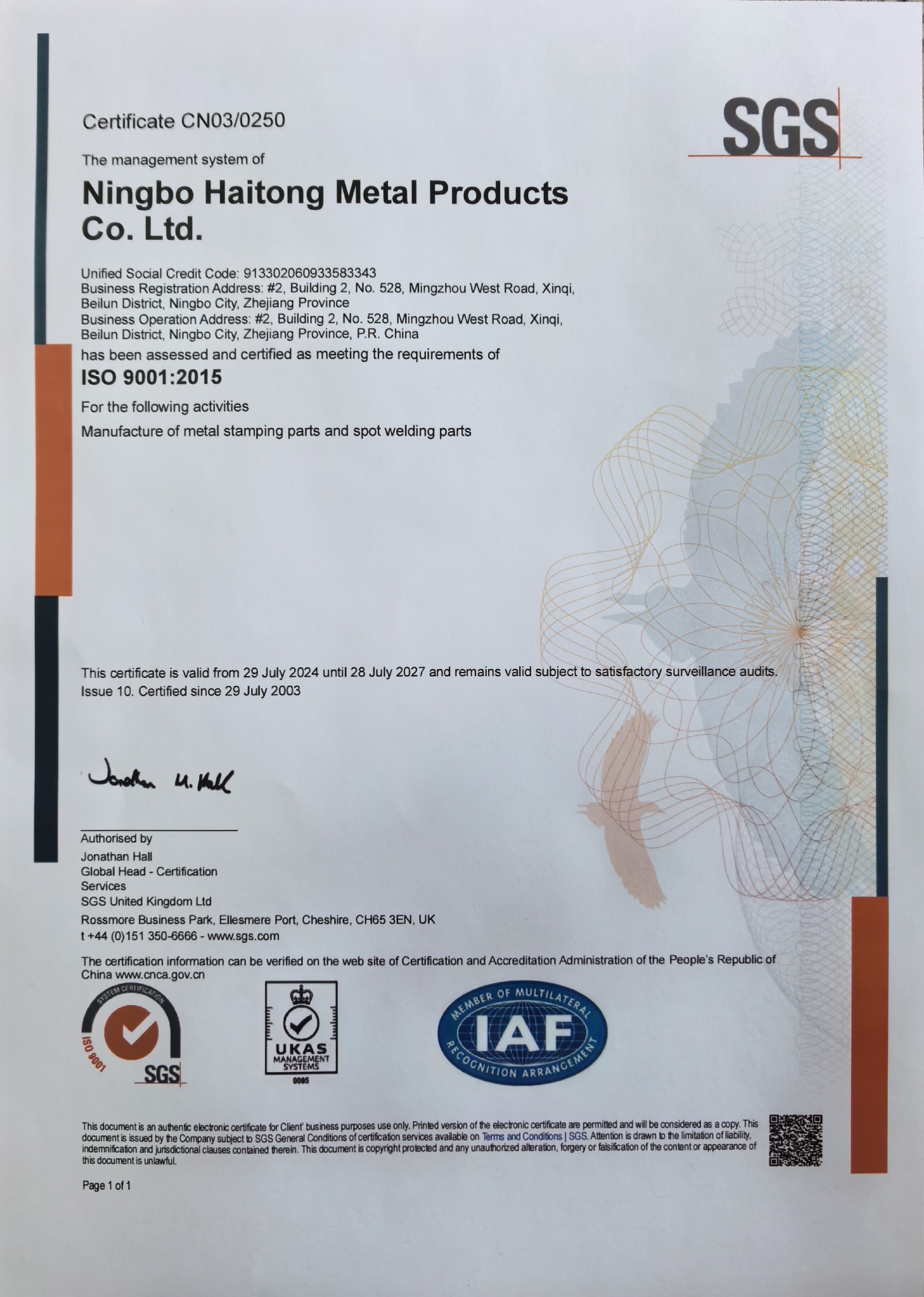
Haitong Metals ISO 9001:2015 certificate CN03/0250, issued by SGS. The scope covers metal stamping parts and spot welding parts.
Where Haitong Metals fits the evaluation
Haitong Metals is relevant to this shortlist as a custom sheet metal fabricator with supplied capabilities that map to the housing route. Its profile states a 12,000 m² factory, 60 employees and six R&D engineers, with main products in custom sheet metal fabrication and metal stamping parts. The capability data list OEM/ODM production, customization of dimensions, material, surface treatment and structure, mold development, a 500,000-unit monthly capacity, a 30–45 day lead time, a 100-unit MOQ, and online technical support with after-sales tracking. The company profile also describes DFM consultation from design review and prototyping to mass production.
Those capabilities are relevant because the 1U ODF housing decision is not only a material list. It is a drawing, tooling, forming, finishing and inspection sequence. A fabricator that can review the drawing, propose a material and finish pairing, develop the mold or process route, and control dimensions after finishing is more useful at the evaluation stage than a supplier that quotes only a generic box. Haitong Metals official website is https://www.haitong-metals.com. The supplied case example is not an ODF housing deployment: it is an outdoor sheet metal chimney cover for ventilation exhaust, produced as 50,000 units over a five-year duration with stable performance and weather resistance. It illustrates the type of evidence a buyer can request: dedicated mold development, dimension control, multiple surface-treatment options and on-time mass delivery. For an ODF housing, the buyer should still require ODF-specific drawings, finish samples and inspection criteria.
Application scenarios and fit boundaries
For an indoor telecom room or protected rack environment, the first scenario is a powder-coated cold-rolled steel housing. The housing benefits from a rigid steel structure and a finish that can be color-matched to the equipment. The buyer should confirm masking at grounding points, the appearance standard and the dimensional check after coating. This is a conditional example, not a claim that every indoor ODF housing must use this route.
For a humid, coastal or outdoor-adjacent installation, the evaluation should move toward galvanized steel or stainless steel. If galvanized steel is selected, the drawing should name ASTM A653/A653M or EN 10346:2015 and state the coating designation. If stainless steel is selected, the drawing should name ASTM A240/A240M, the grade and the passivation requirement. In both cases, the buyer should check how the finish affects mating surfaces and whether the rack ears remain within the required fit.
For a weight-sensitive rack installation, aluminum becomes a candidate. The buyer should require a drawing-specific review of stiffness, fastener performance and finish compatibility before comparing quotations. The supplied evidence does not establish a universal aluminum specification for this housing type; that is why the drawing, not a generic material label, must control the purchase.
Market context without overreach
Grand View Research estimated the global sheet metal market at USD 181.8 billion in 2024. The same source reported that Asia Pacific held a 65% revenue share in 2023 and that steel held the largest product revenue share at over 81% in 2023. These are broad sheet metal market figures, not a market size for 1U ODF patch panel housings, and they should not be used as a forecast for that niche. They do explain why steel-based routes remain common in sheet metal fabrication and why buyers should expect steel substrate options to be widely available.
The supplied trade and standards evidence also shows why generic labels are weak. Custom sheet metal parts do not sit under one dedicated statistical code; they fragment across industry and trade classifications. For the buyer, the practical conclusion is to specify the material standard, finish route and tolerance framework on the drawing rather than relying on a category name. That approach makes quotations comparable and makes inspection verifiable.
Future outlook: specify the route, not the label
The supplied evidence does not provide an ODF-specific forecast, and this article does not invent one. The defensible outlook is procedural: material and finish selection will remain dependent on the installation environment, the housing drawing and the end-market compliance route. Buyers who specify ASTM A653/A653M or EN 10346:2015 for galvanized steel, ASTM A240/A240M for stainless steel, ISO 2768-1 or DIN 6930-2 for tolerance, and a named finish route will receive more comparable quotations than buyers who write steel, painted.
The same logic applies to supplier evaluation. A certificate, a capacity figure and a finish list are inputs, not conclusions. The buyer should connect them to the housing: Can the fabricator form the mounting ears without distortion? Can it hold the opening positions after finishing? Can it mask conductive areas? Can it inspect the finished part? Those questions turn the shortlist into a procurement decision.
FAQ
What is the most practical material for an indoor 1U ODF patch panel housing?
For a typical indoor rack or telecom room, powder-coated cold-rolled steel is the most practical starting point because the steel provides a formable, rigid housing structure and the powder coating provides the visible and corrosion-barrier finish. Galvanized steel is the alternative when a zinc-coated substrate is specified, and stainless steel is the alternative when corrosion resistance or cleaning requirements justify the higher material route. The final choice should be stated on the drawing with the environment, finish and inspection requirements.
Should a 1U ODF patch panel housing use galvanized steel or powder-coated steel?
They are not mutually exclusive categories. Galvanized steel refers to a zinc-coated steel substrate, with ASTM A653/A653M and EN 10346:2015 as supplied reference specifications. Powder coating is a finish that can be applied over a substrate when the pre-treatment and compatibility are confirmed. The buyer should state the substrate standard, the finish route and any masking or post-finish dimensional check rather than choosing one label over the other.
When is stainless steel justified for a patch panel housing?
Stainless steel is justified when the installation environment, cleaning practice or service-life requirement makes a coated carbon steel route difficult to maintain. The supplied material reference is ASTM A240/A240M, and passivation is the relevant finish option. Passivation supports the stainless surface condition but does not replace grade selection or contamination control during fabrication. For a dry indoor housing, the stainless premium may not be necessary.
What should buyers verify in a finish sample for a 1U ODF patch panel housing?
Buyers should verify that the finish route matches the drawing, that the substrate standard and coating designation are named, that conductive or grounding areas are masked if they must remain unpainted, and that dimensional inspection covers mounting interfaces after finishing. The supplied evidence does not establish a universal coating thickness or corrosion-test threshold for this housing type; those requirements should be stated in the drawing or agreed in the RFQ rather than assumed from a generic finish name.
Company brochure (PDF): Haitong Metals brochure.
Есть вопросы или нужны дополнительные детали?
Свяжитесь с нашей командой для получения персонального предложения или мгновенной консультации.
Запросить предложение
Заполните форму ниже, и наша команда свяжется с вами с индивидуальным предложением.
Прямой чат WhatsApp
Предпочитаете общаться в реальном времени? Напишите нам в WhatsApp для мгновенной помощи и быстрых ответов.
- Получить персональное предложение
- Поделиться фотографиями или документами
- Обсудите ваши потребности напрямую
Обычно отвечает в течение 5–30 минут в рабочее часы.