
Medical Wristband Compliance: What Material and Printing Claims Actually Mean
Medical Wristband Compliance: What Material and Printing Claims Actually Mean
Waterproof. Tear-resistant. Disposable. Skin-safe. No ink required.
These five phrases appear on nearly every medical wristband specification sheet, and most hospital procurement teams read them as a compliance summary. They are not one. Each phrase describes how a material behaves in use. None of them describes a regulatory status, a test result, or a certification. When a buyer treats a material claim as a compliance claim, the mismatch usually surfaces after the first ward trial — a printed patient name that loses contrast on a long-stay ward, or a band selected for single-use infection control that was actually specified for durability and extended wear.
This reference explains what the material and printing claims attached to medical wristbands actually cover, using the three constructions most frequently quoted in hospital tenders: thermal-sensitive synthetic paper, PVC, and Tyvek. It then sets out how buyers can map those claims to hospital requirements without assuming certifications the product does not carry.
The Gap Between Spec-Sheet Claims and Ward Reality
Material claims and hospital requirements sit on two different levels. A claim such as "water-resistant" is a statement about a substrate. A hospital requirement such as "the patient identifier must remain legible through a full admission in an isolation ward" is a statement about a workflow, a wear duration, and a cleaning regime combined. The two only connect through an interpretation step that most datasheets leave to the buyer.
That interpretation step has three parts. The first is wear duration: how long the band stays on the patient before it is removed or replaced. The second is print exposure: what the printed information field will encounter — moisture, friction against bedding, hand hygiene, topical preparations. The third is infection control: whether the band is intended for single use or for repeated wear on the same patient.
Most procurement errors occur when a buyer answers all three questions with a single word from the datasheet. A band described as waterproof may still carry a print method that behaves differently when wet from another band carrying the same waterproof description. A band described as disposable is not automatically the band a specific infection-control protocol requires. Separating the material claim from the operational requirement is the whole task.
What the DDJOY Medical Wristband Range Actually Specifies
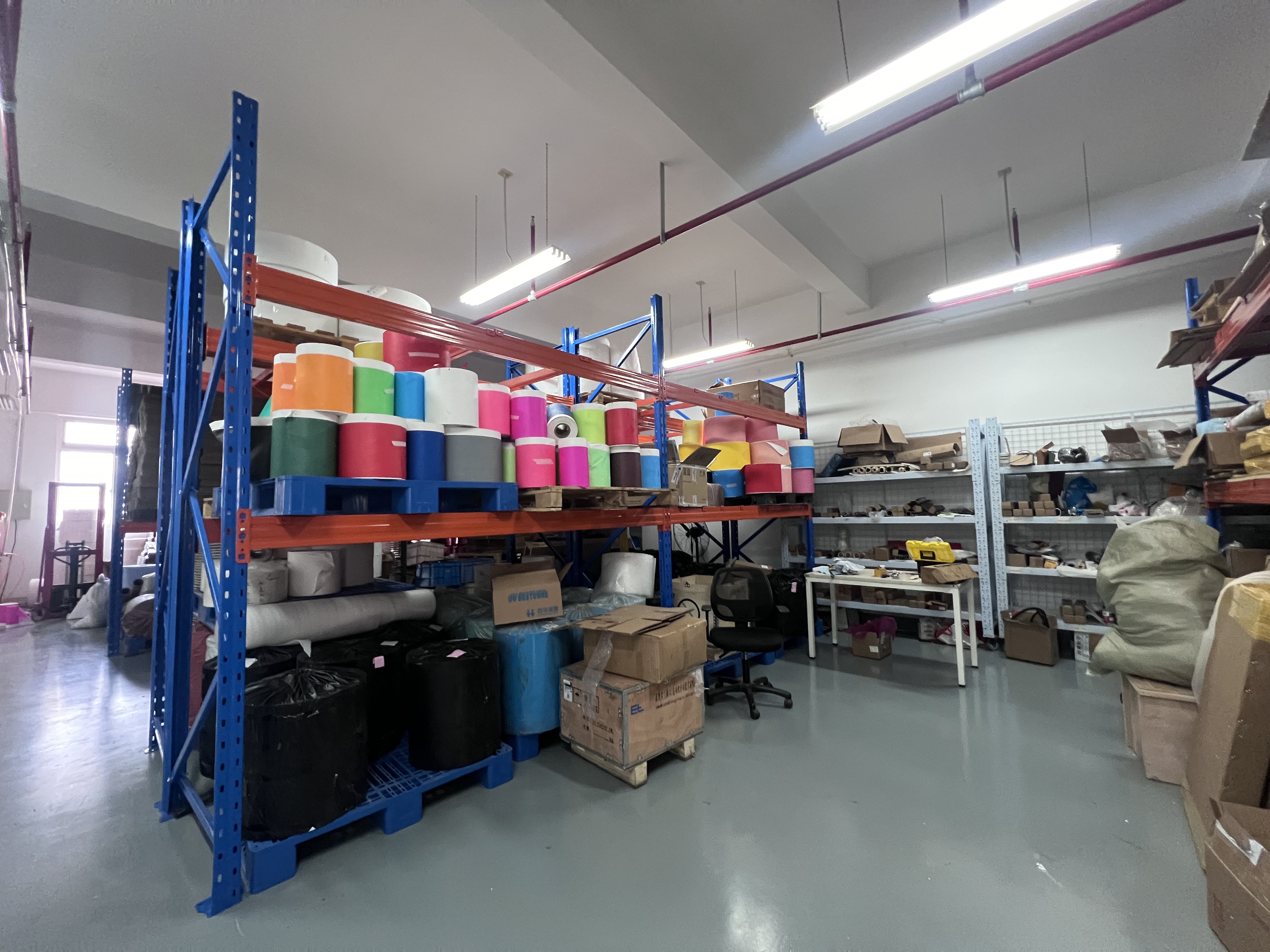
Shanghai Dingba Identification Co., Ltd. is a Shanghai-based manufacturer of wristbands and RFID products, founded in 2010, operating a 10,000 m² facility with more than 50 employees and a five-engineer R&D team. The company reports that roughly 70% of its output is exported, with the European Union and the United States as its main markets, and markets its medical line as DDJOY-Medical Wristbands. Its published quality position includes ISO 9001 certification and on-site verification by Alibaba and SGS.
Within that range, four constructions are relevant to hospital identification work, and each carries a different set of material claims.
The medical thermal wristband is stated as using thermal-sensitive synthetic paper, produced by direct thermal printing at a standard size of 260 × 25 mm with custom sizing available. Its stated features are water resistance, tear resistance, printable patient information, disposability, and skin safety for patient use. It is explicitly listed as requiring a direct thermal printer as supporting equipment, and the thermal method requires no ink.
The PVC patient ID wristband is stated at 250 × 25 mm or 250 × 16 mm, made of PVC, with printable patient information and described as durable, waterproof, and comfortable to wear. Its listed industries are hospitals and elderly care institutions, and its positioning emphasises comfortable long-term wear rather than a single-use designation.
The Tyvek wristband is stated at 250 × 19 mm or 250 × 25 mm, made of Tyvek, described as disposable, tear-resistant and waterproof, with clear printing. Its listed industries include hospitals alongside exhibitions, events and ticketing — a reminder that Tyvek is a general-purpose identification substrate, not a medical-only one.
The RFID wristband adds a machine-readable layer rather than replacing the material decision. It is available in silicone, PVC, Tyvek or paper with a built-in low-frequency, high-frequency or ultra-high-frequency chip that is readable and writable, and its listed applications include medical settings alongside access control and member management.
What Direct Thermal Printing Without Ink Actually Changes
"No ink required" is the most frequently misread claim in the category, because buyers often treat it as a printing-quality promise. It is a consumable statement.
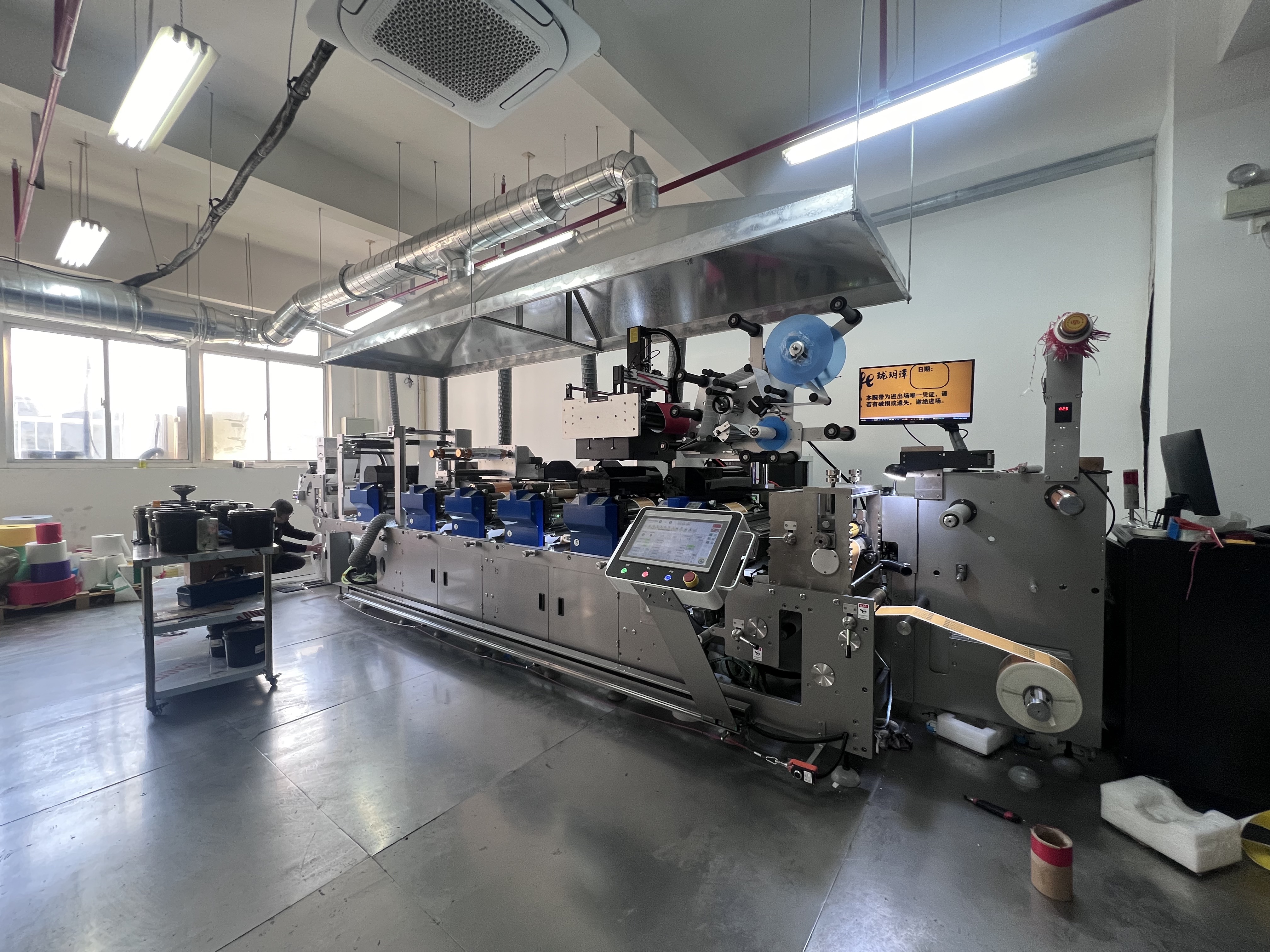
In direct thermal printing, the band's thermal-sensitive synthetic paper carries a coating that reacts to heat. When the band passes under the print head of a compatible direct thermal printer, the head's heat generates the image directly in that coating. There is no ink, no ribbon, and no separate imaging consumable. The consequence for procurement is twofold. First, the identifier is produced at the point of admission or registration, which is what makes the band suitable for custom patient identification projects and for printing patient information on demand. Second, the printing outcome depends on the band, the printer and the printer settings being compatible — the wristband is specified with a direct thermal printer as matched equipment, not with any generic label printer.
By contrast, a construction such as the PVC patient ID wristband carries printed patient information applied to a plastic surface. Here the claim that matters is not "ink or no ink" but how the applied print behaves against a PVC surface over the wear period. The two printing claims describe different physical events: in one case an image is formed inside the substrate coating, in the other an image is applied onto a substrate.
This is why "clear printing" and "printable patient information" should never be treated as interchangeable between constructions. They are claims about two different processes, and they fail in different ways. A buyer comparing bands should ask a single question that resolves most of the ambiguity: on this band, where does the printed image physically live — in the coating, on the surface, or in an embedded chip?
Where RFID changes the verification task
An RFID medical wristband introduces a third location for the identifier: the chip. The DDJOY RFID wristband uses a readable and writable chip available in multiple frequency bands, and it is positioned for medical use alongside access control and system integration. That shifts verification away from print legibility and toward read reliability, frequency selection and how the chip data is written and reconciled with the hospital's own system. A RFID band can be perfectly waterproof and tear-resistant while still failing a ward trial because the reader environment was never specified — a material claim cannot cover a systems claim.
Blank Bands, Intended Purpose, and the EU Regulatory Line
Compliance-relevant attributes and compliance status are not the same thing, and European law has recently made that distinction explicit.
In Case C-427/24, the Court of Justice of the European Union ruled that blank patient wristbands are not classified as medical devices under EU MDR 2017/745, effective 2 July 2026. The ruling turns on intended purpose: a wristband supplied blank functions as an identification tool, and the classification follows the purpose for which the product is placed on the market rather than the fact that it is used in a clinical setting.
The practical implication for buyers is straightforward. A supplier describing a band as waterproof, tear-resistant, skin-safe and disposable is making material statements. Those statements do not, on their own, place the product inside a medical device classification, and buyers who need device-level documentation should confirm the intended purpose the supplier has declared rather than inferring it from adjectives. Conversely, buyers who only need an identification tool should not assume they are receiving — or paying for — device-level regulatory work that the product category does not carry.
Labelling is a separate and moving area. ISO 15223-1:2021 Amendment 1 (2025) introduces changes to the authorised representative symbol, transitioning from the EC REP marking toward EU-REP. For wristband packaging and accompanying documentation that includes such symbols, the transition is a labelling change that sits alongside — not inside — the material specification.
Mapping Material Claims to Hospital Requirements
Once material claims are read as material claims, the buyer's job becomes a mapping exercise. The table below sets out how the stated attributes of the three main constructions line up against the requirement types hospitals typically raise during evaluation. Entries reflect the published product data for each construction; where a construction carries no stated claim for an attribute, that is recorded as not stated rather than assumed.
| Attribute as claimed | Medical thermal wristband | PVC patient ID wristband | Tyvek wristband |
|---|---|---|---|
| Base material | Thermal-sensitive synthetic paper | PVC | Tyvek |
| Stated sizes | 260 × 25 mm, customizable | 250 × 25 mm / 250 × 16 mm | 250 × 19 mm / 250 × 25 mm |
| Printing claim | Direct thermal printing, no ink required | Printable patient information | Clear printing |
| Water resistance | Water-resistant / waterproof | Waterproof | Waterproof |
| Tear resistance | Tear-resistant | Not stated as a separate claim | Tear-resistant |
| Disposability | Disposable, safe for patients | Not stated; described by durability and long-term wear | Disposable |
| Comfort claim | Skin-safe for patient use | Comfortable to wear | Not stated as a separate claim |
| Stated equipment dependency | Direct thermal printer | Not stated | Not stated |
| Listed industries | Hospitals, medical clinics, healthcare institutions, patient management | Hospitals, elderly care institutions | Hospitals, exhibitions, events, ticketing |
A four-question mapping method
A procurement team can convert this table into a decision by answering four questions in sequence.
- How long will the band stay on the patient? If the band is replaced at every admission or at every shift, a disposable construction matches the workflow. If the same band stays on a patient across an extended stay, a construction described through durability and long-term comfort is the closer match.
- What happens to the printed information field? If information is generated at the point of registration and must survive normal ward conditions, the direct thermal construction's stated water and tear resistance is the relevant claim. If the printed field is applied to a plastic surface, the relevant question is how that applied print behaves over the wear period.
- Does the ward require single use? The thermal and Tyvek constructions are stated as disposable; the PVC patient ID construction is described by durability and long-term wear instead. A single-use protocol and a durability-based specification are not the same requirement, and they should be matched deliberately.
- Is the identifier printed, encoded, or both? If the answer is "both", the material decision covers only part of the risk, and chip, reader and data-reconciliation questions must be raised separately.
Applications and Settings Where These Constructions Fit
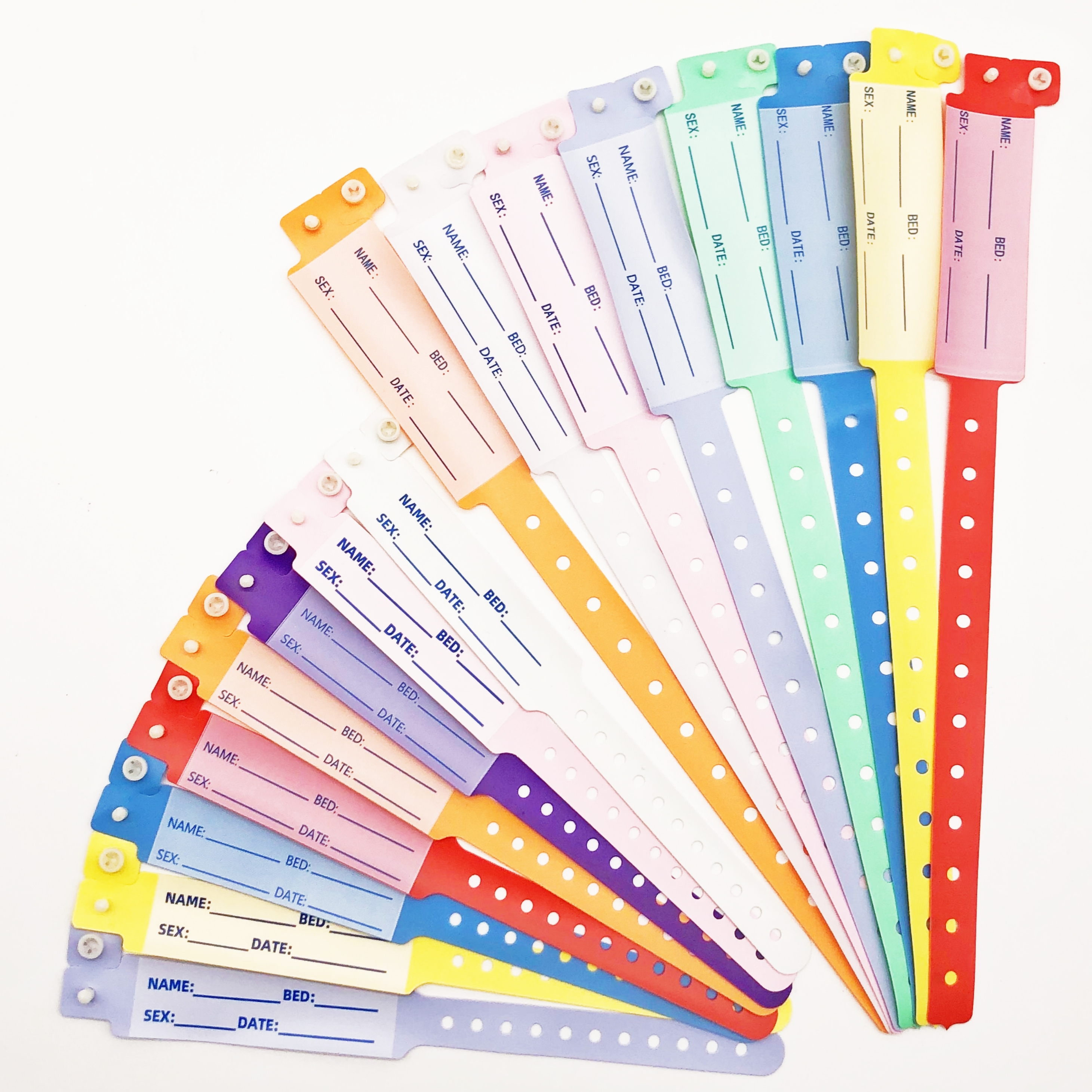
The application data attached to these products describes a consistent operating envelope: healthcare and hospital and clinic environments, custom patient identification projects, wearing-mode operation, indoor and outdoor normal-temperature conditions, and a matched direct thermal printer where printing is performed on site. The functional scope is patient identification and ward information management, and the special requirements recorded for the application are water resistance, tear resistance, disposability and skin safety.
Within that envelope, the differences between constructions map onto care settings in a predictable way.
High-turnover settings — admission, outpatient and diagnostic points where bands are printed, applied and removed within a short window — align with the on-demand, no-ink direct thermal workflow, because the identifier is produced at the moment of registration and the band does not need to survive beyond the visit.
Extended-stay settings — long-stay wards, elderly care institutions and similar environments — align with the PVC patient ID construction, whose stated position is durable, waterproof and comfortable long-term wear. The same durability logic applies where the patient identifier is expected to remain in place through repeated handling.
Settings that combine identification with event-style entry control, or that need a lightweight single-use band, align with the Tyvek construction, which is stated as disposable, tear-resistant and waterproof with clear printing and is listed for both hospital and event use.
Where the hospital needs contactless identification rather than visual reading — for example, where a wristband must be reconciled automatically against a system — the RFID construction applies instead, with the caveat that chip and reader performance must be verified independently of the material claims.
Comparison with Traditional and Alternative Solutions: Where Each One Stops
Comparing medical wristband constructions is not a question of which is better. It is a question of which one stops being the right answer first. Each of the three main constructions carries a real boundary, and the boundaries are more useful to a buyer than the advantages.
| Construction | What the claims support | Where the claim stops |
|---|---|---|
| Medical thermal wristband (thermal-sensitive synthetic paper) | On-demand printing of patient information at the point of registration, no ink consumable, water and tear resistance, disposable and skin-safe use | The method depends on a compatible direct thermal printer as matched equipment. The band cannot be printed on a generic printer, and print legibility over a long wear period is a function of the coating, the printer and how the band is handled rather than a fixed guarantee. |
| PVC patient ID wristband | Durable, waterproof and comfortable long-term wear with printable patient information, positioned for hospitals and elderly care | The published specification does not carry a disposable designation. Where a hospital's infection-control protocol requires single use, this construction addresses a different requirement set and should not be substituted on the strength of the word "waterproof" alone. |
| Tyvek wristband | Disposable, tear-resistant and waterproof with clear printing; suitable for hospital, exhibition, event and ticketing use | It is a general-purpose identification substrate listed across medical and non-medical industries. It does not carry the on-demand thermal printing workflow, and its specification is not built around long-term wear. |
| RFID wristband | Contactless, readable and writable identification integrated with access control, payment and system workflows | The material is only one variable. Frequency selection, reader environment, and how chip data is written and reconciled with the hospital system all sit outside the material claim and must be validated as a system. |
There is a second, quieter limitation that applies across all four: none of these constructions converts a material claim into a certification. A supplier can state that a band is waterproof, tear-resistant, disposable and skin-safe without that statement constituting device classification, a test report, or a regulatory determination. The compliance value of the claim depends entirely on the evidence a buyer asks for behind it.
Market Signals and What They Do and Do Not Tell Buyers
Category-level data is useful context for budgeting and for judging how seriously to treat the identification category, but it should be read with its own limitations in view.
The global patient identification wristbands market was projected to reach USD 576.1 million in 2025 in a forecast published by Future Market Insights. A separate estimate from Precedence Research places the 2025 figure at USD 1.61 billion. The gap is not a rounding difference: it reflects a methodology and scope difference, most plausibly between a narrow definition centred on blank or printed patient ID wristbands and a broader definition that includes identification accessories and system-integrated products. Buyers using market size to justify an investment case should cite the scope, not only the number.
Regional concentration is clearer. North America held a 41% share of the market in 2025 according to Precedence Research, which is consistent with the procurement maturity and the regulatory attention the region applies to patient identification.
At supplier level, PDC Healthcare, a Brady Corporation brand, holds a projected market share in the 14–18% range according to Future Market Insights — a figure derived rather than directly reported, and one that should be treated as directional. Zebra Technologies, whose Asset Intelligence & Tracking segment includes wristband-related business, reported net sales of USD 346 million for that segment in Q4 2023 in its annual report. That figure covers a broader segment than wristbands alone and illustrates how difficult it is to isolate the medical wristband category inside public company reporting.
The practical takeaway for a hospital buyer is that the category is large enough to support competitive sourcing and specialised suppliers, but not so transparently reported that any single market figure should drive a sourcing decision. Material-level evidence remains the more reliable basis for evaluation.
Future Outlook
Three developments are likely to shape how material and printing claims are read over the next procurement cycles.
The first is regulatory clarification. The CJEU ruling on blank patient wristbands removes a longstanding ambiguity about whether a blank band is a medical device under EU MDR 2017/745. The effect is not to reduce requirements but to relocate them: responsibility shifts toward the buyer to define and document intended purpose when the product category itself does not carry device classification.
The second is labelling transition. The symbol changes introduced by ISO 15223-1:2021 Amendment 1 (2025) mean that packaging and accompanying documentation carrying authorised representative markings will move through a transition period. Suppliers exporting to the EU will need to align artwork, and buyers reviewing supplier documentation should expect two symbol variants to coexist in the market for a period.
The third is the gradual layering of data capture onto identification. RFID constructions with readable and writable chips already sit alongside the material-based products in the same range, and the direction of travel is toward wristbands that carry both a visually readable identifier and a machine-readable one. When that happens, the buyer's verification checklist lengthens: material claims, print claims and system claims each have to be tested separately, and none of them substitutes for the others.
FAQ
What does "waterproof" actually mean on a medical wristband specification sheet?
It describes the resistance of the band material to moisture during normal wear. It is a material-level statement rather than a standardised immersion rating or a test certification. In the DDJOY range, the medical thermal wristband is described as water-resistant and waterproof on thermal-sensitive synthetic paper, the PVC patient ID wristband is described as durable and waterproof, and the Tyvek wristband is described as disposable, tear-resistant and waterproof. Because the claim is material-level, two bands can both be labelled waterproof while the printed information behaves differently, since the thermal construction forms its image by direct thermal printing with no ink while the other constructions use applied printing.
Does a "disposable" medical wristband automatically meet isolation ward requirements?
No. Disposable means the product is intended for single-use medical environments in order to minimise cross-contamination risk, which is how the thermal wristband and the Tyvek wristband are described. The PVC patient ID wristband, by contrast, is described through durability and comfortable long-term wear rather than through a disposable designation. Whether a specific single-use band satisfies a specific hospital infection-control protocol is a decision the hospital makes; the supplier's material statement is an input to that decision, not a substitute for it.
Do medical thermal wristbands require a specific printer?
Yes. The direct thermal method generates the image when the thermal-sensitive coating on the synthetic paper reacts to the heat of a print head, and the product is specified with a direct thermal printer as its matched supporting equipment. No ink or ribbon is consumed because the image is formed in the coating rather than applied to the surface. This is also why the printing outcome depends on the band, the printer and the printer settings being compatible with each other.
Are blank patient wristbands regulated as medical devices in the European Union?
Under the Court of Justice of the European Union ruling in Case C-427/24, blank patient wristbands are not classified as medical devices under EU MDR 2017/745, effective 2 July 2026. The classification depends on the intended purpose for which the product is placed on the market. Buyers who require device-level documentation should therefore confirm the intended purpose declared by the supplier rather than inferring classification from material descriptions such as waterproof, tear-resistant or skin-safe.
How should a procurement team compare thermal, PVC and Tyvek wristbands for the same hospital?
By mapping claims to requirements rather than by ranking the materials. Wear duration determines whether a disposable construction or a durability-based construction fits. Print exposure determines whether the relevant claim is about an image formed inside a thermal coating or an image applied to a plastic or Tyvek surface. Infection-control policy determines whether single use is mandatory. Where contactless identification is needed, RFID adds a chip layer that must be validated independently of the material claims. Constructed this way, the comparison produces a fit decision rather than a preference.
How can a hospital verify material and printing claims before committing to a rollout?
Verification is a sample-based exercise. Request product samples in the intended size, print them with the hospital's own direct thermal printer where the thermal construction is being considered, and check print legibility after a wear period representative of the target ward. Confirm the stated water and tear resistance against the actual handling the band will receive, confirm skin-safety claims for the patient population in question, and confirm commercial parameters such as minimum order quantity and production lead time — the capability data for this range records a minimum order quantity of 1000 units and a lead time of 7–10 days, with 100% testing and remote after-sales support.
Medical wristband compliance begins with reading material claims as what they are: descriptions of how paper, PVC, Tyvek or an embedded chip behave in a hospital environment. The compliance work — intended purpose, infection control, print durability, system integration — is what the buyer builds on top of them. A downloadable product reference is available at the DDJOY product brochure, and manufacturer information is published at ddlf.com.