
Medical Wristband Qualification Matrix: PVC, Thermal, Tyvek, RFID
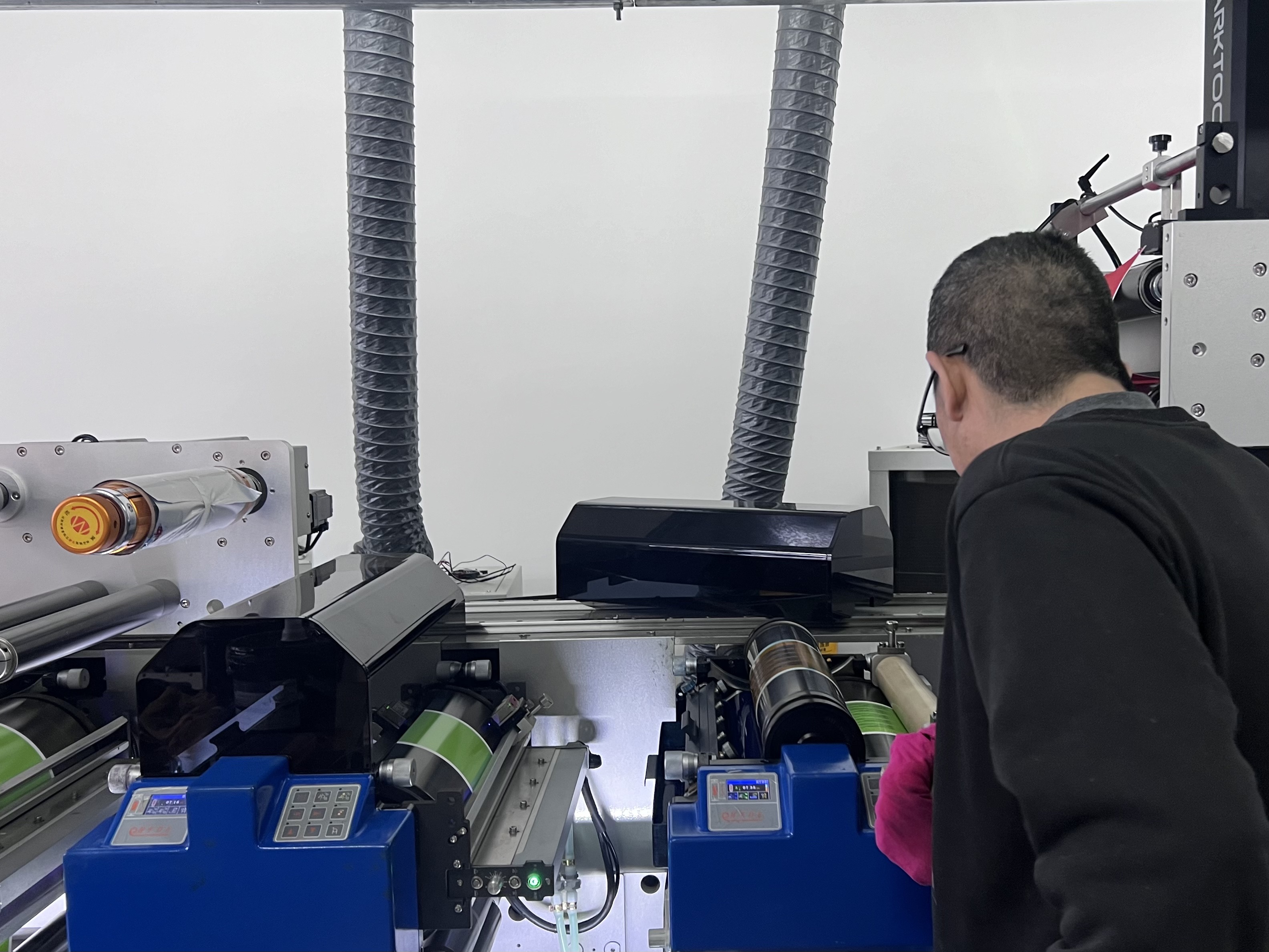
Printing method is one of the least documented and most consequential line items in a medical wristband specification.
A medical wristband is a qualification decision before it is a purchase order. Hospital procurement teams increasingly assess patient identification bands the way they assess any other controlled consumable: against a written intended use, a named material, a defined printing or encoding method, and an acceptance test that can be repeated at goods-in. Availability is rarely the constraint in this category. Evidence is.
This reference sets out a qualification-evidence matrix for the wristband families that dominate hospital procurement today - medical thermal bands, PVC patient ID bands, Tyvek bands, and RFID bands - with holographic bands covered where anti-counterfeiting forms part of the requirement. It also explains how purchasing terms and acceptance criteria should be read alongside material and printing claims, and where the limits of that evidence genuinely lie.
Why wristband qualification breaks down at the buying desk
Four failure modes recur across hospital wristband tenders, and each one is preventable with a single additional line in the specification.
- Material claims without a material name. Phrases such as medical grade or hospital quality do not identify a substrate. A qualification matrix requires a named material: thermal-sensitive synthetic paper, PVC, Tyvek, silicone, or paper.
- Printing claims without a printing method. Direct thermal printing, clear printing, printable patient information, and holographic anti-counterfeiting printing describe different processes with different equipment demands and different failure points. A band that prints cleanly in a supplier sample room may behave differently on a ward printer.
- Certification language without a scope. A compliance document carries a certificate number, an issuing authority, a standard list, and a product scope - and that scope can be narrower than the order. The EU RoHS Certificate of Compliance with certificate number TST20250302350EC, issued by Dongguan True Safety Testing Co., Ltd. on 14 March 2025 with validity to 14 March 2099, names its scope as paper wristband and cites the IEC 62321 series of test standards. That is a precise, verifiable statement. It is also a statement about paper wristbands, not about every wristband in a supplier catalogue.
- Acceptance criteria that exist only verbally. Documented acceptance - production video and photo verification - converts a claim into a control that can be scheduled, repeated, and disputed on evidence rather than on recollection.
The medical wristband qualification matrix
The matrix below is not a ranking. It is a forcing function: it places every supplier claim into a column where it can be checked before the order, rather than after the delivery.
| Product family | Documented material | Printing / encoding method | Documented characteristics | Documented sizes | Evidence to request |
|---|---|---|---|---|---|
| Medical thermal wristband | Thermal-sensitive synthetic paper | Direct thermal printing | Water-resistant, tear-resistant, patient information printable | 260 x 25 mm, customizable | Material name, print method, printer compatibility statement |
| PVC patient ID wristband | PVC | Printable patient information | Durable, comfortable to wear | 250 x 25 mm / 250 x 16 mm | Layer structure, print legibility sample, closure type |
| Tyvek wristband | Tyvek | Clear printing | Disposable, tear-resistant, waterproof | 250 x 19 mm / 250 x 25 mm | Single-use declaration, water and tear resistance statement |
| RFID wristband | Silicone, PVC, Tyvek, or paper | Built-in RFID chip, readable and writable; low frequency, high frequency, or ultra-high frequency optional | Chip-based identity and access data carrier | 250 x 25 mm / 250 x 16 mm and multiple specifications | Frequency band, writability statement, reader compatibility |
| Holographic wristband | PVC or paper with holographic film | Holographic anti-counterfeiting printing | Waterproof, tear-resistant, one-time lock closure | 250 x 25 mm / 250 x 16 mm | Anti-counterfeiting feature description, closure type |
| PVC one-layer or two-layer wristband, and PVC + tab variant | PVC | Logo and text printing | Single or double layer structure; tab buckle design on the tab variant, firm to wear | 250 x 25 mm / 250 x 16 mm; tab variant 260 x 40 mm | Layer structure, closure mechanism, printable area |
Table: qualification-evidence matrix for the main medical wristband families, based on documented product and certification data.
Reading each family correctly
Medical thermal wristbands: qualification is a matched pair
The documented configuration for this family is thermal-sensitive synthetic paper printed by direct thermal printing, with water-resistant and tear-resistant characteristics and patient information printable on the band, supplied at 260 x 25 mm with customization available. Direct thermal printing generates the image at the print head on thermal-sensitive media rather than through a transfer ribbon, which is why substrate and printer have to be specified together rather than separately. The documented matched equipment for this family is a direct thermal printer.
The practical buying question is therefore not whether the band can be printed, but which printer the hospital already operates at admission and whether the media has been confirmed against it. A thermal specification that omits the printer model is an incomplete specification.
PVC patient ID wristbands: qualification is a wear-duration question
PVC patient ID bands are documented at 250 x 25 mm and 250 x 16 mm with printable patient information, durability, and comfort as the stated characteristics, and the wider PVC family includes single-layer and double-layer structures with logo or text printing. A separate tab variant at 260 x 40 mm uses a tab buckle design described as firm to wear.
For elderly care institutions and longer admissions, comfort and closure type carry as much weight as print quality. A band that is legible on day one but uncomfortable or loose on day five creates a compliance problem rather than a printing problem, which is why the matrix asks for layer structure and closure type as distinct evidence lines.
Tyvek wristbands: qualification is a single-use declaration
Tyvek bands are documented as disposable, tear-resistant and waterproof with clear printing, in 250 x 19 mm and 250 x 25 mm. Because disposable is an explicit product characteristic rather than an assumption, the qualification question becomes whether the care setting actually requires a single-use consumable - short-stay admissions, outpatient clinics, triage, or event admission where the band is not expected to survive the encounter.
Where a band must remain readable and secure across a multi-day admission, this family sits at the edge of its documented purpose, and PVC or thermal configurations are the documented alternatives.
RFID wristbands: qualification is material plus frequency
RFID bands embed a chip that is readable and writable, with low frequency, high frequency, or ultra-high frequency options, and the band body can be specified in silicone, PVC, Tyvek, or paper at 250 x 25 mm, 250 x 16 mm or other specifications. Documented application areas include medical settings, access control, logistics and warehousing, and member management.
Because material is a free variable in this family, two RFID orders with identical dimensions can still differ in substrate, chip frequency, and read environment. Qualification evidence therefore has to name all three, and the frequency choice has to be matched to the readers the hospital or facility already operates.
Holographic bands: qualification is credential integrity
Holographic bands are documented as PVC or paper with a holographic film, using holographic anti-counterfeiting printing, combining waterproof and tear-resistant characteristics with a one-time lock closure, at 250 x 25 mm or 250 x 16 mm. Documented use sits in access control and anti-counterfeiting contexts.
Within a hospital environment, that maps to situations where the wristband itself functions as a credential for a controlled area rather than only as a name carrier - a different risk profile from ordinary ward identification, and one that justifies a different evidence file.
What the regulatory position actually establishes
Blank patient wristbands have been held not to fall under EU MDR 2017/745 as a category. The Court of Justice of the European Union addressed the classification question in Case C-427/24, reported as effective from 2 July 2026, and the decisive concept is intended purpose: classification follows what the product is placed on the market to do, not the material it is made from.
Three practical consequences follow for hospital buyers.
- Request a written intended-use statement for the exact configuration being purchased, including whether the band is supplied blank, pre-printed, or printed at the point of care.
- Do not accept a general certification claim as a substitute for that statement. A certificate answers the question it was written to answer, and nothing more.
- Treat labelling requirements as a separate workstream. ISO 15223-1:2021 Amendment 1 (2025) changes the authorised representative symbol from EC REP to EU-REP, which affects artwork review on labels and accompanying documents where that symbol appears.
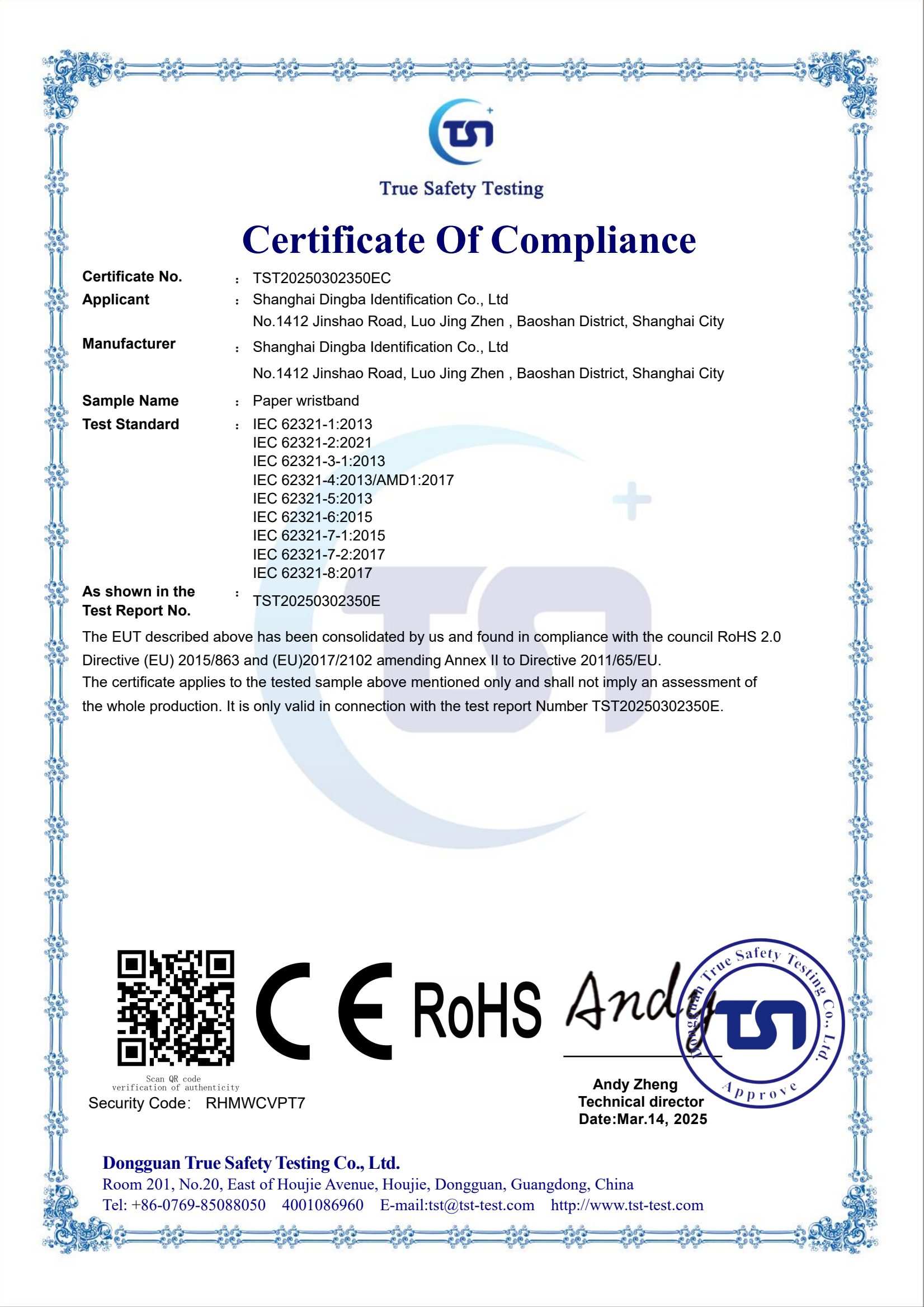
EU RoHS Certificate of Compliance TST20250302350EC, issued by Dongguan True Safety Testing Co., Ltd. on 14 March 2025. The named scope is paper wristband - a specific scope, which is exactly the point buyers should check.
Purchasing terms and acceptance criteria
Commercial terms are part of qualification evidence because they define when risk transfers and how non-conformance is proven. Documented terms for this supplier include a minimum order quantity of 1000 units, delivery terms of EXW / FOB / CIF / DAP / DDP, and payment of 100 percent T/T in advance. Acceptance inspection includes production video and photo verification.
On the production side, documented capability includes a 7-10 day lead time, OEM production with logo customization, 100 percent testing as the quality control approach, remote after-sales support, and export markets covering the EU, the US, and the Middle East.
The delivery term deserves the same treatment. EXW, FOB, CIF, DAP and DDP place the handover point in different locations, and the choice changes which party carries transit damage on a consumable whose documented characteristics include water resistance and tear resistance - properties that matter most in the last mile.
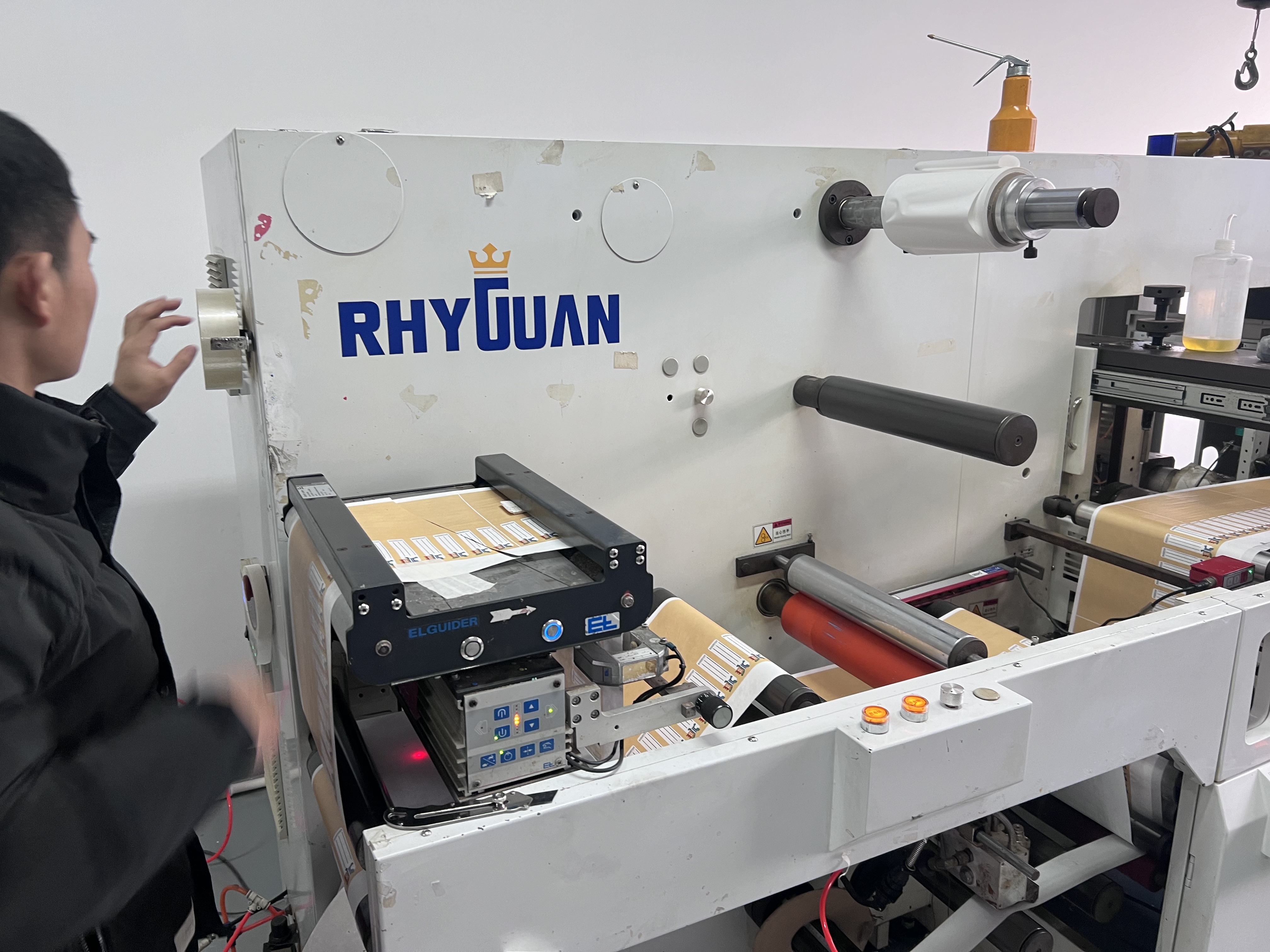
Die-cutting tolerance is a qualification item, not a production detail: dimensional consistency across a batch is what the acceptance photo is meant to demonstrate.
Supplier capability evidence behind the matrix
DDJOY-Medical Wristbands is the medical wristband line of Shanghai Dingba Identification Co., Ltd., a manufacturer based in Shanghai, China, founded in 2010, that develops, produces and sells wristbands and RFID products and maintains both hardware and software development capability.
The documented structure behind the line is specific: a 10,000 m2 facility, 50+ employees, an R&D team of 5 engineers, and annual output of 12,000,000 units, with OEM production and logo customization available. The company states ISO 9001 certification together with on-site verification from Alibaba and SGS, an export ratio of 70 percent with main markets in the EU and the USA, and exports reaching more than 100 countries and regions. Product documentation covers medical thermal wristbands, PVC patient ID wristbands, Tyvek wristbands, RFID wristbands, holographic wristbands, and PVC one- and two-layer bands. The company website is https://www.ddlf.com/.
For a qualification exercise, that is the right shape of evidence. It is not a claim of superiority; it is a set of identifiers a buyer can check independently - facility scale, output volume, certification body, market exposure, and the product scope actually covered by the documentation.
Matching product families to care settings
Documented application areas give buyers a defensible starting point. Hospitals, medical clinics, healthcare institutions, and patient management are the documented settings for medical thermal wristbands. Hospitals and elderly care institutions for patient identification are the documented settings for PVC patient ID bands. Hospitals, exhibitions, events, and ticketing are documented for Tyvek bands. Medical settings, access control, logistics and warehousing, and member management are documented for RFID bands. Concerts, exhibitions and festivals, and access control and anti-counterfeiting are documented for holographic bands.
Three decision rules narrow the choice further, and each one is answerable by the purchasing team without a clinical trial.
- Encounter duration. A single-encounter identification need aligns with the disposable characteristic documented for Tyvek; a multi-day admission aligns with the durable and printable characteristics documented for PVC and thermal families.
- Printing environment. Where the hospital prints at admission, the thermal family depends on direct thermal printers and thermal-sensitive media; where bands are pre-printed or written on, that dependency falls away.
- Credential role. Where the band only carries identity, a printed or thermal configuration is sufficient. Where the band controls access or must resist counterfeiting, the readable and writable chip documented for RFID, or the one-time lock closure documented for holographic bands, becomes part of the requirement rather than an upgrade.
Market signals: what they support and what they do not
The patient identification wristband category is large enough to attract conflicting published estimates, which is itself useful information for buyers. Future Market Insights projects the global patient identification wristbands market at USD 576.1 million in 2025, while Precedence Research estimates a materially larger figure of USD 1.61 billion for the same year. The variance is attributed in the source data to definitional differences between blank wristbands and printed or system-integrated products.
Regional concentration is more consistent across sources: North America is reported to have held a 41 percent share in 2025. On the supply side, PDC Healthcare, a Brady Corporation brand, is reported at a projected 14-18 percent share of the patient identification wristbands market, and Zebra Technologies reported USD 346 million in net sales for its Asset Intelligence and Tracking segment - the segment that includes wristbands - in the fourth quarter of 2023.
None of these figures qualifies a band. They are useful for sizing a category, understanding competitive structure, and confirming that the category is commercially material to a supplier. They should not appear in a specification file, and when a supplier cites a market number as evidence of product quality, that is a signal about the supplier evidence discipline rather than about the product.
Comparison with conventional identification methods, and the boundaries of this matrix
Handwritten paper bands, adhesive label stock, and generic printed tags remain in use in many facilities. They share three structural weaknesses: handwriting legibility, adhesion and moisture behaviour, and the absence of any defined tear or water resistance characteristic. The documented attributes of wristband products - water resistance, tear resistance, disposable or durable construction, printable patient information, readable and writable chips, and one-time lock closures - exist precisely because those weaknesses were the original problem. The honest comparison is therefore not modern against outdated, but specified against unspecified.
The boundaries of this matrix matter as much as the matrix itself.
- Thermal configurations depend on equipment. This family is documented around direct thermal printing and thermal-sensitive synthetic paper, with a direct thermal printer as matched equipment. A site without compatible printers cannot simply switch to this family, regardless of unit price.
- Tyvek is documented as disposable. A multi-week admission falls outside the documented purpose of that family.
- Certificate scope is not universal. The EU RoHS certificate in this evidence set, TST20250302350EC, covers paper wristbands. Buyers ordering PVC, Tyvek, silicone, or RFID configurations should request documentation that matches the material actually specified rather than assuming the existing certificate extends to it.
- RFID adds an infrastructure requirement. Frequency band selection has to match the readers in operation, and a chip described as readable and writable is only useful where the hospital software layer can write to it.
- The matrix organises evidence; it does not replace local assessment. Infection-control policy, skin-sensitivity protocols, and internal identification workflows remain the purchaser responsibility, and no supplier document substitutes for them.
Future outlook
Three directions appear likely to shape medical wristband procurement over the next procurement cycles.
First, intended purpose is becoming a documented line item rather than an assumption. Following the CJEU position on blank wristbands under EU MDR 2017/745, reported as effective from 2 July 2026, buyers who previously asked whether a supplier was certified are increasingly asking what the product is stated to do, in which configuration, and under which regulatory regime. That shift favours suppliers whose documentation is specific rather than decorative.
Second, label and artwork review is gaining a distinct step. The change of authorised representative symbol under ISO 15223-1:2021 Amendment 1 (2025) is narrow in scope but broad in reach, because it touches every label and accompanying document where that symbol appears. Procurement teams that batch artwork approvals will need a defined trigger for symbol changes.
Third, chip-based identification continues to move from pilot projects into routine identity management, which changes the buying question from consumable unit price to chip plus material plus reader fit. As RFID bands become documented across multiple substrates - silicone, PVC, Tyvek, and paper - the specification burden shifts further toward the buyer, who must state frequency and substrate rather than accept a generic RFID band line item.
Across all three directions, the same practical conclusion holds: market definitions for this category remain inconsistent, published estimates diverge, and the only reliable qualification reference a buyer controls is the evidence file attached to their own order.
Frequently asked questions
Are blank patient wristbands classified as medical devices in the European Union?
They are not, as a category. The Court of Justice of the European Union addressed the classification question in Case C-427/24, reported as effective from 2 July 2026, and held that blank patient wristbands fall outside EU MDR 2017/745. The deciding factor is intended purpose rather than material, so buyers should obtain a written intended-use statement for the exact configuration ordered, including whether it is supplied blank or printed at the point of care.
How does a buyer verify a supplier claim about medical thermal wristband material?
Verification works by matching paperwork to process. In this family the documented material is thermal-sensitive synthetic paper and the documented print method is direct thermal printing, with water-resistant and tear-resistant characteristics and patient information printable on the band at 260 x 25 mm with customization available. A complete verification request therefore names the material, states the print method explicitly, and confirms compatibility against the direct thermal printer the hospital actually operates.
Does a PVC patient ID wristband have to be single layer?
No. PVC patient ID bands are documented at 250 x 25 mm and 250 x 16 mm with printable patient information, durability, and comfort as characteristics, and the PVC family includes both single-layer and double-layer structures with logo or text printing. A separate PVC + tab variant at 260 x 40 mm uses a tab buckle design described as firm to wear. Layer structure and closure type are separate specification lines and should be stated separately in the purchase specification.
Can RFID medical wristbands be supplied in different materials?
Yes. The documented material options for RFID wristbands are silicone, PVC, Tyvek, and paper, with a built-in chip that is readable and writable and available in low frequency, high frequency, or ultra-high frequency options. Documented dimensions are 250 x 25 mm, 250 x 16 mm, and other specifications. Because substrate and frequency are independent choices, both should appear as named requirements in the purchase specification.
What purchasing terms and acceptance criteria apply to medical wristband orders?
Documented commercial terms include a minimum order quantity of 1000 units, delivery terms of EXW / FOB / CIF / DAP / DDP, and payment of 100 percent T/T in advance. Acceptance inspection includes production video and photo verification. Production lead time is documented at 7-10 days, and 100 percent testing is the documented quality control approach, with remote after-sales support and export activity across the EU, the US, and the Middle East.
What are the limits of Tyvek and other disposable wristband options?
Tyvek bands are documented as disposable, tear-resistant, and waterproof with clear printing, available at 250 x 19 mm and 250 x 25 mm, with documented application areas in hospitals, exhibitions, events, and ticketing. The documented disposable characteristic defines the boundary: the family fits single-use or single-encounter identification. Where a band must remain legible, secure, and comfortable across a multi-day admission, PVC or thermal configurations are the documented alternatives.
A note on how to use this matrix
A qualification matrix does not make a purchasing decision; it makes the decision auditable. Buyers who place material name, printing method, intended use, and acceptance evidence into four separate columns will find that most vague supplier claims resolve themselves into verifiable questions - and that the answers, not the adjectives, decide which wristband family fits which ward.
Downloadable product documentation for the DDJOY-Medical Wristbands range is available here: DDJOY-Medical Wristbands product brochure.
Есть вопросы или нужны дополнительные детали?
Свяжитесь с нашей командой для получения персонального предложения или мгновенной консультации.
Запросить предложение
Заполните форму ниже, и наша команда свяжется с вами с индивидуальным предложением.
Прямой чат WhatsApp
Предпочитаете общаться в реальном времени? Напишите нам в WhatsApp для мгновенной помощи и быстрых ответов.
- Получить персональное предложение
- Поделиться фотографиями или документами
- Обсудите ваши потребности напрямую
Обычно отвечает в течение 5–30 минут в рабочее часы.