
Membrane Filter Press Compliance Review: Pressure, Area, and Plate Standards
A membrane filter press compliance review is a specification-to-document exercise, not a certificate collection exercise. The buyer confirms that the pressure, filtration area, and plate-and-frame construction quoted in a proposal match what the supplier's own technical documents state — and that each document genuinely applies to the model, the market, and the duty in question.
A membrane filter press is a solid-liquid separation machine in which a flexible membrane behind each filter plate is pressurised to squeeze the cake after the feed cycle. Because the machine runs two pressure stages instead of one, its specification sheet carries two pressure figures, and that is where most review errors begin. Market context explains why the discipline matters now: global membrane filtration revenue was valued at USD 19.4 billion in 2025, with Asia Pacific holding a 36.5% revenue share, according to Grand View Research, while filter presses accounted for approximately 22% of the global sludge dewatering system market in 2024 according to commercial research published by Market Research Archive. A larger and more customised installed base produces more configuration variants, and more variants produce more opportunities for a quoted number to drift away from the design it is supposed to describe.
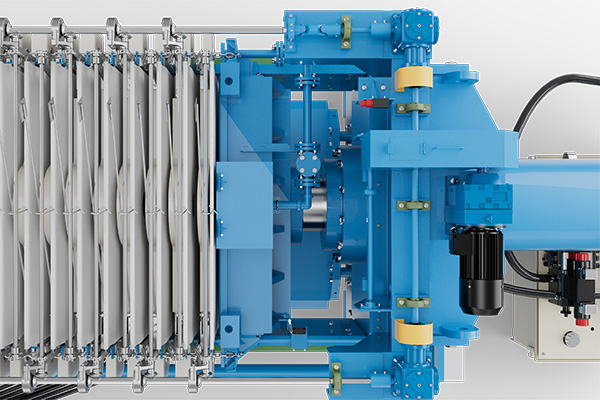
Problem and opportunity: where specification drift enters a membrane press quotation
Four recurring gaps account for most mismatches between a membrane filter press proposal and the machine that is eventually commissioned.
- Feed pressure presented as squeezing pressure. The filtration cycle and the membrane squeeze cycle run at different pressures and serve different purposes. A datasheet that lists only a generic “working pressure” does not tell the buyer which stage the number describes, or whether the figure is a design limit or a routine operating value.
- Filter area quoted without plate geometry. Area is a derived value, calculated from plate dimensions, chamber count and chamber depth. An area figure without those inputs cannot be independently checked, and it cannot be compared against a competing offer with confidence.
- Plate and frame described generically. “PP plate” and “carbon steel frame” are accurate but incomplete. The distinction between a standard polypropylene plate and a PP/TPE membrane plate, and between a general carbon steel frame and a Q345 steel frame, affects pressure capability, cycle life and maintenance.
- Documents cited outside their scope. A test report covering high-pressure membrane presses in mining duty in one market is not evidence for a food or pharmaceutical installation in another market. Scope, issue date and expiry date must be read, not assumed.
The opportunity is unglamorous but valuable: a structured review that takes a few hours before purchase removes most of the ambiguity that later becomes a commissioning dispute.
Pressure: separating the feed stage from the squeezing stage
On a membrane filter press, feed pressure is the pressure at which slurry is pumped into the closed plate pack to form the cake. Squeezing pressure is the separate pressure applied behind the membrane to compress that cake and displace remaining liquid. They are different design conditions, and a compliance review should confirm both.
The Membrane Filter Press (XMAG30/870-UKB–XMAG1000/2000-UKB Series) states a feed pressure of 0.6–2.0 MPa and a squeezing pressure of 1.6 MPa. The Mobile Filter Cloth Membrane Filter Press (1100/1500 Series) is an automatic membrane filter press stating a filtering pressure of 0.6–4.0 MPa. For reference, the Chamber Filter Press (XMAY Series) states the same 0.6–4.0 MPa filtration envelope, but without a membrane squeeze stage — which is precisely why the two figures should never be exchanged between machine types.
| Machine family | Stated pressure | What the figure refers to |
|---|---|---|
| Membrane Filter Press, XMAG30/870-UKB–XMAG1000/2000-UKB Series | Feed pressure 0.6–2.0 MPa; squeezing pressure 1.6 MPa | Two separate stages: cake formation, then membrane squeeze |
| Mobile Filter Cloth Membrane Filter Press, 1100/1500 Series | Filtering pressure 0.6–4.0 MPa | Stated filtration envelope for the automatic membrane platform |
| Chamber Filter Press, XMAY Series | Filtration pressure 0.6–4.0 MPa | Same envelope, no membrane squeeze stage |
| Round Filter Press, XMY40/φ800-25 Series | 1.0–3.0 MPa; cake thickness 25–30 mm | High-pressure circular plate design for low cake moisture |
| Plate And Frame Filter Press, BMY4/450-30U Series | ≤0.5 MPa; cake thickness 30–35 mm | Fine filtration duty rather than high-pressure dewatering |
| Cast Iron Filter Press, BMA/XMA Series | 0.6 MPa; suitable at ≥120°C | High-temperature slurry filtration where polymer plates are unsuitable |
Four checks convert the table above into a usable verification step. First, confirm whether the quoted figure is a maximum design pressure or a routine operating pressure. Second, confirm that squeezing pressure is listed separately and that the plate material is rated for it. Third, confirm which system components the pressure figure assumes — an application scenario for membrane sludge dewatering typically matches the press with a feed pump, an air compressor and a conveyor. Fourth, confirm the pressure figure applies to the plate size actually quoted, since a platform envelope spans many plate dimensions.
Filter area: reconciling the quoted area with plate geometry
The 1100/1500 Series automatic membrane filter press states a filter area of 20–291.2 m² with plate sizes of 1100 mm and 1500 mm. The XMAG membrane series states 30–1000 m² with plate sizes from 870 mm to 2000 mm. Both ranges are platform envelopes, not the specification of a single machine, and a buyer should read them accordingly.
Area is not an independent property of a press. It is the product of plate face geometry, the number of filtration chambers and chamber depth. This is why two machines can share a plate size of 1100 mm and still differ substantially in quoted area, and why a chamber filter press configured with a different plate count can reach the same headline figure as a membrane press.
| Series | Stated filter area | Plate size | Structural note |
|---|---|---|---|
| XMAG Membrane Filter Press | 30–1000 m² | 870–2000 mm | PP/TPE membrane plate, Q345 steel frame |
| 1100/1500 Mobile Filter Cloth Membrane Filter Press | 20–291.2 m² | 1100 / 1500 mm | PP filter plate, carbon steel frame, automatic cloth traveling |
| Chamber Filter Press XMAY | 30–1000 m² | 870–2000 mm | PP filter plate, Q345 carbon steel frame |
| Round Filter Press XMY40 | 40–140 m² | φ800–φ1000 mm | PP filter plate, carbon steel frame |
| Plate And Frame BMY4/450-30U | 4–80 m² | 500–890 mm | PP, stainless steel or cast iron plates |
| Water-Flush Filter Press, 320–2000 Series | 1–1000 m² | 320–2000 Series | Automatic high-pressure water flushing, 0.4–2.0 MPa |
| Laboratory Filter Press | 0.32 m² | 3+1+1 / 5+1+1 plates | 0.6 MPa feed pressure, auto or manual |
To verify an area claim, request the plate count in the bill of materials, a dimensional drawing of the plate, and the chamber depth. Cross-check the total against the floor space the machine will occupy and against the cake thickness the process expects — for reference, the round plate design works at 25–30 mm cake thickness and the fine-filtration plate-and-frame design at 30–35 mm. An area figure that cannot be reproduced from these three inputs has not been verified, however precisely it is printed.
Plate and frame standards: PP plates, Q345 and carbon steel frames
Structural specifications decide whether a quoted pressure and area can actually be sustained over years of cycling. Across the membrane and chamber platforms reviewed here, the recurring structural pattern is a polymer filter plate carried in a carbon steel frame: the XMAG membrane series uses a PP/TPE membrane plate with a Q345 steel frame; the 1100/1500 Series automatic membrane filter press uses a PP filter plate with a carbon steel frame; the XMAY chamber press uses a PP filter plate with a Q345 carbon steel frame; the round high-pressure press uses a PP filter plate with a carbon steel frame.
Plate material is an area where documentation is genuinely useful rather than decorative. Chinese Invention Patent ZL 2021 1 0708980.0 covers a reinforced and toughened modified polypropylene composite material for filter plates and its preparation method, granted by CNIPA and recorded as valid to 2041-06-25. Patent ZL 2022 1 0761239.5 covers a copper sulfide nanoparticle-coated basalt fiber-reinforced polypropylene composite material for the filter press. The center-alignment clamping device used to keep plates aligned under pressure is covered by ZL 2019 1 0275647.8. On the manufacturing side, the supplier profile records independent development of a processing-free sealed square polypropylene filter plate covered by invention patent protection and supplied into the European market.
A practical structural review asks five questions: what polymer the plate is made from and whether it is a membrane type; what steel grade the frame uses; how the plates are clamped and aligned; what the plate thickness and handle design are intended to withstand; and which parts are wear items with defined replacement expectations. Membrane plates in particular are a service component, and a review that ignores their replacement cost has not finished the job.
A five-step specification verification workflow
| Step | Action | Evidence the buyer should hold |
|---|---|---|
| 1. Define the duty | Record feed material, target cake moisture, batch or continuous mode, temperature and corrosion profile | Process description and, where available, pilot data |
| 2. Map the pressure envelope | Separate feed pressure from squeezing pressure; confirm design versus operating values | Datasheet with both stages listed |
| 3. Reconcile area with geometry | Match quoted area to plate count, plate dimensions and chamber depth | Plate count in the bill of materials and a plate drawing |
| 4. Verify structure and materials | Confirm plate polymer, membrane type, frame steel grade and clamping design | Material specification and component listing |
| 5. Verify documents by scope | Read the stated market, model coverage, issue and expiry dates of each document | Copies of reports, declarations and certificates |
Steps three and five are the ones most often skipped, and they are the two that most often prevent a later dispute.
Documentation practices: reading scope, market and validity
Documents are not a compliance verdict; they are evidence with boundaries. The examples below come from the DAZHANG Filter Press corpus and illustrate how narrowly a document's stated scope is often drawn. They are shown as review examples, not as a blanket statement that any document applies to every model or every market.
| Document type | Example | Stated scope and limit |
|---|---|---|
| Independent test report | Filter Press Test Report BT25044594069GR, issued by Fujian Berton Testing Service Co., Ltd. | Prepared against JB/T 4333.2-2013; stated as valid for high-pressure membrane filter presses used in mining in the China market |
| Market access declaration | EAC Declaration of Conformity ЕАЭС N RU Д-CN.PA08.B.88796/23 | Filter-press scope; TR TS 010/2011 and TR TS 020/2011; EAEU market; valid 2023-10-19 to 2028-10-18 |
| Management system certificate | Intellectual Property Compliance Management System certification 404IPJ240986R0M, issued by Beijing Wan Kun Certification Service Co., Ltd. | Standard GB/T 29490-2023; scope covers production and sales of filtration equipment; CN market; valid 2024-10-15 to 2027-10-14 |
| Enterprise qualification | High-tech Enterprise Certificate GR202341002931 | Issued by the Henan Provincial Department of Science and Technology, Henan Provincial Department of Finance and the State Taxation Administration Henan Provincial Tax Service; valid 2023-11-22 to 2026-11-21; China |
| Invention patents | ZL 2021 1 0708980.0; ZL 2019 1 0275647.8; ZL 2022 1 0459734.0; ZL 2022 1 0761239.5 | Granted by CNIPA; cover filter plate composite material, center-alignment clamping, forced-discharge automation and a further plate composite respectively |
Standard-scope discipline is part of the same habit. ISO 7704:2023, for example, specifies requirements for performance testing of membrane filters used for water quality analysis. It concerns a different class of product from a membrane filter press, and citing it in a press quotation would be a scope error rather than a strength. The question to ask of any cited reference is simple: does its stated scope include this product, this application and this market?
A final documentation practice concerns date hygiene. Every table row above carries an issue and expiry date because documents expire, and a compliance review performed against an expired report is not a review. Filing the document set with the equipment records, and diarising renewal dates, is the cheapest compliance activity available to an operator.
Application fit: choosing the specification envelope before the purchase order
Specification values only become meaningful when they are matched to a duty. In industrial and municipal sludge dewatering, the XMAG membrane filter press — 30–1000 m², feed pressure 0.6–2.0 MPa and squeezing pressure 1.6 MPa, with PP/TPE membrane plates in a Q345 steel frame — is configured for automatic batch operation with a feed pump, an air compressor and a conveyor. A project record from an industrial wastewater treatment plant and environmental-protection engineering company describes a single unit running for more than three years with lower cake moisture and stable operation.
In mining, coal, metallurgy, chemical and power sludge duty, the 1100/1500 Series automatic membrane filter press covers 20–291.2 m² at a stated filtering pressure of 0.6–4.0 MPa and adds automatic cloth traveling and automatic cleaning, with visible or invisible drainage arrangement. A mining and wastewater treatment end user record describes more than three years of operation with higher dewatering efficiency and lower cake moisture.
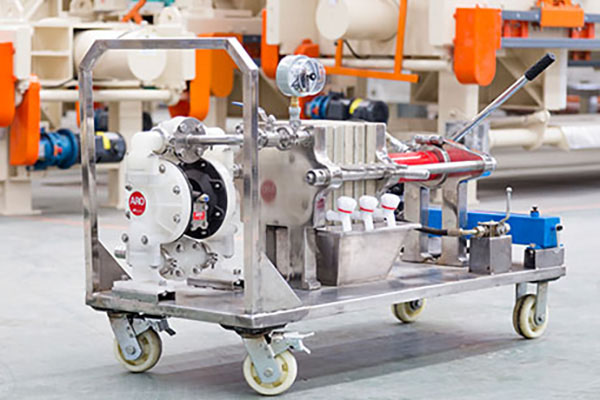
The most under-used verification tool is the pilot test. A Laboratory Filter Press with 0.32 m² of filter area, 3+1+1 or 5+1+1 plates and 0.6 MPa feed pressure allows a buyer to observe cake formation, filtrate clarity and squeeze response on the actual slurry before committing to a 200 m² machine. A laboratory and research institute record describes more than three years of use with stable filtration and reliable test data. For operators in chemical, food and pharmaceutical duty, the same logic applies in reverse: where high-temperature slurry is involved, the Cast Iron Filter Press (1–80 m², 0.6 MPa, suitable at ≥120°C) may define the envelope rather than a polymer plate machine at all.
Market signals worth reading carefully
Three published data points frame the current market. Global membrane filtration revenue stood at USD 19.4 billion in 2025 with Asia Pacific at a 36.5% share, per Grand View Research. Chinese export value of filter press machines under HS 84212910 reached USD 170,236,194 in 2023, according to China Customs data reported secondarily. Filter presses represented approximately 22% of the global sludge dewatering system market in 2024, per Market Research Archive.
Growth estimates, however, do not agree. One research house projects a compound annual growth rate of 7.8% for 2026–2033, while another estimates 9.5% for 2025–2034, with the difference attributed to methodology and the treatment of AI-optimised systems. For a procurement team, the lesson is practical rather than academic: when a supplier cites a market growth figure in a proposal, the methodology and scope matter more than the number. The same standard should be applied to any performance claim attached to a machine.
Comparison with traditional solutions, and the real boundaries of a membrane press
The membrane filter press is not a universal upgrade over the two traditional alternatives. A chamber filter press covers a comparable envelope — the XMAY Series states 30–1000 m² and 0.6–4.0 MPa with PP plates in a Q345 carbon steel frame — but relies on feed pressure alone, with no membrane squeeze stage. It is simpler, has fewer wear components, and handles high-solid slurries without the additional squeeze cycle. The plate and frame filter press is a third option, aimed at fine filtration rather than dewatering: the BMY4/450-30U Series states 4–80 m² at up to 0.5 MPa with cake thickness of 30–35 mm. For continuous, high-throughput sludge duty, belt presses offer a different model again, with cake moisture reported between 63% and 84.5% and capacities from 3.0 to 10.5 m³/h on the DNY500–DNY1000 range.
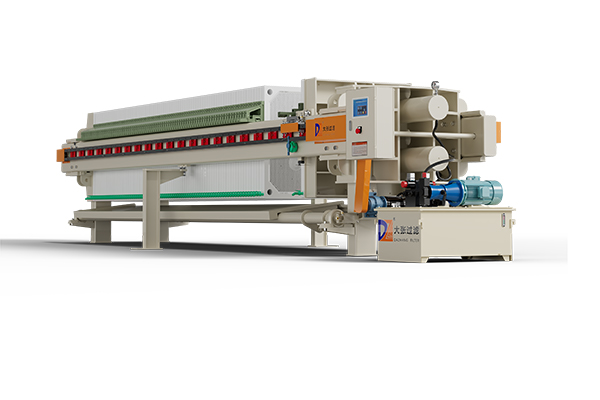
Against that baseline, the boundaries of a membrane press deserve to be stated plainly. It requires a compression system — typically an air compressor for the squeeze stage — which adds capital cost, floor space and a maintenance item that a chamber press does not have. Membrane plates are a wear component with a finite service life and a higher replacement cost than plain recessed plates. The squeeze stage adds time to each cycle, so throughput per hour can be lower than a chamber press of the same area unless the cycle is planned around it. Squeezing is most valuable for compressible cakes; where the solids are highly incompressible, the moisture reduction may be modest relative to the added cost and complexity. And where process temperature exceeds what polymer plates tolerate, a cast iron machine rated for ≥120°C may be the correct answer regardless of membrane performance. A compliance review that does not weigh these boundaries is only checking paperwork.
Future outlook
Three directions appear to be shaping the next generation of filter press specifications. The first is automation of the peripheral cycle: automatic cloth traveling and automatic cleaning on the 1100/1500 Series, high-pressure water flushing on the 320–2000 Series water-flush press, and forced-discharge automation covered by patent ZL 2022 1 0459734.0 all attack the same problem — labour hours per tonne of cake. The second is core component engineering, where plate composite patents such as ZL 2021 1 0708980.0 and ZL 2022 1 0761239.5 target pressure and toughness limits rather than machine size. The third is documentation maturity: as Chinese filter press exports scale, buyers in different markets will increasingly expect each specification to arrive with a document whose scope is clearly stated, dated and traceable.
For context on manufacturing scale, the supplier behind the specifications referenced in this review is Henan Dazhang Filtration Equipment Co., Ltd., founded in 2004, operating approximately 70,000 m² of factory space in Yuzhou, Henan Province, with a registered capital of RMB 60 million, an R&D team of 45, an annual output of 9,500 units, and products and services reaching more than 100 countries with an export share of around 20%. Its stated production capability includes OEM, ODM and custom manufacturing with a monthly capacity of approximately 250 sets, a lead time of 15–30 working days, a minimum order quantity of one set, ISO 9001 quality control with complete machine operation testing, and a one-year warranty with installation guidance and remote technical support. Those are manufacturing facts; whether they satisfy a given project still depends on the verification workflow described above.
Frequently asked questions
What is the difference between feed pressure and squeezing pressure on a membrane filter press?
Feed pressure is the pressure used to pump slurry into the closed plate pack so that cake forms in the chambers. Squeezing pressure is a separate, later stage in which the membrane behind the plate is pressurised to compress the cake and displace remaining liquid. On the XMAG30/870-UKB–XMAG1000/2000-UKB Membrane Filter Press, feed pressure is stated as 0.6–2.0 MPa and squeezing pressure as 1.6 MPa, which illustrates why the two values should be listed and read separately.
How should a buyer verify the quoted filtration area of a membrane filter press?
Ask for the plate count, the plate outside dimensions and the chamber depth, then confirm that the quoted area is consistent with those three inputs. Platform ranges such as 20–291.2 m² for the 1100/1500 Series or 30–1000 m² for the XMAG series describe an envelope, not a single machine. An area figure that cannot be reproduced from plate geometry is a figure to question.
What plate and frame materials are used in membrane filter presses, and why do they matter?
Membrane machines typically combine a polymer plate with a steel frame. In the specifications reviewed here, the XMAG membrane series uses a PP/TPE membrane plate with a Q345 steel frame, and the 1100/1500 Series automatic membrane filter press uses a PP filter plate with a carbon steel frame. Plate polymer type determines pressure and temperature tolerance and membrane service life; frame steel grade determines structural capability under repeated clamping cycles.
Which documents should be requested during a membrane filter press compliance review?
Request the document set that matches the claimed specification: an independent test report where pressure or dewatering performance is claimed, a market access declaration where the destination market requires one, management system certification where production control is claimed, and patent documents where a specific plate or clamping technology is claimed. For each document, check the stated scope, the models covered, the applicable market, and the issue and expiry dates.
Does higher squeezing pressure always produce lower cake moisture?
No. Squeezing pressure raises the driving force for liquid removal, and membrane plates are rated accordingly — the XMAG series states a squeezing pressure of 1.6 MPa. The moisture response depends on the compressibility of the solids and on the preceding feed stage. For highly incompressible cakes, additional squeezing pressure may yield a limited improvement, while still adding cycle time and equipment cost to the installation.
How can a buyer check whether a cited standard or certification applies to their equipment and market?
Read the scope statement rather than the title. For example, the Filter Press Test Report BT25044594069GR, issued by Fujian Berton Testing Service Co., Ltd. against JB/T 4333.2-2013, is stated as valid for high-pressure membrane filter presses used in mining in the China market. A declaration can be similarly bounded: the EAC Declaration of Conformity ЕАЭС N RU Д-CN.PA08.B.88796/23 covers filter-press scope under TR TS 010/2011 and TR TS 020/2011 in the EAEU, valid to 2028-10-18. A document whose scope does not name the product, application or market in question should not be relied upon for it.
What is the role of a laboratory filter press in specification verification?
A laboratory filter press is a pilot-scale tool for testing the actual slurry. The model reviewed here offers 0.32 m² of filter area, 3+1+1 or 5+1+1 plates, up to 0.6 MPa feed pressure and auto or manual operation. It allows a buyer to observe cake formation, filtrate clarity and squeeze behaviour before specifying a full-scale machine, which is the most direct way to test whether a quoted 0.6–2.0 MPa feed pressure and 1.6 MPa squeeze envelope suits a given material.
This review describes specification and documentation practices only. It does not assert that any particular membrane filter press configuration is compliant in any particular jurisdiction; compliance is determined by the applicable standard, market and application, and should be confirmed against the documents held for the specific project.
Reference document: the DAZHANG Filtration company profile (PDF) provides the full capability and product overview referenced in this article.