
Membrane Filter Press XMAG Models: Plate Size and Area FAQ
Membrane Filter Press XMAG Models: Plate Size and Area FAQ
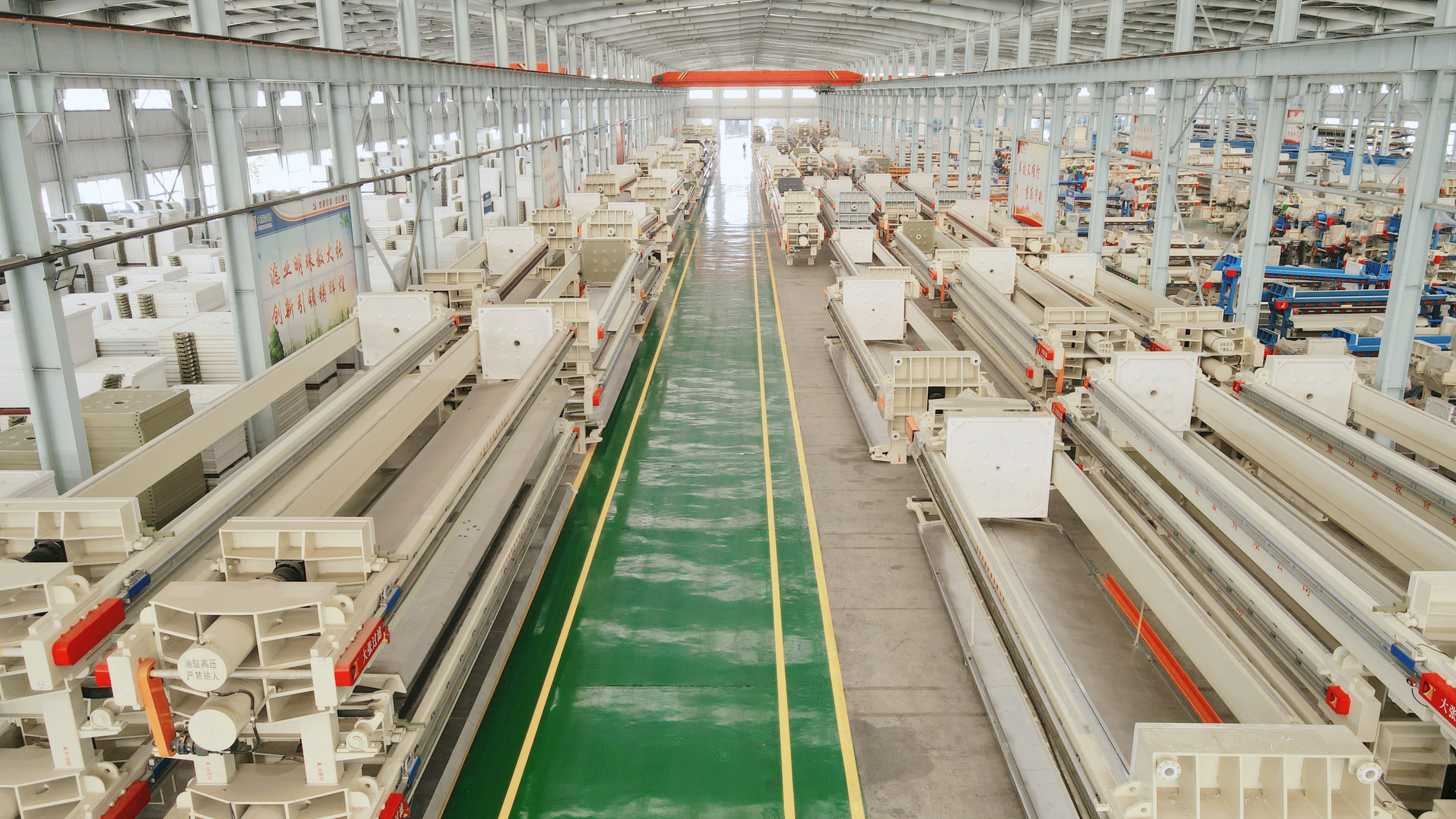
Filter press manufacturing operations — plate format and filter area are fixed at the design stage, long before commissioning.
Two numbers shape almost every membrane filter press quotation before price, delivery or warranty is discussed: plate size and filter area. In the XMAG automatic membrane filter press series, those numbers span 870 mm to 2,000 mm and 30 m² to 1,000 m² respectively, and the model code itself — from XMAG30/870-UKB to XMAG1000/2000-UKB — is built around them.
DAZHANG Filter Press (Henan Dazhang Filtration Equipment Co., Ltd.) is a filtration and solid–liquid separation equipment manufacturer founded in 2004 and based in Yuzhou, Henan Province, China. The company produces membrane filter presses, chamber filter presses, plate and frame filter presses, high-pressure round plate filter presses, mobile skid-mounted filter presses, filter plates, filter cloths, hydraulic systems and automatic washing systems, and supplies more than 100 countries across Asia, Europe, North America, South America, Africa and the Middle East. The XMAG series sits inside that portfolio as the automatic membrane platform.
This FAQ is written for buyers at the evaluation and decision stage — the point at which a shortlist exists and the remaining question is whether a given plate format and filter area will hold up in service. It works through model decoding, pressure verification, plate and frame materials, automation, drainage configuration, and the limits that should be accepted before an order is placed.
Why Plate-and-Area Mismatches Survive the Quotation Stage
Most procurement errors in membrane filter press purchasing are not arithmetic errors; they are scope errors. A buyer sizes a machine against a target tonnage, compares three quotations by price per unit of filter area, and discovers the mismatch only after commissioning, when cycle times, cake moisture or cake handling no longer match the plant's original assumptions.
Three mismatches recur:
- Area without duty. Filter area indicates how much filtration surface is available, not how much dry solids the machine will deliver per shift. Cycle time, feed solids concentration and target cake moisture all intervene.
- Plate format without space planning. A 2,000 mm plate format is a fundamentally larger machine than an 870 mm format. Layout, foundations, plate handling and maintenance access all scale with plate size.
- Pressure rating without pump matching. A machine rated to a maximum feed pressure only performs as designed if the feed pump, piping and squeeze circuit can deliver that pressure profile.
Recorded selection guidance from DAZHANG's published technical FAQ places the decision variables in this order: feed material characteristics, target cake moisture, treatment capacity, automation requirement and project budget. Plate size and filter area are the physical expression of those five variables, which is why they should be fixed after them rather than before them.
How to Read an XMAG Model Code
The recorded series runs from XMAG30/870-UKB to XMAG1000/2000-UKB, and the two numeric blocks track the documented specification bands: the first corresponds to filter area in square metres (30–1,000 m²) and the second to plate size in millimetres (870–2,000 mm). The range endpoints are therefore also the extremes of the platform — a 30 m² machine on 870 mm plates at the lower end, and a 1,000 m² machine on 2,000 mm plates at the upper end.
Two cautions matter. First, only the band endpoints and the overall ranges are documented; a specific intermediate configuration should be confirmed from the approved drawing and nameplate rather than inferred from a model number. Second, plate count and chamber depth are separate variables: two machines with the same filter area can differ in how many plates they use and how thick the resulting cake is. The model code identifies the platform family and its principal dimensions — the drawing identifies the machine.
Aligning Plate Size and Filter Area with Project Duty
| Specification | Recorded value for the XMAG series | What it governs in procurement |
|---|---|---|
| Model range | XMAG30/870-UKB – XMAG1000/2000-UKB | Identifies the platform and its principal dimensions |
| Filter area | 30–1,000 m² | Available filtration surface; drives throughput potential and machine size |
| Plate size | 870–2,000 mm | Chamber volume per plate, footprint, handling and maintenance access |
| Feed pressure | 0.6–2.0 MPa | Must be matched to the feed pump and slurry characteristics |
| Squeezing pressure | 1.6 MPa | Separate membrane circuit; defines final dewatering intensity |
| Membrane plate material | PP / TPE | Chemical and temperature compatibility of the wetted plates |
| Frame material | Q345 steel frame | Carries the closing force at the rated pressure |
| Equipment type | Automatic membrane filter press | Defines the automation scope in the quotation |
| Typical industries | Wastewater, mining, chemical, food, pharmaceutical, metallurgy | Reference base for comparable installations |
Working upward through the series is not simply a matter of buying more area. As plate size and area increase, the machine envelope, plate handling and structural requirements change with them, and the economics change too: a larger machine only pays back if the duty genuinely runs at the higher throughput for enough hours.
A short pre-quotation sequence helps fix the two numbers in the right order: define the feed (solids concentration, particle size distribution, chemistry, temperature); set the target cake moisture from what downstream handling can accept rather than from the driest figure in a brochure; convert that into batch size and cycles per day, then into required filter area; select the smallest plate format that supports that area at the required pressure and discharge method; and confirm automation scope last, because it changes labour and maintenance rather than filtration physics.
Checking Filtering Pressure Before Purchase
Pressure is where the XMAG series and the wider DAZHANG automatic platform must be read carefully, because the numbers belong to different circuits. Three figures should be separated in any technical comparison.
Feed (filtration) pressure is the pressure at which slurry is pumped into the chambers. For the XMAG membrane series the recorded band is 0.6–2.0 MPa. Across the wider automatic filter press platform the recorded filtration pressure band extends to 0.6–4.0 MPa: the XMAY chamber filter press series is specified at 0.6–4.0 MPa, and the 1100/1500 mobile filter cloth membrane filter press is also specified at 0.6–4.0 MPa. Other platforms sit at different points — the XMY40 round high-pressure series at 1.0–3.0 MPa, fine-filtration plate and frame presses such as the BMY4/450-30U series at ≤0.5 MPa, and stainless steel and cast iron fine-filtration presses at around 0.6 MPa.
Membrane squeezing pressure is applied through the membrane behind the filter cloth after the chamber is filled. The XMAG series records 1.6 MPa. This figure drives the additional dewatering step, and it is supplied by a separate circuit, not by the feed pump.
Platform maximum versus operating point. A machine's rated maximum is a structural limit, not a target. Most installations run well below the platform ceiling for most of their service life, because pumping a compressible cake harder stops producing proportionate returns.
Pressure ratings also only hold when the feed circuit can deliver the required profile — low pressure and high flow while the chambers fill, then higher pressure as the cake builds. Documented high-pressure platforms reach feed pressures up to 2.5 MPa, and circular plate designs are recorded as offering higher pressure resistance than typical square chamber designs. That comparison is relevant to membrane buyers too, because it shows how much the pressure requirement alone can change the machine category a project belongs to.
PP and TPE Membrane Plates: What the Choice Actually Controls
The XMAG series is recorded with PP/TPE membrane plates. In practice the plate decision is driven by the feed's chemistry and temperature, because the membrane plate is both the sealing surface and the moving element that performs the squeeze.
DAZHANG's plate development work is concentrated in this area. The company develops polypropylene filter plate materials, structural designs and manufacturing processes, and independently developed a processing-free sealed square polypropylene filter plate with related invention patent protection — a product that has entered the European market. It has also developed high-temperature-resistant and toughened PP polymer filter plates and differentiated polymer plate technologies intended to improve performance under high-temperature, high-pressure and demanding operating conditions; the differentiated polymer filter plate project received a second prize in a 2022 “Maker in China” competition.
Recorded comparison data places high-temperature configurations at operating temperatures up to 120 °C, against conventional PP filter presses typically limited to around 80 °C. Buyers handling hot slurries, oils or aggressive chemical streams should confirm the temperature rating of the specific plate compound offered, not of “PP” as a general category.
Two limits deserve equal billing. Membrane plates are a wear component and a recurring cost, and the squeeze circuit adds valves, controls and maintenance points that a conventional chamber press does not have.
Frame Construction: Carbon Steel and Q345
The XMAG membrane filter press is recorded with a Q345 steel frame. Other automatic lines in the same portfolio — the 1100/1500 mobile filter cloth membrane filter press and the 320–2000 water-flush series — are recorded with carbon steel frames, while the XMAY chamber series is recorded with a Q345 carbon steel frame. The frame is not cosmetic: it carries the closing force that holds the plate pack sealed at operating pressure.
The practical consequence is that frame specification should be read together with plate size and pressure, not separately. A large plate format combined with a high pressure band places the greatest structural demand on the frame, and also on foundations, lifting equipment and maintenance access. Where the plant layout is already fixed, that combination should be reviewed at the enquiry stage rather than after the drawing is issued.
What “Automatic” and Drainage Type Change
The XMAG series is recorded as an automatic membrane filter press. Within DAZHANG's portfolio, automation extends to hydraulic closing and pressure holding, automatic plate movement, automatic cloth washing and cloth traveling systems, and integrated hydraulic and electrical control; the company lists hydraulic systems and automatic washing systems among its core products and carries out R&D on intelligent control systems.
Recorded comparisons put numbers on part of that scope: automatic cloth washing reduces cloth clogging relative to standard chamber filter presses, with a higher initial cost offset by lower long-term maintenance; and hydraulic closing with automatic pressure holding cuts manual tightening work by around 80% compared with manual stainless steel plate and frame filter presses.
Duty-based selection guidance adds a further rule: automatic cloth-washing or traveling-cloth designs are intended for heavy-duty continuous scenarios, where their purpose is to reduce cloth clogging and cut manual maintenance workload, rather than simply to add features to a specification sheet.
Visible and invisible drainage
Drainage configuration is recorded as a selectable option (visible / invisible) on the 1100/1500 mobile filter cloth membrane filter press series, and should be confirmed against the approved specification for any given XMAG configuration. In general filter press terminology, visible drainage discharges filtrate from individual outlets or taps that an operator can observe, making it easier to spot a leaking or blinded cloth by eye. Invisible (closed) drainage collects filtrate through internal channels, containing liquid and vapour where operator exposure, odour or foaming is a concern; the trade-off is that per-chamber observation becomes harder, so filtrate quality has to be monitored by other means. The plant's actual requirement should be stated before the piping scope is fixed.
Where the Series Fits: Documented Application Scenarios
- Municipal and industrial sludge dewatering. Sludge medium in an ambient-temperature industrial workshop, automatic batch operation, with high-pressure squeezing and corrosion resistance as special requirements, supported by feed pump, air compressor and conveyor.
- Deep dewatering with automatic cake discharge. Fully automatic operation on high-moisture sludge, with moving filter cloth and high-pressure squeezing, supported by feed pump, air compressor and cloth-washing system.
- Dewatering with automatic cloth washing. Automatic operation using a high-pressure water pump and washing system, specified for high-pressure flushing and automatic cloth cleaning.
- Fast cake discharge. One-time plate opening with hydraulic system and conveyor, aimed at shortening discharge time and improving cycle efficiency.
- High-pressure slurry filtration in mining, chemical and wastewater service. Configured for reduced cake moisture, with feed pump, hydraulic system and conveyor as matched equipment.
- High-temperature and high-pressure separation. Chemical, petroleum and metallurgy duties where high-temperature and high-pressure resistance and robust structure govern the selection.
Typical industry coverage recorded for the series is wastewater, mining, chemical, food, pharmaceutical and metallurgy, with related applications in coal slurry, FGD gypsum and sludge. Where the dewatering behaviour of a new slurry is unknown, a laboratory filter press with a 0.32 m² filter area and 0.6 MPa feed pressure is recorded as an option for filtration testing and dewatering evaluation before full-scale plate and area selection is committed.
Market Context: What the Numbers Do and Do Not Say
Third-party data supports the view that membrane-based separation continues to expand, but the figures should be read with their sources attached.
- The global membrane filtration market was valued at USD 19.4 billion in 2025 (Grand View Research).
- Asia Pacific held a 36.5% revenue share of that market in 2025 — the largest regional concentration (Grand View Research).
- Chinese export value of filter press machines under HS code 84212910 reached USD 170,236,194 in 2023, based on China Customs data reported secondarily.
- Filter presses account for approximately 22% of the global sludge dewatering system market, based on 2024 commercial research of medium confidence.
Forecast growth rates deserve more caution than market size. Published projections for membrane filtration diverge — 7.8% for 2026–2033 from one research house against 9.5% for 2025–2034 from another — with the difference attributed to methodology, including how AI-optimised systems are treated. For a buyer, that divergence carries a simple message: growth forecasts are an assumption, not a procurement input. Machine specification is.
What does affect buying decisions is the spread of configurations. As filter areas extend from 30 m² to 1,000 m² and plate formats from 870 mm to 2,000 mm within a single membrane series, quotations become harder to compare at a glance — which is precisely why plate size, plate count and pressure rating belong in the comparison table alongside price.
Membrane vs. Chamber vs. Plate and Frame: Where the Extra Cost Goes
| Comparison point | Membrane filter press (XMAG type) | Chamber filter press | Plate and frame press |
|---|---|---|---|
| Cake moisture | Secondary membrane squeezing recorded as reducing cake moisture by about 5–15% | No secondary squeeze stage | Not designed for high-pressure dewatering |
| Filtration pressure | XMAG feed 0.6–2.0 MPa; squeeze 1.6 MPa | XMAY series 0.6–4.0 MPa | BMY4/450-30U series ≤0.5 MPa |
| Filter area range | 30–1,000 m² | 30–1,000 m² | 4–80 m² |
| Initial cost | Higher | Lower than membrane | Lower |
| Maintenance | More complex, driven by automation and the squeeze circuit | Simpler, proven design | Simple; manual discharge is common |
| Cake discharge | Automatic options with cloth washing | Auto / semi-auto / manual options | Often manual |
| Best fit | Sludge, mining, chemical and food duties requiring deep dewatering | Standard dewatering where the moisture target does not justify a squeeze stage | Fine filtration of low-solids liquids; food, beverage, pharmaceutical and fine chemical service |
Stated plainly, the boundary conditions on a membrane press are these:
- Higher upfront investment. The squeeze circuit, membrane plates and automation all add cost relative to a simpler press, and the benefit appears only where drier cake has real downstream value.
- More complex maintenance. Recorded comparison data explicitly lists more complex maintenance as the trade-off for a higher automation level, even where long-term maintenance costs are lower overall.
- Not always the right category. For standard dewatering duties, simpler presses are recorded as offering lower investment and lower operating cost with a proven design and easier maintenance across sludge, mining, chemical and ceramics applications. For fine filtration of low-solids feed liquids at filtration pressures up to about 0.5 MPa, a plate and frame press with filter paper is the recorded fit rather than a membrane machine.
- Physical scale. Selecting the upper end of the plate and area range increases footprint, structural demand and handling requirements. Plants with constrained layouts should test the large-format case early rather than treat it as a simple upgrade path.
Future Outlook
Three directions are visible in the recorded capability base. First, plate technology continues to move toward higher temperature and pressure tolerance, with toughened PP and differentiated polymer plate development already recognised in national-level competitions. Second, control and automation are converging: DAZHANG's stated R&D scope covers intelligent control systems alongside plate materials, and the company participates in filtration-related technical standardisation, which tends to push automation and energy-efficiency expectations into the specification baseline. Third, export reach keeps widening — the company's products and services reach more than 100 countries — which raises the value of documented specifications that buyers in different markets can compare on equal terms.
What is less certain is the pace. With published market projections diverging by methodology, buyers are poorly served by a supplier citing a growth curve. A more useful forward-looking question is whether the machine's plate format, area and pressure band will still match the plant's duty in five years, and whether the automation scope can be extended without replacing the frame.
Procurement FAQ
1. What determines whether an XMAG membrane filter press fits my project?
Feed material characteristics, target cake moisture, treatment capacity, automation requirement and project budget. The XMAG series covers filter areas from 30 m² to 1,000 m² with plate sizes from 870 mm to 2,000 mm, so the fit question is not whether the platform can cover a duty in principle, but which plate format and area combination satisfies it.
2. How do plate size and filter area relate within the series?
The series runs from XMAG30/870-UKB to XMAG1000/2000-UKB, and the two numeric blocks correspond to the documented bands: filter area in square metres (30–1,000 m²) and plate size in millimetres (870–2,000 mm). Plate count and chamber depth are separate variables that should be confirmed on the approved drawing, because two machines with the same filter area can differ in plate count and cake thickness.
3. Which pressure figures should I verify before placing an order?
Three: feed (filtration) pressure, membrane squeezing pressure, and the relationship between the machine's rated maximum and its normal operating point. The XMAG series records feed pressure of 0.6–2.0 MPa and squeezing pressure of 1.6 MPa. The wider automatic platform reaches a filtration pressure band of 0.6–4.0 MPa, with the XMAY chamber series and the 1100/1500 mobile filter cloth membrane filter press both specified in that band. A quotation that lists only a maximum pressure has not shown how the feed pump and squeeze circuit will deliver it.
4. Should I specify PP or TPE membrane plates?
The XMAG series is recorded with PP/TPE membrane plates, and the practical selection driver is the feed's chemistry and temperature. DAZHANG develops polypropylene plate materials and has produced high-temperature-resistant and toughened PP plates intended for high-temperature and high-pressure conditions. Recorded comparison data places high-temperature configurations at operating temperatures up to 120 °C against roughly 80 °C for conventional PP presses, so the rating of the specific compound — not of PP as a category — should be confirmed.
5. Does the frame material change the specification?
Yes — the frame carries the closing force that seals the plate pack at operating pressure. The XMAG series is recorded with a Q345 steel frame, the XMAY chamber series with a Q345 carbon steel frame, and other automatic lines such as the 1100/1500 mobile filter cloth membrane press and the 320–2000 water-flush series with carbon steel frames. Frame specification should be reviewed together with plate size and pressure, because the largest plate formats under the highest pressure band place the greatest structural demand on it.
6. What does an automatic membrane filter press include in practice?
Recorded automation scope in this portfolio covers hydraulic closing and automatic pressure holding, automatic plate movement, automatic cloth washing and cloth traveling systems, and integrated hydraulic and electrical control. Recorded comparisons indicate that automatic cloth washing reduces clogging relative to standard chamber filter presses, and that hydraulic closing with pressure holding cuts manual tightening work by about 80% compared with manual stainless steel plate and frame filter presses. Automatic cloth-washing and traveling-cloth designs are recommended for heavy-duty continuous duties where clogging and manual cleaning are the main costs.
7. What is the difference between visible and invisible drainage?
Visible drainage discharges filtrate from individual outlets or taps that an operator can see, which makes it easier to detect a leaking or blinded cloth. Invisible (closed) drainage routes filtrate through internal channels, containing liquid and vapour where operator exposure, odour or foaming is a concern, at the cost of easy per-chamber observation. The option is recorded as selectable on the 1100/1500 mobile filter cloth membrane filter press series and should be confirmed against the approved specification for a specific XMAG order.
8. When is a chamber or plate and frame press a better choice than a membrane press?
When the duty does not justify secondary squeezing. Simpler presses are recorded as offering lower investment and operating cost, a simple structure, proven design and easier maintenance for standard dewatering in sludge, mining, chemical and ceramics applications. For fine filtration of low-solids feed liquids at filtration pressures up to about 0.5 MPa, a plate and frame press with filter paper is the recorded fit rather than a membrane machine. Membrane presses remain the appropriate choice where deep dewatering matters: secondary squeezing is recorded as reducing cake moisture by about 5–15% with shorter filtration cycles, at higher initial cost and more complex maintenance.
This article is written as an independent procurement reference. DAZHANG product specifications, model codes, materials and application scenarios cited above are drawn from the manufacturer's published technical and product documentation; market figures are attributed to their named sources, and where sources disagree that disagreement is stated rather than resolved.
Further company and product detail is available in the DAZHANG Filtration company profile (PDF): DAZHANG Filtration company profile.