
Membrane Filter Press vs. Chamber Filter Press: An Independent Buyer's Comparison
Most solid-liquid separation projects in mining, chemicals, food processing and municipal wastewater are not decided by brand. They are decided by plate geometry, and then by the question that follows it: does the press need to compress the cake mechanically, or is feed pressure enough?
For buyers at the evaluation stage, the practical fork is between a chamber filter press — a recessed-plate machine that relies entirely on feed pump pressure — and a membrane filter press, which adds an elastomeric squeeze stage after the filtration phase. The two designs share the same frame architecture, the same plate formats and, in many configurations, the same filtration areas. What separates them is cake dryness, pressure strategy and plate construction, and those three variables translate directly into capital cost, consumable cost and cake disposal cost.
This comparison is written from the buyer's side. It uses documented product data, named third-party market research and manufacturer case records. It does not assume that either design is universally better, and it deliberately stops short of an overall ranking, because the correct choice is duty-dependent.
What each design actually is — and what it is not
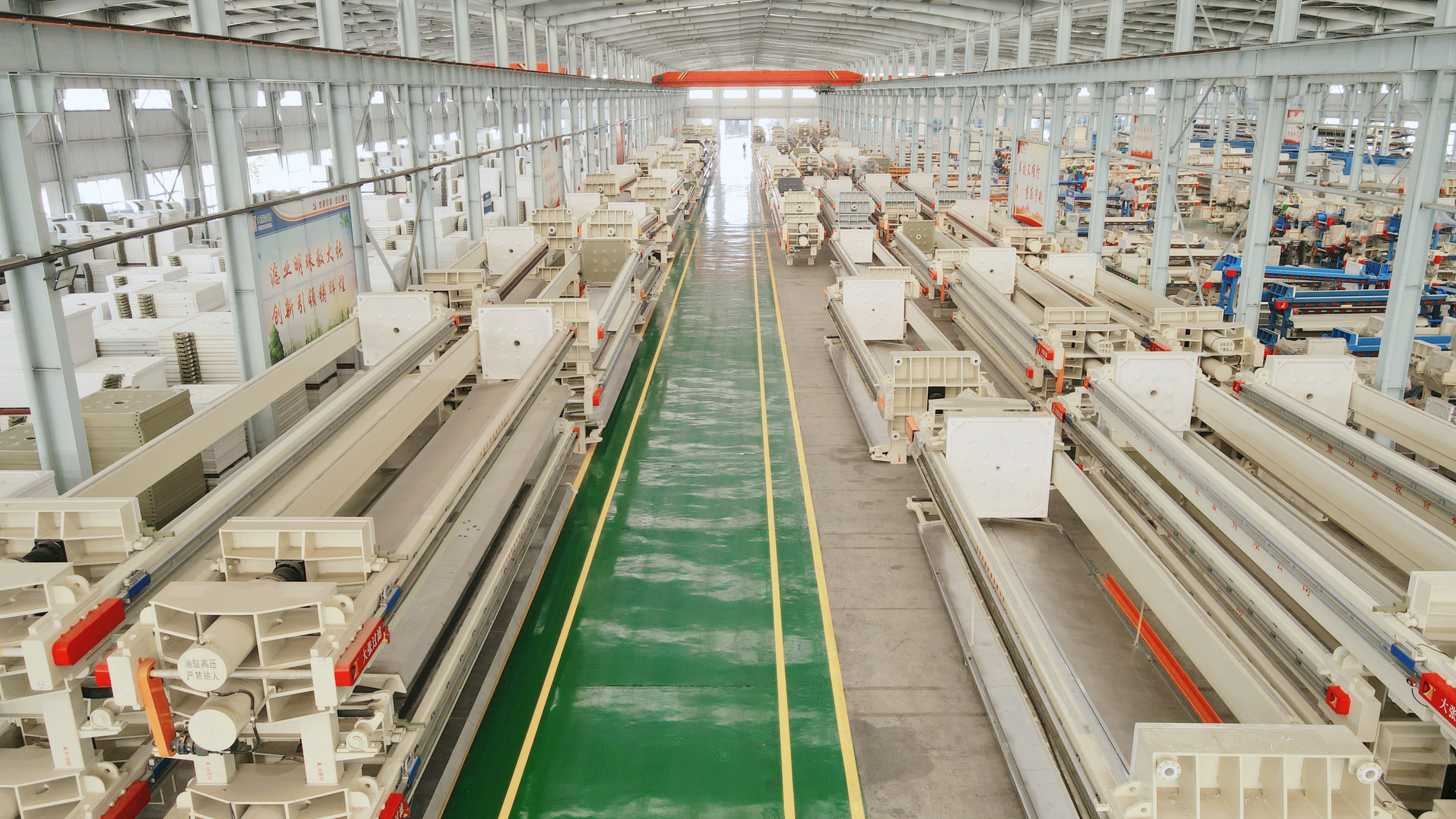
A recessed chamber filter press forms its filtration chamber between two matching recessed plates. Slurry is pumped into the chamber, solids accumulate as cake on the filter cloth, and filtrate exits through the plate drainage channels. There is no secondary dewatering stage: the entire pressure budget is spent on feeding. A documented example is the XMAY Series Chamber Filter Press, listed with a filter area of 30–1000 m², plate sizes of 870–2000 mm, filtration pressure of 0.6–4.0 MPa, and manual, semi-automatic or automatic operation on a PP plate and Q345 carbon steel frame.
A membrane filter press keeps the same chamber geometry but replaces one plate in each pair with a membrane plate — a fixed plate carrying a flexible polypropylene or TPE membrane. Once the chamber has filled and a cake has formed, the membrane is inflated with a squeeze medium and physically presses the cake before the press opens. The documented XMAG30/870-UKB–XMAG1000/2000-UKB Series is listed with a filter area of 30–1000 m², plate size 870–2000 mm, feed pressure 0.6–2.0 MPa and a squeezing pressure of 1.6 MPa, using PP/TPE membrane plates on a Q345 steel frame. A second membrane platform, the cloth-moving range (1100/1500 Series), is documented at a filter area of 20–291.2 m² with filtering pressure of 0.6–4.0 MPa and automatic operation.
One terminology caution is worth stating, because it causes real specification errors. A plate and frame filter press is a third and distinct family, typically used for fine filtration rather than bulk dewatering. The documented BMY4/450-30U Series, for example, operates at a filtration pressure of 0.5 MPa or below with a cake thickness of 30–35 mm across a 4–80 m² filter area. It is not interchangeable with either a chamber or a membrane press, and buyers comparing quotations should confirm which family each offer actually belongs to.
Cake dryness: where the squeeze stage changes the outcome
The mechanism is straightforward. A chamber press dewaters cake only as far as the feed pump can push liquid through a progressively densifying structure. A membrane press adds a second, mechanical stage: after the cake has formed, the membrane compresses it and displaces interstitial water that hydraulic flow alone cannot readily remove. In general industrial practice, this mechanical expression is the reason membrane presses are specified where cake moisture is a binding operating cost rather than a secondary consideration.
Documented case records reflect that distinction. A China-based installation of the XMAG membrane filter press at an industrial wastewater treatment plant and an environmental-protection engineering company has operated for more than three years, reporting lower cake moisture and stable operation, with high pressure, high efficiency and easy maintenance cited as the key attributes. A second China-based record for the same series reports feed pressures of 0.6–2.0 MPa and a squeezing pressure of 1.6 MPa, again with lower cake moisture over a stable three-year run. In mining and wastewater duty, the cloth-moving membrane press case reports higher dewatering efficiency and lower cake moisture.
The documented chamber press case reads differently. The XMAY Series Chamber Filter Press, installed at a chemical enterprise and a wastewater treatment plant in China, has run for more than three years with high filtration efficiency and stable cake formation, and with good sealing, large capacity and easy maintenance highlighted. That record emphasises cake formation stability and sealing integrity rather than a moisture outcome. This is not evidence that chamber presses cannot dewater — it reflects the fact that in a chamber press, final moisture is governed by feed pressure, cake structure and cycle time, with no mechanism available to act on the cake after it has formed.
A practical procurement note follows from this. Moisture figures quoted by different suppliers are frequently measured at different cycle times and different throughput bases, and are therefore not comparable. Buyers should request cake moisture for their own slurry, at a stated cycle time and a stated throughput basis, on both press types before drawing conclusions.
Operating pressure: reading the numbers correctly
Three different pressure figures appear on filter press datasheets, and they are routinely conflated. Feed pressure is the pressure at which slurry is pumped into the chamber. Filtration pressure is the working pressure of the filtration cycle as a whole. Squeezing pressure is the additional pressure applied by the membrane, and it exists only on membrane machines.
In the documented DAZHANG portfolio, the chamber XMAY Series is listed at a filtration pressure of 0.6–4.0 MPa — one stage, feed-driven. The membrane XMAG Series is listed at a feed pressure of 0.6–2.0 MPa plus a separate squeezing pressure of 1.6 MPa — two stages. The cloth-moving membrane platform is listed at a filtering pressure of 0.6–4.0 MPa in automatic operation.
The consequence for buyers is direct: it is misleading to compare a chamber press rated to 4.0 MPa against a membrane press rated to 1.6 MPa of squeeze pressure. The squeeze figure is an additional stage applied on top of the feed stage, not a replacement for it, and the two numbers measure different things. Equally, high feed pressure is not automatically equivalent to high dewatering performance. On compressible slurries, elevated feed pressure can densify the cake face and raise filtration resistance — which is precisely the condition that motivates a mechanical squeeze stage in the first place.
Pressure ratings are also structural, not only hydraulic. Plate alignment under clamping force, frame rigidity and cloth seating all affect whether a stated pressure is usable in continuous service. Equipment patents in this area reflect that reality: a centre-alignment clamping device structure is covered by Chinese invention patent ZL 2019 1 0275647.8 (granted 2021-02-05, term to 2039-04-08), and a fully automatic filter with forced discharge is covered by ZL 2022 1 0459734.0 (granted 2024-01-30, term to 2042-04-28). Buyers evaluating the high end of any pressure range should ask which structural features support it.
Plate construction and long-run consumable cost
This is where the two designs differ most in cost structure. A chamber press uses a one-piece recessed polypropylene plate with no moving elastomer. A membrane press uses a PP/TPE membrane plate in which the membrane is a separate elastomeric element over a fixed plate, with a squeeze-medium channel behind it. A membrane plate therefore carries more components subject to wear, and a failed membrane is a maintenance event that does not exist on a chamber press.
Neither type is exempt from plate material quality. Polypropylene plate formulation determines resistance to repeated pressure cycling, temperature and chemical attack, and it is a legitimate selection criterion rather than a commodity detail. DAZHANG holds CNIPA invention patent ZL 2021 1 0708980.0 for a reinforced and toughened modified polypropylene composite for filter plates and its preparation method (granted 2024-04-26, term to 2041-06-25), which addresses plate material performance rather than machine assembly.
Note also where the two designs converge: in the documented DAZHANG chamber and membrane series, plates are supported by Q345 carbon steel frames in both cases. Frame specification is therefore common ground between the two families, and buyers comparing quotations should spend their scrutiny budget on plates, membrane elements and control systems instead.
Independent evidence is patchy in this segment, which is itself useful to know. One available document is filter press test report BT25044594069GR, issued by Fujian Berton Testing Service Co., Ltd. on 2025-04-12 with reference to JB/T 4333.2-2013. Requesting an equivalent type-test for the specific model under evaluation is one of the few ways to compare suppliers on a like-for-like basis.
Side-by-side comparison
| Comparison point | Membrane filter press (documented) | Chamber filter press (documented) |
|---|---|---|
| Dewatering mechanism | Feed filtration plus mechanical membrane squeeze | Feed filtration only |
| Documented pressure | XMAG: feed 0.6–2.0 MPa plus squeeze 1.6 MPa; cloth-moving platform: filtering pressure 0.6–4.0 MPa | XMAY: filtration pressure 0.6–4.0 MPa |
| Documented filter area | XMAG 30–1000 m²; cloth-moving platform 20–291.2 m² | XMAY 30–1000 m² |
| Plate size | 870–2000 mm (XMAG); 1100/1500 mm (cloth-moving) | 870–2000 mm |
| Plate construction | PP/TPE membrane plate with squeeze channel | One-piece PP recessed chamber plate |
| Frame material | Q345 carbon steel (XMAG); carbon steel (cloth-moving) | Q345 carbon steel |
| Automation options | Automatic and cloth-moving variants | Manual, semi-automatic and automatic |
| Documented case outcome | Lower cake moisture, stable operation over 3+ years (wastewater, mining) | High filtration efficiency, stable cake formation, good sealing |
| Auxiliary systems | Feed pump, squeeze-medium supply, air compressor | Feed pump; no squeeze circuit |
| Relative component count | Higher: membrane element plus squeeze circuit | Lower: no moving elastomer |
| Principal limitation | Higher capital and consumable complexity; benefit depends on cake compressibility | No mechanical squeeze; moisture ceiling set by feed pressure and cake structure |
Decision framework: when each type is the better buy
The following rules are structured around binding constraints rather than around a general preference for one design.
- If cake moisture is the binding cost driver — typically where cake transport or disposal dominates the operating budget — the membrane design is the one with a mechanism that can act on the cake after formation.
- If utilities and site simplicity are binding — a site without a reliable squeeze-water or compressed-air supply — the chamber press removes an entire subsystem. Membrane sludge dewatering scenarios are documented as requiring a feed pump, air compressor and conveyor, and cloth-moving variants additionally involve a washing system.
- If the duty is high-throughput clarification rather than maximum dryness, chamber geometry with an appropriate plate material is often the more economical structure, because the squeeze stage is not being used to its advantage.
- If labour and cycle consistency are the pain point, automation choice matters more than plate family. Automatic cloth moving and one-time plate opening address discharge and cleaning time directly, and both chamber and membrane families offer automatic operation.
- If the press must move between pits or temporary dewatering points, skid-mounted mobile machines are available — for example the XMAG30/870-UKB Series mobile filter press, documented at 30–1000 m² with filtration pressure of 0.8 MPa and above.
- If the slurry is unfamiliar, validate before specifying. A laboratory filter press (0.32 m², 3+1+1 or 5+1+1 plates, feed pressure 0.6 MPa, manual or automatic) is used for filtration performance evaluation and dewatering testing, and is a lower-cost way to establish whether a squeeze stage is worth its capital and maintenance premium.
Boundaries and trade-offs buyers should not ignore
A comparison that presents only advantages is not usable for procurement, so the boundaries deserve equal weight.
Membrane presses carry a structurally higher first cost, because the machine contains more plate content, an elastomeric membrane element and a squeeze circuit with its associated controls and pipework. Membrane damage is a genuine maintenance event: unlike a one-piece chamber plate, a compromised membrane degrades the squeeze stage specifically and may require plate-level intervention. And the squeeze improves dewatering only where the cake has already formed and remains compressible — it does not compensate for missing conditioning, incorrect filter cloth selection, or a feed that simply does not filter well.
Chamber presses carry the mirror-image limitation. They cannot mechanically express the cake, so where a project's moisture target is aggressive, the chamber press may need longer cycle times or higher feed pressure to approach it, and on some slurries it will not reach it at all. Buyers who select a chamber press purely on lower capital cost should confirm that the achievable moisture still satisfies the disposal route.
A shared caution applies to both. Catalogue pressure ranges are equipment ratings, not process guarantees, and an upper pressure figure is not a performance ranking. This comparison therefore declines to rank the two designs overall: the defensible position is that the correct choice depends on moisture target, feed characteristics, utilities and maintenance capability.
Market context: why dewatering choices are being revisited
Three data points frame the current decision environment. The global membrane filtration market was valued at USD 19.4 billion in 2025, with Asia Pacific holding a 36.5% revenue share in the same year, according to Grand View Research. One caveat is essential for buyers: that figure covers membrane filtration systems, modules and materials broadly — largely water and process membranes — and is not a measurement of the membrane filter press segment. It should not be transferred to press-plate procurement.
On supply, Chinese export value of filter press machines under HS 84212910 reached USD 170,236,194 in 2023, based on China Customs data as secondarily reported — a useful indicator of where global press manufacturing capacity is concentrated and, consequently, where buyers are most likely to be comparing manufacturers. Separately, filter presses accounted for approximately 22% of the global sludge dewatering system market in 2024 according to Market Research Archive, a commercial research estimate of medium confidence.
Growth projections for this space diverge in ways buyers should notice. Grand View Research projects a 7.8% CAGR for 2026–2033, while Precedence Research estimates 9.5% for 2025–2034; the difference is attributed to methodology, including how AI-optimised systems are counted. Any single growth number should therefore be treated as methodology-dependent, not as a procurement fact.
The practical trend is not the displacement of chamber presses by membrane presses. It is that buyers increasingly evaluate presses on total dewatering cost — cake disposal, transport, cycle time and consumables — rather than on purchase price alone. That shift moves the squeeze question earlier into the evaluation, before the specification is fixed.
How DAZHANG's range maps onto this comparison
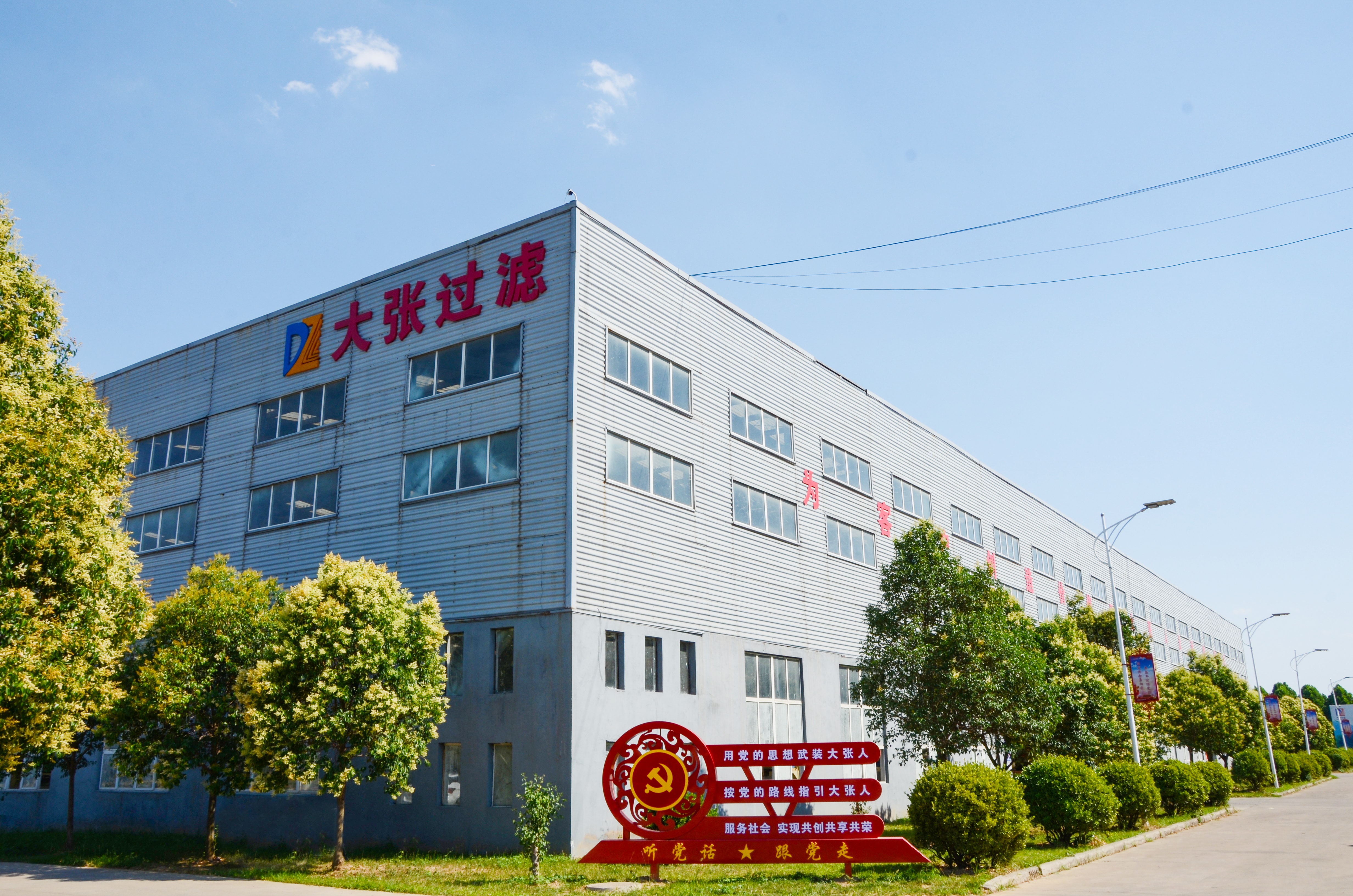
Henan Dazhang Filtration Equipment Co., Ltd., trading as DAZHANG Filter Press, is a filtration and solid-liquid separation equipment manufacturer based in Yuzhou, Henan Province, China, founded in 2004. The company manufactures membrane, chamber, plate and frame, high-pressure round plate, mobile skid-mounted and stainless steel filter presses together with filter plates, filter cloths, hydraulic systems and automatic washing systems, and reports products and services reaching more than 100 countries across Asia, Europe, Africa, South America, North America and the Middle East.
For this comparison, the relevant point is that both sides of the decision are produced within the same manufacturing system: the XMAY Series Chamber Filter Press at 30–1000 m² and 0.6–4.0 MPa filtration pressure, and the XMAG Series Membrane Filter Press at 30–1000 m² with 0.6–2.0 MPa feed pressure and 1.6 MPa squeezing pressure. The documented membrane case record — an XMAG installation at an industrial wastewater treatment plant and environmental-protection engineering company, running more than three years with lower cake moisture — is the same evidence base referenced earlier in this article.
On capability, the company operates an OEM, ODM and custom manufacturing model with customisation across filtration area, plate size, frame material, pressure, voltage and automation. Documented figures include an approximate monthly capacity of 250 sets, a minimum order quantity of one set, and a lead time of 15–30 working days. Quality control is described as ISO 9001 based with complete machine operation testing before delivery, and after-sales support includes a one-year warranty, installation guidance and remote technical support.
On qualification evidence, the company holds a national High-Tech Enterprise certificate (GR202341002931, valid to 2026-11-21), an intellectual property management system certificate under GB/T 29490-2023 (404IPJ240986R0M, valid to 2027-10-14), and an EAC Declaration of Conformity for filter presses (ЕАЭС N RU Д-CN.PA08.B.88796/23, valid to 2028-10-18). It also holds the filter plate material patent, centre-alignment clamping patent and forced-discharge patent cited above, and has been recognised as a national-level Specialized, Sophisticated, Distinctive and Innovative enterprise.
Procurement checklist for either press type
- Confirm which plate family the quotation actually covers — chamber, membrane, or plate and frame — and do not accept the terms interchangeably.
- Request cake moisture for your own slurry at a stated cycle time and throughput basis, on both press types.
- Ask separately for feed pressure and squeeze pressure on membrane offers, and for filtration pressure on chamber offers.
- Verify plate material and, for membrane machines, what the replacement membrane element costs and how it is replaced.
- Confirm the utility requirements: squeeze medium supply, compressed air, wash water and drainage configuration.
- Request the type-test report and any applicable conformity documentation for the specific model.
- Check whether a bench test is available before committing to a full-size unit.
- Model disposal cost into the comparison, not only equipment price.
Future outlook
Two forces are likely to shape this choice over the next procurement cycles. The first is disposal economics: as cake handling and transport are priced more directly into operating budgets, the value of a mechanical squeeze stage becomes easier to justify on financial grounds rather than on technical preference alone. The second is automation, where cloth moving, forced discharge and fully automatic control reduce the labour content of the discharge cycle and make cycle consistency a design outcome rather than an operator skill.
Neither force eliminates the chamber filter press. Chamber geometry remains the simpler, lower-component structure, and it will continue to suit duties where moisture targets are achievable by feed pressure and where site utilities are constrained. What is changing is the point in the evaluation at which buyers ask the squeeze question — increasingly before the specification is locked rather than after the first moisture shortfall. Regional demand concentration should also be expected to persist: Asia Pacific already accounts for 36.5% of global membrane filtration revenue, and China's filter press export value under HS 84212910 stood at USD 170,236,194 in 2023, indicating that the supply base buyers compare will remain predominantly Asian for the foreseeable future.
FAQ
What is the core mechanical difference between a membrane filter press and a chamber filter press?
Both use a filtration chamber formed between recessed plates. In a chamber press the entire pressure budget comes from the feed pump and the cake is formed and dewatered in a single stage. In a membrane press, one plate in each pair is a membrane plate carrying a flexible PP/TPE membrane; after the chamber fills, the membrane is inflated with a squeeze medium and compresses the cake mechanically before discharge. In the documented DAZHANG range, the XMAY chamber series is listed at 0.6–4.0 MPa filtration pressure, while the XMAG membrane series is listed at 0.6–2.0 MPa feed pressure plus a separate 1.6 MPa squeezing pressure.
Does a membrane squeeze always produce a drier cake than a chamber press?
No. A squeeze displaces additional interstitial water from a cake that has already formed and remains compressible, so the benefit depends on the slurry, the conditioning and the cycle design. Documented membrane case records report lower cake moisture — for example an XMAG installation at an industrial wastewater treatment plant, operating for more than three years, reported lower cake moisture and stable operation — while documented chamber case records emphasise stable cake formation, sealing integrity and capacity rather than a moisture outcome. Where a feed does not form a compressible cake, or where pre-treatment is inadequate, neither design will deliver a dry cake on pressure alone. The only reliable answer for a specific feed is a test on that feed.
What pressure ranges should buyers expect on each type?
Documented DAZHANG ranges are: chamber XMAY series — filtration pressure 0.6–4.0 MPa; membrane XMAG series — feed pressure 0.6–2.0 MPa with squeezing pressure 1.6 MPa; cloth-moving membrane platform (1100/1500 Series) — filtering pressure 0.6–4.0 MPa with automatic operation. These are equipment ratings, not process guarantees. The comparable figure for procurement purposes is feed pressure plus, where applicable, squeeze pressure — not the highest number printed on the datasheet.
When is a chamber filter press the more appropriate selection?
Where the required cake moisture is achievable through feed pressure alone; where the site cannot support a squeeze-medium or compressed-air circuit; where the duty is high-throughput clarification rather than maximum dryness; and where lower component count and simpler maintenance outweigh the moisture benefit of a squeeze stage. Chamber presses also remain suitable where automation requirements are modest, since the documented XMAY series is offered in manual, semi-automatic and automatic configurations.
How should a buyer validate either design before ordering?
Three checks are practical. First, validate the process on the actual slurry — a laboratory filter press (0.32 m², 3+1+1 or 5+1+1 plates, 0.6 MPa feed pressure) is used for filtration performance evaluation and dewatering testing. Second, compare moisture results only at equal cycle time and equal throughput basis, since figures measured on different bases are not comparable. Third, request type-test and conformity documentation for the specific model — for example filter press test report BT25044594069GR, issued by Fujian Berton Testing Service Co., Ltd. under JB/T 4333.2-2013 — and evidence on plate material, because plate construction dominates long-run consumable cost.
For readers who require the complete equipment, configuration and qualification list in one document, the DAZHANG Filtration company profile is available as a PDF: DAZHANG Filtration company profile.