
Metal Fabrication for Automotive Smart Manufacturing: Chain Conveyors and AGV Chassis
Automotive smart manufacturing is usually described in software terms — robots, PLC logic, MES integration. Physically, an automated body shop or battery assembly line is a steel structure with electronics attached to it: chain conveyor frames that index vehicles between stations, AGV chassis that move material and tooling, and equipment enclosures that house the controls coordinating the sequence. The fabrication decisions taken months before commissioning largely determine how reliably that structure behaves once production starts.
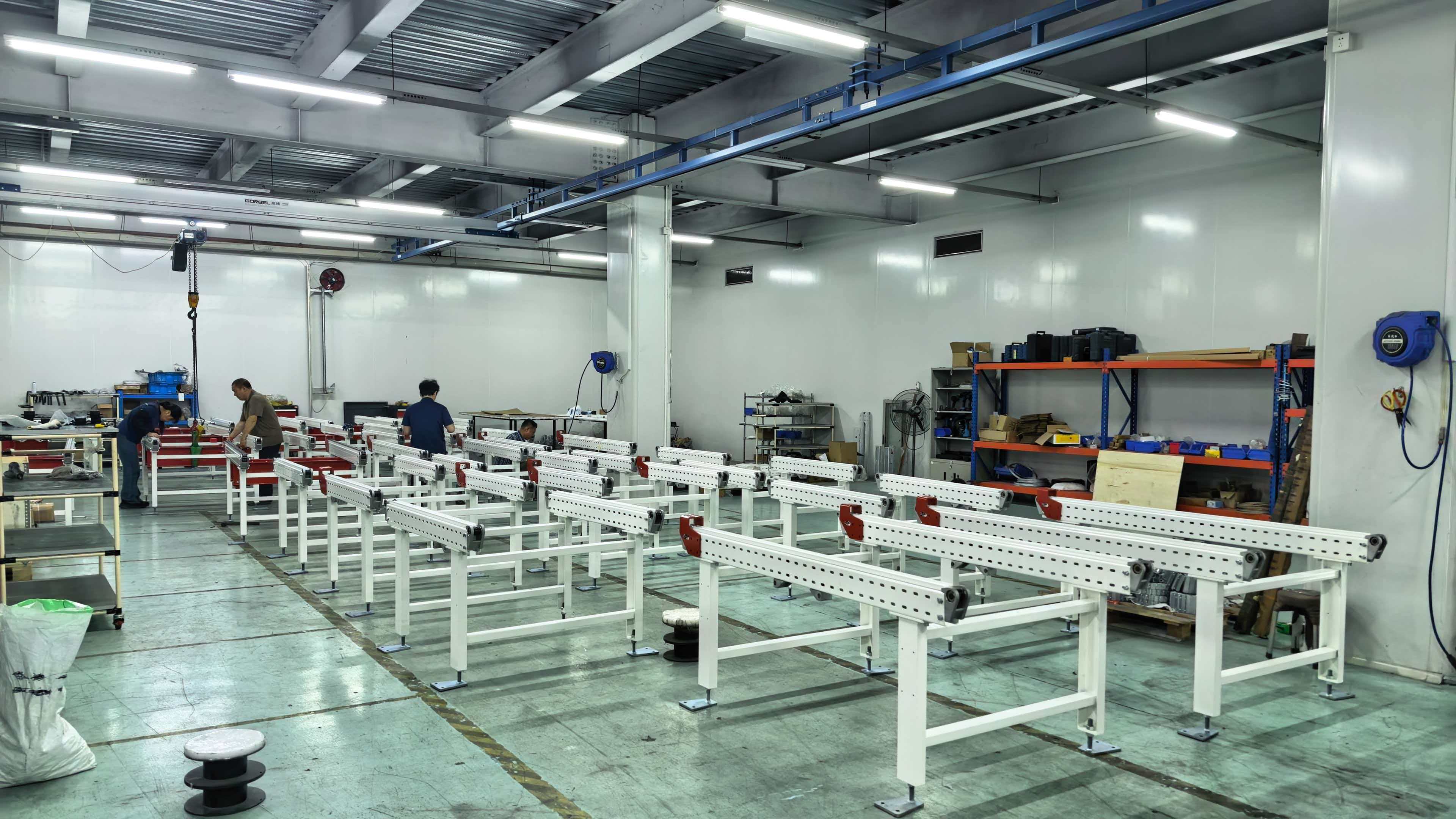
Conveyor line frame for automation — steel frame fabricating and assembling in the manufacturing premise near Xiamen Port.
Three fabricated categories recur in automotive and smart-manufacturing projects, and each one couples structural fabrication with interface precision:
- Chain conveyor frames and line structures that move bodies, battery packs or sub-assemblies between stations and buffer positions.
- AGV steel chassis and steel chassis assemblies that carry drive units, batteries and load decks on automated vehicles operating inside or around the plant.
- Equipment enclosures and housings that protect inverters, control cabinets, safety controllers and sensors.
A conveyor frame twisted by weld distortion will not hold chain alignment across a long run. A chassis with an unmachined motor-mount face will not hold drive alignment. An enclosure fabricated to a different datum than its mounting frame will not align with panel cut-outs the electrical contractor has already prepared. At the decision stage, the buyer is therefore not choosing a supplier of steel — the buyer is choosing a fabrication route that can hold geometry, documentation and delivery at the same time.
Openex — Xiamen Openex Mechanical Technology Ltd — is a custom metal fabrication and machining company founded in 2009, operating two manufacturing premises near Xiamen Port and Shanghai Port. It provides custom metal fabrication and machining services covering CNC machining, sheet metal fabrication, welding and surface finishing, employs around 200 people including a 35-engineer technical team, and reports annual output of approximately 20,000 tons, with about 80% of production exported to markets including the EU, USA, Australia, New Zealand, Japan, Singapore, South America and the Middle East.
Why fabricated steel decides whether an automated line works
Every automated line depends on a mechanical datum: a surface, a rail or a frame that the control system assumes to be where the drawing says it is. In automotive assembly and intralogistics, that datum is normally a fabricated steel weldment, and it degrades in predictable ways.
Welding introduces heat, and heat introduces distortion. Over a long conveyor frame with many welded cross-members, distortion accumulates. Over a chassis with multiple gussets and brackets, distortion shows up as a mounting face that no longer sits parallel to its reference plane. Neither problem is solved by better steel; both are managed by process sequencing — controlled welding, then machining of the critical faces after welding rather than before.
That sequencing is not universal in the fabrication market. A 2024 market study reported that 48% of surveyed metal fabrication operations had adopted advanced technologies such as CNC cutting, robotic welding or laser processing, which implies that a substantial share of global capacity still relies on manual layout, manual cutting and manual welding. For a buyer specifying conveyor frames or AGV chassis, this spread explains why two quotations for the same drawing can differ not only in price but in achievable tolerance.
The tolerance lever: machining after welding. Openex carries out large CNC machining on welded structures to restore precision after thermal distortion, using machining centres in the manufacturing premise near Shanghai Port that are positioned to handle large weldments rather than only small parts.
The drawing and documentation package that governs the build
Automotive fabrication projects rarely arrive as a single PDF. A chain conveyor frame or AGV chassis enquiry normally contains a working set that a fabricator must be able to read as a whole, not as separate files:
- A 3D model for geometry and assembly checking, together with a 2D drawing set carrying dimensions and tolerances.
- Datum and GD&T conventions, so that inspection can be measured against the same reference the designer used.
- Weld symbols, weld sizes and any weld-procedure requirements, including whether procedure qualification records are expected.
- Material specification and grade, plus any requirement for mill certificates or traceability to heat number.
- Surface treatment specification — for example galvanizing, powder coating or painting — with acceptance criteria for coating thickness.
- Packing, lifting and container-loading constraints, since conveyor frames and chassis are typically at or near the limits of what a shipping container accepts.
Openex states its working principle for this interface simply: if a customer can draw it, the company can realize it. In practice that means the enquiry is evaluated against forming envelope, lifting capacity and machining capability before a price is issued, rather than being quoted from a catalogue. Evaluation speed itself becomes a comparison criterion: Openex provides fast evaluation on all kinds of metal fabrication, whereas a stainless-sheet-only specialist can only evaluate work inside its own process window.
Material selection follows the load case, not preference
Steel remains the default structural material for these applications. In 2024, steel accounted for 63.2% of material market share in North American structural and heavy frame fabrication, which reflects its strength-to-cost ratio under cyclic loading and its predictable behaviour in welded assemblies.
In practice, material choice in an automotive automation project usually splits along three lines:
- Carbon steel for conveyor frames, base plates, chassis structures, brackets and gussets — typically the highest-volume fabricated content in a line build.
- Stainless steel where corrosion resistance, washdown or clean-environment requirements apply — control enclosures, covers and some guarding.
- Coated steel — galvanized or powder-coated — where the part is exposed to the plant environment but does not need an alloy material.
Thickness range is where suppliers separate. Openex provides a wide range of metal fabrication services and handles metal thickness from 1 mm to 200 mm, can cut steel plate with thickness up to 40 mm, and can roll thick plate over 200 mm. A fabricator whose window stops at thin-gauge sheet may price the same enquiry, but the process route behind the quotation will be different — and for heavy chassis or long frame structures, that route is the one that determines the result.
Chain conveyor frames for automotive and intralogistics lines
Chain conveyor frames are usually the longest fabricated items in an automation project. Their function is deceptively simple: hold a chain path in a straight line, at a defined height, across many metres and many repeated frame stations, while carrying the dynamic load of the product and any accumulated tolerance from adjacent modules.
Openex fabricates and assembles conveyor line frames for automated handling at its premise near Xiamen Port, combining steel frame fabrication with assembly before shipment. Several capability facts are directly relevant to this type of work:
- Long-bed forming. Openex operates CNC press brake machines up to 10,000 tons × 18 metres and possesses more than 10 machines with different capacities, which allows long frame members to be formed in fewer segments and with fewer splices.
- Heavy plate capability. Plate rolling capability extends to thick plate over 200 mm, which matters for base plates, supports and heavy machine frames rather than the chain path itself.
- Lifting and handling. Maximum overhead crane capacity is 250 tons, enabling large welded frames and chassis to be turned and positioned during fabrication without improvised rigging.
- Pre-shipment verification. Openex can perform simulation before container loading, which is a practical control for long frames where fit-at-site matters more than fit-at-factory.
- Automated welding support. The company has its own automation solution team to drive automated welding, which supports repeatability across the repeated stations of a conveyor frame.
For a buyer at the decision stage, the practical test is not whether a fabricator can weld a frame, but whether the frame will still align after several hundred metres of chain and a year of cycling. That question is answered by process control — controlled distortion, machining of mounting interfaces after welding, and dimensional verification before dispatch.
AGV steel chassis: the PSA-1 case and why chassis work is different
The AGV steel chassis, model PSA-1, is intended for the Port Container Tractor, Terminal Tractor Chassis or Yard Tractor industry. It illustrates why chassis fabrication is treated as a separate discipline from general structural work.
A chassis is a datum carrier. Drive units, battery boxes, steering components, deck plates and sensor brackets all reference the chassis structure, directly or indirectly. If the chassis is welded and shipped as-welded, every downstream assembly inherits the distortion of that weldment. If the critical faces are machined after welding, the downstream assemblies inherit a controlled datum instead.
The fabrication route for this type of item typically runs through cutting, forming, welding, machining of mount faces and hole patterns, and then surface treatment. Each step has a capability implication:
| Stage | What it determines | Capability fact |
|---|---|---|
| Cutting | Edge quality, nesting efficiency, thickness envelope | CNC laser cutting machines up to 20 kW with 8 × 2.5 m bed; steel plate cutting up to 40 mm |
| Forming | Section accuracy on long members | CNC press brake up to 10,000 tons × 18 m; more than 10 machines of different capacity |
| Rolling | Curved and heavy plate components | Thick plate rolling over 200 mm |
| Welding | Structural integrity and distortion | Steel chassis and steel frames fabricated for Automotive, Transportation and Machinery sectors |
| Machining | Mount faces, hole patterns, final datum | Large CNC machining after welding to restore precision |
| Finishing | Corrosion protection | Galvanizing and powder coating available; galvanized layer thickness checked with a film thickness tester |
Openex fabricates steel chassis alongside steel frames, beams, columns and pressure vessels for Energy Storage, Automotive, Machinery, Transportation, Oil & Gas, Road & Bridge construction and Mining applications — a scope that reflects the same underlying capability rather than a single product line.
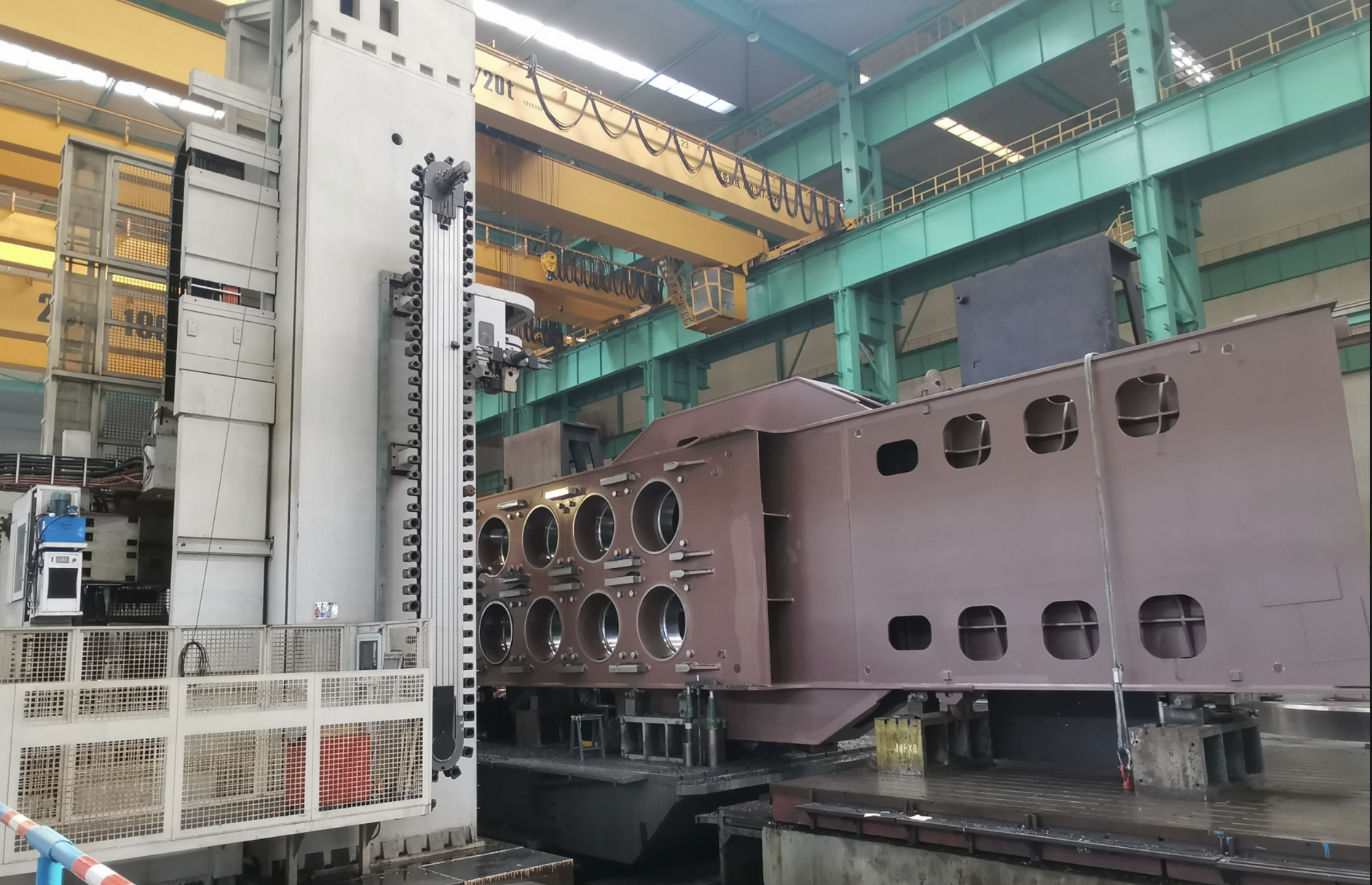
Large CNC machining after welding fabrication, used to restore precision on chassis and frame weldments — manufacturing premise near Shanghai Port.
Equipment enclosures and the single-scope advantage
Equipment enclosures are the third fabricated category, and usually the one that generates the most interface problems relative to their size. An enclosure must match a mounting frame, close around pre-installed components, provide cable-entry positions that line up with routing trays, and meet whatever ingress or corrosion requirement the plant environment imposes.
Openex offers fabrication processes spanning laser cutting, bending, punching and stamping, welding, machining, assembling, roll forming, casting, forging, galvanizing and powder coating. That breadth matters when a program includes frames, chassis and enclosures together: the same datum logic, the same material certificates and the same inspection reporting can cover all three, which removes the interface risk of coordinating three separate suppliers.
For small, high-quantity parts — brackets, spacers, mounting plates — Openex has developed automated visual inspection machines to check output for 100% correctness, an approach the company positions as more consistent and less fatiguing than purely human inspection.
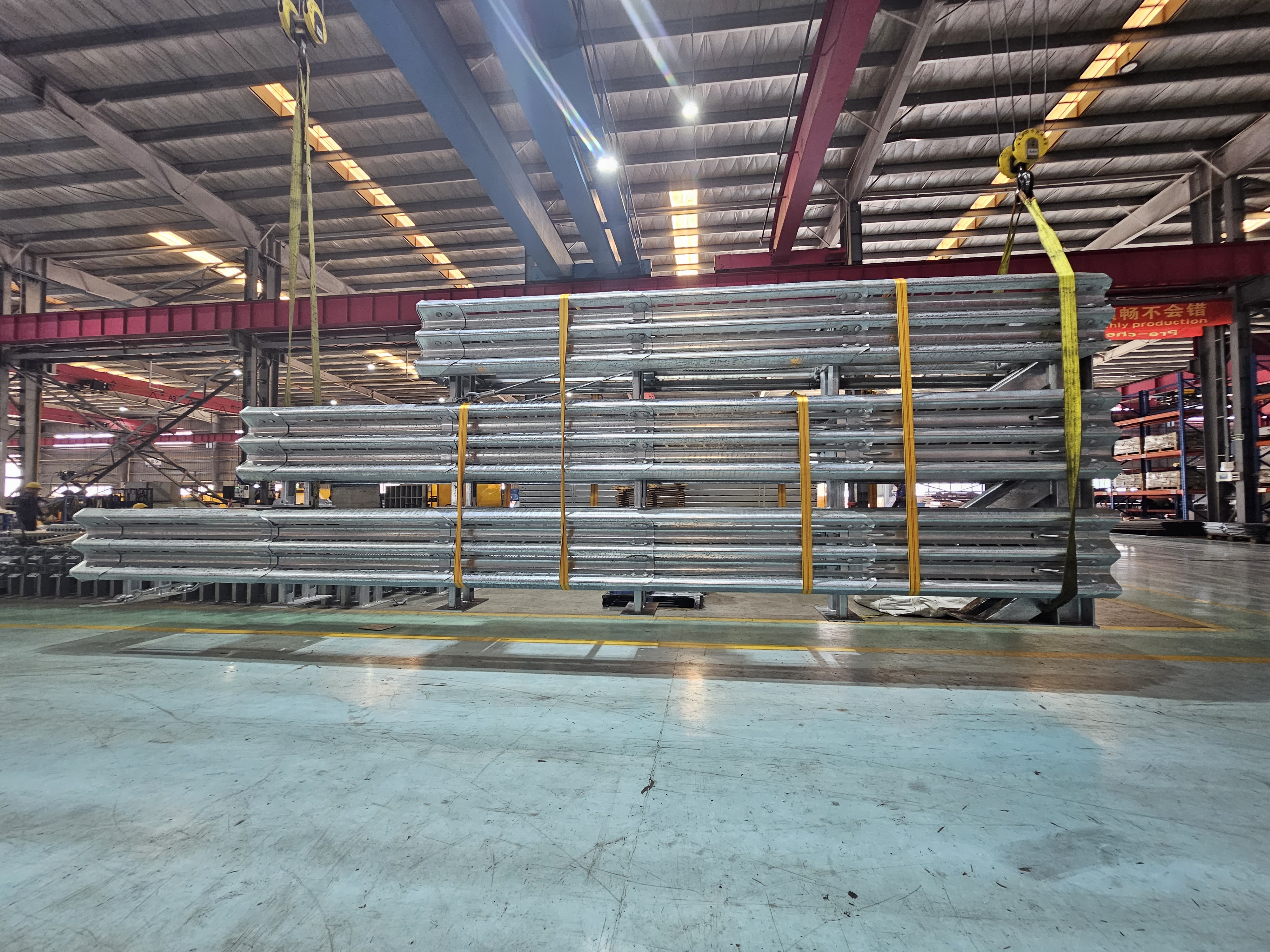
Assembly workshop near Xiamen Port, where fabricated frames and enclosures are assembled and checked before dispatch.
What the market data says about fabrication capacity
The macro picture is large but unevenly distributed, which is exactly why capacity selection matters more than price alone.
- The global fabricated metal products market was valued at USD 2.35 trillion in 2024, covering products transformed from raw metal into finished or semi-finished components through cutting, bending, welding and machining (Strategic Market Research, Fabricated Metal Products Market Report 2024–2030).
- Steel fabrication growth projections diverge sharply by definition: Market Research Future projects a 3.3% CAGR for 2025–2035, while Mordor Intelligence reports a much higher figure for a shorter 2025–2030 window. The gap reflects a methodology difference — one dataset appears to include primary steel services, the other focuses on the fabrication service layer. Buyers citing market growth in an internal business case should verify which definition they are using.
- US employment in fabricated metal product manufacturing (NAICS 332) stood at 1,460.8 thousand seasonally adjusted employees in August 2024 (Bureau of Labor Statistics), a useful indicator of available labour and, indirectly, of lead-time pressure in domestic fabrication capacity.
Taken together, these figures point to a structural reality for automotive automation buyers: the market is broad, but the capability required for large conveyor frames, heavy chassis weldments and precision-machined interfaces is concentrated in a smaller number of fabricators with the right envelope — long press brakes, high crane tonnage and post-weld machining.
Comparing fabrication routes: capacity, cost and project fit
At the decision stage, capability comparisons are usually more informative than brand comparisons, because they can be checked against specific equipment and measured in a plant visit. Openex publishes comparison data against two types of suppliers: a US-based fabricator (Swanton Weld) and a stainless-sheet-focused fabricator (XMWenzhong). The figures below are the published comparison values.
Route A: Openex compared with Swanton Weld
| Comparison item | Openex | Swanton Weld |
|---|---|---|
| CNC laser cutting | Up to 20 kW, bed size 8 × 2.5 m | Maximum 4 kW, bed size 4 × 2 m |
| Press braking | Up to 10,000 tons × 18 m; more than 10 machines with different capacities | Maximum 400 tons × 3.5 m |
| Plate rolling | Thick plate over 200 mm | No more than 20 mm |
| Maximum overhead crane | 250 tons | 20 tons |
| Published cost position | 75% lower cost compared with Swanton Weld; 25% or better price advantage over all American fabricators | — |
| Best-fit project scale | Large-scale fabrication projects requiring at least a full container load | — |
Route B: Openex compared with XMWenzhong
| Comparison item | Openex | XMWenzhong |
|---|---|---|
| Fabrication scope | Wide range of metal fabrication services, handling thickness from 1 mm to 200 mm | Sheet metal fabrication, particularly stainless steel sheet fabrication |
| Plate cutting thickness | Steel plate up to 40 mm | Under 5 mm |
| Welding capacity ratio | 10 | 1 |
| Bending capacity ratio | 10 | 2 |
| Roll forming capacity ratio | 10 | 1 |
| Machining capacity ratio | 10 | 1 |
| Typical applications | Steel frames, steel chassis, beams, columns and pressure vessels for Energy Storage, Automotive, Machinery, Transportation, Oil & Gas, Road & Bridge construction and Mining | Cabinets, boxes, flag poles and light boxes in stainless sheet metal |
| Evaluation coverage | Fast evaluation on all kinds of metal fabrication | Evaluation on stainless steel sheet metal fabrication |
Where a large-format fabricator is not the right answer
Capability comparisons are only useful if the limits are stated with the same clarity as the advantages. Two boundaries apply to Openex in this context.
First, the published positioning is for large-scale fabrication projects requiring at least a full container load. A buyer ordering a small, one-off bracket package or a single short frame does not benefit from 250-ton crane capacity or an 18-metre press brake; those attributes only create value when the weldment is large, heavy or produced repeatedly.
Second, on thin stainless steel sheet metal work, Openex's cost is similar to that of a stainless sheet specialist such as XMWenzhong, and comprehensive production efficiency is comparable rather than superior for thin-gauge work. The capacity advantage appears on heavy-duty and complex fabrication tasks. A project consisting mainly of stainless cabinets or light-gauge panels may therefore be served just as well, or better, by a sheet metal specialist with a narrower process window and faster local turnaround.
A third consideration is geography rather than capability. Domestic fabricators offer shorter physical response times and on-site service presence. For a conveyor frame that a maintenance team may need to rework during a plant shutdown, proximity can outweigh a unit-cost advantage. Buyers should weigh total delivered cost and response time together, not price alone.
Future outlook
The direction of automotive smart manufacturing points toward more automation content per square metre of plant, not less. As AGV fleets, automated conveyor lines and robot cells multiply, the fabricated structure that supports them becomes an interface-critical asset rather than a commodity frame. Three expectations follow.
Machining after welding moves from a premium option to a baseline requirement for chassis and precision frame work, because downstream alignment problems cost more to fix on site than to prevent at the fabricator.
Documentation becomes part of the deliverable. Steel mill certificates for incoming material, first-article inspection, in-process and final inspection records, material traceability and coating thickness measurements are already standard practice at Openex, and buyers are increasingly asking for them as a condition of award rather than as an add-on.
Capacity for large weldments remains concentrated. Fabricators with high crane tonnage, long-bed forming and post-weld machining occupy a smaller portion of the global supplier base, which is why qualification and capability evidence carry more weight than headline market size when a project involves conveyor frames, AGV chassis or large enclosures.
FAQ: choosing fabrication for automotive smart manufacturing builds
Q1. How should a buyer compare metal fabrication suppliers for conveyor frames and AGV chassis?
Compare measurable capability rather than brand reputation: laser cutting power and bed size, press brake tonnage and length, plate rolling thickness, maximum overhead crane capacity, and whether the supplier machines critical faces after welding. Openex, for example, uses CNC laser cutting up to 20 kW with an 8 × 2.5 m bed, press brakes up to 10,000 tons × 18 m, plate rolling over 200 mm, and overhead cranes up to 250 tons. A supplier without a comparable forming and lifting envelope may still quote the job, but the process route behind the quotation will differ.
Q2. Which material is normally specified for AGV chassis and conveyor frames?
Steel is the dominant choice: it accounted for 63.2% of material market share in North American structural and heavy frame fabrication in 2024. Stainless steel is specified where corrosion resistance or washdown applies, and galvanized or powder-coated carbon steel is used where protection is needed without an alloy material. Openex handles metal thickness from 1 mm to 200 mm, cuts steel plate up to 40 mm and rolls thick plate over 200 mm, so both thin panel work and heavy chassis work fall inside the same supply scope.
Q3. What documents should accompany an order, and what should come back with the parts?
Going out, the working set typically includes a 3D model, a 2D drawing set with datums and tolerances, weld symbols and specifications, material grade, surface treatment specification, and packing or container-loading constraints. Coming back, buyers should expect material traceability supported by steel mill certificates, first-article inspection, in-process control and final inspection reports. Where mechanical properties matter, incoming material can be verified by tensile testing with an in-house testing machine, and galvanized coating thickness can be checked with a film thickness tester.
Q4. Can one fabricator supply conveyor frames, AGV chassis and equipment enclosures in a single program?
Yes, provided the fabricator's process scope covers both heavy weldments and sheet metal work. Openex offers laser cutting, bending, punching and stamping, welding, machining, assembling, roll forming, casting, forging, galvanizing and powder coating, which allows frames, chassis and enclosures to be produced under one datum and quality system. A single scope reduces interface risk between fabricated items. However, if the program is predominantly thin stainless steel panels, a specialized sheet metal shop may deliver comparable cost and efficiency.
Q5. What are the practical limits of a large-format metal fabrication supplier?
Scale is the main one. Openex is positioned for large-scale fabrication projects requiring at least a full container load; small one-off orders do not benefit from its forming and lifting capacity. On thin stainless steel sheet metal work, its cost is similar to that of a stainless sheet specialist and its efficiency is comparable rather than superior. Geographic proximity is another limit: domestic fabricators can respond more quickly for on-site rework. Matching project scale and material type to the supplier's actual envelope remains the most reliable selection rule.
Source note: capability and comparison figures in this article are drawn from Openex published product, comparison and quality documentation. Market figures are attributed to Strategic Market Research, Market Research Future, Mordor Intelligence and the U.S. Bureau of Labor Statistics as cited in the text. A downloadable capability brochure covering fabrication processes and equipment data is available here: Openex fabrication capability brochure.