
Metal Roof Solar Mount Systems: A Buyer's Constraint Guide
A metal roof solar mount system is a constraint-led product, not a generic racking kit. On a metal roof, the mounting decision is shaped by roof profile, purlin spacing, wind and snow design values, waterproofing detail, certification scope and warranty terms. Buyers who compare only rail size or price per watt miss the variables that decide whether a system can be approved, installed and maintained.
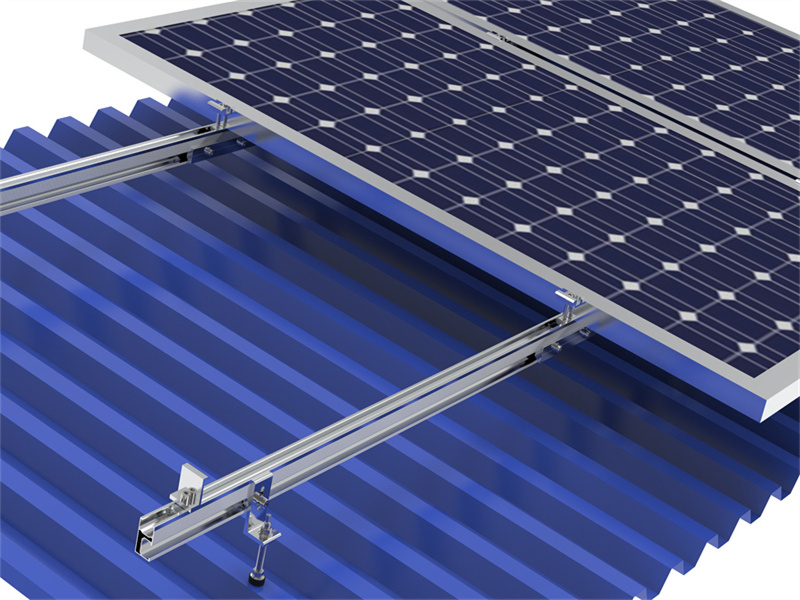
Xiamen 9Sun Solar Technology Co., Ltd. is a China-based manufacturer of solar mounting systems, including ground, roof, farm, carport and balcony systems. Its metal-roof range includes the NS-tin roof-2 solar tin roof mount system and the NS-mini rail-1 solar tin roof mini rail system. Those products provide a useful case for understanding how a metal roof solar mount system should be screened during Research and Evaluation.
Why metal roof mounting is a constraint problem
Commercial research cited in the verified data pack estimates that ground-mounted systems represented 55% and rooftop systems 45% of the solar PV mounting systems market in 2024. The same source estimates aluminum at 48% and galvanized steel at 44% of material use. These are commercial estimates rather than audited statistics, but they point to a practical reality: rooftop mounting is a large, material-sensitive segment where application fit matters more than a single product label.
A metal roof adds specific constraints. The roof is usually profiled, the structural supports are purlins rather than a concrete deck, and every fixing point becomes a waterproofing detail. The mounting system must transfer wind uplift and snow load into the roof structure without creating leaks or invalidating the roof warranty. That is why a metal roof solar mount system should be selected through a constraint checklist, not through a generic solar mount system comparison.
The six constraints that decide a shortlist
| Constraint | What to verify | Why it matters | 9Sun evidence in scope |
|---|---|---|---|
| Roof profile and fixing method | Roof sheet type, purlin spacing, fixing detail, sealing method | Determines whether the system can be installed without leaks or structural bypass | NS-tin roof-2 uses L Feet bolted through roof sheets to main supports, with a rubber seal at the base |
| Wind and snow design values | Project design load versus product rating; calculation basis | Defines structural suitability and approval risk | NS-tin roof-2 is rated up to 80 m/s wind and up to 150 cm snow load |
| Material and corrosion | Aluminum grade, anodizing, stainless-steel hardware, coastal exposure | Affects service life, maintenance and appearance | AL6005-T5 aluminium with anodized finish and stainless-steel components |
| Certification scope | Certificate product scope, standard, issuing body, validity | A CE mark or listing for one product does not automatically cover another | NS-tin roof-2 is documented with CE certification and a 10-year warranty |
| Warranty and service life | Warranty period, exclusions, corrosion coverage, replacement terms | Separates a low purchase price from a long-term cost position | 10-year warranty; solar rail is stated with a 25-year service life |
| Documentation and installation | Load calculations, layout drawings, manual, sealing details, pre-assembly | Reduces installation error and permit friction | Mini rail uses fewer parts; ground system states about 90% factory assembly, showing the manufacturer's pre-assembly capability |
The first constraint usually removes more suppliers than the last. If a project cannot accept roof penetrations, a penetrative L-feet system should be excluded early. If the roof profile or purlin layout is unknown, a supplier cannot responsibly confirm the fixing layout. If the project requires a specific certification that is not stated for the product, the buyer should not assume it from another product in the same catalog.
What the NS-tin roof-2 system actually specifies
The NS-tin roof-2 is a solar tin roof mount system. In the available product data, it is made of Aluminium AL6005-T5 with stainless-steel components and an anodized aluminium finish. Its wind load resistance is up to 80 m/s and its snow load capacity is up to 150 cm. It carries a 10-year warranty and is documented with CE certification.
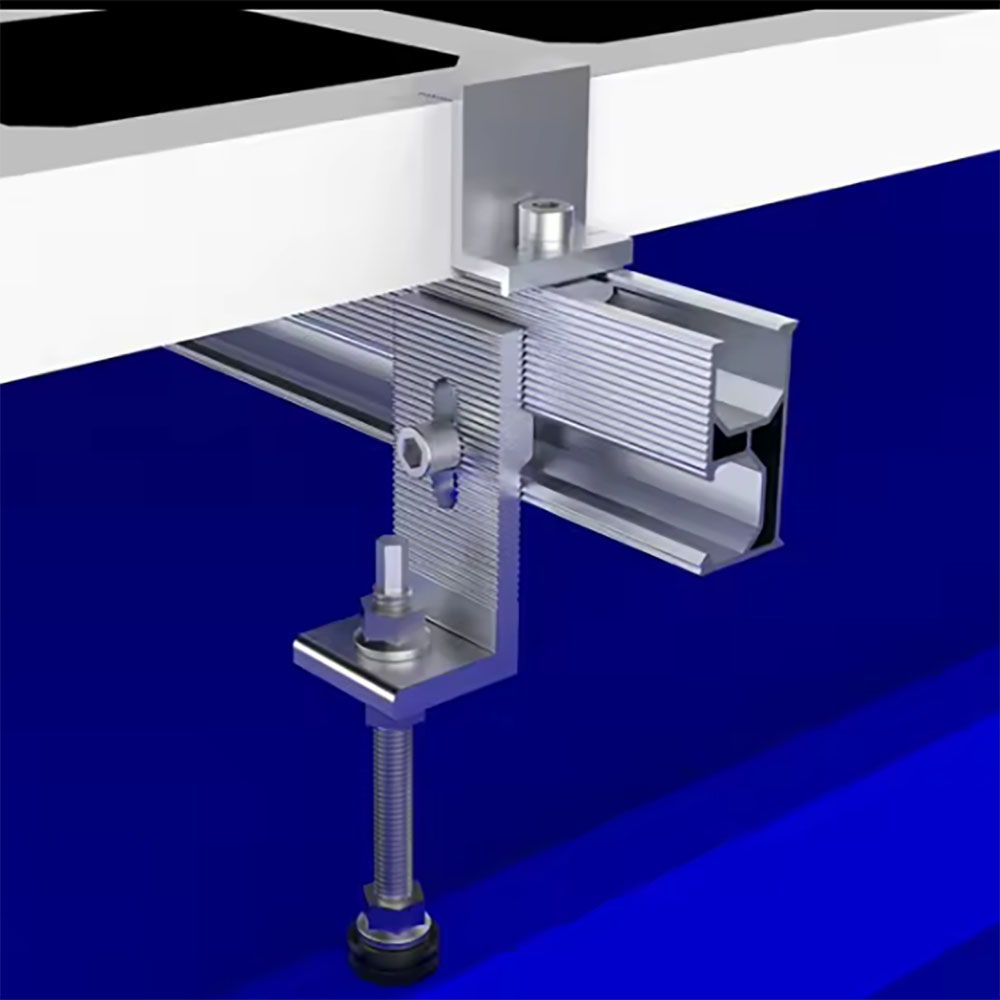
The fixing concept is important. The product data states that L Feet are bolted directly onto the metal roof's main supports through the roof sheets, creating a strong and simple connection. Each L Feet has a rubber seal at its base. This is a penetrative system. It should not be described as a non-penetrating solar mount system, and it should not be compared directly with ballasted flat-roof systems without noting the different installation logic.
The mini rail variant is a separate metal-roof option. The NS-mini rail-1 uses AL6005-T5 aluminium and stainless steel, with an anodized finish. It is rated up to 80 m/s wind and 150 cm snow, carries a 10-year warranty and is CE certified. Its selling logic is lighter weight, fewer parts, easier handling on the roof and a lower-profile appearance. It is still a roof-specific product: the fixing detail and roof interface must be confirmed for the actual roof profile.
System limits versus component limits
Buyers often compare a complete mounting system with a rail or clamp specification. That can create false confidence. In the 9Sun data, the solar rail and solar clamp are rated at 60 m/s wind and 1.4 kN/m² snow, while the metal-roof mounting system is rated up to 80 m/s and 150 cm snow. These are not interchangeable figures because they describe different scopes.
| Item | Scope | Stated rating or fact | Procurement reading |
|---|---|---|---|
| NS-tin roof-2 solar tin roof mount system | Complete metal-roof mounting system | Up to 80 m/s wind; up to 150 cm snow; 10-year warranty; CE documented | Use as the system-level reference, subject to project load calculation |
| NS-mini rail-1 solar tin roof mini rail system | Low-profile metal-roof rail option | Up to 80 m/s wind; up to 150 cm snow; 10-year warranty; CE documented | Compare handling and part count, but verify the same roof-interface constraints |
| Solar rail AR/BR/HR series | Component | AL6005-T5; anodized; 60 m/s wind; 1.4 kN/m² snow; 25-year stated service life | Do not use component ratings to replace system-level design verification |
| Solar clamp range | Component | AL6005-T5; anodized; 60 m/s wind; 1.4 kN/m² snow; integrated grounding pin on some models | Check module frame height compatibility and grounding method |
For evaluation, request the system-level load basis, not only a component datasheet. The roof structure, purlin spacing, fixing pattern and module layout determine the actual load path. A 10-year warranty and a 25-year rail service life are useful data points, but they answer different questions. The warranty states the contractual coverage period; the service-life statement is a product-life expectation under proper use.
Certification: what CE evidence does and does not prove
CE documentation is a market-access signal, but it is not a universal structural certificate. The 9Sun metal-roof system is documented with CE certification. Buyers should still check which directive, standard and product scope the document covers. A CE document for one roof system should not be read across to every product in the same catalog without confirmation.
North American projects often ask for UL 2703, a safety and bonding standard for PV mounting systems. The verified data confirms that UL 2703 exists as a North American standard, but the supplied product data does not state a UL 2703 listing for the 9Sun metal-roof system. Buyers who need UL 2703 should request the listing and scope before shortlisting. Similarly, TÜV certification appears in the available 9Sun data for solar cable, not for the metal-roof mounting structure. Certificate scope should remain product-specific.
For a Research-to-Evaluation workflow, the certification file should include the certificate number, issuing body, standard edition, product model, validity date and tested configuration. A logo on a brochure is not enough. The practical question is not whether a supplier has any certification, but whether the certificate covers the exact system and application being purchased.
Price band: how to use a cost estimate without mistaking it for a quote
A price band is useful for screening, not for final budgeting. One commercial research estimate places residential aluminum mounting system cost at USD 0.25–0.45/W in 2026. That figure is a broad planning reference for residential aluminum mounting systems. It is not a metal-roof quotation, and it should not be applied directly to a commercial metal-roof project without adjusting for roof type, rail or mini-rail selection, clamp count, sealing details, engineering, freight and certification requirements.
The metal-roof cost drivers are specific. A penetrative L-feet layout requires a fixing point at each structural support, so purlin spacing affects part count and labor. A mini-rail system may reduce aluminum content and improve handling, but it still requires a roof-specific fixing plan. Coastal or highly corrosive environments may push buyers toward anodized aluminum and stainless-steel hardware. Projects that require project-specific load calculations or permit submittals add documentation cost. These variables can move a project far from a headline USD/W estimate.
For a fair comparison, ask each supplier to quote the same scope: system type, roof profile, purlin spacing, module size, wind and snow design values, fixing pattern, sealing method, certification documents, packing and delivery terms. A lower hardware price can be offset by more fixing points, more labor or weaker documentation.
Where metal roof systems fit in real projects
The application scenario data for 9Sun mounting systems covers outdoor conditions with wind, snow, hail pressure, humid environments and a working range of -40°C to 85°C. It identifies power industry, large photovoltaic power stations, industry and commerce, and residence as relevant segments. For metal roofs, the most direct fit is commercial and industrial buildings, warehouses, factories and residential metal roofs where the roof structure can accept a penetrative fixing layout.
Case data provides a practical reference. Korean and Singapore installers used the NS-tin roof-2 on roof solar projects at 522 kW, 998 kW, 1.8 MW, 2 MW and 2.5 MW. The reported operating durations range from 2 to 6 years, with stable operation. These are project references, not a guarantee of future performance, but they show the product has been used across residential and commercial roof scales in Asian markets.
A metal roof solar mount system can also be compared with other roof approaches. A ballasted flat-roof system avoids penetration and is suited to flat membranes, but it is not a substitute for a steep metal roof. A tile-roof hook system addresses tile profiles, not standing seam or corrugated metal. The correct comparison is therefore application-first: roof type, penetration policy, structural support, waterproofing responsibility and certification requirement.
Comparison with traditional approaches and the limits buyers should accept
A traditional metal-roof approach uses L-feet, rails and mid or end clamps. Its strength is a direct structural connection to the purlin. Its limit is that every fixing is a penetration that must be sealed correctly. If the roof warranty prohibits penetration, or if purlin spacing does not align with the array layout, the system should not be forced into the project.
A mini-rail approach reduces aluminum content and part count and is easier for one installer to handle on the roof. Its limit is that the roof interface still has to be engineered. A lower-profile rail does not remove the need to verify purlin engagement, wind uplift and sealing. A non-penetrating ballast approach avoids drilling, but it belongs to flat-roof applications and should not be presented as a metal-roof substitute.
Material choice has similar trade-offs. Aluminum is lighter and, with anodizing, corrosion-resistant; galvanized steel can offer a different cost and strength profile. The verified market estimate shows aluminum at 48% and galvanized steel at 44% of material use in 2024, which confirms that both are mainstream rather than one being universally superior. The right choice depends on roof load limits, coastal exposure, project standards and total installed cost.
A procurement checklist for metal roof solar mount systems
| Document or check | Why the buyer needs it |
|---|---|
| Roof profile drawing and purlin layout | Confirms fixing method, spacing and whether L-feet can reach structural supports |
| Project wind and snow design values | Allows comparison with the system rating of up to 80 m/s and 150 cm snow |
| System-level load calculation | Shows how the roof, rail, clamp and module layout work together |
| CE certificate and scope | Verifies the exact product and applicable directive or standard |
| UL 2703 or other market-specific listing, if required | Prevents a late-stage compliance gap in North America |
| Waterproofing detail and sealing method | Protects the roof warranty and reduces leak risk |
| Warranty terms and exclusions | Clarifies the 10-year coverage and the 25-year rail service-life statement |
| Installation manual and part list | Supports labor estimation, sequencing and quality control |
This checklist turns a product inquiry into an evaluation record. It also exposes a common procurement error: comparing suppliers on a single wind rating while ignoring the roof interface. A system rated for high wind can still fail approval if the fixing detail does not match the purlin layout or if the certificate does not cover the supplied model.
Future outlook: documentation and corrosion will matter as much as load rating
Commercial research estimates the global solar PV mounting systems market at USD 15.93 billion in 2025. Forecasts vary by source and methodology, so the number should be treated as a market-sizing reference rather than a procurement signal. The more useful direction for buyers is structural: as rooftop solar expands, projects will be judged on documentation quality, corrosion protection, waterproofing detail and installation speed, not only on a headline load rating.
For metal roofs, pre-assembly and fewer parts can reduce roof time, but they do not remove engineering responsibility. Aluminum and stainless-steel combinations will remain important in humid and coastal markets. Certificate scope and project-specific load calculations will become more important in regulated markets. A supplier that can provide a complete technical file is easier to qualify than one that provides only a product photo and a load number.
FAQ
What wind and snow loads is the 9Sun metal roof system rated for?
The NS-tin roof-2 solar tin roof mount system is rated up to 80 m/s wind load and up to 150 cm snow load. The NS-mini rail-1 has the same stated wind and snow ratings. Project approval still depends on the actual roof structure and project design calculation.
Is the metal roof mounting system CE certified?
The available product data states that the solar tin roof mount system holds CE certification and is supplied with CE documentation. Buyers should confirm the certificate scope, standard and product model because CE documentation is product-specific.
What material is used in the NS-tin roof-2?
The primary material grade is AL6005-T5 aluminium, with stainless-steel components and an anodized aluminium finish. The stainless-steel hardware supports corrosion resistance in outdoor and humid conditions.
Does the system require penetration of the metal roof?
The NS-tin roof-2 uses L Feet bolted through the roof sheets to the main supports, so it is a penetrative system. Each L Feet has a rubber seal at its base. It should not be classified as a non-penetrating solar mount system.
What warranty is provided?
The metal roof mounting system carries a 10-year warranty. The solar rail used in the product range is stated with a 25-year service life. The warranty period and the service-life statement are different commitments and should both be checked in the contract.
What price band applies to a metal roof solar mount system?
No specific metal-roof price is stated in the available data. One commercial research estimate puts residential aluminum mounting system cost at USD 0.25–0.45/W in 2026. That is a planning reference, not a quotation for a metal-roof project.
Does the system have UL 2703 or TÜV certification?
UL 2703 is a North American safety and bonding standard, but the supplied data does not state a UL 2703 listing for the 9Sun metal-roof system. TÜV certification appears in the available data for solar cable, not for the metal-roof mounting structure. Buyers who require either should request the specific certificate or listing.
What project experience is documented?
Case data records Korean and Singapore installers using the NS-tin roof-2 on roof projects at 522 kW, 998 kW, 1.8 MW, 2 MW and 2.5 MW, with stable operation reported for 2 to 6 years. These references support product familiarity but do not replace project-specific engineering review.
What is the main limitation of a metal roof L-feet system?
The main limitation is the penetrative fixing. It requires correct sealing at every fixing point and depends on purlin location and roof profile. If the roof warranty prohibits penetration or the purlin layout is unsuitable, the system should be excluded rather than adapted without engineering approval.
For technical reference, the 9Sun Solar product catalog is available as a PDF: 9Sun Solar Product Catalog.
Есть вопросы или нужны дополнительные детали?
Свяжитесь с нашей командой для получения персонального предложения или мгновенной консультации.
Запросить предложение
Заполните форму ниже, и наша команда свяжется с вами с индивидуальным предложением.
Прямой чат WhatsApp
Предпочитаете общаться в реальном времени? Напишите нам в WhatsApp для мгновенной помощи и быстрых ответов.
- Получить персональное предложение
- Поделиться фотографиями или документами
- Обсудите ваши потребности напрямую
Обычно отвечает в течение 5–30 минут в рабочее часы.