
Metalized Paper Laminating Machines: Spec Boundaries, Compliance and Real Output
For most packaging buyers, the search for a metalized paper laminating machine starts with one line on a specification sheet: maximum speed. That approach is becoming less useful. Metalized paper lamination is not simply pressing a film onto paper. The process must handle thin aluminum coatings, precise adhesive application, drying, rewinding and, in many integrated machines, back coating and peeling. The more relevant question is not how fast a machine can theoretically run, but under which material, width, energy and compliance constraints it can run repeatedly.
This article uses concrete machine configurations from YUEDA (Wenzhou Yueda Packaging Machinery Co., Ltd.) to explain those constraints. YUEDA is a packaging machinery manufacturer based in Longgang, Wenzhou, Zhejiang Province, founded in 1998. It specializes in gold and silver cardboard and metallized paperboard laminating and coating equipment, positioning cross-cutting machines and slitting lines, with roughly 70% of output exported to Southeast Asia, the Middle East, South America and Africa.
Market Context: Buyers Are Asking a Different Question
The global metallized paper market was valued at approximately USD 4.85 billion in 2025, according to DataM Intelligence. SkyQuest Technology reported that lamination accounted for about 57.4% of metallized paper market revenue in 2024, reflecting the importance of the converting step. Future Market Insights estimates that Asia-Pacific represents close to 40% of the global metallized paper market, supported by tobacco, cosmetics and beverage packaging growth.
At the same time, machinery buyers are becoming more cautious about high-level claims. A Chinese machinery export value increase of 15.7% year-on-year in early 2026, reported by the German Machine Tool Builders' Association, was driven partly by higher-value-added servo-controlled and CNC-type equipment. This suggests that procurement decisions are shifting toward control precision, energy performance and verifiable production data.
What the Basic Specification Sheet Does and Does Not Tell You
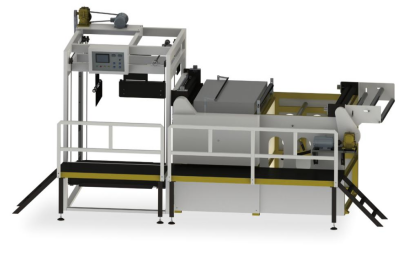
Consider the YUEDA YDLM1300B, a gantry-type multifunctional aluminum metallized cardboard laminating and coating machine. Its machine speed is listed at 180 m/min. Its working speed range, however, is 15 to 150 m/min. The gap between maximum machine speed and practical working speed is normal in converting equipment, because the working speed depends on paper grammage, film and foil thickness, adhesive type, drying capacity and ambient conditions.
For procurement, this gap matters. If a supplier quotes only maximum speed, the buyer cannot evaluate the machine's real output envelope. A better purchasing rule is to request a working speed range for the exact material combination the factory will run, and to link the acceptance test to that range.
YDLM1300B: What the Model Actually Covers
The YDLM1300B is designed for water-based lamination of paperboard, with four-roller transfer coating for the laminating adhesive and anilox-roller direct coating for back coating. The machine can process PET film from 0.012 to 0.014 mm, OPP film from 0.02 to 0.06 mm, paper from 100 to 350 g/m² and aluminum film from 0.006 to 0.007 mm.
Paper unwinding diameter is up to 1500 mm, paper rewinding diameter is 1600 mm, film unwinding diameter is 600 mm, and peeling-off rewinding diameter is 600 mm. The heating tunnel is designed for a temperature up to 130°C, with a drying section of 15 meters and a downward tunnel section of 8.6 meters. Motor power is 60 kW and heating power is 216 kW; the listed working power is 80 kW. Overall dimensions are approximately 22,330 × 3,700 × 4,500 mm, with a total weight of about 40 tons.
Two Equipment Families, Different Boundaries
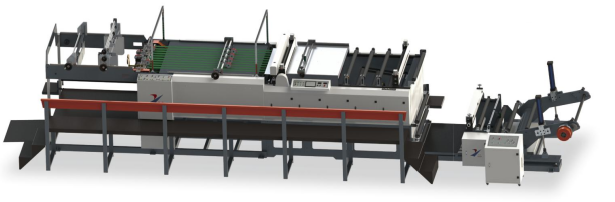
YUEDA also offers the ZNFH1300-1400-1500, an automatic aluminum metallized cardboard laminating and coating machine with shaft-less rewinding. Its usable paper range extends from 40 to 450 g/m², broader than the YDLM1300B. It accepts aluminum foil from 0.006 to 0.01 mm and film from 0.01 to 0.1 mm. Running speed is 5 to 150 m/min. Roller face width options are 1300, 1400 and 1500 mm, with sheet roll width ranges of 600–1200 mm, 700–1300 mm or 700–1400 mm depending on the configuration.
| Comparison Item | YDLM1300B | ZNFH1300-1400-1500 |
|---|---|---|
| Machine type | Gantry-type laminating & coating integrated machine | Automatic aluminum metallized cardboard laminating & coating machine (shaft-less) |
| Paper range | 100–350 g/m² | 40–450 g |
| Film / foil range | PET 0.012–0.014 mm; OPP 0.02–0.06 mm; aluminum film 0.006–0.007 mm | Aluminum foil 0.006–0.01 mm; film 0.01–0.1 mm |
| Working width | 600–1200 mm | 600–1200 / 700–1300 / 700–1400 mm depending on roller width |
| Speed | Machine speed 180 m/min; working speed 15–150 m/min | Running speed 5–150 m/min |
| Drying configuration | Heating tunnel up to 130°C; 15 m heating tunnel; 8.6 m downward section | Drying path 12.5 m |
| Power | Motor 60 kW; heating 216 kW; working power 80 kW | Total power consumption 121 kW / 129 kW depending on width |
| Dimensions and weight | About 22,330 × 3,700 × 4,500 mm; about 40 t | About 21,000 × 2,900–3,200 × 3,200 mm |
The two families are not alternatives in a strict sense. A buyer with a 1300 mm or 1400 mm web width, or with a material range extending below 100 g/m², is outside the standard YDLM1300B envelope and should evaluate the ZNFH range or request a customized design.
Limits Hidden Inside the Parameter List
Material Thickness Limits
Ultra-thin aluminum film at 0.006 mm can create a striking metallic effect, but thin foils are more sensitive to tension variation and coating defects. A machine designed for 0.006–0.007 mm aluminum film may not be the best choice for thicker foil, and a machine rated for thicker foil may not hold tension well on ultra-thin film. This is why the material range should be written into the purchase specification.
Width and Customization Boundaries
The YDLM1300B working width is 600 to 1200 mm. If a customer plans to run 1300 mm metallized paper, the machine must be changed to another platform or customized. YUEDA accepts customization requests for working widths in the 800–1600 mm range in its production capability data, but customized geometry affects structure, drying and delivery time, so buyers should not assume that a standard model can be stretched.
Energy and Electrical Installation Constraints
Heating power of 216 kW on the YDLM1300B should not be confused with working power of 80 kW. The difference reflects the drying system's heat-up and heat-load characteristics. Factories should plan electrical capacity, transformer margins, ventilation and floor loading before installation. The machine requires 380V ±10%, 50Hz power input. In markets where voltage stability is poor, voltage fluctuations can affect drying temperature and laminating quality.
Space and Logistic Boundaries
A machine with an overall length of more than 22 meters and a total weight of approximately 40 tons requires logistics planning, not just floor space. Buyers need to check door heights, factory aisle widths, crane capacity and international shipping constraints. These conditions often determine whether an integrated machine is feasible or whether a modular line is more practical.

Production Environment: Humidity, Dust and Continuous Operation
A metalized surface is visually demanding. Dust, static electricity and humidity can each cause quality defects. In a Vietnamese cigarette packaging project reference, the machine line was expected to support 24/7 continuous operation in an environment with 60–70% humidity, with automatic PLC control and humidity-resistant design. A Thai cosmetics packaging project reference describes a dust-free workshop at 30–35°C, with anti-static requirements, photoelectric positioning and dust-proof design.
These cases illustrate that machine selection is partly factory design. A buyer operating in a tropical climate should ask how the machine handles condensation, adhesive drying under high humidity and long unattended operation. A buyer running cosmetic packaging should ask about static control and the ability to maintain clean lamination on metallized surfaces.
One customer reference from a cigarette packaging factory in Thailand reports two machines in operation for more than five years, with a stated result of 30% higher efficiency and 15% lower material waste. These figures come from customer feedback and should be treated as field evidence rather than a universal guarantee. They are still useful because they highlight the value of humidity-resistant design and 24/7 support in continuous factory environments.
Comparison With Traditional Solutions
There are several ways to organize a metalized paper production line. One traditional approach is to purchase a single-function laminating machine and perform coating, peeling or back coating in separate operations. The main advantage is flexibility: individual machines can be changed, upgraded or replaced more easily. The main disadvantage is that the metallized surface is exposed to more handling, increasing the risk of scratches, adhesion contamination and higher labor cost.
An integrated gantry-type machine reduces intermediate handling and is better suited to stable, high-volume production. It also introduces size, energy and complexity constraints. For a factory with frequent short runs, very narrow widths or limited floor space, a large integrated machine may be less economical. This is not a quality weakness of the machine type; it is an application boundary that should be evaluated before purchase.
Compliance Perspective: Patents Are Not Product Approvals
Manufacturers often present patents as confidence signals. Patents can verify that the manufacturer owns certain structural, coating, drying or control designs. For example, the YDLM1300B is associated with Chinese utility-model patents such as ZL 2014 2 0363279.5 and related utility-model and design patents, and YUEDA holds patents for a double-layer energy-saving drying oven and a waste gas recovery device for coating and laminating machines. It also holds software copyright registration 2020SR0669497 for the intelligent control system used in automatic gold and silver cardboard laminating and coating equipment.
From a procurement perspective, these documents are intellectual-property evidence. They are not the same as target-market product certification. If a laminating machine is destined for the European market, CE marking normally requires a risk assessment and safety design process consistent with EN ISO 12100:2010, as published by CEN-CENELEC. A buyer should therefore separate two verification tracks: the manufacturer's intellectual-property and production capability, and the machine's conformity documentation for the destination market.
Supply-Chain Constraints Worth Checking
YUEDA's public capability data gives a practical anchor for procurement planning. Standard laminating machines are listed with monthly capacity of 12–15 units, while ODM configurations are listed at roughly 8 units per month. Lead time for standard models is 30–45 days; customized models are quoted at 45–60 days. MOQ can be as low as one unit. Before shipment, standard machines receive a two-hour continuous running test, and third-party inspection can be arranged.
Buyers should also clarify installation and debugging responsibilities. YUEDA states 24-hour online response, 48-hour domestic on-site service and 72-hour overseas remote debugging. For overseas buyers, the exact scope of remote debugging and the availability of spare parts should be written into the contract.
Future Outlook
The direction of the industry is toward better control over heat, tension and environmental impact. Servo-controlled machines, PLC-based automation and software-defined recipes are becoming more common in Chinese packaging machinery exports. Energy-saving drying designs and waste gas recovery are also moving from optional features to regulatory requirements in several markets.
For metalized paper laminating machines, the future selection criterion will be the availability of verifiable operating data: material-specific speed ranges, energy consumption at normal working speed, drying capacity, dimensional tolerance and installation conditions. The supplier that can provide such data for a specific project will have a clear advantage in shortlisting.
Frequently Asked Questions
Which specifications and certifications should a buyer check first for a metalized paper laminating machine?
The first technical specifications are working width, paper grammage range, film and foil thickness range, working speed range, drying path length, heating power, working power and floor space requirements. For compliance, check intellectual-property certificates separately from target-market conformity documents. If the machine will be sold or installed in the EU, confirm that the CE process is based on a safety design and risk assessment consistent with EN ISO 12100:2010.
What materials can the YUEDA YDLM1300B process?
According to its product specification, the YDLM1300B handles PET film from 0.012 to 0.014 mm, OPP film from 0.02 to 0.06 mm, paper from 100 to 350 g/m² and aluminum film from 0.006 to 0.007 mm. Its working width is 600 to 1200 mm. The laminating type is water-based lamination of paperboard.
Does a maximum machine speed of 180 m/min mean the production line will run at 180 m/min?
No. The YDLM1300B has a machine speed of 180 m/min, while the working speed range is stated as 15 to 150 m/min. The actual running speed depends on the substrate, adhesive, drying temperature and required lamination quality. Buyers should request a speed expectation test using their own materials.
How should energy consumption be evaluated?
Compare motor power, heating power and total power consumption. For example, the YDLM1300B lists 60 kW motor power, 216 kW heating power and 80 kW working power. The ZNFH1300-1400-1500 lists total power consumption of 121 kW or 129 kW depending on width configuration. Electricity supply capacity, voltage stability and peak heating demand should be included in the plant assessment.
What should a buyer do if the required working width exceeds 1200 mm?
The YDLM1300B standard working width is limited to 1200 mm. For wider webs, evaluate a machine such as the ZNFH1300-1400-1500, which supports roller face widths from 1300 to 1500 mm and sheet roll width ranges up to 1400 mm depending on configuration. YUEDA also accepts customization requests for working widths in the 800–1600 mm range, but customized models require longer lead times.
What after-sales support parameters should be included in a purchase contract?
YUEDA states 24-hour online response, 48-hour domestic on-site service and 72-hour overseas remote debugging. Buyers should also agree on pre-shipment testing, third-party inspection rights, spare parts availability and the exact boundary of remote debugging before signing.
Metalized paper lamination is a process where visible quality depends on invisible boundaries. In 2026, the most useful procurement question is not which machine has the highest speed, but under what operating envelope the machine can maintain lamination quality in a specific factory environment. Buyers who check material ranges, drying capacity, energy demand, compliance documents and installation logistics will make more reliable decisions than those who compare only peak speed figures.
For a full technical reference, YUEDA's public corporate brochure is available at yueda.com brochure PDF.
Есть вопросы или нужны дополнительные детали?
Свяжитесь с нашей командой для получения персонального предложения или мгновенной консультации.
Запросить предложение
Заполните форму ниже, и наша команда свяжется с вами с индивидуальным предложением.
Прямой чат WhatsApp
Предпочитаете общаться в реальном времени? Напишите нам в WhatsApp для мгновенной помощи и быстрых ответов.
- Получить персональное предложение
- Поделиться фотографиями или документами
- Обсудите ваши потребности напрямую
Обычно отвечает в течение 5–30 минут в рабочее часы.