
Metric vs PG Cable Glands: A Buyer Decision Framework for Waterproof Connector Accessories
Metric vs PG Cable Glands: A Buyer Decision Framework for Waterproof Connector Accessories
Two cable glands can look identical in a catalogue and still be incompatible with the same enclosure. The difference is the thread. PG and Metric are separate thread families, and a mismatch is normally discovered at installation rather than at quotation. This framework is written for buyers in the research and evaluation stage who need to align thread standard, certification and cable range with a specific project — and who want to avoid paying for specifications the project never required.
The category these parts belong to is large and still expanding. The global cable glands market was valued at approximately USD 2.16 billion to 2.25 billion in 2024–2025, and published forecasts for 2034 range from USD 3.07 billion to USD 4.96 billion depending on methodology and scope (Straits Research; Spherical Insights). The broader waterproof connector market was valued at roughly USD 13.4 billion in 2024 and is projected to reach USD 25.48 billion by 2033 at a CAGR of 7.4% (AOHUA / Industry Intelligence). The absolute figures differ by definition; the direction does not.
Zhejiang Gutai Connector Co., Ltd. (Gutai) is a Chinese manufacturer of waterproof cable glands, solar MC4 connectors, mini waterproof boxes and connectors, and hose fitting series including AD quick connectors, watertight corrugated connectors and flexible pipe. The company exports approximately 80% of its output to the Middle East, Southeast Asia, India, Pakistan, the EU, the United Kingdom and the USA, and builds both PG and Metric gland families from the same material set — which makes its published specifications a practical reference for the comparison below.
Why the Thread Standard Is a Project-Fit Decision, Not a Preference
A cable gland performs two jobs decided by two different specifications. It must screw into the enclosure, which is decided by thread standard and thread size. It must also seal around the cable, which is decided by clamping range and sealing material. Buyers who treat “PG or Metric” as a quality ranking are looking at the wrong variable. Both families are manufactured to the same construction concept and often to the same material bill.
In the Gutai range, both the PG series and the Metric series use UL-approved Nylon PA66 for the structural components and NBR (nitrile butadiene rubber) for the sealing parts. Both are rated IP68 for waterproof and dustproof protection, and both are offered across four mainstream thread types — Metric, PG, G thread and NPT — so that the same sealing design can serve different equipment wiring conventions. The PG and Metric variants differ at the thread interface, not in the sealing principle.
The practical consequence is straightforward. On a new-build project, the thread is already dictated by the panel drawing and the enclosure supplier. On a retrofit or a spare-parts order, it is dictated by the equipment in front of you. Cable range, certification and material are selected after that decision, not before it.
The Two Thread Families at a Glance
The two series overlap in most of their engineering data and separate on exactly one line: the thread interface itself.
| Decision variable | PG series | Metric series |
|---|---|---|
| Thread size range | PG7 – PG48 | M12 – M63 |
| Thread outer diameter | 12.5 – 59.3 mm | 12 – 63 mm |
| Thread length | 9 – 21 mm | 9 – 21 mm |
| Cable clamping range | 3 – 45 mm | 3 – 45 mm |
| Structural material | UL-approved Nylon PA66 | UL-approved Nylon PA66 |
| Sealing material | NBR nitrile butadiene rubber | NBR nitrile butadiene rubber |
| Ingress protection | IP68 (waterproof and dustproof) | IP68 (waterproof and dustproof) |
| Certification carried by the family | CE, RoHS, REACH, IP68, CCC; PA66 material UL approved | CE, RoHS, REACH, IP68, CCC; PA66 material UL approved |
| Static temperature range | −40 °C to +100 °C, peak 120 °C | −40 °C to +100 °C, peak 120 °C |
| Dynamic temperature range | −20 °C to +80 °C, peak 100 °C | −20 °C to +80 °C, peak 100 °C |
Read down the table and the buying question becomes narrow: the thread is the only line that forces a choice. Everything below it is a shared specification that applies to whichever thread the enclosure accepts.
Where the Ranges Diverge: Thread Size, Outer Diameter and Length
The two families are close in span but not equivalent in labelling. The Metric series runs from M12 to M63 with thread outer diameters from 12 mm to 63 mm, and thread lengths between 9 mm and 21 mm. The PG series runs from PG7 to PG48 with thread outer diameters from 12.5 mm to 59.3 mm and the same 9–21 mm thread length band.
The naming convention is the part buyers most often misread. Metric designations track the nominal thread diameter, so the outer-diameter band (12–63 mm) and the size designations (M12–M63) line up. PG designations are size codes rather than diameters: the PG range spans PG7 to PG48 while its outer diameters span 12.5 to 59.3 mm, so the number on the gland tells you almost nothing about the physical thread diameter. A PG16 entry and an M16 entry are different threads and are not interchangeable, and neither is a PG7 entry and an M12 entry.
Thread length matters for a different reason. A 9 mm thread is adequate for a thin wall or a sheet-metal panel with a locknut, while a 21 mm thread is intended for deeper bosses or where the entry passes through a thicker casting. Specifying a 21 mm thread into a 9 mm requirement adds exposed thread and, in tight cabinets, can interfere with neighbouring components. Thread length is a mechanical fit variable, not a quality variable.
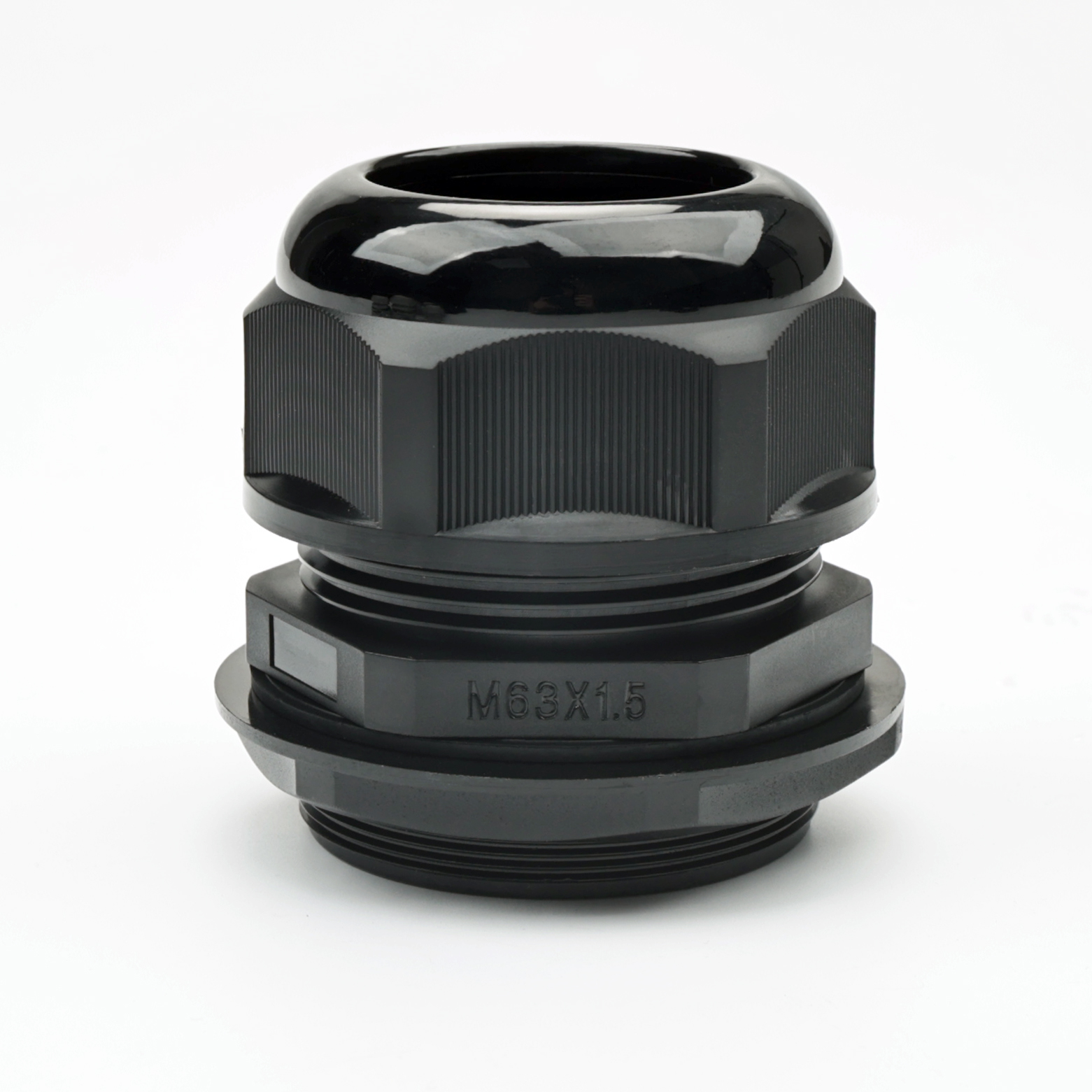
Metric M63 cable gland — the upper end of the M12–M63 metric thread range, with a 35–45 mm cable clamping window.
Cable Range Matching: The Specification That Actually Decides the Part
Once the thread is fixed, the cable range determines the part number. Both families cover 3 mm to 45 mm of cable, but the coverage is distributed differently across sizes, and the same nominal thread size frequently exists in more than one clamping variant.
| Metric size | Cable range | PG size | Cable range |
|---|---|---|---|
| M12 | 4 – 8 mm | PG7 | 4 – 8 mm |
| M12S (compact) | 3 – 6.5 mm | PG7S (compact) | 3 – 6.5 mm |
| M16 | 6 – 10 mm | PG9 | 4 – 8 mm |
| M16S (compact) | 4 – 8 mm | PG11 | 6 – 10 mm |
| M18 | 6 – 10 mm | PG13.5 | 6 – 12 mm |
| M20 | 8.5 – 14 mm | PG16 | 8.5 – 14 mm |
| M20S (compact) | 6 – 12 mm | PG19 | 12 – 15 mm |
| M25 | 12.5 – 18 mm | PG25 | 15 – 21 mm |
| M25S (compact) | 8.5 – 14 mm | PG29 | 18 – 25 mm |
| M32 | 18 – 25 mm | PG36 | 24 – 32 mm |
| M50 | 31 – 41 mm | PG42 | 31 – 41 mm |
| M63 | 35 – 45 mm | PG48 | 35 – 45 mm |
Three decision rules follow from this table. First, the same nominal size can hold different cables: an M20 covers 8.5–14 mm while an M20S covers 6–12 mm, and an M16 covers 6–10 mm while an M16S covers 4–8 mm. Selecting a size without checking the compact variant is one of the most common sources of rework. Second, the largest thread does not automatically mean the widest clamping range is required — M32 covers 18–25 mm and M50 covers 31–41 mm, so a 20 mm cable belongs in an M32, not in a larger gland with a reducer. Third, a cable should ideally sit in the middle of the stated clamping window. A cable at the extreme edge of the range leaves less material compression for the sealing parts and less reserve for pull-out resistance.
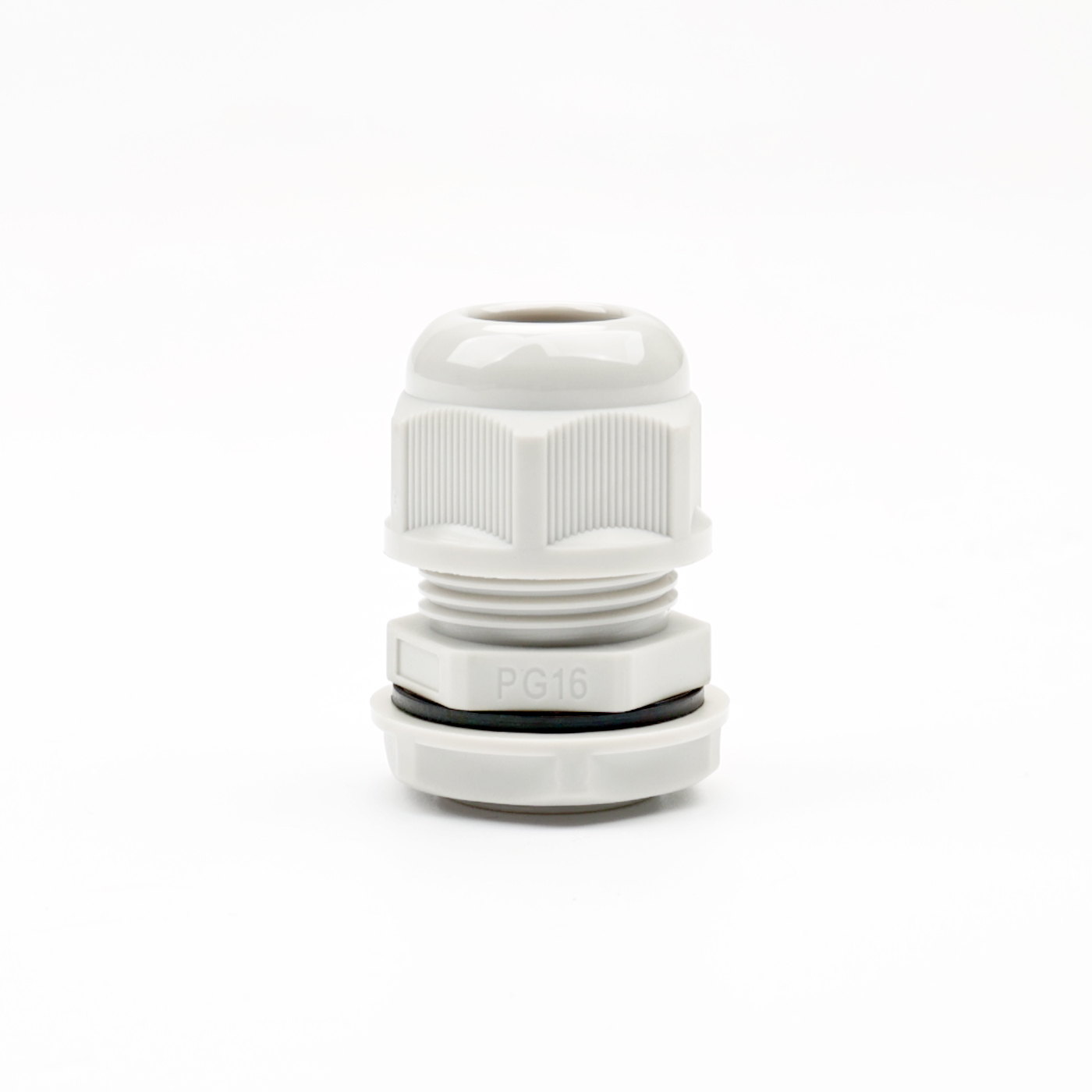
PG16 cable gland with an 8.5–14 mm clamping range — a PG size code that does not correspond to the thread diameter.
Certification Alignment: CE, EN 62444:2013, UL 514B and the Market You Ship To
Certification does not depend on the thread family. A gland is certified as a part number, and the same sealing design can be certified whether the thread is PG or Metric. What buyers actually need to verify is that the certificate covers the construction they are ordering and that it matches the destination market.
- European Union. EN 62444:2013 is the harmonised standard governing the construction and performance requirements for cable glands for electrical installations, and it replaced the older BS EN 50262. A CE declaration for a cable gland should be traceable to EN 62444:2013 rather than to a superseded reference.
- Ingress protection. IP68 is defined under IEC 60529 as protection against continuous immersion in water under specified conditions. The rating describes the tested condition, not an unconditional promise about every installed assembly.
- North America. UL 514B is the standard buyers typically reference for conduit fittings in US and Canadian projects, and it is normally verified alongside UL approval of the polymer material. The Nylon PA66 used in the Gutai gland construction is UL approved, which supports compliance with environmental requirements for European and American export markets.
- Substance and market compliance. RoHS and REACH declarations address restricted substances, and CCC covers the Chinese market. These sit alongside CE and IP68 in the Gutai certificate set.
The buyer-side rule is therefore: confirm the thread first, then confirm that the certificate covers that specific product. A certificate issued for one construction does not automatically extend to a different thread size, body material or sealing arrangement.
IP68 and Material Performance: What Nylon PA66 and NBR Deliver
Both families share the same material strategy, and understanding it explains where the products belong and where they do not. Structural components A, C, E and F are moulded in UL-certified Nylon PA66 selected for strength and anti-aging performance. Sealing parts B and D are NBR nitrile butadiene rubber, chosen for reliable sealing and oil resistance. The assembly is IP68 rated for waterproof and dustproof service and uses a special clamping claw with a rubber sealing structure, giving a wide clamping window with strong pull-out resistance.
Environmental resistance is broader than water alone. The construction resists salt spray, acid, alkali, alcohol, grease and common solvents, which is what places these glands in the new energy, industrial automation and advanced manufacturing, construction and infrastructure, and marine engineering and shipbuilding sectors. Standard colours are black (RAL9005), light grey (RAL7035) and silver (RAL7001), with custom colours available on request.
Temperature behaviour is where the specification becomes a genuine constraint rather than a formality:
- Static installation: −40 °C to +100 °C, with peak instantaneous temperatures up to 120 °C.
- Dynamic service: −20 °C to +80 °C, with peak instantaneous temperatures up to 100 °C.
Those windows are comfortable for outdoor enclosures, PV combiner boxes, inverters, telecom cabinets and general industrial control panels. They are narrower than what some buyers assume. Where a project combines continuous mechanical movement with heat, or where vibration is a governing load case, the specification conversation shifts from polymer glands toward metal constructions — and that shift should be a deliberate project decision, not an afterthought.
Limits and Boundaries: What the Thread Standard Does Not Solve
A comparison framework is only useful if it says where each option stops working. Four boundaries are worth stating plainly.
- Thread conversion adds an interface. If an enclosure is cut for one family and the specification calls for the other, an adapter is required. Every adapter introduces an additional threaded joint and an additional potential leak path, and it consumes panel depth. Matching the available thread at the design stage is cheaper and more reliable than converting later.
- IP68 is conditional. The rating is established under specified conditions. In service, protection depends on the cable sitting inside the stated clamping range, on the gland being fully tightened against a sound panel surface, and on the seal remaining undamaged. A correctly rated gland installed outside its clamping window is not an IP68 assembly.
- Polymer glands have a thermal and mechanical ceiling. The dynamic range of −20 °C to +80 °C, and the reliance on an elastomer seal, means that high-temperature, high-vibration or heavy salt-fog applications may justify metal. A coastal open-air EV charging project in Europe illustrates the point: the operator moved to IP68-rated metal connectors using 304 stainless steel and a dual-seal anti-loosening structure after conventional connectors failed. The upgraded construction was tested to 1,000 hours of salt spray and to IEC 60068-2-6 vibration, and connector-related electrical failure fell from 18% annually to 2.6%, with annual maintenance cost per station dropping from over 500 RMB to below 80 RMB.
- Overspecification is a real cost, and it is usually invisible. Adding a larger thread than the cable requires, specifying metal where PA66 satisfies the environment, requesting a custom colour without a market reason, or splitting one panel into several single-hole entries when a multi-hole layout would serve: each of these raises unit cost, panel footprint and assembly time without improving protection. Gutai offers multi-hole layouts and specific seal customizations precisely so that the entry count, rather than the thread size, can absorb variation.
A Six-Step Buyer Decision Framework
The sequence below resolves the PG-versus-Metric question in the order that prevents rework. Steps 1 and 2 are non-negotiable; steps 3 to 6 are where cost is either controlled or lost.
- Read the enclosure, not the catalogue. Identify the existing or specified thread on the panel drawing, junction box, inverter or charger housing. New builds follow the drawing; retrofits follow the physical thread.
- Match the thread family and size. PG7–PG48 or M12–M63. Remember that PG size codes are not diameters, and that PG and Metric sizes are not interchangeable at any numeric value.
- Match the clamping range to the actual cable. Use the measured cable outer diameter, not the nominal conductor size, and prefer the middle of the window. Check the compact “S” variant before stepping up a thread size.
- Confirm certification for the destination market. EN 62444:2013 for CE, IEC 60529 for the IP68 claim, UL 514B and UL-approved material where North American markets are involved, plus RoHS, REACH and CCC where applicable.
- Confirm material and environment class. Nylon PA66 with NBR seals for the majority of outdoor and industrial entries; escalate to metal where sustained vibration, extreme salt exposure or higher temperatures govern. Verify thread length (9–21 mm) against wall thickness.
- Validate with a sample before committing volume. A sample order confirms thread fit, sealing behaviour and cable routing on the real enclosure. Gutai accepts small trial orders, which allows this step to happen before a production commitment rather than after.
Scenario Fit: Which Projects Typically Use Which Thread
New-build industrial automation and control cabinets
Metric threads dominate here because panel drawings are dimensioned in metric nominal sizes and the M12–M63 range maps directly onto available hole sizes. The decision is usually a clamping-range decision: M12 (4–8 mm) and M12S (3–6.5 mm) for sensor and signal wiring, M16 (6–10 mm) and M20 (8.5–14 mm) for control and power cores, M25 (12.5–18 mm) for bundled runs.
Retrofit and spare-parts supply for existing European equipment
PG threads remain in service across a large installed base, and the PG7–PG48 range with 12.5–59.3 mm outer diameters covers most of it. For maintenance buyers, the risk is not the thread itself but the clamping variant: replacing a PG13.5 (6–12 mm) with a PG11 (6–10 mm) changes the permissible cable window and can compromise the seal even though the thread fits.
Solar PV, inverters and combiner boxes
Glands handle the AC and enclosure-side entries, while the DC string connection is a separate accessory. In the MC4 product family, connectors are rated 1000 V DC with 30 A (2.5 mm², 4 mm², 6 mm²; 14 AWG, 12 AWG, 10 AWG) and 45 A (4 mm², 6 mm²; 12 AWG, 10 AWG), IP67 when mated, with a contact resistance of 0.5 mΩ, a −40 °C to +85 °C ambient range under IEC and a −40 °F to +194 °F range under UL. In desert PV projects, the specification challenge is UV and heat rather than thread: in one Middle Eastern 150 MW installation, 20,000 sets of anti-UV modified PA66 photovoltaic connectors were supplied over a three-year programme, with housings tested to 1,000 hours of UV aging and seals in high-temperature fluororubber. Connector damage fell from 8% annually with the original imported products to below 1.2%, connection-related downtime fell by 70%, and cumulative maintenance and generation-loss savings exceeded USD 80,000.
Coastal, marine and charging infrastructure
Salt fog, wind and vibration shift the specification toward metal bodies and dual-seal designs regardless of thread family. The thread still has to match the enclosure — but the material and sealing architecture become the decisive variables, which is why material escalation should be decided at the same time as the thread rather than after the first field failure.
Market Context: Why the Thread Question Keeps Reappearing
Regional demand explains part of the persistence of both thread families. Asia Pacific is the leading regional market for cable glands, accounting for approximately 38% to 42% of global revenue, driven primarily by industrialisation in China and India. That manufacturing base exports equipment into markets that use different wiring conventions, so a single production line can generate demand for both Metric and PG entries. Established global competitors in the sector include ABB Ltd., Eaton Corporation, Amphenol Corporation, LAPP Group and HUMMEL AG, alongside a large tier of specialist manufacturers.
On the solar side, the global solar PV connector market was valued at USD 1.31 billion in 2024, with MC4 connectors holding approximately 68% of that segment. That concentration matters to accessory buyers because it standardises the DC interface while leaving the enclosure-entry interface — the gland — project-specific.
Future Outlook
Three shifts are visible from the specification side, and each affects how the PG-versus-Metric decision will be made over the next few years.
The first is consolidation on the metric interface in new equipment. As panel drawings, enclosure suppliers and connector catalogues increasingly use nominal metric sizes, the M12–M63 range becomes the default for new builds, while PG remains a maintenance and retrofit requirement rather than a growth segment. Buyers setting multi-year framework agreements may find it useful to confirm that a supplier carries both families, so that legacy service demand does not become a separate sourcing exercise.
The second is a rising sealing baseline driven by electrification. Outdoor charging, energy storage and renewable generation push enclosures into conditions where IP68 is treated as a starting point rather than a premium option, and where salt-spray and vibration performance begin to appear in accessory specifications that previously mentioned only water ingress.
The third is specification discipline. As material and logistics costs stay volatile, the ability to state clearly why a given thread, clamping range and material were chosen — and why a higher grade was not — becomes a measurable procurement skill. Buyers who can document that reasoning are better placed to defend a design in review, and are less likely to inherit the cost of a specification that was never required.
Frequently Asked Questions
What is the difference between a PG cable gland and a Metric cable gland?
They differ in the thread interface, not in the sealing concept. The PG series covers PG7 to PG48 with thread outer diameters from 12.5 mm to 59.3 mm; the Metric series covers M12 to M63 with thread outer diameters from 12 mm to 63 mm. Both use UL-approved Nylon PA66 for structural parts and NBR for sealing parts, both are rated IP68, both cover a 3–45 mm cable range, and both use 9–21 mm thread lengths. The PG size number is a code and does not correspond to the thread diameter, whereas the Metric designation tracks the nominal thread diameter.
How do I determine which thread size an enclosure needs?
Read the thread from the panel drawing for a new build, or from the physical enclosure for a retrofit or spare-parts order. Then confirm two mechanical dimensions against the drawing: the thread outer diameter (12.5–59.3 mm for PG, 12–63 mm for Metric) and the thread length required, which falls within a 9–21 mm band across the range. Thread fit is the first filter; the cable clamping range is selected only after the thread has been confirmed.
Can a Metric cable gland replace a PG cable gland on the same panel?
Not directly. PG and Metric are different thread families, and sizes are not interchangeable even where the numbers appear similar — a PG16 entry and an M16 entry are different threads. Replacing one family with the other requires an adapter or a re-machined panel opening. An adapter adds an extra threaded joint and an additional potential leak path, so matching the existing thread is generally the lower-risk option for retrofit work.
Is IP68 certification tied to the thread standard?
No. Certification applies to the product construction, not to the thread family. IP68 is defined under IEC 60529 as protection against continuous immersion under specified conditions, and it is achieved by the sealing architecture — the clamping claw and the NBR sealing parts — in combination with the specified cable range. In service, the rating depends on the cable sitting within the stated clamping window, on correct tightening against a sound panel surface, and on the seal remaining undamaged. On the compliance side, CE declarations for cable glands should be traceable to EN 62444:2013.
Which cable clamping range should I specify for a given cable diameter?
Use the measured cable outer diameter and aim for the middle of the clamping window rather than its edge. The same nominal thread size often exists in more than one clamping variant: M20 covers 8.5–14 mm while M20S covers 6–12 mm, and M16 covers 6–10 mm while M16S covers 4–8 mm. A cable positioned at the extreme edge of the range leaves less compression for the sealing parts and less reserve for pull-out resistance.
Should a coastal or marine project use nylon or metal glands?
The decision is driven by the environment rather than the thread. Nylon PA66 glands with NBR seals resist salt spray, acid, alkali, alcohol, grease and common solvents, and operate in a static range of −40 °C to +100 °C (peak 120 °C) and a dynamic range of −20 °C to +80 °C (peak 100 °C). Where sustained vibration, heavy salt fog or higher temperatures govern, metal constructions become the appropriate choice — in one European coastal EV charging project, connectors were upgraded to 304 stainless steel with a dual-seal anti-loosening structure, tested to 1,000 hours of salt spray and to IEC 60068-2-6 vibration.
How many glands should I order for a new enclosure design?
The quantity is a design decision rather than a commercial one, but the entry layout affects cost. Where a panel requires several similar cable entries, a multi-hole layout can carry more cables through a smaller number of openings and avoid stepping up to a larger thread size purely to gain space. Gutai offers multi-hole layouts and specific seal customizations alongside size, thread, material, colour, packaging and OEM labelling options, and accepts small trial orders so that fit and sealing can be validated on the real enclosure before volume ordering.
Reference: the Gutai waterproof connector accessories catalogue, including cable gland and solar MC4 specifications, is available for download at Gutai 2025 product catalogue (PDF). Company background and product ranges are published at gt-connector.com.