
Microfiber Cleaning Products: Application Fit by Project Type
Microfiber cleaning products are often treated as a single procurement line, but the products that perform well in one project environment can be the wrong specification in another. A hotel housekeeping operation needs mop pads that survive repeated wet-dry cycles and support color-coded zone management; a car wash chain needs towels with high water pickup and surfaces that will not scratch paint; a commercial kitchen requires cloths that remove grease without leaving lint on tableware. The raw material is the same — split microfiber — yet the end product is defined by the project conditions it is engineered for.
This article is an independent sourcing reference for buyers and specifiers who need to match microfiber cleaning products to project-level requirements. It explains the key technical specifications, links product formats to common project types in hospitality, automotive care, kitchen, and glass cleaning, and outlines the manufacturing capabilities that support scenario-specific procurement.
Why Project Conditions Should Drive Product Selection
The starting point for a microfiber cleaning product specification is not the product itself but the operating environment. Application data from the manufacturing sector shows that institutional microfiber cleaning products typically operate in indoor enclosed environments at normal room temperatures of approximately 10°C to 35°C, with frequent water immersion, repeated wet-dry cycles, and high-frequency friction from repeated scrubbing. These conditions are documented across two major project types: hotel and resort daily sanitation procurement, and auto beauty and car wash chain supply.
Each condition translates into a measurable product requirement:
- Frequent water immersion requires rapid water absorption and quick-drying behavior.
- Repeated wet-dry cycles require dimensional stability and edge integrity after washing.
- High-frequency friction requires abrasion-resistant fabric structures and secure edge finishing.
- Surface protection requirements — car paint, marble, hardwood, glass — require scratch-free pile designs.
When products are chosen on price or on a generic "microfiber" label alone, failure can occur in any of these dimensions. The more reliable procurement path is to define the project scenario first, then narrow down product format, fabric weight, edge craft, and customization requirements.
Key Technical Specifications for Scenario Matching
Microfiber product performance is not determined by fiber alone. It is the combination of fiber blend, fabric weight, fabric structure, and edge finishing that decides whether a product fits a project.
Fiber blend. Most products in the portfolio of Foshan Patinda Housewares Co., Ltd. use an 80% polyester and 20% polyamide microfiber construction. Some formats use 85% polyester with 15% polyamide — for example, the universal cleaning cloth model MJ-001. Others incorporate functional fibers: the Microfiber Bamboo Fiber Cloth (MW-003) is 60% polyester, 20% polyamide, and 20% bamboo fiber, while the Microfiber Abrasive Mop (MP-020) blends microfiber with PET in the abrasive stripe.
Water absorption. A repeated specification across formats is the ability to absorb up to seven times the product's own weight in liquid. This applies to universal cleaning cloths (MJ-001, MD-020), glass cloths (MJ-013), kitchen towels (MW-003), car wash towels (MJ-022), twisted-loop auto cloths (MJ-023), and the ultra-soft hair drying turban (GFM-002).
Lint-free behavior and edge craft. Lint control is achieved through edge finishing as much as through fiber. Documented edge methods include double overlock stitching at 10–12 stitches per inch, ultrasonic sealed cutting, scalloped laser-cut edges, and die-cut edges.
Fabric structure. Product formats range from warp-knitted terry surfaces (MJ-001), twisted-fiber loop technology (MJ-023, 500–1000gsm), waffle grids (MS-074), coral fleece (PET-001), and tufted loops (MP-006) to chenille pile (MM-069, MM-070) and circular knitting for polishing cloths (MW-002). Each structure changes how the product interacts with the surface it cleans.
GSM. Grams per square meter can be mapped to project needs:
| Use band | GSM range | Representative models |
|---|---|---|
| Light wiping / glass polishing | 180–320 gsm | MJ-013, MJ-012, MW-002 (200–240 gsm) |
| General-purpose kitchen towels | 200–400 gsm | MS-074, MD-020 |
| Terry auto drying cloths | 250–500 gsm | MJ-021 |
| Car wash and detailing towels | 300–500 gsm | MJ-022 |
| High-absorbency detailing cloths | 500–1000 gsm | MJ-023, MJ-030 |
| Glass washer replacement sleeves | 650–680 gsm | CG-002, CG-003 |
Manufacturer Capabilities for Project-Level Procurement
When project-based orders combine multiple product formats and custom specifications, the manufacturer's capability to execute customization consistently becomes part of the buying decision.
Foshan Patinda Housewares Co., Ltd. (Pa Tin Da Group) is a microfiber manufacturer founded in May 2004 and based in Foshan, Guangdong, China. The company operates a 45,000 m² manufacturing plant equipped with over 450 sets of advanced production machinery and more than 10 fully automatic cutting and sewing production lines. It employs 200 people, including 17 engineers, and reports an annual output of 2,184,270 kg. About 98% of its output is exported, with main markets across North America, Europe, Asia-Pacific, and the Middle East.
The company works in OEM/ODM production modes, with a documented customization scope covering size, weight, logo, material, fabric texture, printing, color, accessories, packaging, extra functionality, shipping label, and GSM. Monthly capacity is approximately 182,022 kg, standard lead time is 30–45 days, and the typical MOQ is 3,000 pieces. The company reports 100% testing as part of its quality-control routine.
For a procurement team, this means that a 40×40cm terry cloth and a 100×50cm twisted-loop drying towel can be consolidated under one manufacturing relationship, with consistent quality inspection and a single lead time. Case data also shows that retail distributors, auto care brands, gym brands, and janitorial wholesalers typically order between 1,000 and 50,000 pieces per order, with products remaining reusable for 6–12 months after repeated washing.
Product Families Mapped to Project Scenarios
The practical way to use the technical specifications above is to map them to the project type.
Hotel and Resort Daily Sanitation
Hotel and resort daily sanitation procurement is a recurring institutional buying category, documented as particularly common in Germany and the United States. The operating mode is reusable daily use and repeated washing, which puts durability and drying speed ahead of single-use absorption.
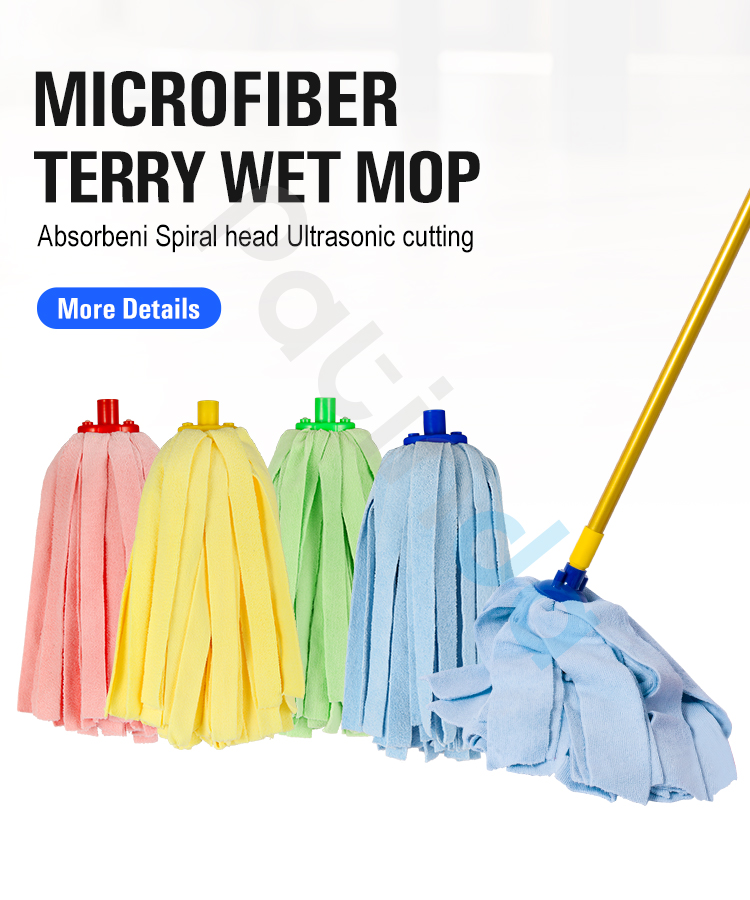
The Microfiber Terry Wet Mop (MT-003) is a terry loop strip wet string mop with ultrasonic sealed-cut strip edges. It uses 80% polyester and 20% polyamide microfiber, with refill weights of 200g or 300g, and is positioned for wet mopping on hardwood, tile, and marble in homes, schools, public buildings, and hotels.
The Microfiber Abrasive Mop (MP-020) is a color-coded commercial dual-purpose dry and wet floor mop pad. Its white microfiber main pile is combined with a red PET abrasive stripe for stubborn stain removal, and the back uses a double-pocket fixing design with a four-color classification label for area management. It is designed to be scratch-free for marble, hardwood, and ceramic tile, and reusable after repeated washing.
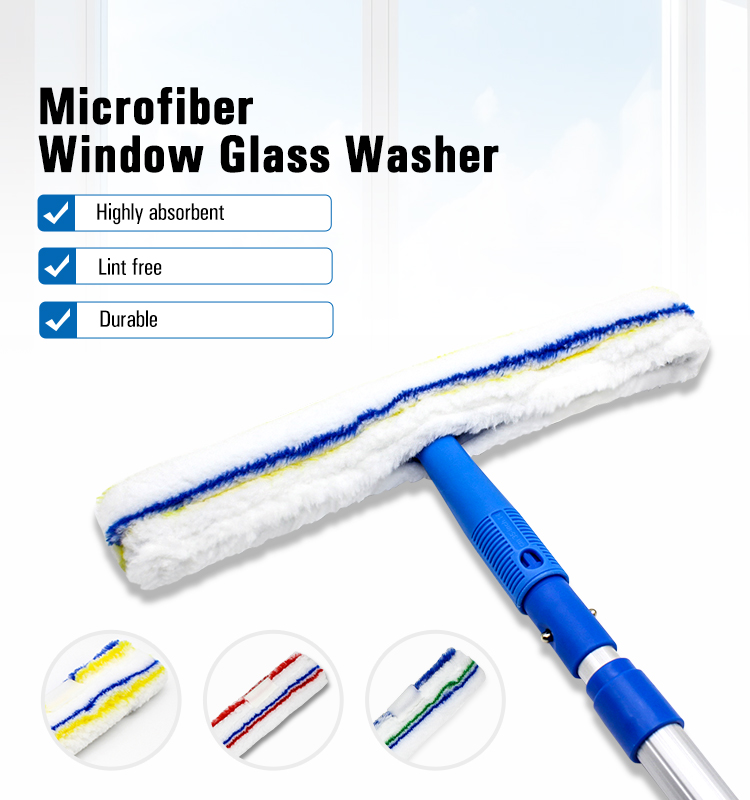
For bathroom and glass surfaces in the same project, the Microfiber Window Glass Washer (CG-002) and the Microfiber-Acrylic Blend Window Glass Washer (CG-003) offer velcro-fixed replacement sleeves at 650–680gsm, fully wrapped edge hemming, and optional built-in stain scraper strips.
Documented buyer requirements for this project type include custom logo, custom size and color, quick-dry, lint-free, and high water absorbency.
Auto Beauty and Car Wash Chain Supply
Auto beauty and car wash chain projects intensify the friction requirement: frequent water immersion, repeated wet-dry cycles, and high-frequency friction and scrubbing. The product's role is to wipe surface dust, absorb water, remove stains, and clean car paint.
The Microfiber Car Wash Towel (MJ-022) is an ultra-absorbent ultrasonic-edge detailing towel at 300–500gsm, with single-side long plush terry pile. It absorbs up to 7 times its own weight of water, is lint-free and scratch-safe for automotive paint and glass, and is machine washable.
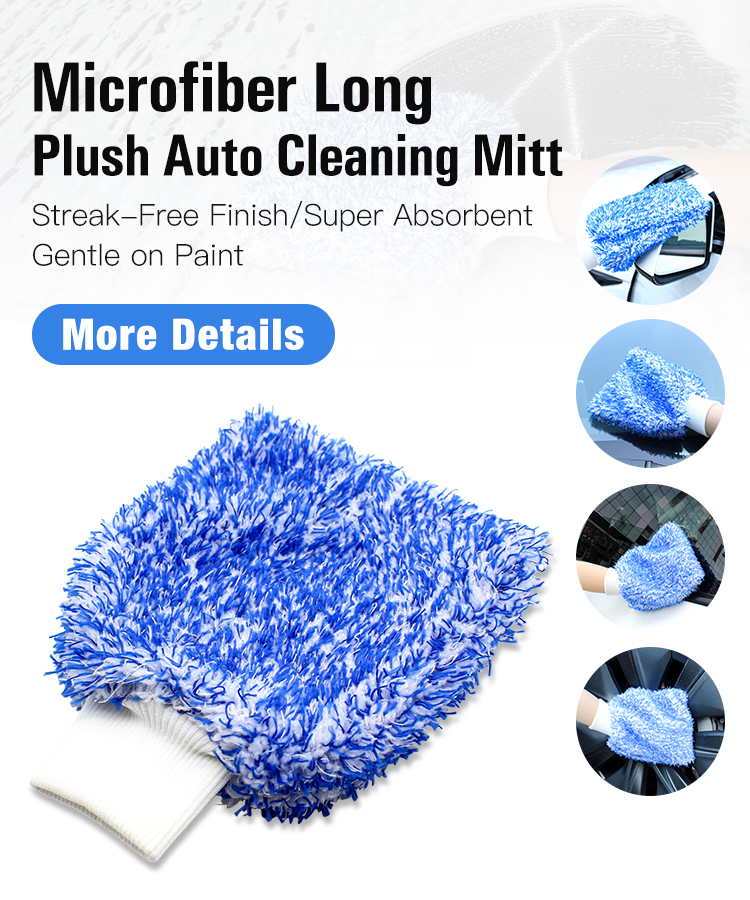
The Microfiber Long Plush Auto Cleaning Mitt (MM-070) is a single-face fluffy plush exterior washing glove with an elastic cuff. It provides high water and foam absorption, no color fading, and a scratch-free profile for car paint, glass, and wheel surfaces.
The Microfiber Twisted Loop Auto Cleaning Cloth (MJ-023) applies twisted-fiber loop technology at 500–1000gsm, absorbs up to 7 times its own weight of liquid, is streak-free and water-spot resistant, and uses a bright-color binding edge to prevent fiber shedding.
The Microfiber Terry Auto Cleaning Cloth (MJ-021), at 250–500gsm, is a high-GSM thick plush drying towel that absorbs up to 7 times its own weight of liquid and is cited as 4x more absorbent than cotton.
Case data for this sector indicates that auto care brands are regular buyers, with typical order quantities of 1,000 to 50,000 pieces and emphasis on custom logos, lightweight products, quick drying, and durability after hundreds of washes.
Kitchen and Household Cleaning
Kitchen projects require cloths that handle grease, stay hygienic, and dry quickly between shifts. The Double Layer Microfiber Dish Cloth (MJ-016) combines a PET mesh side for stain scrubbing with a microfiber side for water absorption, in a 30×30cm format with high-density edge stitching. The Microfiber Bamboo Fiber Cloth (MW-003) is 60% polyester, 20% polyamide, and 20% bamboo fiber, described as antibacterial, odorless, lint-free, and resistant to becoming greasy or hard after long-term use. The Microfiber Fancy Kitchen Towel (MS-074) uses a mini waffle grid and plaid pattern at 200–400gsm, and is quick-dry, lint-free, and non-abrasive.
Glass and Mirror Maintenance
For glass, mirror, and polished surfaces, lint-free and streak-free behavior is decisive. The Microfiber Glass Cleaning Cloth (MJ-013) uses a fine rib weave at 180–320gsm with dual cleaning and polishing functions and high-density double overlock stitching; it removes grease and water stains without lint residue or water marks. The Microfiber Premium Polishing Cloth (MW-002) applies circular knitting with a scalloped laser-cut edge for glass, stainless steel, and screen polishing. The Microfiber Wineglass Wiping Towel (MJ-066) targets hotel and catering glass maintenance, with a 40×60cm format and dense locking edge.
The table below consolidates the scenario mapping:
| Project type | Key product formats | Critical specifications | Representative models |
|---|---|---|---|
| Hotel / resort sanitation | Wet mops, abrasive mops, glass washers | Reusable after washing, color-coded zones, scratch-free | MT-003, MP-020, CG-002, CG-003 |
| Auto beauty / car wash | Wash mitts, drying towels, twisted-loop cloths | 7× absorption, lint-free, scratch-safe for paint | MM-070, MJ-022, MJ-021, MJ-023 |
| Kitchen / household | Dish cloths, bamboo fiber cloths, waffle towels | Oil removal, antibacterial, quick-dry | MJ-016, MW-003, MS-074, MD-020 |
| Glass / mirror | Glass cloths, polishing cloths, wineglass towels | Lint-free, streak-free, no water marks | MJ-013, MW-002, MJ-066 |
Market Context for Project Buyers
Third-party market data provides context for project-level sourcing decisions.
Market size. The global microfiber cleaning cloth market is estimated at approximately USD 3.8 billion in 2025 and is projected to reach USD 27.5 billion by 2034 (Dataintelo). Buyers should treat these figures as directional, as market size estimates vary significantly across research firms depending on whether industrial and retail segments are included.
Household segment share. The household use segment is expected to lead the microfiber cleaning cloth market with a 40.0% share in 2025. This explains why household SKU programs receive disproportionate attention from distributors and retail buyers.
Supply chain concentration. China is the world's largest exporter of microfiber towels, recording 10,544 shipments between June 2024 and May 2025 (Volza). For buyers, this concentration makes on-the-ground manufacturer verification a decisive step.
Competitive landscape. The market also includes global players such as 3M, Freudenberg Group, Toray Industries, and Libman (Business Research Insights), which means project buyers are comparing specialist manufacturers with diversified industrial groups.
Resource efficiency. Microfiber products are reported to reduce chemical usage by up to 60% and water consumption by 90% compared with traditional cleaning tools (Global Growth Insights). These figures are relevant for hotel chains and facility management programs with sustainability targets.
Certifications. Two certifications matter most for microfiber textile projects. OEKO-TEX Standard 100 is the dominant safety certification, requiring testing against more than 1,000 harmful substances. The Global Recycled Standard (GRS) requires a minimum of 20% recycled content and tracks the entire production chain. For EU and US distribution, buyers should treat these as baseline expectations.
Microfiber vs. Traditional Cleaning Tools: Performance and Limits
For buyers evaluating whether to replace cotton cloths or conventional mops, the product-level comparison is supported by documented specifications.
Microfiber towels absorb up to 7 times their own weight in liquid. The Microfiber Terry Auto Cleaning Cloth (MJ-021) cites 4x more absorbency than cotton. The Microfiber Stripe Mop (MP-014) is documented as picking more dust than a regular mop and reusable over 300 washing cycles. These properties reduce the quantity of cloths needed per shift, lower water use, and cut detergent consumption.
There are, however, boundaries that every buyer should include in the evaluation:
- Maintenance dependency. Microfiber performance is tied to repeated washing and drying. The documented operating mode is reusable daily use and repeat washing. If a project cannot support the laundry rotation required to keep cloths clean and dry, the economic advantage of reusable microfiber weakens.
- Synthetic composition. Microfiber is a synthetic textile. For projects with explicit sustainability policies, buyers need verifiable documentation such as OEKO-TEX Standard 100 or GRS certification rather than relying on generic claims. GRS requires a minimum of 20% recycled content; not every microfiber product is made with recycled polymer.
- Market data divergence. Volume projections for microfiber cleaning cloths differ substantially across research firms. A single market-size figure should not be treated as definitive in a business case.
Future Outlook: Where Project Sourcing Is Heading
Three trends are likely to shape project-level microfiber procurement in the coming years.
Certification as a bid condition. OEKO-TEX and GRS requirements are moving from documentation details to preconditions for EU and US-facing hotel, retail, and institutional programs. A supplier without these certificates will face a narrowing addressable market.
Customization as program design. Case data already shows that buyers order custom colors, custom sizes, and custom logos, with packaging that ranges from PET bottles to silicone cases, EVA boxes, and PVC bags. The direction of travel is full program design, where packaging, label, fabric texture, and GSM are all specified before sampling.
Supplier consolidation. The cost of qualifying a factory is high. Once a manufacturer demonstrates consistent output across home, auto, and commercial formats, with documented testing and stable lead times, buyers have an economic incentive to expand the existing relationship rather than onboard new suppliers.
FAQ
Q: Which project types commonly procure microfiber cleaning products?
A: Two documented project types are hotel and resort daily sanitation procurement projects and auto beauty and car wash chain supply projects. The hotel and resort application is described as common in Germany and the United States. Other documented applications include home cleaning, car detailing, gym sweat wiping, and commercial cleaning service.
Q: What working conditions are project-based microfiber cleaning products designed for?
A: Microfiber cleaning products used in institutional projects are typically designed for indoor enclosed environments at normal room temperatures of approximately 10°C to 35°C, with frequent water immersion, repeated wet-dry cycles, and high-frequency friction from repeated scrubbing.
Q: What functions do microfiber cleaning products perform in these projects?
A: The product's documented role is to wipe surface dust, absorb water, remove stains, and clean car paint. Products operate in reusable daily use or repeat washing mode.
Q: What customization and quality requirements should buyers specify?
A: Documented special requirements include custom logo, custom size and color, quick-dry, lint-free, and high water absorbency. Manufacturer capability data additionally lists customization of weight, material, fabric texture, printing, accessories, packaging, extra functionality, shipping label, and GSM. Case data shows typical wholesale order quantities of 1,000 to 50,000 pieces per order.
Q: How does product selection affect resource consumption?
A: Third-party reporting indicates that microfiber products reduce chemical usage by up to 60% and water consumption by 90% compared with traditional cleaning tools. Product specifications also cite absorption of up to 7 times the product's own weight, which supports lower water use in cleaning operations.
For buyers evaluating project-level sourcing options, the full product catalog of Foshan Patinda Housewares Co., Ltd. is available for reference and download: Pa Tin Da 2024 E-Catalog (PDF).