
Microfiber Mop Pads: A Wet/Dry Buyer Comparison Framework
Independent Industry Reference · Microfiber Cleaning Products · Refill Specification
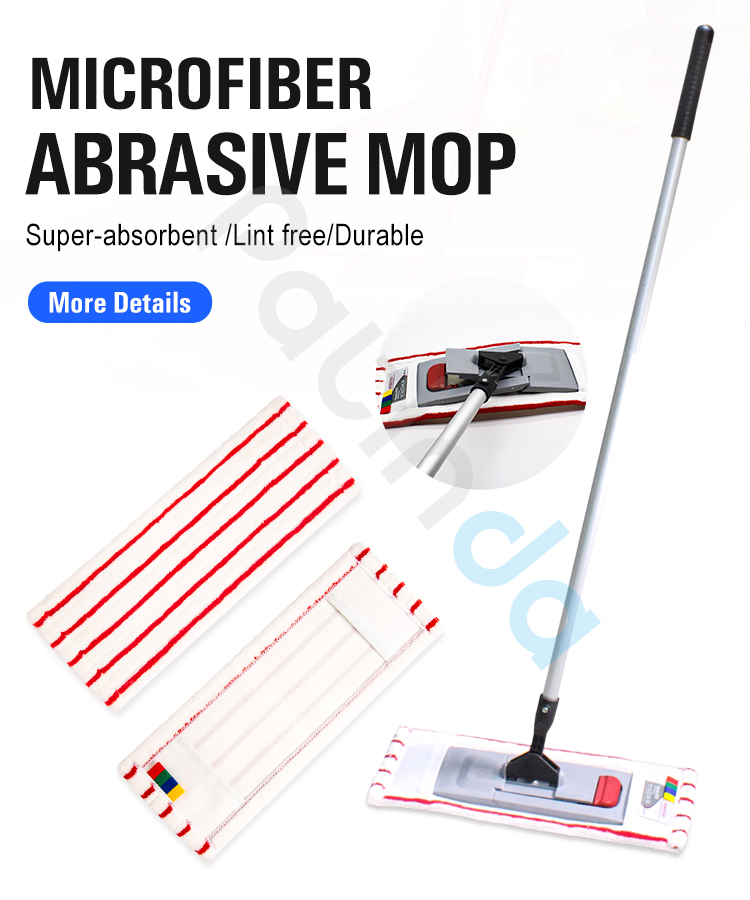
Microfiber mop pads separate on three lines a sample box does not show: fiber blend, backing format, and refill weight per piece.
A commercial floor care program rarely fails because the mop is not microfiber. It fails at the refill line. Five microfiber mop pads that looked interchangeable during sampling turn out to use different fiber blends, different backing formats and different refill weights — and only some of them fit the frames already sitting in the janitor's closet. This reference sets out a comparison framework for buyers who are past the category question and are now specifying pads, refills and reorder cycles.
Foshan Patinda Housewares Co., Ltd. is a microfiber manufacturer based in Foshan, Guangdong, China, producing microfiber cleaning cloths, kitchen and glass cloths, car care textiles and mops for export markets, and offering OEM and ODM production. The company reports operation since May 2004, a 45,000 m² manufacturing plant, and a product range that includes mop pads. The five mop pads compared here are its catalogued constructions: MP-020, MP-014, MP-015, MP-006 and MT-003.
At a glance: what actually differs
- Backing format separates the range more than fiber does. Double-pocket fixing (MP-020, MP-014, MP-006), full velcro on an aluminium plate (MP-015), and a spiral plastic socket string mop (MT-003).
- Fiber blends differ pad by pad: microfiber + PET (MP-020), microfiber + nylon (MP-014), microfiber + polyester (MP-015), 40% cotton / 60% polyester (MP-006), and 80% polyester / 20% polyamide (MT-003).
- Refill weight per piece spans roughly 75 g to 300 g, depending on model and size option.
- Color-coded zone control is built into the three flat-pocket pads and is a color option on the string mop.
The five constructions as catalogued
The table below reproduces the catalogued specification set for each pad. Where the catalog gives a weight per piece rather than a GSM figure, the weight is repeated here rather than inferred into GSM.
| Model | Construction / material | Backing & fixing | Sizes | Refill weight | Catalogued function |
|---|---|---|---|---|---|
| MP-020 Microfiber Abrasive Mop |
Microfiber + PET; white microfiber main pile with red PET abrasive stripe | Double pocket, four-color classification label | 40 cm / 50 cm | 80 g / 95 g | Dual-purpose dry & wet pad for commercial hygienic graded cleaning |
| MP-014 Microfiber Stripe Mop |
Microfiber + nylon; mixed striped pile front | Double pocket, color-coded classification tag | 40 cm / 50 cm | 100 g / 115 g | Wet / dry pad for rough floor dirt capture |
| MP-015 Microfiber Twisted Wet Mop |
Microfiber + polyester (PET); twisted loop absorbent surface | Full velcro sticker matching aluminium mop frame; set includes telescopic aluminium rod and rotating head | 18 in / 24 in | 75 g / 110 g (refill) | Wet floor cleaning set and replacement refill |
| MP-006 Microfiber-Cotton Blended Tufting Mop |
40% cotton + 60% polyester blended yarn; tufted loop with fringe edge | Double pocket, four-color identification tag | 40 cm / 50 cm | 165 g / 200 g | Dust and wet dual-use replacement pad |
| MT-003 Microfiber Terry Wet Mop |
80% polyester / 20% polyamide microfiber terry cloth strips | Spiral plastic socket for pole connection; ultrasonic sealed strip edge | 35 × 10 cm | 200 g / 300 g | Wet string mop refill |
All models are offered with customizable size, color and logo; sizes shown are standard options.
Wet, dry, or dual purpose: the first filter
Two of the five pads are catalogued as dual-purpose dry and wet tools, one is catalogued for both dust sweeping and wet mopping, and two are catalogued for wet cleaning only. That single line in a specification sheet should decide which pads enter a sample request.
| Model | Dry use | Wet use | Catalogued soil focus |
|---|---|---|---|
| MP-020 | Yes | Yes | Dust and hair capture; PET stripe for stubborn stain removal |
| MP-014 | Yes | Yes | Rough floor dirt; stated to pick more dust than a regular mop |
| MP-015 | Not catalogued | Yes | Effective dirt capture; lint-free |
| MP-006 | Yes (dust sweeping) | Yes | Good dust and hair pickup; tufted loop resists loosening |
| MT-003 | Not catalogued | Yes | Strong dirt pickup; high water absorption |
The practical consequence is a two-tier sample set rather than a five-way comparison. A building that runs a single pad across lobbies and washrooms can test MP-020 and MP-014 head to head on dry pickup and stain response. A building that separates sweeping from mopping is better served by comparing MP-006 for sweeping against MP-015 or MT-003 for the wet pass.
Refill format is a purchasing decision, not a detail
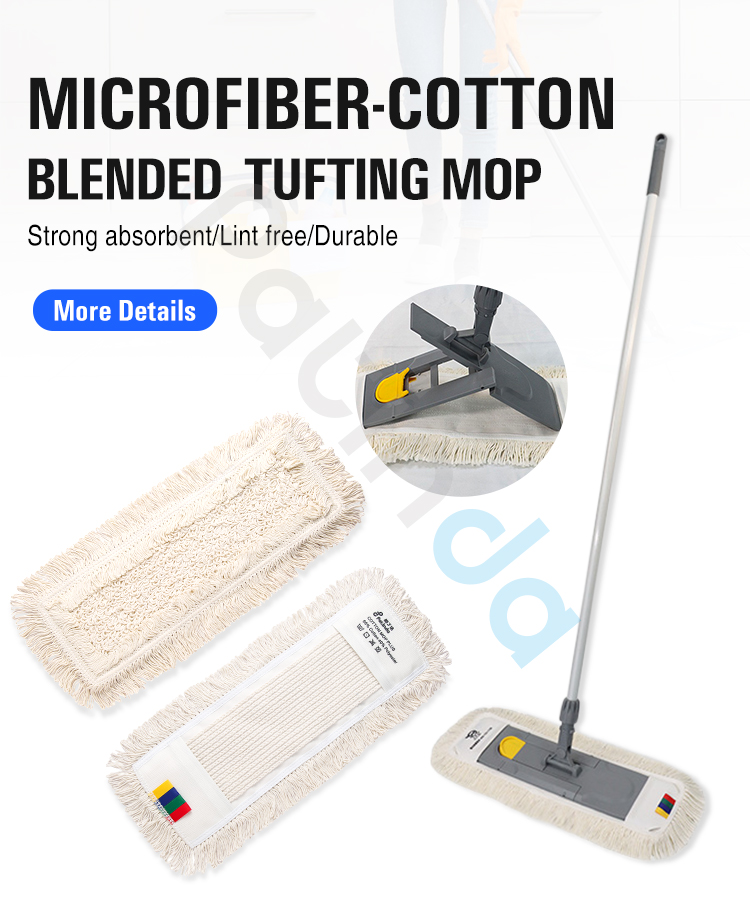
Pocket-style pads (MP-020, MP-014, MP-006) share a backing family; MP-015 uses full velcro on an aluminium plate and MT-003 uses a spiral socket.
Three backing systems appear in this range, and they do not interchange. Pocket pads — MP-020, MP-014 and MP-006 — use a double-pocket fixing design in which the frame's wings slide into fabric pockets. MP-015 uses a full velcro sticker across the back and is supplied as a set with a thickened telescopic aluminium rod and an adjustable rotating mop head, with the refill also sold separately. MT-003 uses a spiral plastic socket that connects to a pole in the traditional string-mop format.
For a buyer in the execution stage, the backing determines three things that never appear on a price list: how many frame types a site has to stock, how refills are received and counted at the loading dock, and how quickly a replacement can be issued mid-shift. Standardising on the pocket format across MP-020, MP-014 and MP-006 means one frame family covers sweeping, stain work and wet mopping — but it excludes MT-003, which serves the crews still working in a string-mop format.
Color coding across the range
Color coding is a management control, not a cleaning claim, and the catalog treats it consistently. MP-020 carries a four-color classification label for area management. MP-014 carries a color-coded classification tag. MP-006 uses a four-color identification tag on its double-pocket back. MT-003 is available in pink, blue, yellow and green. MP-015 lists customizable color without a fixed classification label.
What the catalog does not do is assign specific colors to specific zones. A hospital, a foodservice kitchen and a retail floor will each need a different mapping, and that mapping belongs in the buyer's own specification — written into the purchase order, so the color-to-zone relationship survives a reorder placed eighteen months later by a different person.
Surface and soil scenarios
Every flat pad in this range lists marble, hardwood and ceramic tile in its stated application, so the surface type alone rarely eliminates a model. The differentiator is the soil profile and the cleaning stage.
| Scenario | Shortlist | Catalogued reason |
|---|---|---|
| Graded hygienic cleaning in hospital and clinical areas | MP-020; MP-006 | MP-020 is catalogued for commercial hygienic graded cleaning with four-color zone labelling; MP-006 lists hospital sanitation among its application industries |
| High-traffic entrances with coarse grit and rough dirt | MP-014; MP-020 | MP-014's mixed microfiber and nylon striped pile is aimed at rough floor dirt capture; MP-020's red PET abrasive stripe targets stubborn stains |
| Wide-area wet mopping on an aluminium frame | MP-015 | Sold as a set with a thickened telescopic aluminium rod and adjustable rotating head; refill also supplied separately |
| Stairwells, corners and legacy string-mop workflows | MT-003 | Terry loop strips in a spiral socket format; catalogued for stations and public spaces as well as hotels and schools |
| Sweeping before a wet pass, hair-heavy floors | MP-006 | Tufted loop front with fringe edge; catalogued for good dust and hair pickup alongside wet mopping |
Weight per piece and the laundry loop
Refill weight is the most-quoted and least-interpreted number in this range. The spread is wide: 80 g or 95 g for MP-020, 100 g or 115 g for MP-014, 75 g or 110 g for the MP-015 refill, 165 g or 200 g for MP-006, and 200 g or 300 g for MT-003. Weight per piece is not a quality score. It is an operating input — it affects how many pads fit into a laundry bag, how a cart is loaded, and how the wash cycle is planned. Buyers who treat a heavier pad as automatically better tend to over-order mass they do not need.
Where weight is being used as a proxy for fiber mass per pad, it should be written explicitly into the purchase order rather than inferred from a product name. The catalog states repeated washability across the range and gives one quantified figure: MP-014 is described as reusable over 300 washing cycles. For the other models the statement is qualitative — reusable after repeated washing — and a buyer who needs a cycle figure should specify the test rather than assume parity.
Customization, order quantities and lead time
The customization menu for these pads is broad and applies to the specification lines a private-label buyer usually rewrites: size, weight, logo, material, fabric texture, printing, color, accessories, packaging, extra functional finishes, shipping label and GSM. OEM and ODM production services are provided. The minimum order quantity is 3,000 pieces, typical production lead time is 30–45 days, and monthly production capacity is stated as 182,022 kg. Quality control is described as 100% testing of all products, and after-sales service is available.
At 3,000 pieces the MOQ sits comfortably inside a single mid-size distributor reorder, which matters because a five-model color-coded program run as a launch order will hit that threshold four or five times over. Buyers planning a mixed program typically sequence the order: the pad that carries the most floor area first, the stain-specific and sweeping-specific pads as secondary lines.
Verification: certificates that name the models
Independent documentation is what separates a specification sheet from a claim. Foshan Patinda Housewares Co., Ltd. holds OEKO-TEX STANDARD 100 certificate 20.HCN.36448 issued by Hohenstein Laboratories GmbH & Co. KG, Product Class II, Annex 6, valid to 31 January 2027 — and the mop models MP-020, MT-003, MP-006, MP-015 and MP-014 appear among the products listed against that certificate. ISO 9001:2015 certificate CN24/00007747 and ISO 45001:2018 certificate CN24/00007748, both issued by SGS United Kingdom Ltd with a stated scope of “manufacture of towels and mops,” run to 7 December 2027. A SMETA 4-pillar audit report, ZAA600123152, was issued by Benchmarks Company Limited in April 2025 covering labour standards, health and safety, environment and business ethics.
Extended producer responsibility registrations are also on file: German Packaging Act registration DE3922560298890 through the LUCID register, and French REP Textile UIN FR337512_11LKPC. For a European buyer these are packaging and end-of-life obligations rather than product quality marks, and they belong on a different line of the supplier checklist. Certificate numbers should be checked against the issuing body's registry at purchase order stage — the number on a PDF is only as good as the registry entry behind it.
Where microfiber mop pads are not the automatic answer
Three boundaries are worth stating plainly, because a comparison framework that only lists advantages is not a framework.
Backing lock-in. A site running a traditional socket string mop cannot move to MP-020, MP-014 or MP-006 without buying new frames; MT-003 is the only drop-in microfiber substitution in this range for that workflow. Conversely, a site that standardises on pocket frames loses access to the velcro aluminium-plate format unless it stocks a second frame family.
Data gaps at specification level. The catalog publishes refill weight per piece but not GSM for every mop model, and only MP-014 carries a quantified wash-cycle figure. A buyer who needs lab-verified cycle counts or per-model GSM for all five pads has to write those requirements into the order. The stated 100% testing is a quality-control process, not a substitute for third-party test reports on a specific performance attribute.
Reusable does not mean zero-impact. Textile shedding is a documented environmental concern for microfiber products generally — research institutes define microfibres as microscopic fibres shed from textiles, and reusable cleaning textiles pass through industrial laundry loops repeatedly. That does not disqualify the category, but it does mean sustainability claims should be framed around wash durability, filtration in the laundry process and packaging compliance rather than around the word “reusable” alone.
Market context: modest growth, tightening specification
Published market estimates for microfiber cleaning cloths cluster around one billion US dollars and single-digit growth. Future Market Insights projects the global market at USD 979.2 million in 2025 rising to USD 1,520.7 million by 2035 at a 4.5% CAGR. Fortune Business Insights reports USD 1.04 billion in 2026 growing to USD 1.49 billion by 2034 at a 4.57% CAGR. The two are directionally consistent and are not averaged here. A third commercial estimate roughly three to four times larger circulates in the same category; it is excluded from this article because its scope cannot be reconciled with the others, and readers comparing figures should check product scope before treating them as competing numbers.
Two composition signals matter more to a mop buyer than the headline total. Fortune Business Insights reports that multicomponent microfiber — the polyester/polyamide blend family that most of these pads belong to — held a 58.0% revenue share in 2025, and that kitchen care accounted for 28.3% of the cleaning products market. Meanwhile OEKO-TEX updated STANDARD 100 in 2024 to include a total fluorine limit of 100 mg/kg in response to PFAS regulation. For mop pad sourcing, that combination points to a stable-volume category where the pressure is on documentation and material declarations rather than on demand growth.
Trade records add an operational data point: US import records indexed by ImportInfo list 172 bills of lading under the Foshan Pa Tin Da Housewares name between June 2019 and September 2026. The company also reports an export ratio of 98% and markets including the USA, Canada, Australia, the UK, Germany, France, Italy, the Netherlands, Japan, Korea and others.
Future outlook
The next spec cycle for commercial mop pads is likely to be driven less by new fiber chemistry than by three quieter pressures: chemical-safety documentation attached to specific models rather than to a factory, laundry economics as water and energy costs move, and packaging compliance in Europe. A pad that carries a named certificate, a stated weight per piece and a clear zone label is easier to reorder, easier to audit and easier to defend than one that only carries a category name.
For a buyer, the practical conclusion is that the five pads in this range are not competitors for the same slot. They are four decisions: which backing family, which wet/dry split, which soil profile, and which piece weight the laundry can absorb.
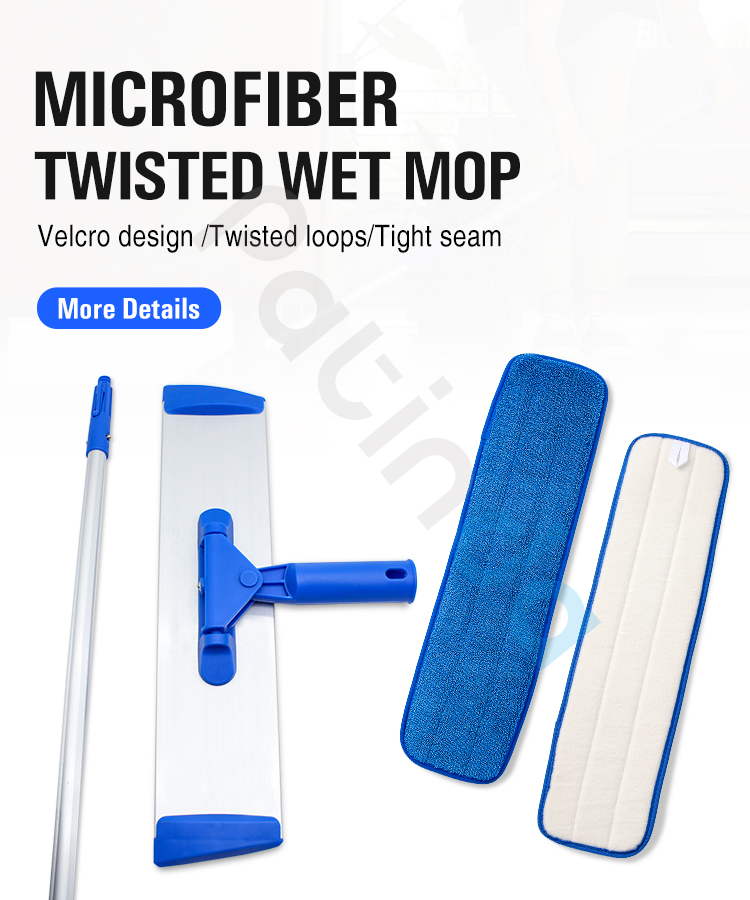
MP-015 pairs a full velcro backing with an aluminium plate, so the refill and the frame are specified together.
FAQ
What is the difference between a pocket-style mop pad and a velcro-backed refill?
A pocket-style pad uses a double-pocket fixing design in which the frame slides into fabric pockets; MP-020, MP-014 and MP-006 are all pocket pads. A velcro-backed refill presses onto an aluminium plate; MP-015 uses a full velcro sticker across the back and is supplied as a set with a thickened telescopic aluminium rod and an adjustable rotating mop head, with the refill also available separately. The two backing types require different frames and cannot be substituted for one another.
Which of these mop pads is specified for dry use?
MP-020 is catalogued as a dual-purpose dry and wet pad, MP-014 as a wet/dry pad, and MP-006 as a dust and wet dual-use replacement pad. MP-015 and MT-003 are catalogued for wet cleaning. Dry-use statements in the catalog are specific: dust and hair capture for MP-020, dust pickup stated as higher than a regular mop for MP-014, and good dust and hair pickup for MP-006.
Does the red PET abrasive stripe on MP-020 damage hard floors?
The catalog describes MP-020 as scratch-free for marble, hardwood and ceramic tile, and describes the red PET stripe as intended for stubborn stain removal. Those two statements appear together in the same specification. Buyers working with specialist or freshly finished surfaces should validate the pad on an off-catalogue sample area before committing a full order, since the catalog does not publish a separate test report for edge-case floor finishes.
How does color-coded classification work across the five models?
MP-020 carries a four-color classification label for area management, MP-014 carries a color-coded classification tag, and MP-006 has a four-color identification tag on its double-pocket back. MT-003 is available in pink, blue, yellow and green. MP-015 lists customizable color but no fixed classification label. The catalog does not assign particular colors to particular zones, so the zone mapping has to be defined by the buyer and written into the purchase order.
What sizes and refill weights are available?
MP-020 is offered at 40 cm and 50 cm in 80 g or 95 g; MP-014 at 40 cm and 50 cm in 100 g or 115 g; MP-015 at 18 in and 24 in with a 75 g or 110 g refill; MP-006 at 40 cm and 50 cm in 165 g or 200 g; MT-003 at 35 × 10 cm in 200 g or 300 g. Custom sizes are available across the range.
What are the minimum order quantity, lead time and customization options?
The minimum order quantity is 3,000 pieces and typical production lead time is 30–45 days, against a stated monthly production capacity of 182,022 kg. OEM and ODM production services are provided, with customization covering size, weight, logo, material, fabric texture, printing, color, accessories, packaging, extra functional finishes, shipping label and GSM. Quality control is described as 100% testing, and after-sales service is available.
Reference note
Full product specifications for the mop pads and the wider microfiber cleaning range, including cloths, kitchen towels, glass cloths and car care textiles, are collected in the Pa Tin Da 2024 e-catalog: download the catalog (PDF).
Есть вопросы или нужны дополнительные детали?
Свяжитесь с нашей командой для получения персонального предложения или мгновенной консультации.
Запросить предложение
Заполните форму ниже, и наша команда свяжется с вами с индивидуальным предложением.
Прямой чат WhatsApp
Предпочитаете общаться в реальном времени? Напишите нам в WhatsApp для мгновенной помощи и быстрых ответов.
- Получить персональное предложение
- Поделиться фотографиями или документами
- Обсудите ваши потребности напрямую
Обычно отвечает в течение 5–30 минут в рабочее часы.