
Mini Loop Band or Power Loop Band: A Sourcing Decision Framework
Mini Loop Band or Power Loop Band: A Sourcing Decision Framework
Resistance band purchasing usually starts with material and unit price. The decision that shapes more of the purchase order sits one level earlier: loop format. A mini loop band and a power loop band are both closed elastic loops, yet they differ in circumference, width, thickness, resistance ceiling and the training contexts they can credibly serve. Those differences determine resistance grading, packaging, test planning and even the customs description on the commercial invoice.
Both reference models are produced by Haiyang Libenli Body-Building Apparatus Co., Ltd. (brand: Libenli), a manufacturer and exporter of latex tubing and latex resistance bands established in 1997, whose export business accounts for 70% of total sales across Germany, the USA, the UK, France and Canada. This article uses the ZLQ-1 mini loop band and the ZLQ-03 power loop band as reference cases for a sourcing framework that applies to any supplier — not as a product showcase.
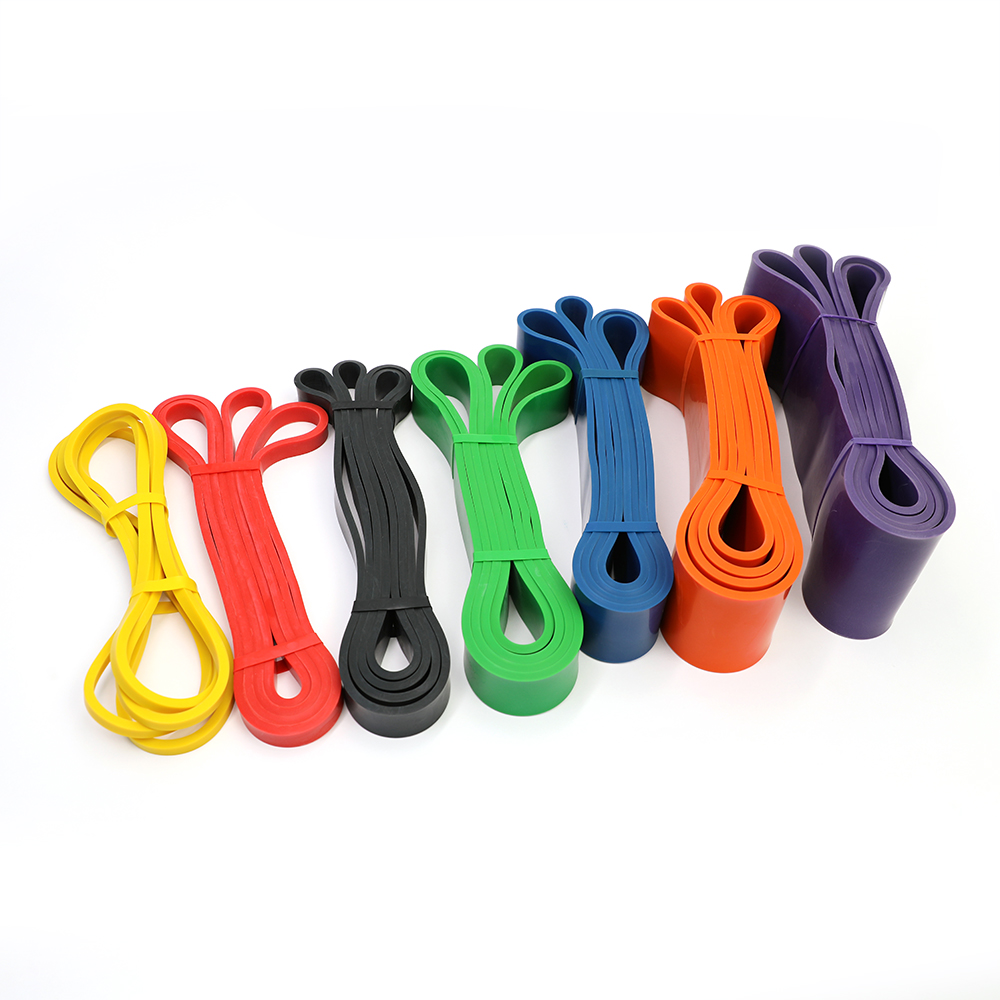
Where the two formats diverge inside a purchase order
Four specification differences drive almost every downstream procurement decision.
Circumference and anchoring. The ZLQ-1 is specified at 600mm circumference, which restricts it to body-anchored work: thighs, ankles, wrists, a fixed point close to the body. The ZLQ-03 is 2080mm in length, which allows anchoring to racks, bars or door attachments and allows the band to be looped or doubled. A buyer choosing between the two is choosing a usage geometry, not a size.
Which dimension carries the resistance gradient. On the ZLQ-1, width is fixed at 50mm while thickness ranges from 0.3mm to 1.2mm — the resistance steps sit in the wall thickness. On the ZLQ-03, thickness is stated as a single value of 0.45mm while width ranges from 6.4mm to 82.5mm — the resistance steps sit in the cut width. This matters operationally: a purchase order that specifies only the model name will not pin down what is being bought. Width or thickness must appear on the PO alongside the model designation.
Resistance ceiling and programme scope. A 5LB–40LB band line supports light-to-moderate loading and precise step progression. An 8LB–230LB line supports pull-up assistance and heavier resistance training. The ceiling defines which retail channels and which training programmes the product can honestly be listed against.
Durability metric. The ZLQ-1 is stated with fatigue resistance of at least 30,000 stretches; the ZLQ-03 is stated with a service life of at least 20,000 stretches. The two numbers are phrased against different metrics and should not be treated as a like-for-like comparison (see the durability section below).
Construction: what "mini loop" and "power loop" actually describe
The ZLQ-1 is classified as a mini loop band, specifically a mini loop band with an anti-slip design, and is intended for the home fitness industry. Its material is Latex or TPE. The anti-slip designation is a functional specification rather than an aesthetic one: narrow bands placed on fabric-covered limbs during hip and glute work tend to roll or migrate under tension, and the anti-slip treatment addresses that behaviour.
The ZLQ-03 is classified as a power loop band, and is also available as a double layer power loop band. Its material is Latex. The "double layer" designation forms part of the product's own classification, and buyers should ask the supplier to confirm exactly what the layer count refers to in the finished band and whether it applies uniformly across the full 6.4mm–82.5mm width range or only to selected widths. That single question removes most of the ambiguity in a power loop quotation.
A related naming point: the ZLQ-03 is also described as a pull up band. In sourcing documents it is common for one physical format to carry several commercial names. The specification, not the name, should govern the order.
ZLQ-1 and ZLQ-03 side by side
| Parameter | ZLQ-1 mini loop band | ZLQ-03 power loop band |
|---|---|---|
| Format classification | Mini loop band, mini loop band with anti-slip | Power loop band; also available as double layer power loop band; described as a pull up band |
| Material | Latex or TPE | Latex |
| Thickness | 0.3mm–1.2mm | 0.45mm |
| Width | 50mm | 6.4mm–82.5mm |
| Length / circumference | 600mm circumference | 2080mm length |
| Resistance range | 5LB–40LB | 8LB–230LB |
| Durability statement | Fatigue resistance ≥30,000 stretches | Service life ≥20,000 stretches |
| Stated applications | Home fitness, yoga and Pilates, hip and glute training, sports rehabilitation, physical therapy, gym training equipment | Fitness gym, home workout, sports rehabilitation, yoga training, physical therapy, outdoor training equipment |
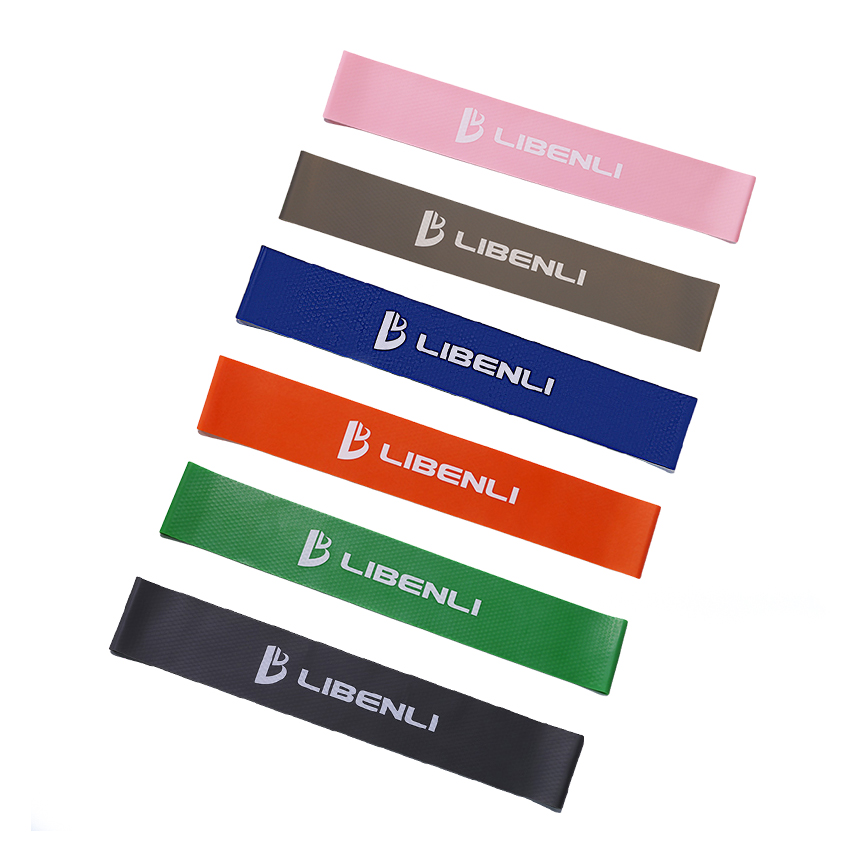
Resistance range: the 8LB–40LB overlap is the real decision zone
Below 5LB, only the mini loop format applies. Above 40LB, only the power loop format applies. The interesting zone for buyers is the overlap between 8LB and 40LB, where both formats can deliver the resistance and the choice becomes about body position, anchoring and programme design rather than load.
Inside that overlap, three practical rules hold:
- Body-anchored movement → mini loop. Lateral band walks, hip abduction, glute activation and Pilates work rarely need an external anchor, and a 600mm loop keeps the band clear of the floor and equipment.
- External anchor or assisted bodyweight → power loop. Pull-up assistance, rack-based pressing or pulling, and any movement where the band must reach a fixed structure require the 2080mm length.
- Programmes that need both → stock both, but grade them separately. A rehab clinic running a phased progression may use mini loops for early-stage hip work and power loops for later-stage loaded patterns; the two lines need their own resistance ladders and their own colour schemes so clinicians do not confuse a 15LB mini loop with a 15LB power loop.
One caution belongs in every RFQ. Resistance ratings are normally quoted at a reference elongation, and a rating stated without that elongation basis is not directly comparable between suppliers. The fix is procedural: require the resistance range and the reference elongation to appear together in the quotation, then verify against samples rather than against the catalogue number.
Material choice: latex, TPE and the anti-slip question
Resistance bands are typically manufactured from latex, TPE or fabric at category level. Within the two loop formats discussed here, the material decision is asymmetric. The ZLQ-1 is offered in Latex or TPE, so a buyer can specify a non-latex variant for the mini loop line. The ZLQ-03 is specified in Latex only, so programmes that require a non-latex long loop are not served by that model as documented.
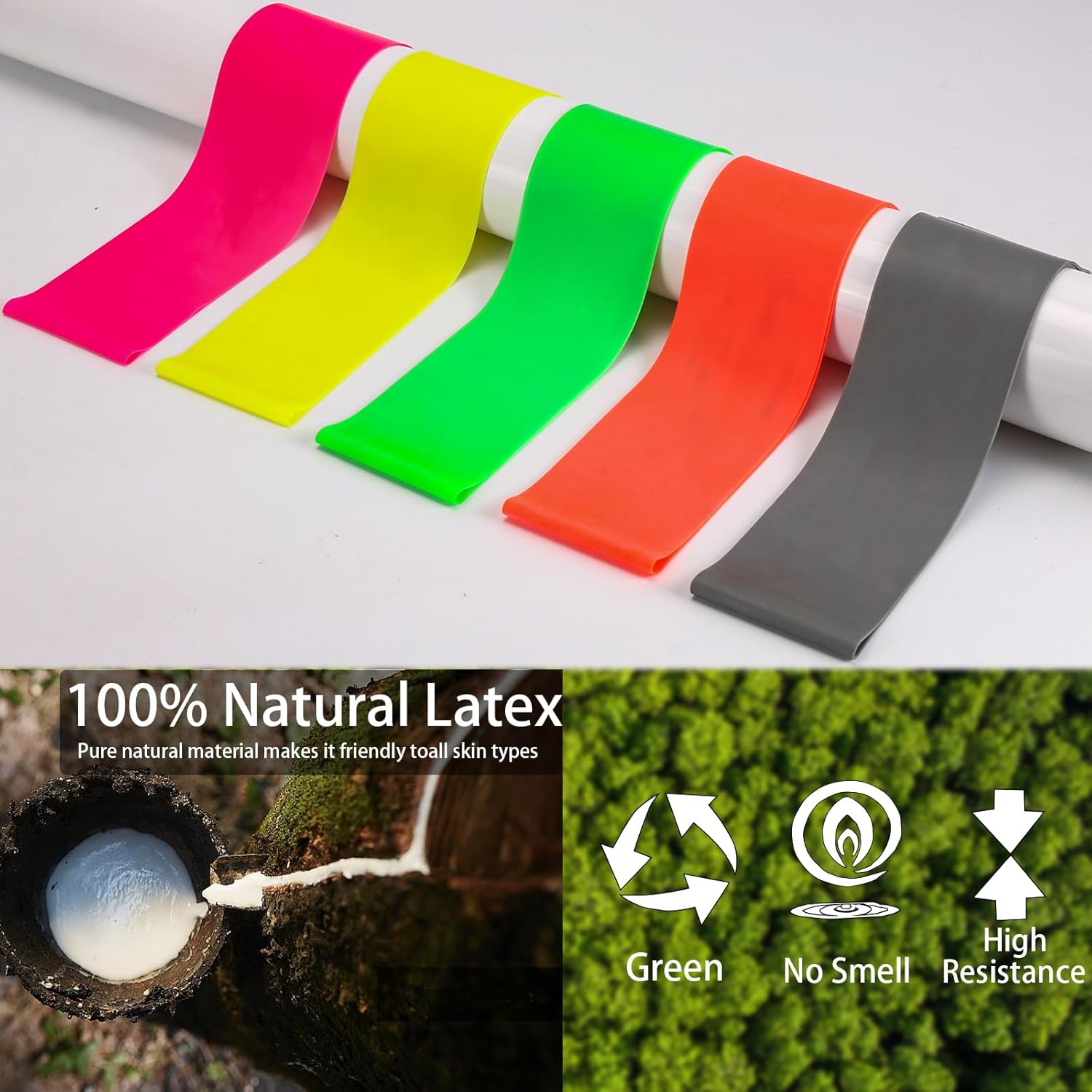
Programme requirements recorded for these applications call for 100% natural non-toxic latex, high stretch durability, skin-friendly contact and multiple resistance colour grades. That list is a usable specification template: it names the material declaration, the durability expectation and the colour grading requirement in one line, which is what a supplier needs in order to quote consistently.
Reading durability claims: 30,000 and 20,000 stretches are not the same number
The ZLQ-1 carries a fatigue resistance statement of at least 30,000 stretches. The ZLQ-03 carries a service life statement of at least 20,000 stretches. A buyer who reads those two figures as a direct ranking will draw the wrong conclusion, because the statements are framed against different metrics — fatigue resistance on one side, service life on the other.
Before accepting either claim, confirm four things in writing:
- The elongation amplitude used in the test — a cycle from a short stretch to a long stretch is far more severe than a short-amplitude cycle.
- The cycle frequency and any rest interval.
- The pass/fail criterion — visible damage, residual deformation, or force loss expressed as a percentage.
- Whether the figure applies to every resistance grade in the line, or only to a mid-range specification.
Environmental boundaries belong in the same conversation. The operating conditions recorded for these applications specify indoor use at room temperature between -10℃ and 50℃ in a dry, low-dust environment. That is a useful storage and shipping clause as well as a product claim.
Application mapping: which format fits which programme
The two models share several stated applications — sports rehabilitation and physical therapy appear on both — which is exactly why format, not category, should drive the assortment decision.
ZLQ-1 mini loop band. Best matched to home fitness, yoga and Pilates, hip and glute training, sports rehabilitation and physical therapy, and gym training equipment where the band is used for activation or auxiliary work. Its short circumference and anti-slip design suit movements performed on a mat, where the band stays close to the body and the training surface is soft.
ZLQ-03 power loop band. Best matched to fitness gym environments, home workouts that include pull-up assistance, sports rehabilitation and physical therapy programmes that progress to loaded patterns, yoga training, and outdoor training equipment. Its 2080mm length and 8LB–230LB range suit movements where the band must reach an anchor point or support bodyweight.
Accessory design is a useful signal for kit builders. The equipment listed alongside these applications includes a yoga mat, fitness handles, ankle straps and a workout storage bag. A mini loop assortment pairs naturally with a mat and ankle straps; a power loop assortment pairs with handles and a storage bag. The bundle, not the band alone, is what many retail programmes actually sell.
Procurement terms to lock before the first sample
A loop band order that omits any of the following tends to produce avoidable sample rounds.
- Model plus the graded dimension. ZLQ-1: model, 50mm width, thickness within 0.3mm–1.2mm, 600mm circumference. ZLQ-03: model, width within 6.4mm–82.5mm, 0.45mm thickness, 2080mm length.
- Material declaration. Latex or TPE for the mini loop; latex for the power loop.
- Resistance range and reference elongation, stated together.
- Durability claim and test basis, using the four questions above.
- Anti-slip requirement, explicitly tied to the mini loop specification.
- Colour grading and number of resistance levels, including which colour maps to which resistance value.
- Kit content where bands are bundled with a mat, handles, ankle straps or a bag.
- Storage and transit conditions, aligned with the -10℃ to 50℃ dry-environment boundary.
- Customs description, written against the actual material and configuration.
Cost is deliberately outside this framework. Comparable factory quotations across the two formats were not available for this analysis, and a price comparison without matched MOQ, Incoterm, material and packaging basis would mislead rather than inform.
Compliance and tariff classification: the part buyers underestimate
Two compliance threads run through loop band sourcing, and neither is automatic.
Standards. ISO 20957-2:2024 specifies safety requirements for stationary strength-training equipment using alternative resistance means, including elastic cords; the 2020 edition of the same part addresses the same equipment category. ASTM lists F2276-23, a standard specification for fitness equipment. Both are legitimate reference points for a test plan, but neither can be assumed to apply automatically to a standalone loop band — applicability depends on product configuration and intended use, and should be confirmed rather than asserted in tender documents.
Customs treatment. UK tariff guidance states that simple resistance bands or fitness bands without features identifying them as general physical exercise articles may be classified according to constituent material rather than under the general physical exercise heading, with headings 4008, 4016 and 6307 cited as possibilities. The practical consequence for a buyer is that a plain mini loop and a handled band set can fall into different treatments, and that a single universal resistance band code should not be assumed. Describe the goods against their real material and configuration, and confirm classification before landed-cost modelling.
On the supplier side, Libenli holds ISO 9000:2000 quality certification (2005) and ISO 9001:2008 quality management system certification (2010), holds 3A credit rating certification issued by the Ministry of Commerce of China and CCPIT, and reports that most items are certified by SGS to meet international environmental and safety requirements. The company holds 2 invention patents and 18 utility model patents.
Market context: why format specialisation matters now
Grand View Research valued the global resistance bands market at USD 1.7 billion in 2024 and projects a 9.9% CAGR for 2025–2030. Other commercial estimates diverge materially — The Insight Partners projects growth from USD 781.78 million in 2025 to USD 1,202.43 million by 2034 — which is a reminder to treat market-size figures as directional rather than as planning constants. The direction of travel, not the decimal, is what should inform a range decision.
Competitive density reinforces the point. Amazon lists over 40,000 results in its resistance bands category, a figure that describes listing volume rather than demand, but accurately describes how hard it is to differentiate a generic loop. A supplier or brand that can state format, resistance ladder, material and durability basis precisely has a defensible proposition; one that lists "resistance bands" without format specification competes on price alone.
Capacity concentration is the other structural factor. Libenli operates 24 production lines for dipped latex tubing with a daily output of 120,000 meters and 2 lines for latex bands with a daily capacity of 25,000 meters, across a 50,000 m² factory with approximately 300 staff, an R&D team of 20 engineers and an annual production capacity of 65,000,000 units. For a buyer, capacity of that order supports volume continuity, but it also means the specification discipline described above is what actually determines whether the delivered band matches the intended programme.
Where this framework stops
Honest boundaries are more useful than additional claims.
- The mini loop cannot substitute for the power loop above 40LB. Its 5LB–40LB range and 600mm circumference make it unsuitable for pull-up assistance or heavy anchored loading, regardless of colour grading.
- The power loop is unwieldy for compact, body-anchored work. A 2080mm band used for hip activation in a small studio space is an awkward fit; the mini loop exists for that reason.
- Non-latex options are documented for one format only. The ZLQ-1 is available in Latex or TPE; the ZLQ-03 is specified in Latex. Programmes requiring a non-latex long loop are not addressed by the documented specification.
- Durability figures are not directly comparable between the two models because they are stated against different metrics.
- Environmental limits apply. The recorded operating condition is indoor use at -10℃ to 50℃ in a dry, low-dust environment; storage and transit clauses should reflect that.
- Standards applicability must be confirmed for each configuration rather than assumed from the presence of a standard number.
Future outlook
Three shifts are likely to shape resistance band sourcing over the next planning cycle. First, format-level specification is becoming a normal part of the RFQ, as buyers discover that model names alone do not pin down width, thickness or resistance basis. Second, material disclosure is moving from a marketing preference to a commercial document requirement, driven by tariffs that classify simple loops by constituent material rather than by function. Third, durability claims are likely to face the same scrutiny that resistance ratings already face, with buyers asking for the test basis rather than the headline number.
For manufacturers, the implication is that range breadth matters less than range clarity. A 5LB–40LB line and an 8LB–230LB line cover most of the practical market between them; what distinguishes a reliable supply partner is the ability to state which band, at which dimension, achieves which resistance, under which test condition.
FAQ
What is the difference between a mini loop band and a power loop band?
A mini loop band is a short closed loop — the ZLQ-1 is 600mm in circumference, 50mm wide and 0.3mm–1.2mm thick, rated 5LB–40LB — used close to the body. A power loop band is a long loop — the ZLQ-03 is 2080mm long, 6.4mm–82.5mm wide and 0.45mm thick, rated 8LB–230LB — used with an external anchor or for assisted bodyweight work. The difference is one of geometry and load ceiling, not merely size.
Which format suits hip and glute training or rehabilitation programmes?
Both formats are listed for sports rehabilitation and physical therapy, so the deciding factor is the movement pattern. Hip and glute work, Pilates and early-stage rehabilitation are typically body-anchored and suit the mini loop, whose anti-slip design and 600mm circumference keep the band in position. Later-stage rehabilitation that progresses to loaded or anchored patterns suits the power loop. Clinics running both phases need separate, clearly graded resistance ladders for each format.
What resistance range should a buyer stock for home fitness versus gym use?
For home fitness and hip or glute programmes, the 5LB–40LB range of the mini loop covers the practical span and allows small resistance steps. For gym, pull-up assistance and outdoor training, the 8LB–230LB range of the power loop covers light assistance through heavy resistance. Where both audiences are served, the two ranges overlap between 8LB and 40LB, and the overlap should be graded so identical colour codes do not represent different resistances across the two lines.
Is a latex or TPE mini loop band better for a retail programme?
The choice depends on the material position the programme needs to hold, not on a universal ranking. The ZLQ-1 is available in Latex or TPE, so both options can be sourced within the same specification envelope of 0.3mm–1.2mm thickness, 50mm width, 600mm circumference and 5LB–40LB resistance. Latex, TPE and fabric are all standard resistance band materials at category level. Buyers should state the material explicitly on the purchase order, because the documented specification differs by material for the long-loop format, where latex is the stated material.
How should durability figures be compared between suppliers?
Only on a matched basis. The ZLQ-1 states fatigue resistance of at least 30,000 stretches; the ZLQ-03 states a service life of at least 20,000 stretches. Because the two statements use different metrics, they cannot be ranked against each other without knowing the elongation amplitude, cycle frequency, pass/fail criterion and whether the figure applies to every resistance grade. The same four questions should be applied when comparing two suppliers offering the same format.
How does material affect customs classification for loop bands?
Material can determine the classification itself. UK tariff guidance states that simple resistance bands or fitness bands without features identifying them as general physical exercise articles may be classified according to constituent material rather than under the general physical exercise heading, referencing headings 4008, 4016 and 6307. A plain mini loop and a handled band set may therefore fall into different treatments. Importers should describe the goods against their real material and configuration and confirm classification before building a landed-cost model.
Reference document: Libenli product catalog (PDF) — specifications, materials and production capability for latex tubing and resistance band lines.
Есть вопросы или нужны дополнительные детали?
Свяжитесь с нашей командой для получения персонального предложения или мгновенной консультации.
Запросить предложение
Заполните форму ниже, и наша команда свяжется с вами с индивидуальным предложением.
Прямой чат WhatsApp
Предпочитаете общаться в реальном времени? Напишите нам в WhatsApp для мгновенной помощи и быстрых ответов.
- Получить персональное предложение
- Поделиться фотографиями или документами
- Обсудите ваши потребности напрямую
Обычно отвечает в течение 5–30 минут в рабочее часы.