
Mini Machinery Dossier: CR468C and FAW Spec Cross-Check
Mini Machinery Dossier: CR468C and FAW Spec Cross-Check
A qualification file is not a folder of certificates. It is the controlled record that proves a specific machine matches the purchasing terms, the approved configuration and the acceptance criteria. For a CR468C minidozer and a FAW truck, the test is the same: the purchase order, datasheet, certificate, packing list and physical unit must agree on model identity, category, dimensions, weight, load or body configuration, safety equipment, tires, materials and battery data where applicable. A mismatch is a qualification finding even when each document looks valid on its own.
Qingdao Chary Machinery Co., Ltd (CHARY) is the China-based company whose public profile lists mini machinery, minidozer, mini loader, mini electric loader and skid steer loader among its product categories. The qualification-file approach below uses the supplied CR468C and FAW truck records as the documentary baseline. It does not treat a company datasheet as independent certification, and it does not replace a physical inspection or a regulatory approval check.

A qualification file is a reconciliation record, not a certificate pack
The file should answer five practical questions before shipment or final acceptance. Is this the exact model ordered? Does the unit carry the ordered body, battery, bucket, safety and tire configuration? Does the certificate or declaration actually cover this model, market and scope? Do measured dimensions, weight and functions match the declared values? If something differs, who approved the change and is the unit released?
| File layer | Question the buyer must answer | Evidence to attach |
|---|---|---|
| Identity | Is this the exact model and category ordered? | Purchase order line, datasheet, unit plate or label photo, packing list |
| Configuration | Does the unit have the ordered body, battery, bucket, safety equipment and tires? | Approved configuration sheet, component labels, inspection record |
| Conformity | Does the certificate or declaration cover this model, market and scope? | Certificate copy, issuing body, scope page and validity |
| Physical acceptance | Do measured dimensions, weight and functions match the declared values? | Measurement record, weigh record, functional check |
| Discrepancy | What differs, who approved it, and is the unit released? | Non-conformance log, approval, corrected documents |
CR468C: the datasheet becomes an acceptance checklist
The CR468C record identifies the product as a Remote Control Lithium Battery Rubber Track Minidozer, model CR468C. That category wording matters because a purchase order that asks for a mini loader or skid steer loader is not automatically satisfied by a minidozer. The qualification file should quote the exact category used in the order and attach the datasheet that supports it. The supplied application material describes the remote-controlled electric mini dozer as suited to very confined spaces and clean-up operations, including conveyor belts, tunnels, box culverts and drainage systems. That application context explains why compact dimensions and remote control belong in the acceptance check, but it does not replace the measured values.
| Datasheet field | Supplied CR468C value | Acceptance cross-check |
|---|---|---|
| Model | CR468C | Match purchase order, datasheet, unit label or plate photo and packing list. |
| Category | Remote Control Lithium Battery Rubber Track Minidozer | Confirm the order does not use a different product category without written equivalence. |
| Overall dimensions | 2,850 × 1,200 × 600 mm | Measure the unit and compare with transport, doorway and work-envelope limits. |
| Self weight | 1,100 kg | Weigh the unit or verify the weigh record; reconcile net weight and self weight terminology in the purchase order. |
| Rated load | 450 kg | Check that the acceptance criterion refers to rated load, not gross weight or bucket volume. |
| Bucket capacity | 0.15 m³ | Verify bucket width of 1,200 mm and the stated capacity in the configuration sheet. |
| Battery | Lithium battery, 300 Ah, 73.6 V | Confirm battery label, charger compatibility with 380/220 V supply and the declared charging time of about 2 hours. |
| Working time | About 8 hours | Treat as a declared operating figure, not a guaranteed site result; record test conditions if a runtime check is required. |
| Material field | Steel, Iron, Aluminum Alloy, Plastic | Use as a category-level declaration; request a unit-specific material list where the purchase order requires one. |

The dimensions and self weight are unit-specific and can be checked directly. Rated load, bucket capacity and battery data are configuration claims that must be tied to the exact unit. The declared working time of about 8 hours is not a performance guarantee for every site; load, terrain, temperature and operator behaviour affect runtime. The qualification file should separate a documentary check from any site trial. The capability record also states 100% full inspection before shipment and a performance test for each machine; because that is a supplier claim, the file should request the actual inspection record rather than assume it.
FAW trucks: lock the model and body category first
The supplied FAW truck records cover several model designations: J7, J6P, J6V, J6E, JH6, J6G, J6L, JK6 and Tiger v. They also list multiple body categories, from tractor and dump truck to cargo/rigid/light truck, concrete mixer, garbage, sprinkler, water tank, fuel tank, wrecker, sweeper, concrete pump, asphalt distributor, high-altitude platform and fire truck. A qualification file cannot treat FAW truck as one specification. It must lock the exact model designation and body category before checking dimensions, weight, safety configuration, tires, material list or certificates.
| Qualification field | Supplied FAW record | Acceptance cross-check |
|---|---|---|
| Model designation | J7 / J6P / J6V / J6E / JH6 / J6G / J6L / JK6 / Tiger v | Match the exact designation on purchase order, datasheet, unit plate or label and certificate scope. |
| Body category | Tractor Truck; Dump Truck; Cargo/Rigid Truck/Light Truck; Concrete Mixer Truck; Garbage Truck; Sprinkler Truck; Water Tank Truck; Fuel Tank Truck; Wrecker Truck; Sweeper Truck; Concrete Pump Truck; Asphalt Distributor Truck; High Altitude Platform Truck; Fire Truck | Confirm the body category and intended use; do not accept a chassis category as a completed body. |
| Dimensions | 6,000 × 2,300 × 3,000 mm to 12,000 × 2,550 × 3,800 mm | This is a range, not a unit measurement; record the actual unit dimensions and check they fall within the ordered range. |
| Weight | 3,000–15,000 kg | Confirm the actual unit weight and the weight basis; do not use the range as a unit-specific value. |
| Safety configuration | ABS / EBS / TCS | Verify the ordered combination on the unit and in the documents; do not assume every variant has the same combination. |
| Tires | Available based on customer needs | Write the exact tire specification into the purchase order and inspection record; customer-specified is not a specification by itself. |
| Material field | Steel, Iron, Aluminum Alloy, Plastic | Use as a category-level declaration; request a unit-specific material list where required. |
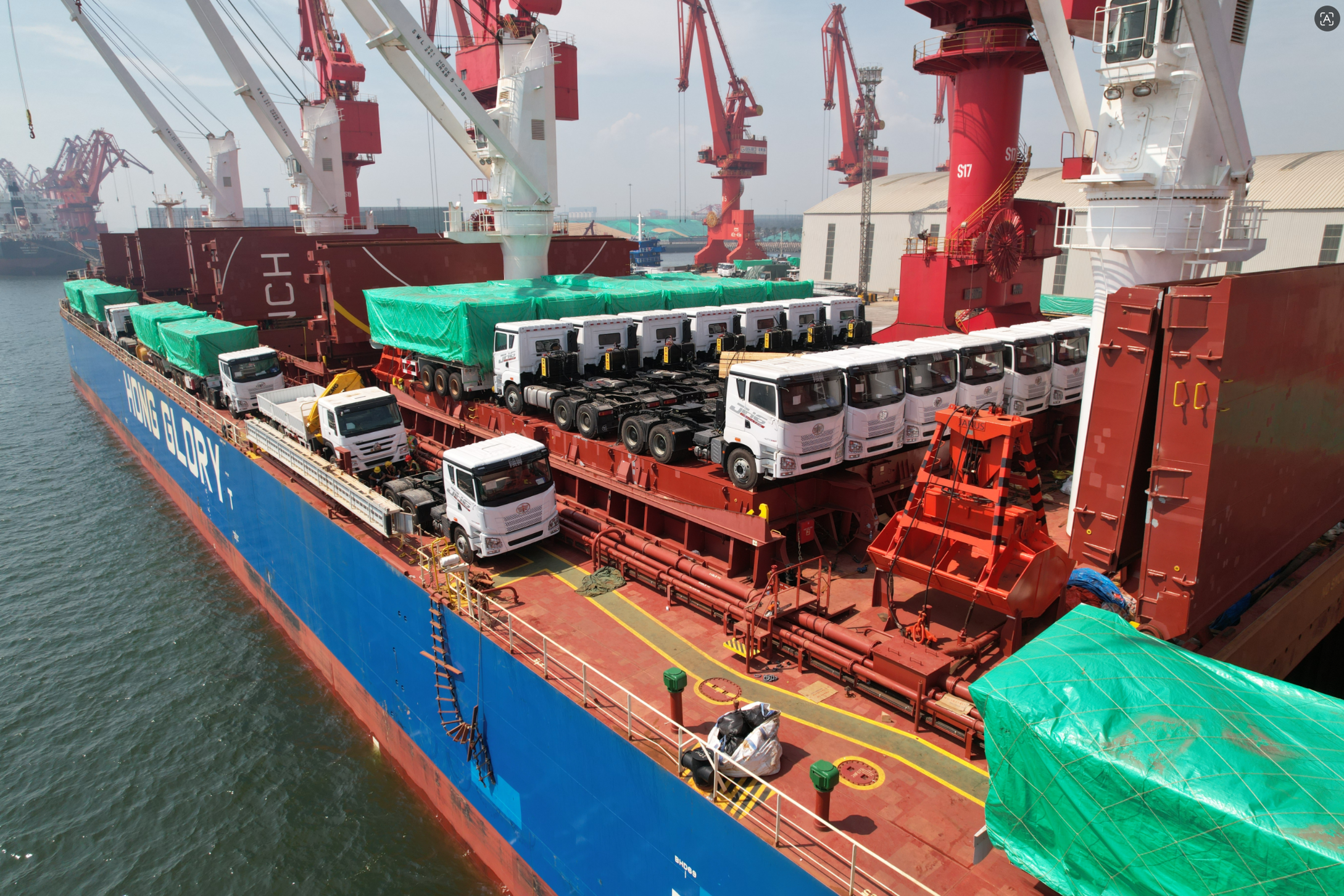
Certificate scope: the detail that changes the file
Two certificate records in the supplied material show why scope checking matters. The ECER105 record has certificate number E13*105R06/01*0023*00, issued by Société Nationale de Certification et d'Homologation (SNCH), Luxembourg, with scope for Dangerous Goods Transport Vehicles (EX/FL/AT/MEMU categories); it is linked to the FAW JK6. The GSO Conformity Certificate (GCC Certificate for Motor Vehicles) has CCR No.435790, issued by the GCC Standardization Organization, with scope for the FAW J6 Series Truck Tractor (4x2, Euro 4 Compliant). Neither record should be used as a blanket certificate for every FAW model or body type.
| Certificate | Number | Authority | Scope to match |
|---|---|---|---|
| ECER105 | E13*105R06/01*0023*00 | SNCH, Luxembourg | Dangerous Goods Transport Vehicles (EX/FL/AT/MEMU categories); linked to JK6 |
| GSO Conformity Certificate | CCR No.435790 | GCC Standardization Organization | FAW J6 Series Truck Tractor (4x2, Euro 4 Compliant) |
The qualification file should place each certificate beside the exact ordered model, market and body scope and mark not applicable where the scope does not match. A certificate that is valid for a dangerous-goods vehicle or a J6 series truck tractor does not automatically cover a different FAW body category, a different model designation or a different market. The same discipline applies to the CR468C: a datasheet value is a declared value until the unit is checked against it.
The shared acceptance checklist for both machines
- Start with the purchase order. Freeze the model, category, body, battery, bucket, tire and safety requirements. A generic description such as mini machinery or FAW truck is not a controlled requirement.
- Attach the exact datasheet and configuration sheet. Highlight the values that will be checked: CR468C dimensions of 2,850 × 1,200 × 600 mm, 1,100 kg self weight, 450 kg rated load, 0.15 m³ bucket and 300 Ah/73.6 V battery; FAW model, body category, dimension range, weight range, ABS/EBS/TCS, tire specification and material list.
- Map certificates to scope. Check certificate number, issuing authority, model, market, body category and validity. Mark non-applicable records clearly rather than placing them in a general certificate folder.
- Measure the physical unit. Record actual dimensions and weight and compare them with the purchase order and datasheet. For FAW, confirm the unit is within the supplied range and that the range was not substituted for a unit measurement. For CR468C, check the stated dimensions and 1,100 kg self weight.
- Verify configuration, not just labels. Check bucket width and capacity on the CR468C; check body category and safety configuration on the FAW unit; check the exact tire specification against the order.
- Check battery and charger data for the CR468C. Confirm 300 Ah, 73.6 V, lithium chemistry, 380/220 V charging compatibility and the declared charging time of about 2 hours. Record any site-specific power constraint that could affect acceptance.
- Record discrepancies. A model alias, a body category mismatch, a tire substitution without written approval or a certificate outside scope is a non-conformance, not a clerical note.
- Release only after closure. The file should show the original requirement, the evidence, the finding, the approval and the corrected document.
Where qualification files commonly fail
- Using the model family as the model. J6 or FAW truck is not a J6P, J6V, J6E, J6G, J6L or JK6. The exact designation must appear in the purchase order, datasheet and unit identity record.
- Treating a range as a measurement. The FAW dimensions of 6,000 × 2,300 × 3,000 mm to 12,000 × 2,550 × 3,800 mm and the 3,000–15,000 kg weight range describe a product envelope. The unit's actual values belong in the file.
- Mixing rated load and machine weight. The CR468C 450 kg rated load is not its 1,100 kg self weight. The acceptance criterion must state which value is being checked.
- Accepting customer-specified tires without a tire specification. The FAW record says tire specifications are available based on customer needs. The purchase order must state the exact tire requirement, and the inspection record must show what was fitted.
- Using a certificate outside its scope. The ECER105 record is linked to JK6 and a dangerous-goods vehicle scope; the GSO record covers the FAW J6 Series Truck Tractor (4x2, Euro 4 Compliant). Neither is a blanket approval for every listed FAW model or body type.
- Relying on material categories as a bill of materials. Steel, Iron, Aluminum Alloy and Plastic are category-level declarations. If the purchase order requires a component-level material list, the qualification file must ask for it.
- Treating about 8 hours of working time as guaranteed. The CR468C record declares this figure. Site conditions and duty cycle can change the observed result, so a runtime check needs recorded conditions.
What this means for procurement, and where the file stops
Done properly, the qualification file changes the buyer's position in three ways. It creates a like-for-like comparison because the same fields are checked for both machines. It gives the buyer a documentary trail for the exact unit. It separates a specification claim from an acceptance result. The boundary is equally important. The supplied CR468C and FAW data are product records; they do not independently certify every unit. The certificate records cover specific scopes. A qualification file is not a substitute for independent testing, regulatory approval or a factory audit. It is a control layer that tells the buyer what has been checked, what remains open and who approved the difference.
The CR468C record is specific to a remote-controlled lithium-battery rubber-track minidozer intended for confined spaces and clean-up work. It is not a general-purpose replacement for a legal road truck. The FAW records cover road truck model families and multiple body categories; the exact model and body must be fixed before any comparison. That distinction prevents a qualification file from creating a false equivalence between a compact site machine and a road vehicle. It also keeps the file useful for procurement: the buyer can compare documented characteristics without claiming that one machine performs the other machine's job.
Why the documentation layer is getting harder
The documentation burden is rising because the equipment mix is broadening. In China, sales of new-energy concrete mixers reached 8,036 units in 2024, with a 43.8% penetration rate, according to CleanTechnica (8 May 2026). China was also the world's largest exporter of excavators under HS Code 8429.52 in 2024, with a total value of $8.27 billion, according to HS Code Match / UN Comtrade data (18 February 2026). Separately, Data Insights Reports valued the global compact mini excavator market at $9.42 billion in 2026 and projected $16.39 billion by 2034 at a 7.2% CAGR. These figures describe the wider compact and electrified equipment context; they do not establish CHARY's market share or the performance of any individual unit. Their procurement relevance is narrower: more configurations, powertrains and body types mean more model-level documents to reconcile.
Outlook: unit-specific files, version-controlled
The practical direction is a more unit-specific file. As buyers compare electric and conventional configurations, the weakest document is the one that describes a family rather than the ordered unit. A qualification file that records exact model, category, dimensions, weight, load, battery, body, safety equipment, tires, materials and certificate scope will remain useful after the quotation stage because it can be reused at pre-shipment inspection and final acceptance. The file should be version-controlled. A revised datasheet or certificate should not silently replace the version used at order, and an approval for one model or body type should not be carried over to another without a new scope check.
FAQ
What should a qualification file for a CR468C minidozer contain?
It should contain the exact model and category, the purchase order, the datasheet, the measured dimensions of 2,850 × 1,200 × 600 mm, the self weight of 1,100 kg, the rated load of 450 kg, the 0.15 m³ bucket, the lithium battery data of 300 Ah and 73.6 V, the material field, the inspection record and the discrepancy log. The file should make clear which values are declared by the supplier and which values were measured or otherwise verified on the unit.
How should a buyer cross-check FAW truck dimensions and weight?
The supplied FAW record gives a dimension range of 6,000 × 2,300 × 3,000 mm to 12,000 × 2,550 × 3,800 mm and a weight range of 3,000–15,000 kg. Those are product ranges, not unit measurements. The buyer should put the exact model and body category in the purchase order, measure the actual unit, record the values and confirm that they fall within the ordered range. The range itself should not be copied into the acceptance record as if it were the unit's measured value.
Which FAW certificates should be matched to which models?
The ECER105 record has certificate number E13*105R06/01*0023*00, issued by SNCH, Luxembourg, with scope for Dangerous Goods Transport Vehicles (EX/FL/AT/MEMU categories), and is linked to the FAW JK6. The GSO Conformity Certificate has CCR No.435790, issued by the GCC Standardization Organization, with scope for the FAW J6 Series Truck Tractor (4x2, Euro 4 Compliant). The qualification file should match each certificate to the exact model, market and body scope and mark it not applicable where the scope does not match.
What safety and tire details belong in the FAW acceptance checklist?
The supplied FAW records list ABS/EBS/TCS as the safety configuration, so the file should verify the ordered combination on the unit and in the documents rather than assuming every variant carries the same combination. Tire specifications are available based on customer needs, so the purchase order must state the exact tire requirement, and the inspection record should show the tires actually fitted. Customer-specified is not a complete specification until the size and other required details are written down.
Does a qualification file replace an independent inspection?
No. The file organizes evidence, records acceptance and exposes discrepancies. Company datasheets are not independent certification, and the certificate records cover specific scopes. Physical inspection and independent testing may still be required by the buyer, the destination market or the contract. The qualification file is useful because it shows what has been checked and what remains open, not because it replaces the checks themselves.
Public reference: the manufacturer's product brochure is available for download at this PDF link. It is a reference document, not a substitute for the unit-specific qualification file.
Есть вопросы или нужны дополнительные детали?
Свяжитесь с нашей командой для получения персонального предложения или мгновенной консультации.
Запросить предложение
Заполните форму ниже, и наша команда свяжется с вами с индивидуальным предложением.
Прямой чат WhatsApp
Предпочитаете общаться в реальном времени? Напишите нам в WhatsApp для мгновенной помощи и быстрых ответов.
- Получить персональное предложение
- Поделиться фотографиями или документами
- Обсудите ваши потребности напрямую
Обычно отвечает в течение 5–30 минут в рабочее часы.