
Mini Machinery Market: Compact Equipment Trends for 2026
The global compact construction equipment market was estimated at USD 43.5 billion in 2024 and is projected to reach USD 69.1 billion by 2034, according to Global Market Insights. Within this category, mini machinery — compact loaders, minidozers, small excavators, and short-radius material handlers — has become a distinct procurement segment for operators working in confined spaces. This article explains what the mini machinery category includes, why the segment is expanding, and what evidence-based factors buyers should evaluate before sourcing compact equipment.
What counts as mini machinery
Mini machinery is an umbrella term for compact equipment engineered for confined spaces and light-to-medium duty cycles. The segment typically includes minidozers, mini loaders, mini electric loaders, skid steer loaders, compact track loaders, mini excavators, mini dumpers, mini wheel loaders, mini road rollers, and backhoe loaders. These machine types share a common design priority: completing loading, dozing, excavation, placement, or transport tasks where full-size equipment cannot fit or cannot operate safely.
| Machine type | Typical role | Common site conditions |
|---|---|---|
| Minidozer | Dozing, leveling, cleanup | Tunnels, conveyor lines, low-clearance areas |
| Mini loader | Loading and carrying bulk material | Warehouses, factories, farms |
| Mini electric loader | Zero-emission loading tasks | Indoor and emission-regulated sites |
| Skid steer loader | Highly maneuverable loading | Urban projects, equipment yards |
| Compact track loader | Low ground pressure loading | Soft or uneven terrain |
| Mini excavator | Digging in restricted areas | Pipe and foundation works |
| Mini dumper | Moving excavated or bulk material | Narrow access sites |
| Mini concrete mixer truck | On-site concrete mixing and delivery | Urban renovation, village roads |
| Mini road roller | Compaction on small sections | Road repairs, sidewalks |
| Forklift | Pallet and unit load handling | Logistics yards, warehouses |
Machine types are listed as general industry segments; not every type is offered by every supplier.
Why compact machines are moving from niche to standard
The practical problem is universal: space. Conventional loaders and bulldozers require wide turning radii, clear overhead space, and open operating lanes. Inside factories, underground tunnels, conveyor structures, and urban service corridors, those conditions rarely exist. Manual handling has been the traditional fallback, but it adds labor cost, physical fatigue, and safety exposure.
Electrification and remote control have changed the cost-benefit balance. A battery-electric minidozer produces no local fumes, runs quietly, and can be operated away from dust, noise, and moving parts. In sectors with monitored air quality and safety requirements — underground mining, ore processing plants, food and agriculture facilities, and dense urban sites — these characteristics are moving compact equipment from an option to a standard solution.
Supplier profile: CHARY and the export-oriented compact model
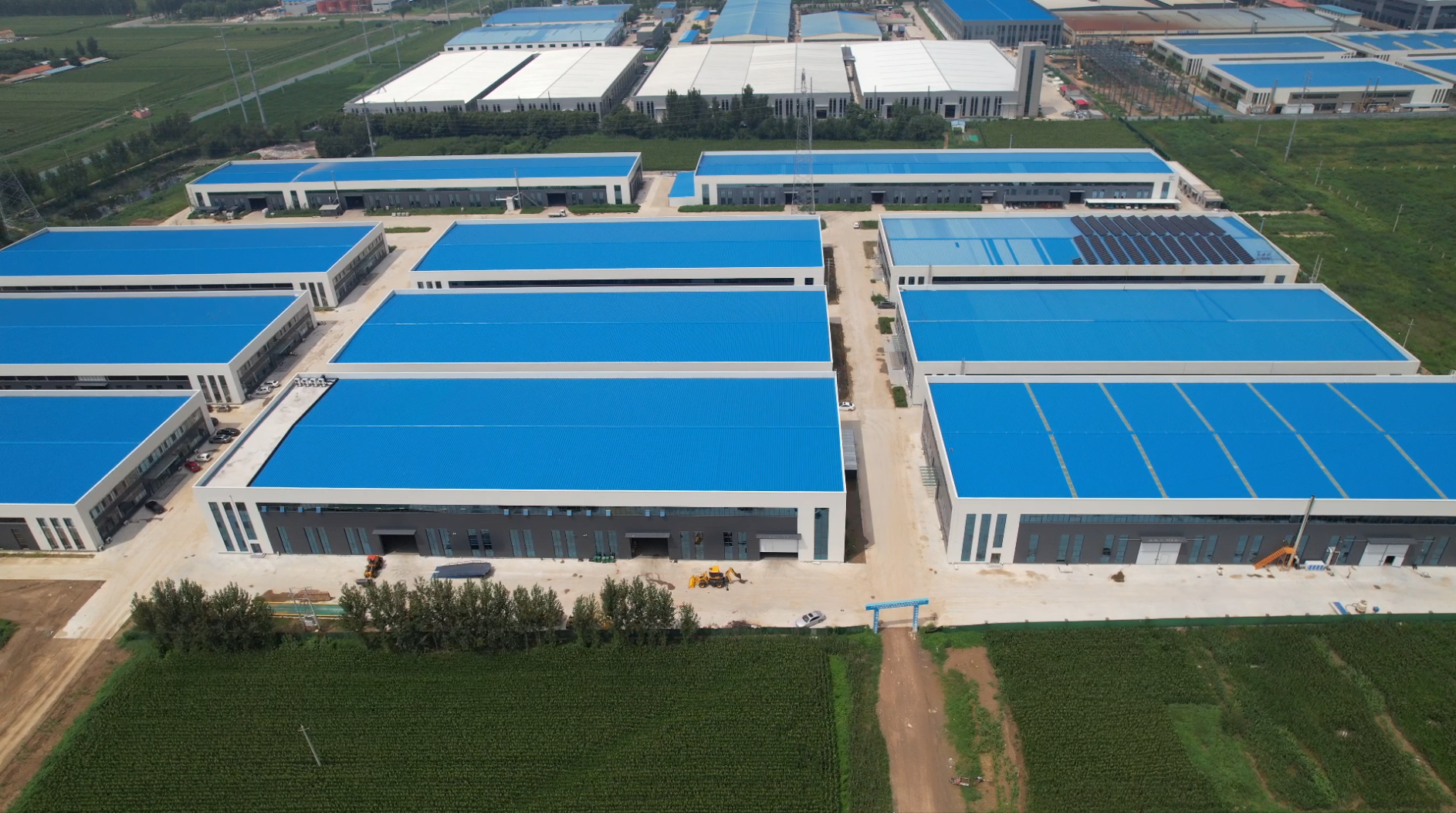
Qingdao Chary Machinery Co., Ltd. (CHARY) is a China-based manufacturer of compact construction equipment and vehicles, established in 2015 and located in Qingdao, a coastal city in China. The company operates a 2000 m² manufacturing facility with an annual production capacity of 500 units and a workforce of more than 100 people, including 15 engineers in the R&D team. Its main products include mini machinery, minidozers, mini loaders, mini electric loaders, and skid steer loaders.
Approximately 80% of CHARY's output is exported, with primary markets in Africa and South America. The company reports an annual export volume of USD 40 million in 2025, serving more than 50 countries and regions. CHARY is also an enterprise for vehicle export authorized and approved by China's Ministry of Commerce, which matters for buyers because the company is registered for cross-border vehicle trade beyond its compact equipment line.
Beyond compact machines, CHARY supplies FAW trucks in a broad range of configurations, including tractor trucks, dump trucks, cargo trucks, concrete mixer trucks, garbage trucks, sprinkler trucks, water tank trucks, fuel tank trucks, wrecker trucks, sweeper trucks, concrete pump trucks, asphalt distributor trucks, high-altitude platform trucks, and fire trucks. For procurement teams, this means site-level compact equipment and road transport assets can be sourced from one supplier, a model the company describes as one-stop assured purchasing. Company documentation is available at www.charymachinery.com.
Technical focus: what the CR468C minidozer shows about compact design
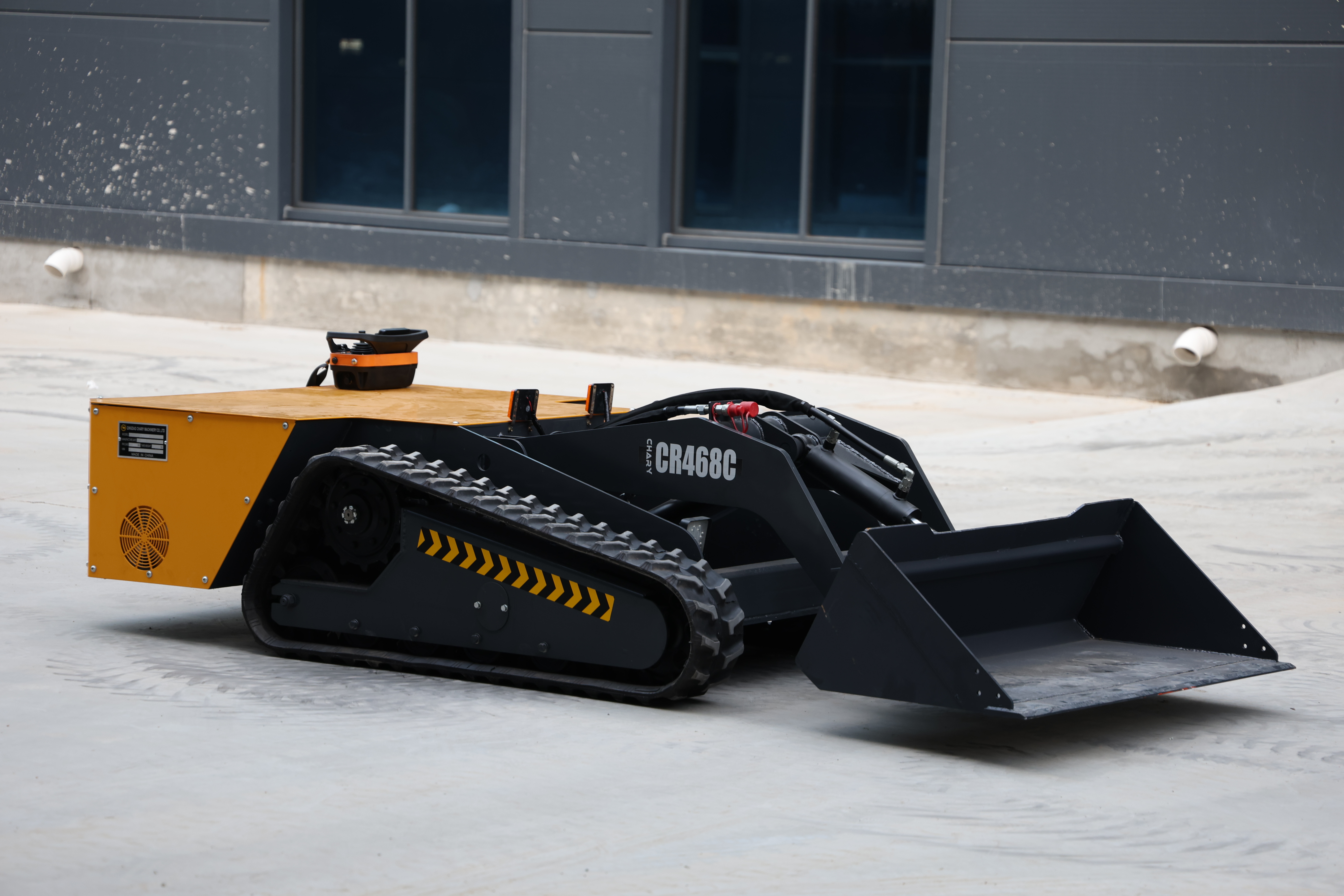
The CR468C is a Remote Control Lithium Battery Rubber Track Minidozer, and its specification sheet illustrates the engineering choices that define the current state of compact machinery.
| Specification | Value |
|---|---|
| Overall dimensions | 2850 × 1200 × 600 mm |
| Total length without bucket | 2250 mm |
| Self weight | 1100 kg |
| Rated load capacity | 450 kg |
| Bucket capacity | 0.15 m³ |
| Bucket width | 1200 mm |
| Unloading height | 530 mm |
| Operation method | Remote control |
| Control distance | 200 m |
| Maximum steering angle | 360° spin in place |
| Maximum driving speed | 4 km/h |
| Climbing ability | 40° |
| Battery | Lithium, 300 Ah, 73.6 V |
| Charging time | About 2 hours |
| Working hours | About 8 hours |
| Walking style | Rubber tracks |
| Working temperature | -10 °C to 60 °C |
| Hydraulic flow | 58 L/min |
The machine's most important dimension is its height. At 2850 × 1200 × 600 mm, the CR468C can pass beneath conveyor structures and pipe racks. The 1200 mm bucket is matched to a 450 kg rated load and a 0.15 m³ bucket capacity, which places the machine in the light-duty category. Rubber tracks spread the 1100 kg self weight and reduce ground damage compared with steel tracks, while adjustable ground clearance supports operation on uneven surfaces.
Remote control is the defining feature. With a control distance of 200 m, the operator can stand outside the dust zone and away from moving machinery. The 360° spin-in-place steering removes the need for a turning circle, an important advantage in box culverts, tunnels, and narrow aisles. The lithium battery delivers about 8 hours of working time per charge, with a charging time of about 2 hours and a working temperature range of -10 °C to 60 °C. Maximum driving speed is 4 km/h, and climbing ability is rated at 40°.
Where compact machines are deployed
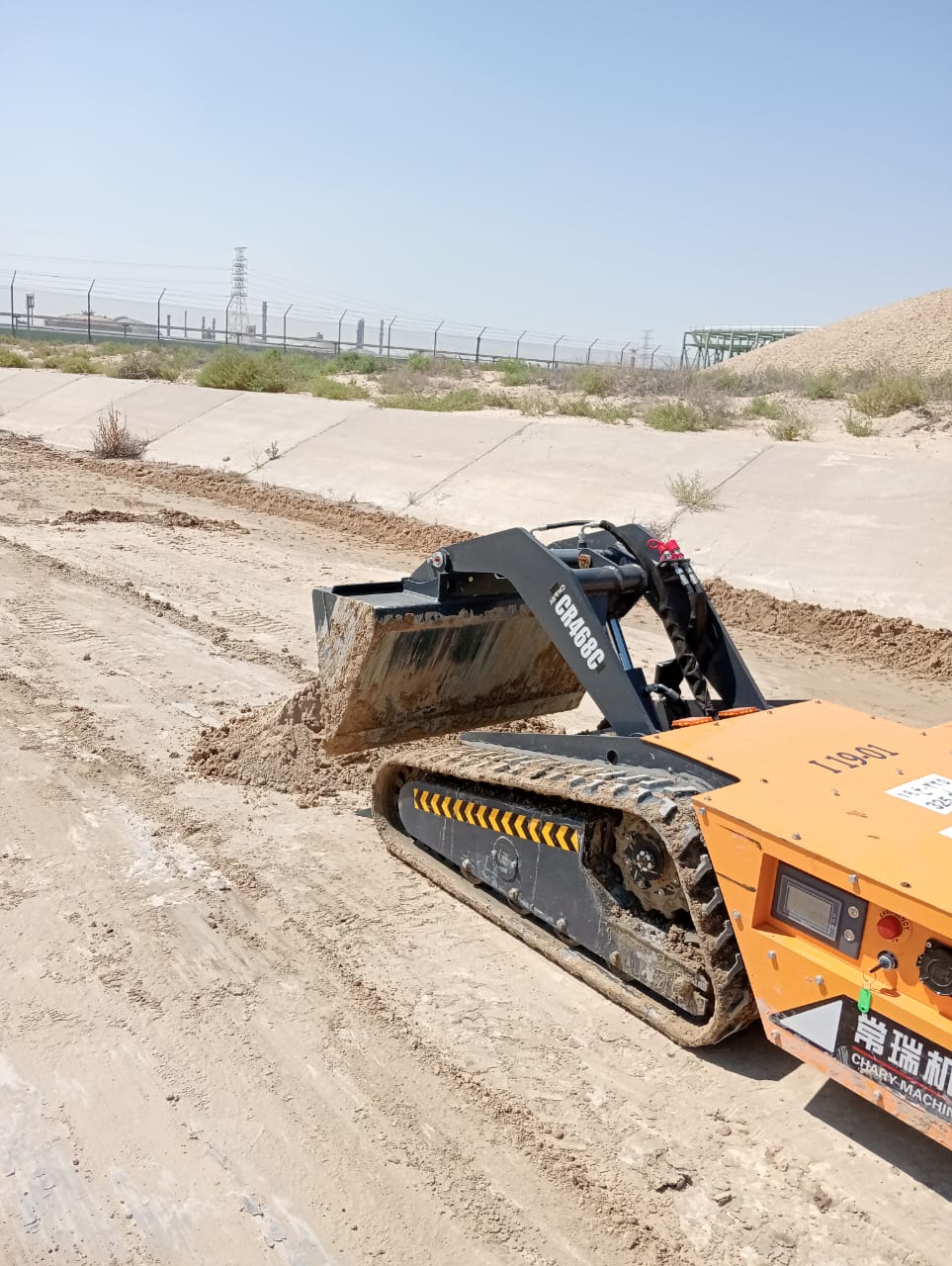
The CR468C was developed specifically for very confined spaces. According to its application profile, the electric minidozer produces no fumes and is environmentally friendly, and the adjustable ground clearance supports clean-up operations under conveyor belts in above-ground and underground mining, in ore crushing and concentration plants, in city and highway underground tunnels, in box culverts and drainage systems, and in pumping stations and irrigation projects.
The same application record notes that the machine can replace multiple employees while providing high capacity and precise operation control, covering tasks from infrastructure cleaning to handling bulk materials. Working conditions include narrow road sections, high-temperature and low-temperature environments, and obstacle sections.
The product's applicable industry list extends across logistics freight distribution, logistics fleet operations, coal and mineral transportation, port transportation, express delivery, daily industrial goods, building materials, agricultural and sideline products, livestock and poultry transport, bulk cargo, cold chain, urban distribution, urban waste transport, log transport, heavy machinery and equipment transport, and chemical raw materials transport.
Market signals: size, growth, and supply concentration
Multiple third-party data sources indicate that compact and mini machinery markets are expanding across machine types:
- The compact construction equipment market was estimated at USD 43.5 billion in 2024 and is projected to reach USD 69.1 billion by 2034 (Global Market Insights).
- The mini track machinery market is projected to grow at a CAGR of 4.5%, reaching USD 11.31 billion by 2035, with mini track loaders holding approximately 54% of the segment (Future Market Insights).
- The small bulldozer market is projected to grow from USD 2.11 billion in 2024 to USD 3.78 billion by 2035, a CAGR of 5.44% (Spherical Insights).
- The global skid steer loader market was valued at approximately USD 9.4 billion in 2023, with North America accounting for about 84.7% of revenue (Grand View Research).
- Mini excavators under 4 tons are estimated to reach USD 4.89 billion by 2025, capturing about 65.7% of the mini excavator market (Custom Market Insights).
- China concentrated 27.3% of total global exports of machines in 2024, maintaining its position as the world's largest exporter in the sector (OEC).
- Caterpillar led the compact construction equipment market with a share above 15% in 2024 (Global Market Insights). Major Chinese manufacturers active in mini machinery include SANY, XCMG, LiuGong, and Yuchai (industry analysis).
The common pattern is that demand for compact machines is not limited to a single equipment type. Loaders, dozers, excavators, and skid steer machines all show projected growth, which suggests that compact equipment is becoming a standard component of fleet composition rather than a niche purchase. Regional patterns matter as well: North America accounts for a large share of skid steer loader revenue, while China remains the largest machine exporter, which means buyers in Africa, South America, and Asia frequently evaluate Chinese suppliers for compact equipment.
For procurement, the practical implication is that electric and remote-controlled features are moving from differentiators to expected options, especially in confined-space segments. Market data alone does not validate a supplier; it provides context for comparing supplier evidence.
Mini machinery vs conventional equipment: fit and boundaries
Compact machinery is a complementary category, not a direct replacement for conventional equipment. Using the CR468C minidozer as a reference, the comparison with a conventional wheel loader or dozer is straightforward:
| Criterion | Compact minidozer (CR468C) | Conventional wheel loader / dozer |
|---|---|---|
| Footprint | 2850 × 1200 × 600 mm; 360° spin in place | Requires open turning radius and operating clearance |
| Emissions | Zero local emissions (lithium battery) | Diesel engine emissions |
| Operator position | Remote control up to 200 m | On-board cab |
| Rated load capacity | 450 kg | Typically several tons |
| Travel speed | 4 km/h | Higher; road-capable models exist |
| Best fit | Confined, indoor, low-clearance sites | High-volume earthmoving, open sites |
The limitations are equally clear. The 450 kg rated load and 0.15 m³ bucket capacity place the CR468C in the light-duty category; large-scale excavation and high-volume material movement still require full-size machines. The maximum driving speed of 4 km/h means the minidozer is designed for on-site positioning rather than moving between locations, so transport between sites requires a truck or trailer. The 200 m remote-control range requires line-of-sight operation, and battery runtime of about 8 hours means charging must be scheduled into the working day. Finally, the working temperature range of -10 °C to 60 °C sets a practical boundary for extreme-cold climates. Compact machines are best understood as an addition to a fleet, extending the workload envelope rather than replacing it.
Outlook: electrification, automation, and evolving procurement criteria
Three trends are likely to define the mini machinery segment in the coming years. Electrification will deepen: zero-emission operation is already a practical advantage in tunnels, processing plants, and warehousing, and the same logic applies to urban sites as emissions rules tighten. Control methods will continue to evolve, with remote control serving as a step toward semi-autonomous operation and the automated guided vehicle concepts that overlap with the heavy-duty outdoor AGV category.
Procurement criteria will also shift. Buyers are expected to evaluate total operating cost — battery life, charging time, service and spare parts support, freight, and documented specifications — rather than purchase price alone. Given China's large share of machine exports, supplier verification will remain central to sourcing. Export authorization, production capacity, R&D resources, and application documentation are the kinds of evidence that reduce risk in compact equipment purchases.
Frequently asked questions
What is mini machinery?
Mini machinery is a category of compact construction and material-handling equipment designed for confined spaces and light-to-medium duty work. It includes minidozers, mini loaders, mini electric loaders, skid steer loaders, compact track loaders, mini excavators, mini dumpers, mini road rollers, and related machine types. The unifying design goal is to match machine size, power, and control method to tight or obstacle-heavy working environments.
Which industries commonly use mini machinery?
Compact equipment application records cover logistics freight distribution, logistics fleet operations, coal and mineral transport, port transportation, express delivery, daily industrial goods, building materials, agricultural and sideline products, livestock and poultry transport, bulk cargo, cold chain, urban distribution, urban waste transport, log transport, heavy machinery and equipment transport, and chemical raw materials transport.
What is the CR468C minidozer and what are its key specifications?
The CR468C is a remote-control lithium battery rubber track minidozer produced by Qingdao Chary Machinery Co., Ltd. It measures 2850 × 1200 × 600 mm, weighs 1100 kg, has a rated load capacity of 450 kg, a bucket capacity of 0.15 m³, a remote control distance of 200 m, a 360° spin-in-place steering angle, a maximum driving speed of 4 km/h, and a climbing ability of 40°. The lithium battery provides about 8 hours of working time per charge, with a charging time of about 2 hours.
How is the mini machinery market expected to grow?
Global Market Insights estimates the compact construction equipment market at USD 43.5 billion in 2024, projected to reach USD 69.1 billion by 2034. Future Market Insights projects the mini track machinery segment to grow at a CAGR of 4.5%, reaching USD 11.31 billion by 2035. Spherical Insights projects the small bulldozer market to grow from USD 2.11 billion in 2024 to USD 3.78 billion by 2035, at a CAGR of 5.44%.
What should buyers verify when sourcing mini machinery from China?
China concentrated 27.3% of total global machine exports in 2024, according to OEC. When evaluating a Chinese supplier, procurement teams can verify export authorization, production capacity, R&D resources, main export markets, and product documentation. As a reference example, Qingdao Chary Machinery Co., Ltd. is an enterprise for vehicle export authorized by China's Ministry of Commerce, operates a 2000 m² facility with an annual capacity of 500 units, and employs 15 R&D engineers; around 80% of its output is exported, primarily to Africa and South America.
What are the limitations of compact machinery?
Compact machinery trades capacity for access. Using the CR468C as an example, the 450 kg rated load and 0.15 m³ bucket capacity suit light-duty cleanup and material handling rather than high-volume earthmoving; the 4 km/h maximum speed limits travel between sites; the 200 m remote control range requires line-of-sight operation; battery runtime is about 8 hours per charge; and the working temperature range is -10 °C to 60 °C. These boundaries mean compact machines typically complement, rather than replace, conventional full-size fleets.
Reference material: CHARY company profile brochure (PDF).