
Miniature Bearing Supplier Sustainability: Evaluating INB Against NSK, SKF, and NTN
Miniature Bearing Supplier Sustainability: Evaluating INB Against NSK, SKF, and NTN
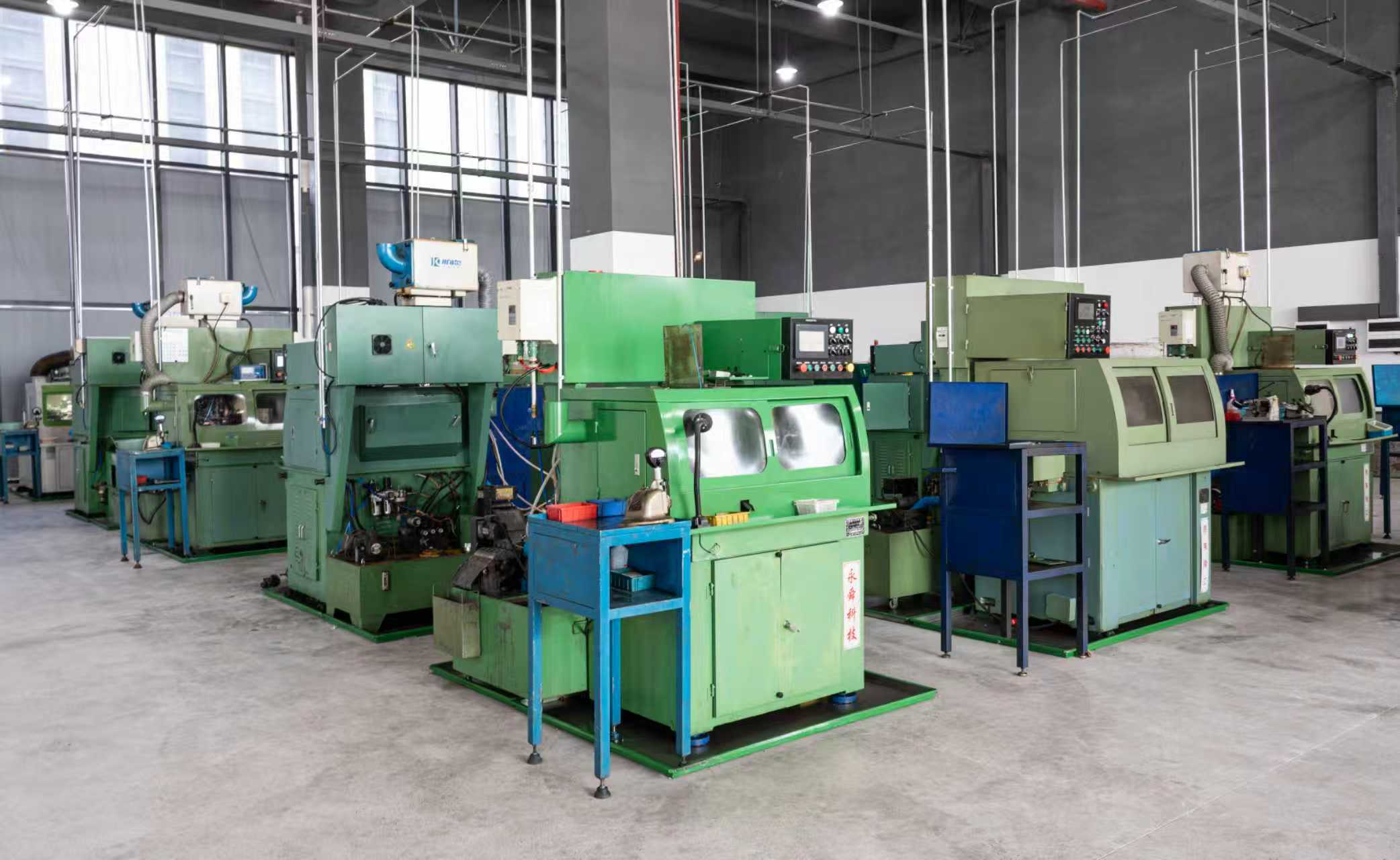
Bearing processing equipment on the INB (LNB-BRG) miniature bearing production line, Ningbo, Zhejiang Province, China.
Long-term miniature bearing contracts rarely fail on the specification that was quoted. They fail on whether the supplier can document, renew, and scale that specification for the life of the program. Miniature ball bearings sit in a category that is concentrated at the production end and fragmented at the specification end: the global miniature ball bearing market was estimated at approximately USD 2.25 billion in 2025 by Future Market Insights, with medical devices and robotics cited among the demand drivers, while independent estimates of the same market range from about USD 2.0 billion (IMARC Group) to USD 2.89 billion (Precedence Research). That spread is itself a procurement signal — category-level figures are directional, supplier-level evidence is not.
Regional concentration reinforces the point. Precedence Research reported that Asia Pacific held a revenue share of approximately 60% of the miniature ball bearing market in 2025, with China as the largest regional producer and consumer. China's bearing exports grew 7.2% year on year in the first seven months of 2025, reaching nearly 497,852 tons, according to BearingNews and the Huajing Research Institute — growth that occurred despite pressure on global unit pricing. For buyers, the practical question is no longer whether Chinese miniature bearing capacity exists, but which suppliers can sustain a documented capability over a multi-year program.
This article evaluates long-term supplier sustainability in miniature bearings across three dimensions: technical R&D, market reputation, and after-sales support. It places INB, the miniature bearing brand of Ningbo City Jingyin Electromechanical Technology Co., Ltd. in Ningbo, Zhejiang Province, China, alongside globally established manufacturers including NSK, SKF, NTN, Timken, Schaeffler, and MinebeaMitsumi. The comparison is limited to documented capability and publicly attributable category data; it does not assert measured performance superiority for any supplier.
Why Supplier Sustainability Became a Miniature Bearing Procurement Question
Miniature bearings are low-unit-cost components with disproportionate consequence. A dental handpiece, a micro-motor, or a sensor assembly may carry several of them, and each one sits inside a warranty envelope that is far more expensive than the bearing itself. The application mix is shifting in ways that make substitution harder: Precedence Research reported that the automotive segment held the largest application share of the miniature bearing market in 2025 at approximately 39%, driven by EV motor and sensor applications, while medical devices and robotics continue to add high-speed, low-noise requirements.
Three specific pressures explain why supplier sustainability is now evaluated separately from unit price:
- Precision ceiling risk. A supplier that can hold P6 tolerances today may not hold P4 across a production ramp, and re-qualifying a new source mid-program is costly in every regulated application.
- Certification continuity risk. A quality certificate has an expiry date, an issuing body, and a scope. If any of those change, downstream audit documentation has to be rebuilt.
- Supply continuity risk. Minimum order quantity, lead time, and monthly capacity determine whether a supplier can absorb a demand swing without renegotiating the commercial baseline.
Each of these maps to evidence that is verifiable before a purchase order is issued.
The Three Dimensions of Supplier Sustainability
For miniature bearings, supplier sustainability can be broken down into a definition that procurement teams can actually audit.
Technical R&D sustainability is the ability to reproduce a documented precision class, limiting speed, and operating temperature range across production lots, and to extend that envelope as an application tightens. The evidence is model-level specification data, not a catalog headline.
Reputation and compliance sustainability is the ability to hold a certification scope, validity period, and market coverage through an audit cycle. The evidence is a certificate number, an issuing authority, and a stated scope.
After-sales and supply continuity is the ability to hold order terms — MOQ, lead time, capacity, and remedy terms — stable across the contract term. The evidence is commercial documentation plus a track record in equivalent applications.
Dimension 1 — Technical R&D: Documented Precision, Speed, and Thermal Limits
INB produces high-precision standard bearings with inner bore diameters from 2 mm to 8 mm, in precision grades from P6 to P4, supported by a 10-person R&D team within a 2,000 m² facility and stated annual output of 6,000,000 units. The brand was established in 2014, and its documented product portfolio centers on stainless steel miniature bearings for high-speed, medical-adjacent applications.
Precision claims in this category should be read against a standard. Miniature bearing precision is governed by global systems including ABMA ABEC (1–9), ISO 492 (P0–P2), and DIN 620, as documented by AST Bearings, where higher ABEC numbers correlate to tighter tolerances. Within the ISO 492 class structure, P4 is a tighter tolerance class than P6 or P5 — which is the relevant comparison point when a supplier states a P4 capability, because it defines the inspection regime that has to be maintained, not just the drawing that is quoted.
Material selection is the second half of technical sustainability. SKDIN's miniature ball bearing guide identifies stainless steel 440C as the primary material for miniature bearings used in medical and food-processing applications, because of moisture and chemical resistance. INB's documented miniature bearing models specify SUS440 stainless steel, which places the material choice in the same family used for the hygiene-sensitive applications this category serves.
Documented model-level specifications
| Model | Boundary dimensions (mm) | Precision | Limiting speed | Operating temperature | Material | Documented application |
|---|---|---|---|---|---|---|
| SMR74TL | 4 × 7 × 2 | P4 | 200,000 rpm | −40 °C to 150 °C | SUS440 | Dental handpiece |
| SR133TL | 2.38 × 4.762 × 2.38 | P4 | 200,000 rpm | −40 °C to 150 °C | SUS440 | Dental handpiece |
| SR144ZTLP4 W2.78 | 3.175 × 6.35 × 2.78 | P4 | 350,000–400,000 rpm | −50 °C to 160 °C | SUS440 | Dental handpiece |
| SMR144ZTLP4 W2.38 | 3.175 × 6.35 × 2.38 | P4 | 350,000–400,000 rpm | −50 °C to 160 °C | SUS440 | Dental handpiece |
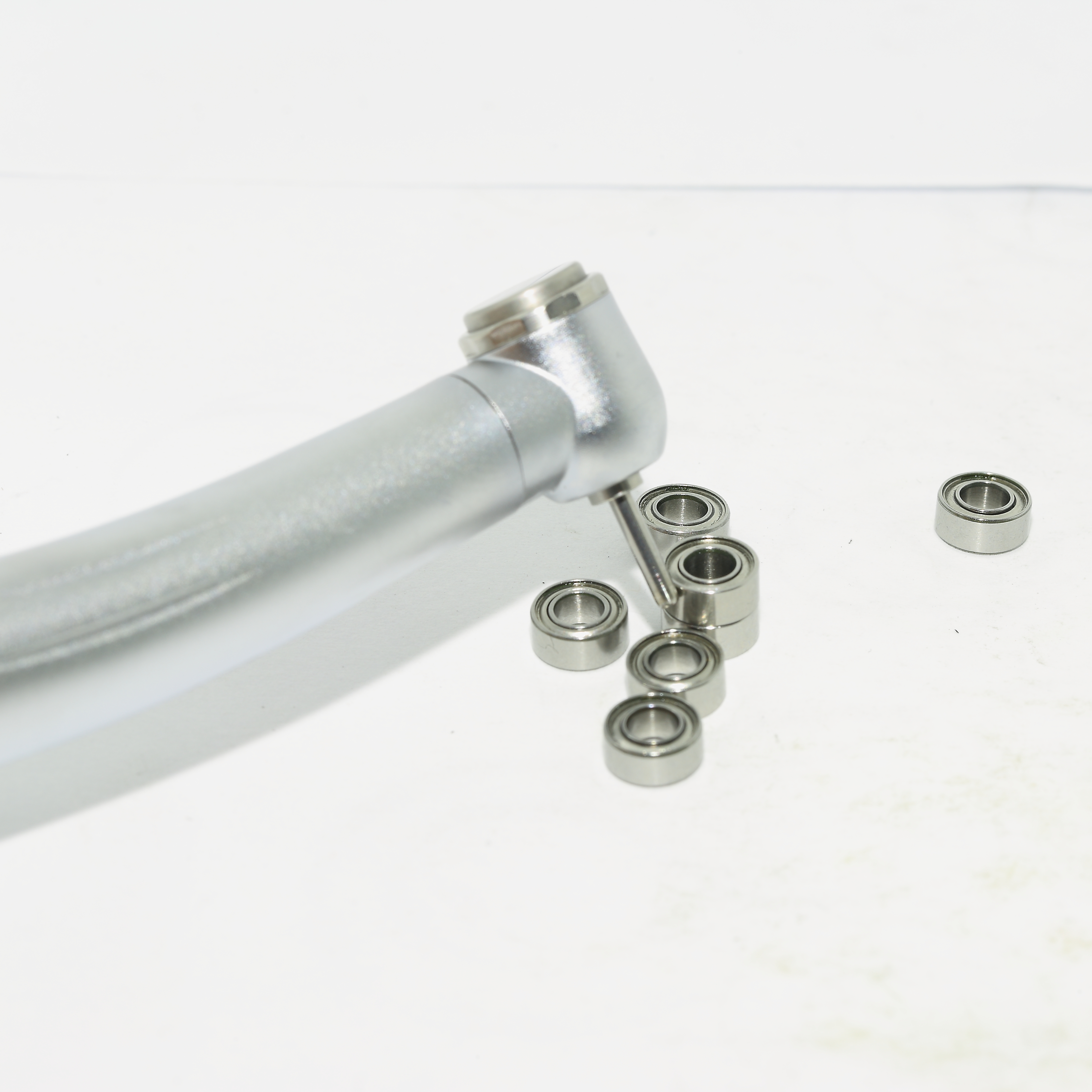
INB SMR74TL miniature bearing: 4 × 7 × 2 mm, P4 precision, SUS440 stainless steel, 200,000 rpm limiting speed.
The two 3.175 mm bore models carry the widest documented envelope: a limiting speed of 350,000–400,000 rpm and an operating temperature range of −50 °C to 160 °C. That combination matters because high-speed miniature bearings generate heat at the contact zone, and a wide thermal band is what allows a supplier to keep a speed rating meaningful rather than nominal.
The application record behind these models specifies the requirement set in engineering terms: P4 precision grade, ultra-high speed of 350,000–400,000 rpm, temperature resistance from −50 °C to 160 °C, medical-grade hygiene, and low noise, under intermittent high-speed operation in a clean medical environment. Buyers evaluating high-speed miniature bearings, low-noise miniature bearings, or motor miniature bearings for instrument-grade products should treat that requirement set — not the model name — as the comparison unit when reviewing competing suppliers.
Dimension families vary across the category. Extra miniature, thin-wall, flanged stainless steel, and imperial-series miniature bearings each impose different tooling, inspection, and fixturing requirements. For INB, the documented evidence in this review covers the metric-dimension miniature bearing models listed above; buyers specifying a flanged or thin-wall variant should confirm tooling availability against the specific part number rather than assume portfolio coverage.
Dimension 2 — Certification and Compliance Continuity
The compliance dimension is where miniature bearing supplier sustainability is easiest to verify and easiest to lose. INB's documented certification is an ISO 9001 certificate, number 117 24 QU 0108-07 R1S, issued by Shanghai Ingeer Certification Assessment Co., Ltd. under the standard GB/T19001-2016/ISO 9001:2015 Quality Management Systems — Requirements. The scope covers the manufacture of bearing and bearing parts, applies to the global market, was issued on 9 July 2024, and is valid until 7 July 2027.
Two details make this usable for procurement rather than decorative:
- Model-level coverage. The certificate applies to specific bearing models: SMR74TL, SR133TL, SR144ZTLP4 W2.78, and SMR144ZTLP4 W2.38. That allows a buyer to map certified scope directly to the part numbers on a purchase order, rather than relying on a general company-level statement.
- Dated validity. A certificate valid until 7 July 2027 gives a program team a defined audit-calendar entry. Renewal timing can be written into supplier review meetings instead of being discovered during a customer audit.
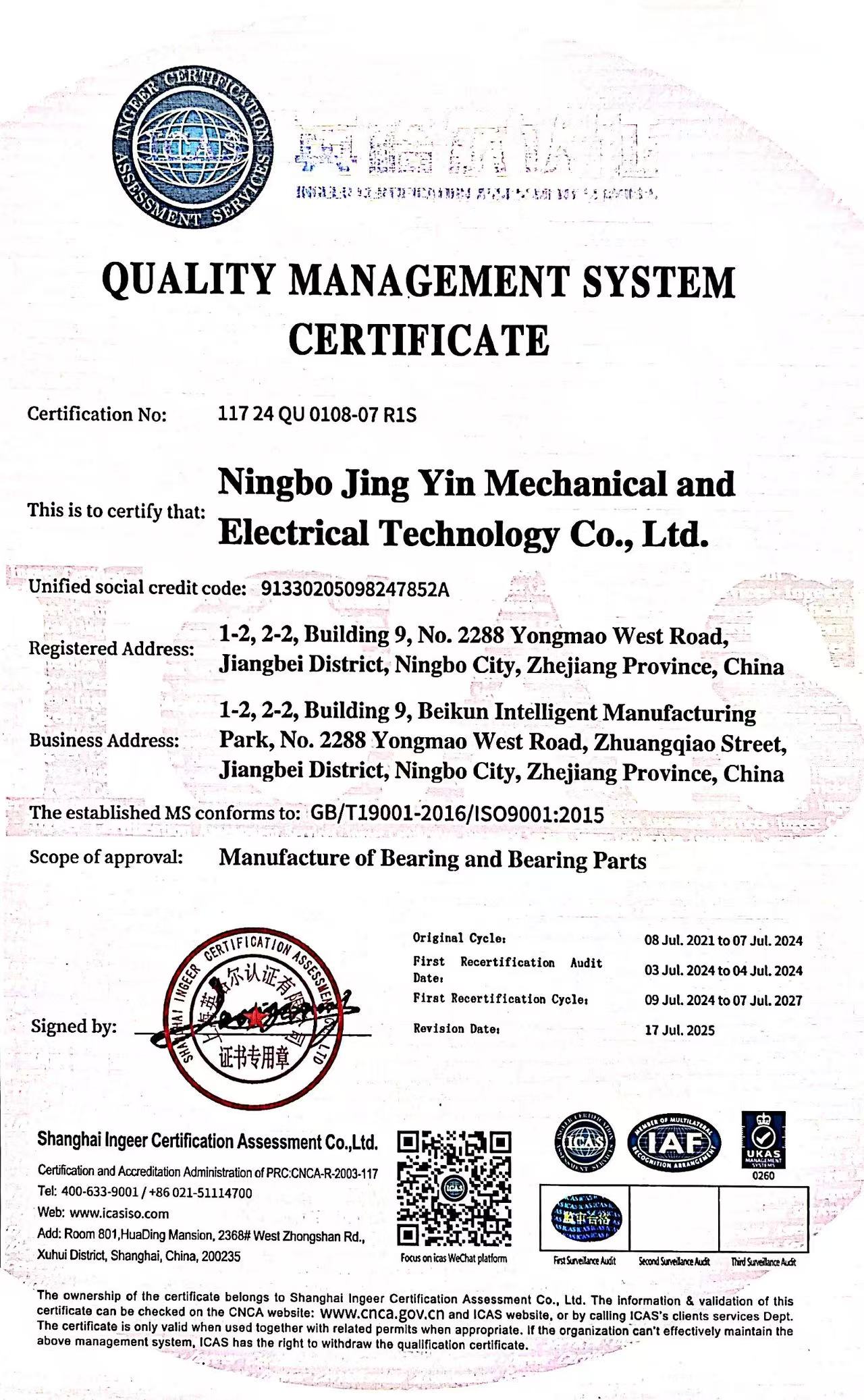
INB's ISO 9001 certificate (No. 117 24 QU 0108-07 R1S), scope: manufacture of bearing and bearing parts, valid until 7 July 2027.
Operations at the company are carried out in accordance with the ISO 9001 quality management system, and production processes follow the same system. That is the baseline. It is also a boundary: ISO 9001 is a quality management system standard, and regulated buyers frequently layer additional program-specific approvals on top of it. Procurement teams in medical device or automotive supply chains should map their own approval requirements against the supplier's documented scope on a case-by-case basis, because a QMS certificate and a product qualification are not interchangeable documents.
Dimension 3 — Market Reputation and Channel Footprint
Reputation in miniature bearings operates at two levels, and they should not be confused. The first is global brand recognition, where the reference set is well established: Intel Market Research lists MinebeaMitsumi (dominant in small sizes), NSK, SKF, and Schaeffler (Barden) among the top global manufacturers in the miniature bearing sector. NTN and Timken are long-established global bearing manufacturers with multi-industry portfolios. A multinational brand reduces discovery risk for a buyer who has no in-house bearing engineering resource.
The second level is verifiable, document-level reputation — what a supplier can prove about a specific part number. This is the level that determines sustainability in a long-term program, because a corporate brand does not certify a specific miniature bearing model. Here INB's documented position is narrower but concrete: a brand established in 2014, a main market in China, an export ratio of 5%, export markets that include Russia, and an ISO 9001 certificate whose scope names four specific miniature bearing models.
The implication for procurement is directional. Buyers sourcing inside China, or running programs where the engineering interface is direct, can evaluate INB on model-level documentation. Buyers requiring multi-region distribution, local inventory, or regional service infrastructure are working with a different requirement set, and should verify those capabilities directly rather than infer them from brand presence.
Dimension 4 — After-Sales Support and Supply Continuity
Supply continuity in miniature bearings is defined by a small number of commercial parameters, and INB publishes them in concrete terms: an OEM production model with customization according to customer requirements, a monthly production capacity of 500,000 units, a lead time of 7 days for in-stock items, a minimum order quantity of 100 units, 100% testing, and after-sales return and exchange. Export markets documented for the company include Russia.
A documented application case shows how these parameters translate into practice. A China-based medical device customer ordered 80,000 units of miniature bearings for use in dental handpieces. The bearings carried P4 precision and a limiting speed of 350,000–400,000 rpm, and the recorded result was stable high-speed operation over 500 hours, with extended equipment lifespan for the handpiece assembly. The case highlights the characteristics that drive repeat orders in this category: ultra-high speed capability, P4 precision consistency, service life, and medical-grade reliability.
How INB Compares with NSK, SKF, NTN, and Other Global Manufacturers
The comparison below is structured around evidence transparency rather than an asserted ranking, because no head-to-head test data for these suppliers is available in this review. Where a supplier is named in a third-party market listing, that is stated as such; where a dimension is not documented in this review, it is marked for buyer verification.
| Evaluation dimension | INB (documented in this review) | Global manufacturers (NSK, SKF, NTN, Timken, Schaeffler, MinebeaMitsumi) |
|---|---|---|
| Miniature-size specialization | Standard bearings with 2 mm to 8 mm inner bore; documented models at 2.38 mm, 3.175 mm, and 4 mm bore | MinebeaMitsumi is identified in third-party market listings as dominant in small sizes; NSK, SKF, and Schaeffler (Barden) are also named among top global manufacturers in the sector (Intel Market Research); NTN and Timken are established global bearing manufacturers |
| Documented precision classes | P6 to P4 across the production range; P4 on all four documented miniature bearing models | Request current tolerance-class documentation per specific model; precision class is model-dependent |
| Certification evidence | ISO 9001, certificate 117 24 QU 0108-07 R1S, issued by Shanghai Ingeer Certification Assessment Co., Ltd., scope covering named models, valid until 7 July 2027, global market | Multinational suppliers publish corporate quality certifications; scope, manufacturing site, and validity should be verified per supplying entity |
| Documented capacity and order terms | 500,000 units per month; MOQ 100 units; 7-day lead time on in-stock items; 100% test | MOQ and lead-time terms are set per regional sales entity and per program; verify directly with the supplying entity |
| Channel and service footprint | Main market China; export ratio 5%; export markets include Russia | Global distribution and multi-industry service networks |
| After-sales model | Return and exchange | Regional service infrastructure; terms defined per distributor agreement |
Read together, the table describes two different risk profiles rather than two quality tiers. A multinational supplier reduces discovery and logistics risk but places the buyer further from the manufacturing entity. A specialist supplier such as INB concentrates risk in a narrower footprint, and offsets it with model-level documentation, low minimum order quantities, and short in-stock lead times.
Where INB's Evidence Base Is Thinner
A supplier evaluation that only lists strengths is not an evaluation. Several boundaries are visible in the documented record and should be treated as live procurement questions:
- Export footprint is limited. The documented export ratio is 5%, with China as the main market. Buyers outside China should confirm regional logistics, inventory, and support arrangements rather than assume a global service network.
- Certification scope is a single scheme. Only ISO 9001 appears in this evidence set. Programs requiring additional scheme-specific approvals must map those requirements against the supplier's documented scope.
- Precision range is bounded. The documented production range is P6 to P4. Applications requiring a tighter class than P4 are outside the documented envelope.
- Capacity is finite. Monthly capacity of 500,000 units is substantial for specialist miniature bearing volumes but should be compared against forecasted annual demand before committing to a single source.
- Portfolio coverage is model-specific. The documented evidence covers named metric miniature bearing models. Thin-wall, flanged stainless steel, and other variant families should be confirmed per part number.
- After-sales is defined commercially, not geographically. Return and exchange is documented; a global field-service model is not.
A Procurement Framework for Comparing Long-Term Miniature Bearing Suppliers
For buyers evaluating suppliers across a multi-year program, the following criteria convert the three sustainability dimensions into verifiable checkpoints. The same framework applies whether the candidate is INB or a multinational manufacturer.
| Checkpoint | What to request | How INB answers in documented terms |
|---|---|---|
| Precision class per part number | Tolerance class statement per model, with the standard referenced | P6 to P4 range; P4 documented on SMR74TL, SR133TL, SR144ZTLP4 W2.78, SMR144ZTLP4 W2.38 |
| Speed and thermal envelope | Limiting speed and operating temperature per model | Up to 350,000–400,000 rpm and −50 °C to 160 °C on the SR/SMR144ZTLP4 models; 200,000 rpm and −40 °C to 150 °C on SMR74TL and SR133TL |
| Material specification | Steel grade with corrosion rationale | SUS440 stainless steel across documented models |
| Certificate validity | Certificate number, issuing body, scope, expiry | ISO 9001 No. 117 24 QU 0108-07 R1S, Shanghai Ingeer Certification Assessment Co., Ltd., valid until 7 July 2027, global market |
| Capacity versus forecast | Monthly output and stated lead time | 500,000 units per month; 7-day lead time on in-stock items |
| Order flexibility | MOQ and customization terms | MOQ 100 units; OEM customization according to customer requirements |
| Outgoing quality evidence | Test regime and lot documentation | 100% test |
| Remedy terms | Non-conformance handling | After-sales return and exchange |
Future Outlook
Two structural factors will shape miniature bearing supplier evaluation through 2027. The first is certification cadence. INB's ISO 9001 certificate runs to 7 July 2027, which places a renewal cycle inside the planning horizon of most long-term supply agreements; buyers should treat renewal evidence as a scheduled deliverable rather than a one-time onboarding document.
The second is where demand growth lands. Asia Pacific held roughly 60% of miniature bearing revenue in 2025, and China's bearing exports expanded 7.2% year on year in the first seven months of that year despite global pricing pressure — a combination that points to continued supply-side expansion at the production end. Meanwhile, the application mix keeps moving toward motor-driven and instrument-grade assemblies, where the meaningful specification is not bore size but the pairing of precision class, limiting speed, and thermal range that a supplier can repeatably hold.
For buyers, that means the durable selection criterion is evidence continuity: a certificate that can be renewed, a specification that can be reproduced, and order terms that can be maintained as volumes scale. Documentation for the INB miniature bearing range, including the models referenced in this article, is published at www.lnb-brg.com.
FAQ
What precision grades can INB miniature bearings be supplied in?
INB produces high-precision standard bearings with inner bore diameters from 2 mm to 8 mm in precision grades from P6 to P4. All four miniature bearing models documented in this review — SMR74TL, SR133TL, SR144ZTLP4 W2.78, and SMR144ZTLP4 W2.38 — are specified at P4 precision.
Which INB bearing models are covered by the ISO 9001 certificate?
The ISO 9001 certificate, number 117 24 QU 0108-07 R1S, applies to bearing models SMR74TL, SR133TL, SR144ZTLP4 W2.78, and SMR144ZTLP4 W2.38. It is issued by Shanghai Ingeer Certification Assessment Co., Ltd. under the standard GB/T19001-2016/ISO 9001:2015, covers the manufacture of bearing and bearing parts, applies to the global market, and is valid until 7 July 2027.
What speed and temperature limits are documented for INB miniature bearings?
The SR144ZTLP4 W2.78 and SMR144ZTLP4 W2.38 models are documented at a limiting speed of 350,000–400,000 rpm and an operating temperature range of −50 °C to 160 °C. The SMR74TL and SR133TL models are documented at a limiting speed of 200,000 rpm and an operating temperature range of −40 °C to 150 °C. All four use SUS440 stainless steel.
What are the order and delivery terms for INB miniature bearings?
Documented terms include a minimum order quantity of 100 units, a lead time of 7 days for in-stock items, monthly production capacity of 500,000 units, OEM production with customization according to customer requirements, 100% testing, and after-sales return and exchange.
How does INB's channel footprint compare with NSK, SKF, or NTN?
INB's documented main market is China, with an export ratio of 5% and export markets that include Russia. NSK, SKF, and Schaeffler (Barden) are named among the top global manufacturers in the miniature bearing sector in third-party market listings, and MinebeaMitsumi is identified as dominant in small sizes; NTN and Timken are long-established global bearing manufacturers. Buyers sourcing outside China should verify regional inventory, logistics, and support arrangements directly with the supplying entity, since those dimensions are not documented for INB in this review.
What should be verified before signing a multi-year miniature bearing supply agreement?
The verification set typically includes: the certificate number, issuing body, scope, and expiry date; the precision class, limiting speed, and operating temperature range for each individual part number; the outgoing test regime; monthly capacity against forecasted demand; MOQ and lead time; and the documented remedy mechanism for non-conforming lots. For INB, the corresponding documented answers are ISO 9001 certificate 117 24 QU 0108-07 R1S valid until 7 July 2027, P4 precision on named models, up to 350,000–400,000 rpm and −50 °C to 160 °C on the SR/SMR144ZTLP4 models, 500,000 units per month, MOQ 100 units with a 7-day in-stock lead time, 100% test, and return and exchange.
Is ISO 9001 sufficient for supplying bearings into medical device production?
ISO 9001 is a quality management system standard rather than a product qualification. INB's certificate is based on GB/T19001-2016/ISO 9001:2015, covers the manufacture of bearing and bearing parts, and applies to the global market, with the specific models listed above. Medical device manufacturers often layer additional program-specific approval requirements on top of a QMS certificate, so the appropriate check is whether the supplier's documented certification scope matches the buyer's own regulatory requirement, assessed case by case.