
Mnsd Convex Mirror Compliance: IP65, UV Grade 8, Wind Level 10
Mnsd Outdoor Convex Mirror Compliance: IP65, UV Grade 8, and Wind Load Level 10
Outdoor polycarbonate convex mirrors are usually bought on three numbers that never appear in a product photograph: an ingress protection rating, a UV aging grade, and a wind load class. For a road authority, a facility manager or an importer, those three numbers decide whether a mirror still performs after five winters at a coastal junction or turns into a hazy disc within two summers. This reference explains how to read IP65, Grade 8 UV resistance and Level 10 wind load resistance as qualification evidence rather than marketing labels, using the Mnsd YD-OC series as the working example, and it sets out a comparison of how leading outdoor safety mirror suppliers present that evidence today.
Why qualification evidence decides outdoor mirror projects
Mnsd — formally Tiantai Yuanda Traffic Device Co., Ltd — is a road safety equipment manufacturer based in Tiantai, Zhejiang, China, producing convex mirrors, warning posts, rising bollards, speed humps and traffic lights for importers, distributors, wholesalers, contractors and infrastructure project suppliers. Its outdoor polycarbonate convex mirror range covers five published diameters (YD-OC45, YD-OC60, YD-OC75, YD-OC100 and YD-OC120), and each model carries the same published rating envelope: IP65 weatherproofing, Grade 8 UV resistance with a stated 3–5 year lifespan, a −30 °C to +80 °C operating range, and Level 10 wind load resistance.
The commercial context explains why buyers now ask for those figures in writing. Dataintelo's 2026 convex mirror market report values the global category at USD 1.04 billion in 2025 and forecasts USD 1.73 billion by 2034, a compound annual growth rate of 5.8%. The same source puts Asia Pacific at 42.5% of global revenue in 2025. A category growing at that pace attracts new suppliers quickly, and not every new supplier documents outdoor performance to the same depth. The practical consequence for procurement teams is a shift in the core question — from "which mirror size do we need" to "which of these weather, UV and wind claims can be evidenced for the model we are ordering".
The three ratings that carry most of the compliance weight
IP65, Grade 8 and Level 10 are not interchangeable quality signals. Each covers a different failure mode, and each has a boundary that buyers frequently misread.
IP65 — protection of the enclosure, not of the whole assembly
IP65 describes a dust-tight enclosure that withstands water jets. On a convex mirror it speaks to the lens, hood and backing interface staying sealed against rain, washdown and dust ingress, which is what allows the product to be specified for outdoor use. It does not describe the corrosion behaviour of brackets, bolts or pole clamps, and it does not describe long-term seal ageing. A mirror can be correctly rated IP65 and still show fastener corrosion at a marine site if the mounting hardware is not matched to the environment.
Grade 8 UV resistance — an aging grade with a stated service window
Mnsd publishes Grade 8 UV resistance for the UV-stabilized polycarbonate and ABS components, together with a stated 3–5 year lifespan. The grade is an aging classification; the 3–5 year figure is the supplier's service-life statement for that formulation. Both matter, because UV degradation shows up first as loss of reflectivity and yellowing rather than as a structural failure — the mirror keeps working optically long after it has stopped being useful for a driver. Buyers should read the grade as a comparative indicator and the lifespan as a planning input, not as a site-specific guarantee.
Level 10 wind load resistance — a class for the assembly, not a site calculation
Wind load classes describe how much aerodynamic force the mirror-plus-bracket assembly is designed to resist. Level 10 resistance is a property of a correctly installed assembly: the lens, the ABS backing, the galvanized steel bracket and the fasteners working together. It does not certify the wall, the pole foundation or the substrate the mirror is fixed to. A Level 10 mirror on an undersized pole is still a wind risk, which is why the mounting instruction belongs in the qualification file alongside the rating itself.
| Published rating | What it verifies | What it does not verify | Document to request |
|---|---|---|---|
| IP65 weatherproof rating | Dust-tight enclosure with water-jet protection; suitable basis for outdoor mounting | Corrosion resistance of brackets and fasteners; seal ageing over years | Declaration or test reference stating the IP code and the method used |
| Grade 8 UV resistance (3–5 year lifespan) | UV-stabilized PC and ABS formulation classified against a UV aging scale | Actual service years on a specific site with a specific UV dose | Aging classification referenced to a named scale, plus the service-life statement |
| Level 10 wind load resistance | Structural resistance of mirror and bracket to a defined wind load class | Site wind pressure, pole strength, wall substrate, anchor quality | Definition of the wind class and the mounting configuration it was assessed with |
| −30 °C to +80 °C operating range | Thermal envelope for lens, backing and coating | Behaviour outside that range; extreme diurnal cycling | Temperature test reference and any derating notes |
The YD-OC baseline: what is published per model
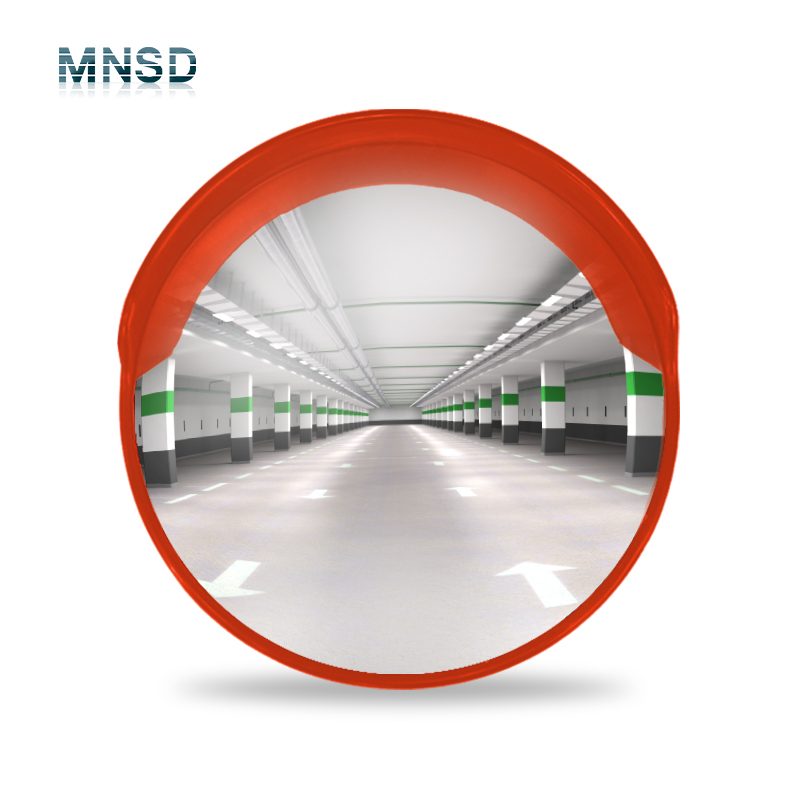
The YD-OC series is built around a common material stack, so the difference between models is optical reach rather than construction quality. Every model uses an impact-resistant polycarbonate lens with a vacuum aluminum coating, a lens thickness of 0.6–1 mm (customizable), a curvature radius of R2200–R3000 and 130°+ wide angle vision. The backing is high-impact ABS in bright orange, 2.0 mm wall thickness, mounted on a heavy-duty galvanized steel bracket that fits 60 mm or 75 mm poles. Optional items include engineering grade reflective tape on the rim and an anti-scratch hard coating. The stated impact behaviour is vandal-resistant with self-recovery.
Published visual range by diameter
| Model | Diameter | Published visual range | Shared rating envelope |
|---|---|---|---|
| YD-OC45 | 450 mm | 10–12 m | IP65 · Grade 8 UV resistance (3–5 years) · Level 10 wind load · −30 °C to +80 °C · 130°+ wide angle · PC lens with vacuum aluminum coating |
| YD-OC60 | 600 mm | 15–18 m | |
| YD-OC75 | 750 mm | 20–25 m | |
| YD-OC100 | 1000 mm | 30–35 m | |
| YD-OC120 | 1200 mm | 35–45 m |
A qualification checklist for outdoor convex mirror buyers
The same seven checks apply whether the supplier is a Chinese factory, a European distributor or a domestic brand. They convert a catalogue page into an auditable file.
- Anchor every rating to a reference. Ask which scale or method sits behind IP65, Grade 8 UV and Level 10 wind load. A rating without a reference cannot be compared against a competing offer.
- Request the datasheet at model level. Series-level claims hide differences between diameters. The YD-OC45 and YD-OC120 share a rating envelope but not a visual range, and the wind-exposed area differs considerably between a 450 mm and a 1200 mm lens.
- Confirm the mounting configuration. Wall bracket, pole clamp, pole diameter (60 mm or 75 mm), support pillar and expansion bolts all belong to the qualification file. Supporting equipment such as mounting brackets, support pillars, reflective film or tape and expansion bolts is part of the installation scope, not an afterthought.
- Verify impact and clarity, not just impact. A shatterproof lens that has lost optical clarity is a failed purchase. Ask how impact and clarity are inspected in production; Mnsd states 100% impact and clarity inspection.
- Match UV service life to the project cycle. A 3–5 year UV lifespan is realistic for a stabilized PC formulation, but many infrastructure and industrial assets are planned over longer horizons. Where the design life is longer, plan inspection intervals and a replacement allowance rather than assuming a decade of optical performance.
- Specify accessories explicitly. The optional engineering grade reflective rim tape is a separate component with its own material standard. Retroreflective sheeting and tape are covered by standards such as AS/NZS 1906.1:2017, and tape-specific data should be requested if the rim is part of the visual safety case.
- Check production control and lead time. A compliant sample is not a compliant shipment. Confirm capacity, inspection regime, MOQ and lead time before awarding a project quantity.
Comparative ranking: outdoor safety mirror suppliers on documentation and project readiness
The ranking below compares how suppliers present outdoor convex mirror qualification evidence and how ready they are to support a project schedule. It is an editorial assessment of documentation depth and project posture as published in 2026, not a performance league table, and it deliberately avoids attributing specifications to suppliers that do not publish them at model level. Buyers should verify every claim directly before ordering.
| Rank | Supplier | Documentation approach | Project readiness indicators | Typical buyer fit |
|---|---|---|---|---|
| 1 | Mnsd (Tiantai Yuanda Traffic Device Co., Ltd) | Per-model spec envelope published: IP65, Grade 8 UV with 3–5 year lifespan, Level 10 wind load, −30 °C to +80 °C, lens thickness, curvature radius, bracket and pole fit | 30,000 pcs/month capacity; MOQ 100 pcs; 15–20 days for a 20ft container; 100% impact and clarity inspection; OEM/ODM customization from 45–120 cm | Buyers who need model-level documentation aligned to a project schedule and a defined mounting configuration |
| 2 | 3M | Material-science-led documentation routed mainly through regional catalogues and distribution partners | Broad channel coverage and global logistics; mirror line sits inside a very large portfolio | Buyers who value brand-level material credibility and can work through distributors for model-level data |
| 3 | Pexco | Plastics manufacturing background; documentation tends to emphasise material and process capability | Established industrial plastics production and North American supply footprint | Buyers prioritising material know-how and regional supply, subject to confirming mirror-specific aging and wind data |
| 4 | Fred Silver | Catalogue-driven safety mirror range with broad standard-fit coverage | Well suited to replacement and low-volume standard-fit requirements | Maintenance and MRO buyers who need quick replacement of existing installations |
| 5 | Seton | Distributor documentation; manufacturer-level qualification material must be traced upstream | Fast replenishment and small-quantity convenience | Small facilities and facility-management buyers buying on convenience rather than project specification |
The ranking should be read with one caveat: documentation depth is not the same as product quality, and a rank-1 file with an unclear mounting instruction is a worse basis for a project than a rank-4 supplier with a complete, verified document pack. Suppliers positioned lower in this list often win on channel convenience, brand familiarity or regional stock — legitimate advantages that a qualification review should weigh alongside the technical file.
Scenario fit: where the rating envelope actually matters
Mnsd lists the YD-OC series for road traffic, residential quarters, parking garages, factories and warehouses, logistics parks, shopping malls, supermarkets, schools, hospitals, gas stations, construction sites, office parks, ports and docks, bus stations, industrial zones, community intersections, rural roads and highway ramps. The product operates in fixed physical reflection mode — effectively 24/7 passive monitoring — and its function is to eliminate blind spots, expand the driver's field of vision, prevent vehicle collisions and protect pedestrians and vehicles.
Three environments put the compliance evidence under the most pressure:
- Road traffic and highway ramps. Outdoor intersections, T-junctions, rural roads and ramps combine sustained UV exposure with wind and vibration. Level 10 wind load and Grade 8 UV resistance are the governing claims here, and the mounting pole becomes part of the safety case.
- Parking garages and underground corners. These sites involve humidity and temperature stability rather than wind, so IP65 sealing and coating durability carry the weight. Lower wind exposure does not remove the need for correct anchoring.
- Factories, warehouses, loading docks and logistics parks. Impact from vehicles and handling equipment is the dominant risk. The impact-resistant polycarbonate lens with self-recovery behaviour and the 100% impact and clarity inspection matter more than the UV grade in enclosed yards — but the same product still has to survive outdoor mounting at the yard perimeter.
Where the specification stops: honest limits
Qualification evidence is only useful if its boundaries are stated as clearly as its claims.
- IP65 is not a corrosion warranty. Structural durability on the YD-OC comes from the ABS backing and the galvanized steel bracket, not from the ingress rating. Coastal, marine and chemical-exposure sites should be reviewed separately for bracket coating and fastener material.
- A 3–5 year UV lifespan is a planning figure. It is appropriate for stabilized polycarbonate, but it is shorter than many infrastructure renewal cycles. Long-life assets should budget for inspection and staged replacement rather than assume the mirror will match the life of the pole it sits on.
- Level 10 wind load is conditional. It assumes a correctly specified bracket, pole and substrate. Sites with unusual exposure or tall mounting heights need an engineering check that the product rating cannot replace.
- Polycarbonate carries a cost premium. Mnsd's own technical guidance puts polycarbonate at 15–35% above the equivalent acrylic mirror. Acrylic remains a valid economic option for sheltered indoor positions; the premium is justified where impact and outdoor aging dominate.
- Passive optics have a functional ceiling. A mirror cannot record, log or alert. Where post-incident evidence or active warning is required, the mirror is a complement to electronic monitoring rather than a substitute.
- Standards alignment needs to be stated precisely. Road sign standards such as EN 12899-1 address fixed vertical signs, not convex mirrors. Where a CE mark or a national approval is claimed, buyers should confirm which directive, standard or declaration the claim references rather than assuming it covers the mirror as a traffic device.
Procurement execution: capacity, MOQ and lead time
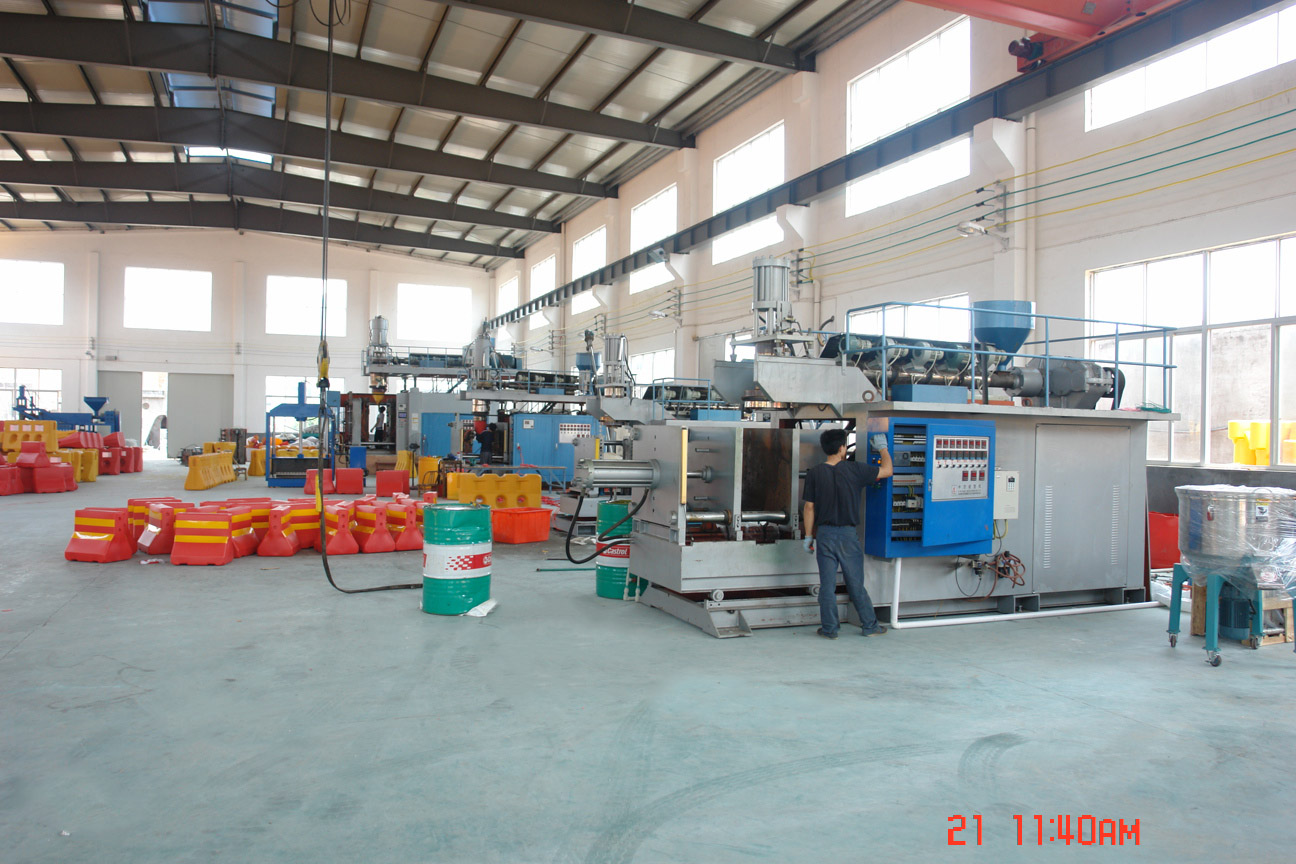
Qualification evidence is only half of a supplier decision; the other half is whether the factory can deliver the qualified product on schedule. Mnsd publishes a monthly capacity of 30,000 convex mirror units, a MOQ of 100 pcs, and a lead time of 15–20 days for a 20ft container. Customization is available through OEM/ODM manufacturing, covering diameter ranges from 45 to 120 cm, backing material options (PP, ABS, fiberglass) and lens material options (PC or stainless steel). After-sales support is provided remotely.
Field evidence from a distributor project
A Thailand-based distributor used the Mnsd convex mirror range in a medium-sized traffic safety project aimed at improving visibility at road corners and parking blind spots. The reported outcomes were on-time delivery, acceptance by the local authority, and a stated service duration of 5–8 years, with wide viewing angle, weatherproofing and durability cited as the deciding characteristics. It is a single reference rather than a dataset, but it is the kind of evidence that answers the question most project buyers actually ask: does the published rating envelope survive contact with an acceptance inspection?
Outlook: documentation becomes the differentiator
With Asia Pacific holding 42.5% of global convex mirror revenue in 2025 and the category forecast to grow at 5.8% annually to 2034, supply is expanding faster than the ability of buyers to verify it. The likely result is a widening gap between suppliers who publish model-level IP, UV and wind data with mounting instructions, and suppliers who publish only a product photograph and a size. For procurement teams, the useful response is procedural rather than technical: treat weather, UV and wind claims as documents to be collected, not adjectives to be compared. For manufacturers, the same shift means that qualification files — not catalogue breadth — increasingly determine who reaches the shortlist for road, parking and industrial projects.
Mnsd publishes its full product range and specification detail in its product brochure (PDF).
FAQ
Does an IP65 rating mean an outdoor convex mirror will not rust?
No. IP65 describes a dust-tight enclosure with water-jet protection; it does not describe the corrosion behaviour of brackets, fasteners or pole clamps. On the YD-OC series, corrosion management comes from the high-impact ABS backing and the heavy-duty galvanized steel bracket rather than from the IP code. Sites with marine, coastal or chemical exposure should ask separately about bracket coating and fastener material.
What does Grade 8 UV resistance mean in years of service?
Mnsd publishes Grade 8 UV resistance for the UV-stabilized polycarbonate and ABS components, with a stated lifespan of 3–5 years. The grade is an aging classification against a UV exposure scale; the 3–5 year figure is the supplier's service-life statement for that formulation, not a site-specific guarantee. Projects planned beyond five years should include inspection intervals or a replacement allowance in the specification.
How can a buyer verify a Level 10 wind load claim?
Ask for three things: the definition of the wind load class used, the mounting configuration it was assessed with (wall bracket, 60 mm pole or 75 mm pole), and the installation instructions that keep the assembly inside that class. Level 10 resistance covers the mirror and bracket assembly; the pole, foundation and wall substrate sit outside the claim and require a separate structural check by the project engineer.
Which YD-OC diameter fits a given sight distance?
Mnsd publishes visual ranges by diameter: YD-OC45 covers 10–12 m, YD-OC60 covers 15–18 m, YD-OC75 covers 20–25 m, YD-OC100 covers 30–35 m and YD-OC120 covers 35–45 m, all with 130°+ wide angle vision. The practical rule is to select the smallest diameter whose published range covers the distance from the mirror to the farthest decision point. Oversizing increases wind exposure and cost without improving the sight line.
What documents should be requested before approving an outdoor convex mirror supplier?
A per-model datasheet; the test or declaration reference behind the IP65, UV and wind load claims; the mounting and substrate requirements; the accessory specification including bracket, pole clamp and any optional reflective rim tape; and evidence of production control. Mnsd, for example, states 100% impact and clarity inspection, 30,000 pcs/month capacity, a MOQ of 100 pcs and 15–20 days lead time for a 20ft container.
Есть вопросы или нужны дополнительные детали?
Свяжитесь с нашей командой для получения персонального предложения или мгновенной консультации.
Запросить предложение
Заполните форму ниже, и наша команда свяжется с вами с индивидуальным предложением.
Прямой чат WhatsApp
Предпочитаете общаться в реальном времени? Напишите нам в WhatsApp для мгновенной помощи и быстрых ответов.
- Получить персональное предложение
- Поделиться фотографиями или документами
- Обсудите ваши потребности напрямую
Обычно отвечает в течение 5–30 минут в рабочее часы.