
Moisture Wicking Functional Knit Fabric: Verification Guide
Industry Reference · Functional Knit Fabric
Moisture Wicking Functional Knit Fabric: Verification Guide
Moisture wicking functional knit fabric is a knitted textile in which yarn composition, loop structure and finishing route are combined so that perspiration is carried away from the skin and dispersed across the fabric surface rather than held against the body. The term describes a performance behaviour, not a single fibre: two fabrics sold under the same label can differ in knit structure, stretch behaviour, finishing chemistry and — most importantly for procurement — in the documentation that supports the claim.
Demand has grown alongside the wider performance textile market. Research and Markets projects the global moisture wicking fabrics market to reach USD 3.99 billion by 2030 at a 6% CAGR, while Fact.MR values the global performance knitted fabrics market at USD 8.58 billion in 2026. For scale, the broader knitted fabric market was estimated at USD 35.7 billion by 2025 with a 6.0% CAGR (Grand View Research), and China's exports of knitted fabrics reached approximately USD 21.2 billion in 2024 (Ken Research).
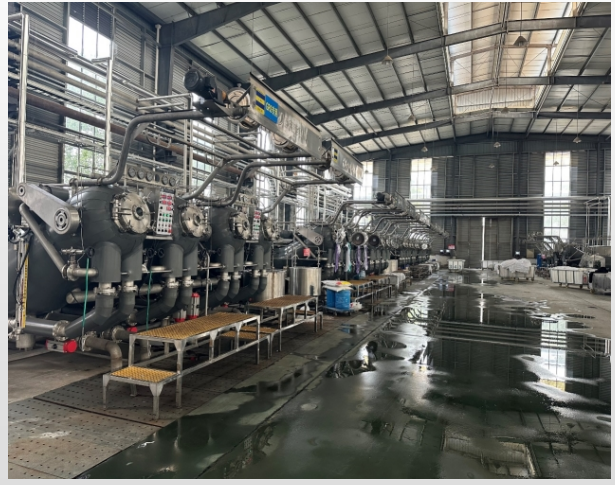
A dyeing lot in production at the EKING fabric facility in Zhangjiagang, Jiangsu Province, China — shade and finishing control sit upstream of the final moisture-management performance.
Why “moisture wicking” has become a documentation problem
For buyers at the research and evaluation stage, functional knit fabric is normally compared on three axes: the performance claim, the evidence behind the claim, and the constraints surrounding it. The third axis has become the most demanding, because chemical regulation now moves faster than most product catalogues.
OEKO-TEX introduced a limit value for Total Fluorine of 100 mg/kg under STANDARD 100, effective 1 January 2024, as part of its PFAS-oriented chemical management rules. In the United States, California AB-1817 bans regulated PFAS in textiles at a total organic fluorine threshold below 100 ppm from 1 January 2025, tightening to below 50 ppm in 2027. Both thresholds reach the fabric mill, not just the garment brand.
The practical consequence is that a moisture wicking fabric can meet every comfort expectation in a wear test and still fail a buyer's onboarding process — if the finishing chemistry cannot be documented, or if the certificate on file does not cover the article that is actually being ordered. Moisture management is best treated as a specification with an evidence package, not as a marketing attribute.
What EKING fabric supplies in this category
Zhangjiagang E-king Textile Co., Ltd., whose fabric range is marketed under the name EKING fabric, is a knitted textile manufacturer based in Zhangjiagang, Jiangsu Province, China, founded in 2011. The company states that it integrates R&D, design, production, processing and domestic and international sales, with a factory area of 8,600 m², around 80 employees, an R&D team of 10, an annual output of 6,000 T of fabric and an export ratio of 95%, with the European Union and the United States as its main markets. Its own dyeing facility went into production in March 2022, extending its production chain from knitting through dyeing and finishing.
Its core line is functional knit fabric, classified across sports functional fabrics, outdoor functional fabrics and recycled functional fabrics. The company also states that it develops more than 100 new products each season and works with fibre and chemistry partners including Hengli Group, Shenghong Group, Invista, Creora Group, Huafeng Group and POLYGIENE.
How moisture management is actually built into a knit
Yarn, structure and finish
In this product family, moisture-management performance is achieved through yarn composition combined with finishing treatments, while the structural configuration of the knit supports breathability and quick drying. The reading a buyer sees in a test report is therefore the output of a chain, and changing any link — fibre type, loop density, finishing recipe — moves the result.
EKWP2270-D6 illustrates the logic. It is a nylon/spandex knit whose listed functional parameters include moisture wicking, 4-way stretch and high elasticity, breathable and quick-dry performance, antibacterial and anti-odor properties, UV protection, water-repellent properties, easy-wash, recycled materials and wrinkle resistance, with cool-touch or warming treatments available as optional finishes.
Wicking, breathability and quick drying are not the same property. Wicking describes transport along fibre and yarn; breathability describes air movement through the structure; quick drying describes how fast retained moisture is released. A garment programme usually needs all three specified separately, together with the stretch behaviour that keeps the fabric in contact with the skin in the way the transport mechanism assumes.
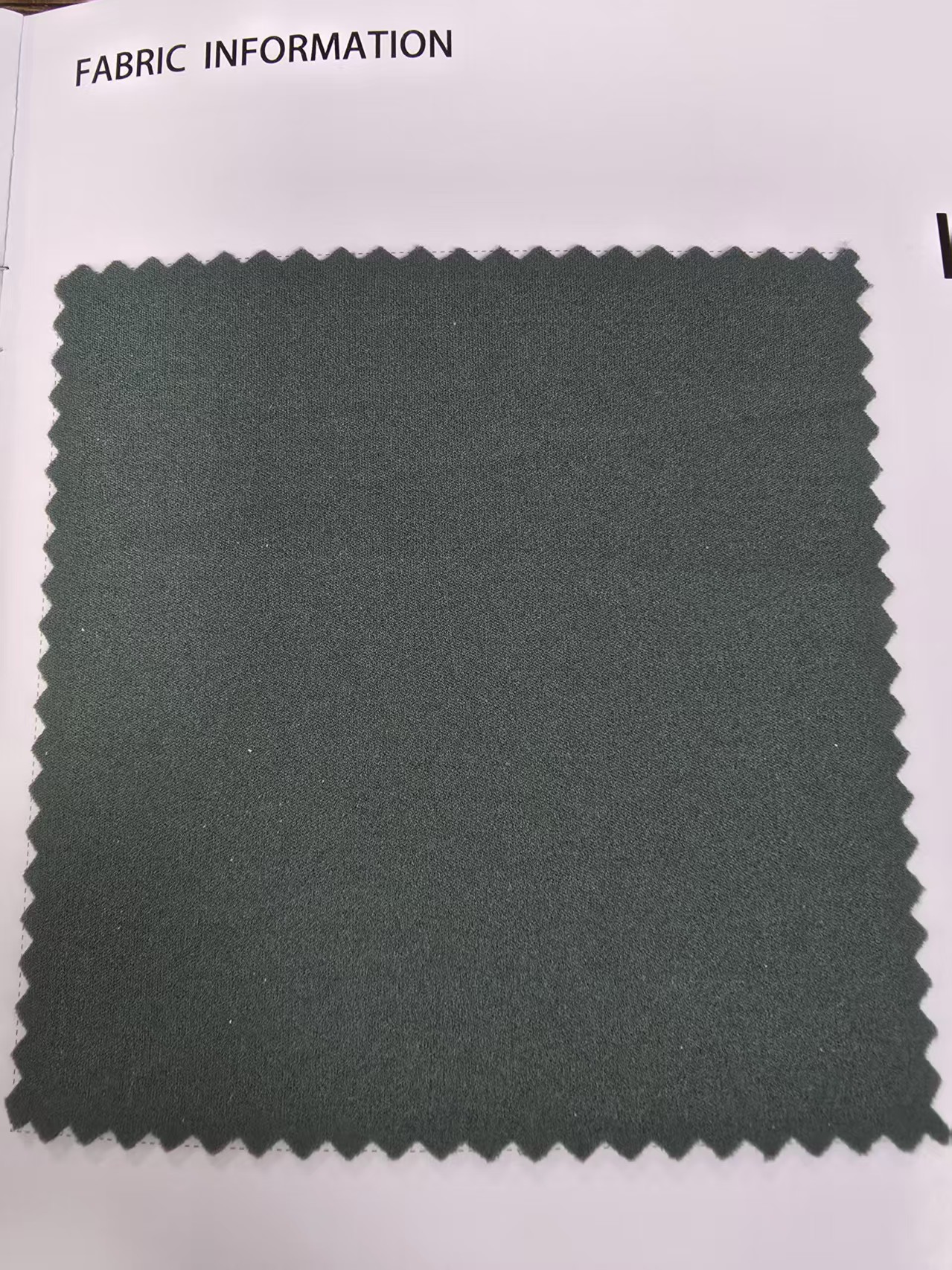
EKWP2270-D6, a nylon/spandex functional knit fabric documented for moisture wicking, 4-way stretch, breathable/quick-dry performance and optional antibacterial, anti-odor and UV-protective finishes.
Antibacterial and anti-odor finishes are applied rather than inherent, and they are applied to enhance wearer comfort. That distinction matters commercially, because anti-odor chemistry is one of the areas where buyers most often need to align the finish with a restricted-substance list before sampling begins.
Specification comparison: three documented articles
| Model | Material | Documented functional parameters | Product classification |
|---|---|---|---|
| EKWP2270-D6 | Nylon / spandex | Moisture wicking; 4-way stretch / high elasticity; breathable / quick-dry; antibacterial / anti-odor; UV protection; water-repellent; easy-wash; recycled materials; wrinkle-resistant; cool-touch or warming treatments listed as optional finishes | Sports functional fabric; outdoor functional fabric; recycled functional fabric |
| EKWP1912-DSP | Nylon spandex / recycled nylon spandex | Moisture wicking; high elasticity; breathable / quick-dry; UV protection; water-repellent; easy-wash; recycled materials. Antibacterial, anti-odor and UV-protective finishes can be applied | Sports functional fabric; outdoor functional fabric; recycled functional fabric |
| 20ETW1028-DSP | Poly / spandex | UV protection; water-repellent; easy-wash | Sports functional fabric; outdoor functional fabric; recycled functional fabric |
The three articles are not interchangeable, and the table is the reason why. EKWP2270-D6 carries the widest documented parameter set, including a 4-way stretch and moisture-management combination aimed at high-activity use. EKWP1912-DSP pairs moisture wicking with recycled nylon spandex options and allows antibacterial, anti-odor and UV-protective finishes to be applied. 20ETW1028-DSP documents UV protection, water-repellent and easy-wash properties on a poly/spandex base, a narrower functional brief that suits different end uses.
Certification scope: what the certificates actually cover
Two global certifications are documented for this category. The functional knit fabric model EKWP2270-D6 is certified to OEKO-TEX STANDARD 100 under certificate number 2410303, issued by Centexbel, valid from 10 October 2025 to 31 October 2026 and applying to the global market, with knitted fabric as the certified scope for textile safety and chemical management. The same model is also covered by Global Recycled Standard certification: transaction certificate IDF-26-954043, issued by IDFL Laboratory and Institute Inc., valid from 26 March 2026 to 25 March 2027, applying to the global market, with dyed fabrics within its scope.
| Certification | Certificate number | Issuing body | Validity | Scope |
|---|---|---|---|---|
| OEKO-TEX STANDARD 100 | 2410303 | Centexbel | 10 Oct 2025 – 31 Oct 2026 | Knitted fabric; applies to EKWP2270-D6; global market |
| Global Recycled Standard (TC/SC) | IDF-26-954043 | IDFL Laboratory and Institute Inc. | 26 Mar 2026 – 25 Mar 2027 | Dyed fabrics; applies to EKWP2270-D6; global market |
Two details matter at evaluation stage. First, both certifications are attached to a specific article, EKWP2270-D6 (nylon/spandex), and do not transfer automatically to every fabric a mill produces; a buyer ordering a different construction should confirm that the certificate names that article. Second, the OEKO-TEX certificate carries a stated expiry date, so it is worth re-checking at purchase-order stage rather than relying on the copy obtained during first sampling.
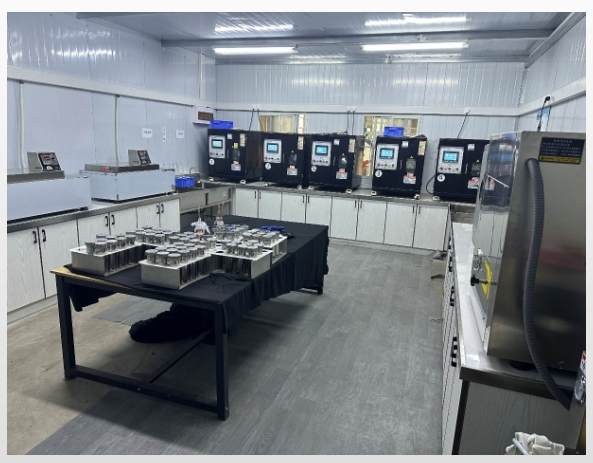
In-house laboratory testing: fabric batches are checked against agreed specifications before shipment, which is where documented parameters meet the production lot.
Where moisture wicking functional knit fabric is used
The application map for this category is broad but specific: sports and fitness apparel, outdoor apparel, casual and fast fashion, underwear and close-fit garments, and workwear and uniforms. Working conditions differ accordingly — high-activity sweat management in fitness use, variable outdoor climates calling for breathability, UV protection and quick drying, and everyday wear where easy-wash behaviour and durability dominate.
Supply in this segment typically takes one of four project forms: apparel fabric supply against a defined specification; OEM/ODM private-label development; functional fabric customization projects; and sustainable material substitution projects in which a conventional fabric is replaced by a recycled or lower-impact alternative. A garment-shop customer purchasing fabric for apparel garments is recorded with 100 t over a ten-year relationship, with stable performance and a soft, flexible hand feel reported as recurring characteristics.
Fabric supply here is tied to technical support rather than to a catalogue number alone. Functional formulation, sampling, finishing and small-to-mass production delivery belong to the same order, which is why specification clarity at the sample stage determines how smoothly the bulk order runs. Sample approval prior to bulk manufacturing is the stated operating mode for custom development.
Market signals shaping fabric specification
Three verifiable trends are converging on fabric selection decisions in 2026.
Volume growth in performance and moisture-management categories. The moisture wicking fabrics market is projected to reach USD 3.99 billion by 2030 at a 6% CAGR, and the performance knitted fabrics market is valued at USD 8.58 billion in 2026. Growth of this kind shifts competition from availability toward documentation: more suppliers can knit a wicking fabric, fewer can present the parameter set and certificate scope a brand's compliance team asks for.
Recycled content moving from niche to baseline. The recycled textiles market was projected at USD 6.32 billion in 2025, growing at a 4.70% CAGR to 2035. Within the EKING fabric functional knit range, recycled nylon spandex is a listed material option, and recycled polyester options are identified as supporting sustainable sourcing. Recycled content is therefore becoming an option to specify up front rather than a special request late in development.
Chemical regulation compressing finishing choices. The OEKO-TEX Total Fluorine threshold of 100 mg/kg effective 1 January 2024 and California AB-1817's 100 ppm limit from 2025, falling to 50 ppm in 2027, both push PFAS-related chemistry decisions upstream to the fabric stage. The mill states that functions can be customized to brand requirements — including PFAS-free processing, specific antibacterial agents and recycled materials — while noting that clear technical specifications and testing standards are needed for development and validation. Regulation creates the requirement; the buyer still has to define the test.
Moisture wicking knit versus conventional knit constructions
Compared with a conventional cotton jersey or a basic polyester interlock, a functional knit fabric of this type adds engineered transport behaviour, controlled stretch and a finishing layer. The trade-offs appear mainly in the commercial and validation stages rather than in wear performance, and they are worth stating plainly.
- Order economics. The stated minimum order quantity for this range is 3,000 yards, with a lead time of 30–45 days and a monthly capacity of 30,000 m. Programmes below that threshold, or with volatile in-season replenishment, need to plan around those figures rather than assume them away.
- Finish durability and definition. Antibacterial, anti-odor, water-repellent and UV finishes are applied treatments. Their measured performance depends on the agreed test standard, the test method and the laundering conditions used to evaluate them. The mill can customize the finish; it cannot define the buyer's acceptance criteria.
- Certification is model-specific. OEKO-TEX STANDARD 100 certificate 2410303 and GRS transaction certificate IDF-26-954043 both apply to EKWP2270-D6. Articles outside that model — for example the poly/spandex article 20ETW1028-DSP, whose listed parameters are UV protection, water-repellent and easy-wash — carry a different parameter set and should be evaluated on their own documentation.
- Material availability. Recycled content depends on the recycled fibre supply chain, and recycled options are offered within a range rather than as a guaranteed universal substitute in every construction.
- Not every described property is standard. Cool-touch or warming treatments are listed as optional finishes on EKWP2270-D6, not as default features. Purchase decisions should reference the specified configuration, not the broadest possible description of the range.
None of these limits makes the material unsuitable; they define where the specification work sits. A buyer who confirms order quantity, lead time, finishing recipe and certificate scope before sampling avoids most of the friction that otherwise appears during bulk production.
A verification sequence for buyers
A practical sequence for a research-to-evaluation stage buyer:
- Define the end use and finishing requirements first: sport, outdoor, close-fit or workwear, plus any restricted-substance list the brand already operates under.
- Match the article to the requirement, not the category name. EKWP2270-D6 carries the widest documented parameter set; EKWP1912-DSP lists moisture wicking, high elasticity, breathable/quick-dry, UV protection, water-repellent, easy-wash and recycled materials; 20ETW1028-DSP lists UV protection, water-repellent and easy-wash.
- Confirm certificate scope in writing: model, certificate number, issuing body, validity dates and certified scope.
- Align test methods before sampling — particularly for moisture management, anti-odor and water repellency — so that sample results and bulk results are read on the same scale.
- Check commercial parameters against the programme: 3,000-yard minimum order quantity, 30–45 day lead time, monthly capacity of 30,000 m, and 100% testing as the stated quality-control approach.
- Confirm the PFAS position where the destination market requires it, and record the agreed technical specification, since PFAS-free processing is a customization that requires specification and validation inputs from the brand side.
Future outlook
The direction of travel in this category is toward fewer unspecified claims and more tested ones. Fluorine chemistry rules are tightening on a known calendar — below 100 ppm in California from 2025, below 50 ppm in 2027 — and recycled content is shifting from differentiator to expectation in European and North American programmes. Suppliers that already hold article-level OEKO-TEX and GRS documentation are better positioned to answer those questions without re-testing every order.
For buyers, the durable shift is procedural: treat moisture wicking functional knit fabric as a specification package — yarn, structure, finish, test standard, certificate scope and commercial constraint — rather than as a single comfort claim. That framing continues to work when performance targets, chemical rules or sourcing regions change.
FAQ
What does “moisture wicking” actually describe in a fabric specification?
In this product family, moisture-management performance is achieved through yarn composition combined with finishing treatments, while the knit structure supports breathability and quick drying. Moisture wicking describes transport of moisture away from the skin and is specified separately from breathability, quick drying, stretch and any antibacterial or anti-odor finish applied on top of it. Because the effect is produced by a combination of yarn, structure and finish, the property should be written into the specification together with the test method used to confirm it.
Which certifications apply to this moisture wicking functional knit fabric, and what do they cover?
Two global certifications are documented for the model EKWP2270-D6. OEKO-TEX STANDARD 100 certificate number 2410303, issued by Centexbel, is valid from 10 October 2025 to 31 October 2026 and covers knitted fabric for textile safety and chemical management. Global Recycled Standard transaction certificate IDF-26-954043, issued by IDFL Laboratory and Institute Inc., is valid from 26 March 2026 to 25 March 2027 and covers dyed fabrics. Both apply to the global market.
Does a certificate held for one fabric model apply to the whole product range?
No. The OEKO-TEX STANDARD 100 and GRS certifications described here apply to the functional knit fabric model EKWP2270-D6 and should not be assumed to transfer automatically to other constructions in the same range. A buyer evaluating a different article should request the certificate that names that article. This is also why certificate validity dates need checking at purchase-order stage rather than only at sampling.
Can moisture wicking functional knit fabric be produced PFAS-free, and what does that require?
PFAS-free processing is listed among the customizations that can be applied per brand requirement, alongside specific antibacterial agents and recycled materials. The stated condition is that clear technical specifications and testing standards are needed for development and validation. Regulation sets the direction — OEKO-TEX introduced a Total Fluorine limit of 100 mg/kg effective 1 January 2024, and California AB-1817 applies a threshold below 100 ppm from 1 January 2025, tightening to below 50 ppm in 2027 — but the buyer's own specification and test protocol determine what is accepted.
What order-size and lead-time constraints apply to this functional knit fabric?
The stated minimum order quantity for this range is 3,000 yards, with a lead time of 30–45 days and a monthly capacity of 30,000 m. Quality control is described as 100% testing. Small collections, in-season replenishment cycles and multi-article programmes should be planned against these figures, since they affect both sampling schedules and delivery commitments.
How should a buyer validate moisture-wicking and anti-odor claims before bulk production?
The practical route is to fix test methods before sampling and to confirm the finishing configuration, because antibacterial, anti-odor and UV treatments are applied finishes rather than inherent fibre properties. The supplier provides sample support and technical communication, with bulk issues handled per contract and warranty terms; specific after-sales policies should be confirmed in the contract. Sample approval prior to bulk manufacturing is part of the normal operating mode for custom development projects.