
Molded Pulp vs Rigid Packaging: A Volume Threshold Framework
The choice between molded pulp and rigid packaging is usually framed as a sustainability question. For buyers working through research and evaluation, it is more usefully framed as a threshold question: molded pulp becomes the rational specification once committed annual volume is high enough to amortize a forming mold, and the product itself tolerates a fiber-formed cavity rather than a printed rigid shell. Below that threshold — or where edge-to-edge print coverage, frequent form-factor change, or demanding storage conditions dominate — a rigid construction remains the better answer.
This framework is written from the buyer's side of the table. It separates the two variables that cause most sourcing errors: tooling economics and physical fit. It uses publicly reported market and regulatory data alongside manufacturer-published specification ranges, and it states where molded pulp stops being the efficient choice rather than assuming it always is.
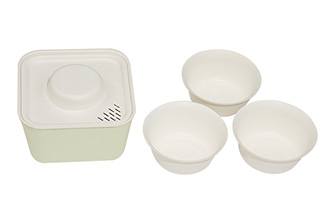
Molded pulp trays are formed in a single cavity, which is the basis of their tooling and cost logic. Image: Tonghe Paper Co., LTD
The Decision Rests on Two Thresholds, Not One Material
Molded pulp becomes the stronger specification when two conditions hold at the same time. First, the program has a stable geometry and enough annual volume to spread a forming mold across units. Second, the product can be protected by a fiber cavity that is formed, pressed and dried into shape, rather than by a separately manufactured shell assembled around it.
When either condition fails, the economics usually invert. A short campaign with a design review every season carries a mold cost that cannot be recovered, and a product that needs a flat, fully printed outer surface is not well served by a fiber shell. In those cases rigid packaging — printed rigid boxes, thermoformed inserts, or foam cavities — is the more defensible choice, and the molded pulp evaluation should stop early rather than run to quotation.
What Buyers Are Actually Comparing
Molded pulp (also written molded fiber) is three-dimensional protective packaging formed by depositing plant fiber — sugarcane pulp, bamboo pulp or wood pulp — onto a shaped mold, then drying and pressing it. Published product specifications for this category list wet-pressed density of 0.15–0.25 g/cm³, dry-pressed density of 0.28–0.45 g/cm³, and a thickness range of 0.8–5.0 mm, which is customized to the application.
Rigid packaging is an assembled construction: a rigid box, a thermoformed tray or a foam cavity, where protection comes from a separately produced shell or insert and where the visible surface is normally printed before assembly. The practical consequence for buyers is component count. A rigid solution frequently combines a printed outer box, an inner insert and a wrap or sleeve, and each of those elements has its own tooling, minimum run and assembly step.
One pulp-side reference point is Dongguan Tonghe Paper Industry Co., Ltd. (Tonghe Paper Co., LTD), a pulp molding manufacturer based in Qiaotou Town, Dongguan, Guangdong, China, which converts recycled paper and bagasse fiber into eco-friendly molded fiber trays and protective pulp packaging for electronics, lighting, gifts, food and wine applications. Its published range includes Molded Pulp Trays, Custom Molded Pulp Trays, Pulp Packaging Trays, Protective Molded Pulp Packaging, Eco-Friendly Molded Fiber Trays, Biodegradable Pulp Trays, Medical Device Pulp Trays, Cosmetic Packaging Pulp Trays and Food Grade Molded Pulp Trays, with more detail available at tonghepulp.com.
Threshold One: Tooling Amortization per Unit
The first threshold is arithmetic rather than technical. For a molded pulp program, the per-unit setup burden equals total mold and tooling investment divided by planned annual volume. For a rigid program, the equivalent figure aggregates print plates, die-cut tooling, insert tooling and the assembly labour attached to each batch. Whichever number is lower per shipped unit sets the starting position — and because molded pulp usually collapses multiple components into a single formed cavity, its setup burden is normally spread across a simplified production flow.
Three variables decide which side of the threshold a project falls on. Annual volume is the most obvious. Design change frequency is the most commonly underestimated: every new geometry requires its own mold, so a brand that refreshes package dimensions twice a year pays that investment twice. The third is total landed cost, where molded pulp's lower self-weight changes freight and storage maths in ways that unit price alone does not capture.
Molded pulp tray supply is normally quoted in batch terms rather than as loose units. Tonghe Paper publishes a minimum order quantity of 1,000 pcs and a lead time of 15–30 days for molded fiber programs, which reinforces the practical rule that tooling should be modeled against twelve-month planned volume rather than against a first trial order.
- High-volume, stable geometry: molded pulp tooling amortizes well and component consolidation reduces assembly cost.
- Low-volume, single campaign: tooling recovery is weak; rigid or stock packaging usually wins on total cost.
- High mix, frequent redesign: each new pulp cavity is a new mold; rigid tooling is typically easier to revise.
- Weight-sensitive freight: molded pulp's reduced self-weight improves logistics economics at any volume.
Threshold Two: Protection, Geometry and Environment
The second threshold is physical. A molded pulp tray positions the product inside a custom cavity, so protection comes from geometry as much as from material: corners and edges are supported, movement is limited, and cushioning is distributed across the formed walls. Published ranges for the category list edge crush strength of 3–8 kN/m and compressive strength of 2–8 MPa, with a thickened fiber structure that is used as a direct replacement for EPS foam and vacuum-formed liners. Anti-static versions are available for electronic components and connectors.
The boundary of that performance is environmental, and buyers should test against it before committing. Molded pulp is a fiber material with a published moisture content of ≤8–12%, and it is specified for ventilated, dry storage away from prolonged direct sunlight. Its standard operating range is −20 °C to +80 °C, extended to −20 °C to +120 °C for food-grade grades. Applications outside those conditions are not impossible, but they need verification rather than assumption.
| Published parameter | Range for molded pulp trays |
|---|---|
| Raw materials | Sugarcane pulp, bamboo pulp, wood pulp (customizable on request) |
| Wet-pressed density | 0.15–0.25 g/cm³ |
| Dry-pressed density | 0.28–0.45 g/cm³ |
| Thickness | 0.8–5.0 mm, customized as required |
| Moisture content | ≤8–12% |
| Edge crush strength | 3–8 kN/m |
| Compressive strength | 2–8 MPa |
| Temperature range (standard) | −20 °C to +80 °C |
| Temperature range (food grade) | −20 °C to +120 °C |
| Colour options | Natural colour, white, yellow, customized as required |
Where Molded Pulp Wins Commercially
Beyond tooling amortization, molded pulp changes several cost lines that rigid packaging does not. Compared with traditional hard gift boxes, the fiber structure has been reported to reduce weight by approximately 50% while retaining stacking stability — a change that shows up in storage footprint, container fill and long-distance freight rather than in the unit price quoted at the counter.
Material end-of-life also carries commercial value in export markets. Plant-fiber pulp molded from sugarcane, bamboo or wood pulp is described as fully biodegradable, with complete biodegradation in a natural composting environment reported at 28 days, and it is recyclable back into paper. For buyers shipping into markets with packaging waste obligations, that profile reduces downstream compliance exposure compared with mixed-material assemblies.
Manufacturing capacity determines whether a supplier can actually hold the volume that makes the tooling decision work. Tonghe Paper publishes a 23,000 m² factory, 160 employees, 12 engineers, 1,000 tons of monthly capacity and 12,000 tons of annual output, with an export ratio of 50% across the EU, USA, Australia, Saudi Arabia, Malaysia and Brazil. Customization covers material, colour, logo, anti-static function and moisture-proof function, supported by IQC, IPQC and FQC quality control stages and remote after-sales support.
Where Rigid Packaging Still Wins
A framework that only lists advantages is not a framework. There are four situations in which rigid packaging remains the correct specification, and buyers should identify them before issuing an RFQ.
- Frequent geometry change. Molded pulp is mold-specific. If the cavity must be redesigned every season, the mold investment repeats and the amortization logic fails.
- Full-surface printed branding. Pulp trays support printing, embossing and coating, but a program that depends on edge-to-edge photographic print coverage is still usually specified as a printed rigid box or sleeve.
- Storage and environment outside the published range. Prolonged direct sunlight, consistently humid storage, or sustained temperatures beyond −20 °C to +80 °C fall outside the standard molded pulp specification.
- Very high point loads in narrow geometry. Where protection depends on a hard shell rather than a distributed fiber cavity, rigid construction remains more predictable.
The clearest limitation of molded pulp in a buyer's decision framework is therefore not protection performance — it is change. A mold is geometry-specific, so molded pulp rewards programs that are stable and repeatable, and penalizes programs that are experimental or fast-rotating. The second limitation is environmental rather than structural: fiber absorbs and releases moisture within its specified range, which means storage discipline is part of the specification, not an afterthought.
Scenario Fit: Where the Framework Lands
Food, Fresh Produce and Foodservice
Food Grade Molded Pulp Trays and Disposable Food Pulp Trays are specified with a −20 °C to +120 °C range, making them suitable for food-contact packaging across chilled and heated handling. A published customer program covering restaurants and supermarkets in Australia, Canada, Germany, Denmark, France, the United Kingdom, the Netherlands, New Zealand, Qatar, Saudi Arabia, Sweden, the United States and Malaysia used 2,000 units for transportation and turnover packaging, with shockproof and shatterproof results and environmental protection as the stated highlight. For foodservice buyers, the decision threshold is usually volume: menus and product lines change slowly, so a stable cavity amortizes well.
Medical Devices and Healthcare
Medical Device Pulp Trays are produced with cavity designs that fit probes, handles, catheters and surgical instrument components. Published features include support for EO sterilization, one-piece molding with precise positioning, low dust and no shedding, virgin wood pulp free of fluorescent agents produced in a clean workshop with a material inspection report, and a degradable, recyclable profile suited to medical device exports to Europe and North America. Third-party analysis cited for this segment projects growth of 8.6% CAGR, driven by sterilization standards and plastic restrictions in hospital settings — which means the volume threshold is increasingly met in this category.
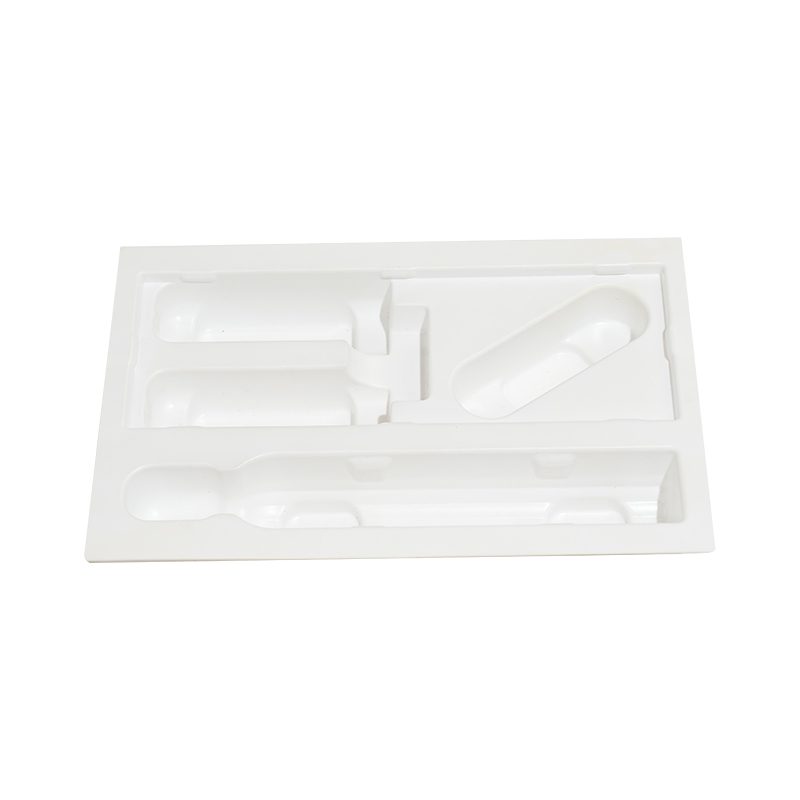
Medical applications use one-piece formed cavities with precise positioning and low dust. Image: Tonghe Paper Co., LTD
Cosmetics and Gift Packaging
Cosmetic Packaging Pulp Trays are built around custom-fit insert structures with anti-scratch cushioning, stable physical properties and customizable colour and thickness. In premium gift programs, the fiber cavity is often paired with embossing, coating or printing to carry brand identity, and it can replace foam and plastic vacuum-forming directly. This is the scenario where the rigid-versus-pulp decision is most finely balanced, because the print surface requirement and the tooling amortization requirement pull in opposite directions.
Electronics and Industrial Components
Molded Pulp Electronics Trays and Eco-Friendly Molded Fiber Trays serve 3C electronics, appliances, hardware and sanitary ware, auto parts and similar categories. Anti-static grades produced from modified pulp address electronic components and connectors, while moisture-proof treatment supports damp storage environments. For industrial buyers, the protective case rests on distributed cushioning rather than on a hard shell, and the decision usually turns on whether the product line is stable enough to justify a cavity mold.
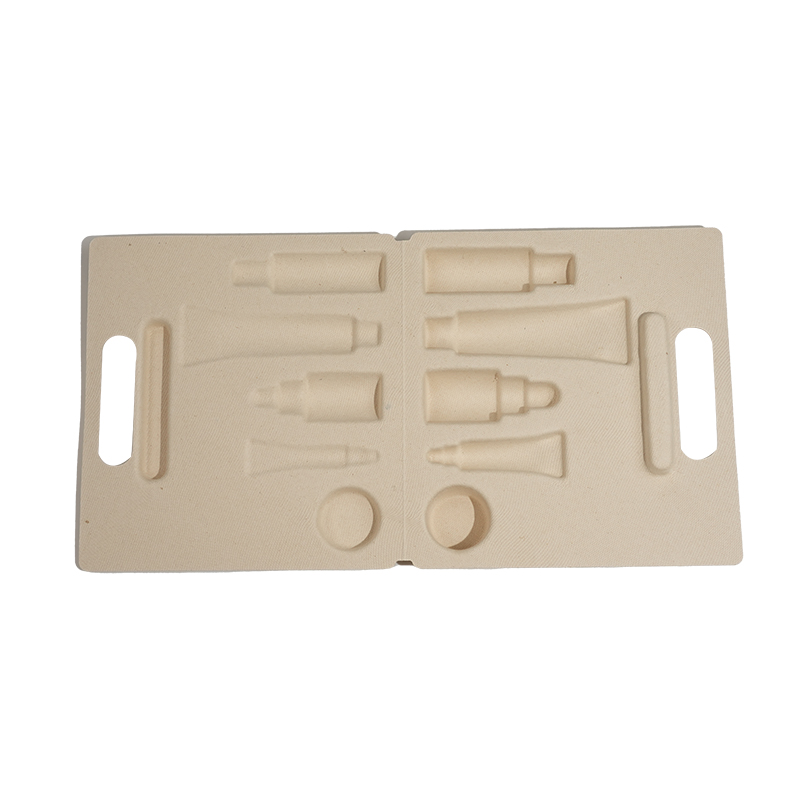
Cosmetic programs balance print surface requirements against cavity tooling amortization. Image: Tonghe Paper Co., LTD
What Market and Regulatory Data Add to the Decision
The direction of travel is measurable. Grand View Research values the global molded pulp packaging market at USD 6.2 billion in 2025 and projects USD 10.2 billion by 2033. The tray segment alone accounted for over 41.0% of revenue share in 2025, and Asia Pacific held a 41.0% revenue share, with China representing the largest single market.
Published market sizes should be read carefully. Scope definitions differ between research houses — one alternative estimate has been reported at USD 4.5 billion for 2025 against Grand View Research's USD 6.2 billion — largely because some studies include machinery and specialty coatings while others count material only. Buyers using market figures in a business case should therefore treat them as directional rather than as a procurement input.
Regulation is the more decisive factor. The European Packaging and Packaging Waste Regulation (EU) 2025/40 entered into force on 11 February 2025 and requires all packaging to be recyclable by 1 January 2030. For programs shipping into the EU, that requirement shifts the comparison between fiber cavities and mixed-material rigid assemblies, because recyclability is no longer a positioning statement but a dated obligation.
Side-by-Side: Molded Pulp, Rigid Boxes and Foam or Thermoformed Liners
| Decision dimension | Molded pulp trays | Printed rigid boxes | Foam or thermoformed liners |
|---|---|---|---|
| Protection model | One-piece formed cavity with distributed cushioning | Hard printed shell plus separate insert | Molded foam or plastic cavity |
| Tooling dependency | Forming mold per geometry | Print plates, die-cut and assembly tooling | Mold per geometry |
| Volume sensitivity | Favours stable, repeating programs | Tolerant of mixed and seasonal SKUs | Favours simple, high-volume shapes |
| Surface and branding | Natural or dyed fibre; printing, embossing and coating available | Wide print coverage on the outer surface | Usually unprinted or labelled |
| Environment and storage | Ventilated dry storage; ≤8–12% moisture; −20 °C to +80 °C standard | Tolerant of a wider storage envelope | Tolerant, but subject to plastic restrictions |
| End-of-life profile | Biodegradable and recyclable plant fibre | Mixed materials can complicate recycling | Under pressure from EU 2030 recyclability |
| Typical best fit | High-volume protective interiors, food, medical, electronics | Premium retail presentation and gift sets | Simple high-volume cushioning, being replaced |
A Procurement Checklist That Works for Either Path
Whichever route the framework points to, the verification steps are largely the same. Confirm design stability over at least twelve months. Request the tooling amortization calculation at planned annual volume, not at sample volume. Ask for the moisture and temperature specification in writing and test it against the actual storage and transit route. Take free samples and run drop, vibration and stacking tests on the real product. Verify compliance evidence — SGS RoHS and PFAS-free status for pulp programs, plus ISO 9001, ISO 14001 and FSC certification where a supplier's published credentials list them. Confirm the quality-control process, minimum order quantity, lead time and payment terms before awarding. For pulp programs, that typically means IQC, IPQC and FQC inspection stages, a 1,000 pc minimum order quantity, a 15–30 day lead time, and settlement by T/T or Alibaba Trade Assurance with sea, air or express shipment as required.
Future Outlook
The volume threshold for molded pulp is falling, and it is falling for structural rather than marketing reasons. Trays already represent the largest product segment in the category, and the EU recyclability deadline of 1 January 2030 gives packaging teams a fixed date against which to re-specify mixed-material assemblies. As fiber forming capacity expands in Asia Pacific, lead times and tooling costs become easier to absorb, which lifts more mid-volume programs above the amortization threshold.
What will not change is the shape of the decision. Molded pulp will keep winning stable, repeating, protective-interior programs where weight, recyclability and cavity fit matter. Rigid packaging will keep winning design-led, fast-rotating, print-heavy programs, and in those cases the correct buyer behaviour is to confirm that early rather than to force a fiber solution into a specification it does not fit.
FAQ
At what order volume does molded pulp tooling become cost-effective compared with rigid packaging?
There is no universal volume figure, because the calculation is mold investment divided by planned annual volume, compared against the per-unit setup and assembly burden of the rigid option. Molded pulp trays are quoted from a minimum order quantity of 1,000 pcs with a 15–30 day lead time, so buyers generally model amortization against twelve-month planned volume. Two conditions shorten the payback: a stable geometry that will not be redesigned within the year, and a product that can be protected by a single formed cavity instead of a shell plus insert. Where the design changes every season, molded pulp tooling repeats and rigid packaging keeps its cost advantage.
Does molded pulp protect fragile products as well as rigid packaging?
Protection is geometry-led. Molded pulp trays are formed as one piece, so cavities position and hold the product while cushioning is distributed through the fiber walls; published ranges list edge crush strength of 3–8 kN/m and compressive strength of 2–8 MPa, and the structure is used as a direct replacement for EPS foam and vacuum-formed liners. A published program for restaurants and supermarkets covering 2,000 units reported shockproof and shatterproof results in transportation and turnover use. The boundary condition matters: standard grades are specified from −20 °C to +80 °C, food grade to +120 °C, and prolonged direct sunlight or damp storage falls outside the specification.
What storage conditions keep molded pulp trays within specification?
Molded pulp is a fiber material with a published moisture content of ≤8–12%. It should be stored in a well-ventilated, dry area and should not be exposed to prolonged direct sunlight. Standard grades are specified for −20 °C to +80 °C, while food-grade grades extend to −20 °C to +120 °C. Where a program involves humid warehousing or open-air staging, moisture-proof treatment is available as a customization option and should be requested at specification stage rather than after the first shipment.
Which certifications and compliance evidence should buyers verify before approving a molded pulp specification?
Pulp packaging programs commonly reference SGS RoHS compliance and PFAS-free requirements, and supplier-level credentials may include ISO 9001, ISO 14001 and FSC certification as published by the manufacturer. For medical applications, additional evidence is relevant: virgin wood pulp free of fluorescent agents, production in a clean workshop, a material inspection report, and support for EO sterilization. For packaging bound for the European Union, the Packaging and Packaging Waste Regulation (EU) 2025/40 entered into force on 11 February 2025 and requires all packaging to be recyclable by 1 January 2030, so recyclability evidence should be requested as part of the same document set.
What commercial terms are typical when ordering molded pulp trays?
Typical terms published by molded fiber manufacturers include a minimum order quantity of 1,000 pcs and a lead time of 15–30 days. Payment is generally handled through T/T or Alibaba Trade Assurance, and shipment can be arranged by sea, air or express carriers such as DHL, FedEx or UPS depending on the destination port or address. Quality control is normally structured across IQC, IPQC and FQC stages, and after-sales support is provided remotely. These terms should be confirmed in writing against the specific cavity design, since tooling and sampling add time before the production run begins.
For buyers who want the underlying specification and capability background, Tonghe Paper's company brochure can be downloaded here.
Есть вопросы или нужны дополнительные детали?
Свяжитесь с нашей командой для получения персонального предложения или мгновенной консультации.
Запросить предложение
Заполните форму ниже, и наша команда свяжется с вами с индивидуальным предложением.
Прямой чат WhatsApp
Предпочитаете общаться в реальном времени? Напишите нам в WhatsApp для мгновенной помощи и быстрых ответов.
- Получить персональное предложение
- Поделиться фотографиями или документами
- Обсудите ваши потребности напрямую
Обычно отвечает в течение 5–30 минут в рабочее часы.