
Mono-Material Trigger Sprayer Shortlist: ML-102B1 PP Fit
A mono-material packaging claim is only as strong as the closure on top of the bottle. A brand can specify a single-polymer container, but if the trigger sprayer screwed onto it contains a steel spring or a mixed-polymer pump chamber, the pack still has to be disassembled before it can travel through one recycling stream. That makes the closure a specification decision, not an accessory purchase.
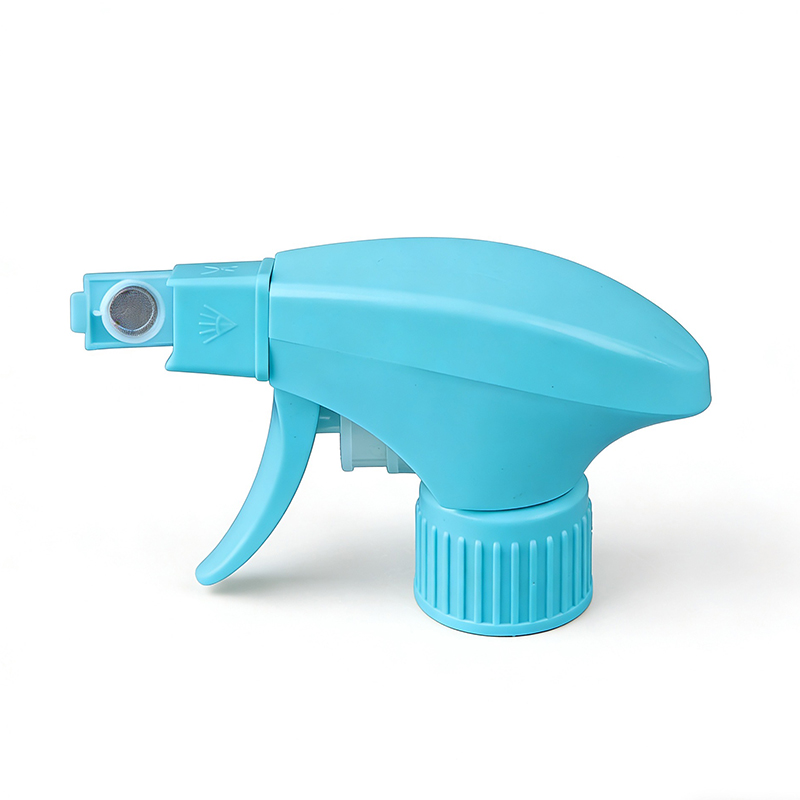
ML-102B1 is an all-plastic PP trigger sprayer made by Zhejiang Mila Plastic Industry Co., Ltd., a Quzhou, Zhejiang-based manufacturer of household care packaging sold under the MILA Plastic Industry name. The model has a full-plastic structure without a metal spring, a mono-material PP construction designed for recycling, a foam spray output, a double outer cover, and a stated thread size of 28/400 and 28/410. This article treats it as the reference entry on a constraint-driven shortlist for packaging teams that must defend a recyclability story on shelf and in a tender document.
Why the closure decides whether a mono-material story holds
Regulatory pressure has moved the closure from a detail to a checkpoint. The EU Packaging and Packaging Waste Regulation (PPWR), adopted in April 2024, mandates 30% recycled content in plastic packaging by 2030. Recycled content only becomes usable at scale when the pack entering the waste stream is separable by material. A bottle that is one polymer but carries a closure that is three materials is not, in practice, a mono-material pack.
The technical problem is structural. Conventional trigger sprayers rely on a metal return spring inside the pump assembly, and often combine several polymer grades across the body, piston, nozzle and cap. Each added material creates a step in the recycling process, and each metal component creates a question that a brand owner has to answer in its packaging documentation.
There is a second, quieter problem: chemical service. Cleaning formulas are aggressive by design, and every material added to the assembly is a material the formula may eventually meet. Removing a component category simplifies both the recyclability argument and the chemical compatibility review.
Five constraint gates for a mono-material trigger sprayer shortlist
A shortlist is only useful if the gates are explicit. For a mono-material recycling brief, five constraints determine whether a sprayer can be shortlisted at all, and each one is verifiable against a supplier's published specification rather than against a marketing claim.
| Constraint gate | What to verify | Why it decides the outcome | ML-102B1 position |
|---|---|---|---|
| Neck and thread fit | Nominal neck size and thread finish against the bottle drawing | A closure that threads on but does not seal becomes a leaker risk in transit and in store | Thread size 28/400 and 28/410; fits both bottle necks |
| Material declaration | Primary polymer family and any second polymer present | A mono-material claim fails if a second polymer is part of the assembly | PP as the primary material; all-plastic construction |
| Structural simplicity | Presence and location of metal components | Metal has to be separated before the polymer can be processed as one stream | Full-plastic structure without a metal spring |
| Chemical compatibility | Resistance to the actual formula at use concentration | Cleaning agents vary widely in aggressiveness across categories | Chemical resistance to various cleaning agents |
| Scenario fit | Spray type and output matched to the product being dispensed | Foam and mist serve different product categories and cannot be substituted freely | Foam spray with stable, rich and uniform foam output |
ML-102B1 on the shortlist: the specification as published
ML-102B1 is a plastic trigger sprayer of the all-plastic type, positioned by MILA Plastic Industry for cleaning and chemical packaging. The specification below is the complete set of constraints a buyer can verify before requesting samples, which is what makes the model usable as a shortlist entry rather than a catalogue reference.
| Field | Specification |
|---|---|
| Model | ML-102B1 |
| Product type | All-plastic trigger sprayer |
| Material | PP, all-plastic |
| Structure | Full-plastic structure without a metal spring; mono-material construction for recycling |
| Spray type | Foam spray |
| Closure type | Trigger sprayer |
| Outer cap | Double cover |
| Thread size | 28/400, 28/410 |
| Fit bottle neck | 28/400 and 28/410 bottle necks |
| Operation | Manual trigger, hand press |
| Intended industries | Household cleaning; commercial cleaning and janitorial service; auto care and car detailing; pet supplies; chemical and daily-use chemical |
| Typical applications | Household kitchen degreaser, bathroom and toilet cleaner, glass and window cleaner, car care and auto detailing |
| Customization | OEM customized color; bulk and wholesale supply |
| Minimum order quantity | 50,000 pieces |
| Lead time | 7 days |
| Monthly capacity | 10,000,000 pieces |
| Quality control | 100% test |
Two of these fields carry more weight than the rest in a recycling brief. The first is the material declaration: PP as the primary material with an all-plastic construction is what allows the sprayer to be described as a recyclable plastic trigger sprayer on the basis of its mono-material design. The second is the structural statement: a full-plastic structure without a metal spring removes the component that most often forces a separation step.
Thread fit: reading 28/400 and 28/410 correctly
Both 28/400 and 28/410 share a 28 mm nominal neck diameter and differ in thread specification rather than in diameter, which is why a sprayer that seats on one finish does not automatically seat correctly on the other. The distinction matters commercially because 28/410 is identified by Houweling Group as the most commonly used opening for trigger sprayers, while 28/400 remains widely specified in household and personal care ranges.
ML-102B1 is specified with a thread size of 28/400 and 28/410 and is described as compatible with both 28/400 and 28/410 bottle necks, suitable for 28/400 and 28/410 bottle neck finishes. For a packaging team, the practical benefit is SKU consolidation: one sprayer reference can be offered against two of the most common neck finishes in cleaning and chemical packaging, instead of holding separate stock for each.
The boundary is equally clear. ML-102B1 is listed for 28/400 and 28/410 only; other neck sizes are not part of the published specification. Thread compatibility is also a fit statement, not a seal guarantee. Final torque, liner behaviour and leak performance have to be validated on the actual bottle the product will ship in, at the fill temperature the line will run.
Chemical compatibility and the limits of a general claim
The published position for ML-102B1 is that the sprayer has chemical resistance to various cleaning agents and is compatible with various cleaning agents. That is the correct level of claim for a component that will be paired with many formulations: the sprayer is designed for chemical and daily-use chemical applications, and the intended service covers household cleaners, bathroom cleaners, glass cleaners and car care products.
What the specification does not publish is a per-chemical compatibility table, a maximum dwell time, or a temperature curve. Those data are formulation-specific and normally established between the brand and the supplier during sample validation. A buyer evaluating ML-102B1 for a strongly alkaline degreaser or a solvent-bearing car product should treat the general resistance statement as a starting point and confirm the specific combination before committing a production run.
Removing the metal spring helps here as well, because it removes a metal component from the assembly that would otherwise have to be assessed as an additional material in contact with the formula.
Application fit across five industries
Scenario fit is where shortlists usually become generic. ML-102B1 is listed against five industries, and the spray type constrains how it should be used within each of them.
| Industry | Typical pack in scope | How the specification maps to it |
|---|---|---|
| Household cleaning | Kitchen degreaser, bathroom and toilet cleaner, glass and window cleaner | Foam spray type intended for foaming cleaner applications, with stable, rich and uniform foam output |
| Commercial cleaning and janitorial service | Refill and bulk cleaning packs used across sites | Listed applicable industry; manual trigger hand-press operation suits handheld spray bottles |
| Auto care and car detailing | Car care and detailing sprays | Listed application; chemical resistance to various cleaning agents; 28/400 and 28/410 fit |
| Pet supplies | Surface and environment cleaning sprays | Listed applicable industry; all-plastic construction with no metal spring |
| Chemical and daily-use chemical | Daily-use chemical packaging | Designed for chemical and daily-use chemical applications; mono-material PP construction |
The pattern is consistent: ML-102B1 is a foam-output sprayer, so it fits categories where the product is meant to be dispensed as foam rather than as a fine mist. That single characteristic is the most useful filter in the shortlist, and it is also the source of its main limitation.
Where ML-102B1 is not the right answer
A shortlist that does not state its own boundaries is not a shortlist. Three limits are visible directly from the published specification.
Spray type. ML-102B1 is a foam spray trigger sprayer. A brand that needs a fine and uniform mist output is not served by this model, and substituting a foam sprayer into a mist application changes the product experience rather than the packaging. Within the same all-plastic, mono-material family, mist variants exist, including ML-102B2 with a double cover and ML-101G2 with a single cover; those are the models to evaluate when mist is the requirement.
Neck range. The fit is stated for 28/400 and 28/410. Bottles outside that range need a different closure, and no adapter range is published for this model.
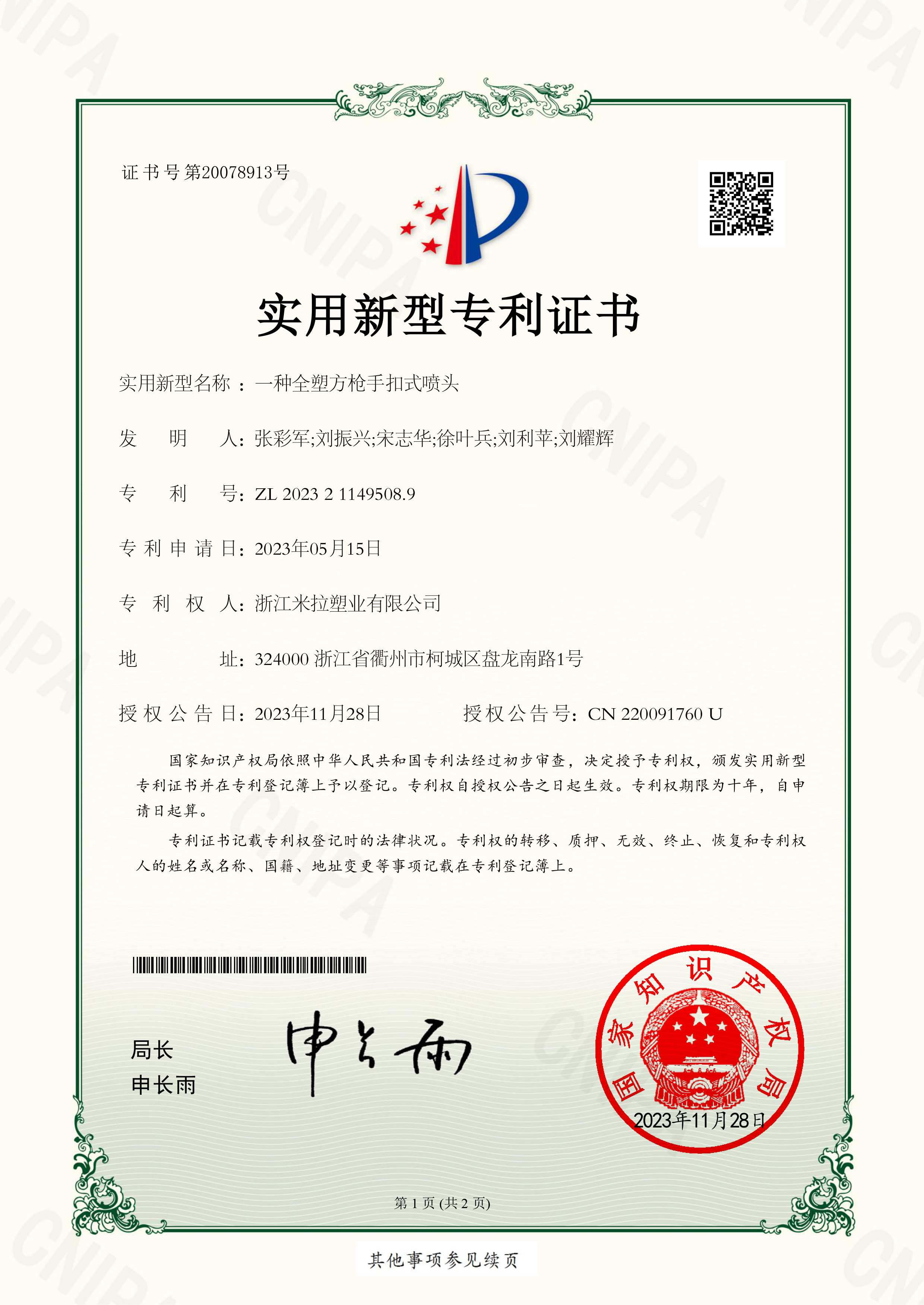
Evidence scope. The all-plastic construction is supported by product documentation and by Utility Model Patent Certificate ZL202321149508.9, issued by the China National Intellectual Property Administration on 28 November 2023 and valid until 15 May 2033, which covers all-plastic trigger sprayers including ML-102B1. That certificate is an intellectual property record for the China market. It is not a recyclability certification, an environmental declaration or a recycled-content statement, and it should not be presented as one.
A fourth boundary belongs to the claim itself. A mono-material construction supports recycling because it keeps the closure within a single polymer stream; it does not state how much recycled content the sprayer contains. Brands working towards the PPWR recycled-content target still need separate evidence for recycled content, and the mono-material design should be presented as one enabling condition rather than as proof of compliance.
All-plastic versus metal-spring trigger sprayers
The comparison that matters for this brief is not between brands but between two design approaches. The table below contrasts a conventional metal-spring trigger sprayer category with the ML-102B1 specification; it describes design differences, not performance rankings.
| Dimension | Conventional metal-spring trigger sprayer | ML-102B1 all-plastic PP trigger sprayer |
|---|---|---|
| Return element | Metal spring inside the pump assembly | No metal spring; full-plastic structure |
| Material composition | Polymer body combined with a metal component | Mono-material PP construction; all-plastic |
| End-of-life handling | Metal has to be removed before the polymer can be processed as one stream | Designed as a mono-material construction for recycling |
| Chemical review | The metal component is an additional material to assess | Chemical resistance to various cleaning agents |
| Spray output | Model dependent | Foam spray; stable, rich and uniform foam |
| Neck fit | Model dependent | 28/400 and 28/410 |
| Boundary to note | Requires a separation step in recycling | Foam output only; two neck sizes; China-market utility model patent |
A verification sequence before a trial order
For buyers in the Research and Evaluation stages, the useful output of a shortlist is a sequence of checks that can be completed before a purchase order. For ML-102B1 the sequence is short because the specification is explicit.
- Confirm the neck finish on the bottle drawing. Verify that the bottle is 28/400 or 28/410 before anything else; the model is not listed outside those two finishes.
- Confirm the spray type requirement. Establish whether the product is dispensed as foam or as mist. ML-102B1 is a foam sprayer, and no substitution should be assumed.
- Validate the formula on samples. The published statement covers resistance to various cleaning agents; the specific formula, concentration and dwell conditions belong in a sample trial.
- Check the material declaration against the brand claim. Record PP as the primary material, the all-plastic construction and the absence of a metal spring in the packaging file that supports the mono-material statement.
- Review the commercial terms. OEM customized color is supported, the minimum order quantity is 50,000 pieces, lead time is 7 days, monthly capacity is 10,000,000 pieces, and quality control is 100% test.
- Separate IP evidence from environmental evidence. File the utility model certificate as IP documentation and obtain recyclability or recycled-content evidence separately.
Market context behind the closure decision
The trigger sprayer category is mature but not static. Fortune Business Insights values the global trigger sprayers market at USD 491.8 million in 2025 and projects a CAGR of 4.7% from 2026 to 2034. Growth of that order does not rewrite a category on its own; what changes behaviour is the regulatory layer sitting on top of it, particularly the recycled-content requirement in the PPWR.
Trade classification is a practical detail that surfaces during procurement. Trigger sprayers fall under HS code 392350, the heading for stoppers, lids, caps and other closures of plastics, which is the code buyers and freight forwarders will use when the closure is imported separately from the filled bottle.
Supply-side capability matters because a mono-material specification only holds if it can be repeated at volume. MILA Plastic Industry reports an annual output of over 600 million pieces from a factory of more than 30,000 square metres, with OEM/ODM production, color, logo and caliber customization, and published certifications covering ISO 9001:2015, ISO 14001:2015 and SGS compliance.
Future outlook
The direction of travel is towards fewer materials per pack, not more. As recycled-content obligations tighten, the closure will increasingly be evaluated on whether it can stay inside the same polymer stream as the bottle, and specifications that combine a single polymer family with a metal-free structure will be easier to defend than those that require separation.
For sprayer design, that points to two parallel tracks: a foam track and a mist track, each offered in all-plastic, mono-material form and across the common 28/400 and 28/410 neck finishes so that one closure platform can serve multiple bottle SKUs. ML-102B1 sits on the foam track of that structure. The remaining work for buyers is procedural rather than technical: tying the closure specification to the packaging material declaration, and keeping IP records, recyclability evidence and recycled-content evidence in separate files so that each claim carries only the proof it actually has.
FAQ
Is ML-102B1 compatible with both 28/400 and 28/410 bottle necks?
Yes. ML-102B1 has a stated thread size of 28/400 and 28/410 and is described as compatible with 28/400 and 28/410 bottle necks and suitable for both neck finishes. That allows a single sprayer reference to be offered against two widely used neck finishes. Thread compatibility is a fit statement; sealing, torque and leak performance still need to be confirmed on the actual bottle.
Does ML-102B1 contain a metal spring?
No. ML-102B1 has a full-plastic structure without a metal spring and is described as an all-plastic trigger sprayer. Its construction is mono-material PP, which is the basis for describing it as a recyclable plastic trigger sprayer due to its mono-material design.
What spray output does ML-102B1 produce?
ML-102B1 is a foam spray trigger sprayer. It provides stable foam output described as rich and uniform, and it is intended for foaming cleaner applications such as kitchen degreasers and bathroom cleaners. A brand that requires a fine and uniform mist output would evaluate a mist-spray model instead, such as ML-102B2 or ML-101G2, which are also all-plastic constructions.
What chemical resistance does ML-102B1 offer?
The product is described as having chemical resistance to various cleaning agents and as compatible with various cleaning agents. Intended service covers household cleaners, bathroom cleaners, glass cleaners and car care products, and the model is designed for chemical and daily-use chemical applications. The published specification does not include a per-chemical compatibility table, dwell time or temperature data, so a buyer normally validates its own formula against samples before a production run.
What evidence supports the all-plastic and mono-material claims?
Two categories of evidence exist. Product documentation states a mono-material PP construction, a full-plastic structure without a metal spring, and a design intended for recycling. Separately, Utility Model Patent Certificate ZL202321149508.9, issued by the China National Intellectual Property Administration on 28 November 2023 and valid until 15 May 2033, covers all-plastic trigger sprayers including ML-102B1. The certificate is an intellectual property record for the China market; it is not a recyclability certification or a recycled-content declaration.
What are the commercial constraints when ordering ML-102B1?
ML-102B1 is supplied under OEM/ODM terms with OEM customized color supported and bulk and wholesale supply available. The stated minimum order quantity is 50,000 pieces, lead time is 7 days, monthly capacity is 10,000,000 pieces, and quality control is 100% test. The manufacturer, MILA Plastic Industry, lists color, logo and caliber customization among its customization options.
Product data referenced in this article is published by MILA Plastic Industry at triggerssprayer.com. Market and regulatory figures are attributed to their respective sources.
Есть вопросы или нужны дополнительные детали?
Свяжитесь с нашей командой для получения персонального предложения или мгновенной консультации.
Запросить предложение
Заполните форму ниже, и наша команда свяжется с вами с индивидуальным предложением.
Прямой чат WhatsApp
Предпочитаете общаться в реальном времени? Напишите нам в WhatsApp для мгновенной помощи и быстрых ответов.
- Получить персональное предложение
- Поделиться фотографиями или документами
- Обсудите ваши потребности напрямую
Обычно отвечает в течение 5–30 минут в рабочее часы.