
Multi-Category Orthodontic Orders: Evidence Buyers Can Audit
Multi-Category Orthodontic Orders: Evidence Buyers Can Audit
This reference sets out the three evidence layers that can be requested and compared before a mixed order is confirmed: product-family consistency, documentation matching, and item-level traceability. It uses the published Yortho product list as a working example of what a multi-category supplier should be able to discuss, and it deliberately does not assume that any certificate covers anything beyond its stated scope.
Why a multi-category order changes the verification job
In a single-family purchase, the buyer compares one specification sheet against one clinical or commercial requirement. In a multi-category order, the object of comparison becomes a system: model naming across families, dimensional logic between brackets and wires, tool-to-auxiliary relationships, and a document set that has to map onto every line of the purchase order.
Supplier-published information is a weak substitute for that mapping. A 2024 peer-reviewed study indexed in PubMed Central under PMC11050458 examined the quality and accuracy of information published on the websites of providers of marketed orthodontic products, which is a formal confirmation that product web content is a due-diligence subject rather than a specification. The practical consequence is straightforward: treat a catalogue as a scope statement and ask for item-linked documentation.
There is a second reason the job changes. Product families are not equally covered by published standards. In the standards review prepared for this article, bracket and buccal tube requirements are addressed by ISO 27020:2019 and arch wire requirements by ISO 15841:2014. No product-specific standard for elastic ligatures, power chains, pliers, face masks or mini-implants was identified in the same review. For those families, acceptance criteria have to be written into the order instead of borrowed from a standard. A supplier that can say which family is governed by which document, and which is not, demonstrates more capability than one that applies a single certificate to the whole list.
What the verified Yortho product scope contains
Yortho is a brand of YAM Global Limited that operates its own orthodontic manufacturing facility in Asia and offers OEM and ODM services; its official site is Yortho. The stated portfolio covers three segments: orthodontic supplies, paediatric dental products and dental laboratory appliances.
For a mixed-order discussion, the useful part of that description is the model structure, because model codes are what a buyer later matches against packing lists, invoices and inspection records.
- Brackets: Y-M1 Mini Bracket in metal, Y-M2 Self-ligating Bracket, Y-M2 Mini Self-ligating Bracket, and Y-C2 Mini Self-ligating Ceramic Bracket, the last also listed under the clear and ceramic bracket category names.
- Buccal tubes and bands: Y-T1 Buccal Tube, Y-T2 Self-ligating Buccal Tube and Y-H6002 Orthodontic Band.
- Arch wires: Y-SS, Y-SN, Y-HN and Y-TMA.
- Elastomerics: Y-S80201 elastic ligatures and Y-S80101 power chains.
- Auxiliary attachments: crimpable hooks Y-F102, Y-F201, Y-F204 and Y-F105L plus Y-F105R; lingual buttons Y-F303, Y-F305C, Y-F307 and Y-F308; auxiliaries Y-F314, Y-F321 and Y-F322.
- Pliers and instruments: Y-Q8001, Y-Q8005, Y-Q3001, Y-Q8008, Y-Q6015, Y-Q6018, Y-Q6026, Y-Q6030, Y-Q5001, Y-Q5005, Y-Q3002 and Y-Q5010, alongside instrument codes such as Y-X101, Y-X104, Y-X201, Y-X202, Y-X203, Y-X303 and Y-OS1406.
- Laboratory and appliance items: K, I and G series expansion appliances, compatible miniscrews, MISPA molar distalization systems, Face Mask/Universal and Adaptable Class III Mask, and Kids Crown paediatric crowns.
That list is a scope statement. It establishes which families can be discussed on one order; it does not establish that any single document covers all of them, which is the subject of the second evidence layer.
Evidence layer 1: product-family consistency
Consistency is testable with a small number of questions, and the answers should be comparable across families rather than delivered as separate brochures.
Ask how model codes are constructed and whether one article can legitimately appear under two catalogue names. In the Yortho list, Y-C2 Mini Self-ligating Ceramic Bracket appears under both the ceramic self-ligating bracket heading and the clear orthodontic bracket heading. Describing one article from two buying angles is reasonable, but the buyer should confirm at quotation that both entries resolve to a single item and record which name will appear on the invoice. Where two names and one code coexist, a third name on the invoice line creates an avoidable reconciliation problem at goods-in.
Ask whether dimensional language is shared between families that meet clinically. Bracket slot data and arch wire dimensions have to be expressed in the same terms, and the supplier should be able to state which wire series is intended for which bracket system instead of presenting independent lists. The same test applies to instruments: a plier range only adds value inside a mixed order if the supplier can say which plier is intended for which task in the same shipment, for example cutting a specific wire series or handling a specific auxiliary. The product-scope material supplied for this article describes arch wires, buccal tubes, bands, ligatures and pliers as matched equipment within one clinical workflow, which is precisely the relationship a buyer should ask a supplier to explain in its own words.
Ask for a family map with one line per family: family name, model codes offered, and the document that governs it. A supplier that cannot produce this map is being asked to assemble it during the quotation, which is where specification errors usually begin.
Evidence layer 2: documentation matching
Documentation matching means checking four fields on every document against the item being bought: issuing authority, document number, scope, and validity period. A document that passes all four checks for pliers may pass none of them for arch wires.
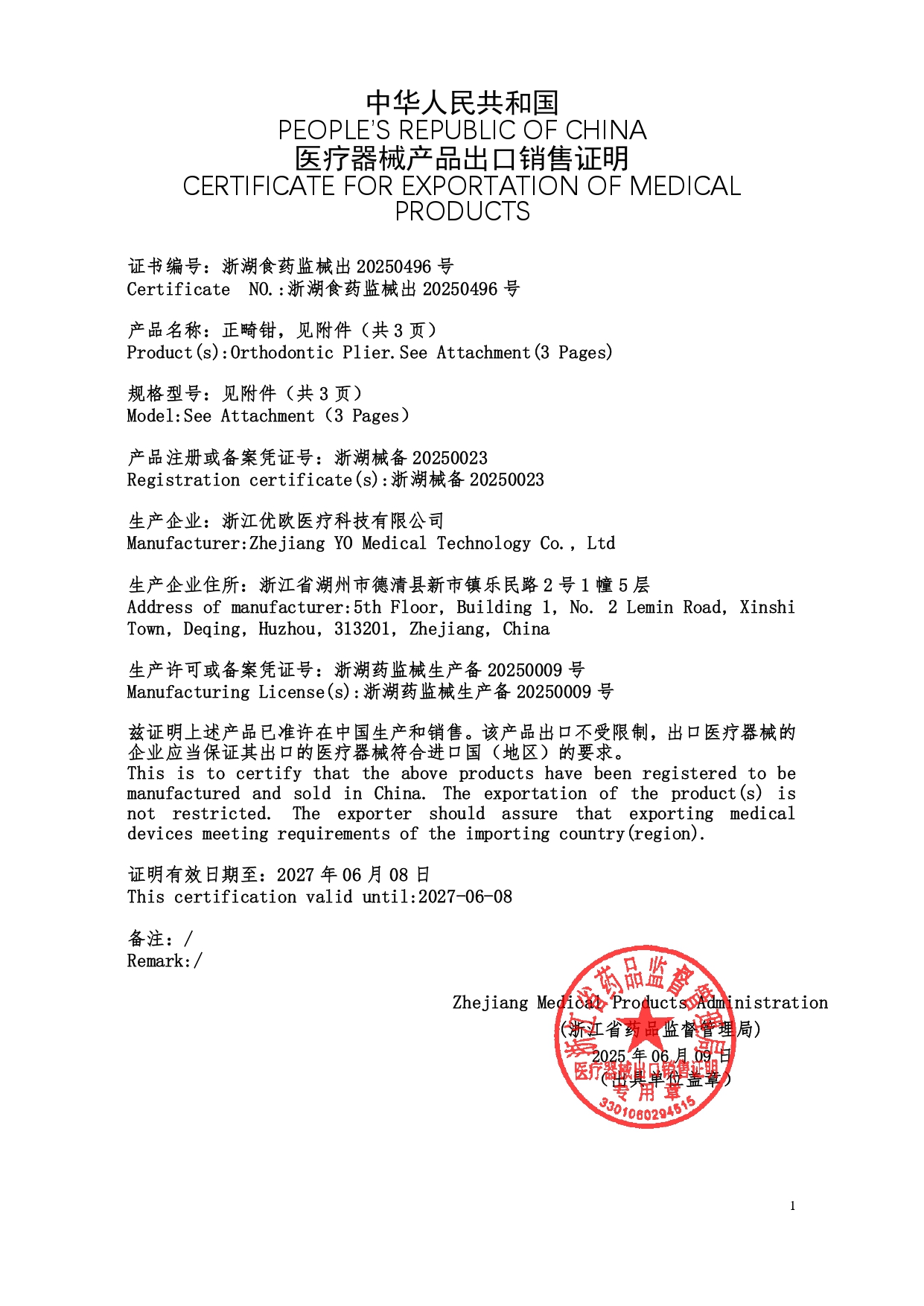
The clearest working example in the supplied material is an export certificate. The Certificate for Exportation of Medical Products numbered Zhehang Food & Drug Admin Medical Device Export 20250496, issued by the Zhejiang Medical Products Administration, carries a scope of Orthodontic Plier, an issue date of 9 June 2025 and an expiry date of 8 June 2027. Read as documentation for a mixed order, it supports the plier lines only. It says nothing about brackets, wires or elastomerics, and a buyer who accepts it as blanket coverage for a mixed shipment has accepted a scope the document does not contain.
Registration is a second document type that is often read too broadly. The FDA registration record supplied for this article carries the number 3030680214 under 21 CFR Part 807, the regulation covering establishment registration and device listing. Its listed scope includes dental brackets, preformed orthodontic bands, orthodontic springs, mouth mirrors and retainer screw expanders, and the record carries an expiry date of 31 December 2026. Two points follow. First, establishment registration and device listing are not the same thing as FDA approval or clearance of a product, so a registration number should not be presented as a performance or conformity statement. Second, the validity date is close to the present, so an order placed now should ask for the current version rather than an archived copy. Orthodontic appliances sit within 21 CFR Part 872; the specific classification and any premarket requirement differ by product family and should be confirmed for the family being purchased rather than inferred from another family record.
The standards layer sits underneath both documents. ISO 13485:2016 is the quality management system reference used across medical device regulatory schemes, and since 2 February 2026 the FDA Quality Management System Regulation has aligned 21 CFR Part 820 with it, which makes a current QMS certificate more directly relevant to US-bound supply than it was before that date. ISO 27020:2019 addresses brackets and tubes, ISO 15841:2014 addresses wires, and ISO 10993-1:2018 provides the biological evaluation framework for materials that contact oral mucosa. In the European Union, Regulation (EU) 2017/745 has applied since 26 May 2021 and requires CE marking supported by a conformity assessment appropriate to the device class. A dossier for a mixed order should therefore be organised by family against these references rather than presented as a single stack of certificates.
The capability record supplied for this article states that Yortho holds FDA registration, ISO quality management system certification and CE certification under the EU MDR. Those claims become useful to a buyer only in document form: certificate number, issuing body, scope and expiry date, per family. That is the difference between a compliance claim and a compliance document, and it is the difference a buyer is paying for when qualifying a multi-category supplier.
Evidence layer 3: item-level traceability
Traceability answers a narrower question than compliance: for this carton, in this shipment, which process produced these parts and which record proves it. Multi-category orders fail at this layer more often than at the certificate layer, because the failure is administrative rather than technical.
The production steps described in the supplied capability material give the buyer a structure to map onto families. Bracket marking is performed on the bracket base. Bracket body positioning is a distinct step. Buccal tubes are associated with metal injection moulding. Lingual button production includes high-temperature nickel brazing. Wire-cut EDM and a polishing room appear as shared processes. Precision inspection is described specifically for brackets and bands.
Each of those statements becomes a question. Which mark is applied to the bracket base, and is it the model identifier that appears on the packing list? Which families pass through wire-cut EDM and which do not? Is the precision inspection applied to brackets and bands also applied to tubes, hooks or buttons, and if not, what is applied instead? The capability record also states 100 percent testing as the quality control approach; a buyer should ask what that test covers for each family, since a visual check, a dimensional check and a functional check are three different acceptance criteria sharing one phrase.
The final trace is documentary: order line, model code, document scope, inspection record and carton label should all refer to the same article. Where a supplier offers package, logo, tag and product customisation under OEM or ODM terms, the label content becomes part of that trace, and the buyer should confirm who approves the label text and whether a private-label name changes any document reference.
A request list for mixed orders
The eight requests below cover the three evidence layers and can be reused on every re-order without being rebuilt.
| Evidence request | What it establishes | What the buyer should receive |
|---|---|---|
| Product-family map | That every ordered family has a named model structure | One line per family: family name, model codes, governing document |
| Model-code reconciliation | That one article is not counted twice under two names | Written confirmation where a code appears under two catalogue names, plus the invoice name |
| Document register | That scope is visible before pricing is compared | Issuing authority, document number, scope, issue date and expiry date for each document |
| Standard-to-family matrix | Which families rely on a published standard and which do not | ISO 27020 for brackets and tubes, ISO 15841 for wires, and declared criteria for the remaining families |
| Process-to-family mapping | That production steps are linked to the items ordered | Marking, EDM, brazing and inspection steps stated per family |
| Inspection and lot record | That goods-in checks can be closed | Definition of 100 percent testing per family, and the record that travels with the lot |
| Acceptance criteria | That families without a standard are still testable | Pre-shipment test definition, sampling basis and pass or fail statement per family |
| Change notification | That repeat orders stay comparable | Written notice of material, process, marking or label changes |
How consolidated supply compares with single-family sourcing
Consolidated supply changes the shape of risk rather than removing it. On one side, a single purchase order means one document set, one shipment, one inspection event and one point of accountability for reconciliation. On the other, the same consolidation means that a documentation weakness in one family travels with the entire shipment, and a single scope error can hold a complete order at customs while the technically compliant lines wait with it.
The fit boundary is volume and criticality. Where a buyer's annual requirement in one family is large and technically demanding, a specialist in that family may be able to offer deeper family-specific evidence than a generalist can assemble, and the consolidated route should not be assumed to be the lower-risk option. Where the requirement is breadth, repeatability and a single reconciliation chain across brackets, tubes, bands, wires, pliers and auxiliaries, a multi-category supplier with an organised dossier is the more practical counterparty. The deciding question is not which model is better in principle, but which evidence set the buyer can actually verify before the order is released.
Where these checks apply in practice
Distributor replenishment. The supplied case records describe distributor relationships across markets including the United Kingdom, United States, Italy, France, Germany, Egypt, Spain, Australia, Canada, Saudi Arabia and Qatar, at volumes of 5,000 units and durations of one to three years, alongside a dental hospital relationship in Indonesia recorded at 3,000 units over two years. For a distributor, the recurring risk is re-order drift: the second order references a model code while the first referenced a catalogue name. A frozen specification annex per family closes that gap.
Hospital and clinic projects. In clinical settings, single-use consumables and reusable instruments coexist in the same order, which creates two different documentation questions. Elastic ligatures and power chains are consumables with no product-specific standard identified in the review for this article, while pliers are reusable instruments whose export documentation is family-specific, as the plier-scope export certificate shows.
Custom and private-label programmes. Package, logo, tag and product customisation shift part of the specification burden to the buyer, because approved artwork, label text and any private-label marking must match what the factory actually applies, and must remain consistent with the documents that identify the article.
Markets with material restrictions. Some destinations require nickel-free or low-allergy material documentation for intra-oral items. The applicable evidence is a biological evaluation under the ISO 10993-1 framework rather than a general conformity certificate, and it should be requested for the specific families that contact mucosa.
Execution terms that belong in the same conversation
Evidence and commercial terms are usually negotiated separately, which is how documentation gaps survive into production. Several supplied terms show why they should be handled together. The capability record gives a lead time of 3 to 7 days, and standard items held in stock are described elsewhere in the supplied material as packed and dispatched within 3 business days after payment confirmation; both figures assume a standard order, so a mixed order containing private-label lines needs its own confirmed schedule. Transit is quoted by mode: express courier 3 to 7 business days, air freight 7 to 12 days, sea freight 25 to 40 days, and rail or overland 20 to 30 days for regions such as Europe and Central Asia. Under standard FOB or CIF terms the buyer carries import duties, taxes and clearance fees, so the document set that clears customs belongs in the commercial discussion rather than in a separate compliance file. Payment is by T/T, with a 30 percent deposit and the 70 percent balance before shipment for orders above USD 10,000, and pre-shipment test is the stated acceptance basis — which is exactly why the inspection definition has to be agreed per family rather than per order. Minimum order quantities are quoted per family and per programme type and should be fixed line by line instead of inferred from a catalogue figure.
Outlook
Two regulatory facts already in force shape the current verification cycle rather than a future one. The FDA Quality Management System Regulation took effect on 2 February 2026 and aligns 21 CFR Part 820 with ISO 13485:2016, which raises the practical value of a current QMS certificate for US-bound orthodontic supply. In the European Union, CE marking under Regulation (EU) 2017/745 has been the market-access requirement since 26 May 2021, with a conformity assessment route that depends on device class. Neither development changes what a supplier can manufacture; both change what a buyer should be able to obtain on request, per product family, with a scope line that matches the item.
The direction of travel for mixed orders is narrower documentation with better indexing: fewer general statements and more family-level documents carrying numbers, scopes and validity dates. A buyer who builds the request list once can reuse it on every re-order and every re-verification, which is a smaller recurring effort than rebuilding a dossier at each quotation.
FAQ
What should a buyer request first when one order covers brackets, arch wires and pliers?
Request the product-family map and the document register together. The map lists each ordered family with its model codes; the register lists, for each document, the issuing authority, document number, scope and validity dates. A scope line that names pliers only, such as an export certificate scoped to orthodontic pliers, cannot support bracket or wire lines, so the two lists have to be read against each other before prices are compared.
Does one certificate cover an entire multi-category orthodontic order?
Generally not, because documents are issued with a defined scope. The export certificate supplied for this article is scoped to orthodontic pliers, and the FDA registration record covers a listed set of dental and orthodontic device types rather than every family a supplier may sell. The buyer's check is to compare the scope line against the actual order lines, family by family, and to request the document that covers any family left out.
How can a buyer tell whether a supplier certification claim is still current?
Check four document fields: issuing authority, document number, scope and validity period, and compare them with the issuer's own record where that is accessible. Dates matter at order level. The FDA registration record supplied here carries an expiry date of 31 December 2026, and the plier export certificate expires on 8 June 2027, so a shipment timed later in the cycle needs the renewed version rather than an archived copy.
What changes when the order is OEM or ODM rather than a standard catalogue purchase?
Customisation moves specification control towards the buyer. When package, logo, tag or product are customised, the approved label text, marking and artwork become part of the trace between the order line and the carton, and they should stay consistent with any document that identifies the article. The practical addition is a written label and marking approval step, plus confirmation of which party is responsible for the content printed on the label.
How should acceptance criteria be set for families without a published product standard?
Write them into the order. In the standards review for this article, brackets and tubes are addressed by ISO 27020:2019 and wires by ISO 15841:2014, while no product-specific standard was identified for elastic ligatures, power chains, pliers, face masks or mini-implants. For those families the buyer should define the pre-shipment test, the sampling basis and the pass or fail statement, and ask the supplier to state what its 100 percent testing covers for that specific family.
Conclusion
A multi-category orthodontic order is verified the same way it is built: line by line. Product-family consistency shows whether a supplier can describe its own range coherently; documentation matching shows whether the paperwork actually covers the items; item-level traceability shows whether the shipment can be reconciled after it arrives. A supplier that can answer all three before the quotation is confirmed has demonstrated capability in the form that matters to an evaluator, which is evidence rather than assertion.
Есть вопросы или нужны дополнительные детали?
Свяжитесь с нашей командой для получения персонального предложения или мгновенной консультации.
Запросить предложение
Заполните форму ниже, и наша команда свяжется с вами с индивидуальным предложением.
Прямой чат WhatsApp
Предпочитаете общаться в реальном времени? Напишите нам в WhatsApp для мгновенной помощи и быстрых ответов.
- Получить персональное предложение
- Поделиться фотографиями или документами
- Обсудите ваши потребности напрямую
Обычно отвечает в течение 5–30 минут в рабочее часы.