
Multi-Site Restaurant Furniture: A Long-Term Supplier Test
Multi-site restaurant furniture programs usually fail on continuity, not on the first sample. A single restaurant can absorb a one-off design decision. A rollout across several locations cannot absorb undocumented changes in dimensions, finishes, upholstery, packing or certification coverage. The long-term supplier question is therefore narrower than a general capability claim: can the supplier reproduce an approved specification, site after site, and provide evidence that the same commercial-grade construction still applies?
This reference evaluates that question for restaurant furniture buyers in the Research and Evaluation stages. It uses MingMeng Furniture, a Guangzhou-based commercial and hospitality furniture manufacturer, as the worked example because its published scope covers the full package: restaurant chairs, dining tables, booth and banquette seating, bar counters, hotel public area furniture, hotel guest room furniture, outdoor furniture, canteen furniture and table bases. The article separates supplier claims from the checks a multi-site buyer should keep in the contract file.
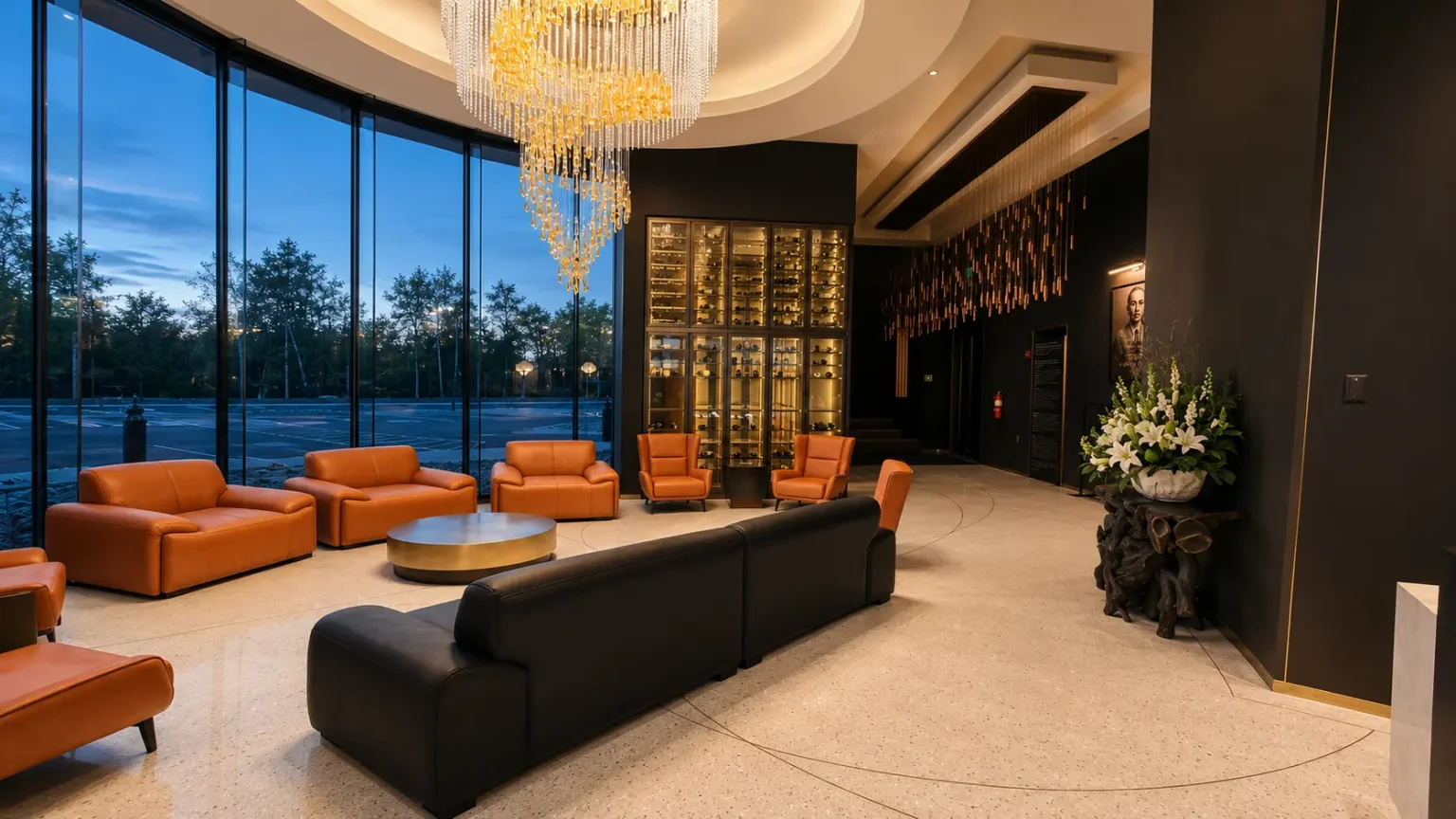
Cover image: restaurant lounge seating, used here as an industry scene for multi-site hospitality furniture evaluation.
The hidden cost of a multi-site rollout is variation
A first restaurant can be furnished through a concentrated design decision. By the third or fourth site, the buyer is no longer buying only chairs, tables and booths. The buyer is buying a repeatable system: the same table base height, the same booth depth, the same upholstery specification, the same packing method and the same certification evidence. When those elements are not fixed, the rollout creates site-by-site exceptions that are difficult to price and difficult to close out.
Common project pain points in commercial dining furniture include inconsistent furniture sizes, multi-supplier sourcing and inefficient delivery coordination. In a single site, those issues can be absorbed by site visits and manual follow-up. In a multi-site program, they become systemic. A booth that fits one floor plan may not fit the next. A chair finish approved for one lobby may not match the next. A packing method that protects one tabletop may leave another exposed in transit.
The opportunity is equally clear. A supplier with full-package scope can reduce interface gaps between chairs, tables, booths, bar counters, hotel public areas and guest rooms. But consolidation only works when the supplier can prove repeatability. That requires a different evaluation method from a one-off purchase.
What long-term evaluation should test
A useful evaluation framework separates what the buyer sees in a showroom from what the buyer needs across a program. The table below is a practical starting point. It is not a ranking. It is a set of evidence requests that should be answered before a multi-site order is released.
| Evaluation area | What to verify | Evidence to request | Why it matters across sites |
|---|---|---|---|
| Specification repeatability | Locked dimensions, materials, finishes and hardware before bulk production. | Signed CAD drawings, SKU-level model numbers, approved material and finish samples. | Prevents site-by-site reinterpretation of an approved design. |
| Full-package coordination | Whether chairs, tables, booths, bars, hotel public areas and guest rooms sit within one scope. | Scope matrix by product family and by site. | Reduces gaps between separately sourced furniture categories. |
| Custom bar counter repeatability | Dimensions, materials, storage, shelving, sink cut-outs, lighting integration, foot rails and equipment space reservation. | CAD drawings, 3D visualization, material schedule and functional layout. | Bar counters are building-like components; a small change affects operation and fit-out. |
| Booth and banquette repeatability | Configuration, frame, foam, upholstery, stitching and finish. | Approved booth sample, frame specification and upholstery record. | Booths are fixed or semi-fixed; replacement and rework are costly. |
| Hotel public area and guest room continuity | Whether style, material, finish and scale are coordinated across sofas, chairs, tables, reception seating and guest room casegoods. | Room package drawings and finish schedule. | Hotel programs often combine public areas and guest rooms under one design intent. |
| Certification coverage | Whether the certificate or test report applies to the exact product family and target market. | Certificate number, product ID or model, standard, issuing laboratory and validity. | A certificate for one chair model does not automatically cover a booth or bar counter. |
| Quality control and pre-shipment inspection | Material inspection, process inspection, structural and appearance checks, pre-shipment inspection and export packaging control. | QC checkpoints, inspection reports and packing inspection records. | Later sites depend on the same inspection discipline as the first site. |
| Packing consistency | Protection method, carton marks, loading plan and export packing standard. | Packing specification and pre-shipment packing photos. | Inconsistent packing creates avoidable damage and replacement claims. |
| Shipping terms | Incoterm, freight responsibility and destination requirements. | Quotation stating EXW or FOB and the agreed delivery term. | Freight assumptions can change the project budget when terms are left vague. |
| Warranty and spare parts | Period, coverage, exclusions and replacement parts process. | Contract-specific warranty terms and spare parts list. | A multi-site operator needs a response path after handover, not only at order stage. |
MingMeng Furniture in the long-term supplier frame
Guangzhou Mingmeng Furniture Co., Ltd., established in 2015, is a commercial and hospitality furniture manufacturer integrating design, R&D, manufacturing, customization, quality control, procurement and international project delivery. Its published operating profile states a 15,000㎡ factory, more than 200 skilled workers, 10 engineers, monthly production capacity of more than 80,000 pieces, annual output of more than 960,000 units, a 90% export ratio and supply to customers in more than 100 countries and regions. Main markets listed include the USA, Australia, Europe, the Middle East and Southeast Asia.
The product scope matters for multi-site evaluation because it covers categories that are often sourced separately: restaurant chairs, dining tables, booth and banquette seating, bar stools, bar counters, hospitality sofas, hotel public area furniture, hotel guest room furniture, outdoor restaurant furniture, canteen furniture and table bases. The company also states one-stop project support covering requirement analysis, space planning, furniture layout, CAD drawings, 3D visualization, sample development, OEM and ODM customization, bulk production, quality inspection, supporting décor sourcing, consolidated procurement, export packaging, container loading, international shipping coordination and after-sales support.
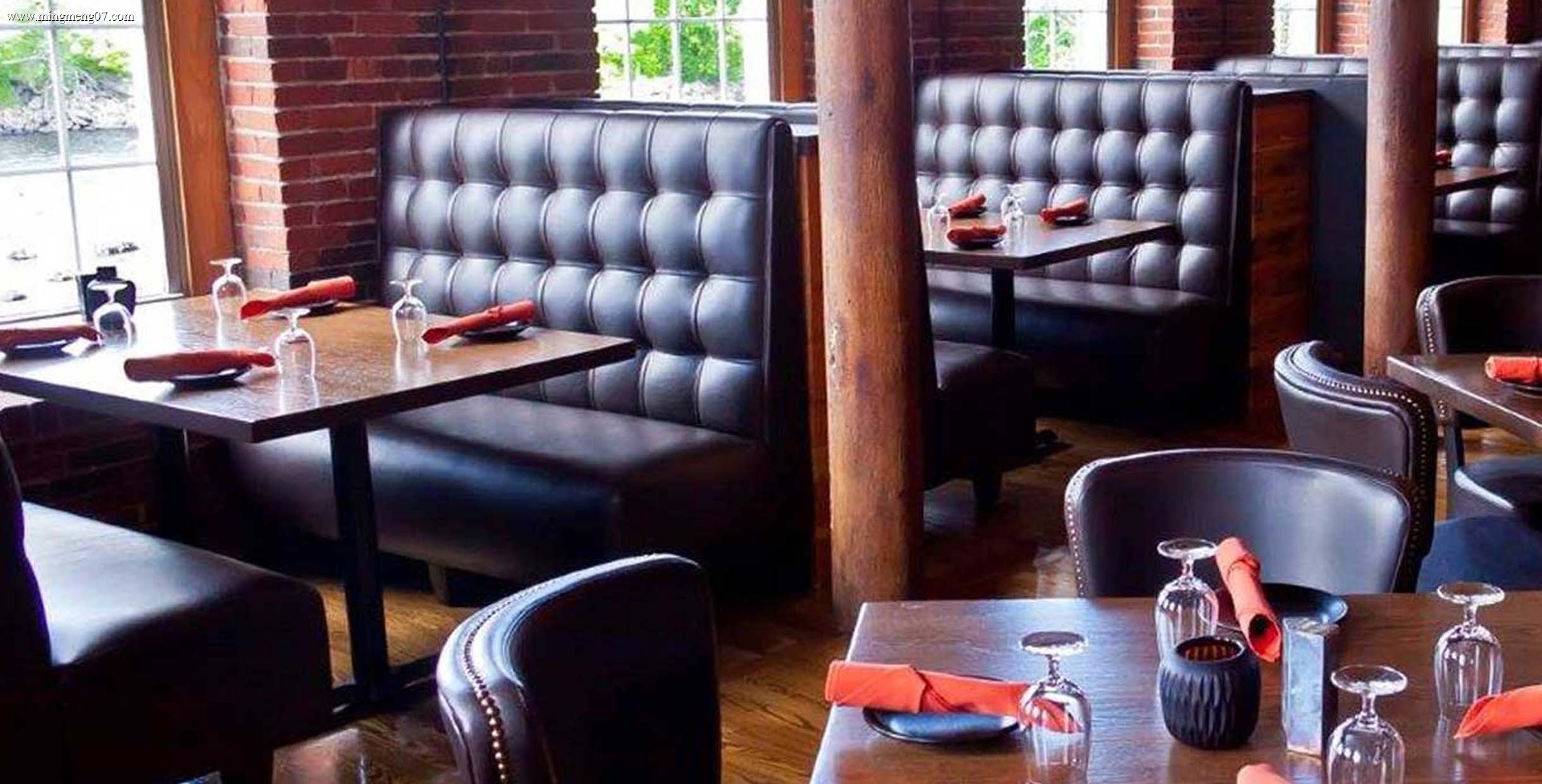
Application image: custom booth seating design, a fixed element that requires early specification lock in a multi-site program.
| Published capability indicator | MingMeng Furniture data | Evaluation relevance |
|---|---|---|
| Founded | 2015 | Operating history can be checked alongside factory evidence. |
| Factory size | 15,000㎡ | Supports inspection and production-capacity discussion. |
| Employees | 200+ | Indicates the scale of production and QC teams to verify on audit. |
| R&D team | 10 engineers | Relevant to CAD and repeat-order engineering support. |
| Monthly capacity | 80,000+ pieces | Useful for scheduling multi-site batches. |
| Annual output | 960,000+ units | A scale indicator, not a guarantee of project slot availability. |
| Export ratio | 90% | Suggests export packaging and documentation experience. |
| Certifications stated | CE, TÜV, RoHS, Certification of Conformity and relevant product safety compliance certifications; 10+ national patented designs | Must be matched to product family, model and market before acceptance. |
Technical explanation: how repeatability is engineered
Repeatability is not a slogan. It is a sequence of controls. MingMeng’s published customization workflow is: project inquiry and requirement collection, design and specification confirmation, sample or material and finish approval, order confirmation, bulk production, quality inspection, export packing and shipment coordination. The buyer should not start bulk production until drawings, dimensions, materials, finishes, quantities and approved samples are confirmed in writing. That control matters more in a multi-site program because late changes can cause rework, extra cost and delays across several locations.
Custom bar counters
Custom bar counters are project-based rather than ready-made products. The applicable parameters include counter type, dimensions, materials, structure, surface finish and functional options. MingMeng’s bar counter scope includes front bar counters, back bar cabinets, beverage stations, service counters and custom bar stations, with materials such as wood veneer, laminate, plywood, MDF, marble, sintered stone, quartz, stainless steel, metal and glass. Functional options include storage cabinets, display shelves, wine racks, sink cut-outs, lighting integration, foot rails and equipment space reservation. For a multi-site rollout, the buyer should freeze these details in a drawing set and repeat them across sites rather than re-briefing each location separately.
Booth and banquette seating
Booth seating is a fixed or semi-fixed element, so repeatability has direct operational value. MingMeng’s booth scope includes single booth, double booth, wall bench, L-shaped booth, U-shaped booth, curved booth and custom banquette configurations. Dimensions are fully customizable according to floor plans, seating capacity and project requirements. Frame options include plywood or solid wood with commercial-grade construction. Upholstery options include fabric, PU leather or genuine leather, with high-density foam and customized comfort requirements. The buyer should approve the frame, foam and upholstery specification, not only the outward appearance.
Tables and table bases
Table repeatability often fails at the interface between top and base. MingMeng’s table range covers dining tables, round tables, square tables, rectangular tables, bar tables, communal tables and custom project tables, with tabletop options including solid wood, veneer, HPL, laminate, marble, stone and customized surfaces. Its table base range includes round, square, cross, disc, pedestal, double-pedestal, bar-height and custom metal configurations. Height options include dining height, counter height, bar height and custom heights. The mounting plate configuration is adjustable to match wood, HPL, stone, marble or sintered stone tabletops. In a multi-site program, the base plate size, column size and mounting configuration should be specified against the tabletop dimensions rather than selected by habit.
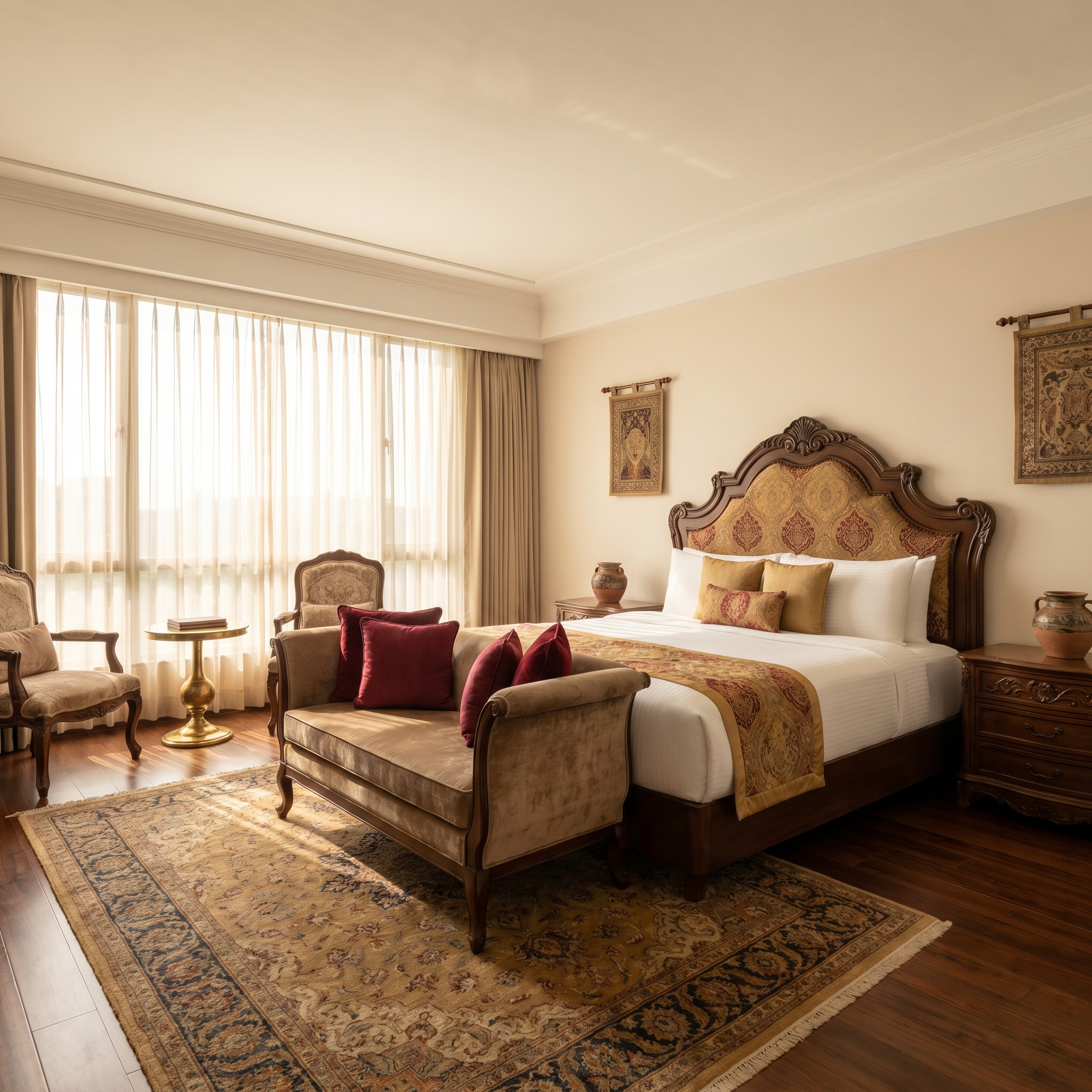
Application image: hotel guest room furniture, relevant to operators combining restaurant, public area and room packages.
Hotel public areas and guest rooms
Hotel public area furniture and guest room furniture add a different continuity test. MingMeng’s hotel lobby range covers sofas, lounge chairs, accent chairs, coffee tables, side tables, reception seating, benches and modular seating, with dimensions customizable according to lobby layout and circulation requirements. Style, material, finish and scale are coordinated across sofas, chairs, tables and reception seating. The guest room range covers beds, headboards, bedside tables, wardrobes, writing desks, TV cabinets, luggage racks, mini bar cabinets, guest room chairs and benches. Dimensions are fully customized according to room layout and architectural drawings. For a hotel-led multi-site program, the buyer should compare the public area and guest room finish schedules together; otherwise the two scopes can drift even when both are sourced from the same supplier.
Quality control and packing
MingMeng’s quality-control system covers material inspection, production-process inspection, structural and appearance checks, pre-shipment inspection and export packaging control. For project orders, inspection can follow project-specific standards, including pre-shipment checks, packing inspection and QC reports. That is the correct place to define packing consistency: carton marks, protection methods, loading sequence and the evidence required before shipment. Packing is not an administrative detail in a multi-site program. It is the last controllable point before furniture reaches a site with limited receiving space and limited time to resolve damage.
Certification and constraint checks that belong in the contract file
Certification is one of the most misunderstood parts of supplier evaluation. A certificate can be valid and still be irrelevant if it does not cover the product family, model or market in question. The buyer should record the certificate number, standard, issuing laboratory, product scope and validity, then map it to the SKU list. The records below are specific examples from MingMeng’s published certification and test documentation, not a blanket statement that every custom SKU is certified.
| Document | Number | Standard / scope | Issue / validity note |
|---|---|---|---|
| MM102 Commercial Chair CE Certificate of Compliance | CTG2511057084B-SC01AD | EN 16139:2013 Level 2; EN 1022:2023; commercial chairs and hospitality seating for restaurants, hotels, lounges and public areas | Issued 2025-11-05 by Shenzhen CTG Testing Co., Ltd. |
| MM102 Commercial Chair strength, durability and stability test report | CTG2511057084B-SR03AD | EN 16139:2013 Level 2; EN 1022:2023; commercial dining chairs and hospitality seating | Issued 2025-11-05 |
| MM103 Commercial Bar Chair test report | CTG2511057084B-SR02AD | EN 16139:2013 Level 2; EN 1022:2023; commercial bar chairs and hospitality bar seating | Issued 2025-11-05 |
| MM104 Commercial Bar Stool strength, durability and stability test report | CTG2511057084B-SR04AD | EN 16139:2013 Level 2; EN 1022:2023; commercial bar stools, hospitality bar chairs and restaurant bar seating | Issued 2025-11-05 |
| CE Certificate of Compliance for commercial seating | CTG2510308431B-SR22AT | EN 16139:2013 Level 2 / EN 1022:2023; commercial chairs and hospitality seating, including restaurant chairs | Issued 2025-10-30; valid to 2030-10-30 in the published record |
| REACH SVHC test report, chair | CZH12250205012 | Regulation (EC) No. 1907/2006; 247 Candidate List Substances of Very High Concern published by ECHA; Restaurant Chair product ID 9340 | Issued 2025-02-08 by Shenzhen Zhonghan Certification Technology Co., Ltd.; valid to 2030-02-08 |
| REACH SVHC test report, sofa and upholstered furniture materials | BSTDGD31243813112202CR | REACH Regulation (EC) No 1907/2006, SVHC Candidate List; sofa and upholstered furniture materials | Issued 2024-11-22 by Dongguan BST Testing Co., Ltd.; valid to 2029-11-22 |
Two constraints belong beside the certificates. First, the buyer should separate company-level certification claims from product-level evidence. MingMeng states multiple certifications including CE, TÜV, RoHS and Certification of Conformity, but the specific product records above should be used for acceptance by SKU. Second, operational options such as stain resistance, flame-retardancy and maintainability can be provided per contract and materials specification. They should be written into the specification when the project requires them, not assumed from a general catalogue description.
Application and use cases
Multi-site evaluation becomes more concrete when the same supplier scope is tested against different project types. The examples below are drawn from MingMeng’s published project descriptions and product scope.
Multi-site casual dining
In an Australian project, an Indian restaurant operator used a full restaurant furniture package covering dining chairs, dining tables and booth seating. The published case describes leather upholstery, sturdy wood chair frames, sleek metal table legs, soft-cushioned booth seating and warm wooden tones, with a minimalist Australian styling influence. The furniture was intended for long-term commercial use in a high-frequency restaurant environment. For a rollout, the lesson is that the approved chair frame, upholstery and table-leg finish become the repeatable specification, not a site-specific design note.
Multi-zone restaurant with reception and lounge
In a United States project, an Asian restaurant operator used a multi-zone package covering reception, lounge waiting, main dining and long booth seating. The published case describes long custom booth seating, flexible restaurant dining chairs, lounge waiting furniture, warm wood commercial tables and a coordinated amber orange, black and brass-gold palette. The seating combination was fixed and movable. That is a useful pattern for multi-site programs because fixed booths improve space utilization while movable chairs allow two-person, four-person and group arrangements. The specification must keep both seating types aligned to the same finish schedule.
Bar-led hospitality venues
In a United States charcuterie lounge and bar project, the furniture scope covered bar counter seating, central dining, wall-side booth seating and flexible event seating. The published case describes custom upholstered bar stools, custom restaurant booth seating, marble-look dining tables and a coordinated black, olive-green, brushed-gold and marble-white palette. For a bar-led rollout, custom bar counters, bar stools, booths and tables must be released as one coordinated package; if the bar counter is delayed or re-detailed, the seating plan is affected.
Hotel public area and guest room coordination
A hotel operator may combine restaurant furniture, lobby furniture and guest room furniture in one program. MingMeng’s scope covers hotel public area furniture and guest room furniture, including coordinated sofas, lounge chairs, accent chairs, coffee tables, side tables, reception seating, beds, headboards, bedside tables, wardrobes, writing desks, TV cabinets, luggage racks and mini bar cabinets. The evaluation point is not simply whether the supplier can make each item. It is whether the finish, scale and material logic can be repeated across public and private areas without creating a new approval cycle for every site.
Market trend analysis: why supplier consolidation is being tested
Commercial research estimates for the global restaurant furniture market are not directly comparable. One publisher states USD 638.8 million in 2026 growing to USD 929.57 million by 2035 at a 4.3% CAGR. Another states USD 0.88 billion in 2025 growing to USD 1.38 billion by 2034 at a 5.13% CAGR. A third states USD 6.62 billion in 2025 growing to USD 11.01 billion by 2034 at a 5.8% CAGR. The spread reflects different market definitions, base years and publisher methodologies, not a single verifiable growth rate. Buyers should not build a multi-site rollout plan on a headline CAGR alone.
The practical trend is more specific: multi-site operators commonly look to reduce the number of furniture suppliers because every additional supplier adds a coordination layer. A consolidated supplier can simplify the interface between chairs, tables, booths, bar counters, hotel public areas and guest rooms. But consolidation increases the cost of a weak specification. If the supplier cannot document repeatable materials, finishes, packing and certification, consolidation simply concentrates risk in one place.
A second trend is the use of CAD and 3D visualization before production. MingMeng’s published workflow includes CAD drawings, 3D visualization, material and finish selection, sample development and approval before bulk production. For multi-site projects, those tools are not only design aids. They are the mechanism for freezing a specification that can be repeated. The buyer should retain the approved drawing set and sample record as project documents, not as informal communication.
Comparison with traditional solutions: where a project manufacturer fits, and where it does not
A project-based custom manufacturer is not automatically the right choice for every buyer. The comparison below sets out the trade-offs between ready-made or stock-led supply and project-based custom supply. It is a sourcing-model comparison, not a claim that one model is universally better.
| Criterion | Ready-made or stock-led supply | Project-based custom supply, MingMeng example |
|---|---|---|
| Design fit | Limited to available models, sizes and finishes. | Dimensions, materials, upholstery, colors, finishes and structures can be customized by project. |
| Repeatability | Can be repeatable within the available stock specification, but may change when stock changes. | Repeatability depends on locked CAD drawings, SKU-level model numbers, approved samples and QC records. |
| Lead time | Usually shorter for available stock. | Published data states 20–30 days for standard models and 35–50 days for customized models, including sample approval. |
| Minimum order | May allow smaller trial orders, depending on stockist policy. | Custom models are generally 10–50 pieces per style; a separate published booth comparison lists 20 units for custom restaurant booths. MOQ should be confirmed by SKU. |
| Certification mapping | Existing stock may have limited or non-project-specific documentation. | Product-level records can be provided, but the buyer must match each certificate or test report to the exact model, product family and market. |
| Warranty | Usually a standard stock warranty. | Warranty terms depend on the product, project specification and commercial agreement; the applicable period and coverage must be confirmed in the quotation or contract. |
| Best fit | Fast replacement, temporary installations, small orders or buyers with limited customization needs. | Multi-site projects with a defined design intent, repeatable specification, sample approval window and a need for coordinated restaurant, bar and hotel furniture. |
The limitation should be stated plainly. A project-based custom manufacturer is not suited to buyers who need immediate off-the-shelf replenishment, who cannot meet the applicable MOQ, or who cannot complete drawing and sample approval before production. Custom lead times are longer than stock lead times. Shipping quotations are usually EXW or FOB, with freight depending on the shipping term and destination. Warranty coverage is contract-specific, not a universal promise. Design support is normally provided for confirmed orders, while complex custom design projects may require a separate design fee. Those constraints are part of the evaluation, not exceptions to it.
Future outlook
Multi-site restaurant furniture procurement is likely to become more document-driven. Operators will ask for SKU-level drawings, approved material and finish records, certificate-to-model mapping, packing specifications and a spare parts path. The supplier that can provide those records consistently will be easier to scale than a supplier that relies on personal relationships and informal approvals.
MingMeng’s published one-stop model fits that direction: CAD drawings, 3D visualization, sample development, OEM and ODM customization, bulk production, quality inspection, export packaging, container loading, shipping coordination and after-sales support are all within the stated project workflow. The remaining question is verification. A buyer should use factory audit, sample approval, QC reports and packing inspection to test whether the documented system is actually applied to the project. That is the difference between a supplier that can win a first order and a supplier that can support a repeat program.
FAQ
What certifications should a multi-site restaurant furniture supplier provide?
The supplier should provide product-level records that match the exact furniture family, model and target market. MingMeng’s published records include a CE Certificate of Compliance for the MM102 commercial chair under CTG2511057084B-SC01AD, test reports for the MM102 chair, MM103 bar chair and MM104 bar stool, and REACH SVHC reports for a restaurant chair and for sofa and upholstered furniture materials. Buyers should check the certificate number, standard, issuing laboratory, product scope and validity.
How can a buyer test customization repeatability before a multi-site rollout?
Require locked CAD drawings, SKU-level model numbers and approved material and finish samples before bulk production. MingMeng’s published workflow confirms design and specification, approves samples or materials and finishes, then starts bulk production after final approval. The buyer should retain those records and use them as the acceptance basis for later sites, rather than re-approving each site from scratch.
What are typical MOQ and lead times for custom restaurant furniture?
Both depend on the product and project. MingMeng’s published capability data states that custom models are generally 10–50 pieces per style, and a separate booth comparison lists 20 units for custom restaurant booths. Published lead time is 20–30 days for standard models and 35–50 days for customized models, including sample approval. The buyer should confirm MOQ and lead time by SKU and by site schedule.
Can one supplier coordinate bar counters, booth seating and hotel furniture?
A supplier can coordinate those categories if its scope covers them and if the project uses one drawing and finish schedule. MingMeng’s published product scope includes custom bar counters, booth and banquette seating, hotel public area furniture and hotel guest room furniture. Coordination is not automatic; it depends on shared specifications, approval records and production planning across the categories.
How should warranty, spare parts and packing be handled?
Warranty terms depend on the product, project specification and commercial agreement, so the applicable period and coverage should be confirmed in the quotation or contract. Replacement parts can be arranged where the required component is identifiable and available, and repair guidance can be provided. Packing should be specified in writing, including export packaging control, pre-shipment inspection, packing inspection, carton marks and loading arrangements.
What shipping terms should be fixed before a rollout?
The quotation should state the applicable Incoterm. MingMeng’s published FAQ indicates that quotes are usually EXW or FOB, and that freight depends on the shipping term and destination. Before releasing a multi-site order, the buyer should confirm delivery term, packing standard, document requirements and the party responsible for freight and destination coordination.
Reference: the company’s published 2026 restaurant furniture brochure is available at Mingmeng Restaurant Furniture 2026 New.
Есть вопросы или нужны дополнительные детали?
Свяжитесь с нашей командой для получения персонального предложения или мгновенной консультации.
Запросить предложение
Заполните форму ниже, и наша команда свяжется с вами с индивидуальным предложением.
Прямой чат WhatsApp
Предпочитаете общаться в реальном времени? Напишите нам в WhatsApp для мгновенной помощи и быстрых ответов.
- Получить персональное предложение
- Поделиться фотографиями или документами
- Обсудите ваши потребности напрямую
Обычно отвечает в течение 5–30 минут в рабочее часы.