
Multi-Spindle CNC Lathes: A 2026 Industry Analysis for Shaft & Disc Parts
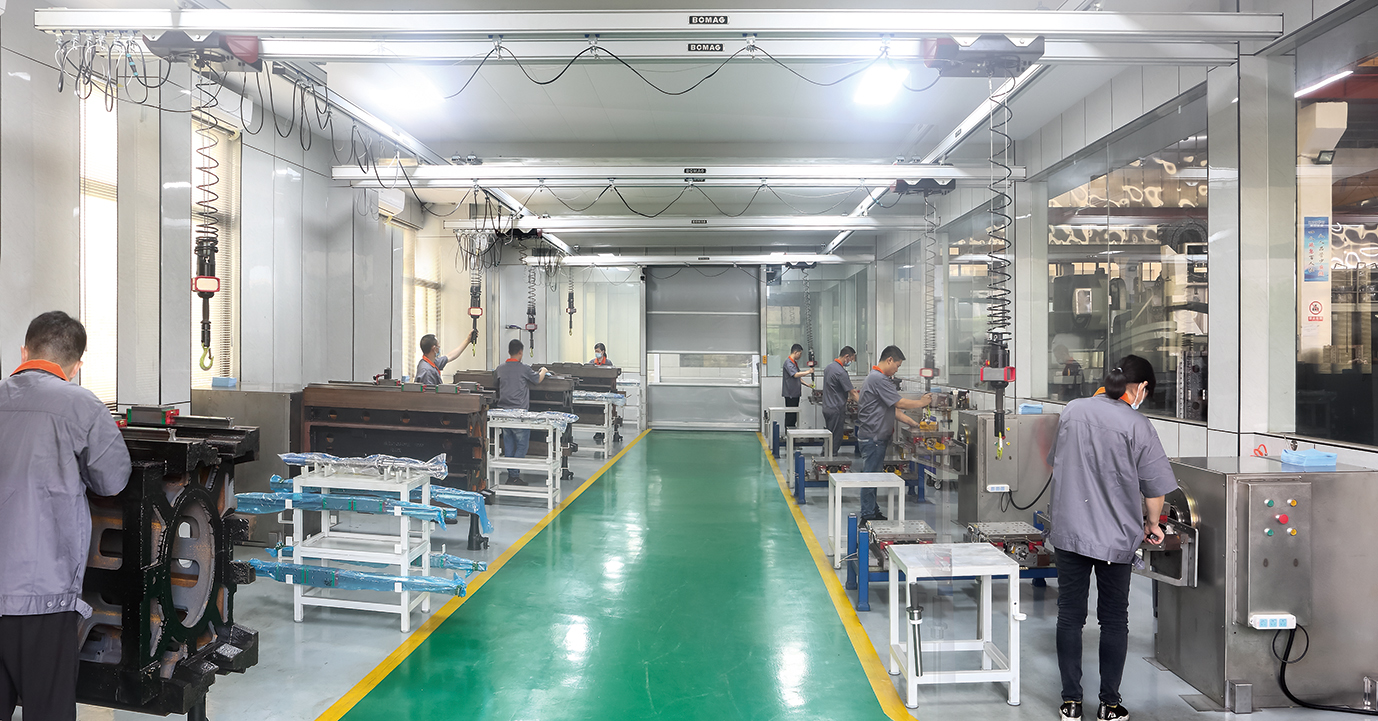
Juxin Machine Tool Co., Ltd. maintains a temperature-controlled assembly environment to ensure precision in CNC lathe manufacturing.
Multi-Spindle and Integrated Machining: The New Standard for Shaft and Disc Parts in 2026
In 2026, the demand for higher throughput and tighter tolerances in shaft and disc part manufacturing has accelerated the adoption of multi-spindle and dual-end lathe configurations. Traditional single-spindle lathes requiring multiple clamping cycles are increasingly replaced by machines that combine turning, milling, drilling, and centering in a single setup. Juxin Machine Tool Co., Ltd., a manufacturer founded in 2005 and based in Wenling, Zhejiang, specializes in such specialized CNC lathe machines, including double-head and twin-spindle vertical lathes designed for efficient processing of shafts and discs.
Problem / Opportunity
Conventional machining of shafts and disc parts often demands separate operations for end facing, center hole drilling, turning, and secondary clamping – each introducing positional errors and lengthening cycle times. The industry need for reduced labor, smaller floor space, and consistent quality created an opportunity for integrated machine designs. According to Juxin’s application documentation, modern multi-process lathes can save 70% to 150% of workshop space, reduce labor by 50% to 80%, improve automation efficiency by 40% to 120%, and cut production costs by over 50%.
Juxin’s Product Family for Shaft & Disc Parts
Juxin Machine Tool Co., Ltd. offers a range of four core machine types that address distinct workpiece geometries and production volumes:
- End Facing and Centering Machine (Model JXZ70-680) – a CNC milling face end face drilling hole lathe. The bed is integrally cast from HT300 gray cast iron for rigidity. It handles machining diameters of 14–500 mm and lengths from 70–5000 mm, supporting face milling, center hole drilling, external cylindrical turning, drilling & tapping, chamfering, boring, and rapid U-drilling in one clamping.
- Middle Drive Double-head CNC Lathe (Model JXS72) – a Double End Simultaneous Turning Lathe. Its integral bed, inclined bed, and column are made of high-strength preheated cast iron and undergo ultra-low temperature cryogenic heat treatment. It processes diameters of 15–180 mm and lengths of 40–800 mm. The guide rail is a high-precision hardened rail (55°/15° integral hard rail or heavy-duty roller linear guide) that undergoes quenching, fine grinding, and manual scraping.
- Twin-Spindle CNC Vertical Lathe Machine for Shafts (Model JXLC45-A) – a dual-position vertical lathe with dual stations, spindles, systems, and tool towers. Maximum shaft diameter is 345 mm and maximum length is 1020 mm.
- Twin-Spindle CNC Vertical Lathe Machine for Disks (Model JXLC63D) – similar dual-station configuration for disk parts, with a maximum processing diameter of 525 mm and maximum machining height of 400 mm.
All models are designed for the automotive parts, agricultural machinery parts, water pumps & motors, railway locomotive axles, construction machinery, transmission, gear, and new energy solar industries. The company holds over 50 innovative technological patents and its products are used by more than ten internationally renowned enterprises.
Technical Construction for Long-Term Precision
Juxin’s lathes share common build principles that contribute to their stiffness and durability. The bed, column, and base are made from high-strength preheated cast iron using resin sand integral casting, then subjected to ultra-low temperature cryogenic heat treatment and stress relief aging. The machine base employs a multi-layer box-type and cross-rib mixed cast iron structure with finite element mechanical design, increasing overall weight and improving anti-resonance performance. The spindle is made of high-quality alloy structural steel. Guide rails are high-precision hardened rails that undergo precision quenching, fine grinding, and hand scraping, ensuring wear resistance and heavy cutting stability.
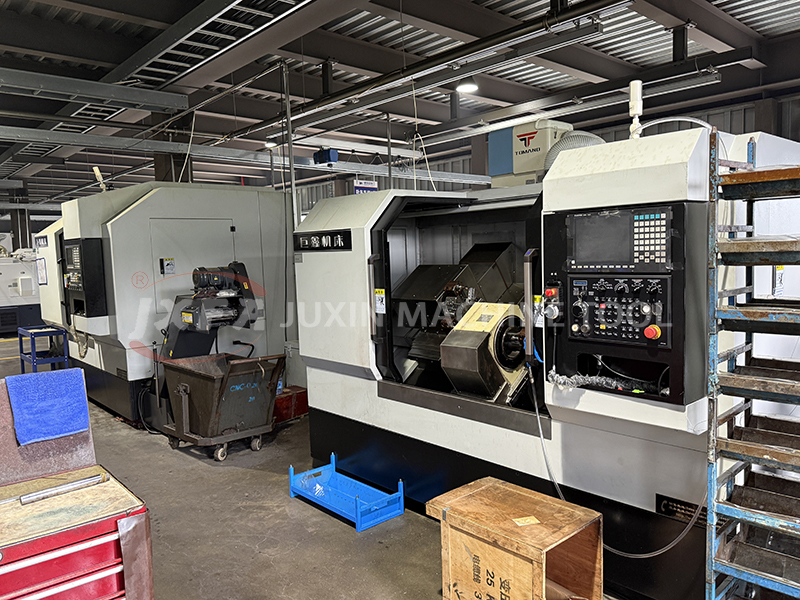
A double-head CNC lathe machining a drive shaft in a single clamping operation.
Real-World Application Scenarios
Automotive and Motor Shaft Processing
For motor shafts, electric vehicle wheels, half shafts, and brake discs, the Middle Drive Double-head CNC Lathe (JXS72) completes outer diameter, inner bore, thread, end face, and center hole machining of both ends in one clamping, eliminating errors from re-clamping. The products operate in ordinary machining workshops under full-automatic single-machine loading and cyclic program control. This scenario is common in Germany and other European markets.
Heavy-Duty Shafts and Gear Housings
The Twin-Spindle CNC Vertical Lathe Machine for Shafts (JXLC45-A) is applied in processing slender shafts, heavy-duty shafts, and gear housings for construction machinery and railway axles. Its vertical structure prevents deflection under gravity, solving vibration and deformation issues during heavy cutting. Multi-machine robotic online mode allows one robot to control 2–3 production lines, enabling man-machine separation. This configuration supports micron-level tool compensation and in-machine detection for long-term precision stability.
Disk Parts for High-Speed Rail and Aerospace
The twin-spindle disk lathe (JXLC63D) handles brake discs, motor housings, and aerospace precision disk parts. Dual stations allow front and back machining in a single clamping – eliminating workpiece turnaround. Turning-milling and turning-grinding composite models can machine parts with hardness above HRC 50, replacing traditional internal grinders. These machines are deployed in constant-temperature precision parts workshops and automated robot cell layouts.
Market Trend Analysis
Demand for specialized CNC lathes for shaft and disc parts is rising globally. According to Juxin’s export data, applications are common in Germany, Russia, Vietnam, Thailand, Malaysia, Indonesia, Egypt, Saudi Arabia, Iran, Pakistan, Turkey, the United States, Brazil, Mexico, South Africa, Nigeria, Kazakhstan, Uzbekistan, Australia, New Zealand, and beyond. The shift toward intelligent automation – where a single operator manages multiple machines through robotic loading and MES integration – is a key growth driver. Multi-spindle and dual-end designs directly address this trend by cutting cycle times and labor dependency. Juxin’s annual production capacity of 2,000 sets and a 10-engineer R&D team support the development of new composite models that combine turning, milling, grinding, and drilling in one platform.
Comparison with Traditional Machining Approaches
Traditional method: Several single-purpose machines (lathe, milling machine, drilling machine) operated in sequence with manual part transfer. Each re-clamping introduces runout errors and lengthens lead time. Typical coaxiality tolerance of ±0.1 mm and center-hole depth inconsistency of ±0.1–0.2 mm.
Juxin’s integrated approach: Single clamping complete with repeat positioning accuracy of 0.008–0.012 mm and length/center-hole depth consistency at both ends of ±0.05 mm (customizable to ±0.02 mm) as per the End Facing and Centering Machine specifications. Cycle times can be reduced by over 50%, and floor space by 50–70%.
One honest limitation: integrated machines require higher initial investment and careful workpiece fixturing. For extremely large workpieces beyond 5 meters or with irregular geometries, custom solutions may be needed. Additionally, the dual-spindle vertical lathe requires a qualified floor foundation for stability.
Future Outlook
The trajectory for shaft and disc parts manufacturing points toward fully unmanned lines where multi-spindle, dual-end lathes act as the core processing nodes, integrated with gantry robots, coordinated material storage, and automated chip removal. Juxin’s products already support options like the KND, GSK, Huazhong, Siemens or Fanuc control systems, and are engineered for digital integration with MES. The company is developing twin-spindle vertical lathes with four spindles and specialized models for ultra-large length-to-diameter ratios. As production scales and automation costs decline, these integrated solutions will become the baseline for competitive machining operations worldwide.
Frequently Asked Questions
What are the main advantages of a twin-spindle CNC vertical lathe compared to a single-spindle lathe?
A twin-spindle vertical lathe (e.g., Juxin JXLC45-A or JXLC63D) features dual stations, dual spindles, dual systems, and dual tool towers. This configuration allows front and back machining of a workpiece in a single clamping, eliminating the need to turn the part around. The result is better coaxiality, shorter cycle times, and reduced labor. Vertical orientation also avoids gravity-induced deflection on slender shafts.
What is a double-end CNC lathe and when should I use it?
A double-end CNC lathe (also called a double-head or two-end lathe) simultaneously machines both ends of a shaft or sleeve part in one setup. Juxin’s Middle Drive Double-head CNC Lathe (JXS72) is an example. It processes diameters from 15 to 180 mm and lengths from 40 to 800 mm. It is ideal for medium-to-high volume production of motor shafts, hydraulic piston rods, and similar parts where end-to-end concentricity and length consistency are critical.
How does an end facing and centering machine differ from a conventional lathe?
An end facing and centering machine (e.g., Juxin JXZ70-680) is a specialized CNC lathe that mills the end face, drills the center hole, and can perform additional operations like external turning, drilling & tapping, chamfering, boring, and even U-drilling – all in one clamping. Its bed is made of HT300 gray cast iron for rigidity. It handles diameters of 14–500 mm and lengths up to 5000 mm. This machine replaces conventional setups that would use a separate facing lathe and a center-hole drilling machine, improving accuracy and throughput.
Can Juxin’s lathes be integrated into an automated production line?
Yes. All four product lines support robotic automation. Application scenarios include “3/4/5-machine robot online mode” where one articulated robot serves multiple machines, automatically bypassing tool-change stations for continuous flow production. The machines also offer in-machine detection, micron-level tool compensation, and digital integration with MES systems for real-time monitoring. Options like servo-programmable tailstocks and automatic chip conveyors facilitate unattended operation.