
Multi-Wire vs Diamond Wire Saw: Choosing a Slab Stone Cutting Machine
A slab stone cutting machine is selected less by brand preference than by where the cut happens. In stone production, cutting takes place in two different locations — at the quarry face, where blocks are separated from the deposit, and inside the processing plant, where blocks are converted into slabs. Diamond wire saw machines handle the first job. Multi-wire saw machines handle the second. Buyers who treat the two as interchangeable line items on a single specification sheet usually discover the mismatch after installation, not before.
This independent buyer comparison sets out the differences using published specifications for the Stonewin ZY-MW multi-wire saw series and for the ZY-45G-6P, ZY-55G-6P and ZY-75G-6P diamond wire saw machines, and marks the points where a buyer should request written confirmation before contracting. Stonewin is the brand of Fujian Xiapu Zhongyuan Machinery Co., Ltd., a stone equipment manufacturer founded in 2011 in Xiapu, Fujian, China, whose product line covers wire saw machines for stone quarrying, multi-wire saw machines for slab processing, polishing lines, resin lines, and diamond wire saws.
The two machine families, defined by the task they perform
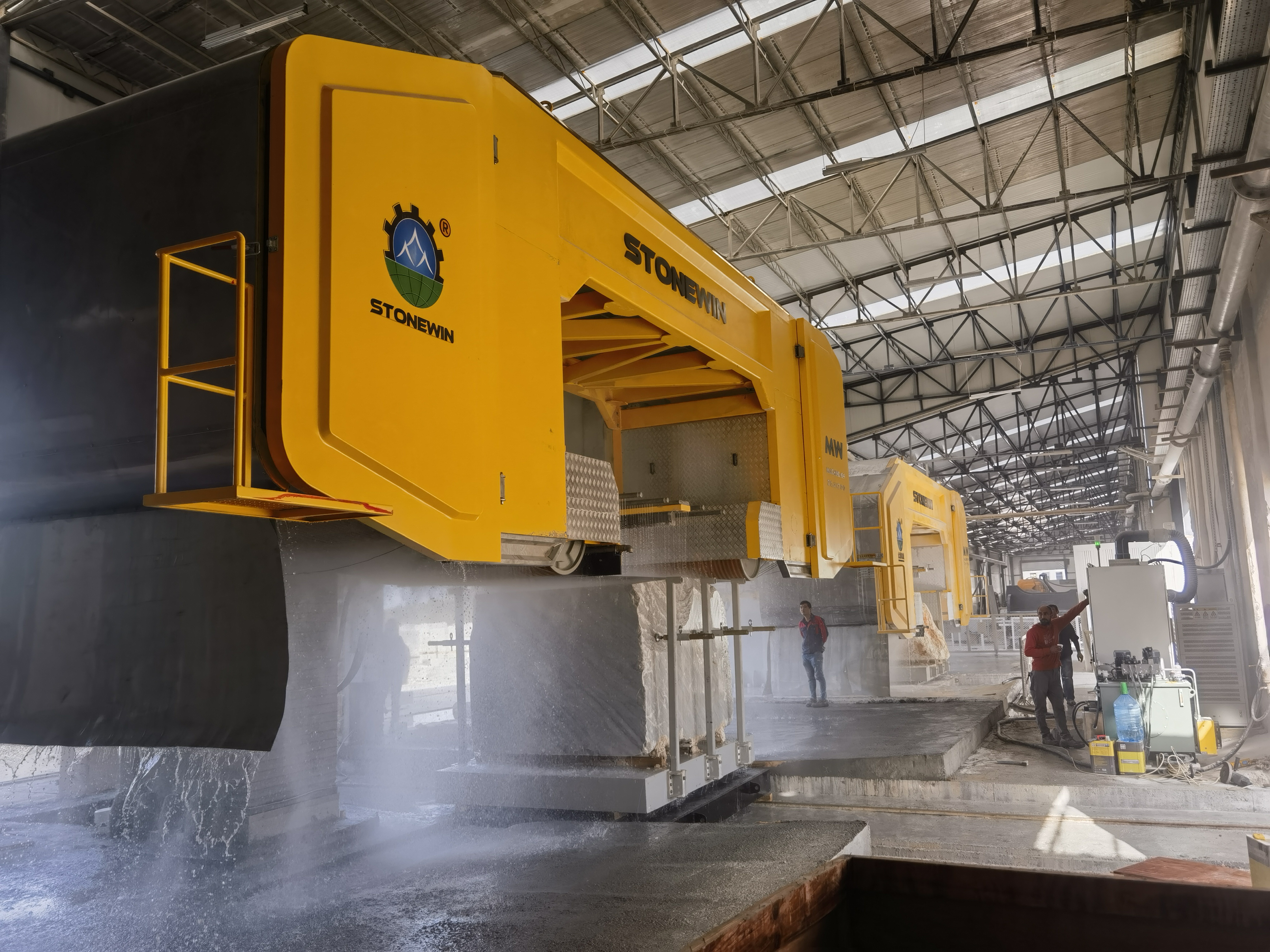
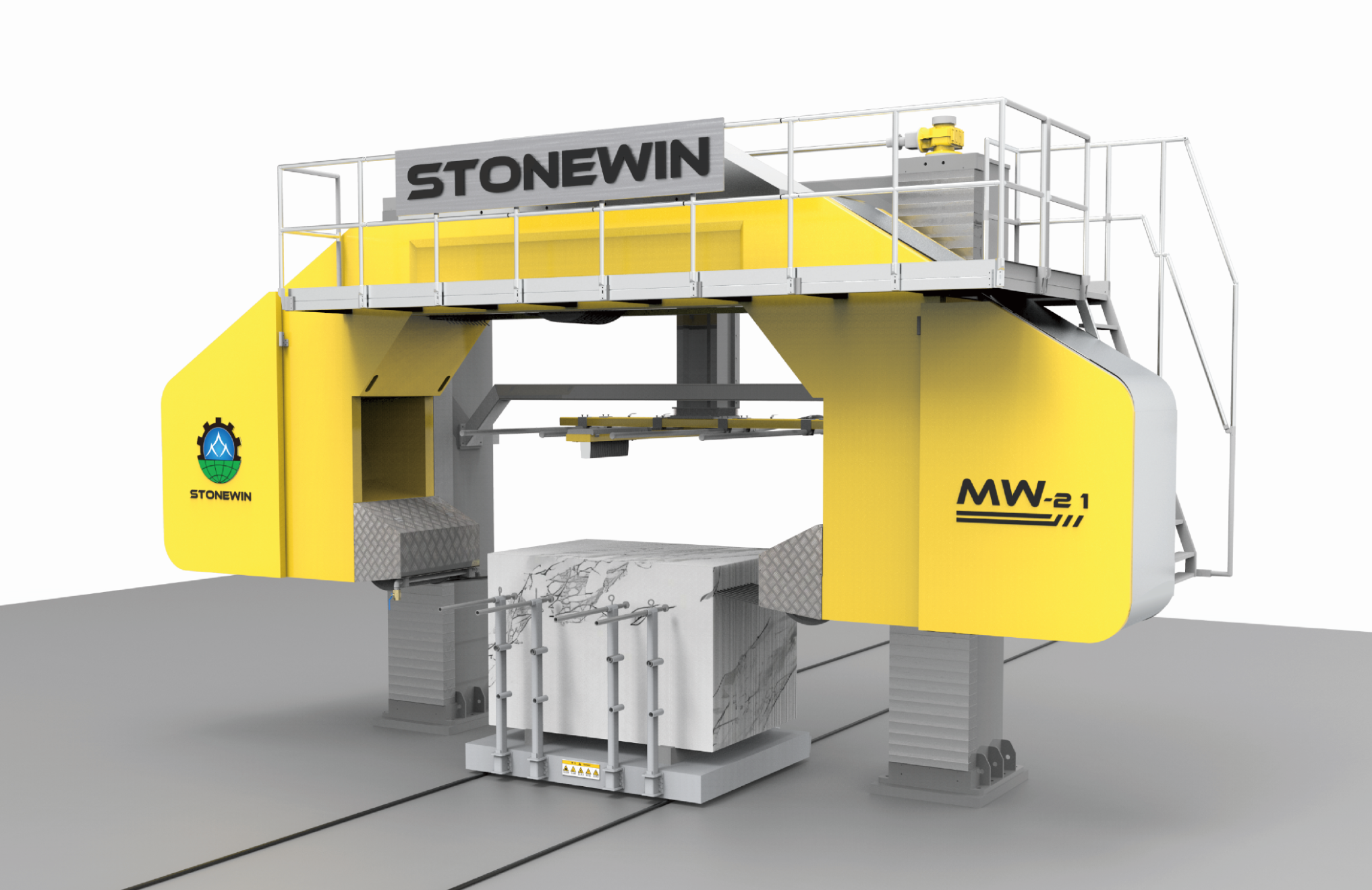
A multi-wire saw machine cuts a stone block with a set of parallel diamond wires running at the same time, producing multiple slabs in one pass. The Stonewin slab-processing range is built on the ZY-MW platform, spanning ZY-MW5 through ZY-MW90 — nominally five to ninety wires depending on the model chosen. Two mechanical configurations exist inside the same series: side-tension multi-wire saw machines and top-tension multi-wire saw machines. Both accept blocks up to 3500 mm (L) × 2200 mm (H), and finished machines weigh between 22 and 80 tons depending on model. Main frames are built from carbon steel, with alloy steel used for key components. The stated applicable industry is stone quarrying and stone processing.
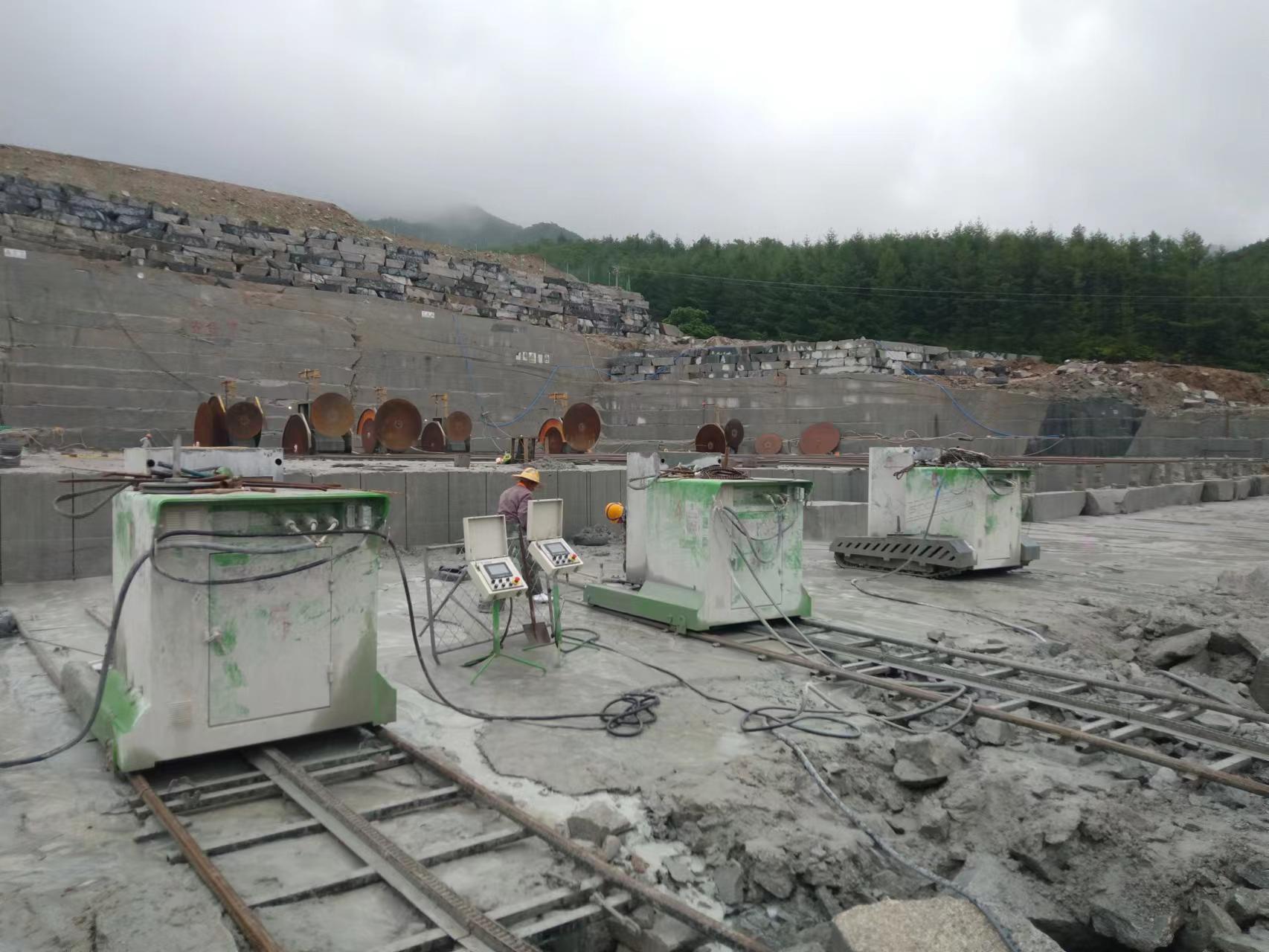
A diamond wire saw machine performs the opposite operation. It drives a continuous diamond wire loop around a fly wheel and moves that loop through stone in place, separating a block from the deposit rather than slicing a block into slabs. The Stonewin quarrying range that includes ZY-45G-6P, ZY-55G-6P and ZY-75G-6P is specified with an φ800 mm fly wheel, a wire saw speed of 0–40 m/s, and 360-degree electrically controlled rotation. Machine body material can be customized to customer requirements, and the stated applicable industry is stone quarrying.
The term “diamond wire saw” also describes the cutting tool itself, and this second meaning regularly causes confusion during procurement. Stonewin manufactures a multi-wire diamond saw for stone slab cutting in diameters from φ3.5 mm to φ12 mm, across models ZY03, ZY04, ZY05, ZY06, ZY07, ZM12, ZG12, ZG13, ZC12 and ZC10, using diamond, steel wire and plastic components. Keeping machine and consumable separate matters commercially: wire is a recurring operating cost, while the machine is a capital item with a multi-year service life.
Multi-wire saw vs diamond wire saw: what the specifications actually compare
| Comparison dimension | Multi-wire saw machine (ZY-MW series) | Diamond wire saw machine (ZY-45G-6P, ZY-55G-6P, ZY-75G-6P) |
|---|---|---|
| Primary task | Slicing blocks into slabs in a processing plant | Separating blocks at the quarry face |
| Stated applicable industry | Stone Quarrying & Stone Processing Industry | Stone quarrying |
| Model range in published specification | ZY-MW5 through ZY-MW90 | ZY-45G-6P, ZY-55G-6P, ZY-75G-6P |
| Wire count | 5–90 wires depending on model | Not part of the published specification |
| Cutting envelope | 3500 mm (L) × 2200 mm (H) | Not part of the published specification |
| Configuration options | Side-tension or top-tension | 360-degree electrically controlled rotation |
| Drive / tooling data | Number of wire saw units is customizable | φ800 mm fly wheel; wire saw speed 0–40 m/s |
| Machine weight | 22–80 tons depending on model | Not part of the published specification |
| Frame / body material | Carbon steel main frame; alloy steel key components | Body material customizable to customer requirements |
| Certification listed | CE, SGS-issued, EN ISO 12100:2010 and EN 60204-1:2018 | Not listed in the multi-wire CE certificate scope |
Read this table as a task map, not a ranking. The two columns answer different production questions, and the “not published” entries are not weaknesses — they are gaps a buyer should close in writing during technical clarification rather than fill with assumptions.
Why the decision has become more consequential
Market data explains why slab producers are scrutinizing this choice more closely than they did a decade ago. The global stone processing machine market was valued at USD 8.76 billion in 2025, according to Fortune Business Insights. Within that equipment landscape, multi-wire saw machines were the largest product segment of the diamond wire saw machine market in 2025, holding a 58.4% share, according to Dataintelo. The same source projects the global diamond wire saw machine market to grow at a compound annual growth rate of 7.2% from 2026 to 2034. Regional demand is concentrated: Asia-Pacific accounted for a 45% revenue share of the stone processing machine market in 2024, based on Custom Market Insights data.
For a buyer, those numbers translate into three practical consequences. First, multi-wire capacity is now the default assumption in slab production planning rather than a premium option, which raises the cost of choosing the wrong wire count. Second, because the segment is still growing, machine specifications are still moving — models introduced a few years ago are not necessarily the models being quoted today. Third, the consumable side of the equation grows with installed capacity, so wire sourcing and wire-to-machine compatibility deserve as much attention in the contract as the machine itself.
Technical explanation: what wire count, tensioning and machine mass actually change
Wire count sets throughput per pass
The ZY-MW series runs from ZY-MW5 at 5 wires to ZY-MW90 at 90 wires, with intermediate models covering 10, 16, 20, 36, 42, 52, 56, 58, 60, 64, 66, 72, 76, 80, 82, 84, 86 and 88 wires. Wire count is the most visible productivity lever in a slab plant, because it determines how many slabs come off one block in a single pass. A 72-wire multi-wire saw machine and an 86-wire multi-wire saw machine differ not only in output but in how many wire paths must be threaded, tensioned, monitored and replaced. Higher counts reduce the number of passes needed to process a given block volume; they also concentrate maintenance into a shorter window and increase the volume of wire consumed per production cycle. The right number therefore depends on stable block supply, target slab thickness and how the plant schedules maintenance — not on the largest figure available.
Tensioning geometry determines how the wire plane is held
Side-tension and top-tension multi-wire saw machines are both offered, and the tensioning mechanism is listed as a customizable option alongside the number of wire saw units. The choice affects how the cutting plane is supported through the block and how the machine is set up and maintained. Because only these two configuration axes — wire saw unit count and tensioning mechanism — are listed as customizable on this platform, buyers with requirements outside them should treat those requirements as a separate technical discussion rather than an assumed standard option.
Cutting envelope and machine mass drive site planning
The published cutting size range is 3500 mm (L) × 2200 mm (H). That figure is the ceiling for a large cutting thickness multi-wire saw on this platform: blocks above it fall outside the published specification. Machine mass, at 22 to 80 tons, is the second constraint. Foundation design, floor loading, workshop crane capacity and inland transport planning all have to be matched to the specific model rather than to a series average. A large-format model and a small-format model are both multi-wire saw machines, but they place very different demands on a building.
Application fit: quarry face, processing plant and slab mix
Stone quarrying
At the quarry, the diamond wire saw machine is the relevant machine. The ZY-45G-6P, ZY-55G-6P and ZY-75G-6P configurations combine an φ800 mm fly wheel with 0–40 m/s wire speed and 360-degree electrically controlled rotation, which allows the cutting direction to be repositioned under electrical control instead of by mechanical resetting. Body material customization is available where site conditions or customer standards require it. Quarrying clients are one of the two recorded client types for this equipment, alongside stone slab processing clients.
Stone processing plants and slab production
Inside the plant, the multi-wire saw machine converts blocks into slabs. Recorded applications cover the cutting and processing of granite and marble slabs in open-pit quarries and processing plants. The installed base exceeds 100 multi-wire saw units globally, with a service history of over 10 years, and reported characteristics of high cutting precision, low energy consumption, stable performance and long service life. The case record names China, Turkey, India, Iran, Poland, Bulgaria, Algeria, South Africa, Brazil, Thailand, Cambodia and Egypt among the markets where this equipment has been applied, while the manufacturer’s stated export destinations are India, the Middle East, Africa, Europe, South America and Southeast Asia.
Marble and granite slab mix
A granite multi-wire saw machine and a marble multi-wire saw machine are often quoted as separate categories, but the deciding variables are block dimensions, target slab thickness and required output rather than the stone name alone. The recorded application range covers several stone hardness levels, and the reported case strength is reliable cutting across slabs of various hardness. Buyers cutting both materials on one site should confirm wire specification and cutting parameters for each material with the machine supplier, because the machine envelope is fixed while the tooling and process settings are not.
What buyers should verify during evaluation and execution
Model-level certification and testing evidence
Ask for the certificate number, the issuing body, the standards applied, the validity dates and the model list. Here the relevant documents are a CE certificate issued by SGS under certificate number IN-XM-5805-23069, assessed against EN ISO 12100:2010 and EN 60204-1:2018, valid from 2023-12-04 to 2028-12-03. Quality control on the manufacturing side is described as internal testing, third-party testing and CE certification, and the stated acceptance criteria are a pre-shipment test plus third-party inspection by SGS.
Automation terminology
Phrases such as CNC controlled multi-wire saw machine or remote-monitoring multi-wire saw machine are used loosely across the stone equipment market. Buyers comparing quotations should ask each supplier to state in writing which functions are machine-controlled, which parameters are monitored remotely, what data is logged, and what happens to production if the monitoring link fails. Granite multi-wire saw machine and marble multi-wire saw machine labels deserve the same treatment: the useful comparison is machine envelope, wire count and tensioning configuration, not the category name.
Commercial terms, lead time and service
The commercial framework recorded for this platform is a minimum order quantity of one unit, FOB delivery terms, and a production lead time of approximately two months against a monthly production capacity of three units. Payment is described as 30% T/T in advance with 70% T/T against a copy of the bill of lading, or installment payments arranged through Sinosure. After-sales support is stated as a one-year warranty with lifetime maintenance. Because monthly capacity is limited, delivery scheduling should be confirmed against a production slot rather than assumed from the lead-time figure alone.
Market trend analysis
Three trends are visible in the available data. Growth in the diamond wire saw machine market, projected at a 7.2% CAGR from 2026 to 2034, is being driven by slab production rather than by quarrying alone. Within that market, multi-wire saw machines already hold the largest product share at 58.4% in 2025, which means growth is concentrated in exactly the machine category this comparison covers. Regional demand is similarly concentrated, with Asia-Pacific holding a 45% revenue share of the stone processing machine market in 2024.
Market size figures should be handled with care. Fortune Business Insights values the global stone processing machine market at USD 8.76 billion in 2025, while other research providers publish materially higher totals for the same year because their definitions include handheld masonry tools and broader construction equipment segments. A buyer building an internal business case on a market headline should check the scope definition behind the number, not only the number itself.
Limitations and boundaries of this comparison
This comparison has real limits, and stating them is part of using it correctly. First, the two machine families are not substitutes: a diamond wire saw machine separates blocks at the quarry face, and a multi-wire saw machine slices blocks into slabs inside a plant. A quarry operation needs the first; a slab line needs the second. Second, the published envelope of 3500 mm (L) × 2200 mm (H) is a ceiling — blocks outside it are not covered by this specification. Third, the CE certificate scope lists specific models to ZY-MW88 while the range extends to ZY-MW90, so model-level coverage must be confirmed. Fourth, the published diamond wire saw machine specification does not state machine weight, installed power or maximum block size, so those parameters must be obtained directly. Fifth, no wire consumption or cost-per-square-meter data is published here, which means a total cost of ownership comparison between wire counts cannot be completed from these figures alone. Finally, capacity is finite: three units per month against a two-month lead time is a constraint on multi-unit plant planning.
Future outlook
The direction of travel in slab stone cutting equipment points toward higher wire counts, tighter control over wire tension and consumption, and better documentation of what each model is actually certified to do. As multi-wire capacity becomes standard in slab plants, differentiation will shift from whether a machine cuts slabs to how predictably it cuts slabs at a given thickness, with what wire consumption, and with what evidence. For buyers in Asia-Pacific, Europe and other regions where stone processing capacity continues to be installed, the practical consequence is that supplier selection will increasingly depend on specification transparency — model-level certification, documented cutting envelopes and stated service terms — rather than on headline machine size. Plants that pair a quarrying wire saw machine with an appropriately sized multi-wire slab line, and that match both to realistic block supply, will be better positioned than plants that buy the largest available machine without checking the envelope and infrastructure it requires.
FAQ
1. What is the difference between a multi-wire saw machine and a diamond wire saw machine?
A multi-wire saw machine cuts a block with multiple parallel diamond wires at once and produces slabs inside a processing plant; the Stonewin ZY-MW series uses 5 to 90 wires depending on model. A diamond wire saw machine drives a single wire loop around a fly wheel to separate blocks in place at the quarry; the ZY-45G-6P, ZY-55G-6P and ZY-75G-6P are specified with an φ800 mm fly wheel, 0–40 m/s wire speed and 360-degree electrically controlled rotation. The two machines perform different tasks in the same production chain.
2. Is a 72-wire or an 86-wire multi-wire saw machine the better choice?
It depends on required output per pass, block supply stability and maintenance capacity rather than on the number alone. Both models exist in the ZY-MW range, which spans 5 to 90 wires with intermediate models including 10, 16, 20, 36, 42, 52, 56, 58, 60, 64, 66, 72, 76, 80, 82, 84, 86 and 88 wires. Higher counts reduce the number of passes needed and increase wire consumption per cycle, so the decision should be made against a stated production target.
3. Should a buyer choose side-tension or top-tension on a multi-wire saw machine?
Both side-tension and top-tension multi-wire saw machines are available on this platform, and the tensioning mechanism is listed as a customizable option together with the number of wire saw units. The choice affects how the cutting plane is supported through the block and how the machine is set up and maintained. Buyers should confirm the selected configuration in the technical agreement, because configuration and cutting envelope are specified separately.
4. Can one multi-wire saw machine cut both granite and marble slabs?
The recorded applications for this equipment cover cutting and processing of granite and marble slabs in open-pit quarries and processing plants, with reported reliable cutting across stone slabs of various hardness. Because marble and granite differ in hardness and cutting behaviour, tooling and process parameters should be confirmed per material even when the same machine envelope — up to 3500 mm (L) × 2200 mm (H) — is used for both.
5. What evidence should be requested before ordering a slab stone cutting machine?
Buyers should request the CE certificate number, issuing body, applicable standards, validity dates and the specific model list. For this multi-wire series the certificate is issued by SGS under number IN-XM-5805-23069, assessed against EN ISO 12100:2010 and EN 60204-1:2018, valid from 2023-12-04 to 2028-12-03, and lists models from ZY-MW5 to ZY-MW88. Acceptance documentation includes a pre-shipment test and third-party inspection by SGS.
6. What commercial terms apply to this equipment?
The recorded terms are a minimum order quantity of one unit, FOB delivery, and a lead time of approximately two months against a monthly production capacity of three units. Payment is 30% T/T in advance with 70% T/T against a copy of the bill of lading, or installment payments through Sinosure. After-sales support is a one-year warranty with lifetime maintenance, and customization is available on the number of wire saw units and the tensioning mechanism.
A complete technical brochure covering the multi-wire saw series, quarrying wire saw machines, diamond wire saws and the related polishing and resin lines is available for download: Stonewin product brochure (PDF).