
Multi-Year Grid Contracts: Scoring Porcelain Insulator Suppliers
A multi-year grid contract is not a large purchase order. It is a commitment to a supplier's future capacity, workforce and documentation trail. That difference changes what a utility buyer should verify before award. Unit price and a single type-test report can qualify a supplier for one delivery; neither shows whether the same supplier will still be producing the same insulator, to the same standard, with the same evidence available, in year three or year five.
A supplier sustainability scorecard for porcelain insulators is a structured evidence check built for that longer horizon. It scores a manufacturer across a defined set of dimensions — operating continuity, technical depth, standards participation, production scale, quality control, environmental and occupational health management, and export record — and asks for documentary proof of each. The scorecard does not replace product testing. It establishes whether product testing will still be meaningful when the second and third call-offs arrive.
Jiangxi QOCI Electric Co., Ltd. is a Chinese porcelain and glass insulator manufacturer established in December 2002, located in Luxi Industrial Park, Pingxiang City, Jiangxi Province, and classified as a national high-tech enterprise. Its disclosed facts are used below as a worked example of how each scorecard dimension can be evidenced — not as a substitute for a buyer's own verification.
Why single-lot qualification fails a multi-year frame
Procurement teams typically build supplier lists from a tender they have already run: a specification, a sample batch, a price, a delivery date. Multi-year framework agreements expose four weaknesses in that approach.
- Re-qualification cost. If a supplier changes ownership, process or material source mid-contract, the buyer repeats type testing, drawing approval and field trial work — often without a corresponding budget line.
- Process drift. Insulator performance depends on stable forming, glazing, firing and cement-joint routines. A supplier that cannot evidence sustained process control offers no guarantee that year-three units match the year-one sample.
- Capacity reallocation. A supplier that passes a sample order may not have the production headroom to absorb a schedule increase, or may deprioritise a small buyer when a larger domestic order arrives.
- Document expiry. Management-system certificates, test reports and customs classifications have validity periods. A contract that outlives the paperwork creates compliance exposure at the buyer's end, not the supplier's.
The scorecard exists to move those four risks from the execution phase, where they are expensive, to the evaluation phase, where they are cheap.
The scorecard at a glance
Seven dimensions cover the questions a utility or EPC buyer needs answered before committing to a multi-year schedule. Weightings are buyer-specific; the evidence column is not negotiable.
| Dimension | What it tests | Evidence to request |
|---|---|---|
| 1. Operating continuity | Legal entity age, site tenure, physical footprint | Business licence, site plan, plant photographs, land or lease documentation |
| 2. Technical depth | Engineering headcount and specialisation | Organisation chart, engineering staffing statement, design-change procedure |
| 3. Standards participation | Engagement with the technical committees that write the rules | Committee membership or participating-unit documentation |
| 4. Production scale | Nameplate capacity, monthly output, quoted lead time | Capacity statement, production schedule, order-allocation policy |
| 5. Quality control | Routine testing coverage and independent inspection | Pre-shipment test protocol, sample test records, third-party inspection reports |
| 6. EHS and environmental management | Certified management systems with scope and validity | ISO 14001 and ISO 45001 certificates with certification body and expiry date |
| 7. Export record and commercial continuity | Market coverage, documentation familiarity, after-sales terms | Market list, shipping references, warranty and replacement terms |
Dimension 1: Operating continuity and physical footprint
The first filter is simple persistence. A supplier that has operated the same site for two decades has already survived the disruptions — raw-material cycles, energy costs, demand shocks — that end younger businesses mid-contract.
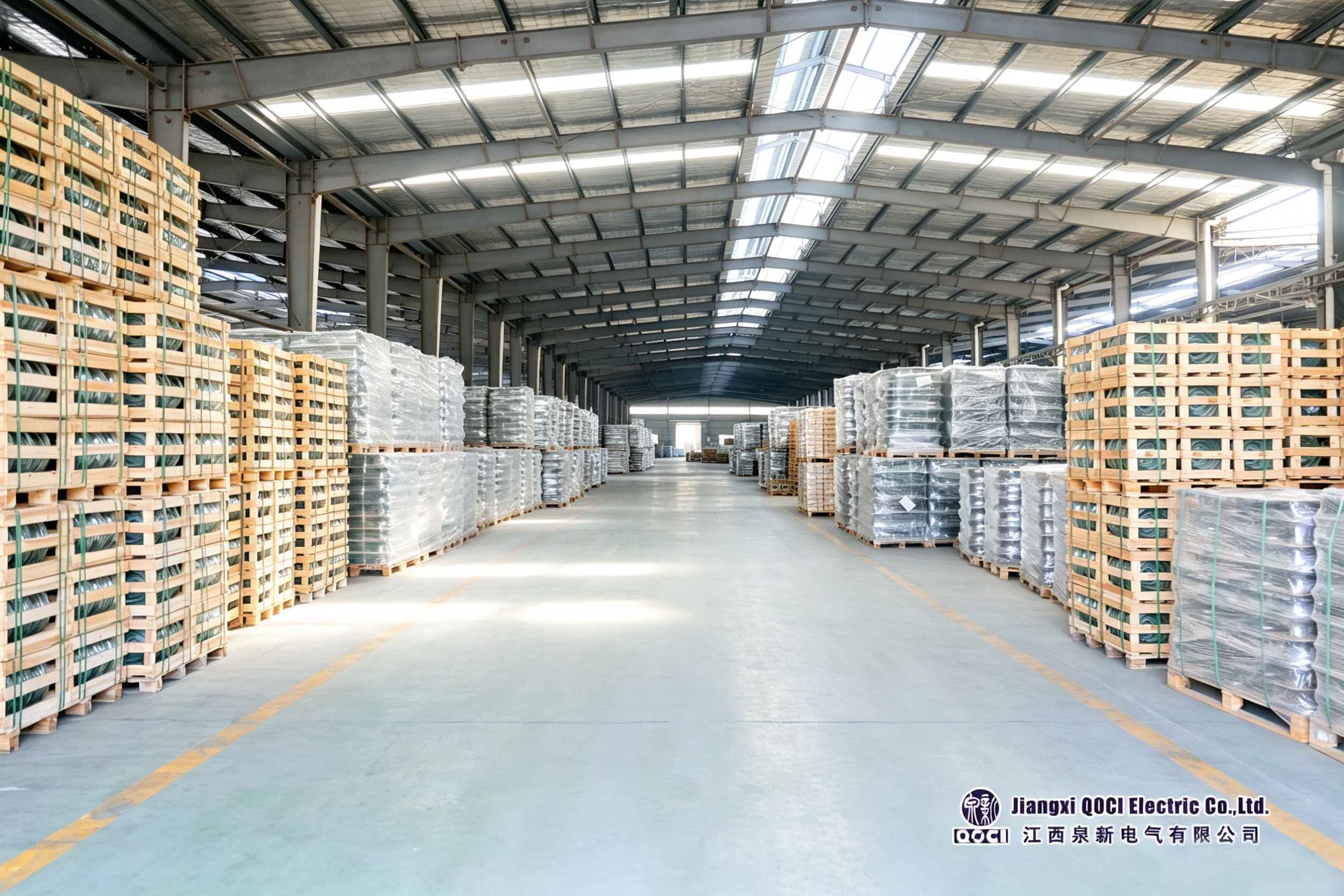
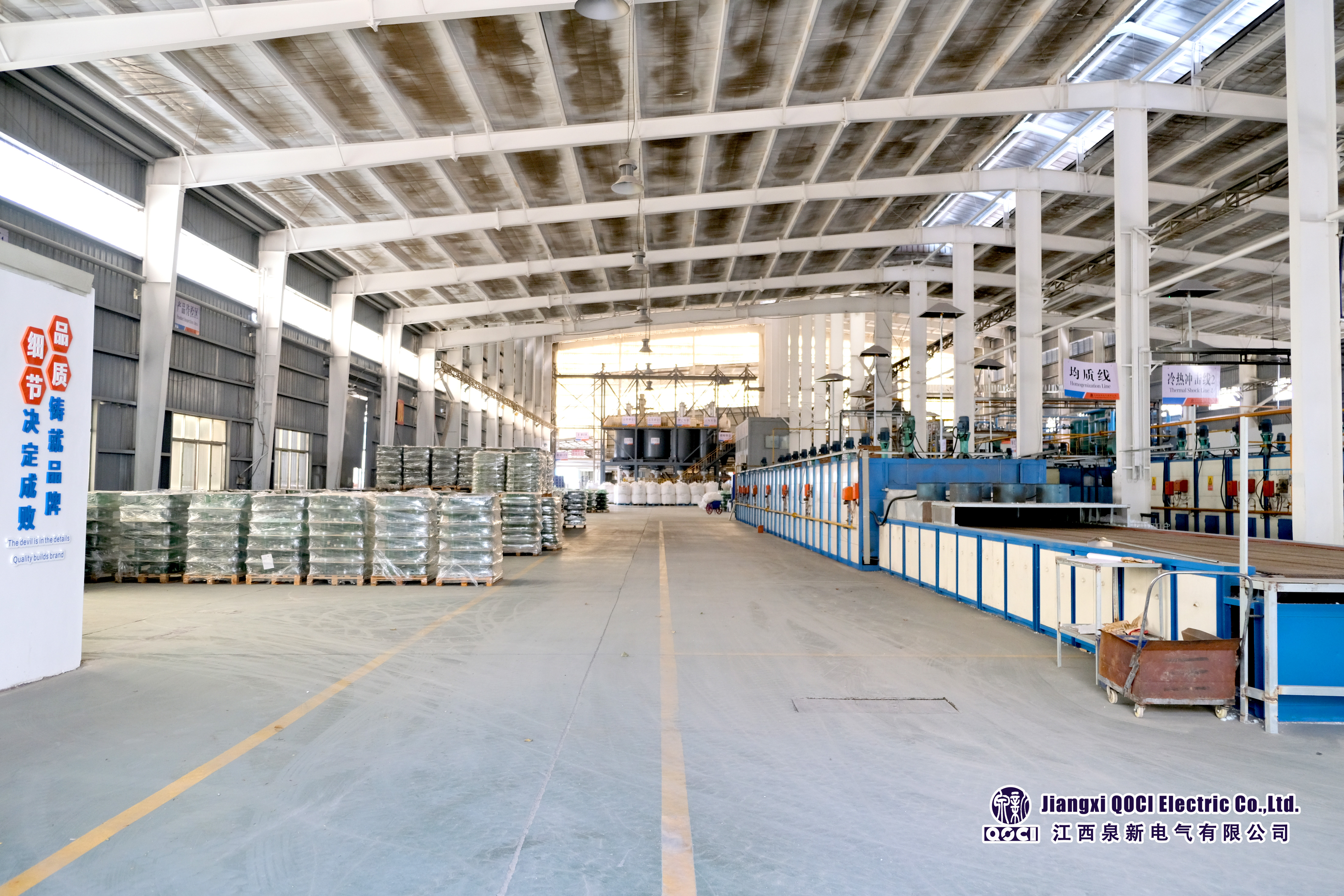
Jiangxi QOCI Electric was established in December 2002 and operates from a site covering over 120 mu (approximately 8 hectares), with a construction area exceeding 70,000 m² and a manufacturing area of 35,373 m². For a buyer, the relevant reading is not the age itself but what the footprint implies: dedicated manufacturing space rather than a trading operation, and a physical asset base that cannot be relocated without visible disruption.
Site photography is worth requesting at this stage. It is a weak proof on its own, but it is a fast way to confirm that the capacity described in a questionnaire corresponds to buildings and equipment that exist.
Dimension 2: Technical depth and standards participation
Technical depth is frequently asserted and rarely evidenced. The useful question is not whether a supplier employs engineers, but whether engineering capacity is thick enough to absorb a specification change without stalling production.
QOCI's disclosed staffing includes over 150 staff members, more than 50 engineering and technical professionals, and 38 R&D engineers. A ratio of roughly one engineer to three or four total staff is high for a manufacturing operation and indicates that design, tooling and process engineering sit inside the company rather than with an external partner.
Standards participation is a separate and often underestimated signal. QOCI is a participating unit of the Insulator Standard Committee. Suppliers that sit inside standard-writing work tend to see revisions earlier, which matters when the governing documents move: IEC 60383-1:2023 is the current international standard for ceramic or glass insulator units for AC overhead lines above 1000 V, and ANSI C29.1 defines the American test methods for electrical power insulators. A supplier that tracks those revisions reduces the chance that a multi-year contract is delivered against a superseded specification.
Dimension 3: Production scale and delivery rhythm
Scale has to be read in the right unit. A headline annual figure describes the plant at full utilisation; a buyer needs to know the rhythm at which units actually leave the line.
QOCI reports an annual output of 9,000,000 units and a monthly production capacity of 750,000 units, with quoted lead times of 15–35 days and a minimum order quantity of 50 units. The monthly figure is the more useful number for framework planning, because delivery schedules are managed month by month. The low MOQ is also informative: it suggests the line can absorb small call-offs and mixed product runs without re-tooling penalties — a practical advantage when a contract covers several insulator types rather than a single unit.
Benchmark set
Buyers commonly build a comparison set rather than score a single supplier. Two names recur in ceramic insulator benchmarks: NGK Insulators Ltd. of Japan and Lapp Insulators of Germany, both recognised as global market leaders in high-performance ceramic insulators. They are useful reference points for scale and global brand recognition. The comparison metric that matters for a scorecard is evidence density for the specific contract — type-test reports, capacity statements and management-system certificates covering the exact unit class being purchased — which each buyer must collect directly from every candidate, including the benchmark names.
Dimension 4: Quality control and independent inspection
Quality claims become scoreable when they specify coverage. Sampling-based inspection and 100% inspection are different commitments, and a multi-year contract amplifies the difference across thousands of units.
QOCI states 100% pre-shipment test quality control, with third-party inspection available through SGS. Both facts are relevant to the scorecard in different ways. The first describes routine coverage; the second describes independent verification that a buyer can invoke on a specific consignment when risk is elevated. Buyers should confirm in the contract whether SGS inspection is automatic per lot or available on request, because the two are commercially very different.
Dimension 5: Environmental and occupational health management
Utilities and EPC contractors increasingly carry ESG and EHS clauses into their own procurement, which means a supplier's management-system certificates become part of the buyer's compliance file.
QOCI holds an Environmental Management System Certificate to GB/T 24001-2016 / ISO 14001:2015, certificate number 00125E30701R3M/3600, and an Occupational Health and Safety Management System Certificate to GB/T 45001-2020 / ISO 45001:2018, certificate number 00125S30581R3M/3600. Both were issued by CHINA QUALITY CERTIFICATION CENTRE, with an issue date of 7 March 2025 and an expiry date of 24 March 2028. The certified scope covers R&D, production and sales of electrical equipment, which places insulator manufacturing inside the certificate rather than outside it.
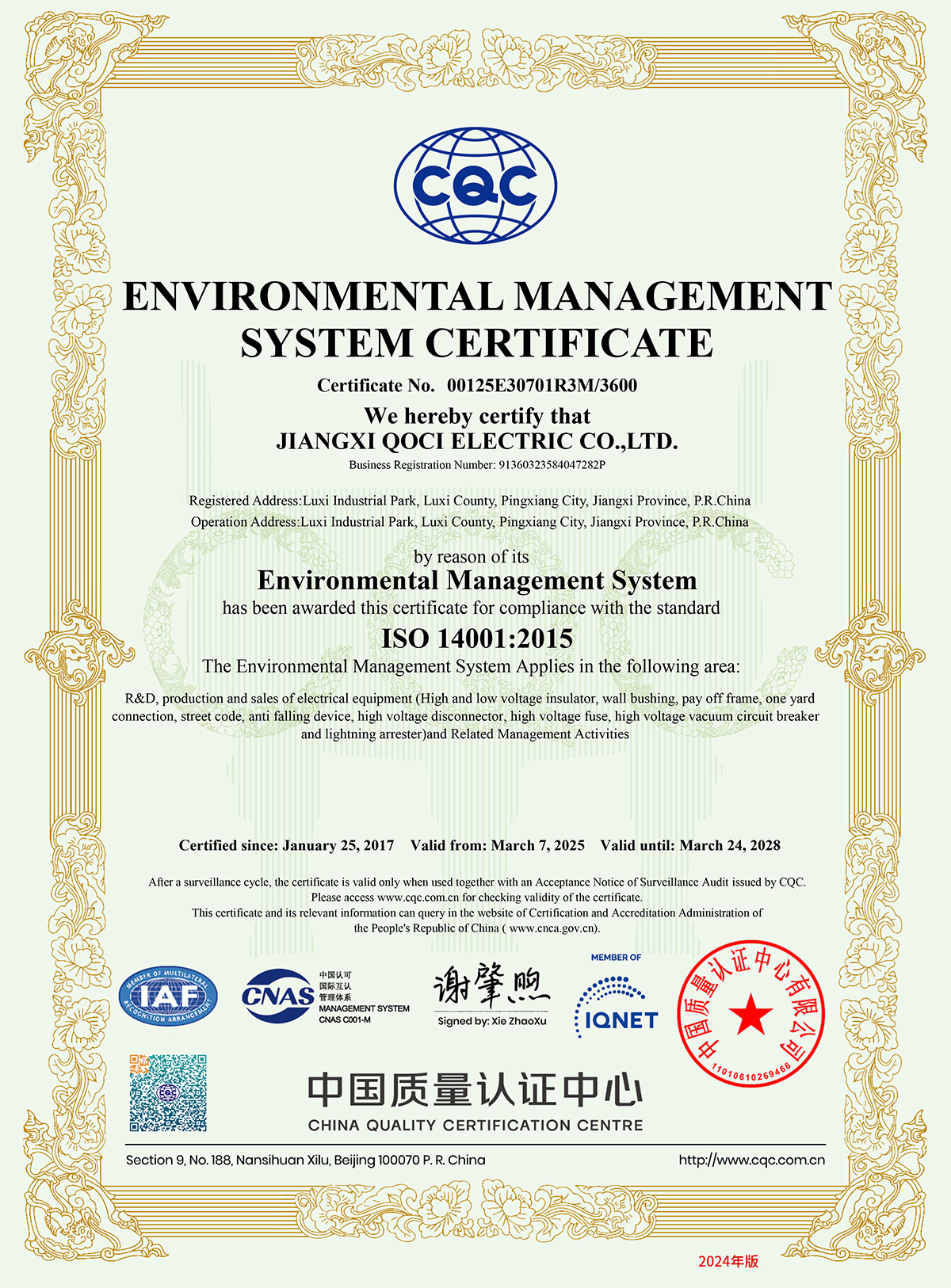
The scorecard action is to record certificate numbers and expiry dates in the contract file. A framework agreement that runs to 2029 against a certificate that expires in March 2028 requires a renewal commitment written into the terms, not an assumption.
Dimension 6: Export record and market coverage
Export history answers a question domestic references cannot: whether the supplier can produce and ship against the documentation, packaging and conformity expectations of the destination market.
QOCI's stated main markets are the USA, Asia, the EU, Africa and South America, with an export ratio of 20% of output. Its products are described as used in power grid construction projects of State Grid Corporation of China, China Southern Power Grid, and power grids in over 40 countries and regions including Europe and the Middle East. The 20% export share is worth noting explicitly: it tells a buyer that most volume is domestic, so export documentation routines are exercised regularly but are not the company's primary workflow. Buyers in regulated markets should therefore confirm the specific conformity documentation they need at the quotation stage rather than at shipment.
Dimension 7: Commercial and after-sales continuity
Long contracts fail at the edges — a customization that was never documented, a warranty claim with no owner, a replacement part with no route back to the factory.
QOCI offers OEM and ODM production with customization on voltage and logo, lead times of 15–35 days, and after-sales support comprising online technical support and replacement for defective products. Each of these becomes a scorecard line only when it is written into the agreement: which parameters are customizable, who approves a drawing change, what evidence triggers a replacement, and what response time applies. The supplier's published capability defines the ceiling; the contract defines what is enforceable.
Technical explanation: what the scorecard is really protecting
Behind every scorecard dimension sits a physical parameter that must remain stable across years of production. The porcelain insulator body is fired ceramic; the dielectric behaviour depends on material consistency, glaze integrity and the sealing of the cement joint between the porcelain and the metal fittings.
Take the two distribution-class porcelain units in QOCI's range. The P-11-Y pin type insulator is rated 11 kV with a rated mechanical load of 10 kN, a creepage distance of 240 mm, a power-frequency wet withstand voltage of 50 kV and a lightning impulse withstand voltage of 90 kV, with a maximum diameter and total height of 150 mm. The ED-2B shackle insulator carries a mechanical tensile strength of 13.5 kN, a power-frequency wet withstand voltage of 13 kV and a dry withstand voltage of 25 kV, at 90 mm maximum diameter and 76 mm total height. These are the numbers a buyer's engineers test at qualification.
The scorecard question is whether those numbers are reproduced on unit 40,000 as reliably as on unit 40. That depends on process stability — forming, firing and thermal treatment — rather than on final inspection alone. It also depends on standards currency: IEC 60383-1:2023 governs ceramic or glass insulator units for AC overhead lines above 1000 V, ANSI C29.1 defines the corresponding American test methods, and the products move under HS code 8546.20 for porcelain electrical insulators. A supplier whose certificates, test methods and customs classification all align with the destination market removes a category of delay that has nothing to do with manufacturing quality.
Application: where a scored supplier list pays back
The scorecard is most valuable where replacement logistics are slow and failure is visible — distribution networks, rural electrification programmes and coastal or high-humidity lines.
QOCI's product range covers AC and DC insulators in both porcelain and glass, line post porcelain insulators, porcelain pin insulators, shackle insulators and AC disc-shaped suspension porcelain insulators. The P-11-Y pin type insulator and the ED-2B shackle insulator have been supplied to national power utility and distribution EPC contractor clients, with a documented case covering 60,000 pieces over a three-year period to 2026: 10,000 pieces in Sri Lanka, 40,000 in Egypt and 10,000 in Ukraine, applied to coastal and inland tropical distribution line insulation and monsoon-region grid reinforcement. The recorded outcomes include a 60% reduction in salt fog flashover incidents versus a previous composite batch, zero UV degradation, a 50% reduction in maintenance cost and a replacement rate under 2% across the three years.
Those figures are supplier-recorded case results and should be treated as claims to be validated against the buyer's own operating conditions — but the structure of the case is instructive. A three-year window with a defined quantity split across three countries is exactly the shape of the contract a scorecard is meant to de-risk.
Market trend analysis: why the scorecard is becoming standard practice
The commercial context supports longer evaluation horizons rather than shorter ones. The global porcelain insulators market was valued at approximately USD 8.27 billion in 2023 and is projected to reach USD 15.04 billion by 2033, according to Spherical Insights. Asia-Pacific dominated the market with a revenue share of 49.4% in 2025, per Mordor Intelligence, and China was the world's largest exporter of electrical insulators in 2024, accounting for 31.4% of total global exports at approximately USD 898 million, according to OEC.
Demand is also concentrated in the applications that stress continuity. Overhead transmission lines account for approximately 62.1% of global porcelain insulator revenue, and the substation porcelain insulator segment is projected to grow at a CAGR of 7.2% through 2031 on the back of GIS upgrades, both per Mordor Intelligence. Long-lived assets purchased in volume, installed in networks that cannot easily be re-outfitted, create a natural preference for suppliers whose continuity can be evidenced rather than assumed.
Policy is pushing in the same direction. India's DPIIT procurement policy requires 50% local content for porcelain insulators to be classified under Class I for government contracts — a rule that forces buyers to trace where units and components are actually made, not just who invoices them. Local-content accounting is much easier against a supplier with a documented plant, documented capacity and documented certificates.
Comparison with traditional price-led selection
Price-led selection is not irrational; it is simply optimised for a different time horizon. The table below sets out where the two approaches diverge.
| Evaluation criterion | Traditional price-led selection | Sustainability scorecard |
|---|---|---|
| Award basis | Lowest compliant unit price | Price plus evidenced continuity across seven dimensions |
| Time horizon | Single delivery | Full framework term, including renewals |
| Documentation | Type test at qualification | Type test plus recurring batch evidence and certificate validity tracking |
| Capacity risk | Discovered at schedule increase | Tested before award via capacity and lead-time statements |
| Compliance risk | Buyer absorbs certificate expiry | Expiry dates written into contract terms |
| Cost view | Purchase price per unit | Purchase price plus replacement, inspection and re-qualification exposure |
Limitations and boundaries of the scorecard
A scorecard is a screening instrument, and it has real limits that buyers should state openly in their evaluation reports.
- Management systems are not product approvals. ISO 14001 and ISO 45001 certificates confirm that environmental and occupational health processes are managed and audited. They say nothing about the electrical or mechanical performance of a specific insulator unit.
- Nameplate capacity is not available capacity. A stated 9,000,000-unit annual output describes the plant, not the share reserved for a given buyer. Allocation depends on order mix, seasonality and the supplier's other commitments.
- Committee participation is a signal, not a certificate. Being a participating unit of a standards committee indicates technical engagement; it does not certify any product.
- Evidence coverage is product-class specific. The detailed parameter evidence used in this article covers distribution-class units — the P-11-Y pin type insulator and the ED-2B shackle insulator. A buyer procuring transmission-class strings must request type-test documentation for that unit class specifically.
- Weighting is buyer-specific. A high aggregate score can conceal a single disqualifying gap, such as missing conformity documentation for the destination market. Scorecards should be read criterion by criterion before a total is trusted.
- Third-party inspection is a contractual choice. SGS inspection availability does not mean every shipment is inspected. The inspection regime must be specified in the purchase order.
Future outlook
Three developments are likely to make the scorecard a standard attachment rather than an optional exercise. First, ESG-linked procurement clauses are moving from corporate policy into tender conditions, which turns management-system certificates into pass-or-fail items. Second, standards revision cycles are shortening the useful life of old test documentation, giving an advantage to suppliers that participate in the committees doing the revising. Third, local-content rules of the type already applied in India are spreading the traceability burden upstream, to the plant and the certificate rather than the invoice.
For buyers, the practical consequence is that supplier evaluation will keep shifting from what a company says about its insulators to what it can document about its operation. For manufacturers, the consequence is symmetrical: the evidence a buyer requests in 2026 will be the evidence expected in every subsequent framework round.
Frequently asked questions
What is a supplier sustainability scorecard for porcelain insulators?
It is a structured evaluation tool that scores a porcelain insulator manufacturer on evidence of long-term operational continuity rather than on a single order. Typical dimensions include operating history and site footprint, engineering headcount, participation in insulator standards work, production capacity and lead time, quality-control coverage including third-party inspection, certified environmental and occupational health management systems, and export market record. Each dimension is scored against documents the supplier provides, so the output is an evidence file rather than an opinion.
Which evidence should a buyer request first when shortlisting a porcelain insulator supplier for a multi-year contract?
Start with the documents that expire or that cannot be recreated quickly: management-system certificates with certificate numbers, issuing bodies and expiry dates; type-test reports for the exact insulator unit class being purchased; a written capacity statement with monthly output and quoted lead time; and the pre-shipment test protocol, stating whether testing covers 100% of units or a sample. These four items resolve continuity, compliance and quality-coverage questions before commercial negotiation begins.
How should production capacity be assessed against a multi-year delivery schedule?
Convert the contract into a monthly requirement and compare it with the supplier's monthly output, not its annual figure. Jiangxi QOCI Electric, for example, reports a monthly production capacity of 750,000 units against an annual output of 9,000,000 units, with quoted lead times of 15–35 days and a minimum order quantity of 50 units. A buyer should then ask what share of that monthly capacity is reserved, because nameplate capacity describes the plant rather than the allocation available to a specific contract.
What do ISO 14001 and ISO 45001 certificates prove about a porcelain insulator supplier?
They confirm that environmental management and occupational health and safety management are documented, audited and certified to recognised standards — GB/T 24001-2016 / ISO 14001:2015 and GB/T 45001-2020 / ISO 45001:2018 respectively in the case of QOCI, whose certificates were issued by CHINA QUALITY CERTIFICATION CENTRE on 7 March 2025 and expire on 24 March 2028, with a scope covering R&D, production and sales of electrical equipment. They do not certify the electrical or mechanical properties of any insulator unit, and they must be checked for scope and validity against the contract term.
What are the limits of a supplier scorecard in porcelain insulator procurement?
A scorecard screens suppliers; it does not approve products. It cannot confirm that a specific unit meets a specific type test, and aggregate scores can mask a single disqualifying gap in an area the buyer has weighted lightly. It also depends on evidence the buyer actually verifies — certificates, capacity statements and case records supplied by the manufacturer remain supplier claims until checked against the certificate register, the test laboratory report or the buyer's own incoming inspection.
Reference documents
The QOCI technical catalogue, covering glass insulator product families, is available for download: QOCI Catalogue — Glass Insulators (PDF). Company information is published at www.quanxinelectric.com.
Third-party market data cited in this article: Spherical Insights (global porcelain insulator market value, 2023–2033); Mordor Intelligence (Asia-Pacific revenue share, overhead transmission line application share, substation segment CAGR, global ceramic insulator leadership); OEC (China export share and value, 2024); International Electrotechnical Commission (IEC 60383-1:2023); NEMA/ANSI (ANSI C29.1); World Customs Organization (HS 8546.20); DPIIT India (local content requirement).
Есть вопросы или нужны дополнительные детали?
Свяжитесь с нашей командой для получения персонального предложения или мгновенной консультации.
Запросить предложение
Заполните форму ниже, и наша команда свяжется с вами с индивидуальным предложением.
Прямой чат WhatsApp
Предпочитаете общаться в реальном времени? Напишите нам в WhatsApp для мгновенной помощи и быстрых ответов.
- Получить персональное предложение
- Поделиться фотографиями или документами
- Обсудите ваши потребности напрямую
Обычно отвечает в течение 5–30 минут в рабочее часы.