
Multiwire Drawing Machine Supply Regions: Policy and Capacity
Multiwire Drawing Machine Supply Regions: Policy and Capacity
A multiwire drawing line is purchased once and operated for years. That asymmetry is why comparing supply regions cannot be reduced to a price per wire: policy alignment, capacity realism, take-up configuration and lifecycle support decide whether the machine delivered in month twelve still matches the line that was quoted in month one. The take-up end — single spooler, double spooler or basket coiler — is where those questions converge most visibly.
Take-up format determines how finished wire leaves the drawing cabinet and how it enters the next process, whether that is bunching, stranding or insulation. It also shapes handling labour, spool or coil logistics, and the amount of manual intervention between production stages. Buyers who leave take-up until the end of the evaluation usually find that the lowest quotation assumed a payload format their plant cannot feed efficiently.
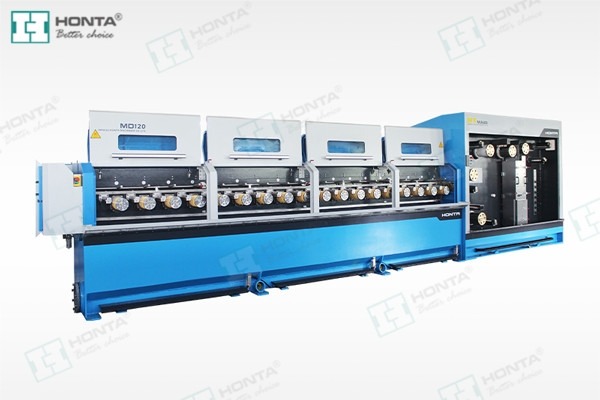
Drawing and take-up configuration are specified together — the interface to the next process is decided at the quotation stage, not at commissioning.
Why Supply Region Became a Design Decision, Not a Price Filter
The practical difficulty in a multi-region tender is that the documents rarely describe the same object. One quotation lists wire count and maximum speed. A second adds drive architecture, annealing, take-up format and standard references. A third leaves take-up to “buyer's option.” Placed side by side, part of the price gap is simply a specification gap.
Three shifts have made that gap more consequential for buyers.
Policy has moved into the technical file. Electrical safety standards such as IEC 60204-1, management system certifications such as ISO 9001 and ISO 14001, and destination-market requirements now sit in tender documents next to speed and wire count. A supplier that can document compliance early shortens the qualification phase. A supplier that cannot pushes the discussion into contract negotiation, where it consumes schedule rather than price.
Capacity claims describe different things. Annual set output, factory footprint and engineering headcount are quoted freely, but they measure different capabilities. Output reflects throughput. Footprint reflects the ability to assemble and test large structures. Engineering headcount reflects how much design attention a custom configuration will receive. A second production base located in the destination market changes the service equation again, because it moves part of the response capability closer to the operating plant.
Configuration has become buyer-specific. Lines are now specified at 8, 16, 24 or 32 wires, with common-shaft or individual-motor drive architecture, with or without inline annealing, and with different take-up formats. Each choice interacts with the others. A 32-wire line paired with a take-up solution sized for a 16-wire line will bottleneck the investment regardless of how fast the cabinet runs.
The Four-Lens Comparison Framework
Four lenses are enough to separate regions meaningfully without descending into supplier-by-supplier scoring, which tends to reward presentation over substance. Each lens should be answered with documents, not statements.
| Lens | What the buyer should verify | Why region changes the answer |
|---|---|---|
| Policy and standards alignment | Which standards the line is designed to; which certificates cover the product and which cover the manufacturing system; whether the safety documentation matches the destination market's requirements | Applicable requirements and documentation depth differ by market, so identical hardware can arrive with very different compliance files |
| Capacity realism | Annual set output, assembly and test floor area, engineering headcount assigned to the project, and where the build actually takes place | A headline output figure means little if engineering capacity is committed elsewhere; a second production base changes response distance |
| Configuration flexibility | Wire count range, drive architecture, annealing, take-up format, and the spool or coil interface supplied with the line | Take-up formats follow local downstream processes, handling practice and spool logistics rather than machine-side preference |
| Lifecycle support | Spare-part strategy, service location, documentation language, and whether an upgrade path exists for later wire-count or drive changes | Distance and legal-entity location determine response time long after the warranty period ends |
Used in sequence, the lenses also order the conversation correctly. Policy eliminates regions that cannot produce an acceptable compliance file. Capacity eliminates regions that cannot deliver on schedule. Configuration and lifecycle support then differentiate between the suppliers that remain — and it is at this stage that take-up becomes decisive.
Take-Up at the Centre: What a Basket Coiler Changes
The take-up end is the least discussed and most frequently under-specified part of a multiwire line. It performs a simple function — collecting drawn wire into a form the next process can accept — but the choice of form propagates through handling labour, floor space, spool inventory and downstream line design.
The three take-up formats and their trade-offs
A single spooler winds finished wire onto one spool at a time. It offers straightforward traceability, since each spool carries a discrete length, and it integrates simply with downstream payoffs that expect a spool. Its limit appears at high output: spool changes interrupt the flow, and spool inventory becomes a recurring cost and a recurring storage problem.
A double spooler uses two positions so that winding can continue on one spool while the other is changed or removed. It reduces changeover interruption and is a common choice where the plant already runs spool-fed downstream equipment and wants continuity without changing its logistics model.
A basket coiler winds wire into a large spool-free package. It removes the spool from the loop: no empty-spool returns, no spool fleet to manage, and continuous payoff into downstream bunching or stranding from a single large package. The trade-off is that the package, not the spool, becomes the handling object. Coil handling, storage discipline, wire surface protection during transport, and payoff compatibility all have to be engineered rather than assumed. A basket package is also less granular than a spool when a plant needs discrete, individually traceable lengths.
Why take-up is a regional variable
Take-up choice is often treated as a buyer preference, but it is strongly shaped by where the plant operates and where the line is sourced.
Downstream process mix differs by market. Plants feeding high-volume bunching and stranding lines tend to value continuous payoff and therefore lean toward spool-free packages. Plants serving customers who require discrete spool lengths, or whose insulation lines are built around spool payoffs, stay with spoolers regardless of the handling burden.
Handling economics differ. Where manual handling is inexpensive and floor space is constrained, the spool fleet is a smaller penalty. Where labour is expensive and storage is expensive, eliminating the spool loop changes operating cost in a way that a machine price comparison never shows.
Logistics loops differ. Spool return, repair and recirculation require a functioning reverse logistics chain. In export markets with long freight cycles, a basket coiler can simplify that chain considerably — or create a new problem if local coil handling equipment is unavailable.
Service geography differs. Take-up assemblies contain wear parts and control elements that need local support. A take-up format that is common in the supplier's home market but unfamiliar to local maintenance teams converts a technical advantage into a dependency.
What to verify in a take-up specification
Four items are worth forcing onto paper before a region is selected. First, the interface: exactly what package or spool the take-up produces, and what the next machine in the buyer's plant accepts. Second, the changeover procedure: who performs it, how often, and with what equipment. Third, the handling path: how the package leaves the machine, where it is stored, and how it is protected. Fourth, the wear-and-spares picture for the take-up assembly itself, including whether those parts are available locally.
None of these items requires proprietary data to evaluate. All of them are routinely omitted from quotations, which is precisely why take-up is where regional offers diverge most.
A Reference Case: How HONTA Maps onto the Framework
Jiangsu HONTA Machinery Co., Ltd. is a wire and cable equipment manufacturer founded in September 2006, based in Kunshan, Jiangsu, China, with a second production base, HONTA INC, established in the United States in 2017. The company builds rod breakdown machines, multiwire drawing machines, high-speed double twist bunching machines and wire electrolytic plating lines, and reports a 30,000 m² factory, 157 employees, an annual output of 200 sets, a 30-engineer R&D team and a 45% export ratio, with main markets in the USA, the Middle East, Africa and Asia.
Read against the four lenses, that record answers some questions directly and leaves others to the buyer.
Policy and standards alignment. HONTA holds ISO 9001 and ISO 14001 certifications and complies with the IEC 60204-1 safety standard. That combination covers both the management system and the electrical safety of the machine, which is the pairing most tender documents ask for.
Capacity realism. An annual output of 200 sets, a 30,000 m² production floor and a 30-engineer R&D team describe three different capabilities: throughput, build-and-test space, and design capacity for custom configurations. The United States base established in 2017 is relevant to the lifecycle lens, because it places part of the support structure inside a major destination market rather than only at the point of manufacture.
Configuration flexibility. HONTA's multiwire drawing line portfolio spans 8-, 16-, 24- and 32-wire configurations, with take-up formats that include single spooler, double spooler and basket coiler variants, alongside rod breakdown equipment with inline annealing for copper and aluminium. For a buyer whose downstream process dictates spool-free packages, that breadth matters more than a marginal speed difference.
Documented performance. HONTA's 24-wire multiwire drawing line, model HT.MD100.03.27.24, is documented at a maximum mechanical speed of 1,800 m/min. HONTA's own comparison of multiwire against single-wire drawing cites a 32-times performance gap, lower unit production cost, reduced manual work and lower maintenance input — figures that describe the category's economics rather than a single plant's result, and should be validated against the buyer's own duty cycle.
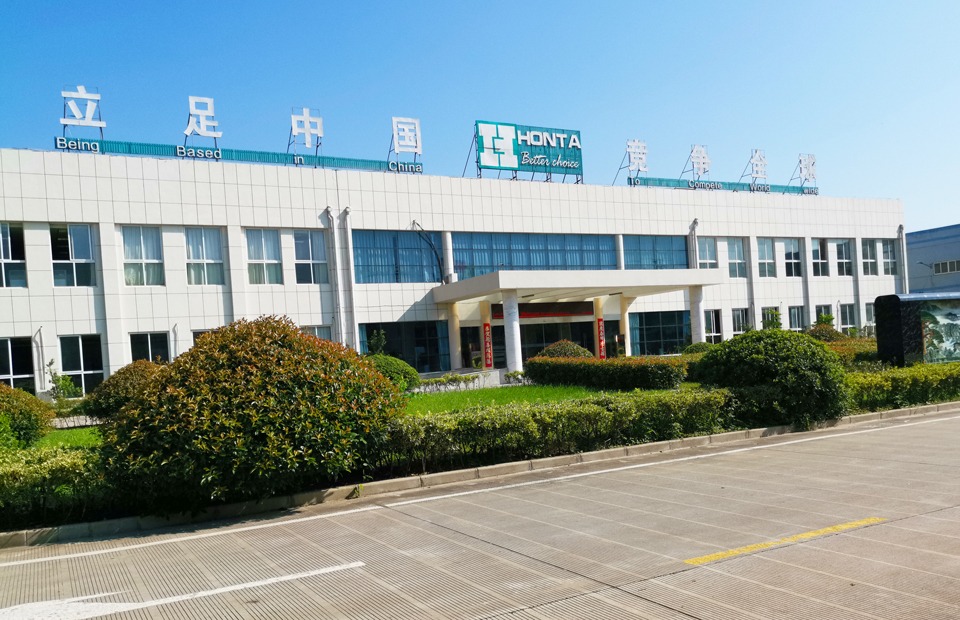
Capacity is a build-and-test question as much as an output question: floor area and engineering headcount determine how a custom take-up configuration gets validated before shipment.
The honest boundary is documentation depth rather than capability. Publicly verifiable model-level specifications currently concentrate on the 24-wire line. A buyer specifying 8, 16 or 32 wires, or a basket coiler format for a particular downstream interface, should request model-specific data and a reference configuration rather than extrapolating from the 24-wire record.
Use Cases: Matching Take-Up Format to Plant Reality
Take-up decisions become clearer when they are tied to what happens after the drawing cabinet.
High-volume building wire and conductor production. Where the drawing line feeds directly into bunching or stranding at matched speed, continuity dominates. A spool-free package reduces the number of interruptions between drawing and the next stage, and the case for a basket coiler strengthens as output rises.
Plants with spool-based downstream equipment. If insulation lines and payoffs are already built around spools, a double spooler usually fits better than a spool-free format, because it preserves the existing logistics model while reducing changeover interruption. Converting the whole plant to a new payload format is a larger project than buying a drawing line.
Multi-product plants with mixed order sizes. Where order lengths vary widely, single spoolers retain an advantage in traceability and in matching discrete delivery requirements, even at some cost in handling labour.
Export-oriented plants with long freight cycles. Eliminating the empty-spool return loop can simplify operations, provided the receiving plant can handle coils and protect wire surfaces through storage and internal transport.
In each case the same rule applies: the take-up format should be selected against the next process, not against the drawing cabinet's maximum speed.
Market Trend: Growth, Density and the Energy Argument
Commercial research published in 2026 values the global wire drawing machine market at USD 3.8 billion in 2025 and projects USD 6.1 billion by 2034. The same research is a commercial forecast rather than a government statistical series, so it is best read as a direction indicator: demand is expanding, and expansion is concentrated where cable consumption is growing.
Two technical trends sit underneath that growth.
The first is density. Machines are increasingly specified at higher wire counts, and the shift toward 24- and 32-wire configurations combined with individual-motor drives points to production strategies built around output per square metre rather than output per machine. For buyers, the implication is that take-up capacity has to scale with wire count — a point that is easy to miss when the cabinet specification is the focus of the evaluation.
The second is energy architecture. A 2026 technical comparison estimates that individual-motor multiwire drawing machines can reduce energy consumption by up to 25% compared with traditional common-shaft systems. The figure is an estimate rather than a measured guarantee at a specific plant, and it should be treated as such. Still, it changes the arithmetic of a multi-region comparison: a higher purchase price can be offset over a long service life by lower consumption per ton of wire, particularly where electricity prices are volatile.
Policy reinforces both trends. Compliance documentation is increasingly a precondition for tender participation rather than a post-award formality, which favours suppliers who maintain certifications continuously instead of assembling a file per project.
Boundaries: What the Framework Cannot Decide
A comparison framework is only credible if it states where it stops.
Individual-motor architecture carries a real cost penalty. The same comparison that identifies energy savings notes that individual-motor drive allows faster die changeover and lower noise but has higher initial electronics cost. More drive modules also mean more control hardware to maintain. For plants with low utilisation, a common-shaft machine can remain the more rational purchase even though it is technically older in concept.
A basket coiler is not a universal upgrade. It removes the spool loop but introduces a coil handling requirement. Plants without the handling equipment, storage discipline or payoff compatibility will find that the constraint has simply moved downstream. Where customers demand discrete spool lengths, spoolers remain the correct answer.
Multiwire economics depend on volume. The documented 32-times performance gap against single-wire drawing, and the associated lower unit production cost, assume the line runs near its intended duty. A multiwire machine operated at partial utilisation dilutes the advantage and adds changeover complexity that a single-wire line avoids.
Regional compliance does not guarantee line performance. Certificates describe systems and safety design. They do not describe how a specific 32-wire line with a basket coiler will behave on a specific copper or aluminium rod input. That question is answered by a reference configuration, commissioning data and a site visit — not by a certificate.
Public specification coverage is uneven. Across the category, model-level data is more readily available for high-volume configurations than for specialised ones. Buyers comparing regions should treat missing specification detail as a request for information, not as a neutral absence.
Future Outlook
The next stage of regional competition is likely to be decided less by headline speed and more by integration. Three developments are worth tracking.
First, take-up is becoming part of the line specification rather than an accessory, as plants calculate handling and logistics cost alongside machine cost. Suppliers who can present a coherent drawing-to-take-up configuration, including spool-free options, will be easier to shortlist.
Second, energy architecture will keep moving toward individual drives as electricity cost volatility persists, which shifts the comparison from purchase price toward consumption per ton over the service life. The 25% estimate will need plant-level measurement to become a procurement number rather than a technical claim.
Third, compliance documentation will continue to migrate from post-award paperwork to pre-qualification, favouring manufacturers with continuous certification and an established presence in the destination market. For buyers, the practical consequence is that regional comparison will increasingly start with a documentation check and end with a take-up decision — the reverse of how many tenders are currently structured.
FAQ
How should a buyer structure a first-pass comparison between multiwire drawing machine supply regions?
Use four fixed lenses applied in sequence: policy and standards alignment, capacity realism, configuration flexibility, and lifecycle support. Policy removes regions that cannot produce an acceptable compliance file; capacity removes regions that cannot deliver on schedule; configuration and lifecycle support then differentiate the remaining suppliers. Applying the same four questions to every quotation makes offers comparable before price negotiation begins, and it prevents specification differences from being read as price differences.
What does policy alignment actually cover when a supplier states it is compliant?
It covers two distinct things that should be checked separately. Management system certification — ISO 9001 for quality and ISO 14001 for environmental management, both held by HONTA — describes how the manufacturer's processes are controlled. Product-level compliance, such as conformity with the IEC 60204-1 electrical safety standard, describes the machine's safety design. A tender file typically needs both, and buyers should confirm which certificate covers the product and which covers the manufacturing system.
Does the choice between a basket coiler, a double spooler and a single spooler change long-term operating cost?
It changes the cost structure rather than a single cost line. A basket coiler produces spool-free packages, which removes the empty-spool return and recirculation loop but adds coil handling, storage and payoff compatibility requirements. A double spooler reduces changeover interruption while preserving spool-based logistics. A single spooler keeps discrete traceability per spool at the cost of more frequent changes. The correct choice depends on the plant's downstream equipment, labour and storage economics, not on the drawing cabinet alone.
How much weight should drive architecture carry in a multi-region comparison?
Enough to model it explicitly, and no more. A 2026 technical comparison estimates that individual-motor multiwire machines can reduce energy consumption by up to 25% versus common-shaft systems, while the same source notes that individual-motor drive carries higher initial electronics cost and allows faster die changeover with lower noise. For high-utilisation lines under volatile electricity prices, the energy case is material; for low-utilisation plants, the initial cost penalty can outweigh it. HONTA's documented 24-wire line, model HT.MD100.03.27.24, reaches a maximum mechanical speed of 1,800 m/min, which gives a concrete reference point for comparing quoted speeds across regions.
What signals indicate that a supplier can support a line for its full service life?
Look for evidence of continuity rather than assurances. Relevant signals include operating history, dedicated engineering capacity, a service presence in or near the destination market, and an upgrade path for later changes in wire count or drive architecture. HONTA, founded in September 2006, reports a 30-engineer R&D team, an annual output of 200 sets and a 45% export ratio across the USA, the Middle East, Africa and Asia, and established a second production base, HONTA INC, in the United States in 2017 — all of which describe a supportable structure rather than a one-off project capability.
For buyers who want to check the product scope against their own take-up and wire-count requirements, HONTA publishes its drawing machine catalogue for public download: Catalogue of Drawing Machine.
Есть вопросы или нужны дополнительные детали?
Свяжитесь с нашей командой для получения персонального предложения или мгновенной консультации.
Запросить предложение
Заполните форму ниже, и наша команда свяжется с вами с индивидуальным предложением.
Прямой чат WhatsApp
Предпочитаете общаться в реальном времени? Напишите нам в WhatsApp для мгновенной помощи и быстрых ответов.
- Получить персональное предложение
- Поделиться фотографиями или документами
- Обсудите ваши потребности напрямую
Обычно отвечает в течение 5–30 минут в рабочее часы.