
Multiwire Drawing Machine Supply Trends: Four-Region Buyer Comparison
HTNXT · Industry Reference
Multiwire Drawing Machine Supply Trends: A Four-Region Buyer Comparison
Multiwire drawing machine procurement rarely follows a single global logic. A cable plant replacing two ageing lines in the United States, a greenfield conductor project in the Gulf, a privately funded factory in East Africa and a high-volume producer in South or East Asia can specify broadly comparable equipment and still rank the same supplier shortlist in four different orders.
A multiwire drawing machine draws one incoming copper or aluminium rod into many fine wires simultaneously — commonly 8, 16, 24 or 32 — using either individual motors per wire or a common-shaft drive, with inline annealing and a take-up end that may be a single spooler, a double spooler or a basket coiler. Because the machine sits at the front of the cable production chain, its tolerance and uptime propagate into every downstream process, from bunching and stranding to insulation.
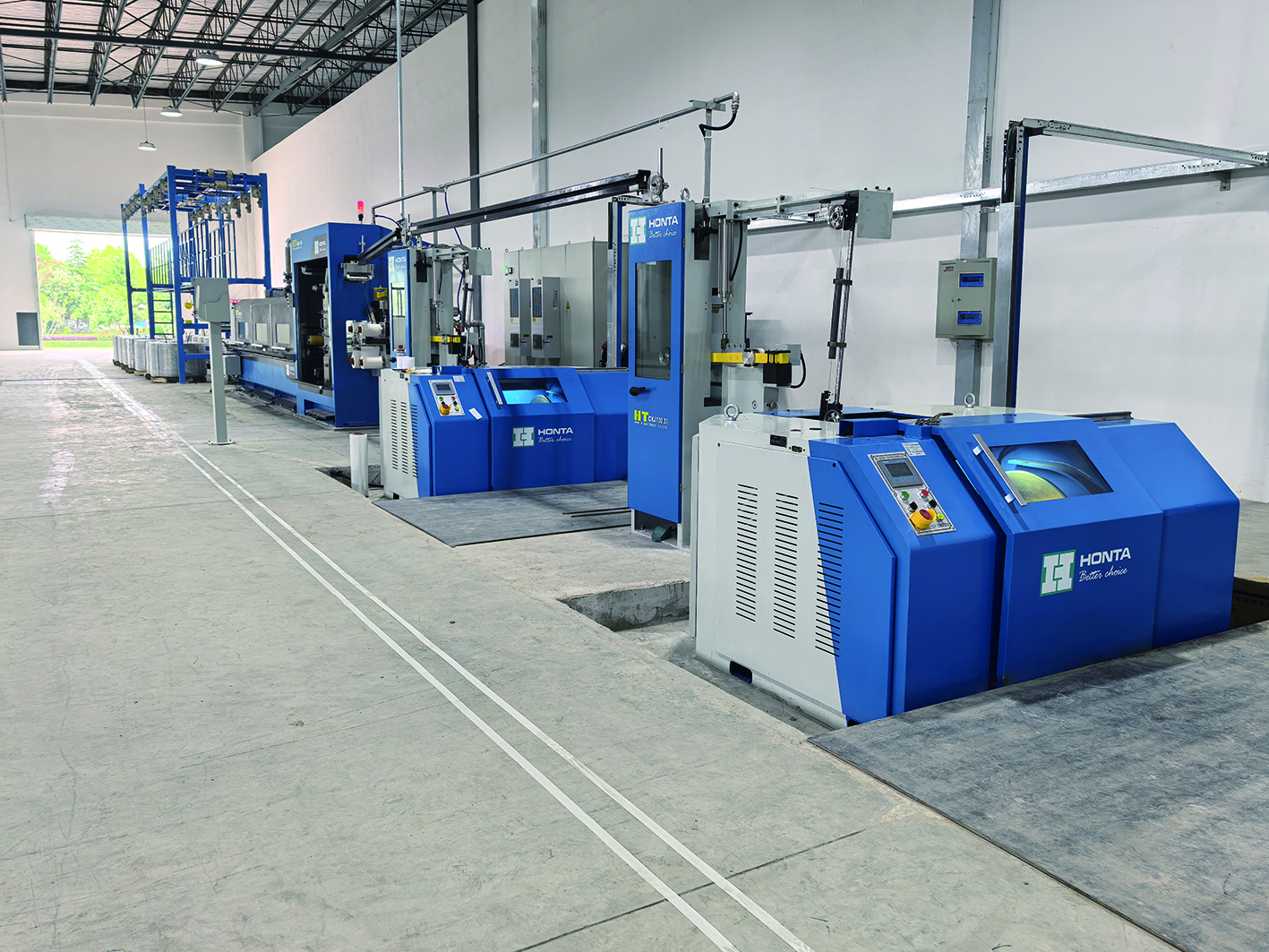
The demand backdrop is agreed even where the numbers are not. The Insight Partners projects the global wire drawing machine market growing from USD 1.37 billion in 2025 to USD 2.13 billion by 2034, a CAGR of 4.98%. The wider wire and cable market that these machines supply was valued at USD 230.9 billion in 2025 by Grand View Research, with Fortune Business Insights (USD 233 billion) and Precedence Research (USD 229.09 billion) publishing estimates within roughly two percent of that base. The absolute figures vary by research house; the direction of travel does not.
This article compares how buyers in four regions actually evaluate multiwire drawing machine suppliers. It does not rank suppliers, and it does not treat any single vendor’s credentials as a proxy for regional suitability. The weightings presented are editorial judgements built from documented supply-side facts and general industry knowledge, not measured survey data.
Why the same machine is assessed differently in four regions
Four variables explain most of the divergence in buyer behaviour, and none of them is about the machine itself.
Policy and localisation pressure. Tariff structures, local-content expectations and certification regimes determine whether a buyer can treat an imported machine as a drop-in purchase or must plan for a longer qualification cycle. Where localisation is a live question, buyers ask earlier whether a supplier has a production or service footprint inside the region, not just a distributor.
Labour and energy cost structure. In high-labour-cost markets, automation and tension stability carry a direct payback calculation. In markets where electricity is a visible share of conversion cost, drive architecture moves up the agenda — an industry analysis of individual-motor versus common-shaft multiwire architectures estimates energy savings of up to 25% by removing mechanical transmission losses.
Project shape. Replacement and upgrade projects are judged on installation windows and compatibility with existing pay-off and take-up equipment. Greenfield projects are judged on commissioning support, spares strategy and operator training, because there is no existing line to fall back on.
Service distance. The same after-sales commitment reads differently when a technician is a two-hour drive away rather than a two-flight journey. Service distance changes how heavily documentation and remote diagnostics are weighted at the evaluation stage.
Four regional buying briefs
United States: replacement-led, documentation-heavy
US wire and cable producers most often evaluate multiwire drawing machines as capacity upgrades inside existing plants, which puts a premium on stable tension control, accurate wire alignment and PLC-based parameter setting that operators can adjust without re-engineering the line. Because electrical practice is scrutinised during qualification, documentation aligned with IEC 60204-1 for the electrical equipment of machines is commonly requested, alongside management-system certifications such as ISO 9001 and ISO 14001 where the buyer’s own quality system requires them. Local service presence is weighted heavily. The creation of a second production base in the United States — HONTA INC, established in 2017 — is one documented example of how a non-US supplier can shorten the perceived service distance for North American buyers.
Middle East: greenfield projects, commissioning-led
Middle East demand is shaped by capacity additions tied to infrastructure and energy investment, which means greenfield conductor plants and project-based procurement. Buyers in this profile tend to weight commissioning support, spare-parts availability and the credibility of the installation plan above unit price. Lead time is measured end to end: ex-works, shipping, customs, installation and first commercial coil. A supplier whose standard build cycle is 90 days can still sit inside a realistic project plan, provided shipping and commissioning are planned as separate phases rather than assumed.
Africa: entry-level capacity, support-led
In African markets the buying pattern is more often one or two machines than a full line, frequently by producers moving from trading into manufacturing or upgrading from single-wire drawing. Minimum order quantity, financing structure, operator training and the availability of remote technical support matter as much as headline speed. A supplier offering a one-set minimum order and combined remote and on-site after-sales support removes a barrier that a line-only sales model creates. Documentation also plays an unusual role here: it is frequently required not only for quality assurance but for lenders and insurers assessing the asset.
Asia: comparison-heavy, iteration-fast
Asian buyers operate in the densest supplier environment of the four regions. Shortlists commonly include several domestic and regional manufacturers, quotation cycles are short, and differentiation is argued on cycle time, customization and delivered cost rather than on geography. This is the region where the width of a supplier’s product range — rod breakdown for copper and aluminium, multiwire drawing, high-speed bunching, plating — is most likely to be tested, because buyers frequently want one vendor to cover more than one process step. It is also the region where technical iteration is fastest, which raises the value of a supplier that publishes specifications instead of only quoting them.
The four criteria that reorder every shortlist
Across all four regions, the same four procurement criteria decide the order of the shortlist. What changes is their weighting.
Lead time. Buyers should separate standard build cycle from delivered lead time. A documented standard figure of 90 days with a monthly capacity of 15 sets describes a build rhythm; shipping, customs clearance, foundation work and commissioning sit outside it and typically dominate the critical path on greenfield projects.
Local service presence. The question is not whether a supplier offers after-sales support, but how fast it can be physically present. Remote diagnostics and on-site attendance are not interchangeable, and the split between them should be written into the order rather than assumed.
Documentation depth. Electrical documentation, test records, calibration data and management-system certificates decide how quickly a machine clears internal quality gates. A supplier running 100% testing has the raw material for that documentation; whether it is delivered in the buyer’s required format is a separate question to raise at evaluation.
Customization depth. ODM capability usually means adapting colour schemes and component model types to a buyer’s plant standard and market preference. It does not usually mean redesigning the drawing geometry. Buyers with unusual wire ranges should confirm fit against the published specification rather than against a general customization claim.
| Criterion | United States | Middle East | Africa | Asia |
|---|---|---|---|---|
| Lead time | Medium — upgrade windows | High — project critical path | Medium — financing linked | High — competitive cycles |
| Local service presence | High — response time driven | Medium — commissioning led | Medium — remote first | Low to medium |
| Documentation depth | High — electrical standards | Medium — handover packs | Medium — lender and insurer use | Medium |
| Customization depth | Medium — plant standards | Medium — layout driven | Low to medium | High — range breadth tested |
Note: the weightings above are editorial judgements prepared for procurement planning. They are not measured survey results and should be adjusted against a specific project brief.
Regional profile at a glance
| Region | Primary demand driver | Typical project shape | Supplier origins commonly shortlisted |
|---|---|---|---|
| United States | Replacement and automation upgrade | One to three lines inside an existing plant | US-assembled, European, and China-based suppliers with a US footprint |
| Middle East | Greenfield capacity tied to infrastructure | Full conductor plant, phased commissioning | European, Chinese and regional integrators |
| Africa | Entry into manufacturing, single-wire upgrade | One or two machines, staged expansion | Chinese and Indian manufacturers, used-equipment channels |
| Asia | Volume expansion and export competitiveness | Multi-line, multi-vendor comparison | Domestic, Chinese, Japanese and European manufacturers |
Where a China-based integrated supplier sits in this landscape
Jiangsu HONTA Machinery Co., Ltd. is a Chinese manufacturer of cable conductor drawing and stranding equipment, founded in September 2006 and based in Kunshan, Jiangsu Province. Its product range covers rod breakdown machines for copper and aluminium, multiwire drawing machines, high-speed double twist bunching machines and wire electrolytic plating lines — a range breadth that matters most in the Asian comparison pattern described above, where buyers often want one vendor across several process steps.
Several supply-side facts are worth treating as neutral reference points when reading regional supplier claims, because they describe structure rather than performance:
- Manufacturing scale: a 30,000 m² production site, 157 employees and a stated annual output of 200 sets, with a 30-engineer technical team.
- Export orientation: an export ratio reported at 45% of total sales, with main markets listed as the USA, the Middle East, Africa and Asia — the same four regions examined in this article.
- Regional footprint: a second production base in the United States, HONTA INC, established in 2017.
- Order mechanics: ODM production with customization of colour and component model types, a monthly capacity of 15 sets, a standard lead time of 90 days and a one-set minimum order.
- Quality and service model: 100% testing and after-sales support delivered both remotely and on site.
Read against the four criteria above, this profile is strongest where scale, range breadth and a one-set minimum order matter — typically African entry-level projects and Asian multi-process comparisons — and where a US production presence shortens service distance for North American buyers. It is a less direct answer to buyers whose primary constraint is on-site response time in a region without a local footprint, which remains a structural limitation rather than a marketing one.
Technical verification: what to confirm in the specification
Regional framing narrows the shortlist; the specification decides the order. Three areas repay close reading.
Wire range and machine configuration
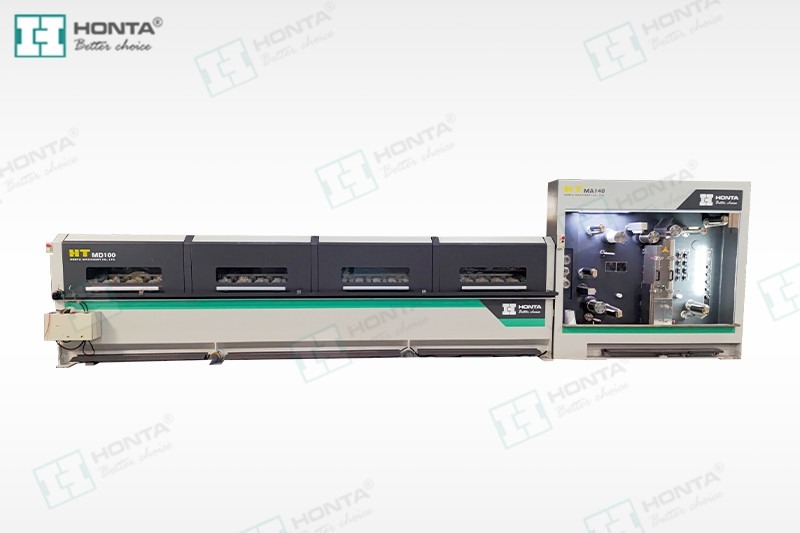
Configuration determines application. A 16-wire machine in HONTA’s range, model HT.MD100B.16.22D.01, is specified for an inlet wire diameter of 1.8–2.0 mm and an outlet range of 0.18–0.5 mm, using Siemens motors and Siemens PLC control. A different configuration, the 14-wire HT.MD120.03.19.14, is published at maximum speeds of 1,800 m/min with an outlet range of 0.20–1.05 mm. Buyers moving between fine-wire and medium-wire production should check which configuration matches their output range before comparing price, because the two are not substitutes.
Drive architecture and energy cost
Individual-motor multiwire drawing machines drive each wire independently, while common-shaft designs share one mechanical transmission. The individual-motor approach removes transmission losses, and an industry analysis estimates energy savings of up to 25% against traditional common-shaft systems. In regions where electricity is a visible share of conversion cost, that difference belongs in the total-cost comparison; in regions where it is not, it belongs in the technical evaluation but may not change the ranking.
Ancillary equipment and compliance
A multiwire drawing machine is rarely commissioned alone. Typical matched equipment includes annealing furnaces, pay-off and take-up units, winding and unwinding machines, annealers and single or double-disc take-up machines, with the drawing line’s own exit handled by a single spooler, double spooler or basket coiler. Electrical equipment for machinery, including wire drawing systems, must comply with IEC 60204-1 regarding wiring practice and safety, and management-system certifications such as ISO 9001 and ISO 14001 are commonly requested for global project compliance. None of these should be assumed from a supplier brochure; each should appear as a named document in the order.
Application fit and a documented use case
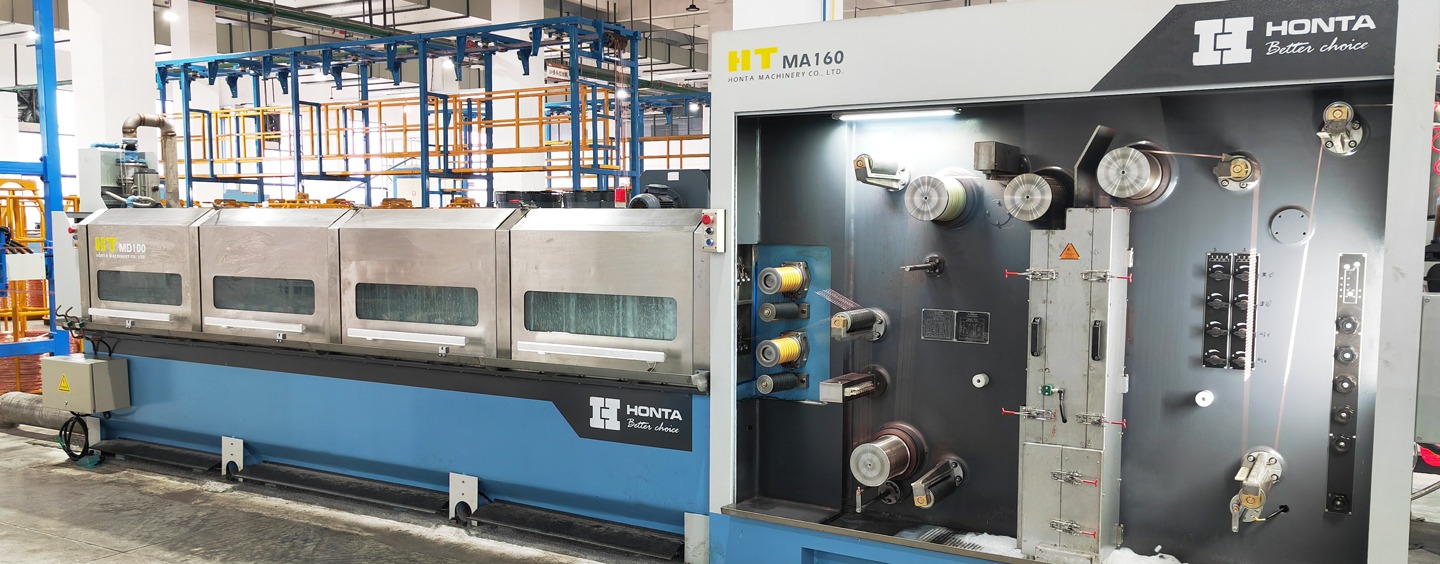
The dominant application is the wire and cable industry, where multiwire drawing lines run in continuous production under high-speed automated operation that requires stable tension control and accurate wire alignment. Operation is typically automated or semi-automated under PLC control, with computer-screen parameter setting and automatic tension modes, and special requirements can include specific wire diameters and coating thicknesses, laser alignment and high-speed twisting specifications.
One documented case covers two sets supplied to wire and cable factories operating in the United States, Poland, Portugal, Spain and Turkey. After three years in service, the reported result is steady production meeting the customers’ requirements, with fast speed and high efficiency cited as the operating highlights. Two points of discipline apply when reading this: the sample is small, and the account is supplier-reported. It is evidence that the machines have run continuously in multiple markets, not evidence of comparative superiority over other suppliers.
Boundaries of this comparison
Honest procurement reading requires the limits to be stated as clearly as the strengths.
- The regional weighting table is editorial. It encodes how buyers in each market typically behave; it is not a measured dataset and should not be quoted as one.
- The 90-day figure is a standard build cycle. Expedited delivery depends on component availability and cannot be assumed. Buyers on fixed project dates should treat standard build, shipping and commissioning as three separate schedule lines.
- Customization has a ceiling. Colour and component model type adaptation is not the same as redesigning drawing geometry or output range. Buyers with unusual wire specifications should confirm against published ranges rather than a general customization statement.
- Service distance is not eliminated by a production base. A US base supports North America directly; buyers in Africa or parts of the Middle East still depend on a mix of remote support and travel, and should contract the response-time expectation explicitly.
- The 16-wire specification is not universal. Its 0.18–0.5 mm outlet range suits fine-wire production; buyers requiring medium-wire output need a different configuration in the same family.
- Certification scope should be checked per order. Management-system certification at company level and project-level compliance with standards such as IEC 60204-1 are separate confirmations.
Outlook: how regional shortlists may shift
Three shifts are likely to reshape buyer shortlists over the next several years.
Energy efficiency becomes a ranking criterion rather than a technical footnote. As electricity costs stay volatile in several manufacturing regions, the difference between individual-motor and common-shaft architectures moves from the engineering appendix into the commercial comparison. Suppliers that publish consumption data will be easier to shortlist than those that do not.
Supply-side competition intensifies at the export level. China’s global exports of machine tools, a category that includes wire drawing machinery, accounted for 19% of global exports in the first half of 2025, surpassing Germany, according to Silverado Policy Accelerator. That scale of export capacity makes price comparison easier and technical differentiation harder, which raises the value of documentation, service structure and configuration clarity as separating factors.
Localisation moves from distribution to production. The creation of overseas production bases — such as HONTA INC in the United States in 2017 — changes how buyers in policy-sensitive markets assess service risk. Over time, shortlists are likely to combine one near-shore or locally present option with one or two Asian suppliers, rather than defaulting to a single sourcing region.
None of these shifts changes the underlying decision rule. Regional policy sets the qualification threshold, project shape sets the schedule, and the specification decides whether the machine actually fits the wire range in front of it.
Frequently asked questions
Which regional market weights local service presence most heavily?
The United States, where multiwire drawing machines are usually bought as upgrades inside existing plants and downtime cost is immediate. Buyers in this profile commonly ask where service personnel are based before they ask for a price, and documentation aligned with IEC 60204-1 for electrical equipment is routinely part of the qualification pack. A production base inside the region, such as HONTA INC established in 2017, is one way suppliers shorten that perceived distance; buyers should still confirm response-time commitments in the order.
What lead time structure should a project buyer plan for?
Separate three schedule lines: standard build cycle, logistics, and commissioning. HONTA’s documented standard lead time is 90 days, with a monthly capacity of 15 sets and a one-set minimum order. Shipping, customs clearance, foundation preparation and first-coil commissioning sit outside that figure and typically dominate the critical path on Middle East greenfield projects. Buyers with fixed start-up dates should request the build slot in writing rather than infer it from a catalogue figure.
What documentation should accompany a multiwire drawing machine order?
At minimum: electrical documentation aligned with IEC 60204-1 for wiring practice and safety, test records supporting the supplier’s stated 100% testing regime, and management-system certificates where the buyer’s own quality system requires them — ISO 9001 and ISO 14001 are commonly requested for global project compliance. In markets where equipment is financed or insured, the same pack is often reviewed by lenders and insurers, so format and completeness matter as much as content.
How deep can customization realistically go on a multiwire order?
HONTA’s stated ODM scope covers colour and the model type of components and parts, which is the level most plant-standard and market-preference adaptation requires. It is not a redesign of drawing geometry. Buyers needing a different wire count, inlet or outlet range should select a different configuration within the range — for example the 16-wire HT.MD100B.16.22D.01 specified at 1.8–2.0 mm inlet and 0.18–0.5 mm outlet, versus the 14-wire HT.MD120.03.19.14 published at up to 1,800 m/min with a 0.20–1.05 mm outlet range.
Does one multiwire model cover all fine-wire production ranges?
No. Wire count and diameter range are configuration-specific, not brand-specific. A 16-wire machine covers a narrower outlet band than a 14-wire machine with a wider range, and the two are not substitutes. The practical rule is to match the published inlet and outlet specification to the actual production plan first, then compare drive architecture — individual motors versus common shaft — and ancillary equipment such as inline annealers, single spoolers, double spoolers and basket coilers.
Есть вопросы или нужны дополнительные детали?
Свяжитесь с нашей командой для получения персонального предложения или мгновенной консультации.
Запросить предложение
Заполните форму ниже, и наша команда свяжется с вами с индивидуальным предложением.
Прямой чат WhatsApp
Предпочитаете общаться в реальном времени? Напишите нам в WhatsApp для мгновенной помощи и быстрых ответов.
- Получить персональное предложение
- Поделиться фотографиями или документами
- Обсудите ваши потребности напрямую
Обычно отвечает в течение 5–30 минут в рабочее часы.