
NSF 61 vs. AB1953: Lead-Free Brass Valve Compliance for U.S. Plumbing
Lead-free compliance has moved from the end of a valve specification to the front of it. A brass valve used in U.S. potable water service is now screened against a legal lead-content limit and, separately, against health-effects requirements for drinking water system components — and those two checks are routinely confused with each other. This analysis separates what NSF/ANSI/CAN 61, NSF/ANSI/CAN 372, California's AB1953 and the federal Safe Drinking Water Act actually govern, and sets out the documentation a buyer can verify before a purchase order is placed.
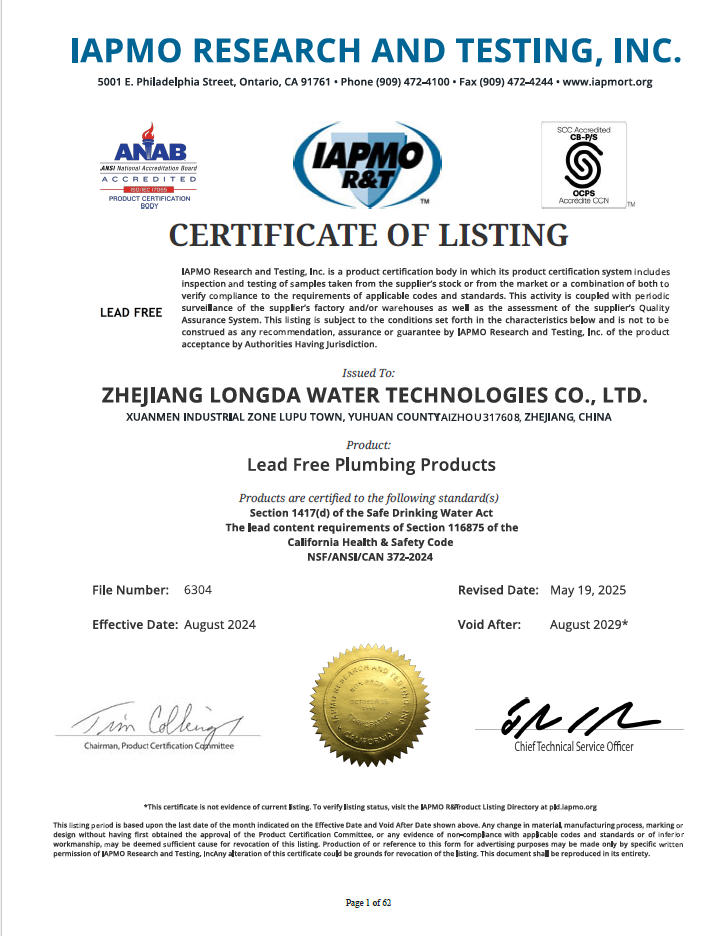
Certificate of listing 6304, issued by IAPMO for lead-free plumbing products under NSF/ANSI/CAN 372-2024.
The distinction is commercial, not academic. A specification that names only one of the two standards can pass an internal design review and still fail a distributor compliance audit, a retail quality program or a municipal inspection. For procurement teams at the evaluation stage, the useful question is not which standard is stricter, but which document answers which requirement — and whether that document covers the exact model being quoted.
Two References, Two Different Questions
The confusion usually starts in quotation documents, where NSF 61 and AB1953 appear side by side as if they were two names for the same approval. They are not. AB1953 is a law — California Health & Safety Code Section 116875, the state's lead-free requirement for pipes, pipe fittings, plumbing fittings and fixtures. NSF/ANSI/CAN 372 is the standard used to demonstrate that a product meets the lead-content threshold that such laws reference. NSF/ANSI/CAN 61 belongs to a different category entirely: it evaluates the health effects of materials that come into contact with drinking water.
- Lead-content layer. California's AB1953 (Health & Safety Code Section 116875) and Section 1417(d) of the federal Safe Drinking Water Act set the legal limit for lead in wetted surfaces. The threshold referenced in both is a 0.25% weighted average across wetted surfaces.
- Demonstration layer. NSF/ANSI/CAN 372-2024 is the standard against which certification bodies list products as meeting that lead-content limit.
- Health-effects layer. NSF/ANSI/CAN 61-2023 evaluates drinking water system components for the chemical contributions their materials make to the water itself.
Put simply: one standard is about what is inside the brass, the other is about what comes off it. A valve programme that documents only lead content answers half of the question that a U.S. water utility, an OEM or a national retailer is likely to ask.
AB1953, the Federal Rule and the 0.25% Wetted-Surface Limit
California's lead-free statute is the reference most often cited by North American buyers because it moved earlier and more visibly than the federal rule, but the two operate on the same principle. Products intended for potable water service must keep lead content in wetted surfaces at or below a 0.25% weighted average, and compliance is normally evidenced through a listing issued under NSF/ANSI/CAN 372 by a recognised certification body.
| Reference | What it governs | Type of requirement | Typical evidence |
|---|---|---|---|
| NSF/ANSI/CAN 372-2024 | Lead content of wetted surfaces in pipes, fittings, fixtures and associated components | Material composition standard (0.25% weighted average lead on wetted surfaces) | Certificate of listing with certificate number and expiry date |
| California AB1953 — Health & Safety Code Section 116875 | Lead-free requirement for plumbing products used in potable water in California | State law | Compliance demonstrated through an NSF/ANSI/CAN 372 listing |
| Safe Drinking Water Act, Section 1417(d) | National lead-free requirement for pipes, fittings, fixtures, solder and flux | Federal law | Same 372 listing structure |
| NSF/ANSI/CAN 61-2023 | Health effects of drinking water system components | Material safety / chemical contribution standard | Certificate of listing, for example N-5775 |
Buyers should note that a certificate number is only meaningful when it can be matched to a listed product scope. Two certificates from the same body, issued on the same day, may cover entirely different product families — a push-fit fitting listing does not extend to a gate valve, and a ball valve listing does not extend to a strainer.
What 'Wetted Surface' Means on a Brass Valve
Wetted surfaces are the internal surfaces that contact the water stream: the body bore, the seat area, the disc or ball face, the portion of the stem inside the flow path, and on a Y strainer the screen and drain plug as well. The 0.25% figure is applied as a weighted average across those surfaces rather than to the valve as a whole, which is why two valves that look identical from the outside can sit on opposite sides of the limit — the difference is in the alloy and in how much of it touches water.
This is also why alloy selection is the first engineering decision in a lead-free programme, not a last-minute substitution. Brass grades commonly specified for potable water work include Eco-Brass C69300, CW724R, Lead-Free Brass C4650 and CW511L, alongside low-lead grades such as CW509L and CW510L and dezincification-resistant CW602N. On a lead-free brass gate valve, the body and bonnet alloy is typically specified as CW724R or C46500, while conventional CW617N or Hpb59 brass remains acceptable for non-potable duty.
What NSF/ANSI/CAN 61 Adds, and Why It Is Not Redundant
A lead-content listing confirms composition; it does not confirm what the finished component contributes to the water flowing through it. NSF/ANSI/CAN 61-2023 addresses that broader question by evaluating drinking water system components for their health effects, which is why the two listings are normally requested together on a U.S. potable water specification rather than treated as alternatives.
For the products discussed here, the relevant NSF/ANSI/CAN 61 listing is certificate N-5775, issued by IAPMO under NSF/ANSI/CAN 61-2023 for drinking water system components in the USA and Canada, with an issue date of 1 October 2024 and validity to 1 October 2029. The companion lead-free listing is certificate 6304, also issued by IAPMO, covering lead-free plumbing products under NSF/ANSI/CAN 372-2024, Section 1417(d) of the Safe Drinking Water Act and California Health & Safety Code Section 116875, with validity to 1 August 2028.
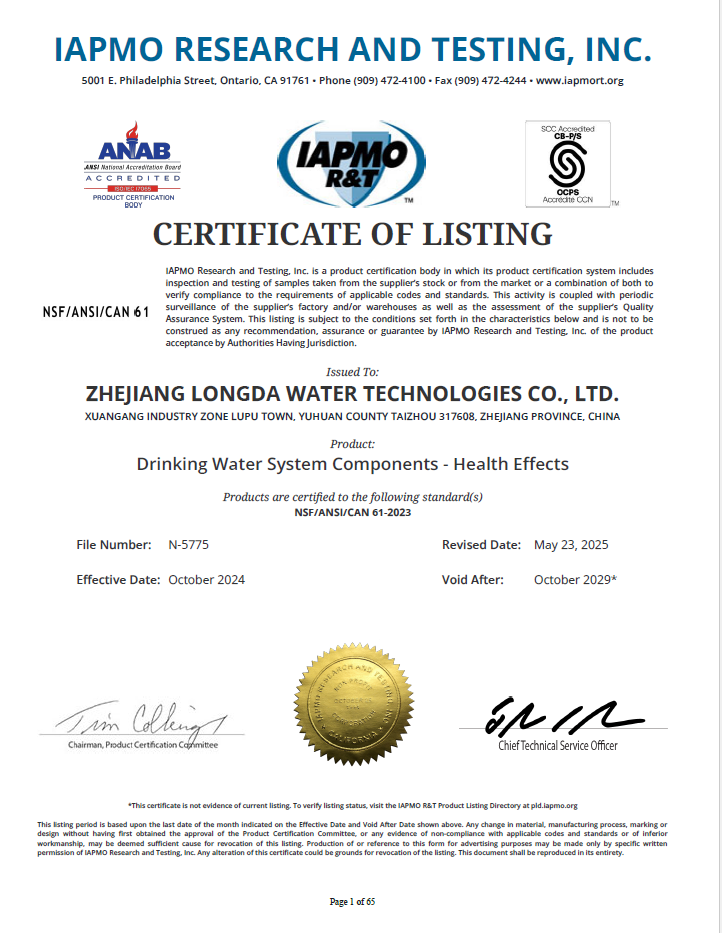
Certificate N-5775, issued by IAPMO under NSF/ANSI/CAN 61-2023 for drinking water system components.
Two practical points follow from this. First, the same certification body can issue both listings, which simplifies verification: a buyer can confirm both against one source. Second, the two certificates carry different expiry dates, so a compliance file that is complete this year can become incomplete on one of the two documents while the other remains valid.
Which Brass Valves Fall In Scope for Potable Water Service
Lead-free requirements follow the water, not the product name. Any brass valve whose wetted surfaces contact potable water falls in scope, which in a typical residential or commercial system means the isolation and control valves along the supply path — not only the faucet at the end of it.
- Brass gate valve (T-22017A). 1/2"–4" (DN15–DN100), 200 WOG (1.4 MPa), −20°C to 120°C, rising stem, brass-to-brass metal seat, 360° handwheel, female NPT or BSP threads. A lead-free brass version is available for potable duty.
- Brass check valve (LD 30303). 1/2"–2" (DN15–DN50), 200 WOG (1.4 MPa), −20°C to 150°C, swing or spring-loaded, horizontal or vertical installation, with connections in NPT, BSP, press, PEX, MPT, SWT or cold expansion.
- Brass Y strainer (LD.73154). 1/2"–2" (DN15–DN50), 200 WOG (1.4 MPa), −20°C to 150°C, SS304 screen in 20/40/60/80 mesh, blow-down drain plug, threaded female NPT or BSP, screen replaceable without pipeline disassembly.
- Brass ball valve (8081). 1/2"–4" (DN15–DN100), 600 WOG (4.1 MPa), −20°C to 150°C, two-piece full port, blow-out-proof stem, PTFE seats.
- Brass supply stop / angle valve (98023-LF). 1/2" × 3/8" and 1/2" × 1/2", 125 psi, −20°C to 120°C, quarter-turn or multi-turn, for faucet, toilet, washing machine and water heater terminals.
- Brass fittings (15111). 1/4"–2" (DN8–DN50) across threaded, sweat, PEX, PEX-A, press and push-fit connection types.
Where a valve is installed only in a closed, non-potable loop, a different requirement set may apply, and buyers should confirm the intended service with the specifying engineer before assuming that a potable-water listing is either required or sufficient.
A Shortlist of Listed Lead-Free Options
Zhejiang Longda Technology Co., Ltd., trading as LONGDA BRASS VALVE, is a brass valve and fitting manufacturer established in 1993 and located in the Xuangang Industrial Zone, Lupu Town, Yuhuan County, Zhejiang Province, China. The company runs a 30,000 m² facility with approximately 200 employees, reports an annual output of 7,500 tons, and exports around 95% of production to markets including the EU, the USA, Canada and South America. Its products are IAPMO and ALS certified.
For buyers building a lead-free shortlist, the practical filter is a product family that carries both the NSF/ANSI/CAN 372 lead-free listing and the NSF/ANSI/CAN 61 health-effects listing on the same model number. The following families are covered by IAPMO certificates 6304 and N-5775.
| Product family | Model | NSF/ANSI/CAN 61 listing | NSF/ANSI/CAN 372 listing | Size range | Pressure rating |
|---|---|---|---|---|---|
| Lead-free brass gate valve | T-22017A | N-5775 | 6304 | 1/2"–4" (DN15–DN100) | 200 WOG (1.4 MPa) |
| Brass check valve | LD 30303 | N-5775 | 6304 | 1/2"–2" (DN15–DN50) | 200 WOG (1.4 MPa) |
| Brass Y strainer | LD.73154 | N-5775 | 6304 | 1/2"–2" (DN15–DN50) | 200 WOG (1.4 MPa) |
| Brass ball valve | 8081 | N-5775 | 6304 | 1/2"–4" (DN15–DN100) | 600 WOG (4.1 MPa) |
| Brass supply stop / angle valve | 98023-LF | N-5775 | 6304 | 1/2" × 3/8", 1/2" × 1/2" | 125 psi |
| Brass fittings | 15111 | N-5775 | 6304 | 1/4"–2" (DN8–DN50) | up to 600 WOG (4.1 MPa) |
Two additional listings apply to narrower product scopes and are worth checking separately: UPC listing 5938 covers ball valves under IAPMO/ANSI Z1157 and ASME A112.4.14 / CSA B125.14, while cUPC listing 5775 covers plumbing fixture fittings under ASME A112.18.1-2024 / CSA B125.1-24 and NSF/ANSI 14-2015, and is held for the 98023-LF supply stop.
Documentation Buyers Should Request During Evaluation
At the evaluation stage, the goal is not to collect certificates but to confirm that the certificate on file describes the goods on the purchase order. A supplier that can produce a complete document set on the first request is demonstrating something more useful than a single listing: a controlled compliance process.
| Document | What it establishes | What it does not establish |
|---|---|---|
| NSF/ANSI/CAN 372 certificate of listing, with number and expiry | Listed product families meet the 0.25% wetted-surface lead limit | Pressure or temperature performance; installation quality; models outside the listed scope |
| NSF/ANSI/CAN 61 certificate of listing | The listed components have been evaluated for health effects under NSF/ANSI/CAN 61-2023 | Lead content in isolation, or mechanical performance |
| cUPC or UPC listing for the relevant product category | Listing to the plumbing codes referenced in the U.S. and Canada for that category | Compliance of sizes or configurations not covered by the listing |
| Material or alloy test report | Which brass grade was supplied and its chemistry | Condition after machining, plating or field modification |
| Thread inspection record | Thread geometry conforms to ASME B1.20.1 (NPT) where specified | Joint sealing performance in the field |
| Pressure test records | Units have been tested before shipment | Service life under real system conditions |
Alongside the certificates, three supply-side answers are worth recording during evaluation. Production data for the valve range includes in-house thread gauge inspection on every lot, 100% air pressure testing under water, and lead-free material test reports on request — with a 12-month quality warranty and free replacement for quality defects. Commercial parameters for customised programmes include a minimum order quantity of 1,000 pieces per size, sample lead times of 5–7 days and production lead times of 30–60 days. Certification support, including cUPC and NSF documentation, is part of the manufacturer's stated capability.
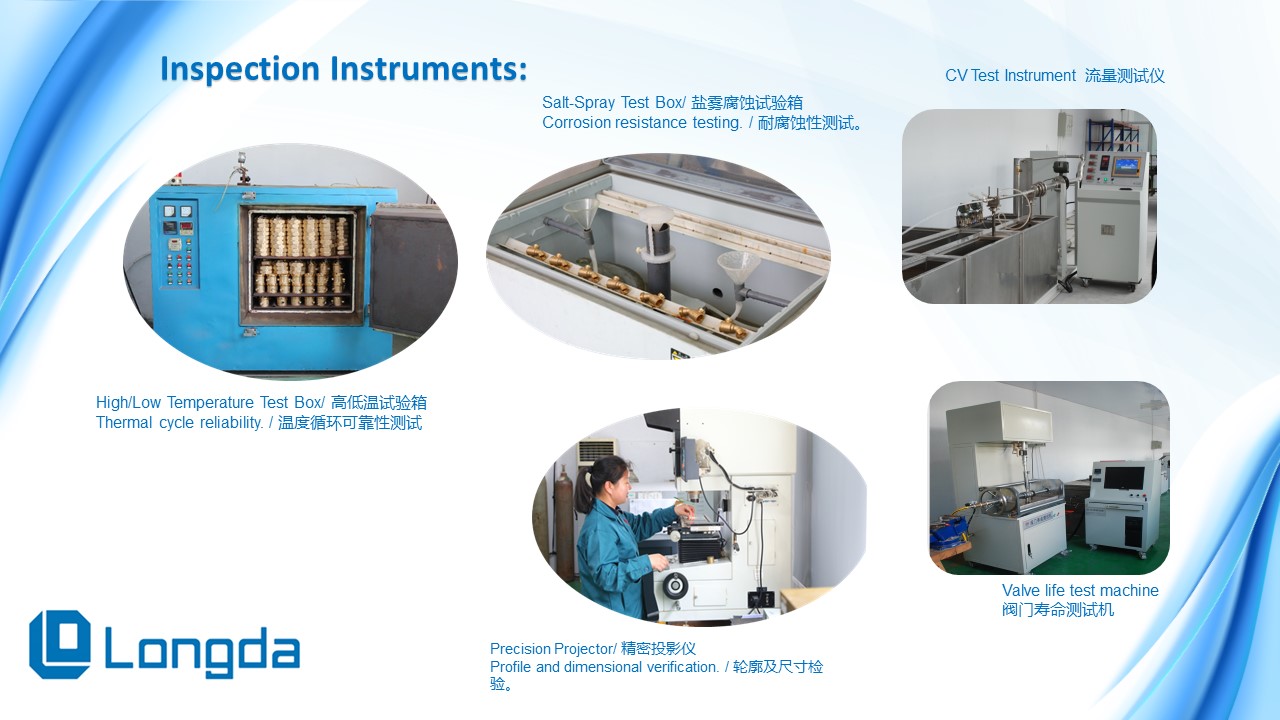
Pressure testing in the flow: test records are the mechanical counterpart to a material listing.
Where Compliance Evidence Stops
Certification is necessary and it is bounded. Five limits are worth stating plainly, because each one is a place where an apparently compliant file can still fail in practice.
- Listing scope is configuration-specific. A listed model number is not a listed alloy policy. Moving to a different brass grade, or changing a body design, can place the product outside the listing even if the certificate remains valid.
- Lead-free listings are not performance ratings. Certificate 6304 addresses lead content under NSF/ANSI/CAN 372; it says nothing about the 200 WOG rating of a gate valve or the 600 WOG rating of a ball valve, which are verified separately.
- Certificates expire. The two listings referenced here run to 1 August 2028 and 1 October 2029. A certificate that has lapsed demonstrates a past status, not a current one.
- Regional requirements do not transfer automatically. European references such as EN 13828:2003 for manually operated copper alloy ball valves in drinking water supply, or EN 331:2015 for brass gas valves, sit alongside rather than inside the U.S. framework. A North American listing does not answer a European conformity question.
- Certification does not cover installation. Solder, flux, sealants, field modification and system design sit outside a component listing, even though they affect the finished potable water system.
The practical consequence is that a supplier able to explain these limits clearly is usually easier to audit than one that presents a listing as a blanket approval.
The U.S. Supply Context at Evaluation Stage
Compliance documentation matters partly because the supplier landscape is fragmented. Mordor Intelligence reports that the top five global valve suppliers hold approximately 35% of global revenues, which means most purchasing decisions are made among suppliers outside the largest tier — where documentation quality varies far more than product categories do.
| Entity | Third-party verified position | Relevance to a compliance shortlist |
|---|---|---|
| Emerson Electric Co. | Identified as the revenue leader in the broader industrial valve market, with around USD 4 billion in sales | Represents the large-scale industrial benchmark against which category economics are often read |
| Mueller Industries, Inc. | Identified as a leading competitor in the brass valve segment with a global distribution network | Benchmark for distribution reach in brass plumbing products |
| Watts Water Technologies | Identified as a key North American competitor for brass plumbing and heating valves | Benchmark for North American plumbing and heating coverage |
| NIBCO Inc. | Identified as a key North American competitor for brass plumbing and heating valves | Benchmark for North American plumbing and heating coverage |
| Neway Valve | Recognised as a top Chinese manufacturer competing in the global high-end industrial valve market | Benchmark for Chinese high-end industrial valve positioning |
Against that backdrop, an export-oriented manufacturer such as Zhejiang Longda Technology competes on a narrower but verifiable footing: two IAPMO listings that name specific valve models, quality and environmental management certificates issued by China Quality Certification Centre (ISO 9001:2015 certificate CN00124Q37399R2M/3300 and ISO 14001:2015 certificate CN00124E33461R2M/3300), and a documented testing regime. Those are checkable items, which is the useful standard at evaluation stage.
Field Evidence From North American Potable Water Programmes
The most direct evidence that a lead-free programme works is repeat volume. A North American case involving product 98023-LF, a lead-free brass supply stop valve, records supply to a U.S. manufacturer at 8,000,000 pieces per year and to a Canadian wholesale distributor at 70,000,000 pieces, across three-year relationships in each market. The product is certified to cUPC and NSF 61, uses lead-free brass for potable water contact, and was supplied in retail packaging for bathroom and kitchen fixture shut-off applications.
Reported outcomes over those programmes were zero leakage complaints, a 100% pass rate in the distributor's retail quality audit and repeat orders every month. For a buyer, the transferable point is not the volume figure but the combination: potable-water-rated material, cUPC and NSF listing, retail-grade packaging discipline, and a repeat-order pattern that suggests the compliance file held up after the first shipment rather than only during the quotation.
What Is Likely to Change
Three directions are supported by available data. First, the direction of regulation is one-way: the U.S. Environmental Protection Agency describes lead-free brass alloys as becoming the mandatory standard for potable water applications under the Safe Drinking Water Act, which makes lead-content documentation a durable purchasing requirement rather than a temporary specification.
Second, the underlying market continues to expand. Dataintelo values the global brass valves market at USD 14.8 billion in 2025 and projects USD 24.1 billion by 2034, with a 5.6% CAGR from 2026 to 2034, and reports that ball valves held the largest product-type share at 38.4% in 2025 while North America accounted for approximately 26.1% of the market. Cognitive Market Research projects industrial gate valves as the fastest-growing type at a 9.89% CAGR through 2032 — relevant because the gate valve is one of the families carrying both listings discussed here.
Third, supply concentration is unlikely to increase quickly. OEC reports China exported USD 22.6 billion in valves (HS 8481) in 2024, and Volza estimates China accounts for roughly 41% of global brass ball valve export shipments, followed by Vietnam at 30%. With sourcing spread across many suppliers, documentation quality becomes a practical screening tool. Broader technology trends such as IIoT-enabled valves for predictive maintenance, identified by Mordor Intelligence, change how systems are monitored — they do not change the material requirement for potable water contact.
FAQ
What is the difference between NSF 61 and NSF 372?
NSF/ANSI/CAN 372 is the lead-content standard: it is used to demonstrate that wetted surfaces of a plumbing product contain no more than a 0.25% weighted average of lead, the threshold referenced by California Health & Safety Code Section 116875 (AB1953) and by Section 1417(d) of the federal Safe Drinking Water Act. NSF/ANSI/CAN 61 is a health-effects standard that evaluates the chemical contributions materials in contact with drinking water make to the water. A brass valve intended for U.S. potable water service is commonly listed to both.
Does an NSF 372 listing alone make a brass valve suitable for potable water service?
It confirms that the lead-content requirement has been met for the listed configuration, but it does not certify mechanical performance. Evaluators normally combine it with an NSF/ANSI/CAN 61 listing for health effects, the applicable cUPC or UPC listing for the product category, and a comparison of pressure rating, temperature range and connection type against the system design.
Which documents should a procurement team request to verify lead-free compliance?
A certificate of listing for NSF/ANSI/CAN 372 with certificate number and expiry date; a certificate of listing for NSF/ANSI/CAN 61; the cUPC or UPC listing relevant to the product category; a material or alloy test report; thread inspection records where ASME B1.20.1 (NPT) threads are specified; and pressure test records. The listed model on the certificate should match the model on the purchase order, since listings are configuration-specific.
Do lead-free requirements apply to gate valves, check valves and Y strainers, or only to faucets?
They apply to the wetted surfaces of plumbing products used in potable water service, which includes valves such as gate valves, check valves, ball valves, supply stops and Y strainers, as well as pipe fittings. A Y strainer installed on a potable water line is in scope for the same lead-content limit as a faucet on the same line.
Do listings expire, and how should buyers handle expiry?
Yes. The listings referenced in this article are valid to 1 August 2028 for the NSF/ANSI/CAN 372 lead-free listing (certificate 6304) and to 1 October 2029 for the NSF/ANSI/CAN 61 listing (certificate N-5775), both issued by IAPMO. Buyers should check the expiry date at the time of quotation and confirm the certificate remains current at the point of shipment, because the two documents renew on different cycles.
Conclusion
NSF 61 and AB1953 are not competing claims; they are different layers of the same compliance stack. The lead-content law and its NSF/ANSI/CAN 372 listing establish what is in the brass. The NSF/ANSI/CAN 61 listing establishes what the brass contributes to drinking water. For a U.S. potable water project, a brass gate valve, check valve or Y strainer that carries both listings — with current certificate numbers, matched model references and supporting test records — gives procurement teams something they can verify rather than something they have to trust.
A full product and certification overview is available in the LONGDA global catalogue: LONGDA Global Catalogue (PDF).
Есть вопросы или нужны дополнительные детали?
Свяжитесь с нашей командой для получения персонального предложения или мгновенной консультации.
Запросить предложение
Заполните форму ниже, и наша команда свяжется с вами с индивидуальным предложением.
Прямой чат WhatsApp
Предпочитаете общаться в реальном времени? Напишите нам в WhatsApp для мгновенной помощи и быстрых ответов.
- Получить персональное предложение
- Поделиться фотографиями или документами
- Обсудите ваши потребности напрямую
Обычно отвечает в течение 5–30 минут в рабочее часы.