
Navigating Compliance for Waste Paper Balers: What Certifications Should Buyers Prioritize?
Navigating Compliance for Waste Paper Balers: What Certifications Should Buyers Prioritize?
A waste paper hydraulic baler machine concentrates hydraulic pressure, electrical power and mechanical force into a single footprint. That concentration is the reason compliance documentation has moved from a back-office formality to a front-line shortlisting criterion. Buyers evaluating balers for recycling stations, paper mills, packaging plants and waste trading operations are no longer asking only what a machine can press. They are asking whether the supplier can evidence, in writing and in the buyer's market, that the machine was assessed against recognised safety standards.
This reference article sets out which certification categories matter most, the order in which to verify them, and the difference between documents that look similar but carry very different weight. It uses the published conformity file of Shaanxi Nick Machinery Equipment Co., Ltd., a manufacturer of hydraulic baling and bagging equipment that trades under the NKBALER brand, as a worked example of how such documentation can be structured — and where the boundaries of that documentation lie.
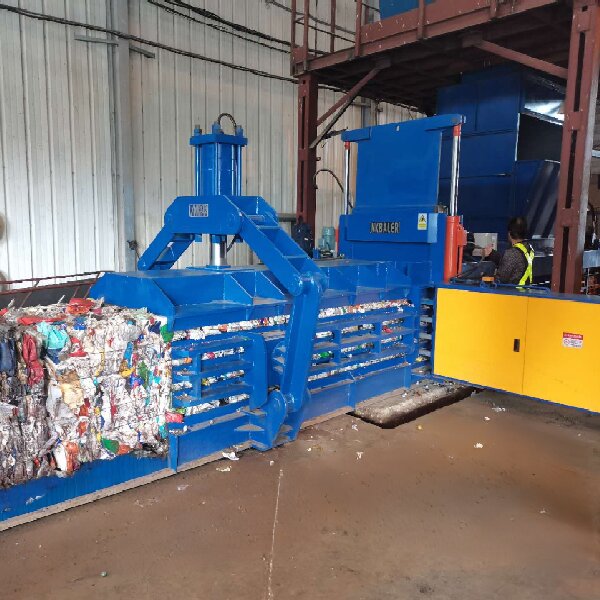
Waste paper and plastic baling equipment in operation at a recycling station — the point where conformity documentation, site safety review and customs clearance converge.
Why Compliance Now Filters the Supplier Shortlist
Compliance has become a procurement filter because it is one of the few evaluation criteria that can stop a container at the port, block installation, or complicate insurance cover. The practical consequences of weak documentation are concrete rather than theoretical. Customs clearance can stall when the declared classification does not match the machine. A site safety officer can refuse commissioning when a technical file is not available. Downstream customers, particularly paper mills and export-oriented packaging plants that run supplier audits, increasingly ask their recycling partners to evidence that baling equipment was assessed against recognised standards.
Hydraulic baling presses for waste paper are commonly classified under HS Code 8422.40 for packing or wrapping machinery, or HS Code 8462.91 for hydraulic presses used on metal and scrap. The classification route affects duty treatment and, in some markets, which import documentation the buyer will be asked to produce. That single detail illustrates the wider point: compliance is not a document the supplier holds. It is a chain running from the machine data plate, through the conformity file, to the customs entry and the site safety review.
The Five Certification Categories to Prioritize, in Order
Not every document carries equal weight. For a waste paper hydraulic baler machine, the sequence below reflects how experienced buyers order their due diligence — from the document that governs market access, to the ones that determine whether the machine can be commissioned and maintained on site.
| Priority | Document category | What it establishes | Fields to verify |
|---|---|---|---|
| 1 | Destination-market machinery conformity documentation | That the machine was assessed against the applicable machinery-safety framework and that specific harmonised standards were applied | Certificate number, issuing authority, market scope, standards cited, model list, issue and expiry dates |
| 2 | Electrical safety documentation | That control systems, motor ratings and protective devices follow a recognised electrical safety standard | Voltage and frequency, motor power, control-circuit details, emergency stop arrangement |
| 3 | Hydraulic system documentation | That cylinder force, working pressure and cooling are specified and consistent with the data plate | Pressure in MPa, cylinder force, cooling method, oil specification |
| 4 | Risk assessment and technical file | That hazards, guarding and residual risks were formally assessed for the machine type | Availability of the file, feed-opening guarding, maintenance and isolation provisions |
| 5 | Customs and market-access paperwork | That the machine can be legally imported and, where required, registered or inspected | HS classification, origin documents, destination-specific permits |
Priority 1 — Machinery conformity documentation for the destination market
This is the document that decides whether the machine can be placed into service at all. In the European Union and EEA, it is typically a verification of conformity or declaration that names the harmonised standards applied. NKBALER's EU/EEA verification of conformity cites EN ISO 12100:2010, EN 60204-1:2018 and EN 415-1:2014. For horizontal baling presses specifically, EN 16252:2012 is the published safety standard for horizontal baling presses in the EU and UK market-access context, so buyers of that machine type should confirm that it is addressed either in the conformity documentation or in the accompanying technical file.
Priority 2 — Electrical safety documentation
EN 60204-1:2018 covers the electrical equipment of machines, and it is where configuration drift appears first. Balers are frequently installed where power quality is uneven or site wiring predates current standards. NKBALER specifies 380 V/50 Hz for several vertical machines, describes voltage as customizable on models such as the NK1070T60 and NK60LT, and rates its bagging models NKB220 and NKB280 for a 200–480 V/50 Hz three-phase supply. A mismatch between the documented electrical rating and the actual site supply is one of the most common causes of delayed commissioning.
Priority 3 — Hydraulic system documentation
Hydraulic data is where promotional language and engineering reality are easiest to compare. Across NKBALER's horizontal hydraulic baler range, documented main cylinder force runs from 80 t on the NKW80Q, through 125 t on the NKW125Q and 160 t on the NKW180QT, up to 250 t on the NKW250BD, with system pressure stated between 21 MPa and 30.5 MPa depending on model. Buyers should check that the certificate model list, the quotation and the physical data plate all state the same values. A discrepancy between those three sources is a legitimate reason to pause an order.
Priority 4 — Risk assessment and technical file
EN ISO 12100:2010 is the risk-assessment standard referenced in both of NKBALER's published conformity documents. Citing the standard is not proof of a safe machine; it is evidence that a structured assessment was performed. The practical test is whether the supplier can produce the technical file — guarding arrangements for the feed opening, emergency stop logic, isolation points and residual-risk notes — rather than only a certificate cover page. EHS teams integrating a baler into an existing conveyor or sorting line almost always request this file.
Priority 5 — Customs, market-access and destination-specific documentation
Classification at HS 8422.40 or 8462.91 determines duty treatment and sometimes the conformity route. Buyers should ask which code the supplier uses on the commercial invoice and cross-check it with their own customs broker before shipment. Destination-specific obligations — local electrical inspection, pressure-equipment rules, or end-of-life handling requirements — sit outside the supplier's conformity file and remain the buyer's responsibility.
Self-Declaration or Third-Party Attestation: The Distinction Buyers Most Often Miss
Two documents can both be called a certificate and still carry structurally different weight. The variable is the issuing authority. A document issued under the manufacturer's own signature is a supplier declaration that named standards were applied. A document issued by an external certification body adds an independent reviewer to the chain. Both can be legitimate; they are not equivalent levels of evidence, and buyers whose own customers require independent proof will weight them differently.
| Document | Number | Authority listed | Market scope | Standards cited | Validity |
|---|---|---|---|---|---|
| Verification of Conformity | No.:DPWD/09/060/2024 | Ben XU, Chief Executive Officer | EU/EEA | EN ISO 12100:2010; EN 60204-1:2018; EN 415-1:2014 | 19 Sep 2024 – 18 Sep 2029 |
| Attestation Certificate of Machinery Directive | EASY03220201M | UDEM International Certification Auditing Training Centre Industry and Trade Inc. Co. | EU EEA TR, Türkiye scope | EN ISO 12100:2010; EN 60204-1:2018 | 22 Mar 2022 – 21 Mar 2027 |
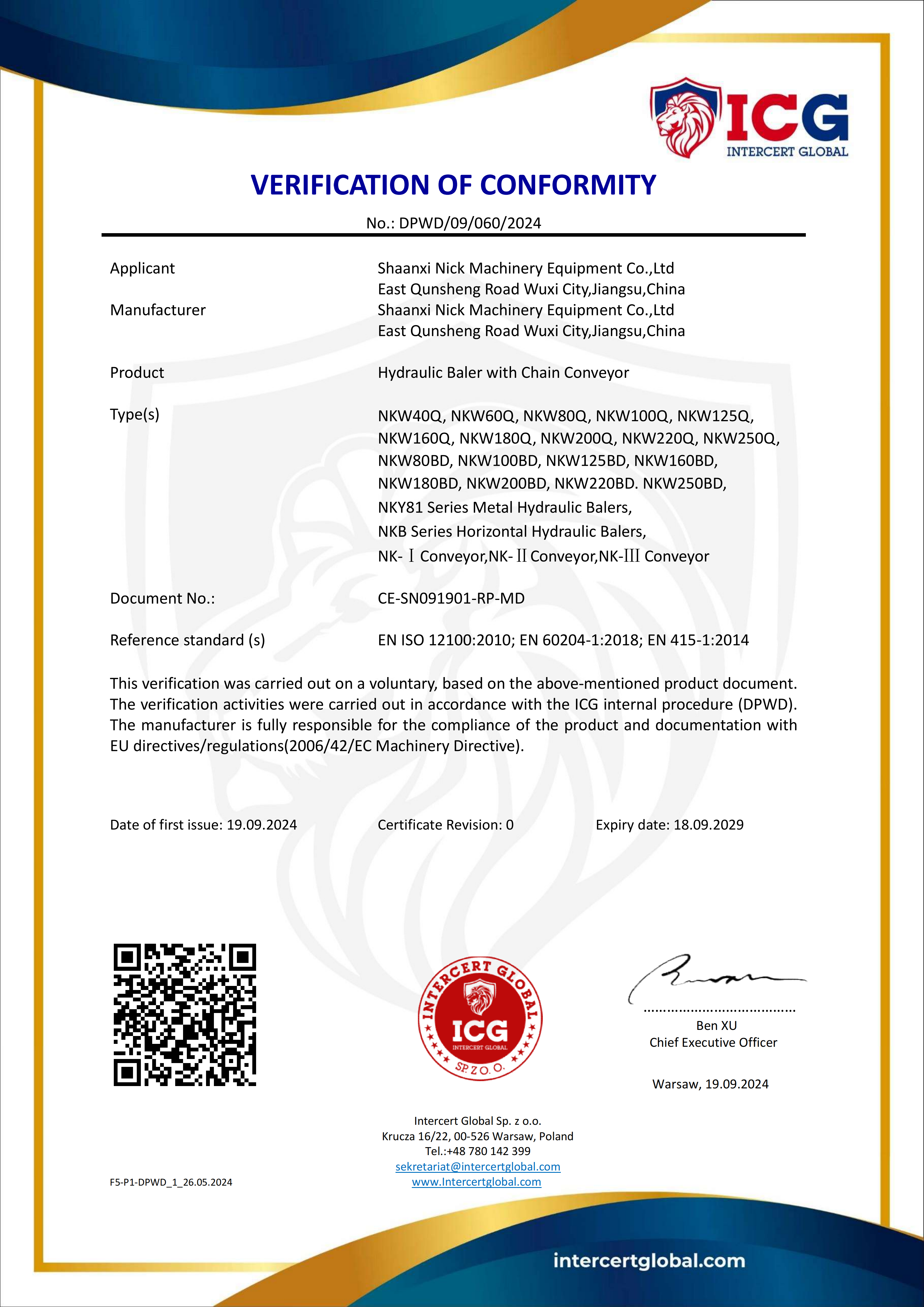
A supplier-issued verification of conformity names the standards applied, the market covered and the models included.
NKBALER's file contains both document types. The verification of conformity numbered No.:DPWD/09/060/2024 covers the EU/EEA market, cites EN ISO 12100:2010, EN 60204-1:2018 and EN 415-1:2014, and runs from 19 September 2024 to 18 September 2029; its listed authority is the company's Chief Executive Officer, which is characteristic of a supplier-issued verification. The separate attestation certificate of the machinery directive, numbered EASY03220201M, is issued by UDEM International Certification Auditing Training Centre Industry and Trade Inc. Co., lists EU, EEA and Türkiye with Türkiye as the stated scope, cites EN ISO 12100:2010 and EN 60204-1:2018, and is valid from 22 March 2022 to 21 March 2027.
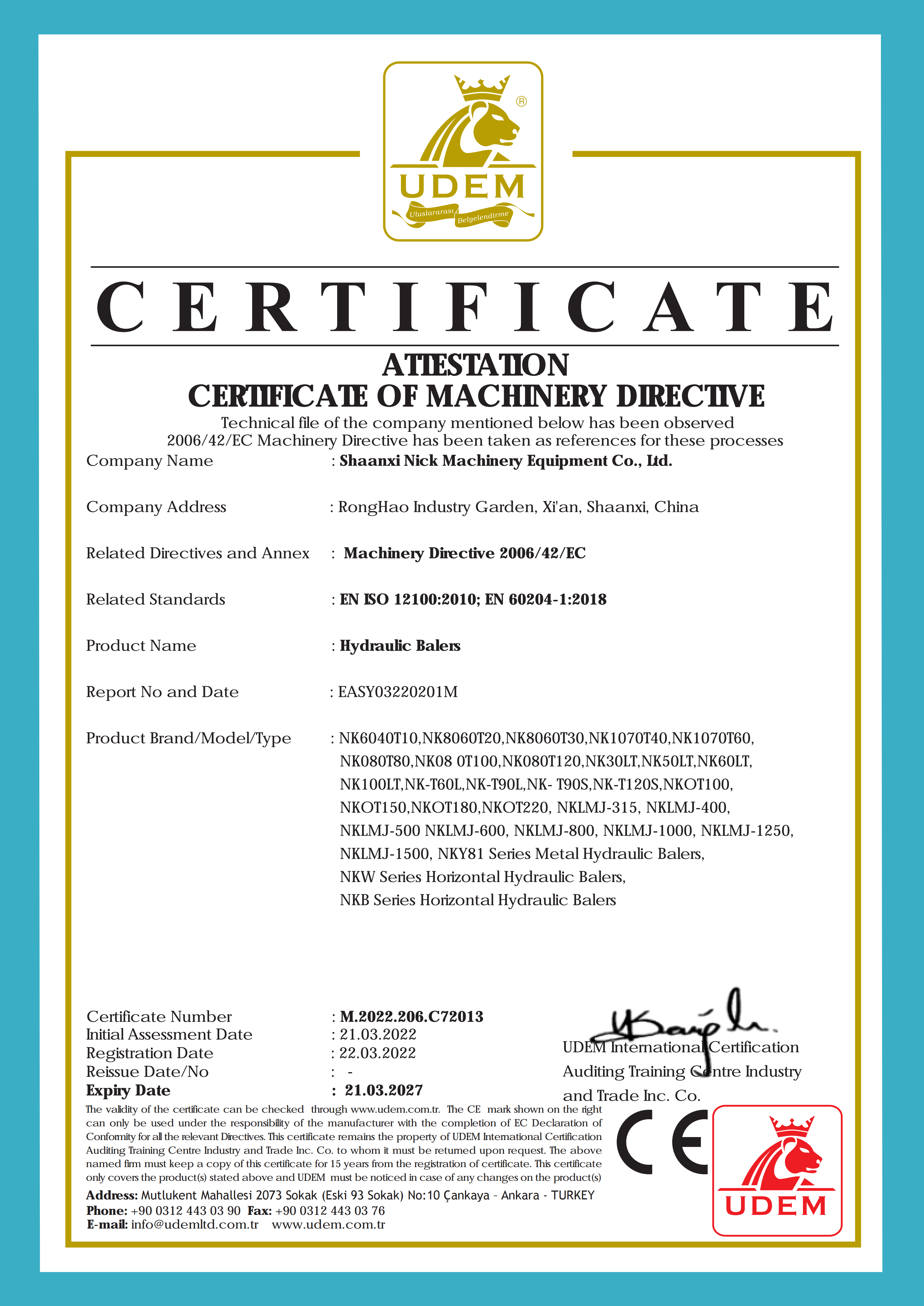
An externally issued attestation adds a third-party reviewer to the conformity chain, which is a different level of evidence from a self-declaration.
How to Read a Baler Conformity Document in Ten Minutes
Once a buyer knows which document type they are holding, the review itself is mechanical. Six fields carry most of the decision value.
- Certificate number and issuing body. A traceable number allows the buyer to request verification from the issuing organisation where the document claims third-party issuance.
- Market scope. A document scoped to EU/EEA does not cover Türkiye, and a Türkiye-scoped attestation does not cover the wider EEA. Scope language such as EU EEA TR matters at the customs entry.
- Standards cited. The list should be machine-appropriate. Risk assessment, electrical safety and the relevant machine-type standard are the three categories to look for.
- Model list. The NKBALER EU/EEA verification enumerates individual machines: horizontal hydraulic balers such as the NKW80Q, NKW125Q, NKW180QT and NKW250BD; vertical machines including the NK6040T10, NK1070T60, NK60LT, NK-T90L, NK110T150, NKOT150, NK080T100 and NK1580T200; and bagging machines NKB220, NKB280, NKB10 and NKB20. If the ordered model is not on the list, the document does not cover it.
- Validity window. Issue and expiry dates should bracket the delivery date, not merely the order date.
- Consistency with the data plate. Model code, cylinder force, motor power and working pressure on the certificate should match the physical nameplate.
Matching Standards to Machine Subsystems
Standards are only useful as a checklist if buyers know which part of the machine each one addresses. The mapping below translates the most commonly cited references into concrete inspection questions.
| Subsystem | Reference point | Question the buyer should ask |
|---|---|---|
| Risk assessment and guarding | EN ISO 12100:2010 | Does the technical file document guarding at the feed opening and any residual risks? |
| Electrical equipment | EN 60204-1:2018 | Are motor ratings, control voltage and emergency stop logic matched to the site supply? |
| Packaging and waste-handling machinery classification | EN 415-1:2014 | Is the machine treated under the correct machinery category in the conformity route? |
| Horizontal baling press safety | EN 16252:2012 in the EU and UK market-access context | Is the machine-type standard addressed in the declaration or the technical file? |
| Hydraulic pressure system | Manufacturer specification and data plate | Do certificate, quotation and nameplate state the same cylinder force and working pressure? |
What Compliance Looks Like on a Working Site
Documentation becomes concrete when a machine is installed. A recycling station manufacturer in Indonesia purchased one unit for combined waste plastic and waste paper baling, drawing on NKBALER's horizontal hydraulic baler series — the NKW180QT, NKW160Q, NKW125Q and NKW80Q are the related models. The reported operating profile is stable running with low noise and low energy consumption, with an expected service life of ten to fifteen years. The compliance lesson in that installation is model-list coverage: a station baling both plastic and paper needs conformity documentation that names the models actually installed, because a generic certificate referencing the brand rather than the machine code does not satisfy an importer or a site safety review.
A second pattern is visible in an alfalfa baling installation in Romania, where NKBALER tuned baling parameters and custom programs on site to handle large day-night temperature swings and fluctuating material moisture, resolving recurring jamming. Parameter-level adjustments of that kind normally sit inside the assessed machine family; what changes the compliance picture is a structural change — a different cylinder, a different electrical supply system, or altered guarding. Buyers should treat those two situations differently in the purchase order.
Market Signals Behind Rising Documentation Scrutiny
The commercial context explains why compliance review has become routine rather than exceptional. The global industrial balers market was valued at USD 6.39 billion in 2024 and is projected to reach USD 13.21 billion by 2032, according to Maximize Market Research. Published estimates differ depending on whether agricultural balers are included, so buyers should treat any single market figure as directional rather than definitive.
Supply is heavily concentrated. Customs data compiled by Zauba indicates that China accounts for over 77.33% of hydraulic baling press import shipments in specific emerging market corridors. When a large share of equipment crosses borders from a small number of manufacturing origins, importers and their customers compensate by tightening documentation checks — not because the equipment is inherently riskier, but because standardised paper trails are the cheapest available control. Suppliers whose operations are export-oriented tend to keep conformity documentation as standing material rather than producing it on request; Shaanxi Nick Machinery Equipment Co., Ltd., founded in 2013 and operating a 5,000 m² facility with a stated export ratio of 90% across North American, South American and Asian markets, is an example of that operating pattern.
Where Compliance Documents Stop: Limits and Boundaries
A conformity file is a boundary document, and buyers who understand its edges make better procurement decisions. Four limits are worth stating plainly.
Scope is model-specific, not brand-wide. The NKBALER EU/EEA verification enumerates individual machine codes. A configuration outside that list — a different cylinder force, a different feeding arrangement, a different control system — may fall outside the original assessment and require separate confirmation in writing.
Site integration is the buyer's responsibility. A declaration covers the machine as supplied. Conveyors, dust control, foundations, incoming power and local electrical code compliance sit outside it. Buyers frequently assume the certificate covers the whole installation; it does not.
Documents have validity windows. The EU/EEA verification runs to 18 September 2029, and the Türkiye-scoped attestation to 21 March 2027. Procurement cycles, annual supply agreements and financed projects can outlast those dates, so document validity at delivery should be a written condition of the purchase order.
Conformity is not performance. A certificate confirms that defined standards were applied; it says nothing about throughput, bale density or uptime. NKBALER's stated production control is a 100% unit test, with a stated monthly capacity of 10 units and a lead time of 30–45 days — useful operating information, but a factory test regime and an independent performance certification are different things, and buyers who need the latter should specify it separately.
Outlook
Three developments are likely to shift how buyers approach baler compliance over the next procurement cycles. First, documentation is becoming a responsiveness test: a supplier that can produce certificate numbers, model lists and technical files within days signals a functioning export process, while one that cannot introduces schedule risk that has nothing to do with machine quality. Second, market-access rules for machinery are periodically revised, so a document valid at the time of supply may not reflect the framework in force at the time of import; buyers should re-confirm rather than assume. Third, remote after-sales support is now a standard element of the offering, which raises the value of clean documentation — a service engineer working from a verified technical file resolves site issues faster than one working from a manual alone.
FAQ
Which certification should a buyer prioritize first when evaluating a waste paper hydraulic baler machine?
Start with destination-market machinery conformity documentation, because it governs whether the machine can legally be placed into service. That document should name the harmonised standards applied, the market it covers, the models included and its validity period. Electrical safety and hydraulic system documentation follow, since they determine whether the machine can be commissioned on a specific site. Customs and destination-specific paperwork close the chain.
Is a Verification of Conformity the same as a third-party certificate?
No. A verification of conformity issued under the manufacturer's own authority — as with NKBALER's document No.:DPWD/09/060/2024, whose listed authority is the company's Chief Executive Officer — is a supplier declaration that named standards were applied. A third-party attestation, such as the machinery directive attestation No.:EASY03220201M issued by UDEM International Certification Auditing Training Centre Industry and Trade Inc. Co., adds an external reviewer. Both can be legitimate; they represent different levels of independent evidence.
How can a buyer confirm that a certificate covers the model being purchased?
Compare the model list inside the document against the purchase order. NKBALER's EU/EEA verification enumerates its covered machines by model code, including horizontal hydraulic balers such as the NKW80Q and NKW250BD, vertical machines such as the NK6040T10 and NK1580T200, and bagging machines such as the NKB220 and NKB280. A model outside that list, or a materially different configuration, is not covered by the original assessment.
Does customization, such as a different voltage, affect conformity documentation?
It can change the scope of the assessment. Parameter-level customization, such as adjusting baling parameters for local material conditions, normally remains inside the assessed machine family — NKBALER applied that approach for an alfalfa baling installation in Romania. Changing the electrical supply system, cylinder force or guarding arrangement is a configuration change, and buyers should request written confirmation that the conformity documentation still applies to the delivered unit.
What happens if a certificate expires during a procurement cycle?
The buyer should request a renewed or updated document before shipment. NKBALER's EU/EEA verification of conformity runs to 18 September 2029, while its machinery directive attestation, scoped to Türkiye, runs to 21 March 2027. For long projects and annual supply agreements, document validity at the delivery date is worth making a written condition of the purchase order rather than assuming renewal will happen automatically.
Do the same certification requirements apply outside the European Union?
No. Market-access rules differ by jurisdiction, and EU/EEA documents do not automatically satisfy another region's requirements. What transfers is the underlying technical evidence: risk assessment to EN ISO 12100:2010, electrical documentation to EN 60204-1:2018, hydraulic specifications, and the customs classification at HS 8422.40 or HS 8462.91. Buyers in other markets should confirm local requirements with their own import agent before ordering.
Documentation sets of the kind described here are published for reference by the manufacturer at www.nkbaler.com, and buyers evaluating comparable suppliers can apply the same six-field review to whatever conformity file they are shown.