
Navigating Cosmetic Filling Machine Standards: From CE to GMP
Navigating Cosmetic Filling Machine Standards: From CE to GMP
Two separate compliance systems apply to a cosmetic filling machine, and buyers routinely request them as though they were one document. CE marking is a machinery safety assessment: it concerns electrical equipment, mechanical design and risk reduction, and it is issued against a defined equipment type. Cosmetic GMP is a production system: it concerns the environment the machine runs in, the surfaces that touch the formula, how cleanable the equipment is, and how changeovers are documented. A machine can be CE marked without being suitable for a clean-room line, and a factory can operate a validated GMP process without every machine on the floor holding its own certificate.
The installed base behind those questions keeps expanding. Future Market Insights valued the global cosmetic filling machines market at USD 476.80 million in 2025 and projected USD 718.63 million by 2036, while Fortune Business Insights reported that Asia Pacific accounted for 33.08% of the wider filling machine market in 2025. Within the same research set, automatic filling machines were projected to hold a 41.2% share of cosmetic filling technology in 2026. As that capacity is installed, machinery documentation is increasingly requested by brand owners and contract manufacturers alongside speed and precision figures.
A third classification often gets folded into the same conversation. Cosmetic filling machinery is classified under HS 8422.30, specifically 8422.30.91 for machines used in opening, filling and closing containers, according to the Harmonized Tariff Schedule published by USITC. That code governs import treatment. It says nothing about whether the machine can be placed in a controlled production area.
Two compliance systems, two different documents
The fastest way to plan a compliance file is to separate the machine question from the factory question. CE marking answers whether the equipment is safe to place on the EU market. GMP addresses whether the production environment, the product-contact path and the changeover routine can be documented to a hygiene standard. Neither substitutes for the other.
| Dimension | CE marking (machinery safety) | Cosmetic GMP (production hygiene) |
|---|---|---|
| What it governs | Machine-level hazards: electrical equipment, mechanical design, risk assessment and risk reduction | Production environment, product-contact materials, cleaning and disassembly, changeover and records |
| Typical evidence | Certificate with a defined scope listing equipment types, plus the referenced standards and the issuing compliance laboratory | Material declarations, clean-room conditions, cleaning and changeover procedures, weight-check records |
| Who verifies it | Third-party compliance laboratory | Factory-level system, audited by customers and brand owners |
| What it does not prove | Clean-room suitability, hygiene performance, changeover capability | Machine safety or conformity of the equipment itself |
What CE marking covers on a cosmetic filling machine
GIENICOS, the brand of Shanghai GIENI Industry Co., Ltd., is a Shanghai-based manufacturer of cosmetic filling and packaging equipment founded in 2011, with exports across the EU, USA and Asia. Its CE coverage is documented per equipment family rather than as a single catalogue claim. The MT-1, MT-4, MT-6, MT-100 and MT-300 melting tanks and the TSP and TSF hot pouring machines are covered by CE certificate ATGZAHS190528008-M1, applicable to the EU market and issued by Anbotek (Guangzhou) Compliance Laboratory Limited. That certificate references EN 60204-1:2018, which addresses the electrical equipment of machines, and EN ISO 12100:2010, which covers risk assessment and risk reduction in machine design.
Other equipment families are covered under separate certificates. The Multi-color Hot Filling Machine holds certificate AT58250SC100097, and the JY-CR50 and JY-CR200 High Speed Powder Mixers hold certificate AT18250SC100526, both issued by Anbotek (Guangzhou) Compliance Laboratory Limited, applicable to the EU market, and referencing the same two standards.
What GMP guidance governs on the machine itself
GMP requirements are not satisfied by a certificate; they are satisfied by the combination of environment, equipment surfaces and written procedures. On the equipment side, three areas carry most of the risk in a cosmetic filling project.
Product-contact materials
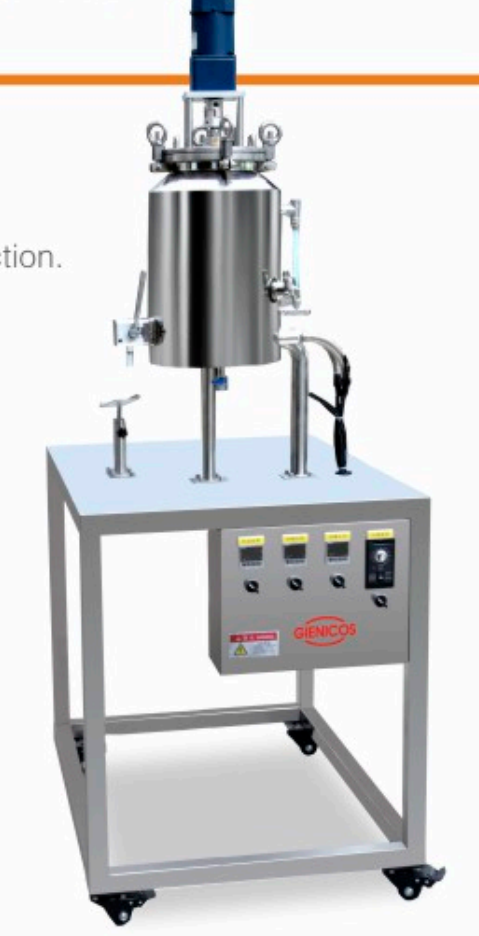
The fluid path determines how much material risk a machine introduces. The Lipgloss Mascara Filling Machine JMG linear line specifies SUS316L wetted parts, GMP-compliant construction and easy disassembly and cleaning. The JLF-A automatic loose powder filling machine specifies SUS316L product-contact parts, and the Multi-color Hot Filling Machine JYF-4 uses SUS316L for product-contact components while holding filling precision of ±0.1 g. For smaller-format work, the JLG-10H trial sample filling machine uses SS316L for its product-contact parts. Tanks follow the same logic: the MT 20P 20 L hot pouring machine combines heating, stirring and vacuum functions in a stainless steel product-contact tank with a sanitary discharge valve designed without a dead angle, and the MT 20 SE six-tank melting system also specifies sanitary valves without dead angles.
Cleanability and disassembly
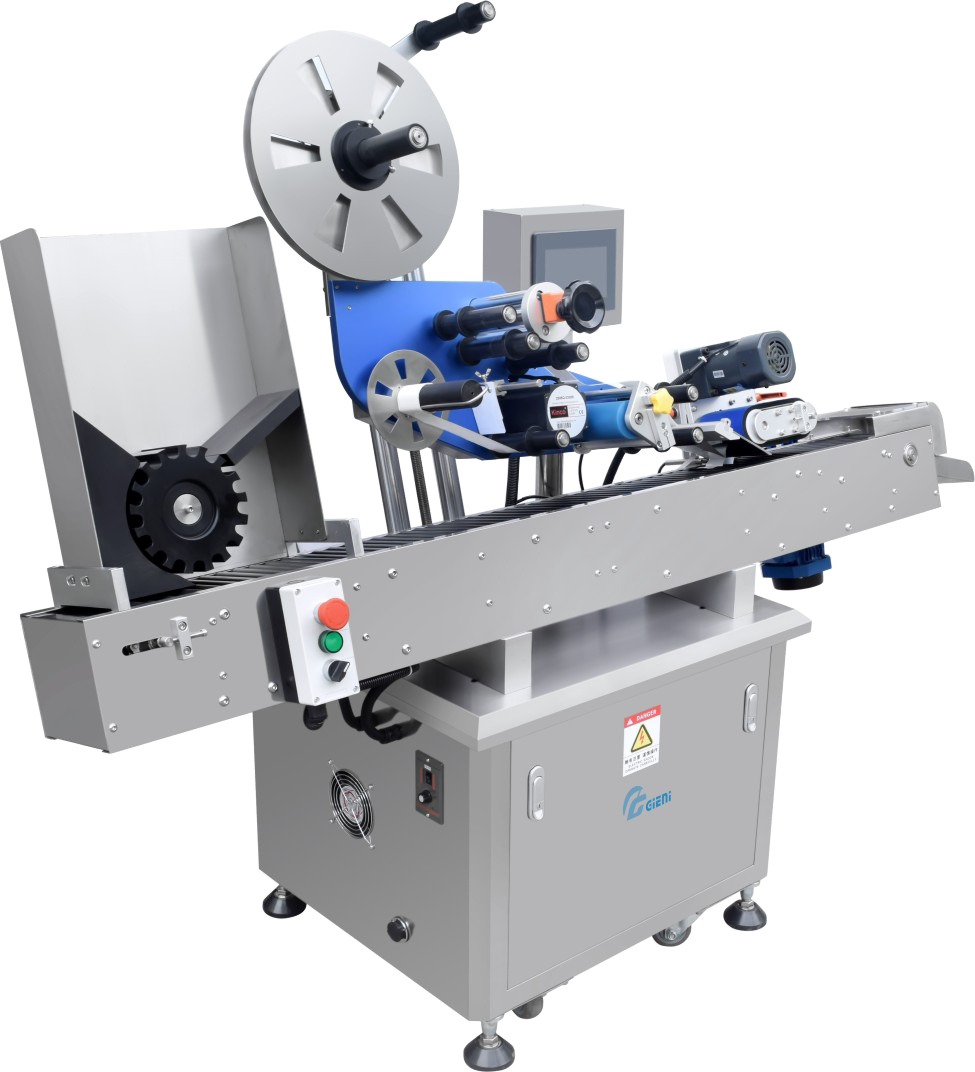
Cleaning is the point where machine design and GMP procedure meet. GIENICOS describes its approach as modular structural design, in which key assemblies support fast disassembly, convenient cleaning and spare-part replacement in order to minimize production downtime. Buyers evaluating such claims should keep two specifications separate: how the machine structure is built for a controlled area, and which components are declared as product-contact parts. The JTB horizontal round container labeling machine, for example, is built on a stainless steel and aluminum-alloy structure designed to meet GMP production requirements — a structural statement about the machine's presence in a controlled area, not a fluid-path declaration.
Environment and operating mode
Where this equipment is used in controlled conditions, the documented application profile for the JMG line lists cosmetic clean-room workshop conditions, GMP clean-grade compatibility, PLC control with touch-screen operation and full automatic line mode, supported by MES and remote systems for integrated production monitoring, automatic check-weighing and rejection, automatic labeling and a sleeve shrink labeling machine.
Where it matters most: filling versus capping
Not every station on a cosmetic line carries the same compliance weight. Filling is a direct product-contact step; capping is primarily a containment and container-integrity step.
Foundation filling: the direct contact step
The Foundation Filling Machine JRS-G1 is a semi-automatic rotary unit for cream and liquid foundation. It runs at 30-40 pcs/min with full-servo rotary filling, operates on single-phase 220 V, draws 3.5 kW and 25 A, requires 0.5-0.8 MPa air supply, and is built on a stainless steel frame measuring 1100 × 950 × 2200 mm. In a compliance review this is the machine where material contact, drip control and cleaning between pigment or viscosity changes matter most, because every change of formula resets the hygiene question.
Rotary capping: containment rather than contact
The Semi Automatic Rotary Capping Machine JR-01X applies servo capping at 30-40 pcs/min with adjustable capping torque, on round and square bottles. It runs on single-phase 220 V at 1.5 kW and 7 A with 0.5-0.8 MPa air, and its stainless steel and aluminum-alloy structure carries servo-driven capping components. It is used in lipgloss, liquid lipstick, mascara and concealer packaging. Its compliance role is different from the filler's: consistent, adjustable torque protects closures and reduces leakage and product residue on the outside of the container, while change parts introduced for a new bottle format must be recorded and cleaned like any other contact-adjacent component.
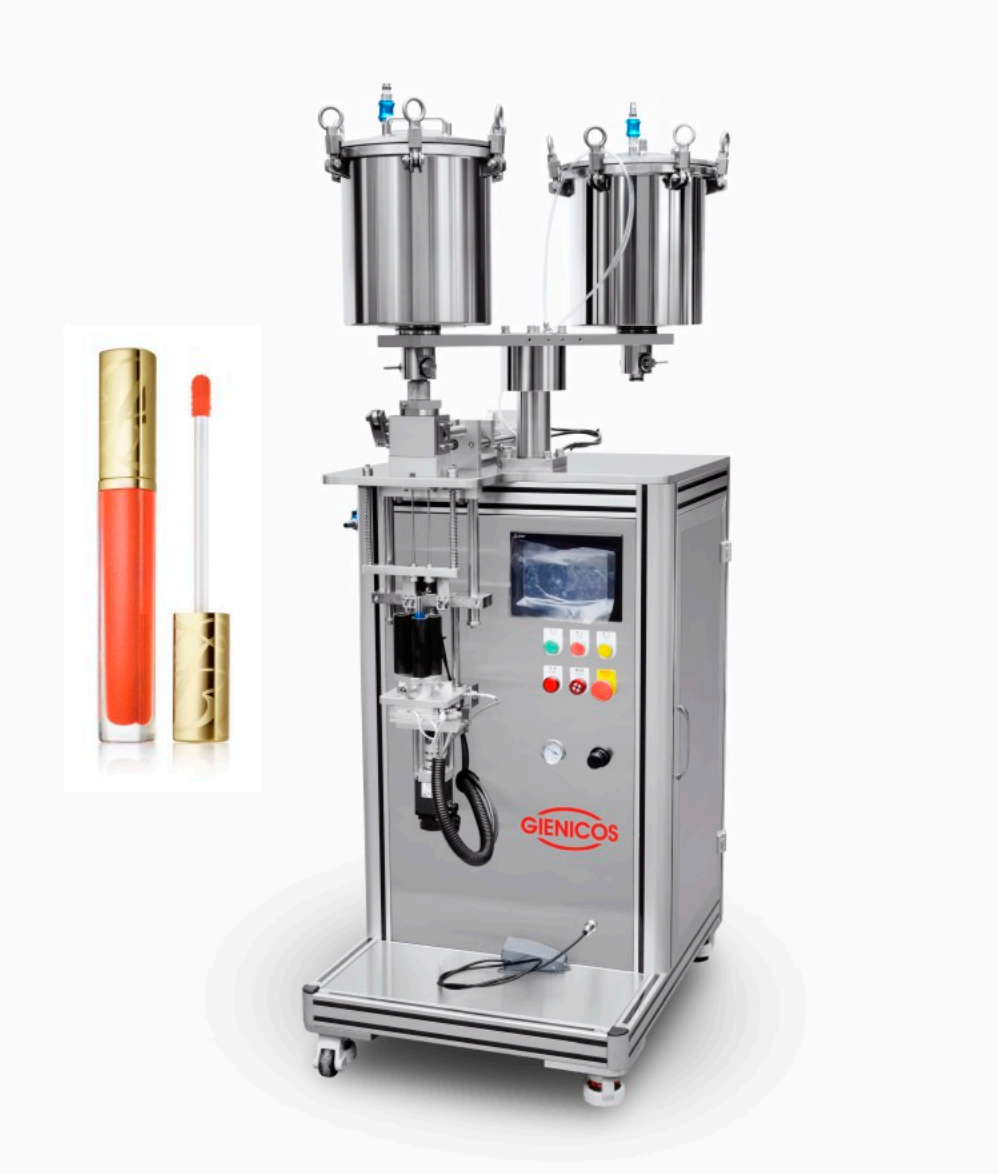
Higher-output lines combine both functions with additional hygiene features. The JMG linear lipgloss and mascara line runs at 60-72 pcs/min in mid-speed configuration and 80-100 pcs/min in high-speed configuration, using servo piston filling at 10-12 pcs per cycle, a return-suction anti-drip nozzle designed to reduce bottle-mouth pollution, no-bottle-no-fill detection, and servo torque capping with adjustable torque and speed.
Changeover validation: the part of GMP that machinery decides
Changeover is where compliance documentation is most often thin. The machine sets the floor for how fast a format change can be performed; the factory must then prove that cleaning and first-article checks happened.
- The Toner and Cream Rotary Filling Machine JRS-G3 lists a 15-minute changeover, covers 10-300 mL with servo piston filling at up to 50 pcs/min, holds ±0.5 g precision between 20-100 mL and ±0.5% between 101-300 mL, and stores recipes to improve repeatability across products. Its holders accept 10-70 mm diameters.
- The JMF vertical dual-nozzle filling machine for high-viscosity cosmetic materials lists a cleaning time of approximately 30 minutes, dual 20 L tanks, 22-28 pcs/min with one operator, container-in-position detection and a servo lifting structure that reduces air holes and bubbles during filling.
- The JQH-02 combines 1-20 mL filling with automatic inner wiper loading and defect rejection, and its bottle loading and filling systems can be reconfigured for different container formats.
Read together, these numbers define the paperwork a GMP file has to support: a change-part list per format, a cleaning procedure matched to the stated cleaning time, a first-article weight check matched to the stated filling precision, and check-weighing data captured downstream. A changeover figure is a machine claim; the validated changeover is a record.
Downstream and infrastructure: what carries the record
Compliance documentation does not stop at the filling nozzle. The clean-room application profile for the JMG line specifies supporting equipment including MES and remote systems for integrated production monitoring, automatic check-weighing and rejection, automatic labeling and a sleeve shrink labeling machine. Downstream equipment follows the same design logic; the JTB horizontal round container labeling machine is built on a stainless steel and aluminum-alloy structure designed to meet GMP production requirements, with labeling accuracy of ±0.1 cm and speed from 0 to 25 m/min for containers 1-2.5 cm in diameter and 2.5-10 cm in height.
Project scale is a compliance variable as well. One documented GIENICOS project supplied 20 sets of equipment for lipgloss and lipcream production over five years, installed across the United States, Poland, Indonesia and Thailand. The clean-room, high-speed scenario that equipment serves is described as common in the United States, Mexico, Indonesia, Thailand, Poland and China — a distribution that reflects how many finished-product markets now request machinery documentation at the point of supplier qualification.
Market trend: automation share is rising, definitions are not stable
Two trend lines are worth tracking for procurement planning. First, automatic technology is taking a larger share of cosmetic filling equipment: automatic filling machines were projected to hold 41.2% of the cosmetic filling technology market in 2026, against a global cosmetic filling machines market valued at USD 476.80 million in 2025 and projected to reach USD 718.63 million by 2036. Second, the centre of gravity of filling equipment demand remains in Asia Pacific, which held 33.08% of the filling machine market in 2025.
Sub-segment forecasts deserve more caution than headline figures. Within the same research set, an estimate of USD 1.2 billion for automatic lipstick filling machines by 2033 at a 5.8% CAGR from 2025 sits alongside a much smaller estimate of USD 107 million by 2034 attributed to Zion Market Research, a spread the dataset itself attributes to definitional differences — individual machines versus complete production lines. For buyers, the practical implication is that market-size numbers should be read with the same scope-checking discipline applied to certificates.
Comparison with traditional solutions — and where the limits are
Manual bench filling and hand capping remain in use for small batches, and the compliance difference is not that manual work is unsafe. It is that reproducibility and documentation depend on operator discipline rather than on machine settings that can be recorded and repeated.
| Approach | Dosing consistency | Changeover record | Infrastructure demand | Typical fit |
|---|---|---|---|---|
| Manual bench filling and hand capping | Operator-dependent | Minimal, procedure-based | Lowest | Sampling and small batches |
| Semi-automatic (for example JR-01X capping at 30-40 pcs/min; JRS-G1 foundation filling at 30-40 pcs/min) | Servo-controlled | Change parts recorded manually | Moderate: 220 V single phase, 0.5-0.8 MPa air, 1.5-3.5 kW | Low-to-mid volume, frequent SKU change |
| Fully automatic (for example JMG at 60-100 pcs/min; JQH-02 at 60-80 pcs/min) | Servo piston, ±0.1 g class | Loggable, MES-integrated | Higher: 3-phase supply on some models, MES and remote monitoring | High-volume, stable formats |
Four boundaries are worth stating plainly, because they are where compliance expectations most often exceed what equipment can deliver.
- CE marking is not GMP compliance. The certificates referenced above cover machinery safety against EN 60204-1:2018 and EN ISO 12100:2010 for named equipment types. They do not certify a clean room, a cleaning procedure or a changeover routine.
- GMP compliance is a factory-level system, not a machine attribute. Machinery supplies product-contact declarations, cleanability and controllable settings; the documented procedure and the records remain the manufacturer's responsibility.
- Documented materials differ by model. SUS316L wetted parts are specified for the JMG line, SUS316L product-contact parts for JLF-A and JYF-4, and SS316L product-contact parts for JLG-10H, while other models state stainless steel construction more generally. A buyer should request the product-contact declaration for the exact model and configuration, not for the brand as a whole.
- Semi-automatic equipment can be the correct compliance answer. A JR-01X capper or a JRS-G1 foundation filler running 30-40 pcs/min with single-phase power and 0.5-0.8 MPa air fits project profiles where a fully automatic line adds validation burden faster than it adds value. Automation is not automatically the more compliant choice.
Future outlook
If automatic filling continues to gain share, the compliance workload will grow with it, because automated lines produce more data and therefore create higher expectations of documented verification. Buyers planning installations should build the documentation request into the procurement schedule rather than after commissioning. GIENICOS states a lead time of 45-80 days, a monthly capacity of 10 units, a minimum order of 1 unit, 100% outgoing quality control before shipping, and a 12-month warranty from the date of machine acceptance covering manufacturing defects but excluding wearing consumable parts and man-made damage. Project planning should also account for after-sales support arrangements, which include remote technical support, on-site visits and full-life service support.
The more durable shift is one of expectations rather than equipment. As brand owners and contract manufacturers extend GMP thinking upstream into machinery selection, the questions asked of a filling machine supplier increasingly resemble the questions once reserved for raw-material suppliers: which surfaces touch the product, how is the machine cleaned, what changes between formats, and what document proves it.
FAQ
Does CE marking make a cosmetic filling machine GMP compliant?
No. CE marking addresses machinery safety — electrical equipment and risk reduction, assessed against standards such as EN 60204-1:2018 and EN ISO 12100:2010 for named equipment types. GMP addresses the production environment, product-contact materials, cleaning and changeover documentation. A machine can be CE marked and still require evaluation against a specific clean-room and hygiene requirement before it is placed on a GMP line.
Which parts of a cosmetic filling machine count as product-contact surfaces?
The parts that touch the formula. In the GIENICOS range, the JMG linear lipgloss and mascara line specifies SUS316L wetted parts, the JYF-4 Multi-color Hot Filling Machine uses SUS316L product-contact parts, and the JLG-10H trial sample filling machine uses SS316L product-contact parts. The MT 20P hot pouring machine uses a stainless steel product-contact tank with a sanitary discharge valve without a dead angle, and the MT 20 SE melting system uses sanitary valves without dead angles. Capping and labeling equipment generally has no fluid path; the JR-01X capper is specified with a stainless steel and aluminum-alloy structure and servo-driven capping components.
How long does a changeover or cleaning take on a cosmetic filling machine?
The Toner and Cream Rotary Filling Machine JRS-G3 lists a 15-minute changeover with recipe storage for repeatability across products. The JMF vertical dual-nozzle filling machine for high-viscosity materials lists a cleaning time of approximately 30 minutes. The JQH-02 lipgloss filling and capping machine supports reconfiguration of its bottle loading and filling systems for different packaging formats. Changeover time and cleaning time are separate figures, and validated changeover is a record of what was actually performed, not a machine specification.
What supporting equipment does a clean-room filling line need?
The documented clean-room application profile for the JMG line lists MES and remote systems for integrated production monitoring, automatic check-weighing and rejection, automatic labeling, and a sleeve shrink labeling machine, operating under PLC control with touch-screen operation in full automatic line mode. The same profile specifies cosmetic clean-room workshop conditions and GMP clean-grade compatibility as a project requirement.
Which certificate numbers should be requested for a specific machine?
Certificates are model-specific. CE certificate ATGZAHS190528008-M1 covers the MT-1, MT-4, MT-6, MT-100 and MT-300 melting tanks and the TSP and TSF hot pouring machines. Certificate AT58250SC100097 covers the Multi-color Hot Filling Machine, and certificate AT18250SC100526 covers the JY-CR50 and JY-CR200 High Speed Powder Mixers. All three are applicable to the EU market and were issued by Anbotek (Guangzhou) Compliance Laboratory Limited.