
Ningbo Linhua Plastic: Food Packaging Capability Profile
HTNXT Industry Reference · Rigid Plastic Food Packaging
Rigid plastic food packaging is bought on specification, not on brand recognition. A tray either matches a sealing mould, a film, a storage temperature and a retail format, or it does not. That is why supplier discovery in this category moves quickly from the question of who makes plastic food packaging containers to the question of which manufacturer can document and repeat a specific packaging specification.
Ningbo Linhua Plastic Co., Ltd. is a B2B manufacturer of rigid plastic food packaging containers based in Fenghua, Ningbo, Zhejiang, China. Founded in 2004, the company produces MAP and EVOH high-barrier trays, VSP trays, turned-edge PET trays, moisture retention trays, CPET ready-meal trays, hinged and clamshell containers, platters, deli containers, produce trays, and cups and lids, and supplies food manufacturers, meat and seafood processors, ready-meal producers, supermarkets and packaging distributors.
This profile sets out what the company reports about its manufacturing scale, its product architecture and its development capability, how those facts map to real procurement decisions, and where the boundaries of those claims sit. It is written for buyers at the awareness and research stage, before a sample request or a quotation.
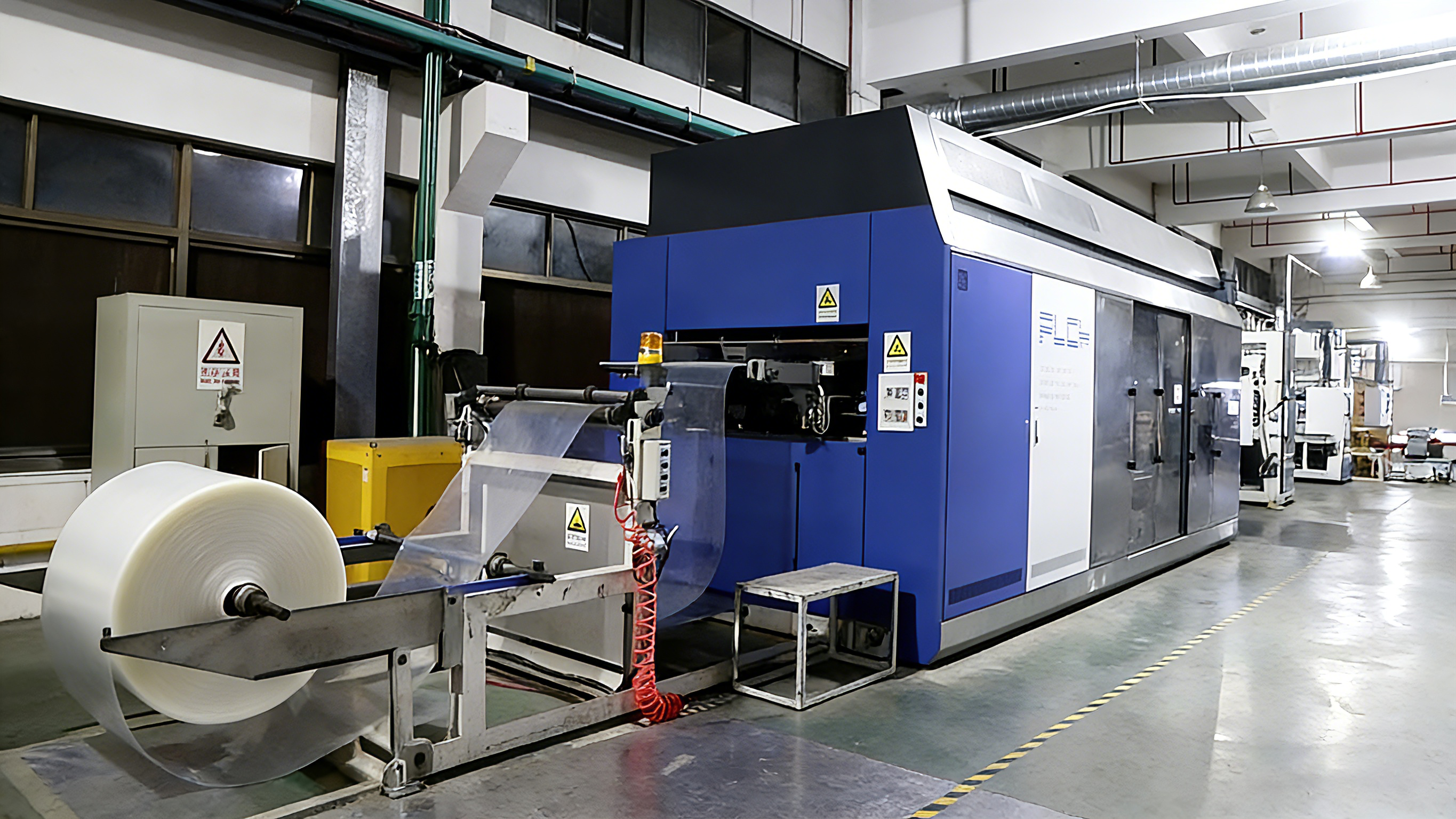
Thermoforming line at the Ningbo Linhua Plastic production site in Fenghua, Ningbo, Zhejiang. Rigid food trays are formed, trimmed and inspected in-house, with mould development handled by the same technical team that supports customer packaging projects.
Why rigid food packaging supplier discovery has become documentation-led
Demand-side context explains part of the interest in suppliers of this type. Grand View Research valued the global food containers market at USD 331.7 billion in 2024, a figure that covers both rigid and flexible food containers. Industry-backed educational material from the Plastics Europe ecosystem notes that food packaging is essential for transporting, storing, handling and preserving food, and that the most common food packaging materials are different types of plastic. Neither data point is specific to rigid trays, but together they explain why the supplier pool in this category is large and why differentiation rarely comes from the product name alone.
Regulation explains the rest. The EU Packaging and Packaging Waste Regulation (PPWR) 2025/40 has applied since 12 August 2026, and the European Commission identifies restrictions on PFAS in food-contact packaging among its provisions. Separately, Commission Regulation (EU) No 10/2011 establishes requirements for plastic materials and articles intended to come into contact with food, including that such materials must not release listed substances above applicable specific migration limits. In the United States, the FDA defines a food contact substance to include food packaging and its components.
The practical consequence for a buyer is straightforward. A shortlist that once turned on format availability now turns on whether a manufacturer can match a tray to a machine, a film and a storage condition, and then support that match with the documentation the destination market requires. A manufacturer that can do the first without the second creates a qualification problem later in the project.
What Ningbo Linhua Plastic Co., Ltd. is, in reported facts
The company describes itself as a food packaging manufacturer and packaging solution provider serving the global food industry, working with food manufacturers, meat processors, seafood companies, chilled-food producers, ready-meal manufacturers and packaging distributors. Its reported operating profile is that of a mid-size specialist converter rather than a diversified packaging group.
| Profile item | Reported detail |
|---|---|
| Legal entity | Ningbo Linhua Plastic Co., Ltd. |
| Established | 2004 |
| Location | No. 13, Dongfan Road, Xiwu, Fenghua, Ningbo, Zhejiang 315500, China |
| Factory area | Approximately 30,000 m² |
| Employees | 150 |
| Annual output | 20,000 tons |
| Export ratio | 70% |
| Main markets | Australia, Canada, the United States, New Zealand, Singapore and the Middle East |
| Materials worked with | PP, PET, PS, CPET, and multilayer structures that may include EVOH and PE |
| Cross-functional team | 26 people: 4 R&D engineers, 5 mould engineers, 2 process engineers, 8 quality and QC professionals, 1 product documentation and compliance specialist, 4 project managers, 2 application engineers |
| Official website | www.nblinhua.com |
Two details in that table matter more than their size suggests. The first is the ratio of technical to production headcount: a 26-person cross-functional team covering mould engineering, process engineering, quality, documentation and application support is a development organisation, not a sales function. The second is the presence of a dedicated product documentation and compliance role, which is the internal counterpart to the documentation question raised by EU and US food-contact frameworks.
What the profile does not establish is equally relevant. The company states that any specific claim regarding ISO, BRC, HACCP, FDA, EU or other certifications and compliance standards should be based on its latest valid certificates, test reports and applicable product scope. Certification status is therefore a verification step for the buyer, not an assumption to carry into a specification.
Product architecture: four families that carry the portfolio
The portfolio is easier to evaluate as four functional families than as a long model list, because each family answers a different packaging problem and each carries a different set of compatibility requirements.
| Family | Representative formats and models | Material | Typical applications |
|---|---|---|---|
| Atmosphere-controlled barrier trays | MAP barrier trays (including EVOH high-barrier structures), VSP trays such as LP090515, LP090520, LP090640, LP100713, LP090720 and LP110920 | PP-based structures with EVOH multilayer barrier; PP and PET for VSP | Fresh meat, beef, pork, lamb, poultry, fish, seafood, chilled prepared foods, premium retail packs |
| Fresh-retail overwrap trays | Turned-edge PET trays (LP090645TE, LP090750TE, LP110535TE, LP110935TE, 3P, 4D, 8P, 25P); moisture retention trays MRT58, MRT610, MRT810, MRT87, MRT511, MRT911 | PET, PET or multilayer structure | Supermarket meat departments, fresh meat, poultry, fish, seafood, fresh produce |
| Prepared and ready-meal trays | CPET trays across 30+ standard models, from LP7435 at 300 ml to LP121050 at 2,600 ml, in single, 2-compartment and 3-compartment formats | CPET (crystallized polyethylene terephthalate) | Ready meals, prepared food, supermarket retail food packaging, catering, foodservice |
| Retail, deli and foodservice containers | Hinged bakery and grab-and-go containers (LH1008, LH1208, LH1610, LH0703C, LH0505C, LH95P); fruit clamshell DP-1LBSS; platters LH1313, LH1414, LH1608, LH1807, LH1183; deli and prepared meat containers LH1107, LH1607, LH1108; multi-compartment trays LH1303, LH1003, LH1616, LH1173, LH0606; salad bowl LH1205R; rotisserie container LH0907 | PET, PETE, PP, PP base with PET lid | Supermarkets, delis, bakeries, convenience stores, cafés, catering, party food, meal kits, fresh produce |
The range is broad, but the more useful observation for a buyer is that the families overlap at the decision level. A ready-meal producer choosing between a CPET tray and a MAP barrier tray is not choosing between two products; it is choosing between reheating performance and atmosphere control. A supermarket choosing between a turned-edge PET tray and a moisture retention tray is choosing between a simple overwrap pack and a pack with integrated purge management. The portfolio is organised to let those decisions be made explicitly.
Technical explanation: how the tray families actually work
MAP and EVOH high-barrier trays
Modified atmosphere packaging replaces or adjusts the air inside a sealed pack with a controlled gas mixture selected for the food. A high-barrier tray and a compatible lidding film hold that atmosphere inside the pack. Together with seal integrity and chilled storage, this helps slow quality deterioration and maintain product colour, texture and freshness. The tray is therefore one component of a system: the barrier structure limits gas exchange, the sealing layer accepts the lidding film, and the machine determines how repeatable the seal is.
In Linhua barrier trays, the main material is a PP or high-barrier PP-based structure, with EVOH or a multilayer structure acting as the functional barrier. Because barrier performance, sealing behaviour and storage conditions are interdependent, tray selection is normally evaluated against the food type, the packaging machine, the film specification, the storage temperature and the target shelf life rather than against a single material property.
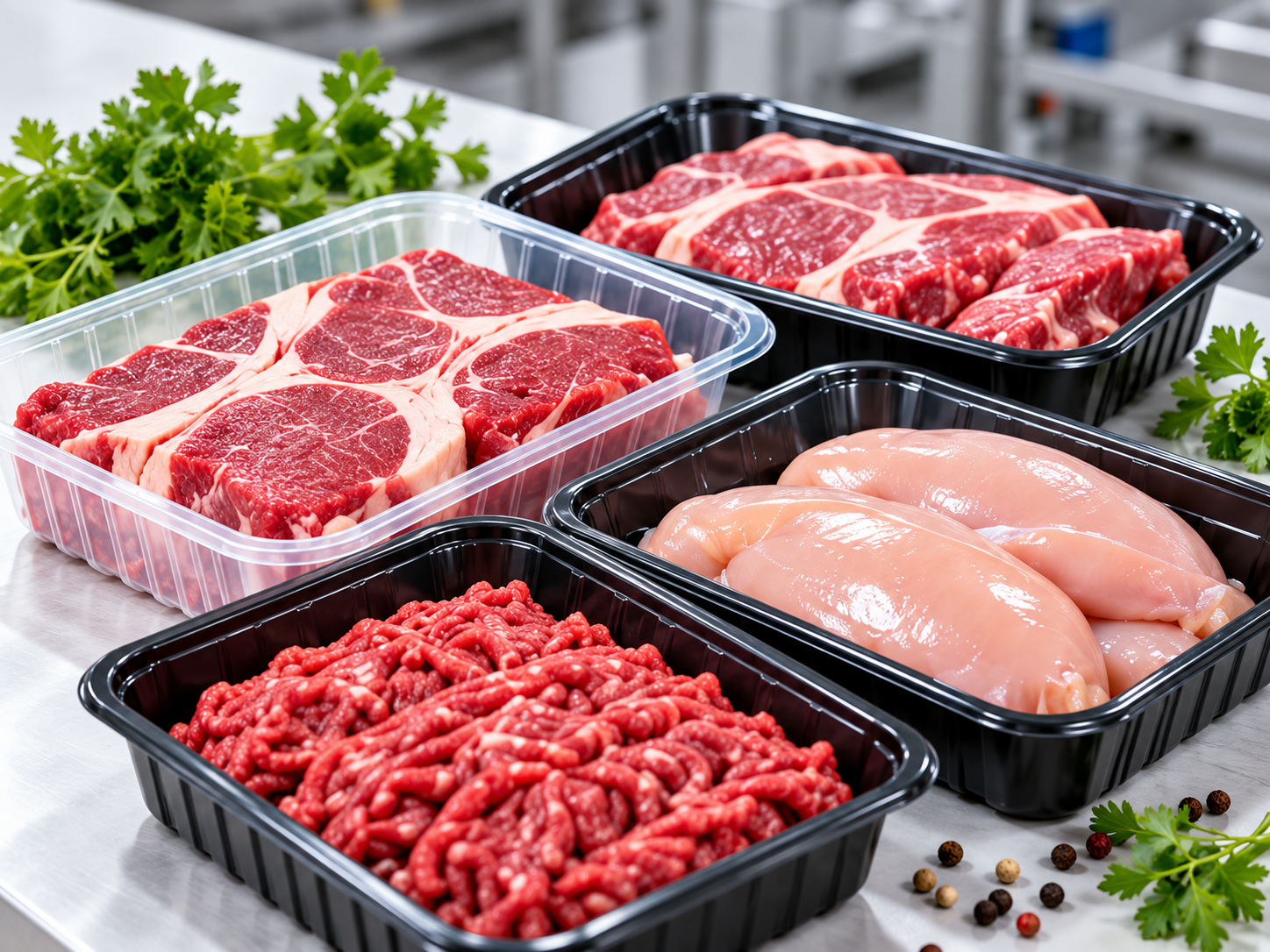
A MAP barrier tray in a fresh-meat application. Barrier structure, lidding film and sealing conditions are selected together; the tray alone does not determine shelf life.
VSP trays
In vacuum skin packaging, air is removed from the pack and a skin film forms closely around the food before sealing to the tray. The product is held in position and the pack presents a clear three-dimensional view of the food, which is why the format is common for steaks, premium cuts, fish fillets and seafood. Linhua VSP trays are offered in PP and PET, in footprints from 220 × 130 × 15 mm (LP090515) up to 295 × 228.5 × 20 mm (LP110920), including compartment variants. Compatibility depends on product height, tray design, film properties, machine settings and storage conditions.
Turned-edge PET trays
A conventional cut PET flange presents a relatively sharp contact edge to a stretch film. The turned-edge process folds and forms the flange into a smoother profile with a larger contact radius, reducing concentrated stress on the film as it is stretched around the tray and helping lower the risk of the film catching, scratching or tearing during overwrap. Actual performance still depends on the film and machine settings, so the benefit is a reduced risk rather than a guarantee.
Moisture retention trays
A moisture retention tray has a network of small recessed cells formed into the tray base. As fresh meat, poultry, fish or seafood releases purge, the liquid moves into these cells below the product instead of pooling visibly around it. Because moisture management is built into the tray structure, the design creates the potential to reduce or eliminate a separate absorbent soaker pad, which simplifies the pack and reduces component count. Performance depends on food type, pack weight, purge volume, storage temperature and storage time.
CPET ready-meal trays
CPET is crystallized polyethylene terephthalate, used where the strength and heat resistance required for ready meals and prepared foods matter. The Linhua range covers more than 30 standard models from 300 ml to 2,600 ml, with single-compartment, 2-compartment and 3-compartment layouts, and black and natural or white options in selected formats. Compartment trays keep main dishes, side dishes and sauces separated for cleaner presentation. Exact temperature limits, sealing-film compatibility and heating conditions should be confirmed for the selected model and application.
Retail and foodservice containers
The retail side of the portfolio is built around handling rather than barrier performance. One-piece hinged containers integrate lid and base, which simplifies packing and closing and generally does not require dedicated sealing equipment. Base-and-lid formats such as the LH0907 rotisserie container, with a 116 mm high profile and a suggested maximum holding weight of 1.5 kg, are shaped around the food rather than around a standard footprint. Multi-compartment trays separate produce, deli selections or snacks, and clamshells such as DP-1LBSS combine a 1 lb capacity with clear presentation for berries.
Development and tooling: the capability buyers underestimate
Standard trays cover a large share of applications, but the projects that stall are usually the ones where no standard footprint fits. Linhua supports development from concept and structural design through prototyping, mould development and mass production, and the internal team structure reflects that sequence: mould engineers, process engineers, application engineers and project managers working alongside quality and documentation roles.
A typical custom project moves through six stages:
- Application and specification confirmation, including food type, storage temperature, packaging method and target shelf life.
- Evaluation against existing models, or definition of a new geometry if none fits.
- Structural design and prototyping, with material and barrier structure selected for the application.
- Mould development where a new tool is required.
- Sampling and customer approval before production is committed.
- Mass production and ongoing supply, with process and inspection controls applied through the run.
For MAP and VSP projects specifically, the inputs that determine feasibility are the food application, tray or mould dimensions, packaging machine model, lidding or skin film specification, storage temperature and required shelf life. Buyers who arrive with those details shorten the evaluation considerably; buyers who arrive with a photograph and a target price can still be helped, but the technical conversation has to happen before a reliable quotation is possible.
Timing is worth stating plainly. Lead time depends on specification, material, colour, quantity, mould status and current production schedule, and is normally four to six weeks. New mould projects require additional development and sampling time on top of that.
Applications: where the portfolio is actually used
Two application environments account for most of the demand patterns in the portfolio.
The first is food processing and high-barrier packaging, spanning fresh meat, poultry, seafood, chilled prepared foods and ready meals. In this environment, MAP trays are gas-flushed and heat-sealed with lidding film, VSP trays are vacuum-sealed with skin film, turned-edge PET trays are wrapped with stretch film, moisture retention trays are overwrapped with liquid-retention cells in the base, CPET trays are filled and sealed for storage and reheating within specified limits, and clamshells are filled and closed for produce. Equipment matching is a real constraint here: trays are selected against the customer machine and film specification, not independently of them.
The second is supermarket and grocery retail, where the same products are packed at in-store counters or central packing facilities and then transported, stacked and displayed. Chilled foods such as salads, deli items and fresh produce are typically held under refrigerated display, while bakery and some prepared foods may be displayed at ambient conditions. This environment is less about barrier performance and more about portioning, protection, food separation, retail presentation and takeaway convenience, supported by preparation tables, scales, label printers and refrigerated cabinets. Container size has to match the actual portion and the display format, and lid fit, stacking, product visibility and compartment layout are confirmed per SKU.
Market trend analysis: what the verified data actually supports
Two trends in the available reference data are relevant to a buyer evaluating this category.
The first is barrier-material demand. Market Research Future projects the global EVOH packaging market growing from USD 1.847 billion in 2025 to USD 3.055 billion by 2035, a CAGR of 5.16%. This is commercial research with medium confidence, and it addresses EVOH packaging rather than rigid food trays specifically, so it should be read as a directional signal: barrier performance is receiving more investment as shelf-life management and food-waste reduction move up the retail agenda.
The second is regulatory. The application of PPWR 2025/40 from 12 August 2026, including restrictions on PFAS in food-contact packaging, together with the long-standing migration requirements under Regulation (EU) No 10/2011, means that material and documentation choices on EU-bound projects are increasingly reviewed together. In the United States, the FDA food contact substance framework applies to packaging and its components. The direction of travel is toward more, not less, substance-level evidence.
Comparison with traditional solutions, and where the traditional approach still fits
Functional trays are not universally better than conventional packaging. The comparison below sets out where each approach earns its place.
| Decision dimension | Conventional approach | Functional tray approach | Boundary condition |
|---|---|---|---|
| Purge and moisture at retail | Tray plus separate absorbent soaker pad | Moisture retention tray with cells formed into the base, potentially reducing or eliminating the pad | Higher purge volumes, or an established line the buyer prefers to keep unchanged, may still favour the pad |
| Film behaviour during overwrap | Standard cut-edge PET flange | Turned-edge flange with a smoother, larger-radius contact surface | Outcome depends on film type and machine settings; it is a risk reduction, not a guarantee |
| Shelf-life management | Overwrap or simple closure | MAP with controlled gas mixture, or VSP with skin film | No tray alone guarantees shelf life; food condition, film, gas or vacuum process, seal integrity, hygiene and temperature all contribute |
| Reheatable meal formats | PP or other standard containers where heat resistance is limited | CPET trays for ready meals and prepared foods | Temperature limits must be confirmed per model and application |
| Component count | Multi-component packs with separate absorbent or inner elements | Integrated functions in the tray structure | Integration only pays off where the pack format and line are compatible |
Three situations still point toward the conventional route. Where purge volume is high and a soaker pad is already performing reliably, the case for changing the tray structure is a presentation case, not a functional necessity, and should be confirmed through packing trials. Where a retailer operates a mature overwrap line with short shelf life and rapid turnover, moving to MAP or VSP adds capital and process complexity that the product may not need. And where volumes are small or the specification is likely to change, a standard tray plus a separate absorbent element can be the lower-risk starting point before a custom mould is justified.
Stated directly: Linhua moisture retention trays, barrier trays and CPET trays are application-specific answers, and the company positions selection as a trial-based decision rather than a catalogue decision.
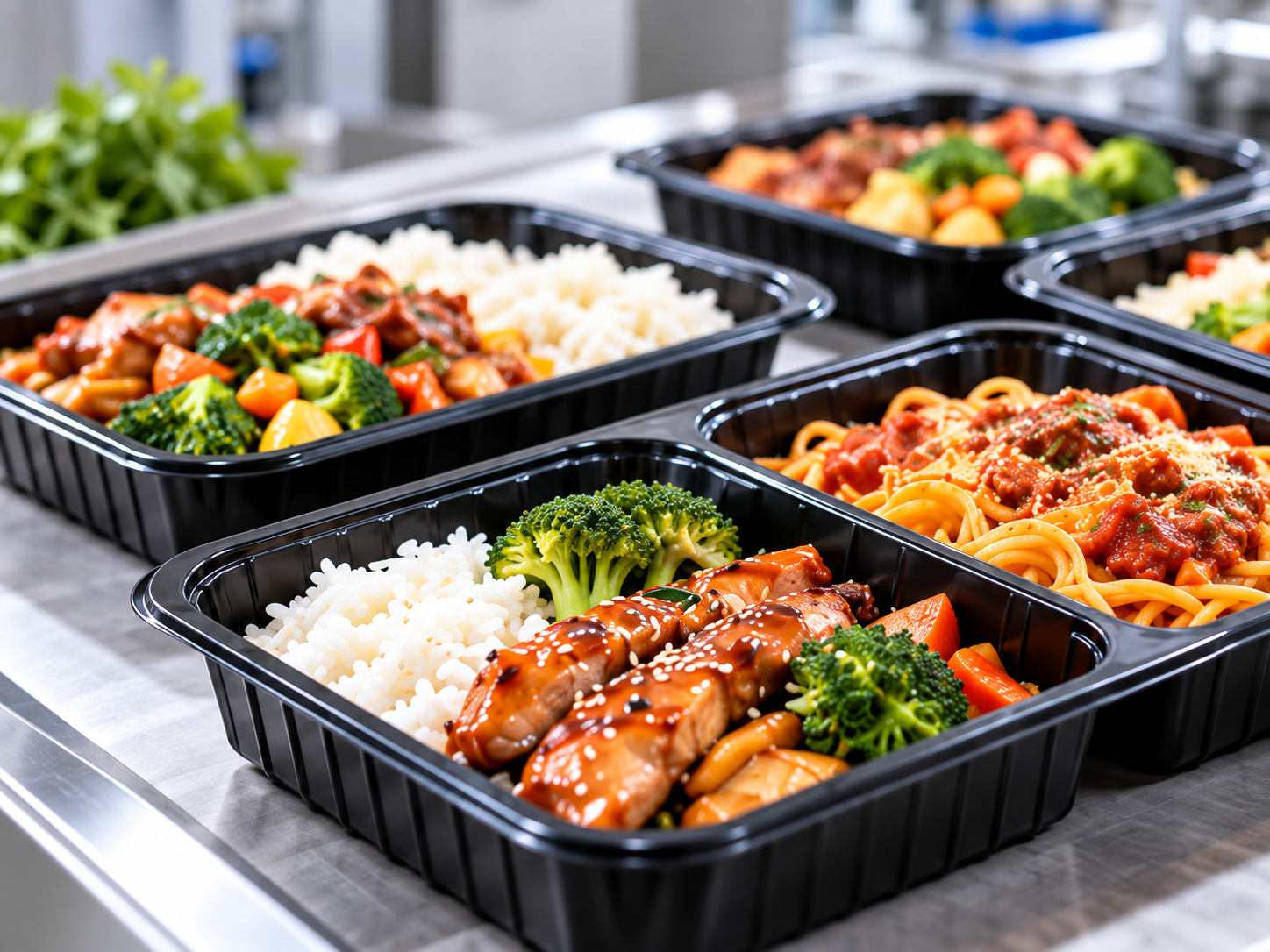
CPET ready-meal tray formats range from compact single portions to large multi-compartment meals. Compartment layouts keep components separated; temperature limits are confirmed per model.
Procurement criteria: six checks before a trial order
For a buyer at the research stage, the useful output of a supplier profile is a question list. These six checks convert the facts above into a qualification sequence.
| Check | Why it decides the project | What to request |
|---|---|---|
| Application and storage conditions | Food type, chilled or frozen storage, heating requirement and target shelf life narrow the material and structure | Written specification covering food, temperature profile and shelf-life target |
| Machine and film compatibility | MAP and VSP performance depends on sealing mould, machine and film as much as on the tray | Machine model, mould dimensions, lidding or skin film specification, and a sealing trial |
| Food-contact documentation | EU and US frameworks place the burden of substance-level evidence on the supply chain | Declaration of compliance, test reports and applicable product scope for the destination market |
| Tooling and MOQ | Custom geometry changes cost structure and lead time | Tooling scope, MOQ by product and colour, and whether existing tooling can be used |
| Sample validation | Dimensions and presentation are confirmed physically, not on a drawing | Free samples against courier cost for existing models, or a sampling plan for custom work |
| Supply continuity | Retail programmes are continuous; a one-off shipment is not a supply relationship | Lead time, capacity by product family and packing and shipping arrangements |
An objective read on industry position
Ningbo Linhua Plastic is best described as a mid-size specialist converter with broad format coverage and unusual depth in application support for its size. A 30,000 m² site, 150 employees and 20,000 tons of annual output place it in a different category from multinational packaging groups, and the 70% export ratio indicates that international customer requirements, not only domestic ones, shape its processes. Its differentiation sits in the combination of barrier and functional tray families, in-house mould development, and a technical team that includes application engineers and a compliance documentation role.
The same reading produces clear limits. The company does not present itself as a global leader in plastic food packaging, and no independent market-share evidence for it appears in the reference material reviewed here. Certification and compliance claims should be verified against current certificates and test reports in the buyer's own destination market rather than assumed from a capability description. Buyers requiring a vertically integrated multinational supplier with global production footprints should treat this as a specialist alternative rather than a like-for-like substitute.
Future outlook
Three developments are likely to shape how suppliers in this segment are evaluated over the next several years. Regulatory documentation will keep moving toward substance-level evidence, following the PPWR application and the existing EU plastics framework, which favours manufacturers with an internal documentation function. Barrier and shelf-life performance will remain a commercial priority as retailers seek to reduce waste without shortening code life, which supports continued investment in EVOH-based structures and skin-pack formats. And retail prepared-food and grab-and-go programmes will keep pulling demand for containers that are shaped around the food, such as rotisserie, platter and compartment formats, rather than around generic footprints.
For buyers, the practical implication is that the specification conversation is becoming the supplier selection conversation. Manufacturers that can carry a project from application definition through mould development to documented production will be easier to qualify than those that can only quote from a catalogue.
FAQ
What materials are used for these food packaging containers, and how is the right one chosen?
Linhua works with food-packaging materials including PET, PP, CPET, PS, TFPP, PLA and multilayer structures that may include EVOH and PE. PET is commonly used where clear product presentation matters, such as fresh meat, seafood and overwrap packaging. PP is widely used for food trays and can form part of MAP or VSP barrier structures. CPET is used for ready meals and prepared foods where higher temperature resistance is required, and EVOH can act as a functional barrier layer in multilayer structures. Selection depends on the food, storage temperature, packaging method, barrier requirement, heating condition and retail presentation.
How are food-contact and market-specific compliance requirements handled?
Requirements vary by market and product. Buyers are asked to state the destination market and the required standard so the applicable material, testing or documentation can be checked before confirmation. Any specific claim regarding ISO, BRC, HACCP, FDA, EU or other certifications and compliance standards should be based on the manufacturer's latest valid certificates, test reports and applicable product scope.
How can a buyer tell whether a MAP or VSP tray will work with an existing packaging machine?
Matching tray dimensions is not sufficient. Compatibility evaluation normally covers the tray size, sealing mould or tooling, packaging machine, lidding or skin film, food application and operating conditions. For a MAP project, the food application, tray or mould dimensions, machine information, lidding-film specification, storage temperature and required shelf life are the relevant inputs. For a VSP project, the food type, product height, tray dimensions, machine model, skin-film information, storage conditions and required shelf life apply. Final compatibility should be confirmed through actual sealing trials, and no tray alone can guarantee a specific shelf life.
What can be customized, and does customization require a new mould?
Depending on the product, customization may cover dimensions, depth, shape, colour, material structure, compartment layout, ventilation holes, tray structure and other functional features. An existing tray sample, drawing or dimensional specification can be used as a reference for evaluation. If no existing mould matches the requirement, a new mould can be evaluated against the confirmed design and application. Customized projects normally begin with application and specification confirmation, and sample approval is part of the process before production.
What information is needed before a quotation can be prepared?
The ordering process starts with product selection and specification confirmation: product or tray type, dimensions, food application, required quantity, and any colour or customization requirements. For MAP or VSP projects, machine, mould, film and storage information may also be required. A photograph, existing tray, drawing or sample can help identify a suitable existing model or scope a custom solution. Minimum order quantity depends on product, material, colour, specification and whether a new mould is needed, and trial-order feasibility depends on the product and existing tooling.
How do samples, production and delivery work?
Once requirements are clear and a suitable existing product is confirmed, samples can be provided free of charge, with the customer covering the courier cost; projects requiring a new mould or custom development are discussed separately. Mass production is scheduled after the final specification, sample approval and commercial terms are confirmed. Lead time depends on specification, material, colour, quantity, mould status and current production schedule, and is normally four to six weeks, with new mould projects requiring additional development and sampling time.
References and further reading
Market context: Grand View Research, Food Containers Market Size and Share Report, 2025–2030 (accessed 2026). Barrier-material forecast: Market Research Future, EVOH Packaging Market Size, Share and Growth Report 2035 (commercial research, medium confidence). Regulation: European Commission, New EU rules on packaging enter into application, 11 August 2026 (PPWR 2025/40); Commission Regulation (EU) No 10/2011 on plastic materials and articles intended to come into contact with food (EUR-Lex). U.S. framework: U.S. Food and Drug Administration, Food Packaging and Other Substances that Come in Contact with Food. Material context: Plastics Europe ecosystem fact sheets on food packaging materials. Company facts, model designations and dimensional data: Ningbo Linhua Plastic Co., Ltd.
A downloadable Linhua E-catalogue 2025 (PDF) lists the full model range, dimensions and material options referenced in this profile.
MAP barrier traysVSP traysCPET ready-meal traysMoisture retention traysTurned-edge PET traysHinged and clamshell containers
Есть вопросы или нужны дополнительные детали?
Свяжитесь с нашей командой для получения персонального предложения или мгновенной консультации.
Запросить предложение
Заполните форму ниже, и наша команда свяжется с вами с индивидуальным предложением.
Прямой чат WhatsApp
Предпочитаете общаться в реальном времени? Напишите нам в WhatsApp для мгновенной помощи и быстрых ответов.
- Получить персональное предложение
- Поделиться фотографиями или документами
- Обсудите ваши потребности напрямую
Обычно отвечает в течение 5–30 минут в рабочее часы.