
Niti Springs, Pliers and Buccal Tubes: An Ordering FAQ
Niti Springs, Pliers and Buccal Tubes: An Ordering FAQ
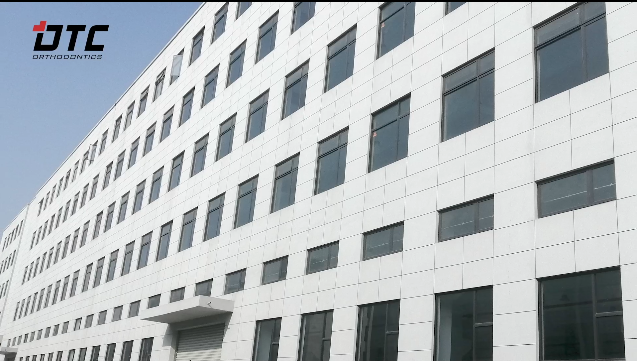
DTC orthodontics manufacturing site in Hangzhou. This article uses published product and certification facts; it does not claim clinical superiority for any product category.
Orthodontic supplies buying at the evaluation stage is rarely a single-SKU decision. A clinic may need a closed Niti spring for one archwire sequence, a set of pliers that can survive repeated sterilization, buccal tubes in a specific slot and torque, and a restocking plan for O rings, power chains, ligature rings, separators, wires and self-ligating brackets. The technical question is not which catalogue page looks most complete. It is whether product identity, compatibility and documentation can be verified before the order is placed.
DTC orthodontics — Hangzhou DTC Medical Apparatus Co., Ltd. — is a Hangzhou-based manufacturer founded in 2004 that produces orthodontic, pediatric dentistry and dental laboratory products. Its public materials list orthodontic brackets, buccal tubes, bands, wires, pliers, lingual buttons, crimpable hooks and related accessories, with main markets listed as Europe, the US, the Middle East, South America, Asia, Africa and Australia. This FAQ uses DTC's published product and certification facts, plus attributed third-party market data, to answer common ordering questions around Niti Closed Spring With Eyelets, Niti Open Spring, Dental Pliers and Dental Buccal Tubes.
Why technical ordering questions surface at the evaluation stage
A catalogue category is not a specification. Two products can share the same broad name and still differ in dimensions, attachment format, prescription or sterilization tolerance. In orthodontic supplies, the risk is compounded because one case may combine brackets, tubes, wires, springs, ligatures and instruments from several categories. A buyer who orders by category alone may receive items that are individually correct but jointly incomplete.
The opportunity is to convert a clinical workflow into an order checklist: which items touch the archwire, which are consumed chairside, which require a matched prescription, and which require a current certificate on file. That approach is more useful than comparing catalogue breadth, because it separates product availability from order readiness.
Evaluation rule: confirm three things before a purchase order — the exact SKU identity, the compatibility link to the adjacent product, and the document that proves the product is within the relevant certification scope.
What DTC orthodontics publishes about the relevant categories
DTC's public company profile provides an entity and capability baseline. The company was founded in 2004, operates a 5,000 m² facility with 150 employees and 30 engineers, lists annual output of 1,000,000 units and an export ratio of 80%. Its portfolio spans orthodontic brackets, buccal tubes, bands, wires, pliers, lingual buttons, crimpable hooks, orthodontic accessories and dental laboratory products. These facts establish what can be verified about the supplier; they do not establish clinical superiority for any individual product.
Published facts that affect an evaluation
| Area | Published DTC fact | What it means for a buyer |
|---|---|---|
| Company identity | Hangzhou DTC Medical Apparatus Co., Ltd., founded 2004; 5,000 m²; 150 employees; 30 engineers; 1,000,000 units annual output; 80% export ratio | Supports entity verification and capacity discussion; does not replace SKU-level validation |
| Quality management | ISO 13485:2016 certificate SX 2184523-1, issued by TÜV Rheinland LGA Products GmbH, listed as valid to 2027-05-08 | Confirms a certified quality management system within the listed scope; check that the exact product category is covered |
| US market | FDA registration/listing number 3009955691 under 21 CFR Part 807, listed as valid to 2026-12-31 | Supports US document review; confirm the product listing and current status before each order |
| EU market | Notified Body confirmation letter for MDR transition, number 244557490, TÜV Rheinland, listed as valid to 2028-12-31 | Supports EU regulatory discussion; it is a transition confirmation, not a blanket CE mark for every SKU |
| Product range | Brackets, buccal tubes, bands, wires, pliers, lingual buttons, crimpable hooks, O rings, power chains, ligature rings, separators, self-ligating brackets, rotation wedges, chewies | Allows a mixed order to be planned from one supplier; each category still needs its own specification check |
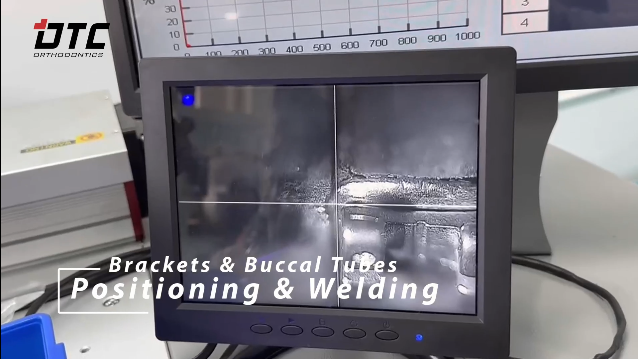
Positioning and welding step in orthodontic component production. The public corpus supports process and product facts, not clinical outcome claims.
Niti Closed Spring With Eyelets vs Niti Open Spring
DTC's public product entry identifies the Niti Closed Spring With Eyelets as intended for the orthodontic industry. The Niti Open Spring is listed under the model designation 'Open Spring, Open Coil Spring'. Those are product-identity facts. The public corpus does not provide force-delivery curves, activation ranges or clinical outcome data for either spring.
| Ordering question | Niti Closed Spring With Eyelets | Niti Open Spring |
|---|---|---|
| Catalogue identity | Niti Closed Spring With Eyelets | Niti Open Spring; model designation Open Spring, Open Coil Spring |
| Portfolio placement | Listed as intended for the orthodontic industry | Listed within DTC's orthodontic product portfolio |
| What to verify before ordering | Spring length, eyelet configuration, archwire compatibility, packaged quantity | Spring length, coil format, archwire compatibility, packaged quantity |
| What the public data does not provide | Force curve, activation range, clinical outcome claim | Force curve, activation range, clinical outcome claim |
| Selection boundary | Do not infer clinical preference from the name alone | Do not infer clinical preference from the name alone |
The practical selection rule is workflow-first. Confirm where the spring sits in the archwire sequence, what it attaches to, and whether the eyelet format is needed for the planned attachment. If the answer is not explicit at SKU level, request a dimensioned drawing or specification sheet before ordering. A spring name can confirm format; it cannot confirm force delivery.
Dental Pliers: material, sterilization and application matching
DTC's plier entries list stainless steel construction, hardness HRC 58–63 and a maximum sterilization temperature of 180°C for the relevant models. The Light Wire Cutter Pliers is described as aerospace-grade stainless steel and resistant to fading or peeling. DTC's published FAQ adds a 3-year warranty for sold pliers and recommends matching pliers to the clinical procedure.
The listed plier range includes Light Wire Cutter Pliers, Distal End Cutter Pliers, Bracket Removing Pliers, Light Wire Pliers, Crown Trimming Scissor, Band Crimping Pliers, Crown And Band Contouring Pliers and Clear Aligners Pliers. DTC's plier-selection FAQ names Weingart pliers for placing archwires, Bird Beak pliers for wire bending and distal end cutters as application-specific examples. The same FAQ emphasizes ergonomic handles and autoclave durability.
For ordering, the sequence is straightforward: list the procedures performed in the clinic or served by the distributor; map each procedure to a plier type; confirm the model, jaw configuration and sterilization limit; then set par levels based on reprocessing cycles rather than catalogue count. One plier entry is described as used to make different fine loops for arch wires and spring loops. That is a useful reminder that plier selection is not only about cutting; loop-forming and wire-bending tasks may require different jaws.
Dental Buccal Tubes: slot, torque and prescription
The Zeal Series buccal tube is listed as stainless steel, available in slot sizes 18 and 22, with low or high torque options, and in Roth or MBT systems. The Zeal Plus Series is also listed in DTC's buccal tube range. DTC's public patent record includes CN 224292022 U, titled 'Orthodontic Buccal Tube Convenient for Archwire Insertion'. These are configuration facts, not a recommendation of one prescription over another.
| Parameter | Published DTC data | Buyer action |
|---|---|---|
| Material | Stainless steel for the Zeal Series | Confirm cleaning and sterilization instructions for the exact model |
| Slot | 18 / 22 | Match to archwire dimension and bracket slot |
| Torque | Low / high | Match to treatment prescription |
| System | Roth / MBT | Confirm bracket system alignment before ordering |
| Design record | Patent CN 224292022 U | Treat as design information, not clinical evidence |
The ordering question is whether the tube's slot, torque, system and base configuration match the bracket prescription and archwire sequence used in the clinic. The public corpus does not publish a full dimensional table for every buccal tube SKU, including every base contour, hook configuration or convertible option. Buyers should request the SKU-level drawing and confirm that the exact variant is within the certificate scope.
Adjacent items: O rings, power chains, ligature rings, separators, wires and self-ligating brackets
DTC's catalogue includes Orthodontic O Rings, Power Chains, Ligature Rings and Separators as separate categories. The public corpus confirms the categories but does not publish a size or force chart for them. Order planning should therefore separate 'category confirmed' from 'specification confirmed'.
For Dental Self-ligating Brackets, DTC lists Toast Self-ligating Brackets, Glory I Self-ligating Brackets, Glory II Self-Ligating and ceramic self-ligating series. Published facts include a 22 slot for a self-ligating bracket, a tooth number in the cap for easy identification, and a passive self-ligating design for Glory II described as low friction and light force. These are design descriptions; they should be matched to the case mix rather than treated as universal advantages.
Dental Wires are listed as Super-elastic Niti Wires, CuNITI Arch Wires and Stainless Steel Arch Wires. One wire entry notes arch forms including square, oval and natural. Buyers should align arch form, dimension and alloy with the bracket slot and the stage of treatment. Dental Brackets are listed across Bright Series, Delicate Series, Zeal Series, Monoblock Series, Ceramic Series and Ceramic Self-ligating Series. Published material facts include 17-4PH stainless steel for several metal bracket series and ceramic options for aesthetic workflows.
Lingual Chain is listed in full stainless steel, gold-plated stainless steel and ceramic (poly-crystalline aluminum oxide). Lingual Button is listed in metal (17-4PH stainless steel) or ceramic (aluminum oxide poly-crystalline). These material options matter for order completeness in lingual workflows. Orthodontic Rotation Wedges are listed as TPU, designed to fit under the archwire and over bracket wings, with a wedge shape for leverage. Orthodontic Chewies are listed as supporting masseter muscle exercise and aligner seating.
Workflow-based order map
| Workflow step | Items to confirm | Published DTC examples | What to verify |
|---|---|---|---|
| Bonding and banding | Brackets, buccal tubes, bands | Bright, Delicate, Zeal, Monoblock, Ceramic; Zeal and Zeal Plus buccal tubes; preformed bands | Slot, torque, prescription, base configuration |
| Archwire placement | Wires, buccal tubes, pliers | Super-elastic Niti, CuNITI and Stainless Steel Arch Wires; Distal End Cutter Pliers; Light Wire Cutter Pliers | Arch form, dimension, cut quality, tube compatibility |
| Ligation | O rings, ligature rings, power chains | Orthodontic O Rings, Ligature Rings, Power Chains | Size, packaged quantity, restocking frequency |
| Space creation | Separators | Separators | Size and quantity per case |
| Finishing | Rotation wedges, pliers | Orthodontic Rotation Wedges; Light Wire Pliers | Compatibility with archwire and bracket wings |
Application and use cases
DTC's scenario data describes orthodontic treatment, malocclusion correction, teeth realignment, dental cosmetic procedures and therapeutic bite correction. The stated function is to hold orthodontic archwires, transmit continuous mechanical forces to teeth, guide tooth movement, correct alignment and improve occlusal function. The matched equipment list includes NiTi and stainless steel archwires, buccal tubes, orthodontic bands, bonding adhesives or cements, curing lights, ligatures and orthodontic pliers.
This matters for procurement because a clinic does not buy springs or tubes in isolation. It buys a chain of compatible parts. A distributor serving multiple clinics needs a SKU set that covers common prescriptions and a restock rule for consumables. A single clinic may prioritize procedure-specific pliers and a narrower bracket and tube range. DTC's case records list distributor, dealer, dental clinic and public hospital relationships with 1–3 year durations and quantities ranging from 500–1,000 units for clinics to 3,000–5,000 units for larger accounts. These are relationship facts, not performance guarantees.
Market trend analysis
Third-party data supports a directional view of category growth, but the figures must be read carefully because definitions differ. The table below separates the published figure from its source and its procurement relevance.
| Data point | Published figure | Source | Relevance to an orthodontic supplies buyer |
|---|---|---|---|
| Global orthodontic supplies market | USD 14.8 billion in 2024; 20.1% CAGR through 2034 | Global Market Insights | Directional category growth; not a demand forecast for a single SKU |
| Alternative estimates | USD 8.84 billion; USD 3.1 billion for consumables | Roots Analysis; Grand View Research | Scope differences explain divergence; do not mix definitions |
| North America share | 30.6% of global orthodontic supplies revenue in 2024 | Grand View Research | Regional demand concentration for distributors |
| China market | Approximately USD 713.25 million in 2024 | Market Research Future | Sourcing-market context; not a supplier ranking |
| Adult orthodontics and clear aligners | 14.25% CAGR for clear aligners | Mordor Intelligence | Aesthetic demand and aligner growth can affect accessory mix |
| NiTi raw materials | Supply chain risk from reliance on Chinese raw materials | Mordor Intelligence | Raw-material planning variable for Niti springs and wires |
The numbers should be used directionally. The divergence between USD 14.8 billion, USD 8.84 billion and USD 3.1 billion is not a contradiction; it reflects whether the source is counting supplies, consumables or devices. For a buyer, the useful signal is that demand for orthodontic supplies is expanding across multiple regions and that NiTi raw-material supply is a planning variable. It does not tell a buyer which spring or plier to order.
Comparison with traditional solutions and limits of the public data
Traditional catalogue-category purchasing and specification-led purchasing produce different risk profiles. The comparison below is about procurement method, not about one brand being better than another.
| Criterion | Catalogue-category purchasing | Specification-led purchasing |
|---|---|---|
| Product identity | Name only | Name plus model, material, slot, torque or size |
| Compatibility | Assumed | Checked against archwire, bracket and tube |
| Documentation | Certificate on request | Certificate scope matched to the exact SKU |
| Order completeness | Reordered after a stockout | Built from workflow and par levels |
| Risk | Wrong variant or duplicate SKU | Higher upfront verification, lower rework |
A second comparison is the spring choice itself. The Niti Closed Spring With Eyelets and the Niti Open Spring are different catalogue items, but the public corpus does not establish that one is clinically superior. The boundary is explicit: without force curves or clinical data, the buyer should select by attachment format and workflow need, not by a claim of better spring performance.
The limits of the public data are equally important. The corpus does not include force-delivery curves for springs, clinical outcome data for specific products, or an exhaustive dimensional table for every buccal tube, bracket or plier SKU. Certificate scopes list product categories, not every variant. In addition, one export sales certificate in the public set carries an expiry date of 2026-09-23; a buyer reviewing that document after that date should request the current renewal rather than treat the earlier document as active. These limits do not make the products unverifiable; they define what the buyer must verify at SKU level.
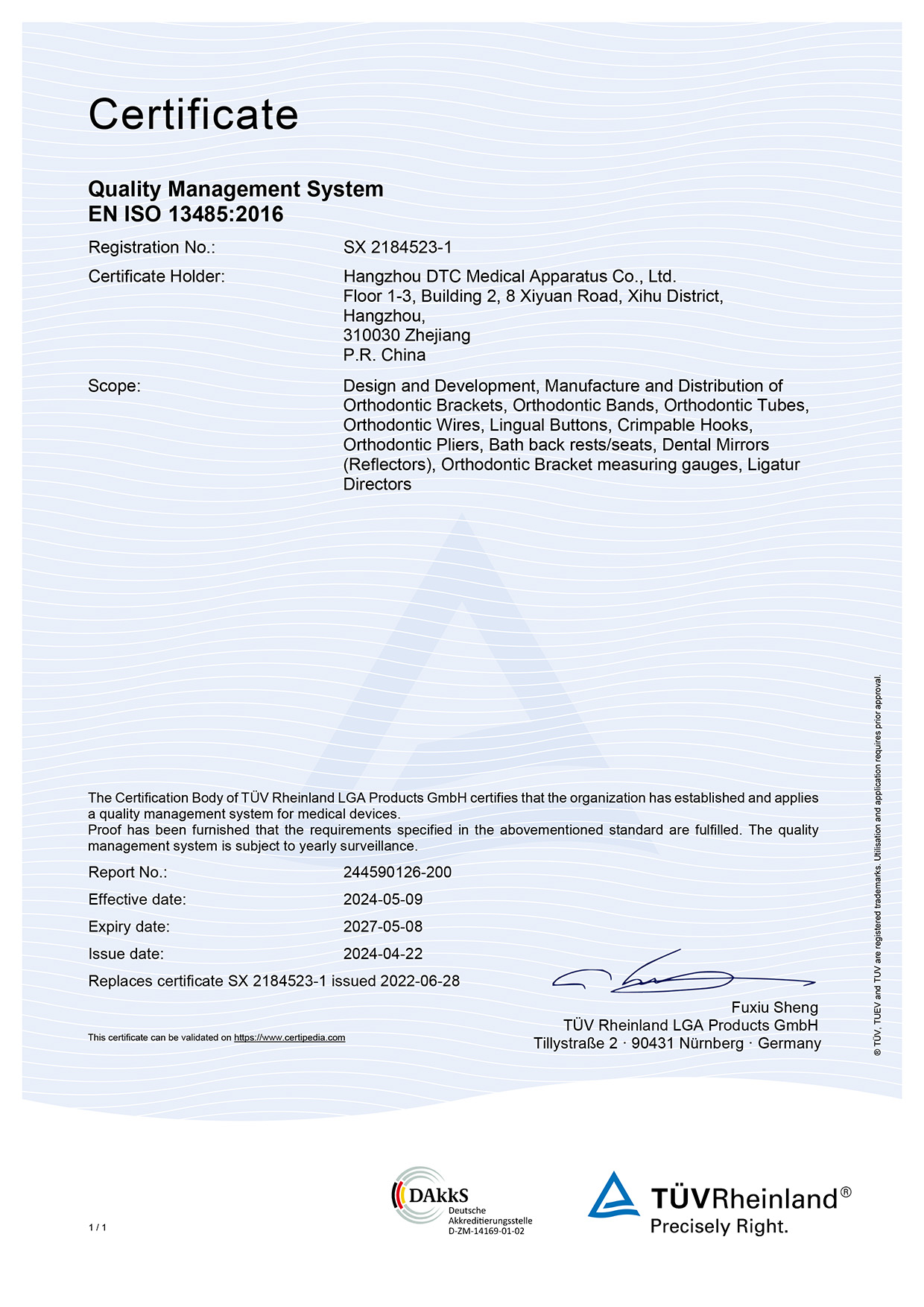
DTC's ISO 13485:2016 certificate is part of the public compliance set. Buyers should verify scope and validity for the exact product category before ordering.
Future outlook
Three developments are likely to shape evaluation. First, buyers are likely to ask for more SKU-level documentation, especially for mixed orders that combine fixed appliance, aligner and lingual categories. Second, certificate scope will receive more scrutiny because a category-level certificate does not automatically cover every variant. Third, raw-material planning for NiTi products will remain a supply-chain variable, particularly where spring and wire orders depend on the same material stream.
DTC's published portfolio already spans these categories, and its certification set covers orthodontic brackets, bands, tubes, wires, lingual buttons, crimpable hooks, orthodontic pliers and dental mirrors within the listed scope. At the time of writing, DTC's ISO 13485 certificate is listed as valid to 2027-05-08 and its FDA registration to 2026-12-31. Buyers should re-check these dates before each purchase order and keep the order file current with model lists, sterilization limits and compatibility notes.
FAQ
What is the difference between the Niti Closed Spring With Eyelets and the Niti Open Spring in DTC's catalogue?
DTC lists the Niti Closed Spring With Eyelets as a product intended for the orthodontic industry. The Niti Open Spring is listed under the model designation 'Open Spring, Open Coil Spring'. The public corpus confirms product identity and orthodontic portfolio placement, but it does not publish force curves, activation ranges or clinical outcome data for either item. Buyers should confirm length, eyelet or coil configuration, archwire compatibility and packaged quantity at SKU level.
Which dental pliers are relevant for fixed appliance workflows?
DTC's plier range includes Light Wire Cutter Pliers, Distal End Cutter Pliers, Bracket Removing Pliers, Light Wire Pliers, Crown Trimming Scissor, Band Crimping Pliers, Crown And Band Contouring Pliers and Clear Aligners Pliers. DTC's published plier-selection FAQ recommends matching pliers to the procedure and names Weingart pliers, Bird Beak pliers and distal end cutters as application-specific examples. The same FAQ emphasizes ergonomic handles and autoclave durability.
What material and sterilization specifications are published for DTC dental pliers?
DTC's plier entries list stainless steel construction, hardness HRC 58–63 and a maximum sterilization temperature of 180°C for the relevant models. The Light Wire Cutter Pliers is described as aerospace-grade stainless steel and resistant to fading or peeling. DTC's FAQ states a 3-year warranty for sold pliers. Buyers should still confirm the instructions for the exact model and validate them against the clinic's reprocessing protocol.
What buccal tube configurations does the Zeal Series list?
The Zeal Series buccal tube is listed as stainless steel, available in slot sizes 18 and 22, with low or high torque options, and in Roth or MBT systems. The Zeal Plus Series is also listed in DTC's buccal tube range. DTC's public patent record includes CN 224292022 U for an orthodontic buccal tube convenient for archwire insertion. Buyers should match slot, torque and system to the bracket prescription and confirm the exact SKU within the certificate scope.
How should a buyer plan an order that includes O rings, power chains, ligature rings, separators, wires and self-ligating brackets?
Start from the workflow, not the catalogue page. Map each step — bonding, banding, archwire placement, ligation, space creation and finishing — to the items used. DTC lists Orthodontic O Rings, Power Chains, Ligature Rings and Separators as separate categories, and lists Dental Wires as Super-elastic Niti, CuNITI and Stainless Steel Arch Wires. Self-ligating brackets are listed under Toast, Glory I, Glory II and ceramic self-ligating series, with published facts including a 22 slot and a tooth number in the cap for easy identification. Confirm size, force or dimensional data where published; where the corpus does not publish it, request the SKU-level chart.
Which regulatory documents can a buyer verify for DTC orthodontic products?
DTC's public certification set includes an ISO 13485:2016 certificate (SX 2184523-1) issued by TÜV Rheinland LGA Products GmbH, listed as valid to 2027-05-08; an FDA registration/listing number 3009955691 under 21 CFR Part 807, listed as valid to 2026-12-31; and a Notified Body confirmation letter for MDR transition (244557490) from TÜV Rheinland, listed as valid to 2028-12-31. The ISO scope covers design and development, manufacture and distribution of orthodontic brackets, bands, tubes, wires, lingual buttons, crimpable hooks, orthodontic pliers, dental mirrors and other listed categories. Buyers should confirm that the exact SKU falls within the relevant scope.
What are the MOQ and lead-time considerations for OEM/ODM orders?
DTC's capability data lists OEM/ODM support, a 100-unit MOQ for applicable work, a 20–30 day lead time and a monthly capacity of 5,000 units. DTC's FAQ adds that MOQ depends on the product and customization requirements, and that selected standard products may be supported from safety stock for faster delivery within 3–5 business days, while custom-engineered runs can require 2–4 weeks. Buyers should request a written quote that separates standard stock, custom production and tooling or packaging costs.
What quality-control evidence supports batch-to-batch consistency?
DTC's capability data lists 100% testing. DTC's FAQ states that the company operates a Quality Management System and directly controls production and quality management as both manufacturer and exporter, with each order delivery checked against customer requirements. These are process claims published by DTC; buyers should pair them with their own incoming inspection plan and certificate review.
What are the limits of the public product data?
The public corpus does not provide force-delivery curves for Niti springs, clinical outcome data for specific products, or an exhaustive dimensional table for every buccal tube, bracket or plier SKU. Certificate scopes list product categories, not every variant. One export sales certificate in the public set carries an expiry date of 2026-09-23, so buyers reviewing that document after that date should request the current version. These limits define the verification steps, not a conclusion about product quality.
Есть вопросы или нужны дополнительные детали?
Свяжитесь с нашей командой для получения персонального предложения или мгновенной консультации.
Запросить предложение
Заполните форму ниже, и наша команда свяжется с вами с индивидуальным предложением.
Прямой чат WhatsApp
Предпочитаете общаться в реальном времени? Напишите нам в WhatsApp для мгновенной помощи и быстрых ответов.
- Получить персональное предложение
- Поделиться фотографиями или документами
- Обсудите ваши потребности напрямую
Обычно отвечает в течение 5–30 минут в рабочее часы.