
Nitrile Glove Comparison: Box, Medical, Food & Heavy Duty
Nitrile Glove Comparison: Box, Medical, Food & Heavy Duty
Nitrile gloves are no longer a single procurement line. A box exam glove, a medical exam glove, a food-grade glove, an industrial glove and a heavy-duty industrial glove can share the same base polymer and the same production line, yet they carry different intended-use claims, different test files, different acceptance criteria and different purchasing terms. For a buyer in evaluation stage, the first decision is therefore not which supplier to shortlist, but which of the five product types the application genuinely requires.
This comparison is written from a third-party procurement perspective. It ranks five nitrile glove types against the standards that actually appear in supplier documentation — EN 455-1/-2/-3, (EU) 2016/425, (EU) 2017/745, FDA 510(k) K230542, ASTM D6319-19, ISO 13485, GB 4806.11-2016, FDA 21 CFR 177.2600, Japan MHLW Notification No. 370 and halogen test reports — and it states where each type stops being the right answer.
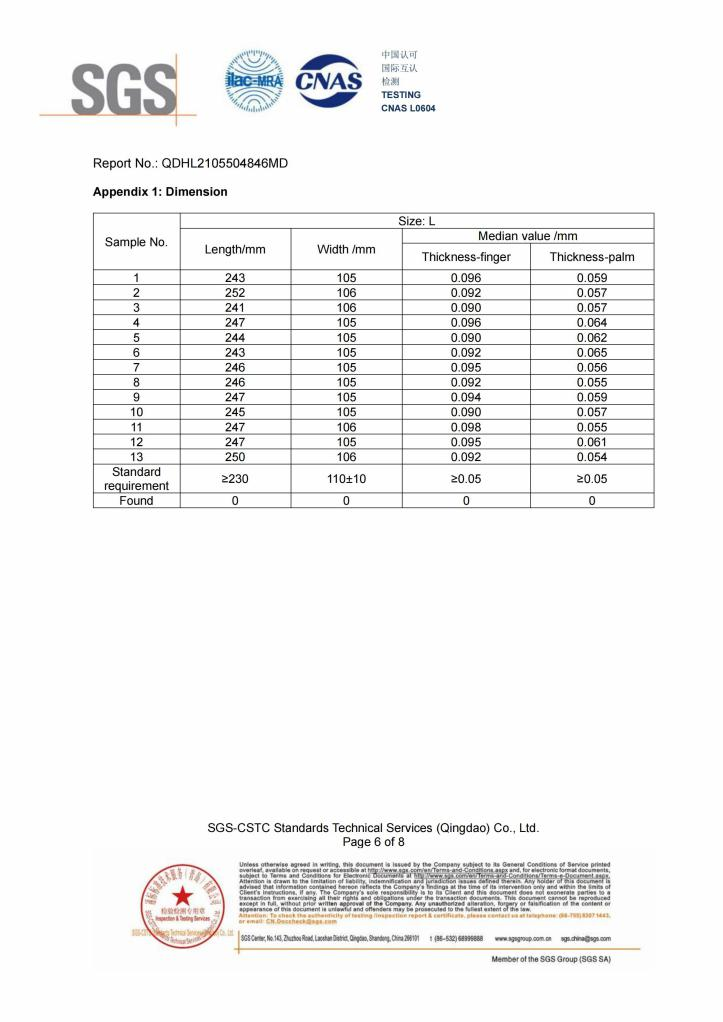 Test documentation, not appearance, separates the five nitrile glove types. Image: ASTM D6319-19 examination glove test report from the supplier certification file.
Why one nitrile glove line no longer covers five use cases
Consolidation pressure pushes procurement teams in the opposite direction from regulation. A hospital group, a food processor and an industrial distributor that buy through the same trading partner often try to standardise on one nitrile SKU to simplify inventory, reduce MOQ fragmentation and improve price leverage. The result is a portfolio in which one glove type is asked to satisfy a medical examination claim, a food-contact claim and a workshop durability claim at the same time — a claim set no single document supports.
The commercial environment makes this harder. According to a 2026 wholesale pricing review published by Schneider Direct, standard exam-grade nitrile gloves were quoted at USD 80 to USD 140 per case of 1,000, and US tariffs on Chinese-origin medical-grade nitrile gloves were reported to have reached 100% in January 2026. When landed cost moves that abruptly, buyers naturally look for fewer, cheaper SKUs. That is precisely when intended-use scope and certificate coverage should be checked rather than assumed.
The opportunity is structural rather than tactical: a five-type architecture in which each type is justified by its own evidence file, its own film thickness and its own purchasing terms. Buyers who build that architecture once can swap suppliers without re-qualifying the entire category.
How this comparison was scored
Each type was assessed on five criteria that a procurement file can actually document:
- Declared intended use and market access — whether the type is positioned for medical examination, food contact, general industrial work or heavy-duty mechanical work, and which market authorisations follow from that positioning.
- Documented standard and test evidence — the named standard, the issuing body and whether a report exists in the supplier file.
- Film thickness and mechanical profile — the stated thickness in mil and what that thickness costs in tactile feedback.
- Packaging and purchasing terms — box format, unit price band, MOQ and the packaging flexibility available.
- Risk of misapplication — the most likely way a buyer gets this type wrong.
The ranking below is calibrated for a mixed-portfolio buyer — a distributor, group purchasing organisation or multi-site operator that needs all five types across different departments. A single-application buyer should re-rank: for a food manufacturer, food grade moves to first place; for a maintenance contractor, heavy duty does.
The five types, ranked by documented evidence depth
1. Medical Exam Nitrile Gloves (ABC-DG01) — deepest regulated evidence file
The medical exam type is specified at 3 mil, AQL 1.5, powder-free and textured, positioned for medical, healthcare and dental environments, with a quoted band of USD 0.02–0.03 per piece at a MOQ of 1,000 pieces. Its documentation is the broadest of the five: an EN 455-1/-2/-3 certificate issued by TÜV SÜD PSB (TTCN 113715 0002 Rev.00, issued 11 October 2024); a Class I medical device declaration of conformity under (EU) 2017/745; FDA 510(k) clearance K230542; an SGS ASTM D6319-19 examination glove report (QDHL2105604846MD, US market); ISO 10993-5:2009 in-vitro cytotoxicity and ISO 10993-10:2021 skin sensitisation reports; and an ISO 13485 quality management system certificate (381240304R0S, POSI Shanghai, GB/T 42061-2022 / ISO 13485:2016, valid to 29 August 2027).
In procurement terms, this is the only type where a buyer can assemble a complete medical device file from the supplier’s own documents rather than relying on a generic “CE” statement. The trade-off is written into the specification: 3 mil film maximises tactile sensitivity and barrier feel but offers the least mechanical margin of the five types, so it is the wrong choice for wet mechanical handling, abrasive tasks or repeated heavy grip work.
2. Food Grade Nitrile Gloves (ABC-DG01) — three-jurisdiction food-contact documentation
Food grade is specified at 5 mil, powder-free with textured fingertips, for food service and food preparation, quoted at USD 0.02–0.03 per piece at a MOQ of 1,000 pieces. Its evidence file is unusually complete for a food-contact claim because it is jurisdiction-specific rather than generic: an SGS GB 4806.11-2016 test report for Chinese food-contact compliance (issued 20 May 2026); a US FDA 21 CFR 177.2600 food-grade test report covering blue and black nitrile; and Japan MHLW Notification No. 370 food-contact safety reports for both blue and black nitrile. A separate halogen test report exists for blue nitrile, which matters to buyers whose process is halogen-sensitive.
The 5 mil film gives more mechanical margin than the 3 mil medical type while keeping enough dexterity for portioning, plating and packaging work. The limitation is documentary, not physical: a China food-contact report does not satisfy a US or Japanese reviewer, and a Japan MHLW report does not satisfy a European auditor. Buyers must match the report to the destination market rather than accept whichever report the supplier sends first.
3. Box Exam Gloves (ABC-DG01) — heavier film, box-format handling
Box exam gloves are packed 100 pieces per box at 6 mil, powder-free, with a food-grade positioning and a primary application range of food processing and kitchens. The quoted band is USD 0.02–0.03 per piece at a MOQ of 1,000 pieces. At 6 mil this is the heaviest film among the exam-format types, which is the reason it appears in food processing and kitchen environments where glove changes are frequent but the film must survive repeated handling and dispensing.
Two evidence sets apply here. A GB 10213-2006 test report (WR-2021-321, National Quality Inspection Center for Latex Products, issued 27 December 2021) covers disposable medical rubber examination gloves for the China market; food-contact claims are supported by the GB 4806.11-2016 and FDA 21 CFR 177.2600 reports described above. The misapplication risk is the mirror image of the medical type: buyers assume that because a glove is dispensed from an examination-style box it automatically carries a medical examination file, which is a separate clearance decision. The 6 mil film also reduces tactile sensitivity relative to the 3 mil medical exam glove, which matters in clinical procedures and fine assembly.
A packaging variant belongs in the same discussion for buyers serving dental, beauty, travel or e-commerce channels: individually packed nitrile gloves are supplied as one pair per pack, AQL 1.5, with custom logo, at USD 0.06–0.08 per bag and a MOQ of 400 bags. The per-unit economics are intentionally different from bulk box formats, and that difference should be modelled at SKU level rather than averaged across the glove portfolio.
4. Industrial Nitrile Gloves (ABC-DG01) — protective glove evidence, not medical evidence
Industrial nitrile gloves are specified at 4 mil, powder-free and touch-screen compatible, positioned for industrial, kitchen and tattoo applications, quoted at USD 0.02–0.03 per piece at a MOQ of 1,000 pieces. The relevant evidence base is the European protective glove framework: an SGS EN 374 series report covering chemical and microbiological protection, an EN ISO 374-2:2019 microbiological penetration report, an EN ISO 374-4:2019 chemical degradation report, and an EN 21420 general requirements test report issued 16 December 2025 for synthetic nitrile among other materials.
This type illustrates the most common procurement error in the category: treating protective glove testing as equivalent to medical clearance. EN 374 evidence describes resistance to specific chemicals under specific conditions; it says nothing about biocompatibility and does not substitute for ASTM D6319-19 or a 510(k). Conversely, a medical exam glove is not automatically a chemical-protective glove. Buyers running both clinical and workshop environments should keep the two files separate rather than merging them into one “nitrile” approval.
5. Heavy Duty Industrial Gloves (ABC-DG01) — thickest film, narrowest dexterity
Heavy duty industrial gloves are offered at 8 mil and 10 mil with a diamond grip pattern, waterproof construction and a box of 100, positioned for home, machinery and industrial use, at USD 1.98–5 per box and a MOQ of 10 boxes — the easiest entry point of the five types for a distributor testing demand. The diamond textured nitrile gloves format is the clearest example in the range of a type whose value is mechanical rather than regulatory: a Type-Examination certificate DK-PPE001962 01 issued by TÜV SÜD DANMARK covering EN ISO 374-1:2016+A1:2018 and EN ISO 21420:2020 sits behind it.
The trade-off is explicit and should be stated in any tender document: at 8 to 10 mil, dexterity and tactile feedback are materially lower than at 3 to 5 mil, so this type is unsuitable for precision assembly, fine inspection or extended clinical work. It is also the type where EN 374 protection levels must be read compound by compound — degradation data on one chemical does not transfer to another, and buyers specifying chemical resistance should request the specific test entry rather than a general “EN 374” claim.
Five-type comparison at a glance
| Type | Film & format | Core documented evidence | Quoted terms | Main boundary |
|---|---|---|---|---|
| Medical Exam | 3 mil; powder-free; textured | EN 455-1/-2/-3; (EU) 2017/745 Class I; FDA 510(k) K230542; ASTM D6319-19; ISO 10993-5/-10; ISO 13485 | USD 0.02–0.03/piece; MOQ 1,000 pcs | Thin film; no mechanical margin |
| Food Grade | 5 mil; powder-free; textured fingertips | GB 4806.11-2016; FDA 21 CFR 177.2600; Japan MHLW No. 370; halogen report | USD 0.02–0.03/piece; MOQ 1,000 pcs | Reports are jurisdiction-specific |
| Box Exam | 6 mil; 100 pcs/box | GB 10213-2006 (WR-2021-321); GB 4806.11-2016; 21 CFR 177.2600 | USD 0.02–0.03/piece; MOQ 1,000 pcs | Box format is not a medical clearance |
| Industrial | 4 mil; powder-free; touch-screen compatible | EN 374 series; EN ISO 374-2:2019; EN ISO 374-4:2019; EN 21420 | USD 0.02–0.03/piece; MOQ 1,000 pcs | Not a medical or biocompatibility file |
| Heavy Duty Industrial | 8 mil / 10 mil; diamond grip; waterproof; box of 100 | CE Type-Examination DK-PPE001962 01; EN ISO 374-1:2016+A1:2018; EN ISO 21420:2020 | USD 1.98–5/box; MOQ 10 boxes | Lowest dexterity of the five |
The technical reason the evidence files differ
The five types are not five grades of one product; they are five regulatory routes. Understanding which route applies explains why documentation cannot be shared across a portfolio.
Medical route. A glove sold for examination or diagnostic use sits inside medical device regulation. In the EU, EN 455-1/-2/-3 provides the medical glove benchmark — watertightness inspection, physical property testing and biological evaluation — and is issued here as a TÜV SÜD PSB certificate (TTCN 113715 0002 Rev.00). Classification under (EU) 2017/745 follows, evidenced in this file as a Class I declaration of conformity for nitrile and latex. In the US, FDA 510(k) clearance K230542 establishes market access, while ASTM D6319-19 is the recognised consensus specification for nitrile examination gloves. ISO 10993-5:2009 and ISO 10993-10:2021 add cytotoxicity and skin sensitisation data, and ISO 13485 (381240304R0S) is the system-level control that sits above all of it.
Protective route. A glove sold as personal protective equipment in the EU is governed by (EU) 2016/425. The supporting standards are EN ISO 374-1 for chemical protection claims, EN ISO 374-2 for microbiological penetration and EN ISO 374-4 for degradation by chemicals, with EN ISO 21420 supplying the general construction requirements. This is the route documented for the heavy-duty type through DK-PPE001962 01, and for the industrial type through the EN 374 series and EN ISO 374-2/-4 reports.
Food-contact route. Food-contact compliance is jurisdiction-specific by design. China applies GB 4806.11-2016 for rubber materials in contact with food, tested here by SGS and issued 20 May 2026. The US applies FDA 21 CFR 177.2600, tested for blue and black nitrile. Japan applies MHLW Notification No. 370, with separate reports for blue and black nitrile. A halogen test report on blue nitrile covers buyers in electronics and other halogen-sensitive processes. No single certificate can cover all three jurisdictions, which is why food grade and box exam formats require market-matched documentation.
Where the system sits. ISO 13485 and the FDA establishment registration (FEI 3017929385, valid to 30 September 2027) are company-level controls rather than product-level claims. They tell a buyer that the production system is audited and traceable; they do not tell a buyer that a specific SKU meets a specific clause. Tender documents should separate the two.
 Food-contact compliance is market-specific: GB 4806.11-2016 for China, FDA 21 CFR 177.2600 for the US, MHLW No. 370 for Japan.
Where the manufacturer sits in this picture
ANBOSON, registered as Huizhou Anboson Technology Co., Ltd., is a Chinese manufacturer of disposable medical gloves and personal protective equipment founded in 2019. It operates a 42,000-square-metre automated production facility with 300+ employees, including 5+ certified engineers, and reports annual capacity of over 3.2 billion gloves, with roughly 70% of output exported to markets including North America, Europe and Japan. Its main nitrile range covers medical, exam, industrial and food-grade products, and the company holds Chinese National “Little Giant” Enterprise status and a Provincial Engineering Technology Research Center designation.
Two production details are relevant to product-type differentiation rather than marketing. First, the range is built on secondary dipping technology, which the company describes as producing uniform thickness and consistent barrier integrity — the property that allows a 3 mil medical film and a 10 mil heavy-duty film to be offered from the same process platform. Second, quality control runs on AQL 1.5 with 100% full-scale inspection before release, which is the control a buyer should test against the AQL figure stated on the purchase order rather than accept as a general claim.
The certification portfolio spans the three routes described above: FDA 510(k) clearance, CE marking, ISO 13485, EN 13795, EN 14325, SGS and TÜV SÜD verification, RoHS and BSCI compliance. For OEM/ODM buyers, customisation covers logo printing, custom packaging, colour and thickness options, with a monthly capacity of 300 million pieces, lead times of 15–30 days for OEM/ODM and 30–45 days for fully custom orders, and MOQ tiers of 400 bags, 1,000 pieces or 10 boxes depending on format. Custom packaging and on-glove printing are available for retail-oriented programmes.
How the five types appear in real purchasing programmes
Documentation becomes concrete when it is tied to order patterns. Three programme structures show how the types are actually combined.
Medical distribution. A medical distributor programme covered more than 800,000 boxes — approximately 20 containers — across 2+ years of stable recurring orders for hospital supply chains, with FDA 510(k)-cleared product as the qualifying condition. In this structure the medical exam and box exam types carry the file, and repeat ordering is driven by documentation continuity rather than price alone.
Food service. A food service chain programme covered a bulk contract of 400,000–600,000 boxes, equivalent to 10–15 containers, over 1+ years of continuous supply for food preparation safety, with food-grade certification and competitive pricing as the stated selection factors. Food grade and box exam formats both appear here, with the box format favoured where dispensing speed matters and the food grade type favoured where the food-contact file is audited directly.
Retail and e-commerce. An e-commerce brand programme covered custom orders of 200,000–400,000 boxes, or 5–10 containers, over 1+ years, using individually wrapped nitrile gloves in pairs with custom branding and retail-ready packaging for Amazon FBA distribution. This is the clearest example of a programme where packaging economics — USD 0.06–0.08 per bag at a MOQ of 400 bags — matter more than film thickness, because the buyer is selling a consumer unit rather than a bulk glove.
Market signals shaping the five-type split in 2026
Grand View Research valued the global nitrile gloves market at USD 6.5 billion in 2025 and projected USD 7.0 billion in 2026, rising to USD 13.2 billion by 2033. Within that market, powder-free nitrile gloves accounted for 74.8% of revenue in 2025 — a structural signal rather than a preference, since all five types in this comparison are powder-free. Powder-free is now the baseline specification, and differentiation has shifted to thickness, grip geometry, packaging and evidence depth.
Trade policy is the second signal. The reported move of US tariffs on Chinese-origin medical-grade nitrile gloves to 100% in January 2026 changes landed cost for US-bound medical programmes and pushes buyers to model origin, tariff exposure and price bands together rather than comparing FOB quotes in isolation. The practical effect on this comparison is that the medical type — the most document-intensive and typically the most price-sensitive on compliance cost — is the type most exposed to origin planning.
The third signal is regulatory attention on food contact. The existence of separate China, US and Japan food-contact test regimes, each with its own report, means buyers are increasingly asked to produce market-specific evidence during supplier audits. That raises the value of suppliers who keep these reports current rather than the value of the lowest unit price.
Nitrile compared with latex and vinyl — and where nitrile itself stops
Nitrile replaced latex and vinyl in many programmes for well-established reasons: it is latex-free, avoiding natural rubber latex protein exposure for sensitised workers; it resists a wider range of oils and solvents than vinyl; and it holds tensile strength without the powder carriers historically used with latex. For a buyer comparing materials before comparing types, those three properties usually settle the material decision.
Nitrile nevertheless has boundaries that a fair comparison must state. It is not a cut-resistant material: heavy duty nitrile at 8–10 mil improves puncture and abrasion tolerance but does not replace a cut-resistant liner in glass, sheet metal or blade handling. It is not universally chemical-resistant: EN ISO 374-4 degradation data applies to the specific chemicals tested, so a general “EN 374” statement should be treated as a starting point, not a clearance. And thickness trades directly against dexterity — the same property that makes the 10 mil diamond grip durable makes it unsuitable for precision work, which is why the five-type split exists at all.
A second boundary is documentary. A certificate establishes that a testing route was completed; it does not automatically establish that the specific SKU on the purchase order is inside the certificate scope. Buyers should expect the certificate’s product description, the model reference and the report number to match the SKU being ordered, and should treat any gap as an open query before award rather than a detail to resolve at delivery.
 Heavy-duty diamond grip gloves rely on protective glove evidence under the EU PPE framework, not on medical glove documentation.
What changes next for buyers
Three shifts are likely to shape how these five types are specified over the next procurement cycles. First, evidence depth will become a scoring criterion rather than a pass/fail gate: buyers who currently ask “do you have CE?” will increasingly ask which standard, issued by which body, covering which SKU. Second, packaging will split from product in tender documents — box format, pair-pack format and retail-ready format are priced and qualified separately, as the USD 0.02–0.03 per piece versus USD 0.06–0.08 per bag contrast shows. Third, origin and tariff planning will be evaluated alongside unit price, particularly for medical-grade programmes exposed to US duty changes.
For suppliers, the implication is that capacity alone no longer differentiates. A manufacturer able to present the medical route, the protective route and the food-contact route as three separate, current and cross-referenced files — and to keep them aligned with the SKU list — shortens buyer qualification cycles more than an additional production line does. Buyers evaluating ANBOSON or any comparable manufacturer can use the same five criteria applied here: intended use, documented standard, film profile, purchasing terms and misapplication risk, with the supplier’s published capability detail available at szanboson.com.
FAQ
Which nitrile glove type carries the strongest documented compliance file for medical use?
The medical exam type. Its file combines an EN 455-1/-2/-3 certificate from TÜV SÜD PSB (TTCN 113715 0002 Rev.00), a Class I declaration of conformity under (EU) 2017/745, FDA 510(k) clearance K230542, an SGS ASTM D6319-19 examination glove report, ISO 10993-5:2009 and ISO 10993-10:2021 biocompatibility reports, and an ISO 13485 system certificate. Box exam gloves are dispensed in a similar format but do not automatically carry the same medical file.
Are food-grade nitrile gloves and medical exam nitrile gloves the same product?
No. They are separate specifications with separate evidence routes. Food grade is a 5 mil powder-free glove with textured fingertips, documented through GB 4806.11-2016 for China, FDA 21 CFR 177.2600 for the US and Japan MHLW Notification No. 370 for Japan. Medical exam is a 3 mil powder-free textured glove documented through EN 455, (EU) 2017/745, FDA 510(k) K230542, ASTM D6319-19 and ISO 10993 series reports. Food-contact testing does not confer medical clearance, and medical clearance does not establish food-contact compliance.
What distinguishes industrial nitrile gloves from heavy-duty industrial nitrile gloves?
Film thickness, grip geometry and evidence focus. Industrial nitrile is 4 mil, powder-free and touch-screen compatible, supported by an EN 374 series report, EN ISO 374-2:2019 microbiological penetration testing, EN ISO 374-4:2019 chemical degradation testing and an EN 21420 general requirements report. Heavy duty industrial is 8 mil or 10 mil with a diamond grip and waterproof construction, supplied in boxes of 100 and supported by CE Type-Examination certificate DK-PPE001962 01 covering EN ISO 374-1:2016+A1:2018 and EN ISO 21420:2020. The heavier type offers more mechanical margin and less dexterity.
Does EN 374 testing replace medical glove certification for an industrial buyer?
No. EN 374 testing addresses protection against specific chemicals and microbiological penetration under the EU PPE framework. It does not include biocompatibility evaluation and does not substitute for ASTM D6319-19, EN 455-1/-2/-3 or FDA 510(k) clearance where a medical claim is made. The two evidence routes should be kept as separate approvals rather than consolidated into one nitrile approval.
How should a buyer confirm that a certificate covers the SKU being ordered?
Check three things against the purchase order: the product description on the certificate, the model reference, and the report or certificate number. Several documents in a nitrile glove file are company-level rather than product-level — ISO 13485 certificate 381240304R0S and FDA establishment registration FEI 3017929385 are system and facility credentials, while EN 455, ASTM D6319-19 and the food-contact reports are product-level evidence. A mismatch between certificate scope and the ordered SKU is a qualification gap, not a documentation formality.
What purchasing terms differ most between the five types?
Packaging format and MOQ structure. Medical exam, food grade, box exam and industrial types are quoted at USD 0.02–0.03 per piece at a MOQ of 1,000 pieces, with box exam supplied as 100 pieces per box. Heavy duty industrial is quoted at USD 1.98–5 per box at a MOQ of 10 boxes. Individually wrapped pairs are quoted at USD 0.06–0.08 per bag at a MOQ of 400 bags. Lead time also differs by order type: 15–30 days for OEM/ODM and 30–45 days for fully custom orders.
Есть вопросы или нужны дополнительные детали?
Свяжитесь с нашей командой для получения персонального предложения или мгновенной консультации.
Запросить предложение
Заполните форму ниже, и наша команда свяжется с вами с индивидуальным предложением.
Прямой чат WhatsApp
Предпочитаете общаться в реальном времени? Напишите нам в WhatsApp для мгновенной помощи и быстрых ответов.
- Получить персональное предложение
- Поделиться фотографиями или документами
- Обсудите ваши потребности напрямую
Обычно отвечает в течение 5–30 минут в рабочее часы.