
No-Primer BOPP Base Film Qualification: What Compliance Evidence Actually Matters
No-Primer BOPP Base Film Qualification: What Compliance Evidence Actually Matters
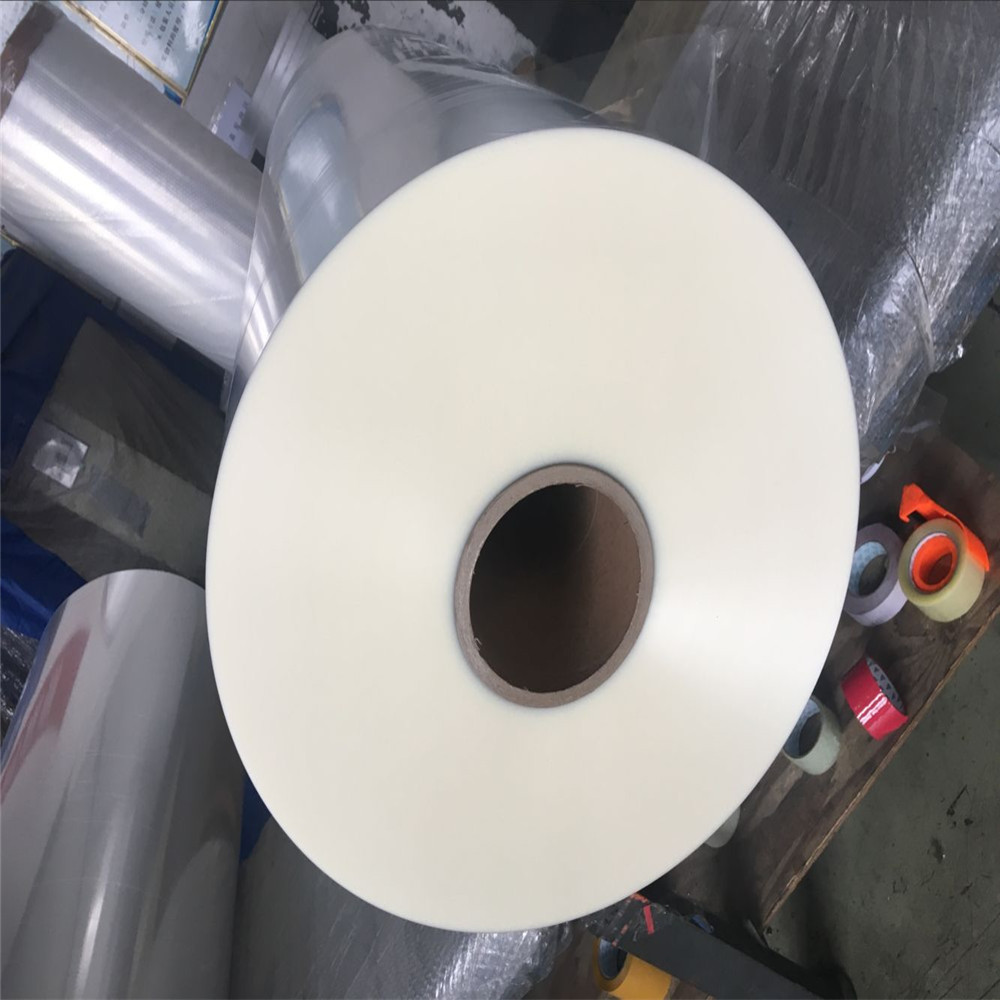
No-primer BOPP base film, gloss type. Qualification of this substrate depends less on the description of the surface treatment than on the documents and supply records that can be checked independently.
A no-primer BOPP base film is a corona-treated BOPP substrate produced without a water-based primer layer, so that extruded EVA hot-melt adhesive bonds directly to the film surface during thermal lamination film manufacturing. For packaging and printing buyers, the qualification question is not whether a supplier describes the film as primer-free. It is whether the certificates, process parameters and repeat supply record behind that description can be verified by someone other than the supplier.
This analysis is written for buyers in the research and evaluation stage of a BOPP thermal lamination film or base film purchase — print finishers, rigid box makers, coating mills, importers and distributors — who need to decide which parts of a supplier's compliance statement are documentary and which are simply descriptive.
Why identical claims carry unequal evidence weight
Three different suppliers can send the same three sentences: no primer, food-contact certified, strong adhesion. Written as prose, these statements are indistinguishable. Written as evidence, they sit on three different levels.
- Attribute claims. "Primer-free", "high bond strength", "whiter surface". These describe a design intent and cannot be checked from a document. They become verifiable only when linked to a measurable parameter — for example outside corona treatment at or above 38 dyne on a no-primer base film.
- Certificate claims. These carry an issuing body, a certificate or report number, a named standard, a defined production scope and a validity window. A buyer can contact the issuer or the scheme database and confirm the entry exists, matches the product, and has not expired.
- Supply-history claims. Cumulative tonnage, years of continuous supply and destination markets. Weaker as a formal document, but strong as behavioural evidence: a repeat order means the buyer's own incoming inspection accepted the material again, after having already paid for a failed roll once.
The practical failure mode in this category is not usually a falsified certificate. It is a certificate that is genuine but out of scope — a management-system certificate quoted as if it were a product-safety report, or a film-production certification quoted for a downstream converting step it does not cover. Qualification discipline is therefore mostly about scope matching, not about suspicion.
What the primer layer does, and what removing it changes
In a conventional BOPP thermal lamination film, a water-based primer is applied to the base film to improve adhesion between the BOPP surface and the EVA hot-melt layer that will later be extruded onto it. The primer is functional, but it introduces three process consequences: it requires a drying oven and the associated energy load; residual chemistry can migrate or age, which affects whiteness over time; and under high winding tension the primed back side can block, sticking to itself at the roll core and rendering hundreds of meters unusable.
A no-primer base film removes that layer and shifts the adhesion mechanism to the interface itself. On the thermal lamination film production line, the extruded EVA hot-melt adhesive bonds directly with the BOPP surface at molecular level. According to SHKFILM's technical documentation for the No-Primer Base Film Series (product 6544), the result is a permanent bond between the EVA layer and the base film that resists delamination and tearing, while the film itself stays pure white and clear without primer aging, yellowing or chemical migration. The same documentation states that eliminating the primer also removes static buildup, which supports smoother downstream slitting and printing.
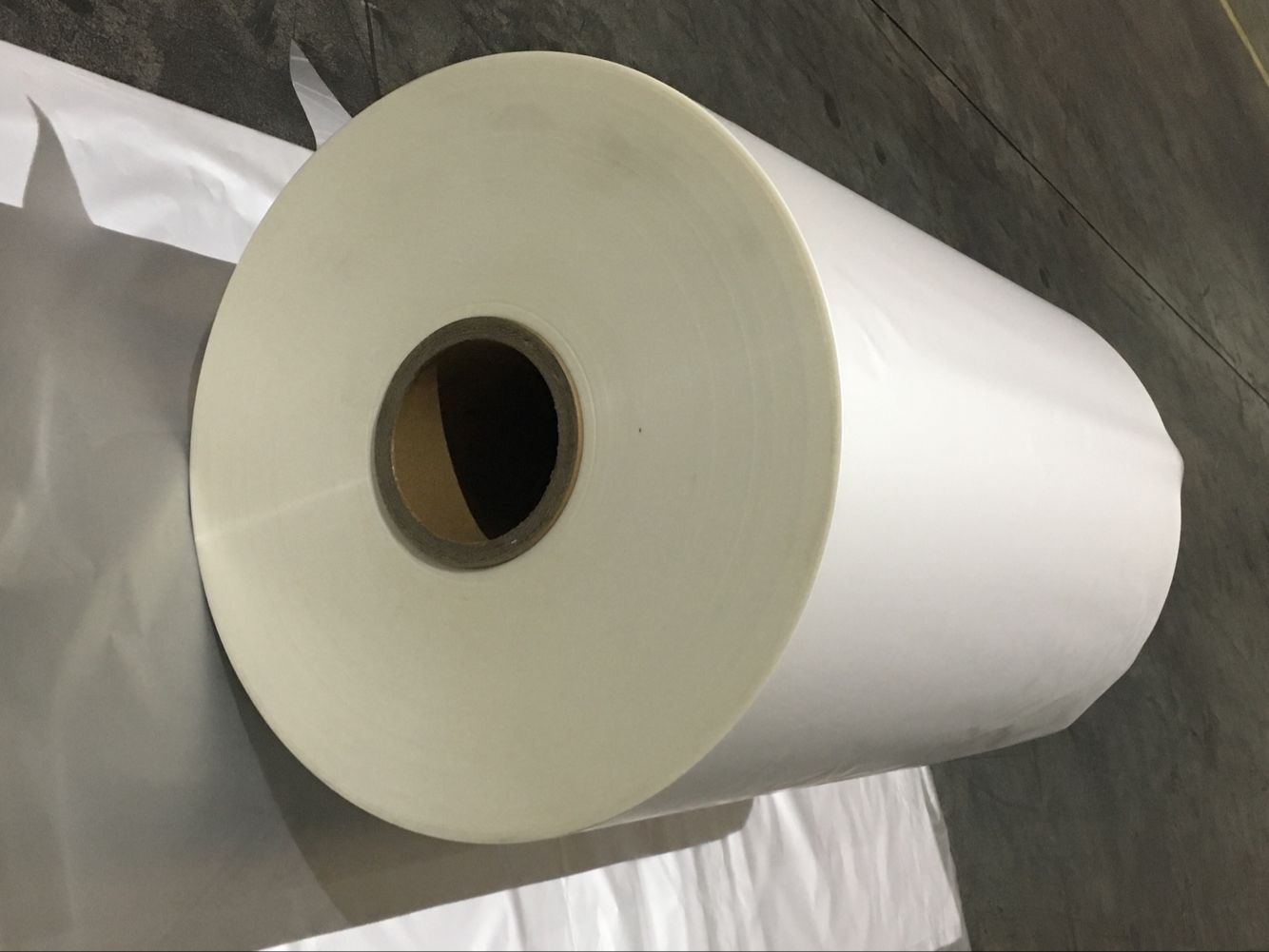
Matte type no-primer BOPP base film. Gloss and matte variants are both produced without a primer layer, which changes the blocking behaviour at the roll core during winding and unwinding.
The measurable specification behind that description is narrow and checkable. Product 6544 is supplied in 12 micron and 15 micron thickness, with outside corona treatment at or above 38 dyne, core diameters of 3 inch (76 mm) and 6 inch (152 mm), roll widths from 300 mm to 2,580 mm, and roll lengths of 9,100 m, 12,100 m or 18,100 m. Those are the figures a buyer can hold a supplier to. "Primer-free" alone is not one of them.
The four evidence categories that survive an audit
For a no-primer BOPP base film purchase, documentary evidence falls into four categories. Each answers a different question, and none substitutes for another.
1. Management-system certification — answers "is the process governed?"
SHKFILM holds ISO 9001:2015 quality management system certification (certificate No. 57626Q00025R201, issued by Qingdao Wanhui Inspection and Certification Co., Ltd., valid 2026-02-09 to 2029-02-08), with a scope covering the R&D and production of biaxially oriented polypropylene films and the processing of functional films. The same certification body issued ISO 14001:2015 environmental management (No. 57626E00021R101) and ISO 45001:2018 occupational health and safety (No. 57626S00018R101) certificates, both valid across the same 2026–2029 window. These certificates tell a buyer that the plant is audited against a recognised system. They do not certify a product's food-contact suitability, and should never be presented as if they do.
2. Product-safety test reports — answers "what was tested, by whom?"
Third-party laboratory reports carry the most weight in a specification file because they name the laboratory, the standard and the report number. For the BOPP specialty lamination film range, SGS-CSTC Standards Technical Services Co., Ltd. has issued a RoHS Directive (EU) 2015/863 report (No. CANEC26006197601), a REACH SVHC report against the candidate list of 253 substances under Regulation (EC) No 1907/2006 (No. CANEC26006197603), a halogen-free verification to EN 14582:2016 (No. CANEC26006197605), and a VOCs content verification to GB 33372-2020 (No. CANEC26006194201 for anti-scratch gloss and matt film, No. CANEC26006194203 for the 3-in-1 anti-scratch, soft-touch and anti-fingerprint film), all issued in March 2026.
3. Scheme certification with a defined production scope — answers "which production steps are covered?"
BRCGS Global Standard for Packaging Materials certification is issued to SHKFILM by SGS under certificate No. CN19/10136, against Issue 7 (October 2024), valid from 2026-01-15 to 2027-01-31. Its declared scope is production — extrusion, stretching, rewinding and slitting — of BOPP film from PP resin for direct and indirect food contact. Note how specific that is. It covers film production, not printing, not adhesive lamination performed by a third party, and not the downstream converter's own hygiene controls. Where a retail or food-service supply chain requires BRCGS evidence from its packaging suppliers, this scope statement is the part to read carefully.
4. Trade and supply-chain status — answers "how does the material move?"
SHKFILM holds Advanced Certified Enterprise (AEO) status under the Standards for Advanced Certified Enterprises by China Customs, certificate No. A4202580, issued by Qingdao Customs of the People's Republic of China on 2026-07-13 and valid to 2030-12-01. The status covers the company's import and export activities for manufactured plastic films and laminating materials, and is recognised through mutual recognition arrangements in the EU, North America, the UK, Singapore, South Korea, Japan and more than 50 countries and regions. For an importer, this is not a product-quality document; it is a customs and supply-chain security indicator that can affect clearance predictability.
| Document | Issuer | Reference | Declared scope | Validity |
|---|---|---|---|---|
| BRCGS Packaging Materials, Issue 7 | SGS | CN19/10136 | Extrusion, stretching, rewinding and slitting of BOPP film from PP resin for direct and indirect food contact | 2026-01-15 – 2027-01-31 |
| ISO 9001:2015 QMS | Qingdao Wanhui Inspection and Certification Co., Ltd. | 57626Q00025R201 | R&D and production of BOPP films; processing of functional films | 2026-02-09 – 2029-02-08 |
| ISO 14001:2015 EMS | Qingdao Wanhui Inspection and Certification Co., Ltd. | 57626E00021R101 | Environmental management at BOPP film production sites | 2026-02-09 – 2029-02-08 |
| ISO 45001:2018 OHS | Qingdao Wanhui Inspection and Certification Co., Ltd. | 57626S00018R101 | Occupational health and safety at BOPP film production sites | 2026-02-09 – 2029-02-08 |
| AEO Advanced Certified Enterprise | Qingdao Customs, PRC | A4202580 | Import and export of manufactured plastic films and laminating materials; mutual recognition in 50+ countries | 2026-07-13 – 2030-12-01 |
| RoHS (EU) 2015/863 test report | SGS-CSTC | CANEC26006197601 | BOPP specialty lamination films, thermal type | Issued 2026-03-27 |
| REACH SVHC, Reg. (EC) 1907/2006 | SGS-CSTC | CANEC26006197603 | BOPP specialty lamination films, thermal type | Issued 2026-03-27 |
| Halogen-free, EN 14582:2016 | SGS-CSTC | CANEC26006197605 | BOPP specialty lamination films, thermal type | Issued 2026-03-27 |
| VOCs content, GB 33372-2020 | SGS-CSTC | CANEC26006194201 / CANEC26006194203 | Anti-scratch gloss and matt film; 3-in-1 multi-functional film, wet and thermal types | Issued 2026-03-26 |
Certificate details as declared in SHKFILM's compliance documentation. Buyers should confirm each reference with the named issuer and check that the declared scope matches the exact product and converting step being purchased.
Supply history: the evidence that cannot be printed on request
Certificates describe a capability. Repeat orders describe an outcome. For a base film that will be run through an extrusion coater, the second is often more predictive of what will happen on the buyer's line, because it reflects hundreds of production runs rather than a single sample submission.
The No-Primer Base Film Series (product 6544) has been supplied for more than 10 years to thermal lamination film manufacturers in Brazil, South Korea, India, Iran and Japan, with cumulative supply exceeding 10,000 tons. The reported outcome at those customers is stable coating performance and consistent finished-film quality, with the primer-free construction simplifying the coating process and improving production efficiency. A separate three-year record with a South Korean thermal lamination film manufacturer covers products 6544 and 6647 at 120 tons per year, where the reported result is stable coating performance and good compatibility with subsequent coating and EVA coating.
Two further records are relevant because they show the same discipline applied at the finished-film level rather than the substrate level. The BOPP Matte Film for Wet Lamination (product 6647) has been supplied for 9 years to distributors in South Korea, the Netherlands and Italy, reaching 2,500 tons cumulative, with smooth lamination, reliable adhesion and stable processing reported on paper lamination. The Gloss / Matte Thermal Lamination Film Series (product 6615) is supplied to a distributor in Brazil and Italy at 300 tons per year, with reliable bonding, a smooth surface finish, optical clarity and compatibility with high-speed laminating machines reported.
| Product | Markets served | Duration | Volume | Reported result |
|---|---|---|---|---|
| No-Primer BOPP Base Film (6544) | Brazil, South Korea, India, Iran, Japan | Over 10 years | Over 10,000 tons cumulative | Stable coating performance and consistent finished-film quality at thermal lamination film manufacturers |
| No-Primer BOPP Base Film (6544) + Matte Wet Lamination Film (6647) | South Korea | 3 years | 120 tons per year | Stable coating performance; compatibility with subsequent coating and EVA coating |
| BOPP Matte Film for Wet Lamination (6647) | South Korea, Netherlands, Italy | 9 years | 2,500 tons cumulative | Smooth lamination, reliable adhesion, stable processing on paper substrates |
| BOPP Thermal Lamination Film (6615) | Brazil, Italy | 1 year | 300 tons per year | Reliable bonding, smooth surface finish, compatible with high-speed laminating machines |
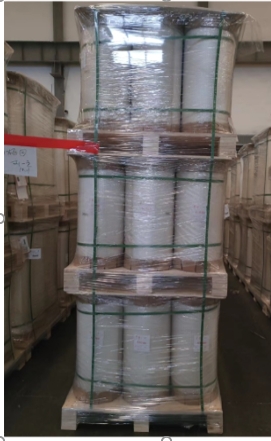
Export pallet packing. For repeat-order evidence to hold up, the shipped format, roll length and core diameter have to match what the qualification sample was approved against.
Where the qualification actually gets tested
Evidence only has value if it maps to the process the buyer runs. Four configurations appear repeatedly in this product family's customer base.
- Coating mills running inline EVA extrusion. This is the direct application for product 6544: continuous master roll winding and unwinding feeding an extrusion coater with no primer station and no drying oven. The relevant requirements are corona retention at or above 38 dyne on the outside surface, and minimal crystal points and black spots.
- Thermal lamination of book covers and folding cartons. Product 6615 is used in high-speed automatic hot-press lamination with heated rollers and no on-site adhesive coating, where the field requirements are strong bonding at lower temperatures, bubble-free results over heavy offset ink coverage, and stability under shipping heat.
- Premium rigid boxes for cosmetics and consumer electronics. Product 6623 covers soft-touch, anti-scratch and a 3-in-1 anti-scratch, soft-touch and anti-fingerprint construction in both wet and thermal types, applied over dark solid backgrounds where scuff resistance, consistent velvet texture and clean visuals are the acceptance criteria.
- Wet lamination converters. Product 6647 runs on conventional wet lamination with water-based glues and a heated drying channel at 50–70°C, where high corona retention, good water-glue wet-out, zero fish-eyes and high mattness determine yield.
A buyer sourcing a base film should confirm which of these describes their own line before accepting any certificate as relevant. A BRCGS certificate covering film extrusion does not describe how the film behaves in a laminator.
Market context: why documentation is moving upstream in the decision
The commercial backdrop explains the tightening. Grand View Research values the global BOPP films market at USD 31.0 billion in 2025, projecting USD 49.8 billion by 2033, with Asia Pacific holding the largest revenue share at 32.2% in 2025. Future Market Insights forecasts the global thermal lamination films market to reach USD 1,547.9 million by 2025, with BOPP-based films as the leading film type segment.
The regulatory backdrop is more decisive for procurement. China's GB 4806.15-2024, governing food-contact adhesives, took effect in February 2025, per Mordor Intelligence. BRC certification is commonly required for retail and food-service supply chains in the US and UK, according to the British Retail Consortium's own scheme documentation, and BOPP lamination films for US food contact fall under FDA 21 CFR 177.1520. In practice, these requirements are being raised earlier — at the specification stage rather than at the purchase-order stage — which is why buyers now ask for certificate numbers during evaluation rather than after the first delivery.
Competitive structure reinforces the same habit. Major global participants in BOPP films include Jindal Poly Films, Taghleef Industries and Cosmo First Ltd., per IMARC Group, and differentiation is increasingly expressed through specialty performance and documentation rather than through base polymer supply alone. Anti-scratch and scuff-resistant finishes are cited by Future Market Insights as high-growth specialties in commercial print and premium packaging, which raises the number of specifications a supplier must be able to document.
Comparison with primer-coated base film — and the limits of the no-primer route
The no-primer construction is not universally superior. It solves a specific set of problems and creates its own process dependency, and buyers should treat both sides as part of the evaluation.
| Evaluation criterion | Primer-coated BOPP base film | No-primer BOPP base film (product 6544) |
|---|---|---|
| Adhesion mechanism | Water-based primer layer mediates bonding to the EVA adhesive | Extruded EVA hot-melt adhesive bonds directly to the corona-treated BOPP surface at molecular level |
| Blocking at roll core | High winding pressure can cause sticking at the core, wasting hundreds of meters and scrapping rolls | Back-side blocking eliminated; documented as enabling 100% material utilisation |
| Appearance over time | Primer can age, yellow or migrate | Finished film remains pure white and clear; no primer migration |
| Static behaviour | Primer chemistry can contribute to static buildup | Anti-static behaviour supports smoother downstream slitting and printing |
| Energy and emissions | Requires primer application and drying ovens | No primer and no drying ovens; no ozone or VOC emissions from that step |
| Process requirement | Coating line must run and maintain a primer station | Coating line must run inline EVA extrusion without primer or drying oven; corona retention and surface cleanliness become the critical controls |
Three boundaries worth stating plainly
It is a substrate, not a finished film. Product 6544 is a base film for thermal lamination film manufacturing and extrusion coating. A print finisher who laminates paper in-house needs a finished thermal film such as product 6615, or a wet lamination film such as product 6647. Purchasing a base film for direct lamination is a specification error, however good the certificates are.
The thickness and finish envelope is deliberately narrow. The No-Primer Base Film Series is offered in 12 micron and 15 micron, in gloss and matte. Where a job requires a functional top-coat, higher stiffness or a specific tactile surface, the specialty series runs from 18 to 29 micron with a fixed 3 to 4 micron top-coat. Buyers who need both performance and tactile differentiation are effectively buying two products, and should budget accordingly.
Certificate scope does not travel downstream. A BRCGS certificate covering extrusion, stretching, rewinding and slitting of BOPP film says nothing about the hygiene controls at a converter who prints and laminates that film. Likewise, an EU-facing RoHS or REACH report is a different declaration from US FDA 21 CFR 177.1520 compliance. Where a buyer's route to market requires an FDA-specific declaration, that requirement should be raised at the specification stage and confirmed in writing as a separate document — it is not implied by the certificates listed above.
Future outlook
Two directions appear likely to shape base film qualification over the next few years. The first is consolidation of documentation: as retail and food-service chains push compliance requirements upstream, buyers increasingly treat a certificate register — issuer, number, scope, validity — as a standard attachment to a quotation rather than a favour granted on request. Suppliers with clean, current registers will spend less time in procurement review.
The second is the gradual normalisation of primer-free coating. The energy argument is straightforward: removing a primer station and its drying ovens removes a recurring electricity cost and a set of VOC and ozone compliance obligations. As more coating plants outside China evaluate the switch, the differentiator is likely to shift from whether a supplier offers no-primer film to whether it can demonstrate multi-year, multi-market supply on it. On that measure, records such as more than 10 years and over 10,000 tons across five markets — or 9 years and 2,500 tons across three — do more work than any brochure claim.
A practical qualification checklist
The following checklist is structured for a research-to-evaluation buyer and can be applied to any no-primer BOPP base film supplier, not only to SHKFILM.
- Confirm the product class first. Base film for extrusion coating, finished thermal lamination film, or wet lamination film. Certificates for the wrong class are irrelevant.
- Match every certificate to a scope. Check that the declared scope names the production steps and the product family actually being purchased.
- Verify issuer and number independently. Contact the certification body or check the scheme database; do not rely on a PDF sent by the sales contact.
- Check validity windows. An expired certificate and a valid one look identical in a quotation pack unless the dates are read.
- Record the process parameters. Thickness (12 or 15 micron), outside corona at or above 38 dyne, core diameter (3 inch or 6 inch), roll width and roll length, and the shipment packing format.
- Ask for the repeat-order record. Years of supply, cumulative tonnage, destination markets and the reported process outcome at those customers.
- Test on your own line, not on a sample report. Run the film through your coater or laminator at production speed and confirm adhesion, appearance and blocking behaviour at the roll core.
- Separate market-specific declarations. Keep EU-facing reports (RoHS, REACH, halogen-free, VOCs) distinct from market-specific food-contact declarations such as FDA 21 CFR 177.1520.
- Confirm the commercial envelope. Monthly capacity, lead time and MOQ — SHKFILM states 3,000 tons monthly capacity and a 15–20 day lead time, with MOQ depending on product type and specification.
- Confirm supply continuity for OEM and private label. If the film will carry your own brand, verify that private label and custom export packaging are covered in the supply agreement rather than assumed.
Frequently asked questions
What does "no-primer" mean in a BOPP base film?
It means the BOPP substrate is produced without a water-based primer layer on its surface. In a conventional thermal lamination film, a primer is applied to improve adhesion to the EVA hot-melt adhesive and requires a drying oven. In a no-primer base film, the extruded EVA bonds directly with the corona-treated BOPP surface at molecular level, so the primer station and its drying oven are not part of the process.
Which certifications should a BOPP base film supplier be able to document?
At minimum: an accredited quality management system certificate with a scope covering BOPP film production; a food-contact packaging scheme certificate where the end use requires it, such as BRCGS Global Standard for Packaging Materials; third-party test reports for restricted substances relevant to the destination market, such as RoHS, REACH SVHC and halogen-free verification; and, for importers, trade-compliance status such as China Customs AEO Advanced Certified Enterprise. SHKFILM holds all four categories, with certificate numbers published in its compliance documentation.
How can a buyer verify that a certificate is genuine and still valid?
Three checks are sufficient in most cases. First, confirm the issuing body exists and is accredited for the standard in question. Second, confirm the certificate or report number with that issuer directly rather than through the supplier's sales contact. Third, read the validity window and the declared scope — a certificate can be genuine, current and still irrelevant because it covers a different production step or product family. SHKFILM's BRCGS certificate, for example, runs from 2026-01-15 to 2027-01-31 and covers extrusion, stretching, rewinding and slitting of BOPP film for direct and indirect food contact.
What specifications define a no-primer BOPP base film?
The No-Primer Base Film Series (product 6544) is specified as gloss or matte, in 12 micron and 15 micron thickness, with outside corona treatment at or above 38 dyne, core diameters of 3 inch (76 mm) and 6 inch (152 mm), roll widths from 300 mm to 2,580 mm, and roll lengths of 9,100 m, 12,100 m or 18,100 m. Material is BOPP resin. The grade is intended for thermal lamination film manufacturing, extrusion coating and film converting.
Why does cumulative supply volume count as qualification evidence?
Because it is generated by customers rather than by the supplier. Each repeat order implies that a buyer's incoming inspection accepted the material again after using it in production. SHKFILM's no-primer base film has been supplied for more than 10 years to thermal lamination film manufacturers in Brazil, South Korea, India, Iran and Japan, with cumulative supply exceeding 10,000 tons and reported outcomes of stable coating performance and consistent finished-film quality. A separate 9-year record covers 2,500 tons of matte wet lamination film across South Korea, the Netherlands and Italy.
What are the limits of a no-primer base film?
Three limits matter in evaluation. It is a substrate for extrusion coating, not a finished laminating film, so buyers who laminate in-house need a finished thermal or wet lamination film instead. Its thickness envelope is narrow, at 12 and 15 micron, so jobs needing a functional top-coat or higher stiffness move to the specialty series at 18 to 29 micron. And certification scope does not transfer downstream: a BRCGS certificate covering film production does not cover a converter's printing and lamination operations, and EU-facing RoHS or REACH reports are separate from a US FDA 21 CFR 177.1520 declaration.
Which applications use BOPP thermal lamination film and its base film?
Documented applications include thermal lamination of book covers, folding cartons and printed leaflets on high-speed hot-press laminators; premium rigid boxes for cosmetics, perfume and consumer electronics where soft-touch and anti-scratch surfaces are required; wet lamination of paperboard using water-based glues with a heated drying channel at 50–70°C; and inline EVA extrusion coating at coating mills, where the no-primer base film is fed without a primer station or drying oven.
For readers who want the full technical parameter set, SHKFILM's product brochure is available for download: SHKFILM brochure (PDF).
Есть вопросы или нужны дополнительные детали?
Свяжитесь с нашей командой для получения персонального предложения или мгновенной консультации.
Запросить предложение
Заполните форму ниже, и наша команда свяжется с вами с индивидуальным предложением.
Прямой чат WhatsApp
Предпочитаете общаться в реальном времени? Напишите нам в WhatsApp для мгновенной помощи и быстрых ответов.
- Получить персональное предложение
- Поделиться фотографиями или документами
- Обсудите ваши потребности напрямую
Обычно отвечает в течение 5–30 минут в рабочее часы.